
DOCUMENTATION OF ASSUMPTIONS AND SYSTEM VULNERABILITY MONITORING THE
DOCUMENTATION OF ASSUMPTIONS AND SYSTEM VULNERABILITY MONITORING: THE CASE OF SYSTEM THEORETIC PROCESS ANALYSIS (STPA) Dr. Nektarios Karanikas, CEng, PMP, Grad. IOSH, MIET, MRAe. S Associate Professor of Safety & Human Factors Aviation Academy STAMP EU Workshop, 14 -15 September 2017, Reykjavik, Iceland 1
WHY ASSUMPTIONS? • Assumptions are an inextricable part of problem-solving due to limited knowledge, capacity and resources to: • comprehend completely systems dynamics and complexity • exert full control over interactions and individual behaviours • ensure entirely that our solutions will sustain any external or internal disturbance • Assumptions mainly refer to the: • conceptual and analytical models used • relationships and behaviours of system elements, considering also surrounding conditions • quality of available data 2
ASSUMPTIONS AND SYSTEM PERFORMANCE • The more the assumptions made, the higher the dependency on agents and factors outside our direct control • The validity of assumptions is of paramount importance to maintain viability of any solution • Assumptions must be visibly documented to allow their check and revision • The more the invalid assumptions, the more vulnerable the system • The monitoring of validity of assumptions can function as a leading performance indicator 3
ASSUMPTIONS & STPA • Ideally: a complete analysis with STPA includes all parameters affecting system performance and leads to development and testing of inclusive and exhaustive causal scenarios to evaluate system vulnerability • Reality: we are not fully knowledgeable of and don’t have full control over open systems – we might lack the resources required for analysis and testing • Consequence: assumptions are unavoidably part of the STPA execution and deliverables 4
STUDY QUESTIONS What assumptions might be made during the application of STPA? How can the acknowledgement of such assumptions assist the STPA analysts and system performance monitoring? 5
PRINCIPAL RESULTS • Ten assumption groups were identified • Assumptions might be generated along the various stages of STPA preparation and execution as well as the exploitation of the analysis deliverables • Assumptions falling in six of the groups are deemed as inevitable • The assumptions linked to the rest of the groups depend on the scope and resources linked with the analysis and utilization of its products 6
PRINCIPAL RESULTS • The analysis stage and system level of assumptions were connected with their expected impact: • the higher the hierarchical level the assumptions are invalid, the higher the vulnerability of the system • the assumptions generated earlier in the analysis will have larger effects on system performance than the assumptions made at lower analysis levels • The monitoring of assumptions validity is suggested to be performed under a top-down system level priority 7
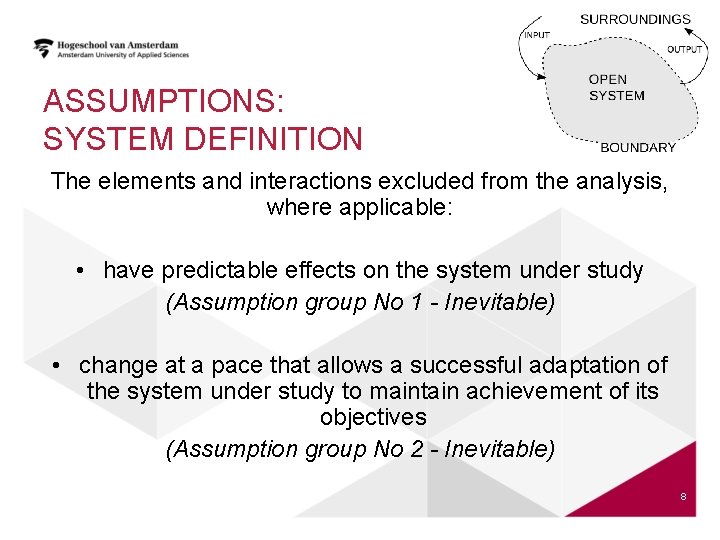
ASSUMPTIONS: SYSTEM DEFINITION The elements and interactions excluded from the analysis, where applicable: • have predictable effects on the system under study (Assumption group No 1 - Inevitable) • change at a pace that allows a successful adaptation of the system under study to maintain achievement of its objectives (Assumption group No 2 - Inevitable) 8
ASSUMPTIONS: SYSTEM OBJECTIVES & CONSTRAINTS Assumptions group No 3 (System Objectives) The system objectives included in the analysis do not conflict with the system objectives excluded from the analysis Assumptions group No 4 (System Constraints) The agents outside the system under study maintain the system constraints assigned to them 9
ASSUMPTIONS: CONTROL STRUCTURE & SYSTEM REQUIREMENTS Assumptions group No 5 – Inevitable (Control Structure) The behaviour of elements and/or subsystems belonging to system levels lower than the ones analysed can be confidently predicted Assumptions group No 6 – Inevitable (System Requirements) External agents will fulfil the requirements assigned to them Assumptions group No 7 – Inevitable (System Requirements) The system controllers will fulfil the requirements assigned to them given that external agents will have fulfilled their relevant requirements 10
ASSUMPTIONS: CAUSAL SCENARIOS TESTING Assumptions group No 8 The occurrence of causal scenarios not to be tested is practically improbable Assumptions group No 9 The requirements excluded from scenario testing are always fulfilled Assumptions group No 10 - Inevitable The results from causal scenario tests are reliable and valid 11
REMARKS (1/2) • The list of assumption groups was based on a specific line of reasoning grounded in literature and practice • The total number of analysis assumptions per case will be finalised after all STPA application iterations • It was out of the scope to consider assumptions relevant to the skills of the analysts in terms of analysis depth and quality • The current study aims to: • raise awareness of analysts about possible and inevitable “imperfections” of any analysis • demonstrate that even system-focused and systematic analysis techniques such as STPA can be still subject to assumptions 12
REMARKS (2/2) • The assumption groups proposed can be amended based on further experience and perspectives of other analysts as well as future research • But most importantly: The systematic nature of STPA allowed a systematic way of indicating areas of possible assumptions. This confirms the analytical power the technique offers. 13
ACTION ITEMS • Documentation and traceability of assumptions consistently and transparently to increase the credibility of STPA analyses • Inclusion of a dedicated section about assumptions in the next versions of the STPA Primer or future relevant handbook/guidebook • Incorporation of fields about assumptions in the software packages supporting STPA application (e. g. , XSTAMPP, SAHRA, ERMF) 14
DOCUMENTATION OF ASSUMPTIONS AND SYSTEM VULNERABILITY MONITORING: THE CASE OF SYSTEM THEORETIC PROCESS ANALYSIS (STPA) ? e s a e l p s n o i t s e u Q Dr. Nektarios Karanikas, CEng, PMP, Grad. IOSH, MIET, MRAe. S Associate Professor of Safety & Human Factors Aviation Academy STAMP EU Workshop, 14 -15 September 2017, Reykjavik, Iceland Contact: n. karanikas@hva. nl 15
- Slides: 15