
Documentary Analysis Observation and Discussion DOD Principle I

Documentary Analysis Observation and Discussion (DOD)
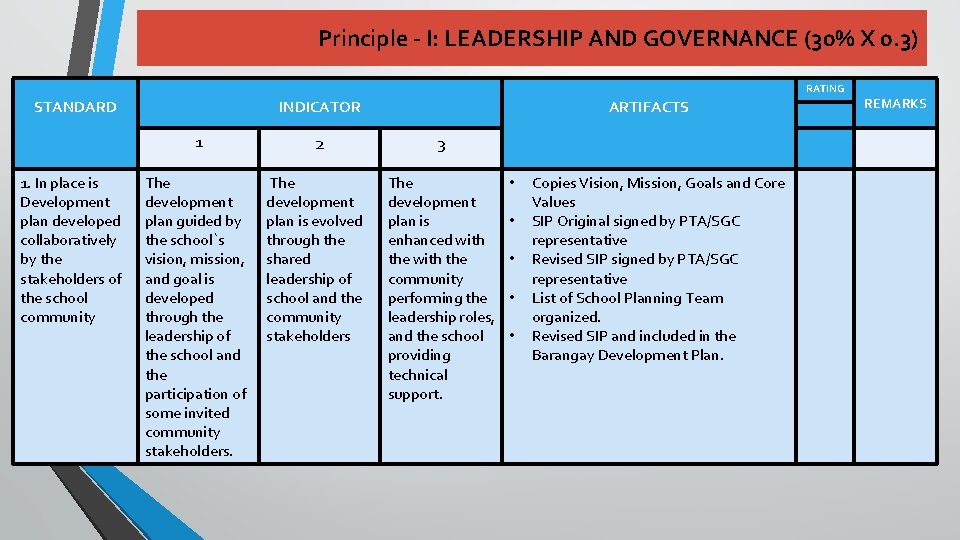
Principle - I: LEADERSHIP AND GOVERNANCE (30% X 0. 3) RATING STANDARD INDICATOR 1 1. In place is Development plan developed collaboratively by the stakeholders of the school community The development plan guided by the school`s vision, mission, and goal is developed through the leadership of the school and the participation of some invited community stakeholders. 2 The development plan is evolved through the shared leadership of school and the community stakeholders ARTIFACTS 3 The development plan is enhanced with the community performing the leadership roles, and the school providing technical support. • • • Copies Vision, Mission, Goals and Core Values SIP Original signed by PTA/SGC representative Revised SIP signed by PTA/SGC representative List of School Planning Team organized. Revised SIP and included in the Barangay Development Plan. REMARKS
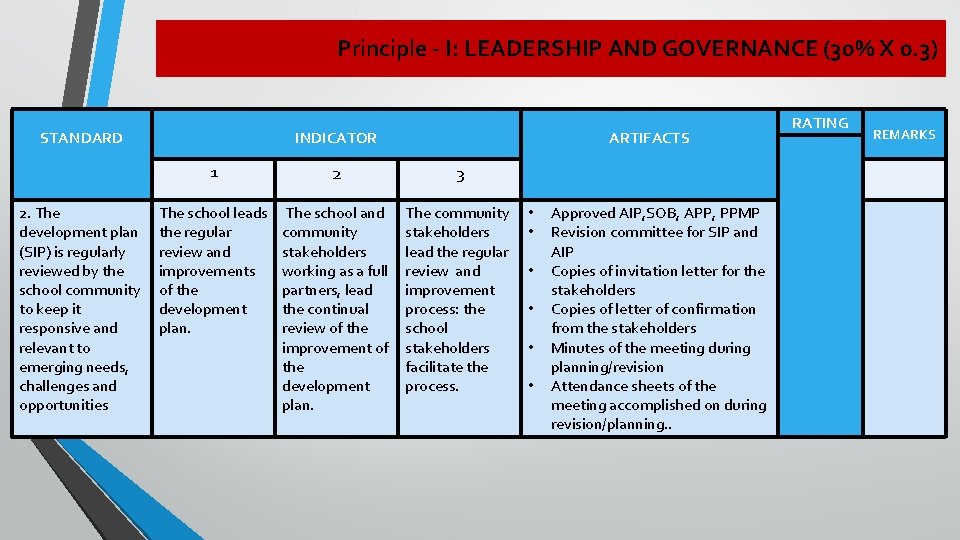
Principle - I: LEADERSHIP AND GOVERNANCE (30% X 0. 3) STANDARD 2. The development plan (SIP) is regularly reviewed by the school community to keep it responsive and relevant to emerging needs, challenges and opportunities INDICATOR ARTIFACTS 1 2 3 The school leads the regular review and improvements of the development plan. The school and community stakeholders working as a full partners, lead the continual review of the improvement of the development plan. The community stakeholders lead the regular review and improvement process: the school stakeholders facilitate the process. • • • Approved AIP, SOB, APP, PPMP Revision committee for SIP and AIP Copies of invitation letter for the stakeholders Copies of letter of confirmation from the stakeholders Minutes of the meeting during planning/revision Attendance sheets of the meeting accomplished on during revision/planning. . RATING REMARKS
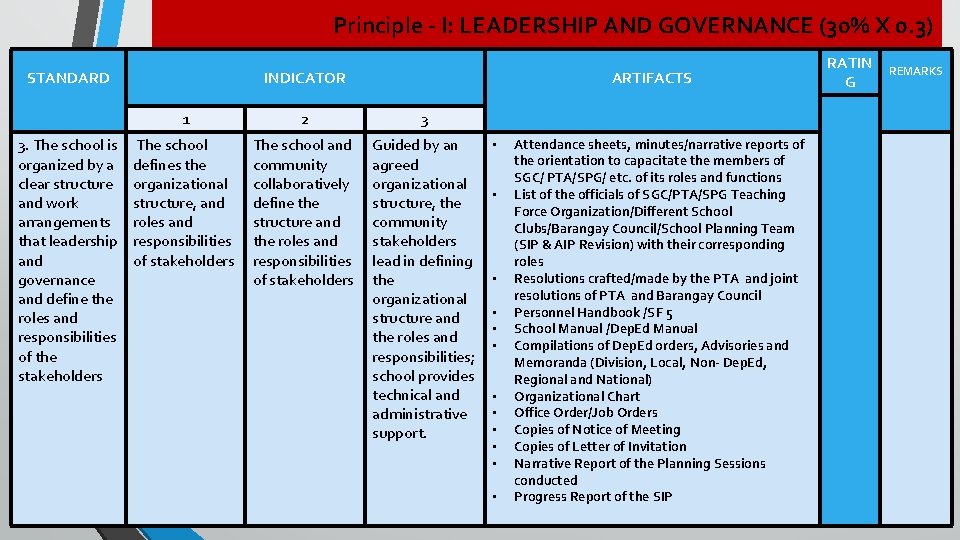
Principle - I: LEADERSHIP AND GOVERNANCE (30% X 0. 3) STANDARD 3. The school is organized by a clear structure and work arrangements that leadership and governance and define the roles and responsibilities of the stakeholders INDICATOR ARTIFACTS 1 2 3 The school defines the organizational structure, and roles and responsibilities of stakeholders The school and community collaboratively define the structure and the roles and responsibilities of stakeholders Guided by an agreed organizational structure, the community stakeholders lead in defining the organizational structure and the roles and responsibilities; school provides technical and administrative support. • • • Attendance sheets, minutes/narrative reports of the orientation to capacitate the members of SGC/ PTA/SPG/ etc. of its roles and functions List of the officials of SGC/PTA/SPG Teaching Force Organization/Different School Clubs/Barangay Council/School Planning Team (SIP & AIP Revision) with their corresponding roles Resolutions crafted/made by the PTA and joint resolutions of PTA and Barangay Council Personnel Handbook /SF 5 School Manual /Dep. Ed Manual Compilations of Dep. Ed orders, Advisories and Memoranda (Division, Local, Non- Dep. Ed, Regional and National) Organizational Chart Office Order/Job Orders Copies of Notice of Meeting Copies of Letter of Invitation Narrative Report of the Planning Sessions conducted Progress Report of the SIP RATIN G REMARKS
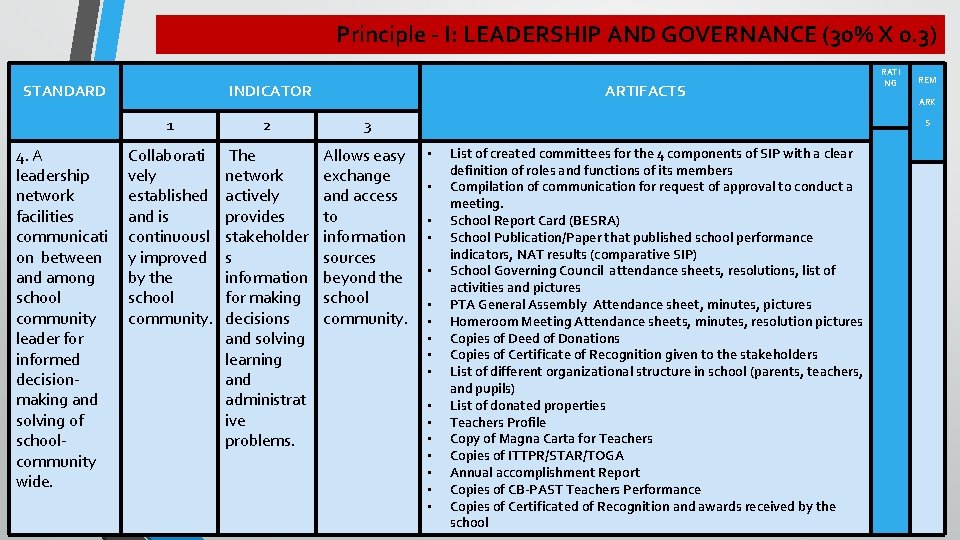
Principle - I: LEADERSHIP AND GOVERNANCE (30% X 0. 3) STANDARD 4. A leadership network facilities communicati on between and among school community leader for informed decisionmaking and solving of schoolcommunity wide. INDICATOR ARTIFACTS 1 2 3 Collaborati vely established and is continuousl y improved by the school community. The network actively provides stakeholder s information for making decisions and solving learning and administrat ive problems. Allows easy exchange and access to information sources beyond the school community. RATI NG REM ARK S • • • • • List of created committees for the 4 components of SIP with a clear definition of roles and functions of its members Compilation of communication for request of approval to conduct a meeting. School Report Card (BESRA) School Publication/Paper that published school performance indicators, NAT results (comparative SIP) School Governing Council attendance sheets, resolutions, list of activities and pictures PTA General Assembly Attendance sheet, minutes, pictures Homeroom Meeting Attendance sheets, minutes, resolution pictures Copies of Deed of Donations Copies of Certificate of Recognition given to the stakeholders List of different organizational structure in school (parents, teachers, and pupils) List of donated properties Teachers Profile Copy of Magna Carta for Teachers Copies of ITTPR/STAR/TOGA Annual accomplishment Report Copies of CB-PAST Teachers Performance Copies of Certificated of Recognition and awards received by the school
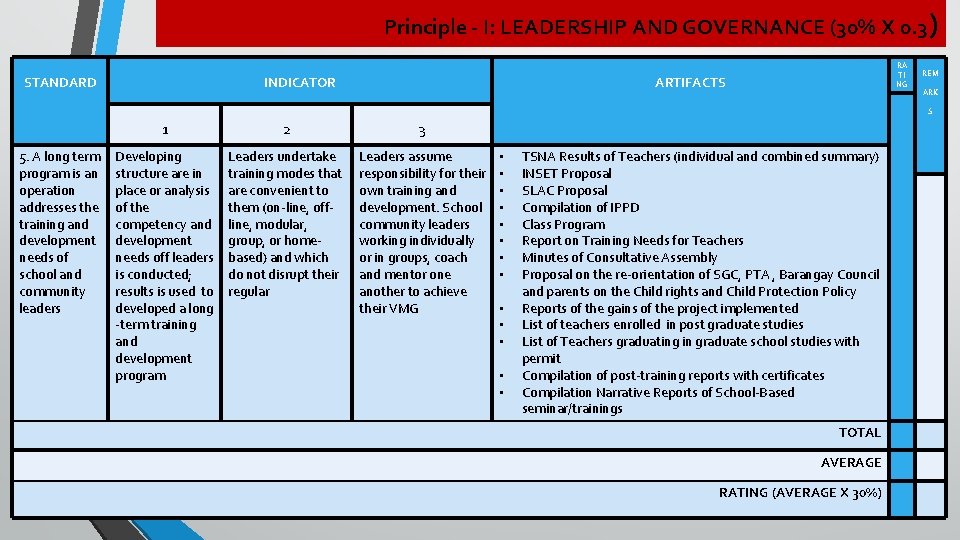
Principle - I: LEADERSHIP AND GOVERNANCE (30% X 0. 3) STANDARD INDICATOR RA TI NG ARTIFACTS REM ARK S 5. A long term program is an operation addresses the training and development needs of school and community leaders 1 2 3 Developing structure are in place or analysis of the competency and development needs off leaders is conducted; results is used to developed a long -term training and development program Leaders undertake training modes that are convenient to them (on-line, offline, modular, group, or homebased) and which do not disrupt their regular Leaders assume responsibility for their own training and development. School community leaders working individually or in groups, coach and mentor one another to achieve their VMG • • • • TSNA Results of Teachers (individual and combined summary) INSET Proposal SLAC Proposal Compilation of IPPD Class Program Report on Training Needs for Teachers Minutes of Consultative Assembly Proposal on the re-orientation of SGC, PTA , Barangay Council and parents on the Child rights and Child Protection Policy Reports of the gains of the project implemented List of teachers enrolled in post graduate studies List of Teachers graduating in graduate school studies with permit Compilation of post-training reports with certificates Compilation Narrative Reports of School-Based seminar/trainings TOTAL AVERAGE RATING (AVERAGE X 30%)
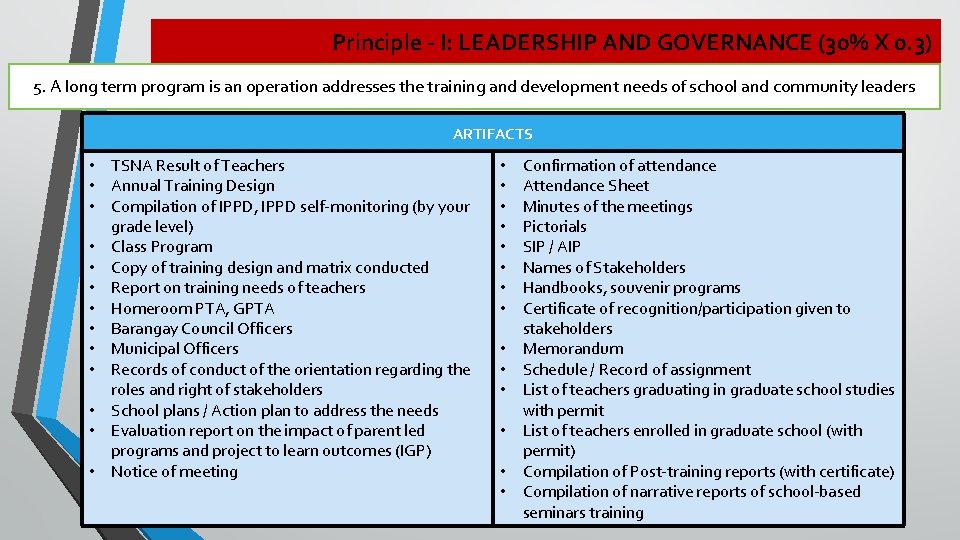
Principle - I: LEADERSHIP AND GOVERNANCE (30% X 0. 3) 5. A long term program is an operation addresses the training and development needs of school and community leaders ARTIFACTS • TSNA Result of Teachers • Annual Training Design • Compilation of IPPD, IPPD self-monitoring (by your grade level) • Class Program • Copy of training design and matrix conducted • Report on training needs of teachers • Homeroom PTA, GPTA • Barangay Council Officers • Municipal Officers • Records of conduct of the orientation regarding the roles and right of stakeholders • School plans / Action plan to address the needs • Evaluation report on the impact of parent led programs and project to learn outcomes (IGP) • Notice of meeting • • • • Confirmation of attendance Attendance Sheet Minutes of the meetings Pictorials SIP / AIP Names of Stakeholders Handbooks, souvenir programs Certificate of recognition/participation given to stakeholders Memorandum Schedule / Record of assignment List of teachers graduating in graduate school studies with permit List of teachers enrolled in graduate school (with permit) Compilation of Post-training reports (with certificate) Compilation of narrative reports of school-based seminars training
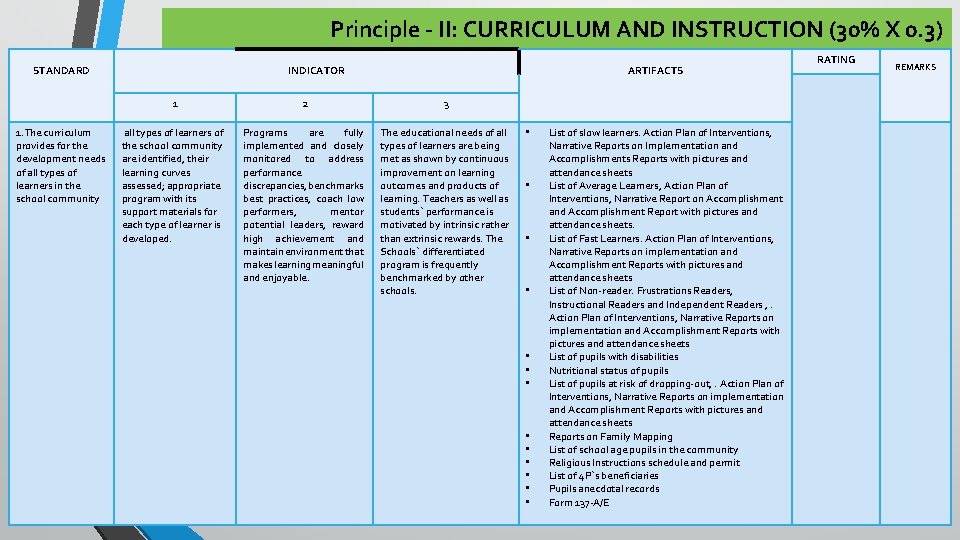
Principle - II: CURRICULUM AND INSTRUCTION (30% X 0. 3) STANDARD 1. The curriculum provides for the development needs of all types of learners in the school community INDICATOR ARTIFACTS 1 2 3 all types of learners of the school community are identified, their learning curves assessed; appropriate program with its support materials for each type of learner is developed. Programs are fully implemented and closely monitored to address performance discrepancies, benchmarks best practices, coach low performers, mentor potential leaders, reward high achievement and maintain environment that makes learning meaningful and enjoyable. The educational needs of all types of learners are being met as shown by continuous improvement on learning outcomes and products of learning. Teachers as well as students` performance is motivated by intrinsic rather than extrinsic rewards. The Schools` differentiated program is frequently benchmarked by other schools. • • • • List of slow learners. Action Plan of Interventions, Narrative Reports on Implementation and Accomplishments Reports with pictures and attendance sheets List of Average Learners, Action Plan of Interventions, Narrative Report on Accomplishment and Accomplishment Report with pictures and attendance sheets. List of Fast Learners. Action Plan of Interventions, Narrative Reports on implementation and Accomplishment Reports with pictures and attendance sheets List of Non-reader. Frustrations Readers, Instructional Readers and Independent Readers , . Action Plan of Interventions, Narrative Reports on implementation and Accomplishment Reports with pictures and attendance sheets List of pupils with disabilities Nutritional status of pupils List of pupils at risk of dropping-out, . Action Plan of Interventions, Narrative Reports on implementation and Accomplishment Reports with pictures and attendance sheets Reports on Family Mapping List of school age pupils in the community Religious Instructions schedule and permit List of 4 P`s beneficiaries Pupils anecdotal records Form 137 -A/E RATING REMARKS
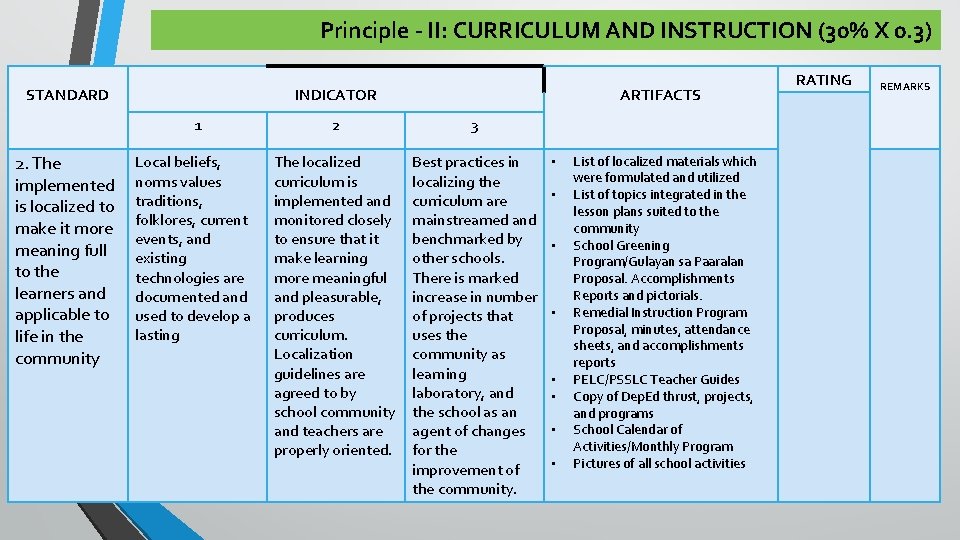
Principle - II: CURRICULUM AND INSTRUCTION (30% X 0. 3) STANDARD 2. The implemented is localized to make it more meaning full to the learners and applicable to life in the community INDICATOR ARTIFACTS 1 2 3 Local beliefs, norms values traditions, folklores, current events, and existing technologies are documented and used to develop a lasting The localized curriculum is implemented and monitored closely to ensure that it make learning more meaningful and pleasurable, produces curriculum. Localization guidelines are agreed to by school community and teachers are properly oriented. Best practices in localizing the curriculum are mainstreamed and benchmarked by other schools. There is marked increase in number of projects that uses the community as learning laboratory, and the school as an agent of changes for the improvement of the community. • • List of localized materials which were formulated and utilized List of topics integrated in the lesson plans suited to the community School Greening Program/Gulayan sa Paaralan Proposal. Accomplishments Reports and pictorials. Remedial Instruction Program Proposal, minutes, attendance sheets, and accomplishments reports PELC/PSSLC Teacher Guides Copy of Dep. Ed thrust, projects, and programs School Calendar of Activities/Monthly Program Pictures of all school activities RATING REMARKS
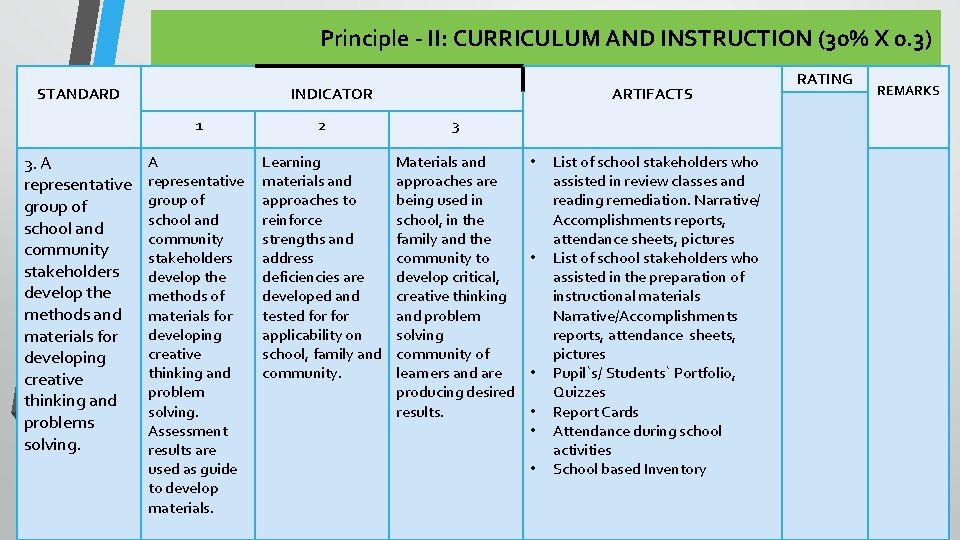
Principle - II: CURRICULUM AND INSTRUCTION (30% X 0. 3) STANDARD 3. A representative group of school and community stakeholders develop the methods and materials for developing creative thinking and problems solving. INDICATOR ARTIFACTS 1 2 3 A representative group of school and community stakeholders develop the methods of materials for developing creative thinking and problem solving. Assessment results are used as guide to develop materials. Learning materials and approaches to reinforce strengths and address deficiencies are developed and tested for applicability on school, family and community. Materials and approaches are being used in school, in the family and the community to develop critical, creative thinking and problem solving community of learners and are producing desired results. • • • List of school stakeholders who assisted in review classes and reading remediation. Narrative/ Accomplishments reports, attendance sheets, pictures List of school stakeholders who assisted in the preparation of instructional materials Narrative/Accomplishments reports, attendance sheets, pictures Pupil`s/ Students` Portfolio, Quizzes Report Cards Attendance during school activities School based Inventory RATING REMARKS
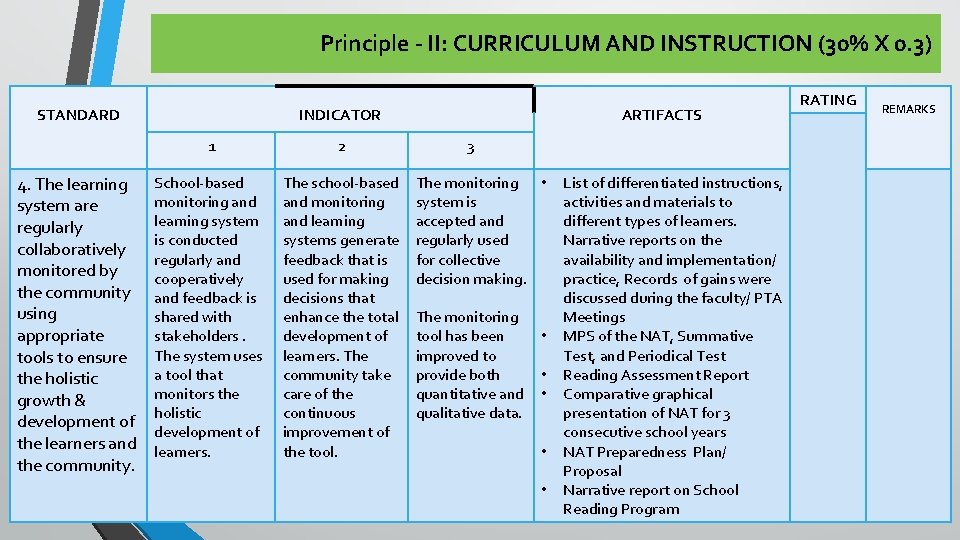
Principle - II: CURRICULUM AND INSTRUCTION (30% X 0. 3) STANDARD 4. The learning system are regularly collaboratively monitored by the community using appropriate tools to ensure the holistic growth & development of the learners and the community. INDICATOR 1 2 School-based monitoring and learning system is conducted regularly and cooperatively and feedback is shared with stakeholders. The system uses a tool that monitors the holistic development of learners. The school-based and monitoring and learning systems generate feedback that is used for making decisions that enhance the total development of learners. The community take care of the continuous improvement of the tool. ARTIFACTS 3 The monitoring • system is accepted and regularly used for collective decision making. The monitoring tool has been improved to provide both quantitative and qualitative data. • • • List of differentiated instructions, activities and materials to different types of learners. Narrative reports on the availability and implementation/ practice, Records of gains were discussed during the faculty/ PTA Meetings MPS of the NAT, Summative Test, and Periodical Test Reading Assessment Report Comparative graphical presentation of NAT for 3 consecutive school years NAT Preparedness Plan/ Proposal Narrative report on School Reading Program RATING REMARKS
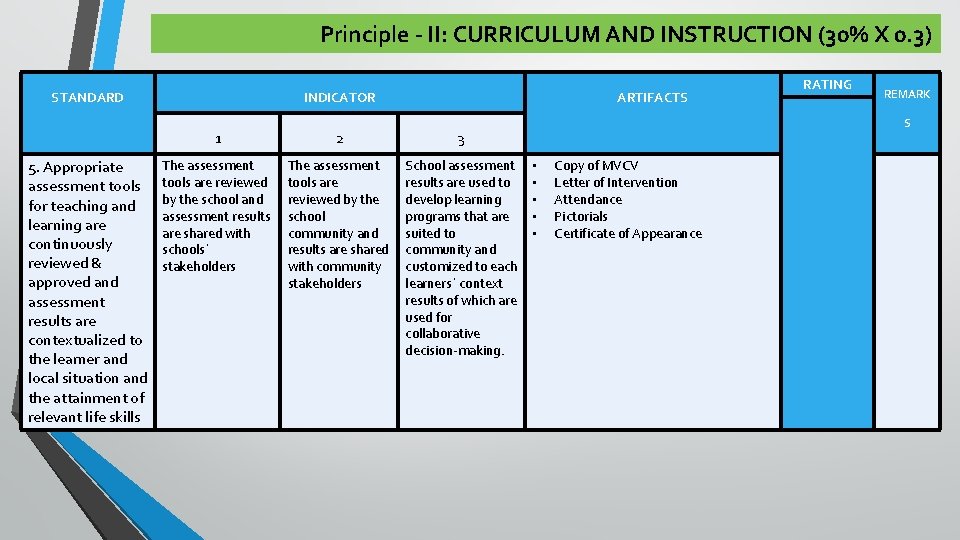
Principle - II: CURRICULUM AND INSTRUCTION (30% X 0. 3) STANDARD 5. Appropriate assessment tools for teaching and learning are continuously reviewed & approved and assessment results are contextualized to the learner and local situation and the attainment of relevant life skills INDICATOR ARTIFACTS 1 2 3 The assessment tools are reviewed by the school and assessment results are shared with schools` stakeholders The assessment tools are reviewed by the school community and results are shared with community stakeholders School assessment results are used to develop learning programs that are suited to community and customized to each learners` context results of which are used for collaborative decision-making. RATING REMARK S • • • Copy of MVCV Letter of Intervention Attendance Pictorials Certificate of Appearance
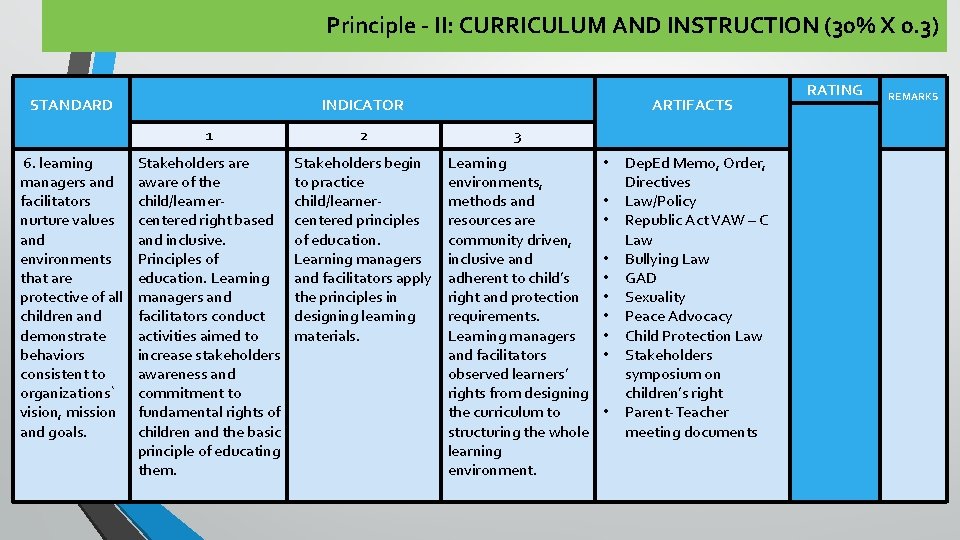
Principle - II: CURRICULUM AND INSTRUCTION (30% X 0. 3) STANDARD 6. learning managers and facilitators nurture values and environments that are protective of all children and demonstrate behaviors consistent to organizations` vision, mission and goals. INDICATOR ARTIFACTS 1 2 3 Stakeholders are aware of the child/learnercentered right based and inclusive. Principles of education. Learning managers and facilitators conduct activities aimed to increase stakeholders awareness and commitment to fundamental rights of children and the basic principle of educating them. Stakeholders begin to practice child/learnercentered principles of education. Learning managers and facilitators apply the principles in designing learning materials. Learning environments, methods and resources are community driven, inclusive and adherent to child’s right and protection requirements. Learning managers and facilitators observed learners’ rights from designing the curriculum to structuring the whole learning environment. • • • Dep. Ed Memo, Order, Directives Law/Policy Republic Act VAW – C Law Bullying Law GAD Sexuality Peace Advocacy Child Protection Law Stakeholders symposium on children’s right Parent-Teacher meeting documents RATING REMARKS
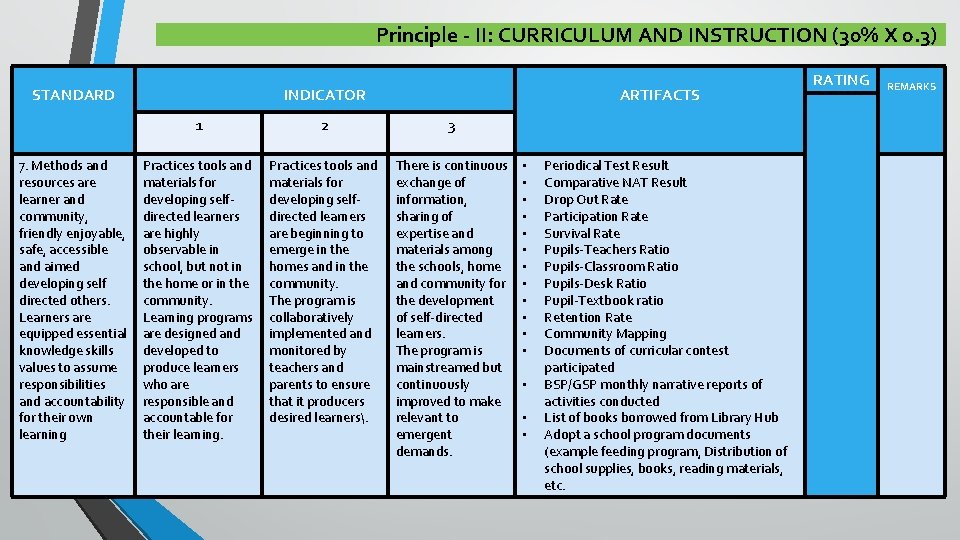
Principle - II: CURRICULUM AND INSTRUCTION (30% X 0. 3) STANDARD 7. Methods and resources are learner and community, friendly enjoyable, safe, accessible and aimed developing self directed others. Learners are equipped essential knowledge skills values to assume responsibilities and accountability for their own learning INDICATOR ARTIFACTS 1 2 3 Practices tools and materials for developing selfdirected learners are highly observable in school, but not in the home or in the community. Learning programs are designed and developed to produce learners who are responsible and accountable for their learning. Practices tools and materials for developing selfdirected learners are beginning to emerge in the homes and in the community. The program is collaboratively implemented and monitored by teachers and parents to ensure that it producers desired learners. There is continuous exchange of information, sharing of expertise and materials among the schools, home and community for the development of self-directed learners. The program is mainstreamed but continuously improved to make relevant to emergent demands. • • • • Periodical Test Result Comparative NAT Result Drop Out Rate Participation Rate Survival Rate Pupils-Teachers Ratio Pupils-Classroom Ratio Pupils-Desk Ratio Pupil-Textbook ratio Retention Rate Community Mapping Documents of curricular contest participated BSP/GSP monthly narrative reports of activities conducted List of books borrowed from Library Hub Adopt a school program documents (example feeding program, Distribution of school supplies, books, reading materials, etc. RATING REMARKS
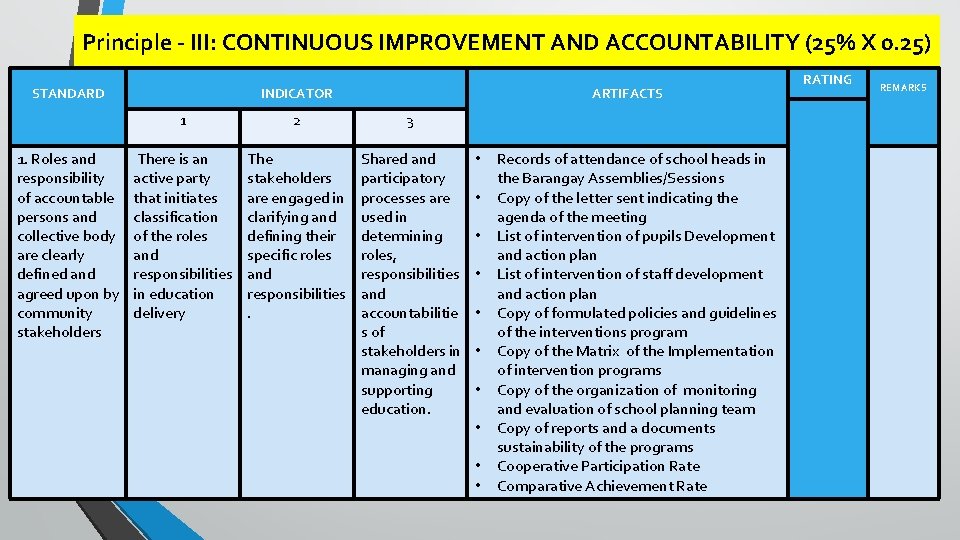
Principle - III: CONTINUOUS IMPROVEMENT AND ACCOUNTABILITY (25% X 0. 25) STANDARD 1. Roles and responsibility of accountable persons and collective body are clearly defined and agreed upon by community stakeholders INDICATOR ARTIFACTS 1 2 3 There is an active party that initiates classification of the roles and responsibilities in education delivery The stakeholders are engaged in clarifying and defining their specific roles and responsibilities. Shared and participatory processes are used in determining roles, responsibilities and accountabilitie s of stakeholders in managing and supporting education. • • • Records of attendance of school heads in the Barangay Assemblies/Sessions Copy of the letter sent indicating the agenda of the meeting List of intervention of pupils Development and action plan List of intervention of staff development and action plan Copy of formulated policies and guidelines of the interventions program Copy of the Matrix of the Implementation of intervention programs Copy of the organization of monitoring and evaluation of school planning team Copy of reports and a documents sustainability of the programs Cooperative Participation Rate Comparative Achievement Rate RATING REMARKS
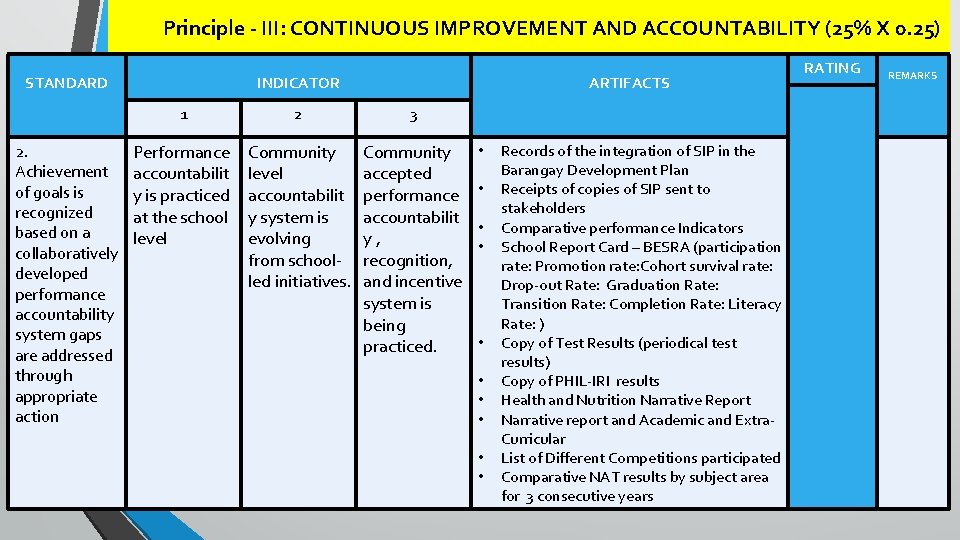
Principle - III: CONTINUOUS IMPROVEMENT AND ACCOUNTABILITY (25% X 0. 25) STANDARD 2. Achievement of goals is recognized based on a collaboratively developed performance accountability system gaps are addressed through appropriate action INDICATOR ARTIFACTS 1 2 3 Performance accountabilit y is practiced at the school level Community level accountabilit y system is evolving from schoolled initiatives. Community accepted performance accountabilit y, recognition, and incentive system is being practiced. • • • Records of the integration of SIP in the Barangay Development Plan Receipts of copies of SIP sent to stakeholders Comparative performance Indicators School Report Card – BESRA (participation rate: Promotion rate: Cohort survival rate: Drop-out Rate: Graduation Rate: Transition Rate: Completion Rate: Literacy Rate: ) Copy of Test Results (periodical test results) Copy of PHIL-IRI results Health and Nutrition Narrative Report Narrative report and Academic and Extra. Curricular List of Different Competitions participated Comparative NAT results by subject area for 3 consecutive years RATING REMARKS
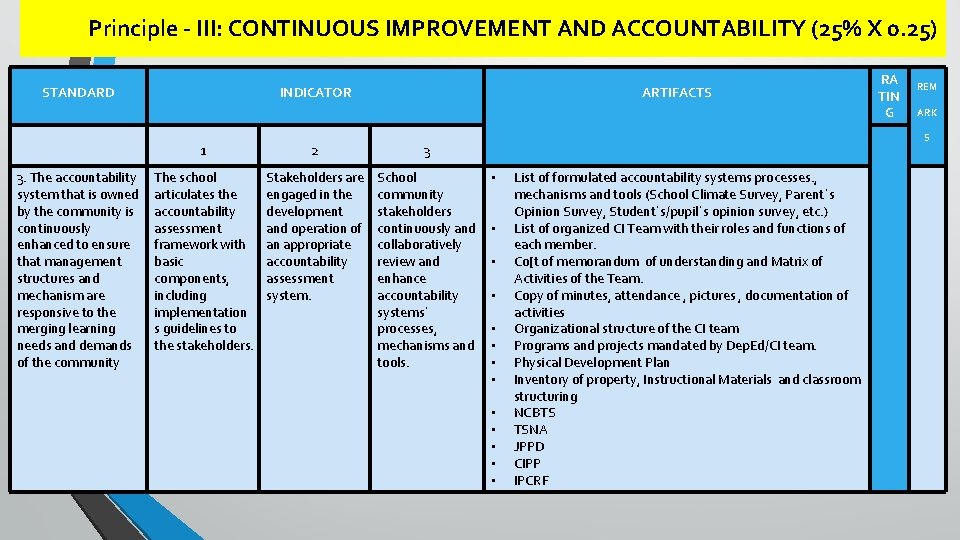
Principle - III: CONTINUOUS IMPROVEMENT AND ACCOUNTABILITY (25% X 0. 25) STANDARD 3. The accountability system that is owned by the community is continuously enhanced to ensure that management structures and mechanism are responsive to the merging learning needs and demands of the community INDICATOR ARTIFACTS 1 2 3 The school articulates the accountability assessment framework with basic components, including implementation s guidelines to the stakeholders. Stakeholders are engaged in the development and operation of an appropriate accountability assessment system. School community stakeholders continuously and collaboratively review and enhance accountability systems` processes, mechanisms and tools. RA TIN G REM ARK S • • • • List of formulated accountability systems processes. , mechanisms and tools (School Climate Survey, Parent`s Opinion Survey, Student`s/pupil`s opinion survey, etc. ) List of organized CI Team with their roles and functions of each member. Co[t of memorandum of understanding and Matrix of Activities of the Team. Copy of minutes, attendance , pictures , documentation of activities Organizational structure of the CI team Programs and projects mandated by Dep. Ed/CI team. Physical Development Plan Inventory of property, Instructional Materials and classroom structuring NCBTS TSNA JPPD CIPP IPCRF
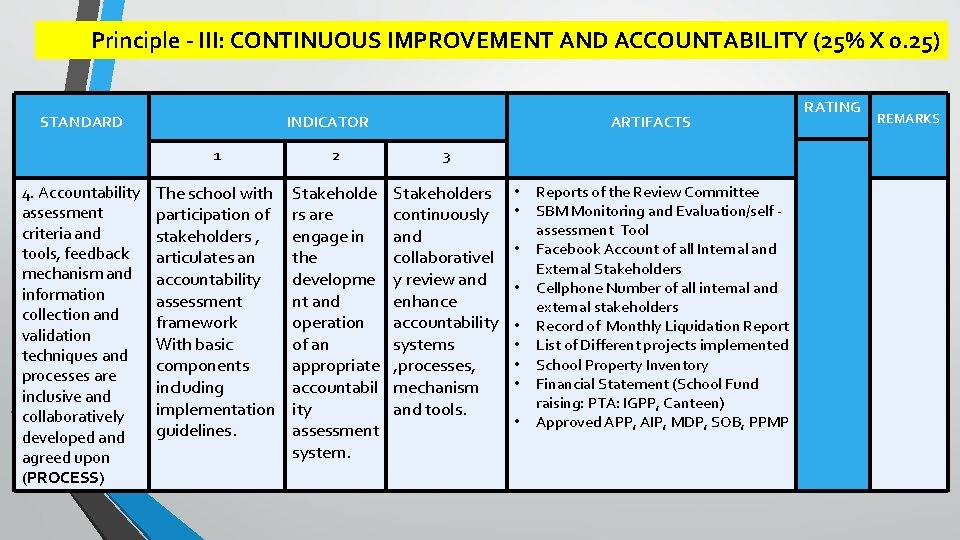
Principle - III: CONTINUOUS IMPROVEMENT AND ACCOUNTABILITY (25% X 0. 25) STANDARD 4. Accountability assessment criteria and tools, feedback mechanism and information collection and validation techniques and processes are inclusive and collaboratively developed and agreed upon (PROCESS) INDICATOR ARTIFACTS 1 2 3 The school with participation of stakeholders , articulates an accountability assessment framework With basic components including implementation guidelines. Stakeholde rs are engage in the developme nt and operation of an appropriate accountabil ity assessment system. Stakeholders continuously and collaborativel y review and enhance accountability systems , processes, mechanism and tools. • • • Reports of the Review Committee SBM Monitoring and Evaluation/self assessment Tool Facebook Account of all Internal and External Stakeholders Cellphone Number of all internal and external stakeholders Record of Monthly Liquidation Report List of Different projects implemented School Property Inventory Financial Statement (School Fund raising: PTA: IGPP, Canteen) Approved APP, AIP, MDP, SOB, PPMP RATING REMARKS
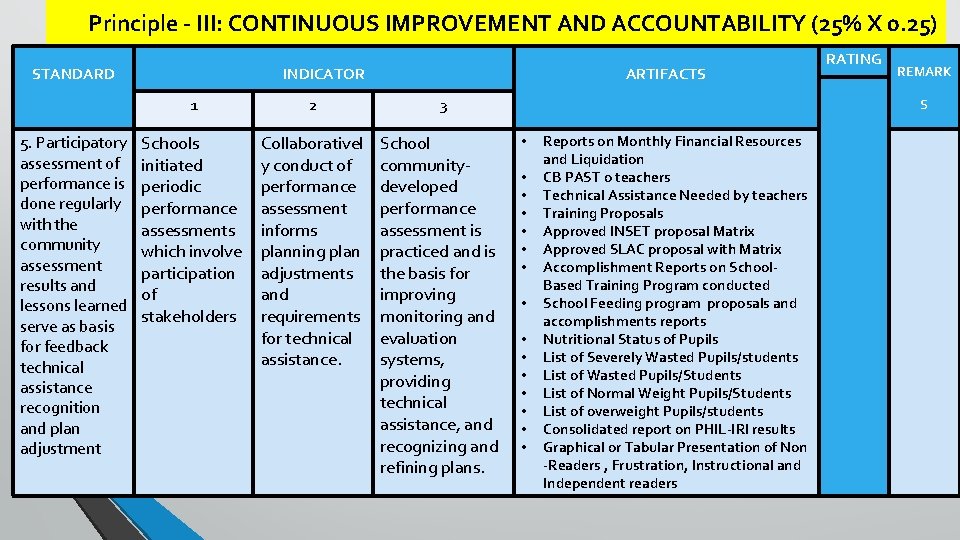
Principle - III: CONTINUOUS IMPROVEMENT AND ACCOUNTABILITY (25% X 0. 25) STANDARD 5. Participatory assessment of performance is done regularly with the community assessment results and lessons learned serve as basis for feedback technical assistance recognition and plan adjustment INDICATOR ARTIFACTS 1 2 3 Schools initiated periodic performance assessments which involve participation of stakeholders Collaborativel y conduct of performance assessment informs planning plan adjustments and requirements for technical assistance. School communitydeveloped performance assessment is practiced and is the basis for improving monitoring and evaluation systems, providing technical assistance, and recognizing and refining plans. RATING REMARK S • • • • Reports on Monthly Financial Resources and Liquidation CB PAST o teachers Technical Assistance Needed by teachers Training Proposals Approved INSET proposal Matrix Approved SLAC proposal with Matrix Accomplishment Reports on School. Based Training Program conducted School Feeding program proposals and accomplishments reports Nutritional Status of Pupils List of Severely Wasted Pupils/students List of Wasted Pupils/Students List of Normal Weight Pupils/Students List of overweight Pupils/students Consolidated report on PHIL-IRI results Graphical or Tabular Presentation of Non -Readers , Frustration, Instructional and Independent readers
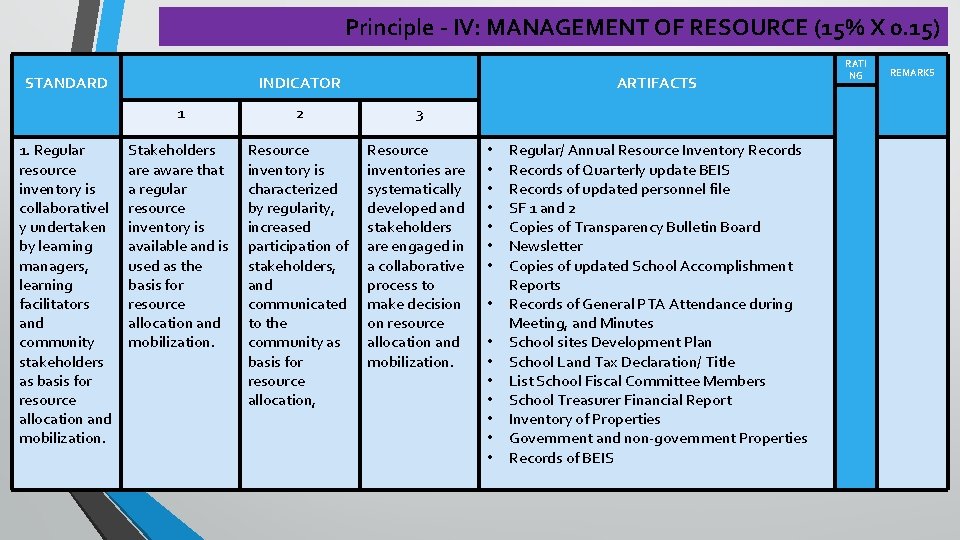
Principle - IV: MANAGEMENT OF RESOURCE (15% X 0. 15) STANDARD 1. Regular resource inventory is collaborativel y undertaken by learning managers, learning facilitators and community stakeholders as basis for resource allocation and mobilization. INDICATOR ARTIFACTS 1 2 3 Stakeholders are aware that a regular resource inventory is available and is used as the basis for resource allocation and mobilization. Resource inventory is characterized by regularity, increased participation of stakeholders, and communicated to the community as basis for resource allocation, Resource inventories are systematically developed and stakeholders are engaged in a collaborative process to make decision on resource allocation and mobilization. • • • • Regular/ Annual Resource Inventory Records of Quarterly update BEIS Records of updated personnel file SF 1 and 2 Copies of Transparency Bulletin Board Newsletter Copies of updated School Accomplishment Reports Records of General PTA Attendance during Meeting, and Minutes School sites Development Plan School Land Tax Declaration/ Title List School Fiscal Committee Members School Treasurer Financial Report Inventory of Properties Government and non-government Properties Records of BEIS RATI NG REMARKS
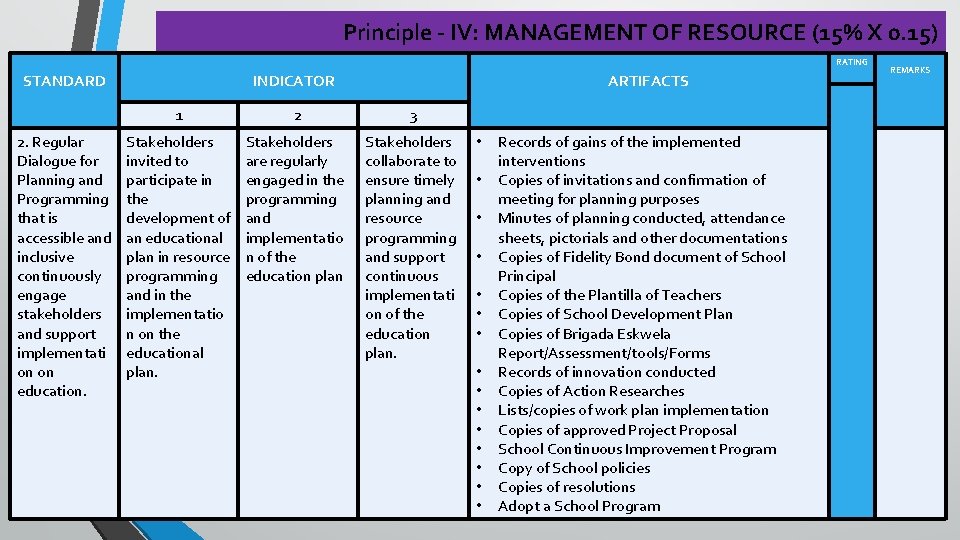
Principle - IV: MANAGEMENT OF RESOURCE (15% X 0. 15) RATING STANDARD 2. Regular Dialogue for Planning and Programming that is accessible and inclusive continuously engage stakeholders and support implementati on on education. INDICATOR ARTIFACTS 1 2 3 Stakeholders invited to participate in the development of an educational plan in resource programming and in the implementatio n on the educational plan. Stakeholders are regularly engaged in the programming and implementatio n of the education plan Stakeholders collaborate to ensure timely planning and resource programming and support continuous implementati on of the education plan. • • • • Records of gains of the implemented interventions Copies of invitations and confirmation of meeting for planning purposes Minutes of planning conducted, attendance sheets, pictorials and other documentations Copies of Fidelity Bond document of School Principal Copies of the Plantilla of Teachers Copies of School Development Plan Copies of Brigada Eskwela Report/Assessment/tools/Forms Records of innovation conducted Copies of Action Researches Lists/copies of work plan implementation Copies of approved Project Proposal School Continuous Improvement Program Copy of School policies Copies of resolutions Adopt a School Program REMARKS
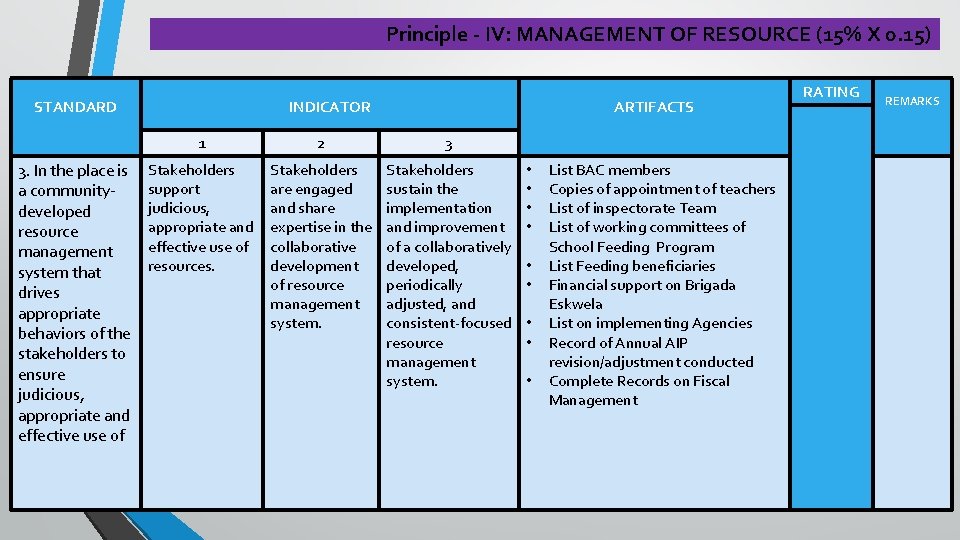
Principle - IV: MANAGEMENT OF RESOURCE (15% X 0. 15) STANDARD 3. In the place is a communitydeveloped resource management system that drives appropriate behaviors of the stakeholders to ensure judicious, appropriate and effective use of INDICATOR ARTIFACTS 1 2 3 Stakeholders support judicious, appropriate and effective use of resources. Stakeholders are engaged and share expertise in the collaborative development of resource management system. Stakeholders sustain the implementation and improvement of a collaboratively developed, periodically adjusted, and consistent-focused resource management system. • • • List BAC members Copies of appointment of teachers List of inspectorate Team List of working committees of School Feeding Program List Feeding beneficiaries Financial support on Brigada Eskwela List on implementing Agencies Record of Annual AIP revision/adjustment conducted Complete Records on Fiscal Management RATING REMARKS
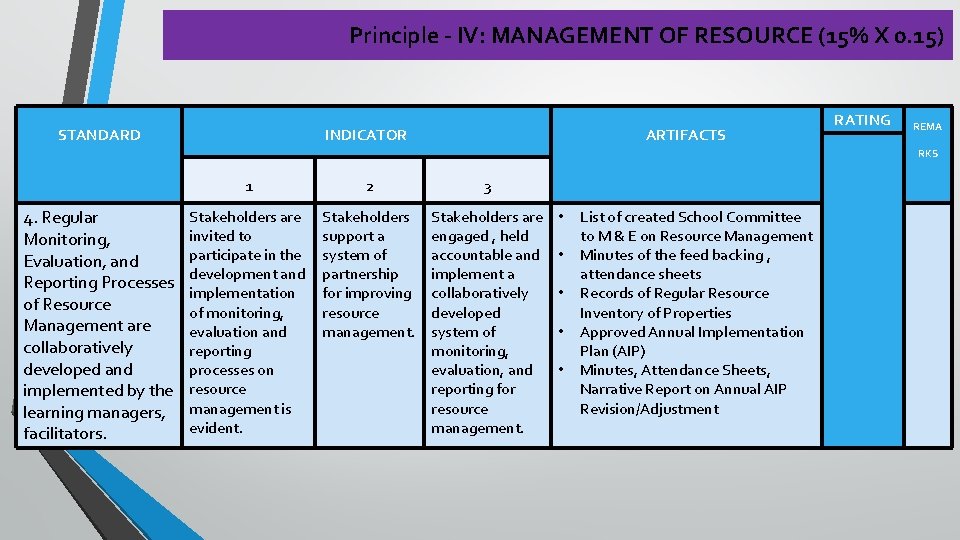
Principle - IV: MANAGEMENT OF RESOURCE (15% X 0. 15) STANDARD INDICATOR ARTIFACTS RATING REMA RKS 4. Regular Monitoring, Evaluation, and Reporting Processes of Resource Management are collaboratively developed and implemented by the learning managers, facilitators. 1 2 3 Stakeholders are invited to participate in the development and implementation of monitoring, evaluation and reporting processes on resource management is evident. Stakeholders support a system of partnership for improving resource management. Stakeholders are engaged , held accountable and implement a collaboratively developed system of monitoring, evaluation, and reporting for resource management. • • • List of created School Committee to M & E on Resource Management Minutes of the feed backing , attendance sheets Records of Regular Resource Inventory of Properties Approved Annual Implementation Plan (AIP) Minutes, Attendance Sheets, Narrative Report on Annual AIP Revision/Adjustment
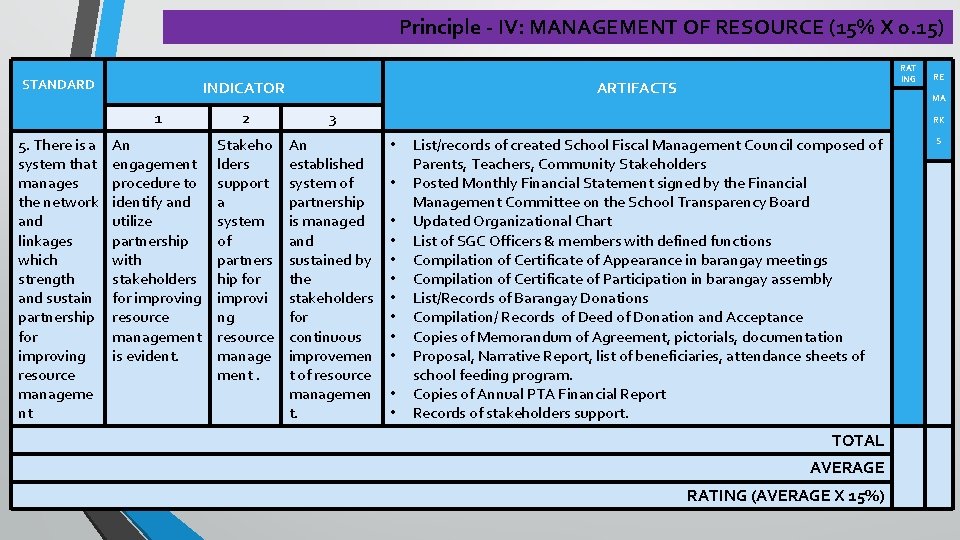
Principle - IV: MANAGEMENT OF RESOURCE (15% X 0. 15) STANDARD 5. There is a system that manages the network and linkages which strength and sustain partnership for improving resource manageme nt INDICATOR RAT ING ARTIFACTS 1 2 3 An engagement procedure to identify and utilize partnership with stakeholders for improving resource management is evident. Stakeho lders support a system of partners hip for improvi ng resource manage ment. An established system of partnership is managed and sustained by the stakeholders for continuous improvemen t of resource managemen t. RE MA RK • • • List/records of created School Fiscal Management Council composed of Parents, Teachers, Community Stakeholders Posted Monthly Financial Statement signed by the Financial Management Committee on the School Transparency Board Updated Organizational Chart List of SGC Officers & members with defined functions Compilation of Certificate of Appearance in barangay meetings Compilation of Certificate of Participation in barangay assembly List/Records of Barangay Donations Compilation/ Records of Deed of Donation and Acceptance Copies of Memorandum of Agreement, pictorials, documentation Proposal, Narrative Report, list of beneficiaries, attendance sheets of school feeding program. Copies of Annual PTA Financial Report Records of stakeholders support. TOTAL AVERAGE RATING (AVERAGE X 15%) S

- Slides: 25