
Document Management Systems Overview n n n Introduction
- Slides: 30
Document Management Systems
Overview n n n Introduction Definitions Benefits Types of Documents: Industries Applications DM Components DM Functionality for the Web Merrill Lynch Case Study Conclusions References Research and Job Opportunities
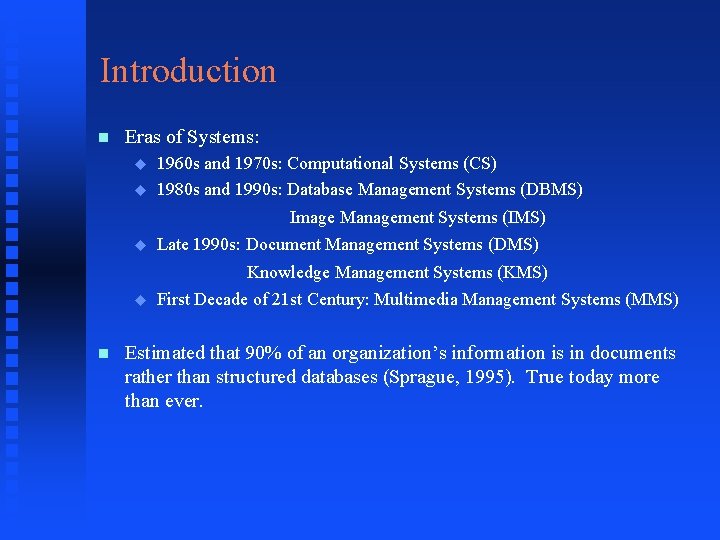
Introduction n Eras of Systems: u 1960 s and 1970 s: Computational Systems (CS) 1980 s and 1990 s: Database Management Systems (DBMS) u Image Management Systems (IMS) Late 1990 s: Document Management Systems (DMS) u Knowledge Management Systems (KMS) First Decade of 21 st Century: Multimedia Management Systems (MMS) u n Estimated that 90% of an organization’s information is in documents rather than structured databases (Sprague, 1995). True today more than ever.
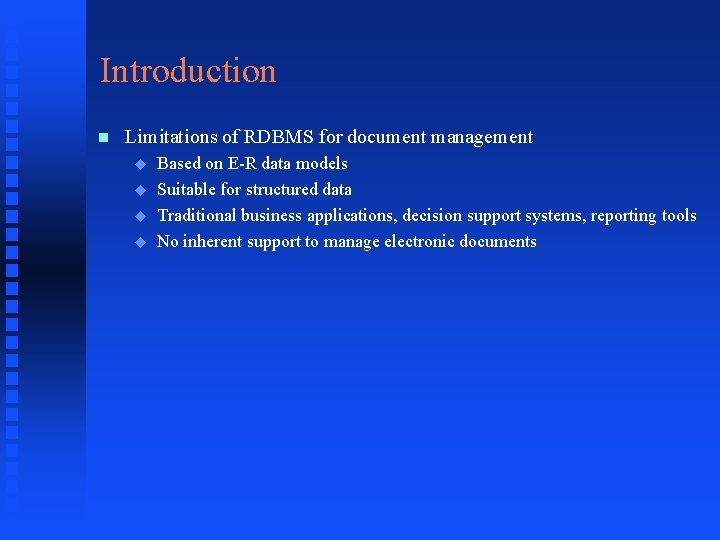
Introduction n Limitations of RDBMS for document management u u Based on E-R data models Suitable for structured data Traditional business applications, decision support systems, reporting tools No inherent support to manage electronic documents
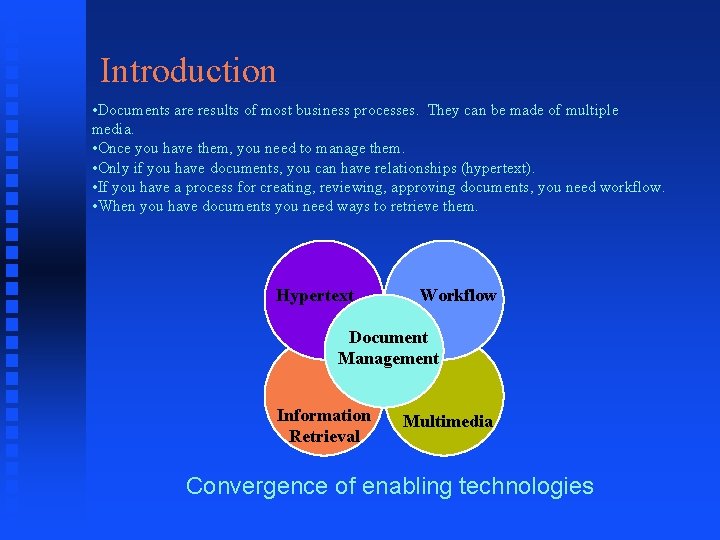
Introduction • Documents are results of most business processes. They can be made of multiple media. • Once you have them, you need to manage them. • Only if you have documents, you can have relationships (hypertext). • If you have a process for creating, reviewing, approving documents, you need workflow. • When you have documents you need ways to retrieve them. Hypertext Workflow Document Management Information Retrieval Multimedia Convergence of enabling technologies
Definitions n n A document is an artifact resulting from the transformation of a set of ideas by people following a set of processes. An electronic document has the following characteristics (Sprague, 1995): u u holds information of multiple media: text, graphics, audio, video contains multiple structures: headers, footers, TOC, sections, paragraphs, tables is dynamic: can be updated on the fly may depend on other documents
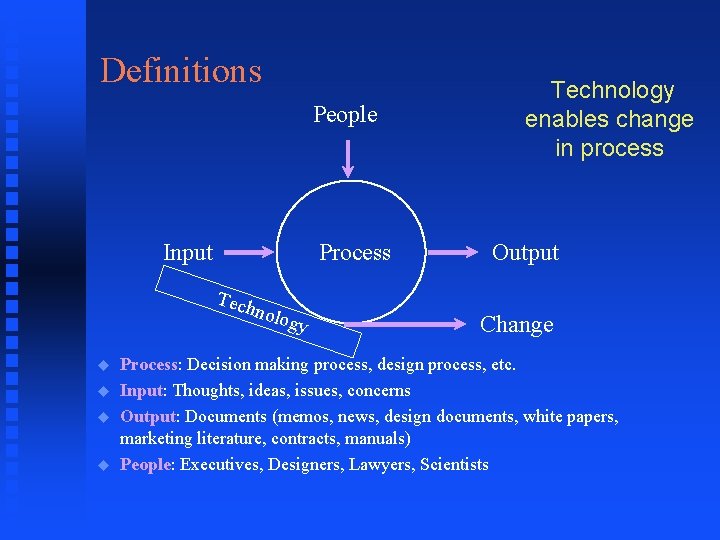
Definitions People Input Process Tech nolo gy u u Technology enables change in process Output Change Process: Decision making process, design process, etc. Input: Thoughts, ideas, issues, concerns Output: Documents (memos, news, design documents, white papers, marketing literature, contracts, manuals) People: Executives, Designers, Lawyers, Scientists
Definitions n Document Management (DM) (Sprague, 1995): creation, storage, organization, transmission, retrieval, manipulation, update, archival and retirement of documents based on organizational needs.
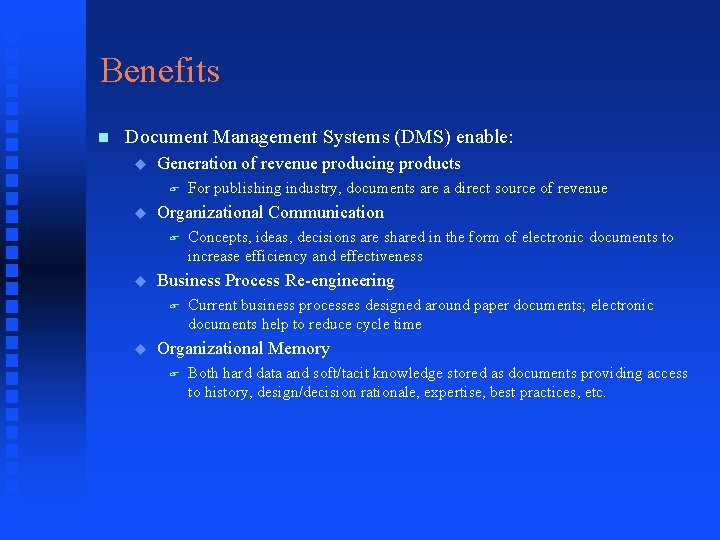
Benefits n Document Management Systems (DMS) enable: u Generation of revenue producing products F u Organizational Communication F u Concepts, ideas, decisions are shared in the form of electronic documents to increase efficiency and effectiveness Business Process Re-engineering F u For publishing industry, documents are a direct source of revenue Current business processes designed around paper documents; electronic documents help to reduce cycle time Organizational Memory F Both hard data and soft/tacit knowledge stored as documents providing access to history, design/decision rationale, expertise, best practices, etc.
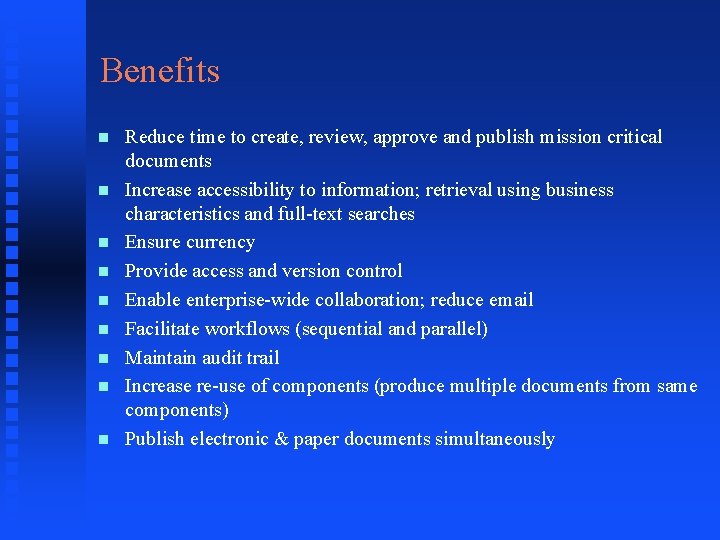
Benefits n n n n n Reduce time to create, review, approve and publish mission critical documents Increase accessibility to information; retrieval using business characteristics and full-text searches Ensure currency Provide access and version control Enable enterprise-wide collaboration; reduce email Facilitate workflows (sequential and parallel) Maintain audit trail Increase re-use of components (produce multiple documents from same components) Publish electronic & paper documents simultaneously
Types of Industries & Documents
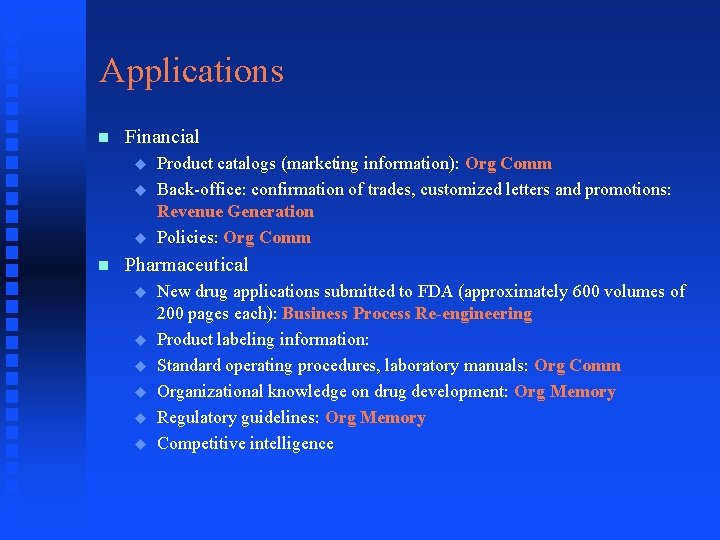
Applications n Financial u u u n Product catalogs (marketing information): Org Comm Back-office: confirmation of trades, customized letters and promotions: Revenue Generation Policies: Org Comm Pharmaceutical u u u New drug applications submitted to FDA (approximately 600 volumes of 200 pages each): Business Process Re-engineering Product labeling information: Standard operating procedures, laboratory manuals: Org Comm Organizational knowledge on drug development: Org Memory Regulatory guidelines: Org Memory Competitive intelligence
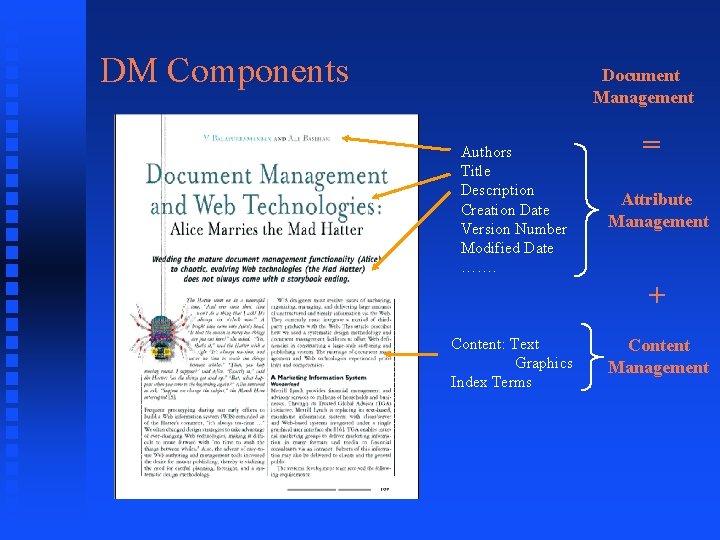
DM Components Document Management Authors Title Description Creation Date Version Number Modified Date ……. = Attribute Management + Content: Text Graphics Index Terms Content Management
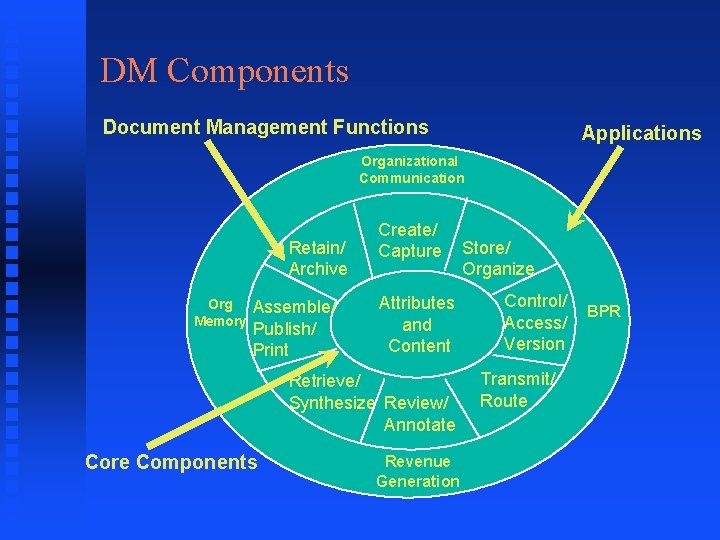
DM Components Document Management Functions Applications Organizational Communication Retain/ Archive Org Memory Assemble/ Publish/ Print Create/ Capture Attributes and Content Retrieve/ Synthesize Review/ Annotate Core Components Revenue Generation Store/ Organize Control/ Access/ Version Transmit/ Route BPR
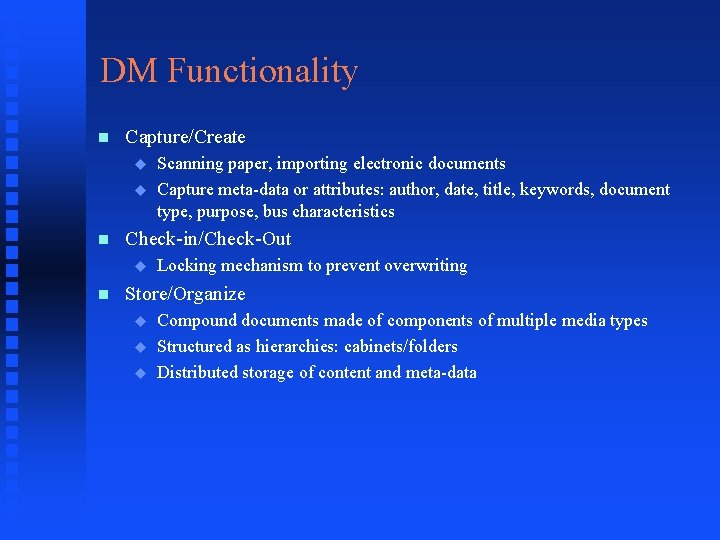
DM Functionality n Capture/Create u u n Check-in/Check-Out u n Scanning paper, importing electronic documents Capture meta-data or attributes: author, date, title, keywords, document type, purpose, bus characteristics Locking mechanism to prevent overwriting Store/Organize u u u Compound documents made of components of multiple media types Structured as hierarchies: cabinets/folders Distributed storage of content and meta-data
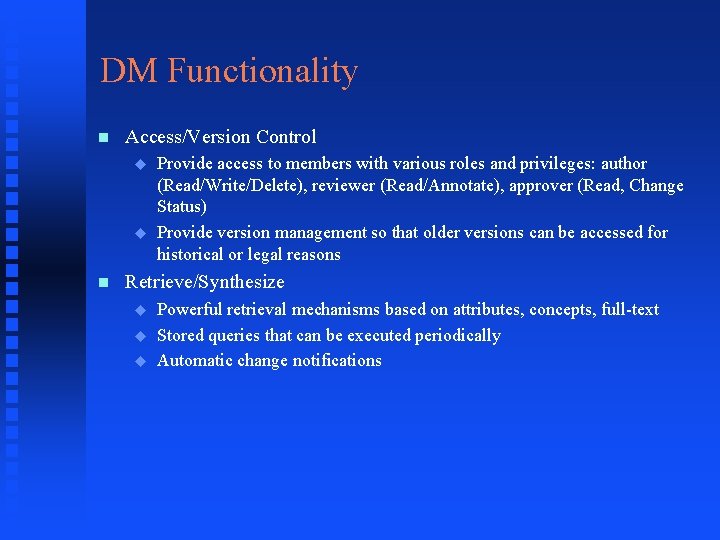
DM Functionality n Access/Version Control u u n Provide access to members with various roles and privileges: author (Read/Write/Delete), reviewer (Read/Annotate), approver (Read, Change Status) Provide version management so that older versions can be accessed for historical or legal reasons Retrieve/Synthesize u u u Powerful retrieval mechanisms based on attributes, concepts, full-text Stored queries that can be executed periodically Automatic change notifications
DM Functionality n Transmit/Route u u n Review/Annotate u n Enable reviewers to read annotate documents; merge annotations Assemble/Publish/Print u u n Create workflows among stakeholders and monitor status Encrypt/decrypt sensitive information Assemble views by combining components based on audience WYSIWYG displays on screen in native format or printing Retain/Archive u Set up rules to retain published and original content (and versions) or to send it to long-term storage (optical disks)
DM Functionality for the Web n n n Immature Web infrastructure for industrial-strength, documentintensive applications Need to extend Web infrastructure using document management functionality (Rein, et al. , 1997) IETF Working Group (WEBDAV) defining standards to extend HTTP for: u u name space management overwrite protection version management meta-data management
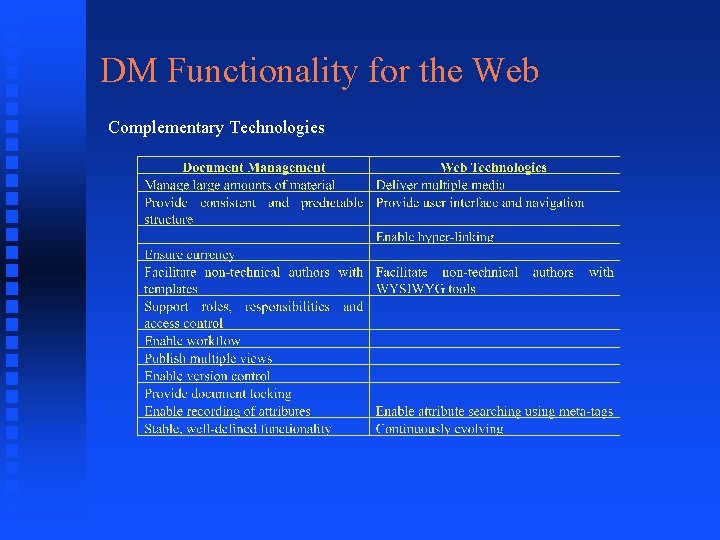
DM Functionality for the Web Complementary Technologies
Merrill Lynch Case Study* n Objectives u u u u Manage and deliver large amounts of product and services marketing material in multiple media via the Intranet/Internet. Provide a consistent structure and user interface. Enable linking of related material. Ensure information is up-to-date. Facilitate non-technical authors in creating content. Support well-defined roles, responsibilities, and access control for various stakeholders in various departments. Enable workflow between authors, product managers, content administrators, editors, attorneys, and system administrators. *Hypertext ‘ 97 Proceedings and Communications of the ACM, July 1998
ML Case Study (Objectives) n Objectives (Continued. . . ) u u Enable assembling and publishing of different views of marketing information for different audiences: financial consultants, clients, and the public. Provide version control to support regulatory requirements. Provide a locking or concurrency control mechanism to prevent two or more people from simultaneously updating the same content. Enable searching and retrieval of content using predefined business characteristics of products and services.
ML Case Study (User Interface)
ML Case Study (Publishing)
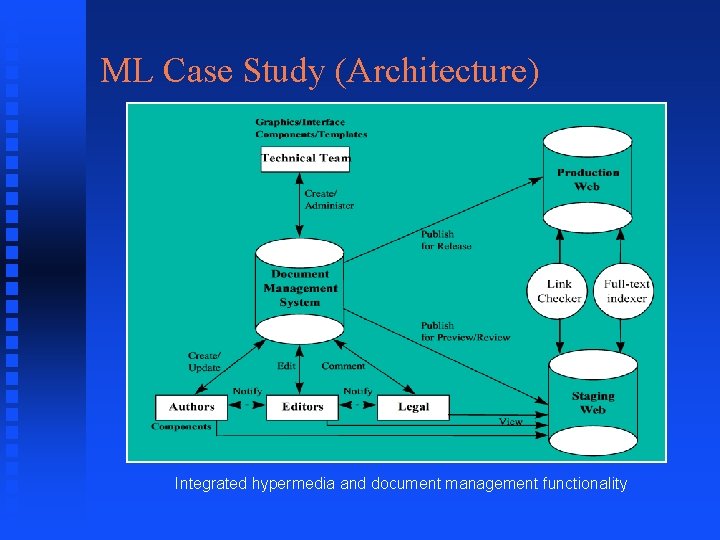
ML Case Study (Architecture) Integrated hypermedia and document management functionality
New Drug Applications (NDA) n n n n Pharmaceutical companies spend an average of $350 million over 10 years to manufacture drugs and conduct clinical trials. No assurance product will make it to the market; even if it does, only 7 years to recover costs and make profits. Information about drug, safety, efficacy, risk-benefit ratio, adverse events, etc. , reported in NDA to FDA. About 600 volumes of 200 pages each. Heavily paper-oriented. On the average FDA takes 18 months to a year to review a NDA. Reducing cycle time by producing documents in electronic form that can be reviewed both internally and externally saves about $1 million a day. Big push by FDA to go completely electronic in the next few years. More importance to electronic document management and publishing.
Issues n n n DMS not good at relationship management; cannot easily manage links between documents. Template management not easy. True joint authoring and merging components or documents is not possible. Different vendors specialize in different parts of the market making system integration a challenging task. Web-based document management systems are emerging only now.
Conclusions n DMS will: u u u become the primary living repositories for organizational information/intellectual assets enable linking of related information (hypertext) provide workflow facilities for various stakeholders increase accessibility to information through meta-data and full-text retrieval and agents enable handling of multimedia
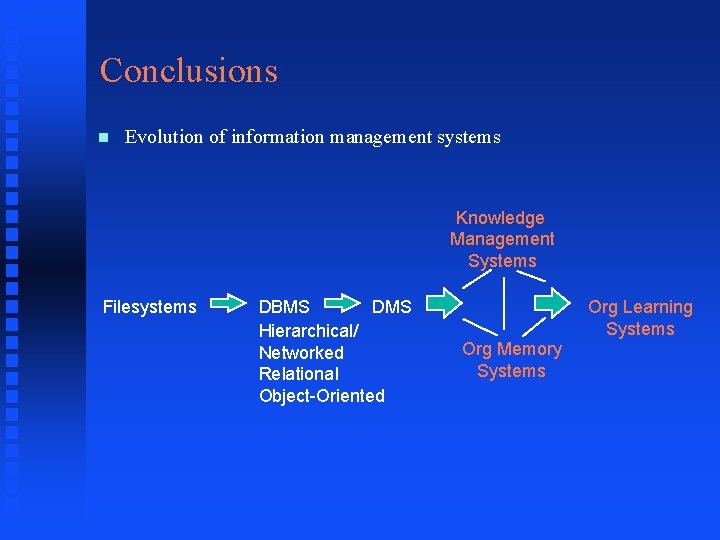
Conclusions n Evolution of information management systems Knowledge Management Systems Filesystems DBMS DMS Hierarchical/ Networked Relational Object-Oriented Org Learning Systems Org Memory Systems
References n n n n Balasubramanian, V. , and Bashian, A. (1998). Document Management and Web Technologies: Alice Marries the Mad Hatter, Communications of the ACM, July 1998. Balasubramanian, V. , Bashian, A. , and Porcher, D. (1997). A Large-Scale Hypermedia Application using Document Management and Web Technologies, Proceedings of Hypertext ‘ 97, ACM Press. Rein, G. L. , Mc. Cue, D. L. , and Slein, J. A. (1997). A Case for Document Management Functions on the Web, Communications of the ACM, September 1997. Documentum: http: //www. documentum. com Opentext/Livelink: http: //www. opentext. com Saros/Mezzanine: http: //www. saros. com PC DOCS: http: //www. pcdocs. com
Research and Job Opportunities n n n Reviewing and implementing WEBDAV recommendations to extend Web infrastructure Template management: propagation of changes to documents instantiated out of templates Indexing and retrieval based on concepts, synonyms Increasing number of jobs in pharmaceutical and financial sectors Managing Web content using DMS u u UI, Server-side programming, Web-DMS gateways Link management