
Document Based Questioning Learning Goal By the end
Document Based Questioning
Learning Goal • By the end of this lesson I will be able to provide a detailed, organized response to the analytical question (question 4) on the Document Based Questioning Assignment.
Document Based Questioning Although the DBQ (Document Based Question) tests your knowledge of a subject, its primary purpose is evaluate your ability to utilize the historical method. When writing a DBQ you will be required to work with the documents to effectively answer the questions provided. Writing a DBQ is an acquired skill and takes practice. When writing a DBQ it is not about finding the right answer, it is about being able to provide a balanced interpretation that is well defended using the documents and your own knowledge.
Tips for Success • Read the documents carefully. There will be four text sources and one visual source (ex. cartoon, map, table of statistics). • Read the questions carefully, highlighting command terms. • First be sure that you understand the content before you attempt an analysis of the documents. • Consider the author’s perspective and potential limitations that exist as a result of this. • Assess the documents validity. • Make sure that you make use of all the documents, do not rely on 1 or 2. • Use the marks as a guide to the length your answer should be. Don’t write a whole page in answer to a question worth 2 or 3 marks. • Watch your time! You only have 60 minutes to complete Paper 1.
The Questions
Question 1 • It is a comprehension question that asks you to identify key facts that are stated in the source. • The question is divided into two parts and is worth 5 marks. • Answering question 1 should not take long. • Use the number of marks allocated to each question as a guide – 3 marks means you need to identify three reasons.
Question 2 • It is a “compare and contrast” question (remember what this command term requires), and will be worth 6 marks. • Make sure you use the correct sources. • These questions are worth 6 marks, so you should be looking for three comparisons and three contrasts. On some occasions you may have more contrasts than comparisons or vice versa. • Use brief examples from the document to support your claims.
Question 2 (continued) • Be detailed, broad comparisons will not gain many marks. • This question is about trying to identify agreement/disagreement in the two sources, avoid comments on the origins of the source. • It is better to write your answers as a continuous prose rather than bullet points as you will write more developed analytical comments. • You must compare and contrast!
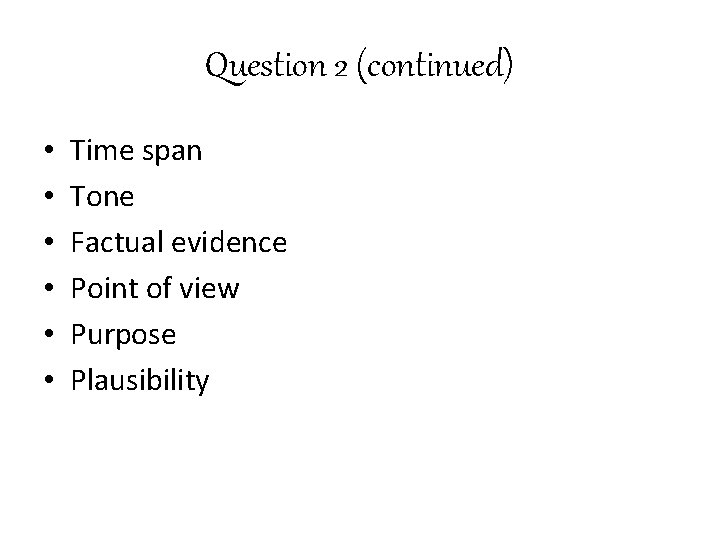
Question 2 (continued) • • • Time span Tone Factual evidence Point of view Purpose Plausibility
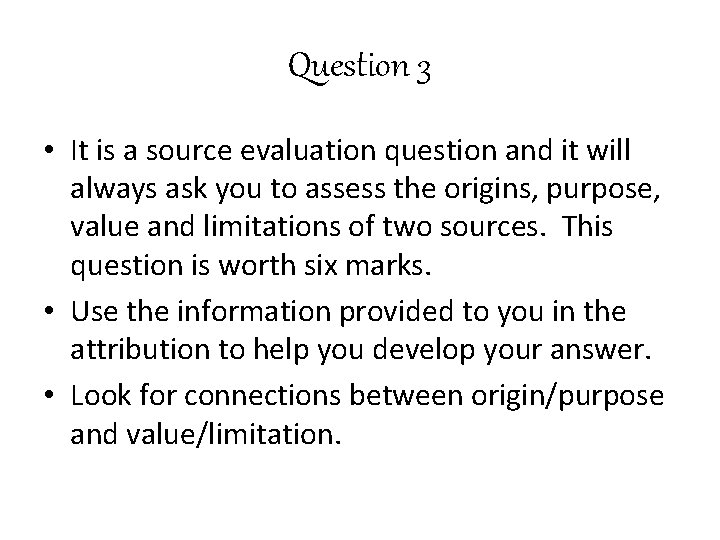
Question 3 • It is a source evaluation question and it will always ask you to assess the origins, purpose, value and limitations of two sources. This question is worth six marks. • Use the information provided to you in the attribution to help you develop your answer. • Look for connections between origin/purpose and value/limitation.
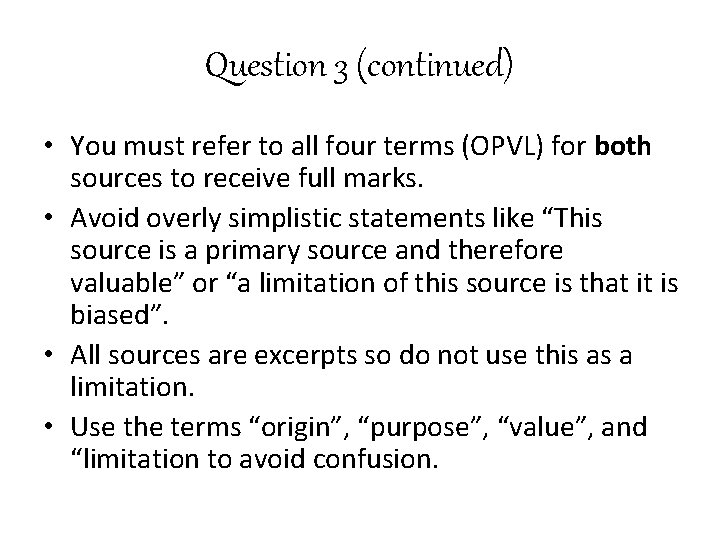
Question 3 (continued) • You must refer to all four terms (OPVL) for both sources to receive full marks. • Avoid overly simplistic statements like “This source is a primary source and therefore valuable” or “a limitation of this source is that it is biased”. • All sources are excerpts so do not use this as a limitation. • Use the terms “origin”, “purpose”, “value”, and “limitation to avoid confusion.
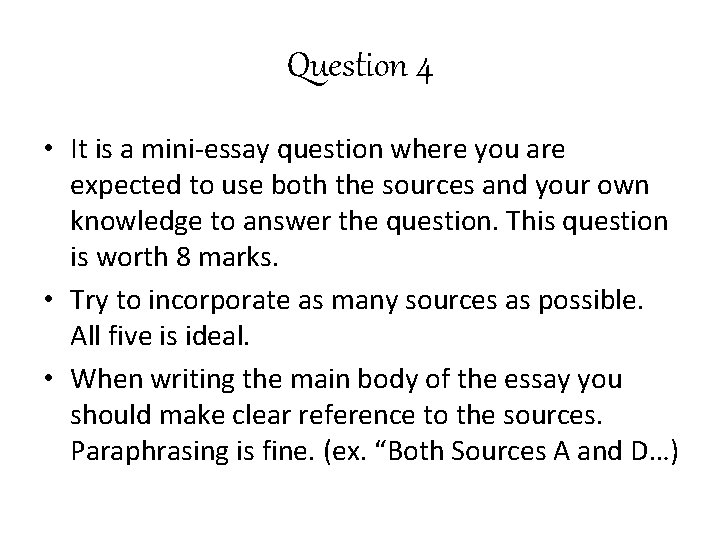
Question 4 • It is a mini-essay question where you are expected to use both the sources and your own knowledge to answer the question. This question is worth 8 marks. • Try to incorporate as many sources as possible. All five is ideal. • When writing the main body of the essay you should make clear reference to the sources. Paraphrasing is fine. (ex. “Both Sources A and D…)
Question 4 (continued) • When possible, include historiography that will help support your argument. • Your own knowledge should be detailed and relevant. • If you use only the sources or your own knowledge you will not gain more than 5 marks. • Leave enough time for this question. Allow approximately 20 -25 minutes to complete the analysis.
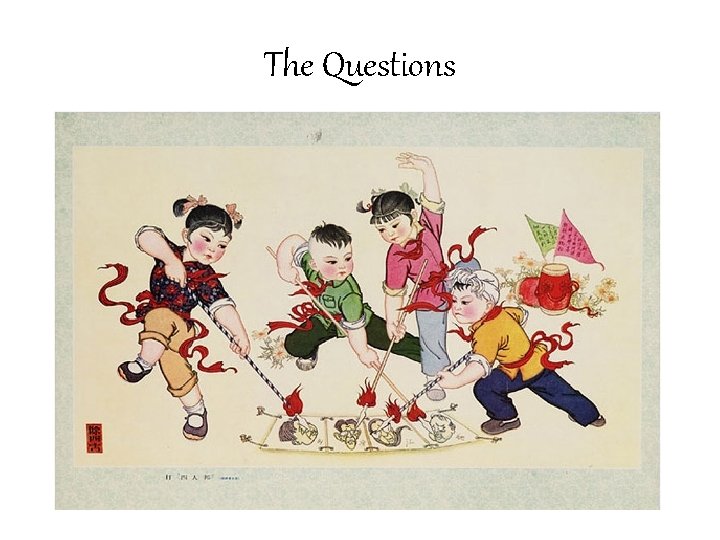
Sample Question • Please use your graphic organizer to address the following Paper 1, Question 4: Using these sources and your own knowledge, analyse the opposition to the Gang of Four. [8 marks]
- Slides: 14