
Doctor Artur Steiner Artur Steinergcu ac uk Strategies
- Slides: 26
Doctor Artur Steiner: Artur. Steiner@gcu. ac. uk Strategies for empowering disadvantaged rural communities The XXVII European Society for Rural Sociology Congress Krakow 24 -27 th July 2017
Recent policy changes • EU and UK policies encourage service co-production through community engagement, empowerment, asset ownership, capacity-building and enhanced community resilience • EU and SG interventions through LEADER
Policy directions • The ‘reform agenda will empower communities to come together to address local issues… giving new powers and rights to neighbourhood groups’ (Conservative Party, 2015). • One of the National Outcomes: ‘We have strong, resilient and supportive communities were people take responsibility for their own action and how they affect others’ (Scottish Government, 2014). • Community Empowerment Bill: ‘communities are a rich source of talent and creative potential and the process of community empowerment helps to unlock that potential. It stimulates and harnesses the energy of local people to come up with creative and successful solutions to local challenges’ (Scottish Government, 2014).
Meaning of Empowerment • A process of transition from a state of powerlessness to a state of relative control (Sadan, 1997). • A united and systematic effort by a group to gain control over and improve their aggregated lives by defining problems, assets, solutions, and the processes by which change can occur (Reininger et al. , 2006).
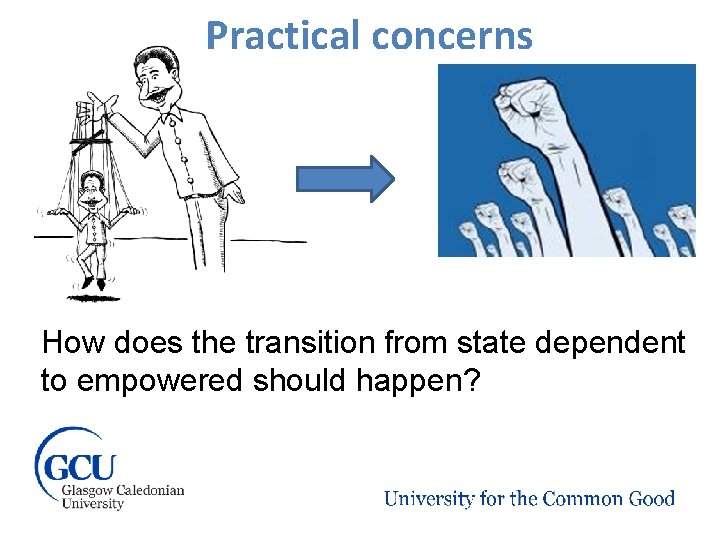
Practical concerns How does the transition from state dependent to empowered should happen?
Practical concerns • Are all communities equally empowered? • What do we do with communities that are less capable and do not engage? ‘It can only be expected that community-based strategies for self-help will increase the division and inequality in rural towns by empowering a small, fairly powerful minority who are better positioned to mobilise themselves’ (Herbert-Cheshire, 2000).
The movement from the ‘hierarchically organised intervening state’ towards the ‘cooperative state’ needs to be better understood (Margarian, 2011).
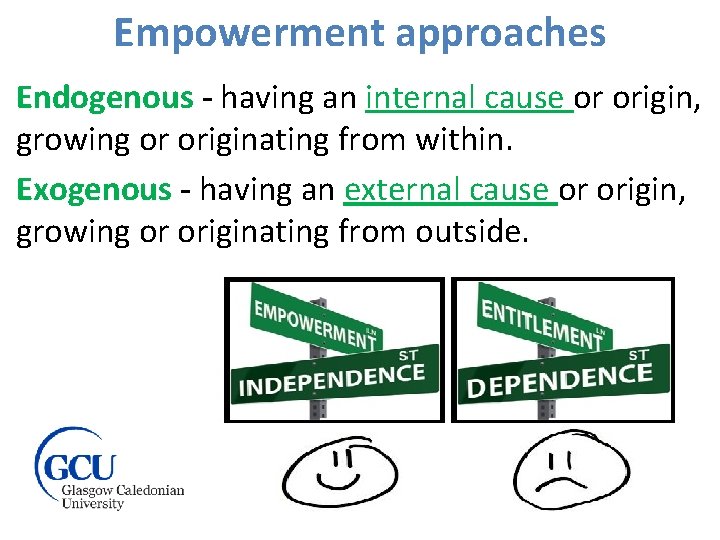
Empowerment approaches Endogenous - having an internal cause or origin, growing or originating from within. Exogenous - having an external cause or origin, growing or originating from outside.
Capacity for Change Programme C 4 C = Capacity for Change What is the driving force of the C 4 C initiative? • To build community capacity and enable less-resourced communities to become empowered and resilient Why should we work with less-resourced communities? • Current LEADER approach might not be efficient • Support goes to ‘capable’ communities • Less-resourced communities miss out on potential support
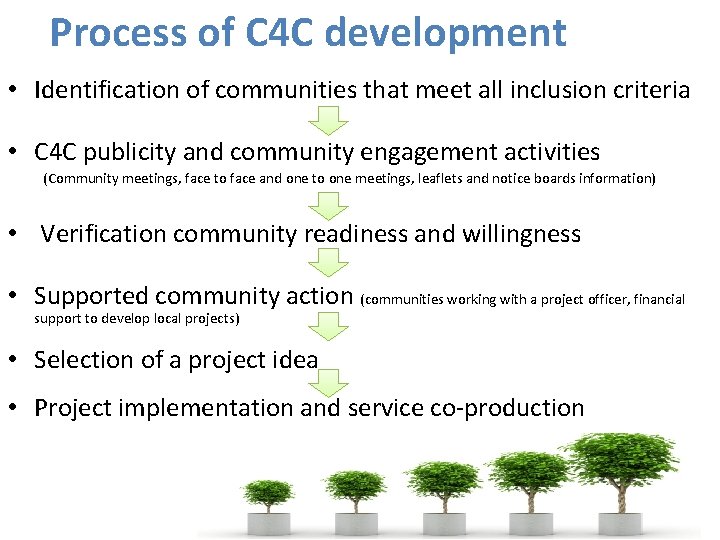
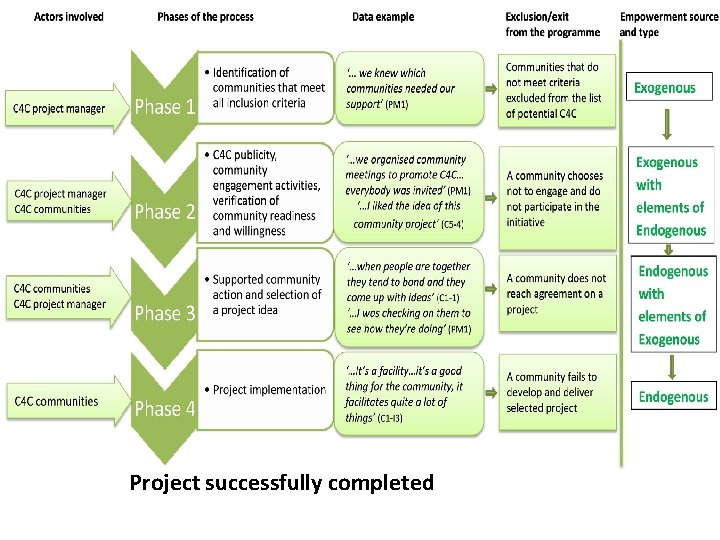
Process of C 4 C development • Identification of communities that meet all inclusion criteria • C 4 C publicity and community engagement activities (Community meetings, face to face and one to one meetings, leaflets and notice boards information) • Verification community readiness and willingness • Supported community action (communities working with a project officer, financial support to develop local projects) • Selection of a project idea • Project implementation and service co-production
Research questions Overarching research objectives: • How effective is the overall C 4 C intervention? • What difference does C 4 C make to the participating communities? • What improvements could be made to the C 4 C programme to make it more effective? Community empowerment questions: • How does the community empowerment process begin? • Who should be responsible for the process of empowerment?
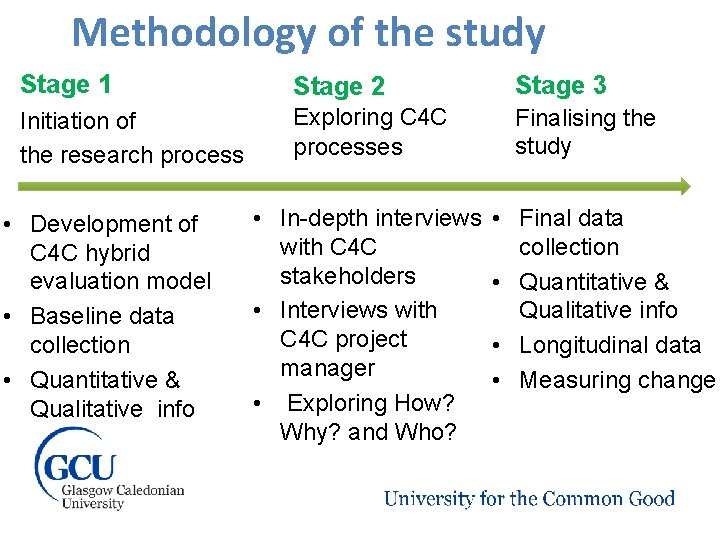
Methodology of the study Stage 1 Stage 2 Stage 3 Initiation of the research process Exploring C 4 C processes Finalising the study • Development of C 4 C hybrid evaluation model • Baseline data collection • Quantitative & Qualitative info • In-depth interviews with C 4 C stakeholders • Interviews with C 4 C project manager • Exploring How? Why? and Who? • Final data collection • Quantitative & Qualitative info • Longitudinal data • Measuring change
Data collection 7 villages were invited to take part in the programme and 6 of them accepted the invitation • Stage 1 involved conducting 178 face-to-face, semi-structured interviews • Stage 2 involved over 30 in-depth interviews • Stage 3 involved conducting 137 face-to-face interviews
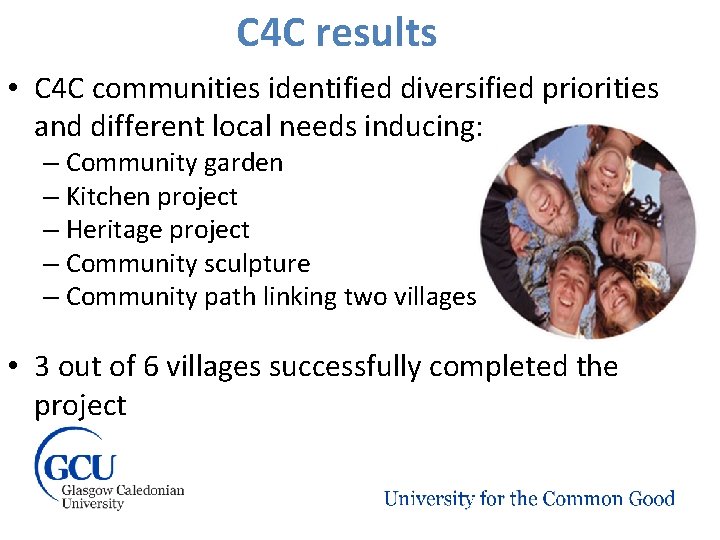
C 4 C results • C 4 C communities identified diversified priorities and different local needs inducing: – Community garden – Kitchen project – Heritage project – Community sculpture – Community path linking two villages • 3 out of 6 villages successfully completed the project
Project successfully completed
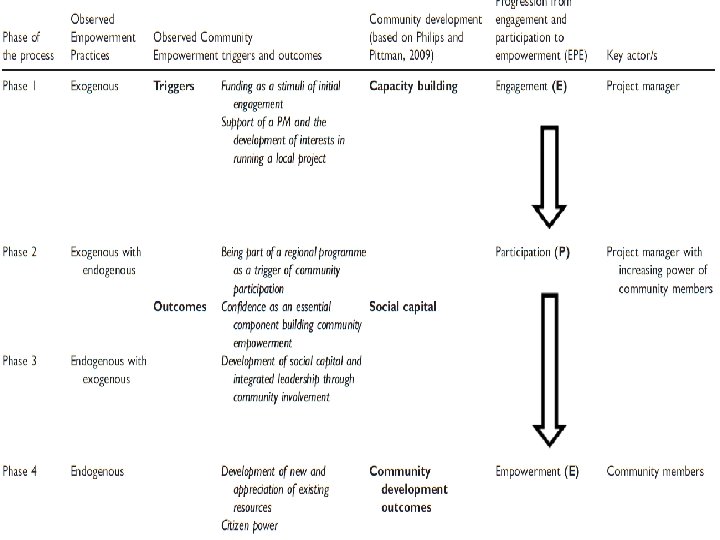
Engagement • Funding source as a platform for community engagement: ‘We got something for nothing didn’t we? …I think the idea’s excellent…the fact that there is finance available’. • Supported community action and work of a project manager: ‘Obviously we didn’t know what we were doing and we had somebody to guide us. You definitely need somebody that knows how the project works to help you work through it. ’
Participation • Being part of a region programme as a trigger of community participation: ‘We often feel that we are neglected. So to be part of this project was great’. • Confidence as an essential component building community empowerment: ‘People will be interested and perhaps that will encourage, just even if it's half a dozen people, to get more involved. . . so that's a real advantage’. • Development of social capital through community involvement: ‘it forced people to work together who normally wouldn’t, so that was a positive. It led within the village to an opening of communication channels which was also positive’.
Empowerment • Development of new and appreciation of existing resources: ‘We've actually got to the end…there is a tangible result now. And it got the village talking. . . it’s an extra facility’. • Citizen power: ‘now we’re looking into ways to raise money separately to try and get a carpet put in the hall to make it nicer so that if we are having people hiring the hall for a café…so from the kitchen it’s spawning other ideas to make the hall more useable’.
Observations Empowering communities that do not engage includes: • Engagement (run by a community development officer) • Participation (which involves collaborative work and transfer of power, resources and control from the development officer to community members) • Empowerment (a stage in which communities take ownership of the project and run the community development initiative)
Conclusions • In relation to communities that do not engage, community empowerment needs to be facilitated and should start with building the capacity of communities. • The research highlights a need for tailored structural support. • The assumption that all communities might be ready to do things for themselves is unrealistic.
Conclusions • Elements of endogenous and exogenous empowerment are necessary for empowerment of communities that have little apparent history of government-induced civic engagement. • Exogenous agencies could add value by providing an enabling environment where endogenous development occurs.
Thank you for your attention C 4 C publications: Steiner, A. and Farmer, J. (2017) Engage, participate, empower: modelling power transfer in disadvantaged rural communities Environment and Planning C. Steiner, A. (2016) Assessing the effectiveness of a capacity building intervention in empowering hard to reach communities. Journal of Community Practice, 24(3), 235 -263. Steiner, A. Woolvin, M. and Skerratt, S. (2016) Measuring community resilience over time: developing and applying a ‘hybrid evaluation’ approach. Community Development Journal. Steiner, A. and Markantoni, M. (2014) Exploring Community Resilience in Scotland through Capacity for Change. Community Development Journal, 49(3), 407 -425. Skerratt, S. and Steiner, A. (2013) Working with communities-of-place: complexities of empowerment. Local Economy, 28(3), 320– 338. Contact details: Artur. steiner@gcu. ac. uk
Key statistical results 1. C 4 C successfully completed projects – The overall level of resilience increased (change statistically significant) 2. C 4 C villages that did not successfully complete their projects – The overall level of resilience decreased (change is not statistically significant)
Advantages and Positive Changes • Funding source as a platform for community engagement • Being part of a regional programme as a trigger of community participation • Development of social capital through community involvement • Knock-on effect and added value • Confidence as an essential component of the community resilience process • Development of new and appreciation of existing resources
C 4 C Challenges • • • Lack of sufficient information about C 4 C Misunderstanding of the C 4 C concept Admin & Management issues Suspicions and scepticism Diverse community needs Hesitance to change Timelines & Deadlines Personal agendas, disputes and conflicts Financial accountability Keep C 4 C going