
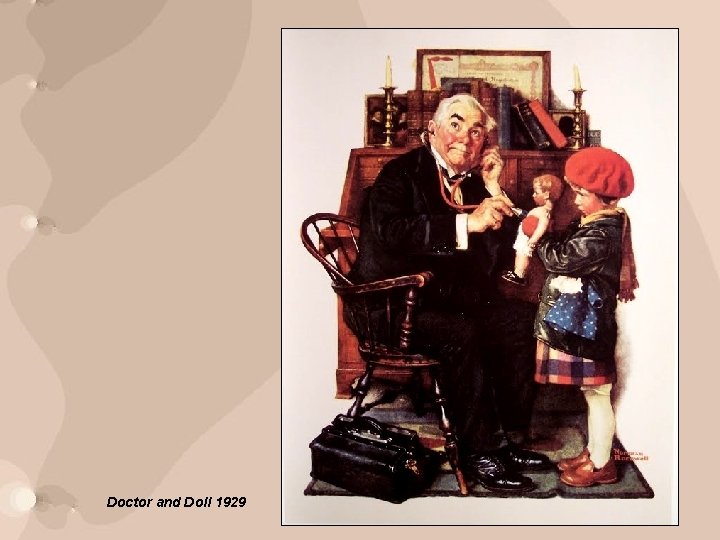
Doctor and Doll 1929 In the future days



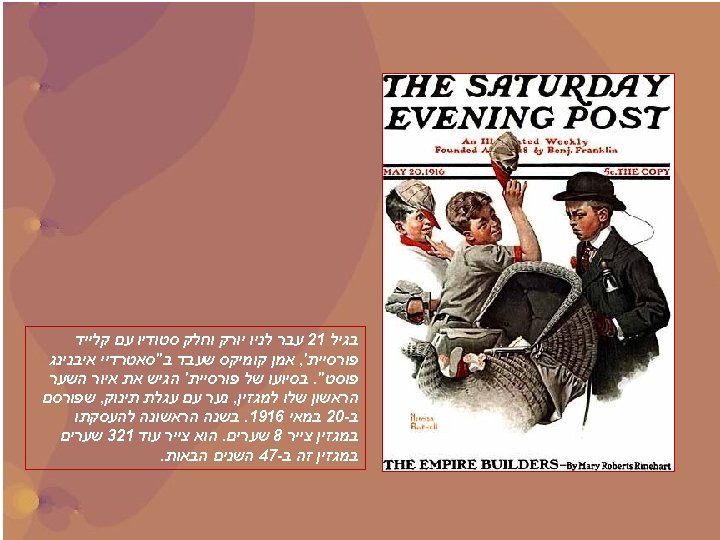

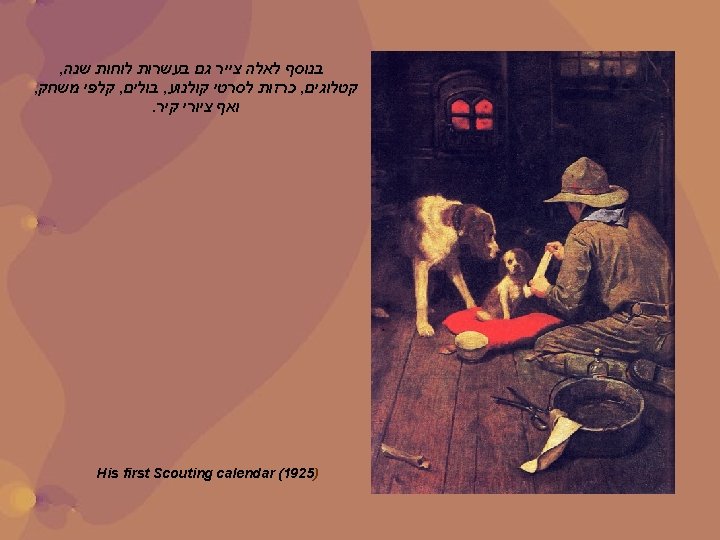









- Slides: 60
Doctor and Doll 1929
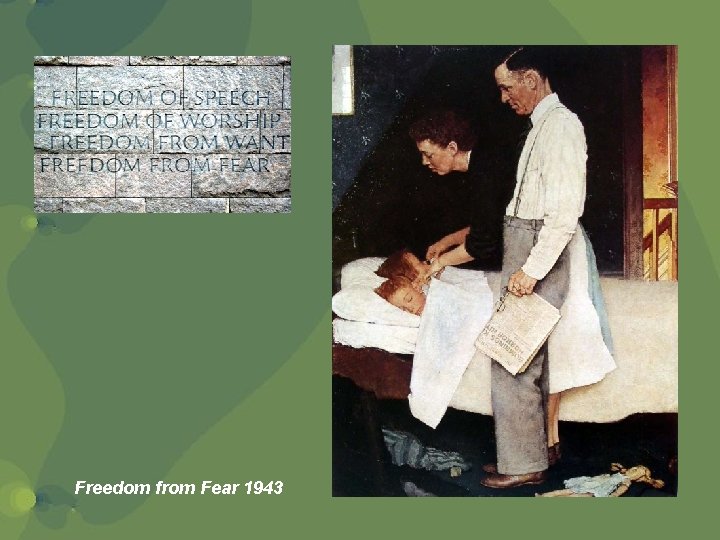
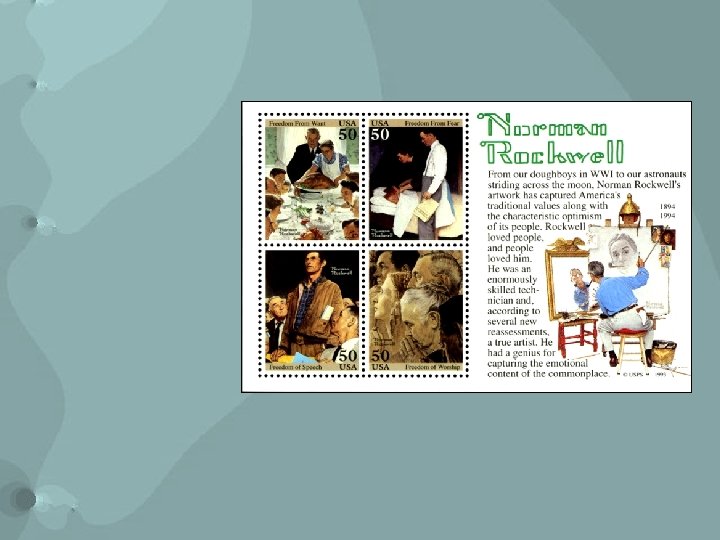
"In the future days, which we seek to make secure, we look forward to a world founded upon four essential human freedoms. The first is freedom of speech and expression— everywhere in the world. The second is freedom of every person to worship God in his own way—everywhere in the world. The third is freedom from want—which, translated into world terms, means economic understandings which will secure to every nation a healthy peacetime life for its inhabitants—everywhere in the world. The fourth is freedom from fear—which, translated into world terms, means a world-wide reduction of armaments to such a point and in such a thorough fashion that no nation will be in a position to commit an act of physical aggression against any neighbor— anywhere in the world. That is no vision of a distant millennium. It is a definite basis for a kind of world attainable in our own time and generation. That kind of world is the very antithesis of the so-called new order of tyranny which the dictators seek to create with the crash of a bomb. " Franklin Delano] Roosevelt Freedom of Worship 1943
Freedom from Fear 1943
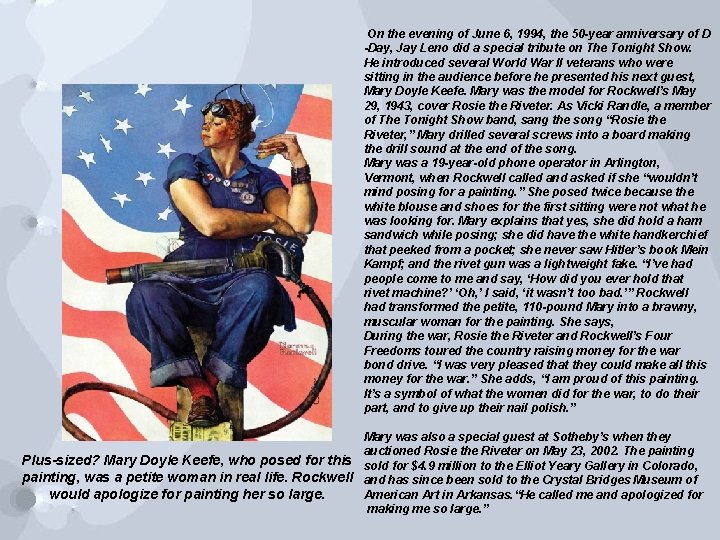
On the evening of June 6, 1994, the 50 -year anniversary of D -Day, Jay Leno did a special tribute on The Tonight Show. He introduced several World War II veterans who were sitting in the audience before he presented his next guest, Mary Doyle Keefe. Mary was the model for Rockwell’s May 29, 1943, cover Rosie the Riveter. As Vicki Randle, a member of The Tonight Show band, sang the song “Rosie the Riveter, ” Mary drilled several screws into a board making the drill sound at the end of the song. Mary was a 19 -year-old phone operator in Arlington, Vermont, when Rockwell called and asked if she “wouldn’t mind posing for a painting. ” She posed twice because the white blouse and shoes for the first sitting were not what he was looking for. Mary explains that yes, she did hold a ham sandwich while posing; she did have the white handkerchief that peeked from a pocket; she never saw Hitler’s book Mein Kampf; and the rivet gun was a lightweight fake. “I’ve had people come to me and say, ‘How did you ever hold that rivet machine? ’ ‘Oh, ’ I said, ‘it wasn’t too bad. ’” Rockwell had transformed the petite, 110 -pound Mary into a brawny, muscular woman for the painting. She says, During the war, Rosie the Riveter and Rockwell’s Four Freedoms toured the country raising money for the war bond drive. “I was very pleased that they could make all this money for the war. ” She adds, “I am proud of this painting. It’s a symbol of what the women did for the war, to do their part, and to give up their nail polish. ” Mary was also a special guest at Sotheby’s when they auctioned Rosie the Riveter on May 23, 2002. The painting Plus-sized? Mary Doyle Keefe, who posed for this sold for $4. 9 million to the Elliot Yeary Gallery in Colorado, painting, was a petite woman in real life. Rockwell and has since been sold to the Crystal Bridges Museum of American Art in Arkansas. “He called me and apologized for would apologize for painting her so large. making me so large. ”
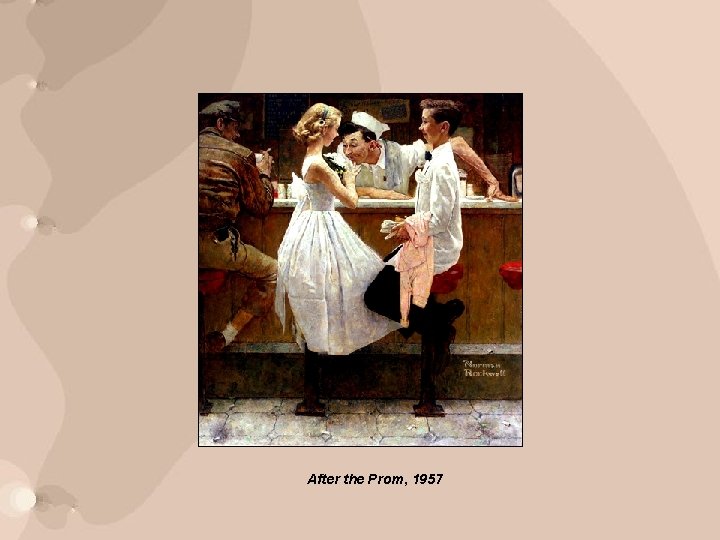
After the Prom, 1957
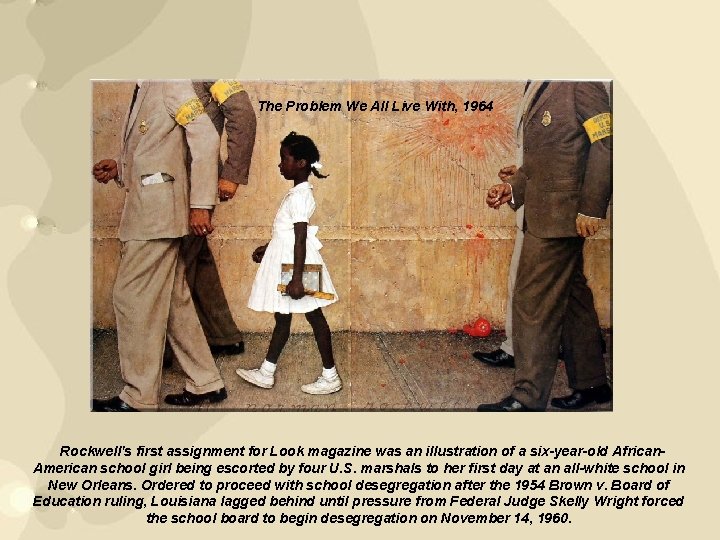
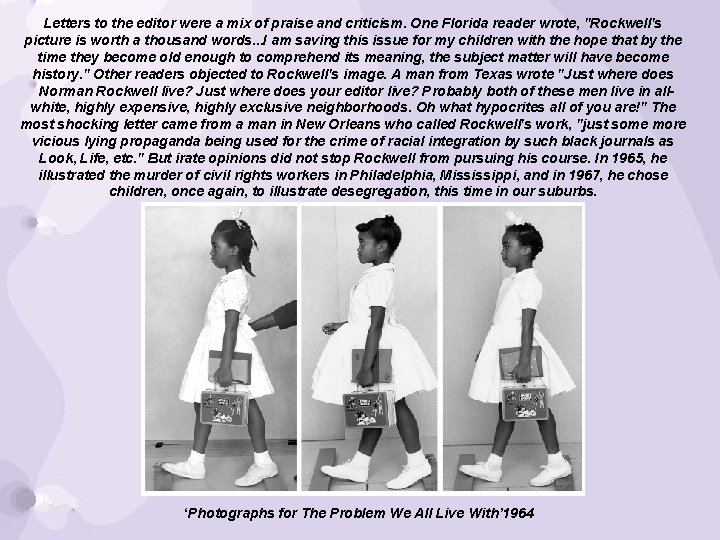
The Problem We All Live With, 1964 Rockwell's first assignment for Look magazine was an illustration of a six-year-old African. American school girl being escorted by four U. S. marshals to her first day at an all-white school in New Orleans. Ordered to proceed with school desegregation after the 1954 Brown v. Board of Education ruling, Louisiana lagged behind until pressure from Federal Judge Skelly Wright forced the school board to begin desegregation on November 14, 1960.
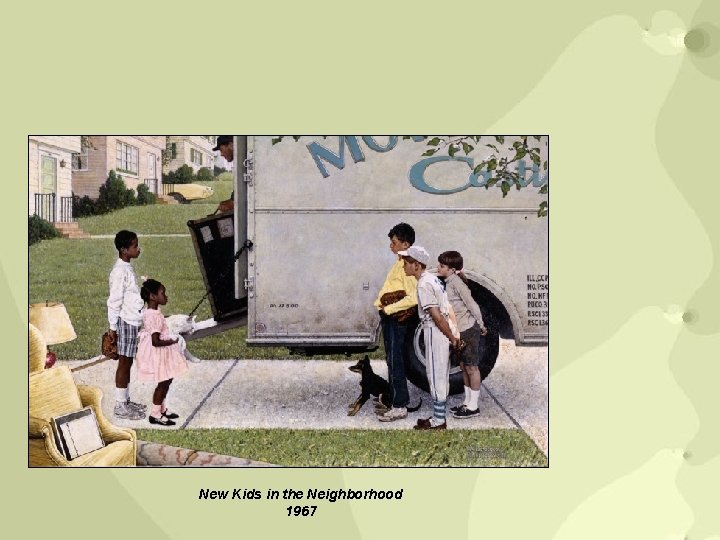
Letters to the editor were a mix of praise and criticism. One Florida reader wrote, "Rockwell's picture is worth a thousand words. . . I am saving this issue for my children with the hope that by the time they become old enough to comprehend its meaning, the subject matter will have become history. " Other readers objected to Rockwell's image. A man from Texas wrote "Just where does Norman Rockwell live? Just where does your editor live? Probably both of these men live in allwhite, highly expensive, highly exclusive neighborhoods. Oh what hypocrites all of you are!" The most shocking letter came from a man in New Orleans who called Rockwell's work, "just some more vicious lying propaganda being used for the crime of racial integration by such black journals as Look, Life, etc. " But irate opinions did not stop Rockwell from pursuing his course. In 1965, he illustrated the murder of civil rights workers in Philadelphia, Mississippi, and in 1967, he chose children, once again, to illustrate desegregation, this time in our suburbs. ‘Photographs for The Problem We All Live With’ 1964
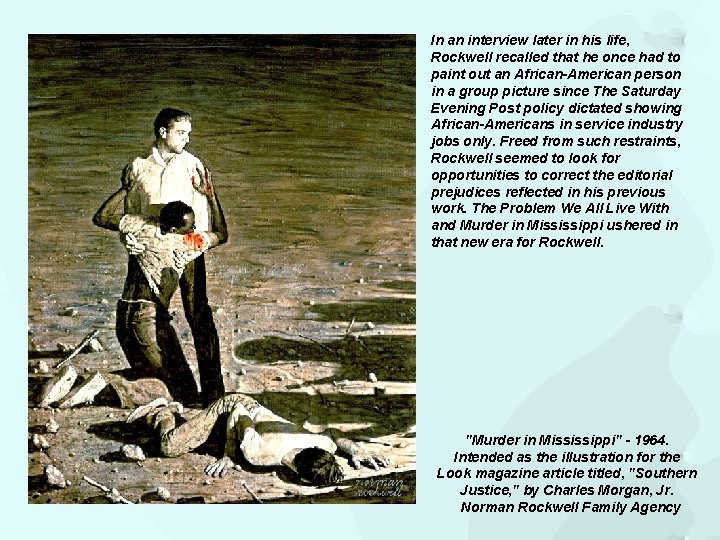
In an interview later in his life, Rockwell recalled that he once had to paint out an African-American person in a group picture since The Saturday Evening Post policy dictated showing African-Americans in service industry jobs only. Freed from such restraints, Rockwell seemed to look for opportunities to correct the editorial prejudices reflected in his previous work. The Problem We All Live With and Murder in Mississippi ushered in that new era for Rockwell. "Murder in Mississippi" - 1964. Intended as the illustration for the Look magazine article titled, "Southern Justice, " by Charles Morgan, Jr. Norman Rockwell Family Agency
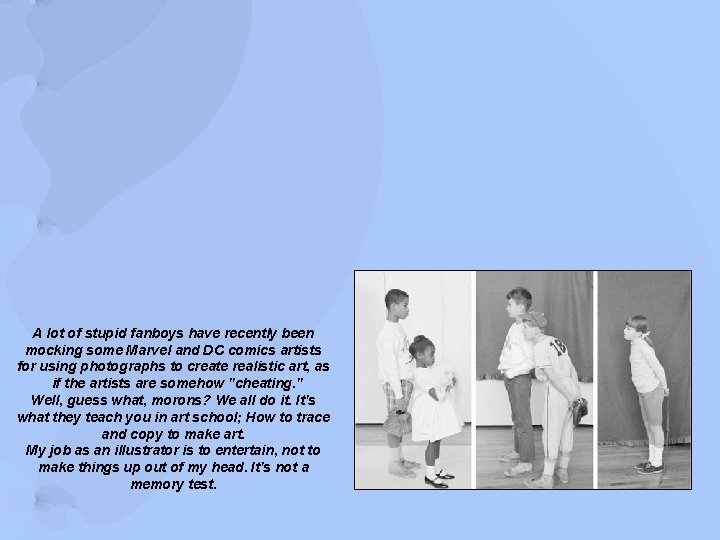
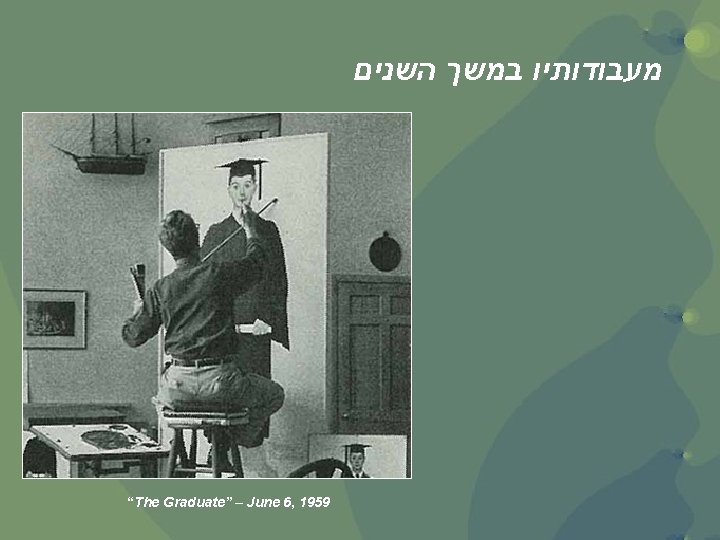
A lot of stupid fanboys have recently been mocking some Marvel and DC comics artists for using photographs to create realistic art, as if the artists are somehow "cheating. " Well, guess what, morons? We all do it. It's what they teach you in art school; How to trace and copy to make art. My job as an illustrator is to entertain, not to make things up out of my head. It's not a memory test.
New Kids in the Neighborhood 1967
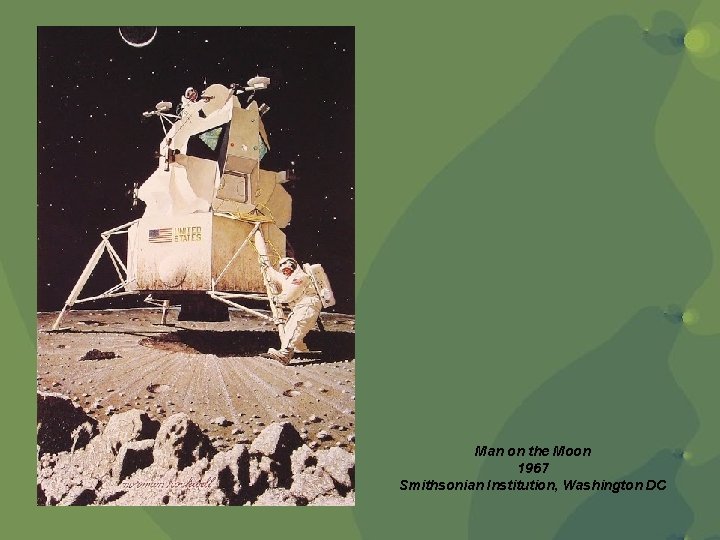
Man on the Moon 1967 Smithsonian Institution, Washington DC
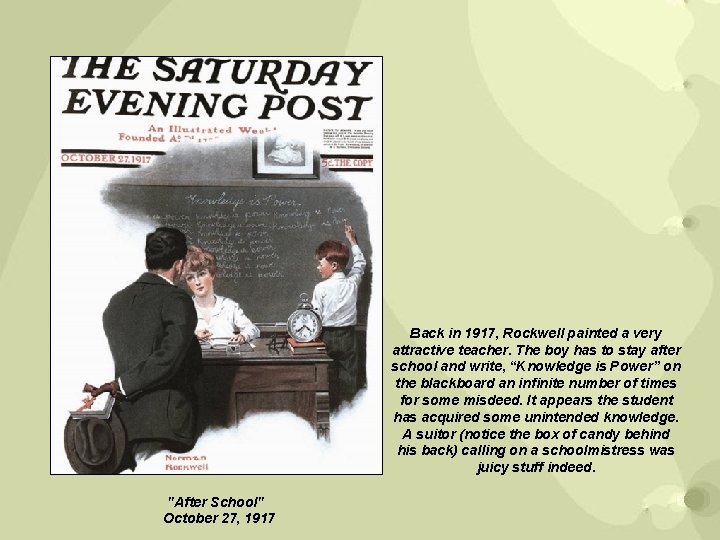
Back in 1917, Rockwell painted a very attractive teacher. The boy has to stay after school and write, “Knowledge is Power” on the blackboard an infinite number of times for some misdeed. It appears the student has acquired some unintended knowledge. A suitor (notice the box of candy behind his back) calling on a schoolmistress was juicy stuff indeed. "After School" October 27, 1917
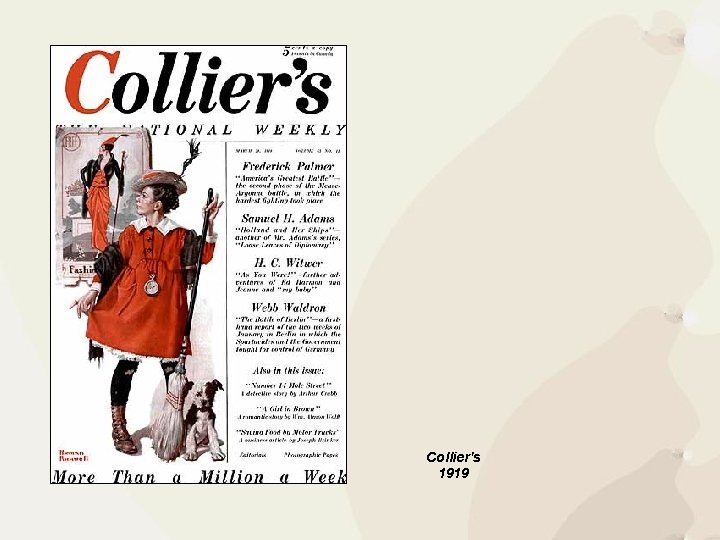
Collier's 1919
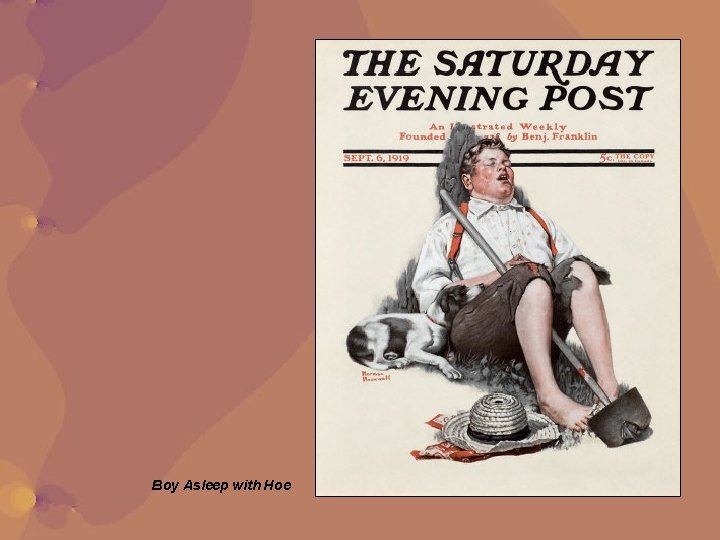
Boy Asleep with Hoe
Cover of October 1920 issue of Popular Science magazine
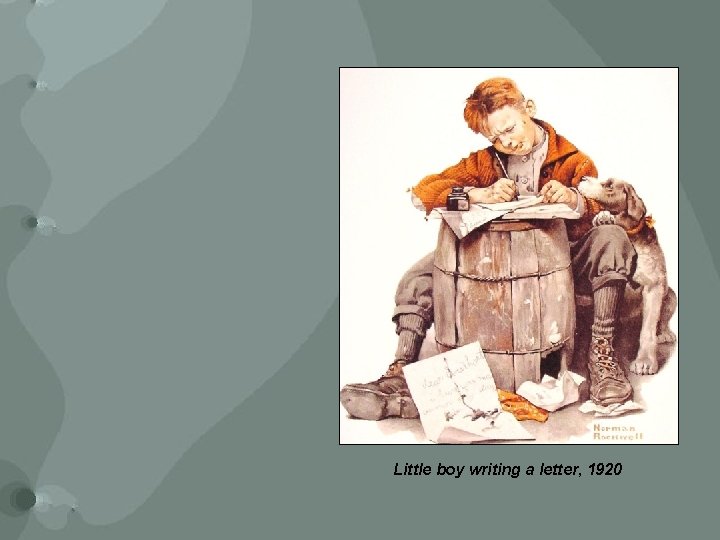
Little boy writing a letter, 1920
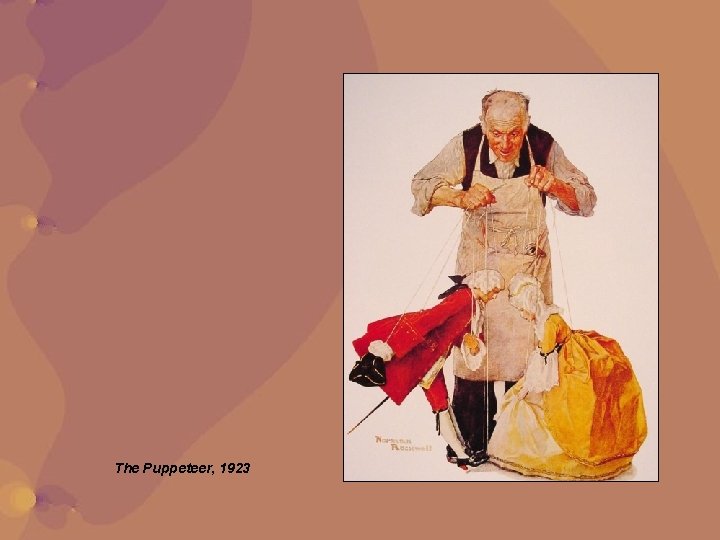
The Puppeteer, 1923
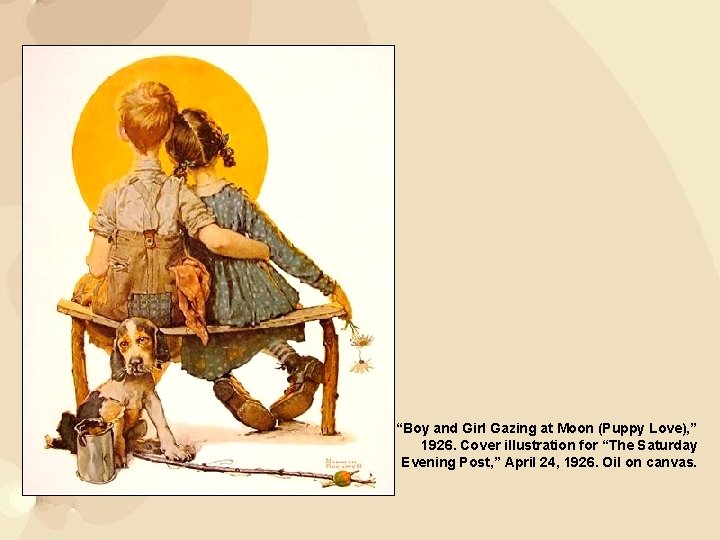
“Boy and Girl Gazing at Moon (Puppy Love), ” 1926. Cover illustration for “The Saturday Evening Post, ” April 24, 1926. Oil on canvas.
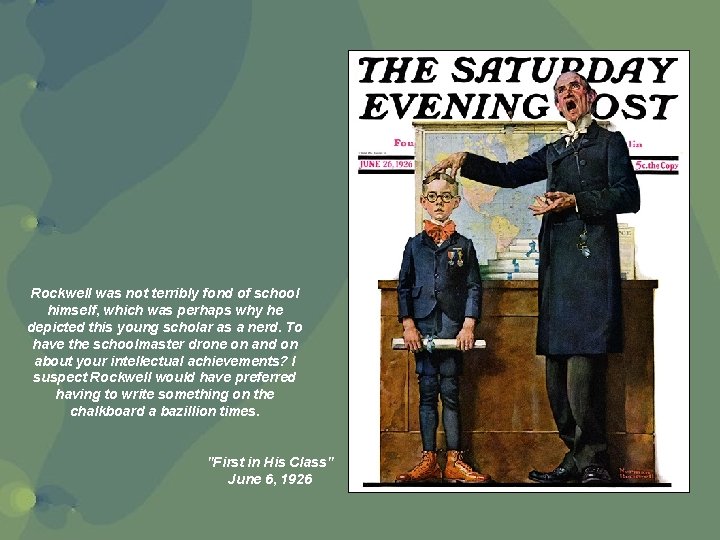
Rockwell was not terribly fond of school himself, which was perhaps why he depicted this young scholar as a nerd. To have the schoolmaster drone on and on about your intellectual achievements? I suspect Rockwell would have preferred having to write something on the chalkboard a bazillion times. "First in His Class" June 6, 1926
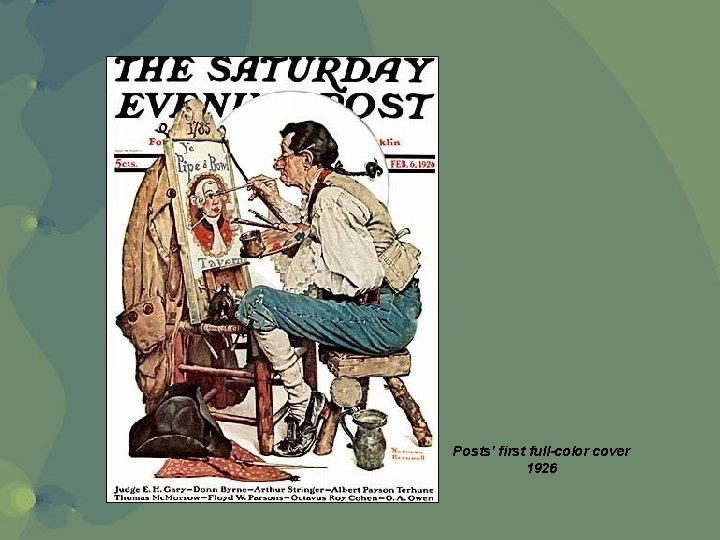
Posts' first full-color cover 1926
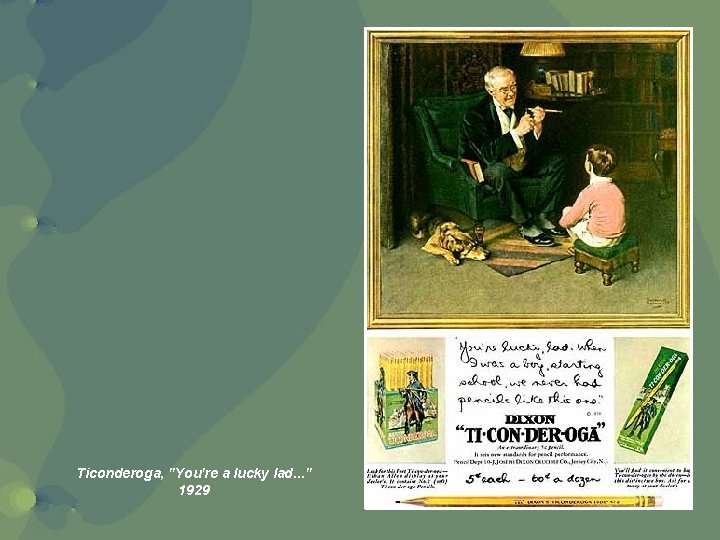
Ticonderoga, "You're a lucky lad. . . " 1929
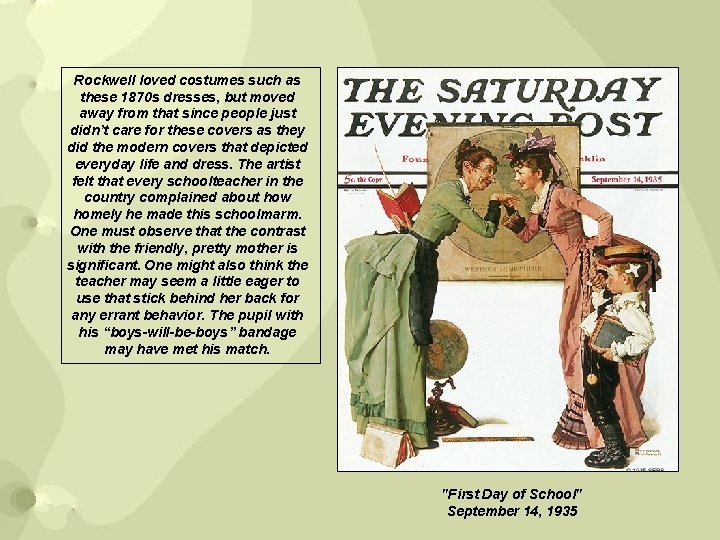
Rockwell loved costumes such as these 1870 s dresses, but moved away from that since people just didn’t care for these covers as they did the modern covers that depicted everyday life and dress. The artist felt that every schoolteacher in the country complained about how homely he made this schoolmarm. One must observe that the contrast with the friendly, pretty mother is significant. One might also think the teacher may seem a little eager to use that stick behind her back for any errant behavior. The pupil with his “boys-will-be-boys” bandage may have met his match. "First Day of School" September 14, 1935
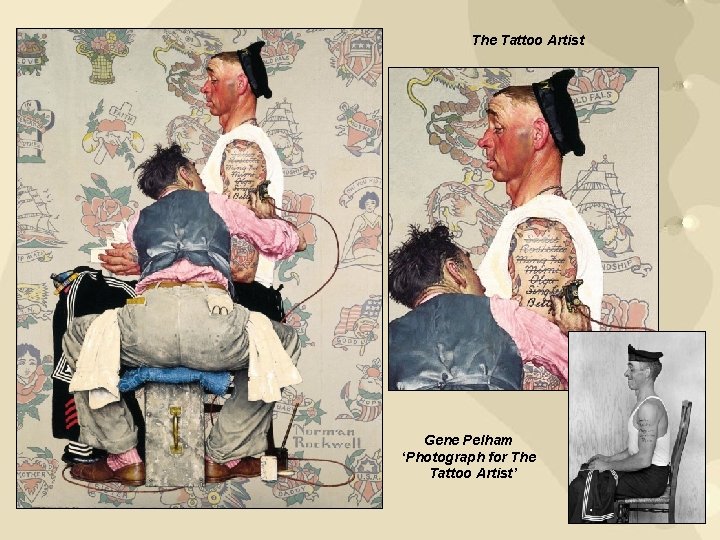
The Tattoo Artist Gene Pelham ‘Photograph for The Tattoo Artist’
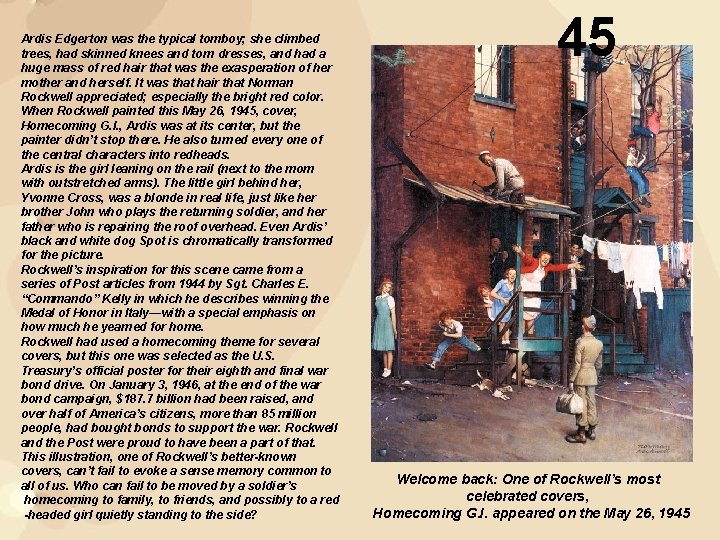
Ardis Edgerton was the typical tomboy; she climbed trees, had skinned knees and torn dresses, and had a huge mass of red hair that was the exasperation of her mother and herself. It was that hair that Norman Rockwell appreciated; especially the bright red color. When Rockwell painted this May 26, 1945, cover, Homecoming G. I. , Ardis was at its center, but the painter didn’t stop there. He also turned every one of the central characters into redheads. Ardis is the girl leaning on the rail (next to the mom with outstretched arms). The little girl behind her, Yvonne Cross, was a blonde in real life, just like her brother John who plays the returning soldier, and her father who is repairing the roof overhead. Even Ardis’ black and white dog Spot is chromatically transformed for the picture. Rockwell’s inspiration for this scene came from a series of Post articles from 1944 by Sgt. Charles E. “Commando” Kelly in which he describes winning the Medal of Honor in Italy—with a special emphasis on how much he yearned for home. Rockwell had used a homecoming theme for several covers, but this one was selected as the U. S. Treasury’s official poster for their eighth and final war bond drive. On January 3, 1946, at the end of the war bond campaign, $187. 7 billion had been raised, and over half of America’s citizens, more than 85 million people, had bought bonds to support the war. Rockwell and the Post were proud to have been a part of that. This illustration, one of Rockwell’s better-known covers, can’t fail to evoke a sense memory common to all of us. Who can fail to be moved by a soldier’s homecoming to family, to friends, and possibly to a red -headed girl quietly standing to the side? 45 Welcome back: One of Rockwell’s most celebrated covers, Homecoming G. I. appeared on the May 26, 1945
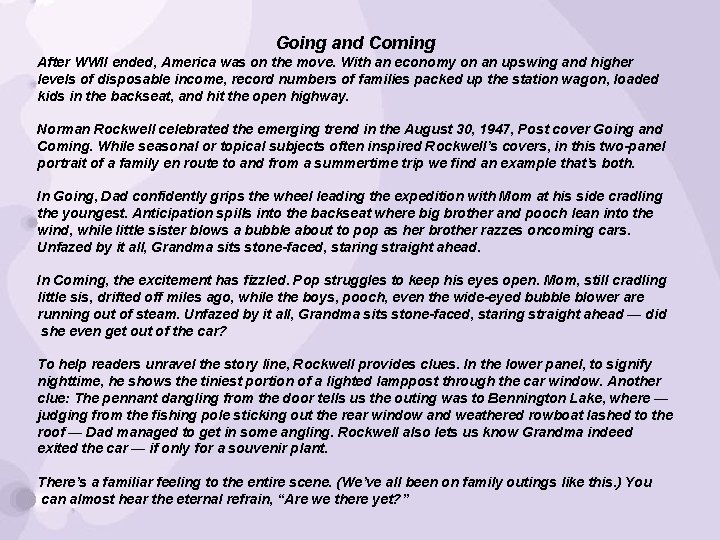
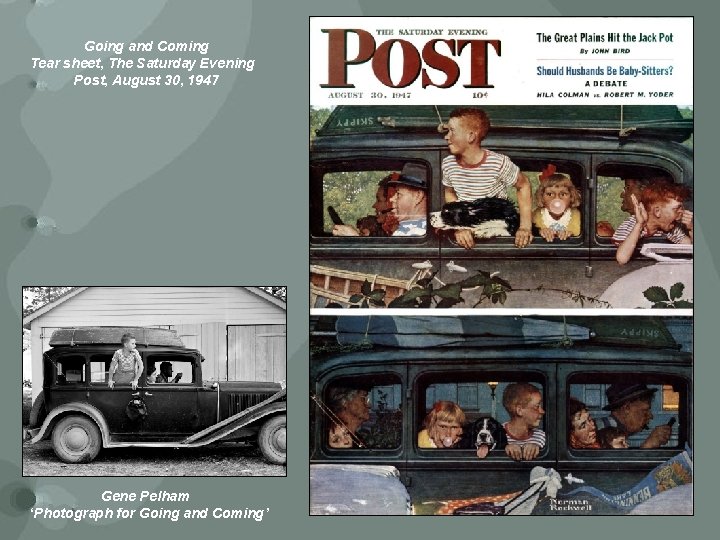
Going and Coming After WWII ended, America was on the move. With an economy on an upswing and higher levels of disposable income, record numbers of families packed up the station wagon, loaded kids in the backseat, and hit the open highway. Norman Rockwell celebrated the emerging trend in the August 30, 1947, Post cover Going and Coming. While seasonal or topical subjects often inspired Rockwell’s covers, in this two-panel portrait of a family en route to and from a summertime trip we find an example that’s both. In Going, Dad confidently grips the wheel leading the expedition with Mom at his side cradling the youngest. Anticipation spills into the backseat where big brother and pooch lean into the wind, while little sister blows a bubble about to pop as her brother razzes oncoming cars. Unfazed by it all, Grandma sits stone-faced, staring straight ahead. In Coming, the excitement has fizzled. Pop struggles to keep his eyes open. Mom, still cradling little sis, drifted off miles ago, while the boys, pooch, even the wide-eyed bubble blower are running out of steam. Unfazed by it all, Grandma sits stone-faced, staring straight ahead — did she even get out of the car? To help readers unravel the story line, Rockwell provides clues. In the lower panel, to signify nighttime, he shows the tiniest portion of a lighted lamppost through the car window. Another clue: The pennant dangling from the door tells us the outing was to Bennington Lake, where — judging from the fishing pole sticking out the rear window and weathered rowboat lashed to the roof — Dad managed to get in some angling. Rockwell also lets us know Grandma indeed exited the car — if only for a souvenir plant. There’s a familiar feeling to the entire scene. (We’ve all been on family outings like this. ) You can almost hear the eternal refrain, “Are we there yet? ”
Going and Coming Tear sheet, The Saturday Evening Post, August 30, 1947 Gene Pelham ‘Photograph for Going and Coming’
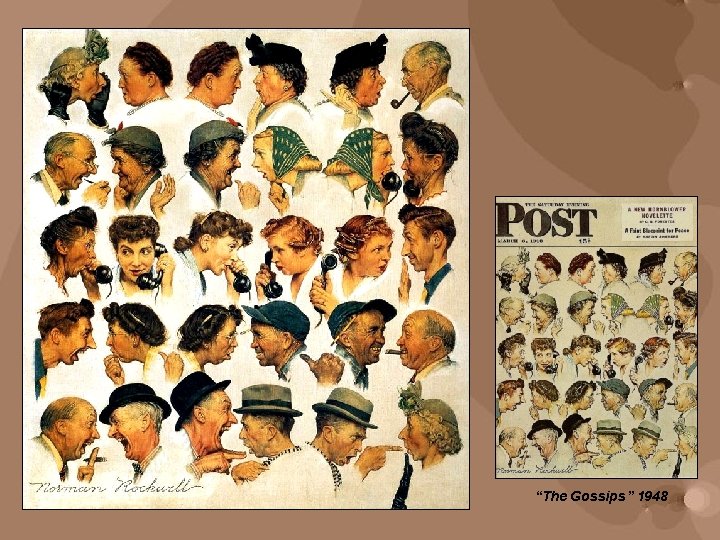
“The Gossips” 1948
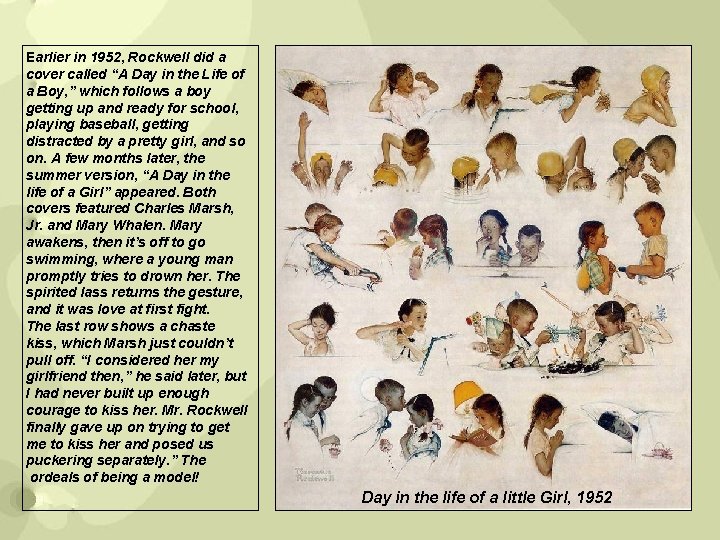
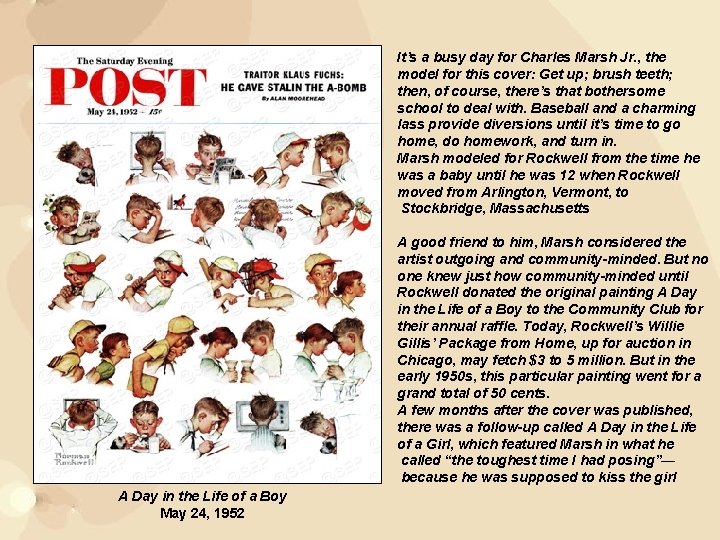
Earlier in 1952, Rockwell did a cover called “A Day in the Life of a Boy, ” which follows a boy getting up and ready for school, playing baseball, getting distracted by a pretty girl, and so on. A few months later, the summer version, “A Day in the life of a Girl” appeared. Both covers featured Charles Marsh, Jr. and Mary Whalen. Mary awakens, then it’s off to go swimming, where a young man promptly tries to drown her. The spirited lass returns the gesture, and it was love at first fight. The last row shows a chaste kiss, which Marsh just couldn’t pull off. “I considered her my girlfriend then, ” he said later, but I had never built up enough courage to kiss her. Mr. Rockwell finally gave up on trying to get me to kiss her and posed us puckering separately. ” The ordeals of being a model! Day in the life of a little Girl, 1952
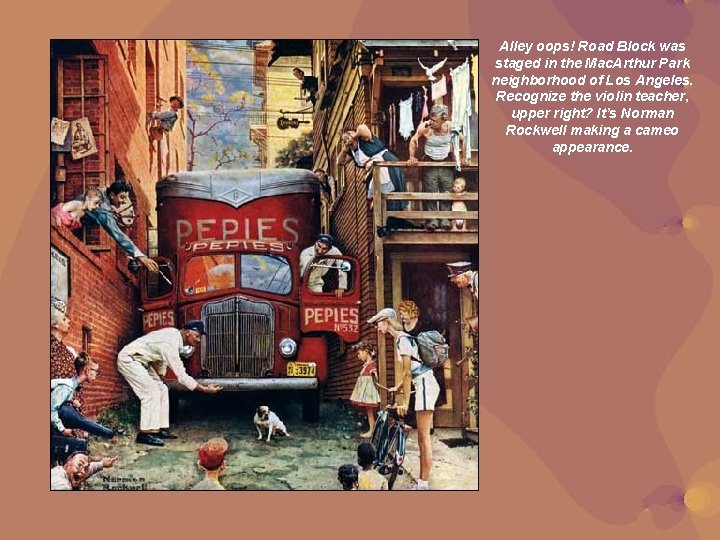
Road Block", 1949 “All the world’s a stage, and all the men and women merely players, ” wrote Shakespeare. Rings true in this urban scene starring a balky bulldog that brings the world to a halt while the supporting cast tries to coax him out of the way. In Norman Rockwell’s Road Block that appeared on the July 9, 1949, issue of the Post, we see the great American visual storyteller at his best. With only a split second to reach his audience on newsstands, Rockwell understood that every cover had to deliver an entire narrative in a flash. And as filmmaker George Lucas noted, Rockwell was a true master “at telling a story in one frame. ” Like a great movie director, Rockwell instinctively knew how to orchestrate each frame for maximum impact — casting models, directing each character’s pose and facial expression, positioning props, and capturing the best lighting for optimal effect. In the late ’ 30 s, Rockwell began using photographs to develop his compositions, at times selecting elements from as many as 100 photographs into color sketches and pencil drawings before painting the final canvas. Nothing is accidental in a Rockwell painting. Employing a pyramidal composition, Rockwell directs the attention of all 20 figures in the painting — and ours — to the central character. The artist’s pointed brush, a window washer’s downward glance, the pet owner’s distraught expression on the balcony, bicyclist and postman on standby, neighborhood kids facing forward, and of course the delayed driver’s urgent pleas, every detail meticulously selected and rendered to capture the viewer’s attention. In a flash, we get it — no explanation required. George Lucas was right. For Rockwell, one frame was all he needed.
Alley oops! Road Block was staged in the Mac. Arthur Park neighborhood of Los Angeles. Recognize the violin teacher, upper right? It’s Norman Rockwell making a cameo appearance.
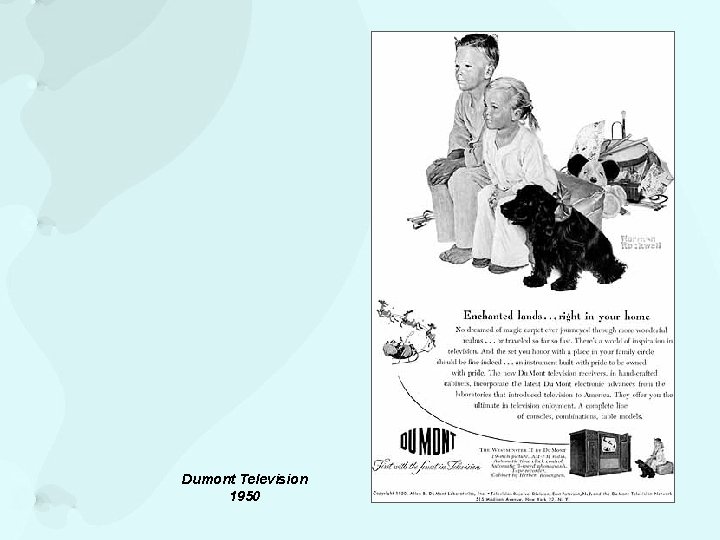
Dumont Television 1950
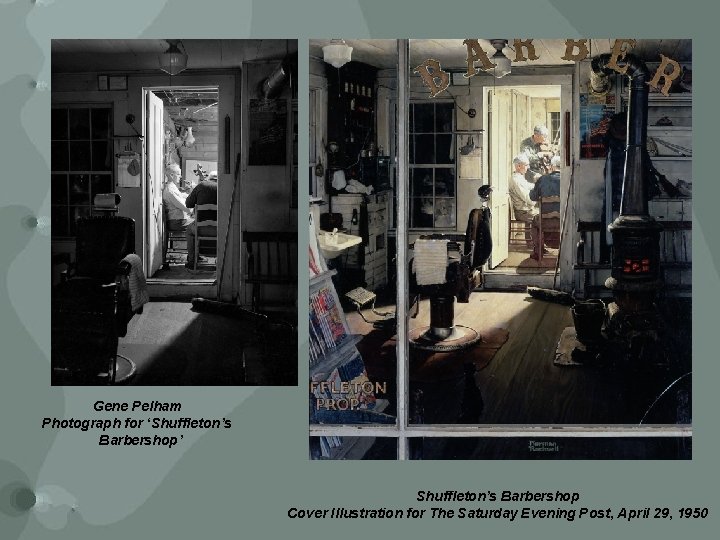
Gene Pelham Photograph for ‘Shuffleton’s Barbershop’ Shuffleton’s Barbershop Cover Illustration for The Saturday Evening Post, April 29, 1950
It’s a busy day for Charles Marsh Jr. , the model for this cover: Get up; brush teeth; then, of course, there’s that bothersome school to deal with. Baseball and a charming lass provide diversions until it’s time to go home, do homework, and turn in. Marsh modeled for Rockwell from the time he was a baby until he was 12 when Rockwell moved from Arlington, Vermont, to Stockbridge, Massachusetts A good friend to him, Marsh considered the artist outgoing and community-minded. But no one knew just how community-minded until Rockwell donated the original painting A Day in the Life of a Boy to the Community Club for their annual raffle. Today, Rockwell’s Willie Gillis’ Package from Home, up for auction in Chicago, may fetch $3 to 5 million. But in the early 1950 s, this particular painting went for a grand total of 50 cents. A few months after the cover was published, there was a follow-up called A Day in the Life of a Girl, which featured Marsh in what he called “the toughest time I had posing”— because he was supposed to kiss the girl A Day in the Life of a Boy May 24, 1952
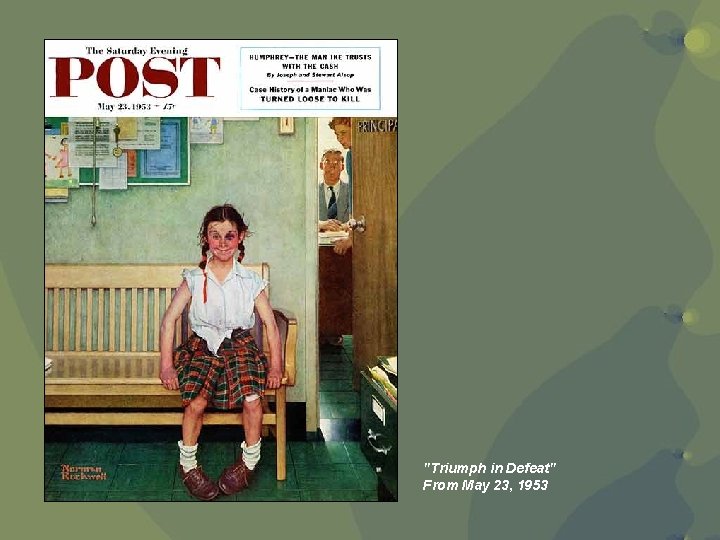
"Triumph in Defeat" From May 23, 1953
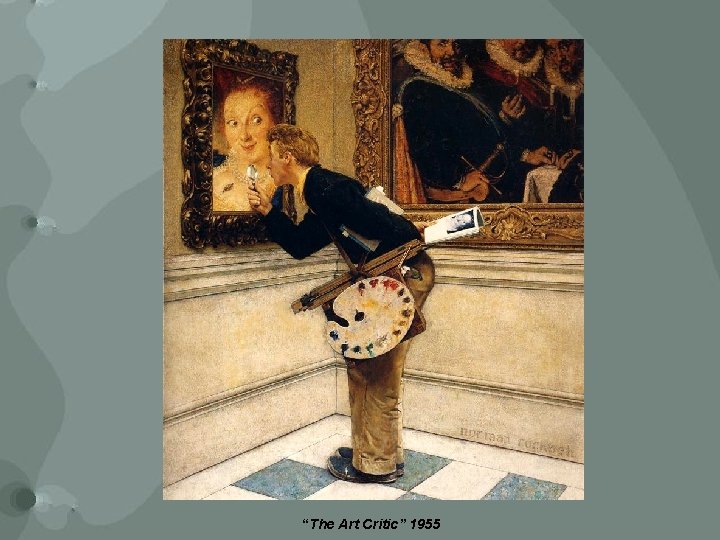
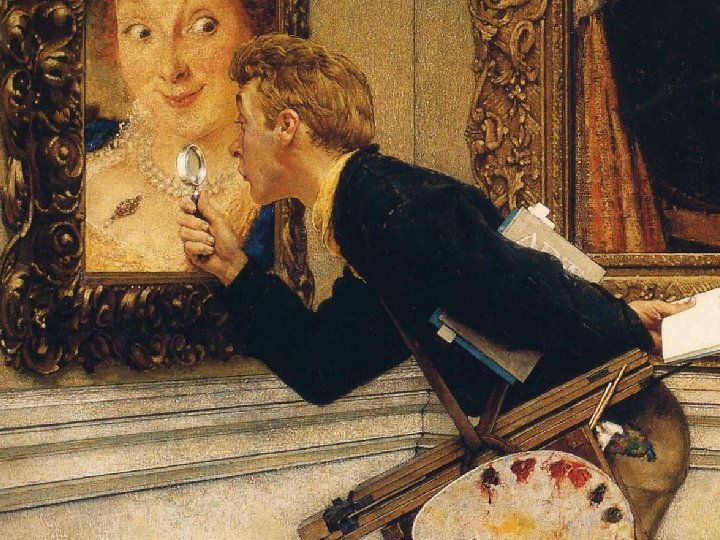
“The Art Critic” 1955
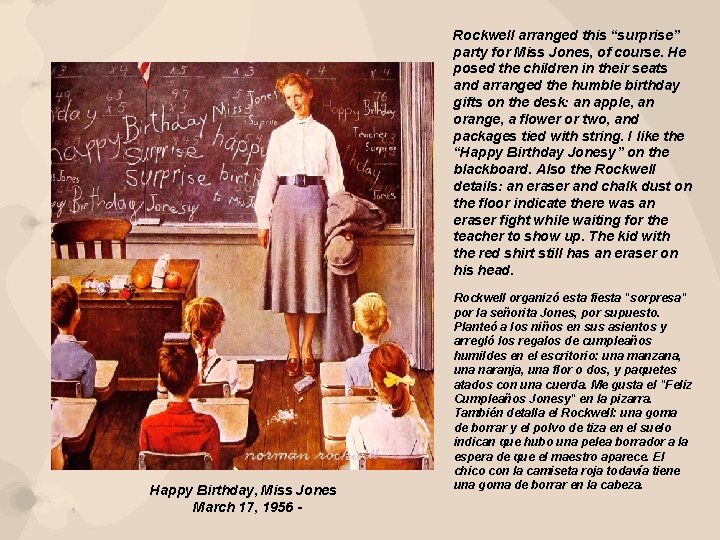
Rockwell arranged this “surprise” party for Miss Jones, of course. He posed the children in their seats and arranged the humble birthday gifts on the desk: an apple, an orange, a flower or two, and packages tied with string. I like the “Happy Birthday Jonesy” on the blackboard. Also the Rockwell details: an eraser and chalk dust on the floor indicate there was an eraser fight while waiting for the teacher to show up. The kid with the red shirt still has an eraser on his head. Happy Birthday, Miss Jones March 17, 1956 - Rockwell organizó esta fiesta "sorpresa" por la señorita Jones, por supuesto. Planteó a los niños en sus asientos y arregló los regalos de cumpleaños humildes en el escritorio: una manzana, una naranja, una flor o dos, y paquetes atados con una cuerda. Me gusta el "Feliz Cumpleaños Jonesy" en la pizarra. También detalla el Rockwell: una goma de borrar y el polvo de tiza en el suelo indican que hubo una pelea borrador a la espera de que el maestro aparece. El chico con la camiseta roja todavía tiene una goma de borrar en la cabeza.
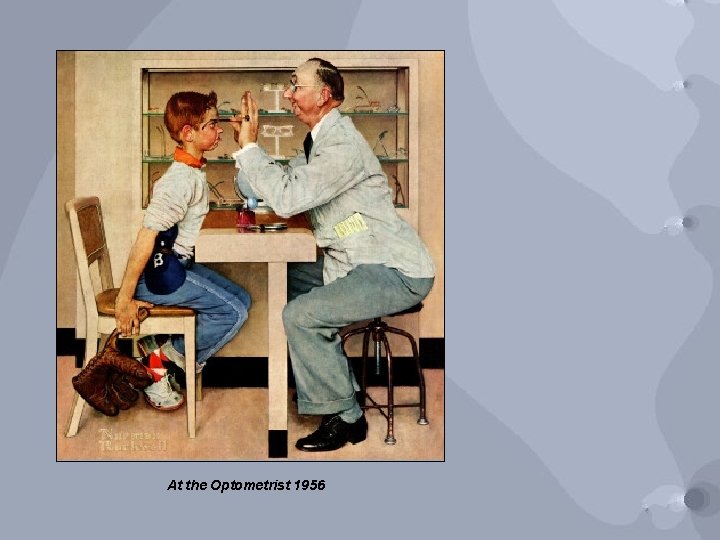
At the Optometrist 1956
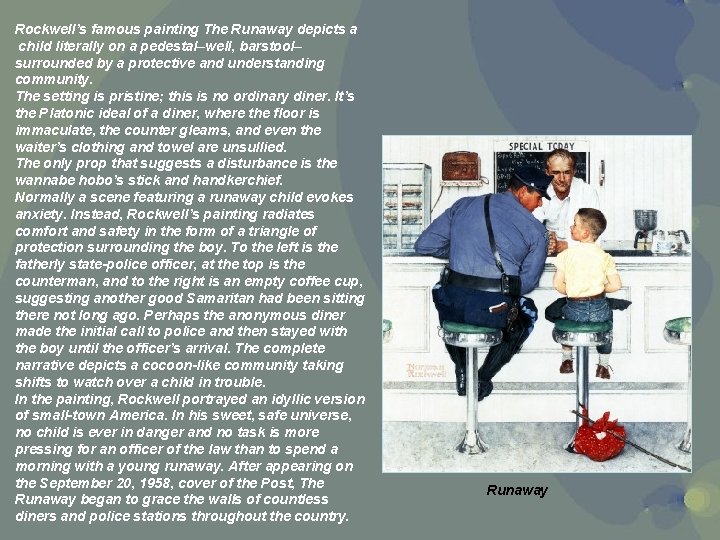
Rockwell’s famous painting The Runaway depicts a child literally on a pedestal–well, barstool– surrounded by a protective and understanding community. The setting is pristine; this is no ordinary diner. It’s the Platonic ideal of a diner, where the floor is immaculate, the counter gleams, and even the waiter’s clothing and towel are unsullied. The only prop that suggests a disturbance is the wannabe hobo’s stick and handkerchief. Normally a scene featuring a runaway child evokes anxiety. Instead, Rockwell’s painting radiates comfort and safety in the form of a triangle of protection surrounding the boy. To the left is the fatherly state-police officer, at the top is the counterman, and to the right is an empty coffee cup, suggesting another good Samaritan had been sitting there not long ago. Perhaps the anonymous diner made the initial call to police and then stayed with the boy until the officer’s arrival. The complete narrative depicts a cocoon-like community taking shifts to watch over a child in trouble. In the painting, Rockwell portrayed an idyllic version of small-town America. In his sweet, safe universe, no child is ever in danger and no task is more pressing for an officer of the law than to spend a morning with a young runaway. After appearing on the September 20, 1958, cover of the Post, The Runaway began to grace the walls of countless diners and police stations throughout the country. Runaway
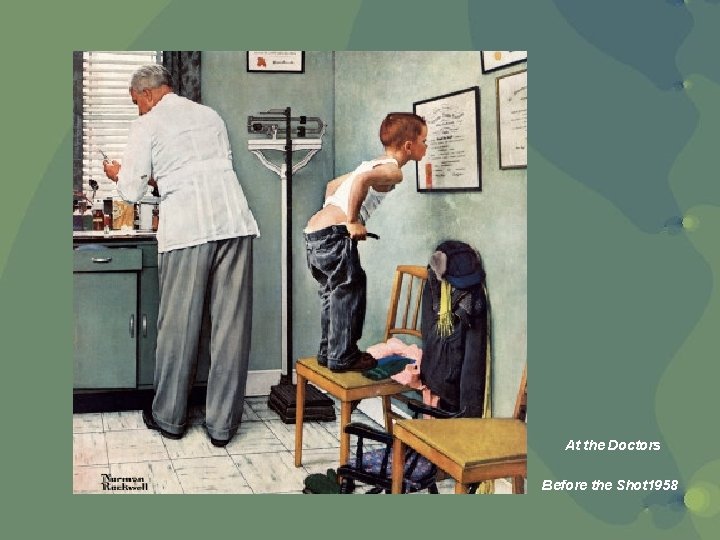
At the Doctors Before the Shot 1958
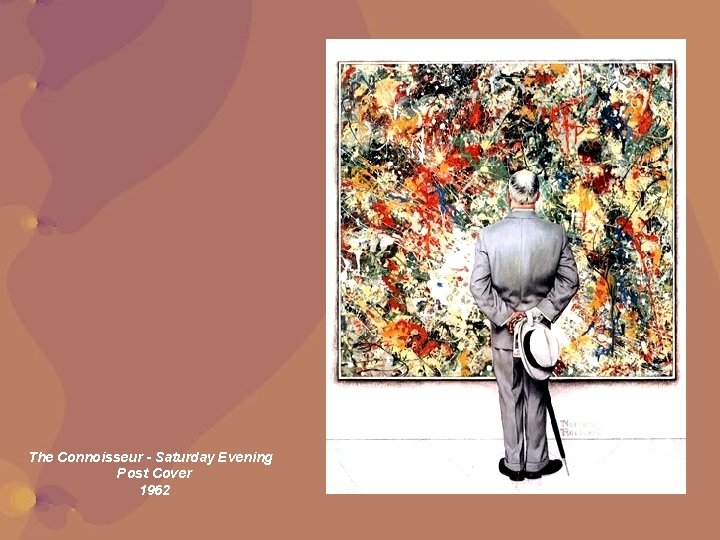
The Connoisseur - Saturday Evening Post Cover 1962
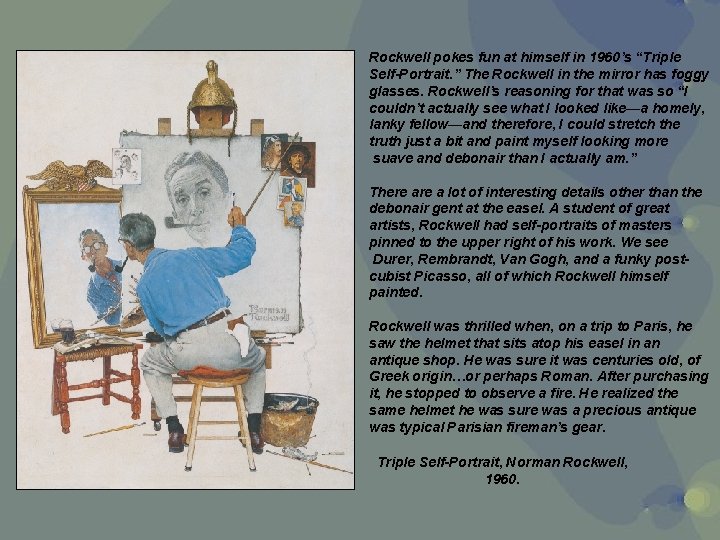
Rockwell pokes fun at himself in 1960’s “Triple Self-Portrait. ” The Rockwell in the mirror has foggy glasses. Rockwell’s reasoning for that was so “I couldn’t actually see what I looked like—a homely, lanky fellow—and therefore, I could stretch the truth just a bit and paint myself looking more suave and debonair than I actually am. ” There a lot of interesting details other than the debonair gent at the easel. A student of great artists, Rockwell had self-portraits of masters pinned to the upper right of his work. We see Durer, Rembrandt, Van Gogh, and a funky postcubist Picasso, all of which Rockwell himself painted. Rockwell was thrilled when, on a trip to Paris, he saw the helmet that sits atop his easel in an antique shop. He was sure it was centuries old, of Greek origin…or perhaps Roman. After purchasing it, he stopped to observe a fire. He realized the same helmet he was sure was a precious antique was typical Parisian fireman’s gear. Triple Self-Portrait, Norman Rockwell, 1960.
: מקורות %/https: //he. wikipedia. org/wiki http: //www. wikiart. org/en/norman-rockwell/ http: //www. wikiart. org/en/norman-rockwell http: //www. poulwebb. blogspot. co. uk/2011/03 http: //art-for-a-change. com/blog/2014/06/ https: //en. wikipedia. org/wiki/Norman_Rockwell http: //oseculoprodigioso. blogspot. co. il/2007/04 http: //www. saturdayeveningpost. com/artists http: //www. saturdayeveningpost. com/2011/08/26 ואפרים קלריטה : שלנו לאתר להיכנס מוזמנים הנכם www. clarita-efraim. com לתגובות נשמח http: //www. poulwebb. blogspot. co. uk/2011/03 http: //www. saturdayeveningpost. com/sections