
DOCSIS 3 1 Overview SCTE Piedmont Other Chapters
- Slides: 40
DOCSIS 3. 1 Overview SCTE Piedmont & Other Chapters July 31, 2014 John J. Downey – Consulting Network Engineer Cisco Systems SCTE DOCSIS 3. 1 © 2007 Cisco Systems, Inc. All rights reserved. Cisco Public 1
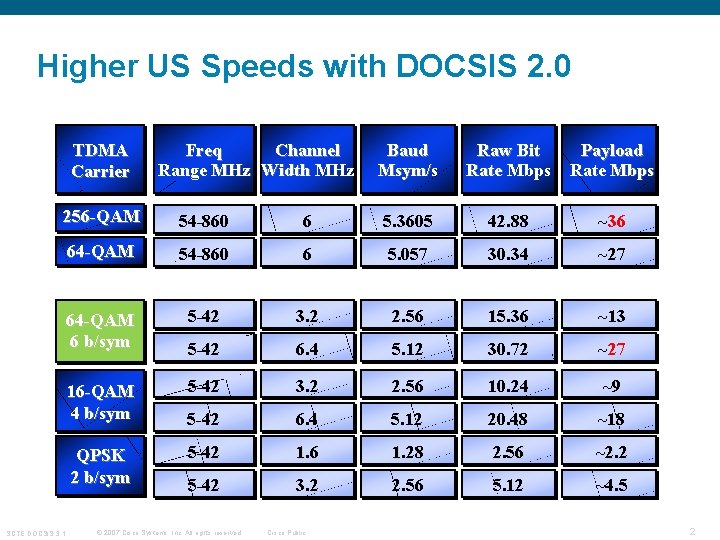
Higher US Speeds with DOCSIS 2. 0 TDMA Carrier Freq Channel Range MHz Width MHz Baud Msym/s Raw Bit Rate Mbps Payload Rate Mbps 256 -QAM 54 -860 6 5. 3605 42. 88 ~36 64 -QAM 54 -860 6 5. 057 30. 34 ~27 64 -QAM 6 b/sym 5 -42 3. 2 2. 56 15. 36 ~13 5 -42 6. 4 5. 12 30. 72 ~27 16 -QAM 4 b/sym 5 -42 3. 2 2. 56 10. 24 ~9 5 -42 6. 4 5. 12 20. 48 ~18 5 -42 1. 6 1. 28 2. 56 ~2. 2 5 -42 3. 2 2. 56 5. 12 ~4. 5 QPSK 2 b/sym SCTE DOCSIS 3. 1 © 2007 Cisco Systems, Inc. All rights reserved. Cisco Public 2
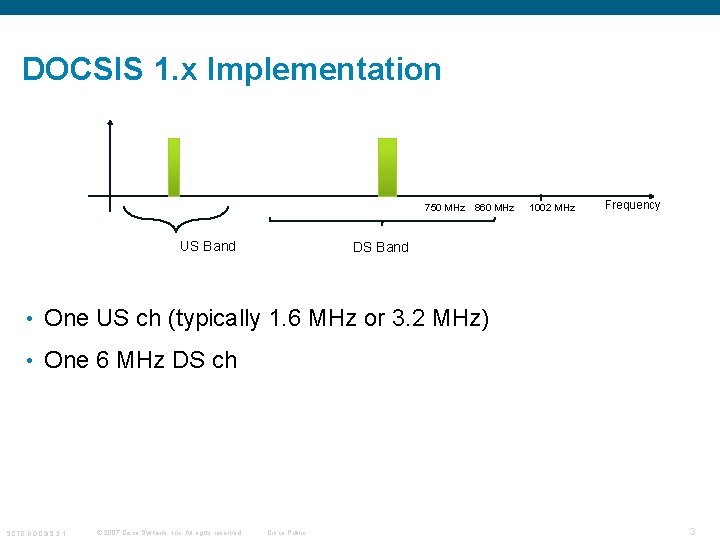
DOCSIS 1. x Implementation 750 MHz 860 MHz US Band 1002 MHz Frequency DS Band • One US ch (typically 1. 6 MHz or 3. 2 MHz) • One 6 MHz DS ch SCTE DOCSIS 3. 1 © 2007 Cisco Systems, Inc. All rights reserved. Cisco Public 3
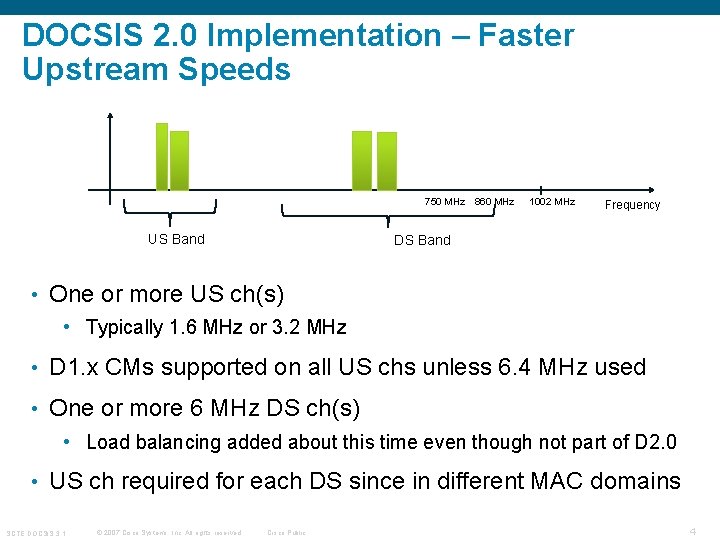
DOCSIS 2. 0 Implementation – Faster Upstream Speeds 750 MHz 860 MHz US Band 1002 MHz Frequency DS Band • One or more US ch(s) • Typically 1. 6 MHz or 3. 2 MHz • D 1. x CMs supported on all US chs unless 6. 4 MHz used • One or more 6 MHz DS ch(s) • Load balancing added about this time even though not part of D 2. 0 • US ch required for each DS since in different MAC domains SCTE DOCSIS 3. 1 © 2007 Cisco Systems, Inc. All rights reserved. Cisco Public 4
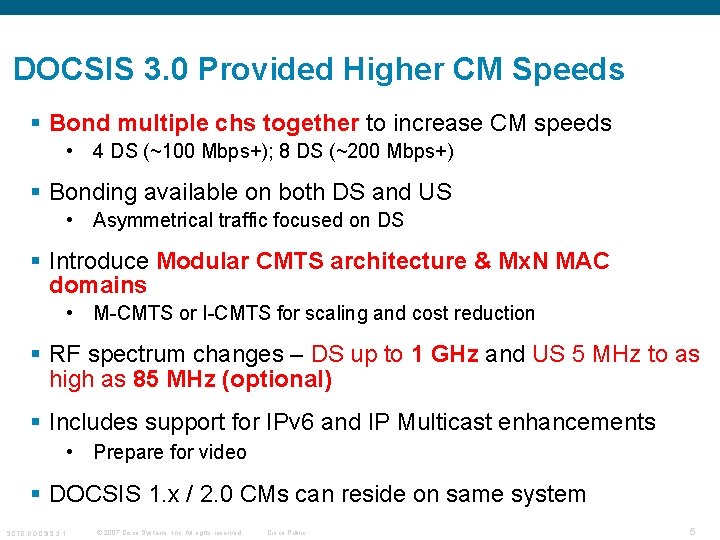
DOCSIS 3. 0 Provided Higher CM Speeds § Bond multiple chs together to increase CM speeds • 4 DS (~100 Mbps+); 8 DS (~200 Mbps+) § Bonding available on both DS and US • Asymmetrical traffic focused on DS § Introduce Modular CMTS architecture & Mx. N MAC domains • M-CMTS or I-CMTS for scaling and cost reduction § RF spectrum changes – DS up to 1 GHz and US 5 MHz to as high as 85 MHz (optional) § Includes support for IPv 6 and IP Multicast enhancements • Prepare for video § DOCSIS 1. x / 2. 0 CMs can reside on same system SCTE DOCSIS 3. 1 © 2007 Cisco Systems, Inc. All rights reserved. Cisco Public 5
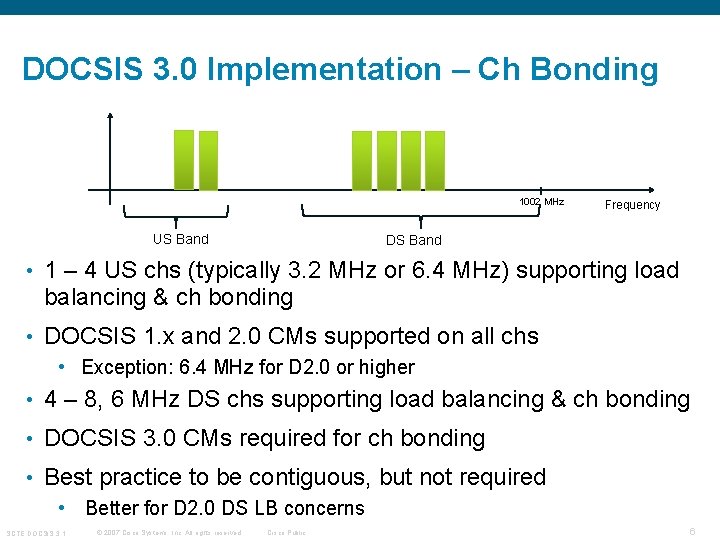
DOCSIS 3. 0 Implementation – Ch Bonding 1002 MHz US Band Frequency DS Band • 1 – 4 US chs (typically 3. 2 MHz or 6. 4 MHz) supporting load balancing & ch bonding • DOCSIS 1. x and 2. 0 CMs supported on all chs • Exception: 6. 4 MHz for D 2. 0 or higher • 4 – 8, 6 MHz DS chs supporting load balancing & ch bonding • DOCSIS 3. 0 CMs required for ch bonding • Best practice to be contiguous, but not required • Better for D 2. 0 DS LB concerns SCTE DOCSIS 3. 1 © 2007 Cisco Systems, Inc. All rights reserved. Cisco Public 6
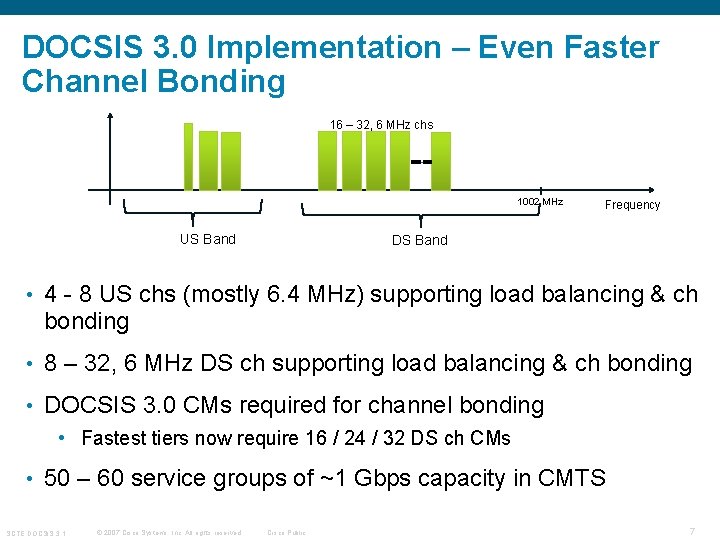
DOCSIS 3. 0 Implementation – Even Faster Channel Bonding 16 – 32, 6 MHz chs 1002 MHz US Band Frequency DS Band • 4 - 8 US chs (mostly 6. 4 MHz) supporting load balancing & ch bonding • 8 – 32, 6 MHz DS ch supporting load balancing & ch bonding • DOCSIS 3. 0 CMs required for channel bonding • Fastest tiers now require 16 / 24 / 32 DS ch CMs • 50 – 60 service groups of ~1 Gbps capacity in CMTS SCTE DOCSIS 3. 1 © 2007 Cisco Systems, Inc. All rights reserved. Cisco Public 7
DOCSIS 3. 1 SCTE DOCSIS 3. 1 © 2007 Cisco Systems, Inc. All rights reserved. 3. 1 Cisco Public 8
Goal of DOCSIS 3. 1 – Faster Speeds § Allow HFC to compete with FTTH • Especially residential where E/GPON may satisfy “cherry picking” of commercial § Achieve 10+ Gbps DS (per-CM speed) § Achieve 2+ Gbps US (per-CM speed) § Continue to be as backward compatible with existing DOCSIS standards as possible § Minimize cost SCTE DOCSIS 3. 1 © 2007 Cisco Systems, Inc. All rights reserved. Cisco Public 9
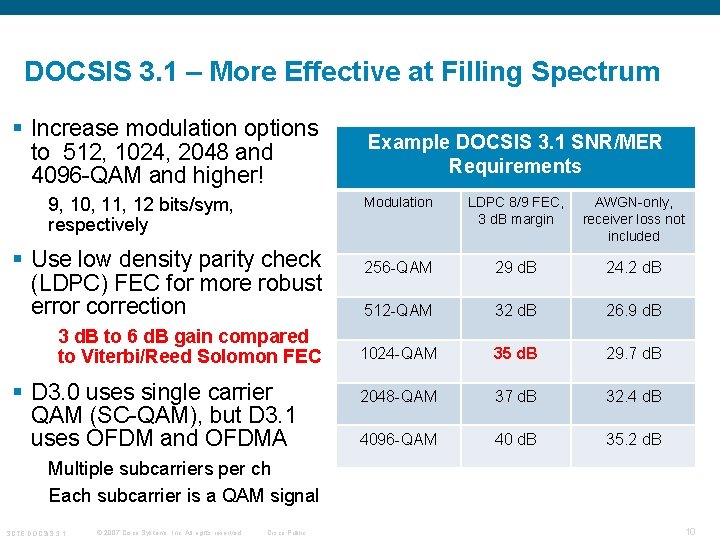
DOCSIS 3. 1 – More Effective at Filling Spectrum § Increase modulation options to 512, 1024, 2048 and 4096 -QAM and higher! 9, 10, 11, 12 bits/sym, respectively § Use low density parity check (LDPC) FEC for more robust error correction 3 d. B to 6 d. B gain compared to Viterbi/Reed Solomon FEC § D 3. 0 uses single carrier QAM (SC-QAM), but D 3. 1 uses OFDM and OFDMA Example DOCSIS 3. 1 SNR/MER Requirements Modulation LDPC 8/9 FEC, 3 d. B margin AWGN-only, receiver loss not included 256 -QAM 29 d. B 24. 2 d. B 512 -QAM 32 d. B 26. 9 d. B 1024 -QAM 35 d. B 29. 7 d. B 2048 -QAM 37 d. B 32. 4 d. B 4096 -QAM 40 d. B 35. 2 d. B Multiple subcarriers per ch Each subcarrier is a QAM signal SCTE DOCSIS 3. 1 © 2007 Cisco Systems, Inc. All rights reserved. Cisco Public 10
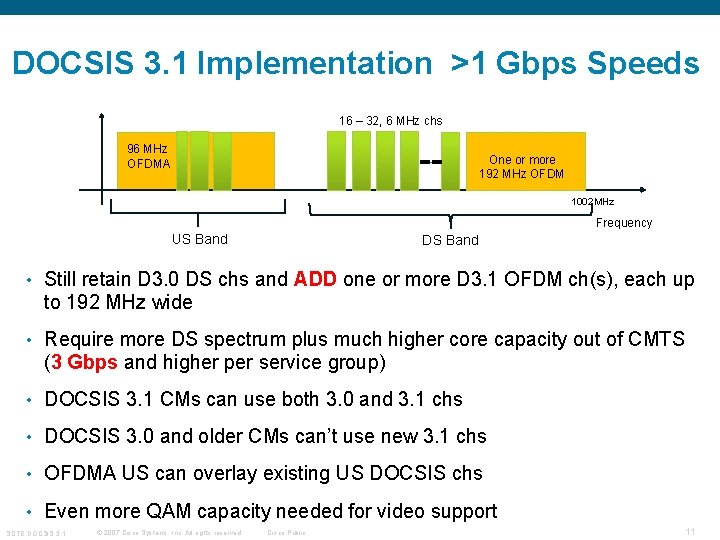
DOCSIS 3. 1 Implementation >1 Gbps Speeds 16 – 32, 6 MHz chs 96 MHz OFDMA One or more 192 MHz OFDM 1002 MHz Frequency US Band DS Band • Still retain D 3. 0 DS chs and ADD one or more D 3. 1 OFDM ch(s), each up to 192 MHz wide • Require more DS spectrum plus much higher core capacity out of CMTS (3 Gbps and higher per service group) • DOCSIS 3. 1 CMs can use both 3. 0 and 3. 1 chs • DOCSIS 3. 0 and older CMs can’t use new 3. 1 chs • OFDMA US can overlay existing US DOCSIS chs • Even more QAM capacity needed for video support SCTE DOCSIS 3. 1 © 2007 Cisco Systems, Inc. All rights reserved. Cisco Public 11
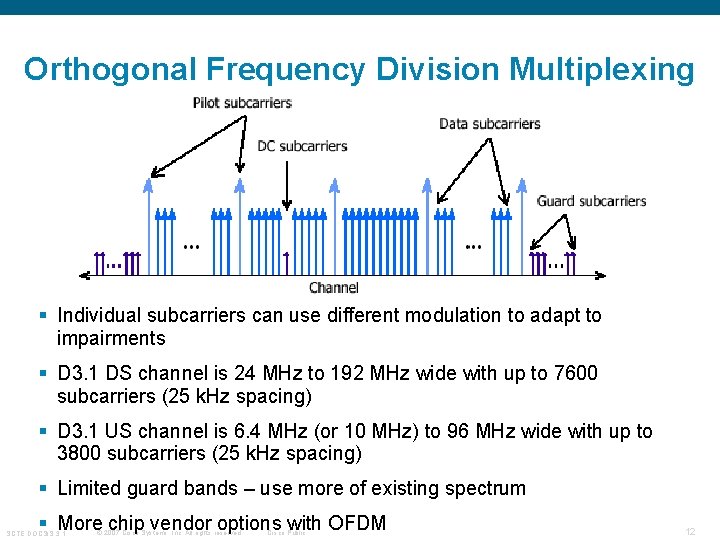
Orthogonal Frequency Division Multiplexing § Individual subcarriers can use different modulation to adapt to impairments § D 3. 1 DS channel is 24 MHz to 192 MHz wide with up to 7600 subcarriers (25 k. Hz spacing) § D 3. 1 US channel is 6. 4 MHz (or 10 MHz) to 96 MHz wide with up to 3800 subcarriers (25 k. Hz spacing) § Limited guard bands – use more of existing spectrum § More chip vendor options with OFDM SCTE DOCSIS 3. 1 © 2007 Cisco Systems, Inc. All rights reserved. Cisco Public 12
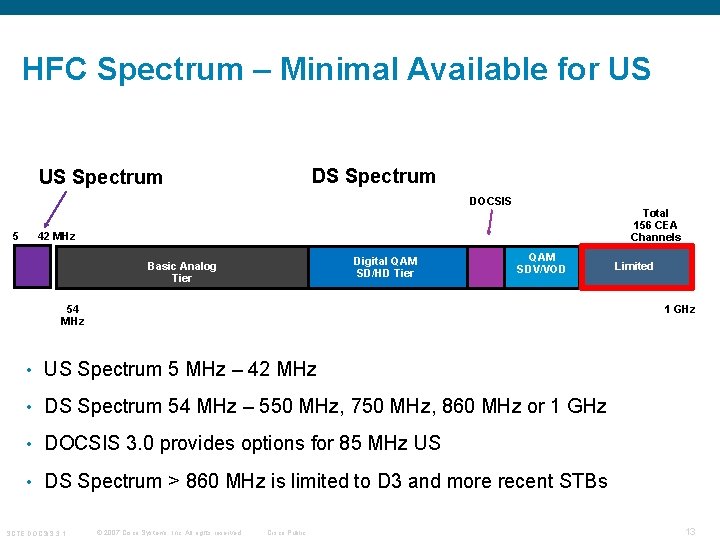
HFC Spectrum – Minimal Available for US DS Spectrum US Spectrum DOCSIS 5 Total 156 CEA Channels 42 MHz Digital QAM SD/HD Tier Basic Analog Tier QAM SDV/VOD Limited 1 GHz 54 MHz • US Spectrum 5 MHz – 42 MHz • DS Spectrum 54 MHz – 550 MHz, 750 MHz, 860 MHz or 1 GHz • DOCSIS 3. 0 provides options for 85 MHz US • DS Spectrum > 860 MHz is limited to D 3 and more recent STBs SCTE DOCSIS 3. 1 © 2007 Cisco Systems, Inc. All rights reserved. Cisco Public 13
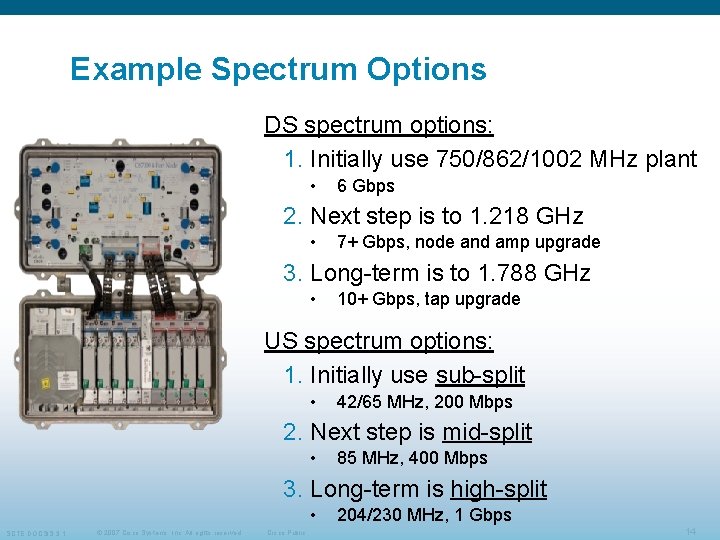
Example Spectrum Options DS spectrum options: 1. Initially use 750/862/1002 MHz plant • 6 Gbps 2. Next step is to 1. 218 GHz • 7+ Gbps, node and amp upgrade 3. Long-term is to 1. 788 GHz • 10+ Gbps, tap upgrade US spectrum options: 1. Initially use sub-split • 42/65 MHz, 200 Mbps 2. Next step is mid-split • 85 MHz, 400 Mbps 3. Long-term is high-split • SCTE DOCSIS 3. 1 © 2007 Cisco Systems, Inc. All rights reserved. Cisco Public 204/230 MHz, 1 Gbps 14
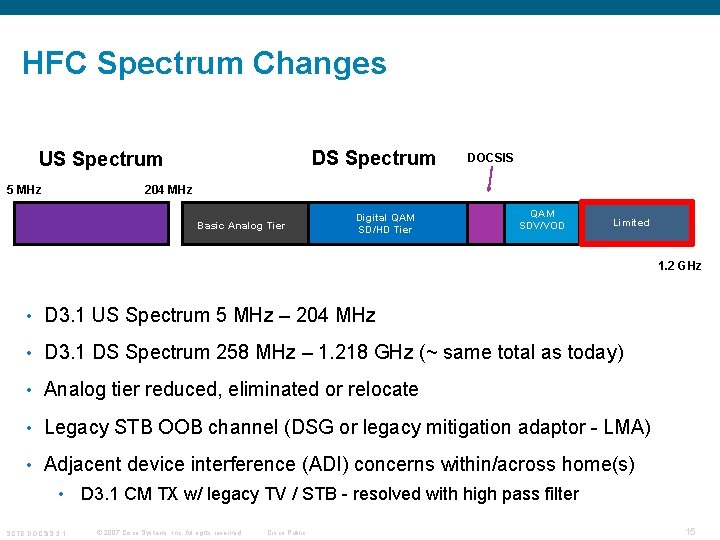
HFC Spectrum Changes DS Spectrum US Spectrum 5 MHz DOCSIS 204 MHz Basic Analog Tier Digital QAM SD/HD Tier QAM SDV/VOD Limited 1. 2 GHz • D 3. 1 US Spectrum 5 MHz – 204 MHz • D 3. 1 DS Spectrum 258 MHz – 1. 218 GHz (~ same total as today) • Analog tier reduced, eliminated or relocate • Legacy STB OOB channel (DSG or legacy mitigation adaptor - LMA) • Adjacent device interference (ADI) concerns within/across home(s) • D 3. 1 CM TX w/ legacy TV / STB - resolved with high pass filter SCTE DOCSIS 3. 1 © 2007 Cisco Systems, Inc. All rights reserved. Cisco Public 15
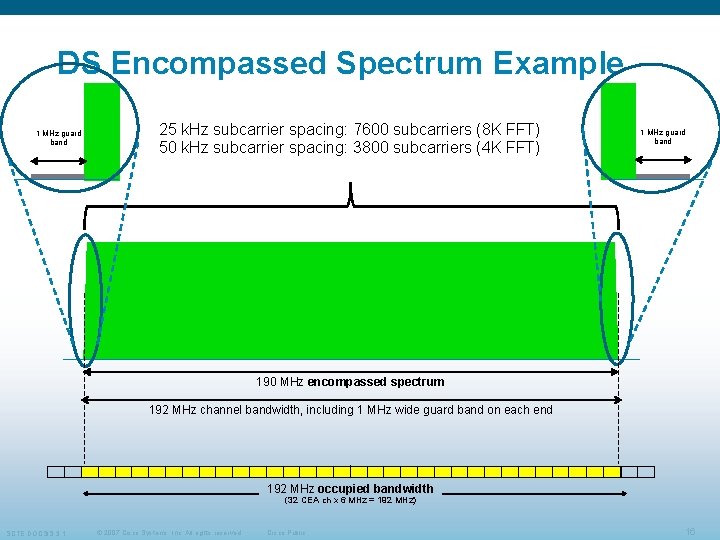
DS Encompassed Spectrum Example 1 MHz guard band 25 k. Hz subcarrier spacing: 7600 subcarriers (8 K FFT) 50 k. Hz subcarrier spacing: 3800 subcarriers (4 K FFT) 1 MHz guard band 190 MHz encompassed spectrum 192 MHz channel bandwidth, including 1 MHz wide guard band on each end 192 MHz occupied bandwidth (32 CEA ch x 6 MHz = 192 MHz) SCTE DOCSIS 3. 1 © 2007 Cisco Systems, Inc. All rights reserved. Cisco Public 16
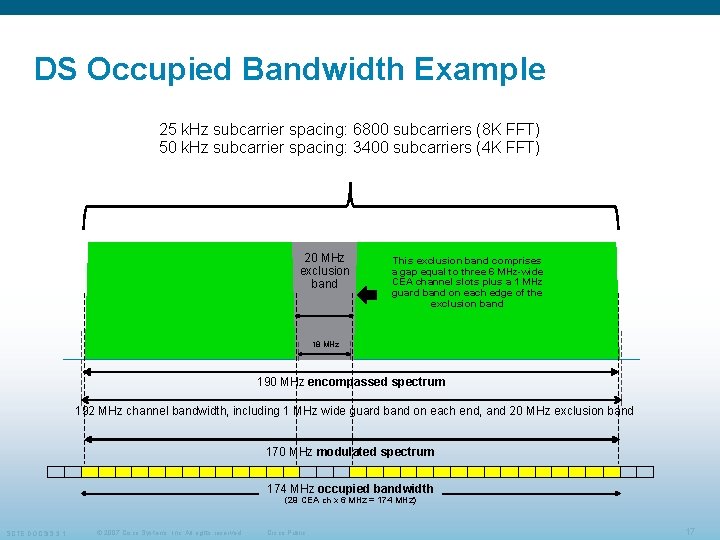
DS Occupied Bandwidth Example 25 k. Hz subcarrier spacing: 6800 subcarriers (8 K FFT) 50 k. Hz subcarrier spacing: 3400 subcarriers (4 K FFT) 20 MHz exclusion band This exclusion band comprises a gap equal to three 6 MHz-wide CEA channel slots plus a 1 MHz guard band on each edge of the exclusion band 18 MHz 190 MHz encompassed spectrum 192 MHz channel bandwidth, including 1 MHz wide guard band on each end, and 20 MHz exclusion band 170 MHz modulated spectrum 174 MHz occupied bandwidth (29 CEA ch x 6 MHz = 174 MHz) SCTE DOCSIS 3. 1 © 2007 Cisco Systems, Inc. All rights reserved. Cisco Public 17
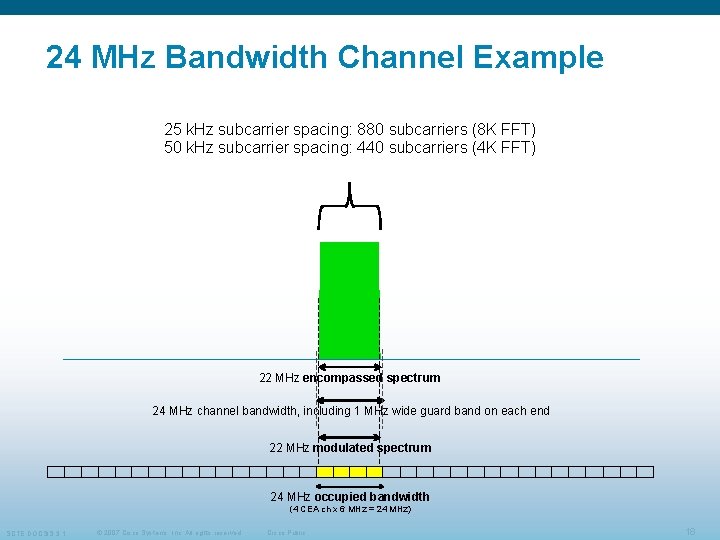
24 MHz Bandwidth Channel Example 25 k. Hz subcarrier spacing: 880 subcarriers (8 K FFT) 50 k. Hz subcarrier spacing: 440 subcarriers (4 K FFT) 22 MHz encompassed spectrum 24 MHz channel bandwidth, including 1 MHz wide guard band on each end 22 MHz modulated spectrum 24 MHz occupied bandwidth (4 CEA ch x 6 MHz = 24 MHz) SCTE DOCSIS 3. 1 © 2007 Cisco Systems, Inc. All rights reserved. Cisco Public 18
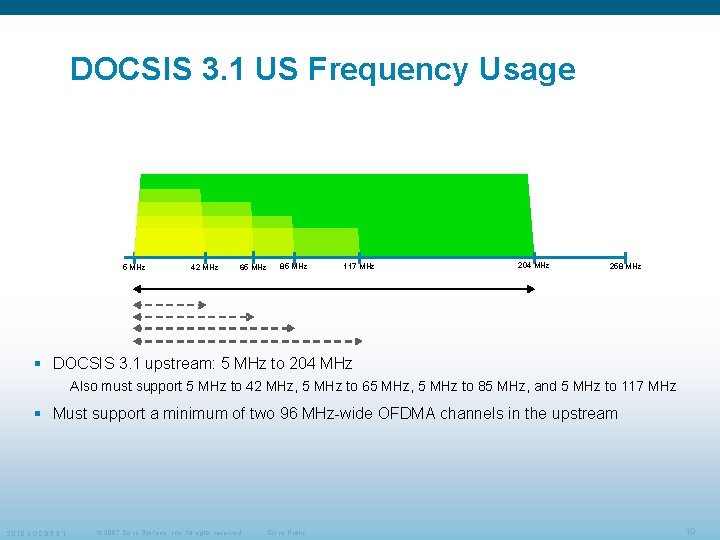
DOCSIS 3. 1 US Frequency Usage 5 MHz 42 MHz 65 MHz 85 MHz 117 MHz 204 MHz 258 MHz § DOCSIS 3. 1 upstream: 5 MHz to 204 MHz Also must support 5 MHz to 42 MHz, 5 MHz to 65 MHz, 5 MHz to 85 MHz, and 5 MHz to 117 MHz § Must support a minimum of two 96 MHz-wide OFDMA channels in the upstream SCTE DOCSIS 3. 1 © 2007 Cisco Systems, Inc. All rights reserved. Cisco Public 19
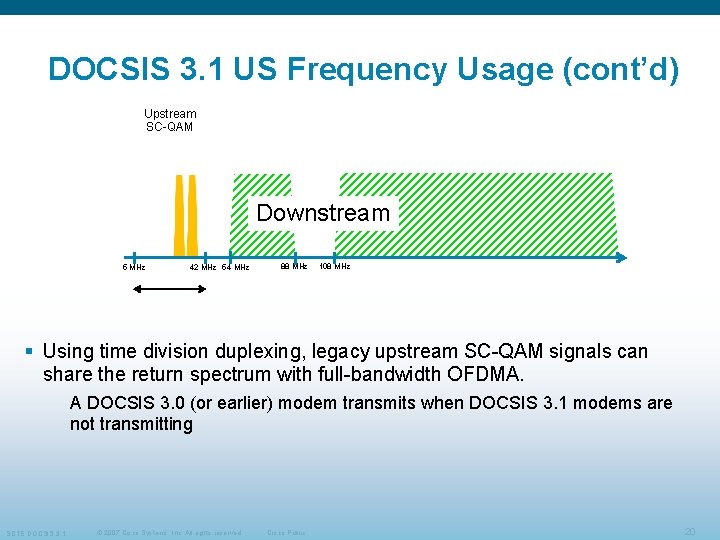
DOCSIS 3. 1 US Frequency Usage (cont’d) Upstream SC-QAM Downstream 5 MHz 42 MHz 54 MHz 88 MHz 108 MHz § Using time division duplexing, legacy upstream SC-QAM signals can share the return spectrum with full-bandwidth OFDMA. A DOCSIS 3. 0 (or earlier) modem transmits when DOCSIS 3. 1 modems are not transmitting SCTE DOCSIS 3. 1 © 2007 Cisco Systems, Inc. All rights reserved. Cisco Public 20
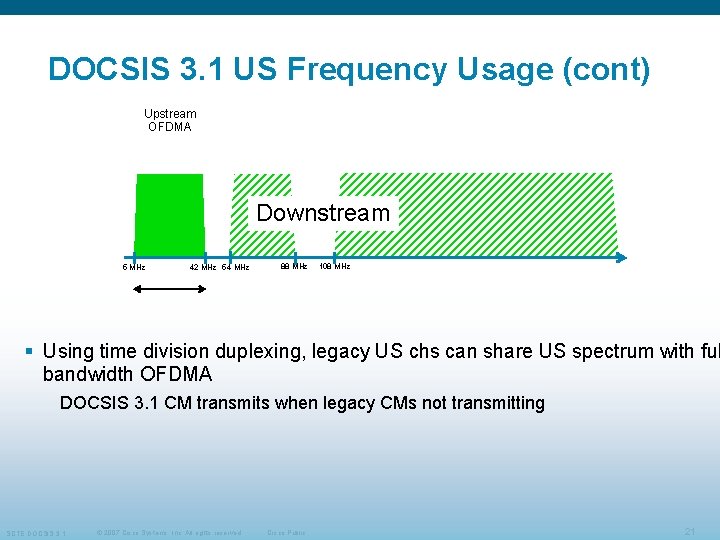
DOCSIS 3. 1 US Frequency Usage (cont) Upstream OFDMA Downstream 5 MHz 42 MHz 54 MHz 88 MHz 108 MHz § Using time division duplexing, legacy US chs can share US spectrum with ful bandwidth OFDMA DOCSIS 3. 1 CM transmits when legacy CMs not transmitting SCTE DOCSIS 3. 1 © 2007 Cisco Systems, Inc. All rights reserved. Cisco Public 21
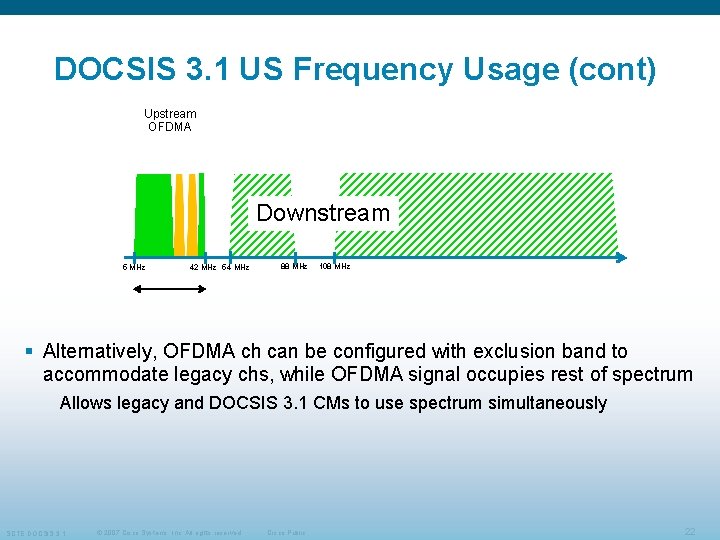
DOCSIS 3. 1 US Frequency Usage (cont) Upstream OFDMA Downstream 5 MHz 42 MHz 54 MHz 88 MHz 108 MHz § Alternatively, OFDMA ch can be configured with exclusion band to accommodate legacy chs, while OFDMA signal occupies rest of spectrum Allows legacy and DOCSIS 3. 1 CMs to use spectrum simultaneously SCTE DOCSIS 3. 1 © 2007 Cisco Systems, Inc. All rights reserved. Cisco Public 22
MER for OFDM § Each subcarrier has its own MER § Thus challenges in how to track MER for OFDM ch § One possibility is to track average MER across ch § Another option is to track bandwidth efficiency for ch (percentage of theoretical efficiency) SCTE DOCSIS 3. 1 © 2007 Cisco Systems, Inc. All rights reserved. Cisco Public 23
DOCSIS 3. 1 DS Targets • 1024 -QAM target modulation with spec out to 16384 -QAM • If DS 256 -QAM works today, D 3. 1 1024 -QAM with LDPC should work with no changes to the plant • D 3. 1 CMs will work with both legacy SC-QAM & OFDM • Target same SNR requirements as existing DOCSIS • LDPC more effective at error correction • Bonding between SC-QAM and OFDM if required • Plant conditions can vary by location • Can have multiple modulation profiles SCTE DOCSIS 3. 1 © 2007 Cisco Systems, Inc. All rights reserved. Cisco Public 24
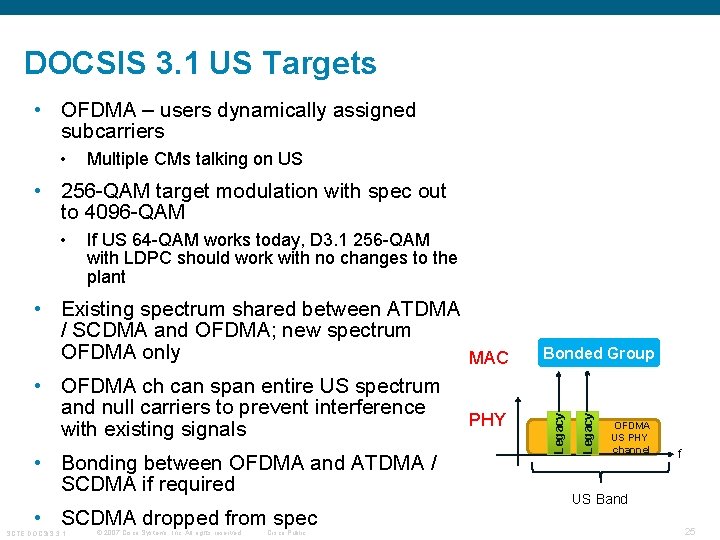
DOCSIS 3. 1 US Targets • OFDMA – users dynamically assigned subcarriers • Multiple CMs talking on US • 256 -QAM target modulation with spec out to 4096 -QAM If US 64 -QAM works today, D 3. 1 256 -QAM with LDPC should work with no changes to the plant • Bonding between OFDMA and ATDMA / SCDMA if required • SCDMA dropped from spec SCTE DOCSIS 3. 1 © 2007 Cisco Systems, Inc. All rights reserved. Cisco Public Bonded Group Legacy • Existing spectrum shared between ATDMA / SCDMA and OFDMA; new spectrum OFDMA only MAC • OFDMA ch can span entire US spectrum and null carriers to prevent interference PHY with existing signals Legacy • OFDMA US PHY channel f US Band 25
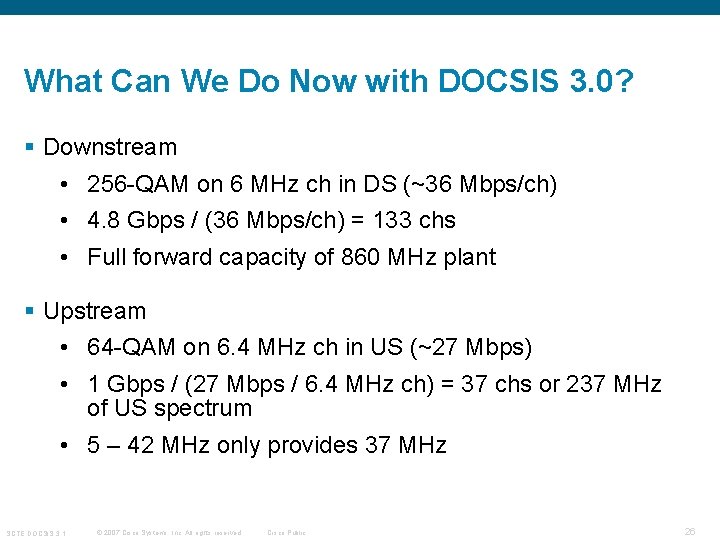
What Can We Do Now with DOCSIS 3. 0? § Downstream • 256 -QAM on 6 MHz ch in DS (~36 Mbps/ch) • 4. 8 Gbps / (36 Mbps/ch) = 133 chs • Full forward capacity of 860 MHz plant § Upstream • 64 -QAM on 6. 4 MHz ch in US (~27 Mbps) • 1 Gbps / (27 Mbps / 6. 4 MHz ch) = 37 chs or 237 MHz of US spectrum • 5 – 42 MHz only provides 37 MHz SCTE DOCSIS 3. 1 © 2007 Cisco Systems, Inc. All rights reserved. Cisco Public 26
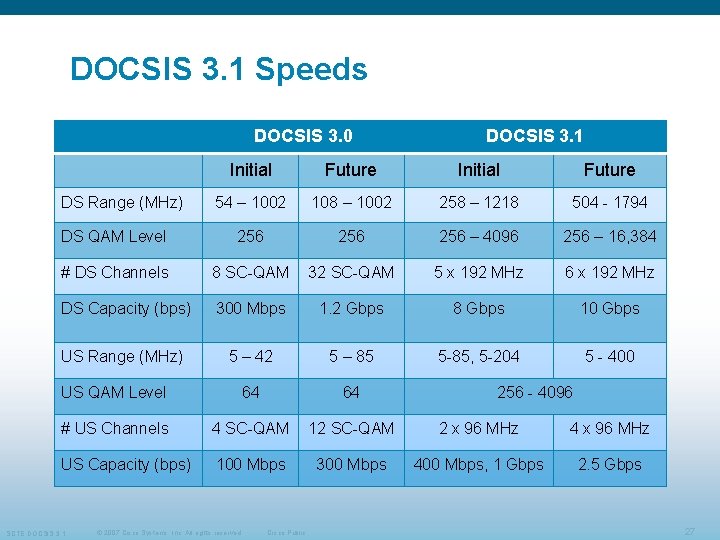
DOCSIS 3. 1 Speeds DOCSIS 3. 0 DOCSIS 3. 1 Initial Future 54 – 1002 108 – 1002 258 – 1218 504 - 1794 DS QAM Level 256 256 – 4096 256 – 16, 384 # DS Channels 8 SC-QAM 32 SC-QAM 5 x 192 MHz 6 x 192 MHz DS Capacity (bps) 300 Mbps 1. 2 Gbps 8 Gbps 10 Gbps US Range (MHz) 5 – 42 5 – 85 5 -85, 5 -204 5 - 400 US QAM Level 64 64 # US Channels 4 SC-QAM 12 SC-QAM 2 x 96 MHz 4 x 96 MHz US Capacity (bps) 100 Mbps 300 Mbps 400 Mbps, 1 Gbps 2. 5 Gbps DS Range (MHz) SCTE DOCSIS 3. 1 © 2007 Cisco Systems, Inc. All rights reserved. Cisco Public 256 - 4096 27
Profile Management CM § Reports MER and receive power of each subcarrier § Can test its ability to receive unused profiles and report result CMTS § Updates and publishes profiles § Assigns CMs to profiles SCTE DOCSIS 3. 1 © 2007 Cisco Systems, Inc. All rights reserved. Cisco Public 28
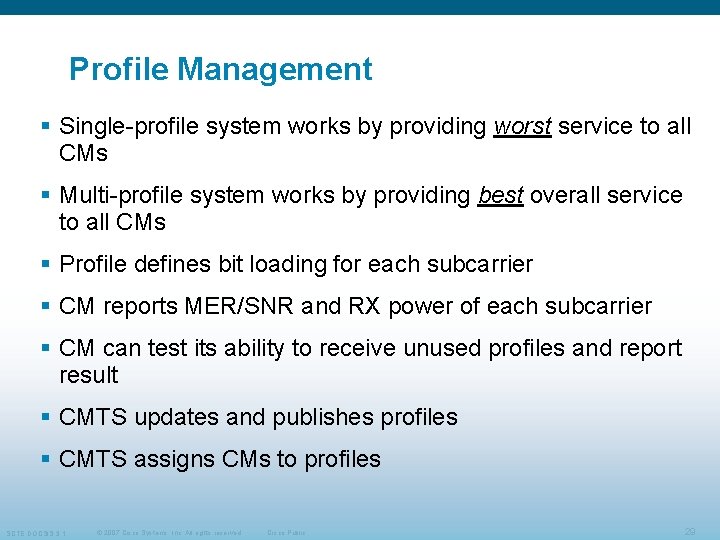
Profile Management § Single-profile system works by providing worst service to all CMs § Multi-profile system works by providing best overall service to all CMs § Profile defines bit loading for each subcarrier § CM reports MER/SNR and RX power of each subcarrier § CM can test its ability to receive unused profiles and report result § CMTS updates and publishes profiles § CMTS assigns CMs to profiles SCTE DOCSIS 3. 1 © 2007 Cisco Systems, Inc. All rights reserved. Cisco Public 29
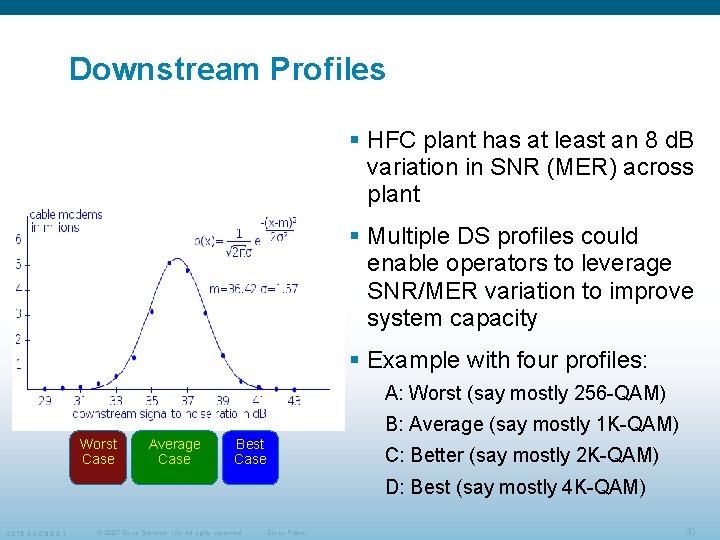
Downstream Profiles § HFC plant has at least an 8 d. B variation in SNR (MER) across plant § Multiple DS profiles could enable operators to leverage SNR/MER variation to improve system capacity § Example with four profiles: A: Worst (say mostly 256 -QAM) B: Average (say mostly 1 K-QAM) Worst Case Average Case Best Case C: Better (say mostly 2 K-QAM) D: Best (say mostly 4 K-QAM) SCTE DOCSIS 3. 1 © 2007 Cisco Systems, Inc. All rights reserved. Cisco Public 30
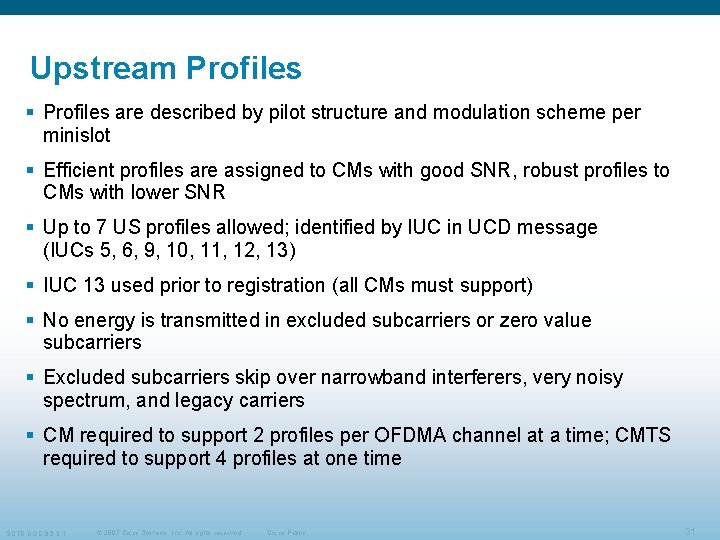
Upstream Profiles § Profiles are described by pilot structure and modulation scheme per minislot § Efficient profiles are assigned to CMs with good SNR, robust profiles to CMs with lower SNR § Up to 7 US profiles allowed; identified by IUC in UCD message (IUCs 5, 6, 9, 10, 11, 12, 13) § IUC 13 used prior to registration (all CMs must support) § No energy is transmitted in excluded subcarriers or zero value subcarriers § Excluded subcarriers skip over narrowband interferers, very noisy spectrum, and legacy carriers § CM required to support 2 profiles per OFDMA channel at a time; CMTS required to support 4 profiles at one time SCTE DOCSIS 3. 1 © 2007 Cisco Systems, Inc. All rights reserved. Cisco Public 31
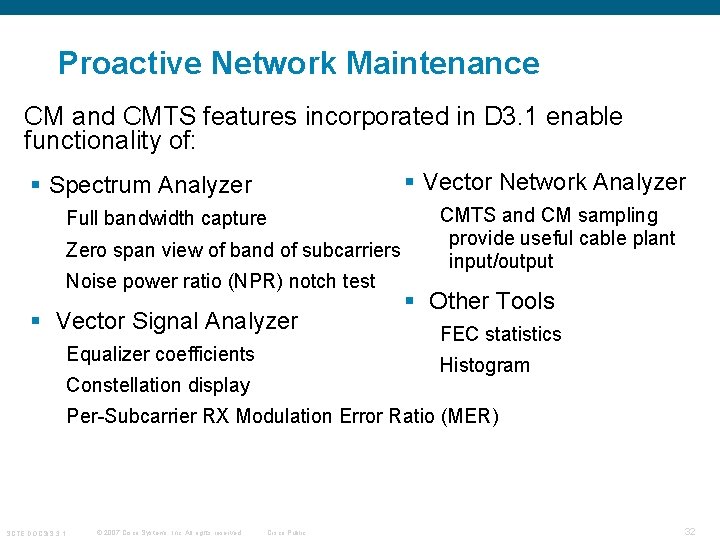
Proactive Network Maintenance CM and CMTS features incorporated in D 3. 1 enable functionality of: § Vector Network Analyzer § Spectrum Analyzer Full bandwidth capture Zero span view of band of subcarriers Noise power ratio (NPR) notch test § Vector Signal Analyzer Equalizer coefficients CMTS and CM sampling provide useful cable plant input/output § Other Tools FEC statistics Histogram Constellation display Per-Subcarrier RX Modulation Error Ratio (MER) SCTE DOCSIS 3. 1 © 2007 Cisco Systems, Inc. All rights reserved. Cisco Public 32
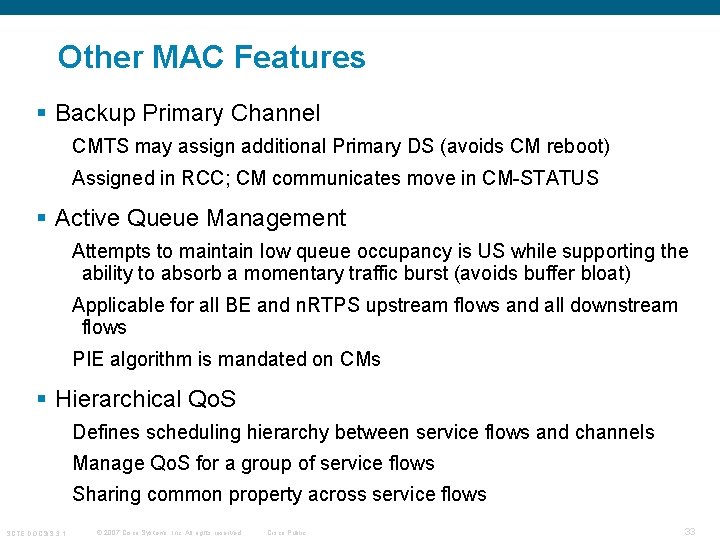
Other MAC Features § Backup Primary Channel CMTS may assign additional Primary DS (avoids CM reboot) Assigned in RCC; CM communicates move in CM-STATUS § Active Queue Management Attempts to maintain low queue occupancy is US while supporting the ability to absorb a momentary traffic burst (avoids buffer bloat) Applicable for all BE and n. RTPS upstream flows and all downstream flows PIE algorithm is mandated on CMs § Hierarchical Qo. S Defines scheduling hierarchy between service flows and channels Manage Qo. S for a group of service flows Sharing common property across service flows SCTE DOCSIS 3. 1 © 2007 Cisco Systems, Inc. All rights reserved. Cisco Public 33
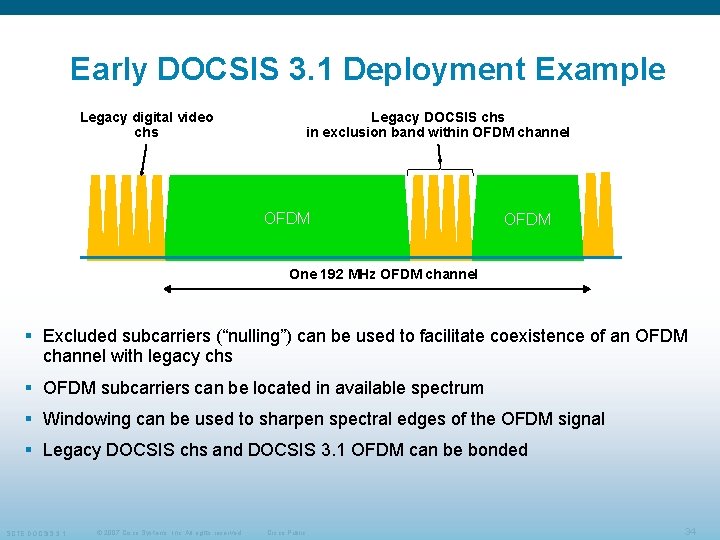
Early DOCSIS 3. 1 Deployment Example Legacy DOCSIS chs in exclusion band within OFDM channel Legacy digital video chs OFDM One 192 MHz OFDM channel § Excluded subcarriers (“nulling”) can be used to facilitate coexistence of an OFDM channel with legacy chs § OFDM subcarriers can be located in available spectrum § Windowing can be used to sharpen spectral edges of the OFDM signal § Legacy DOCSIS chs and DOCSIS 3. 1 OFDM can be bonded SCTE DOCSIS 3. 1 © 2007 Cisco Systems, Inc. All rights reserved. Cisco Public 34
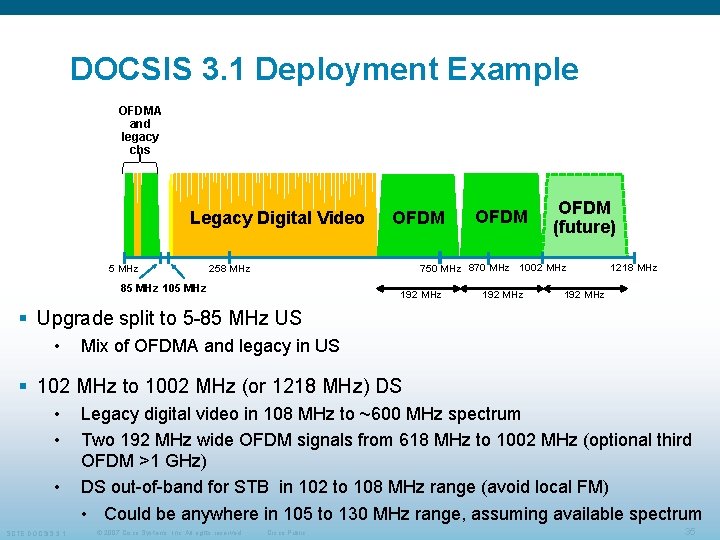
DOCSIS 3. 1 Deployment Example OFDMA and legacy chs Legacy Digital Video 5 MHz OFDM (future) 750 MHz 870 MHz 1002 MHz 258 MHz 85 MHz 105 MHz 192 MHz 1218 MHz 192 MHz § Upgrade split to 5 -85 MHz US • Mix of OFDMA and legacy in US § 102 MHz to 1002 MHz (or 1218 MHz) DS • • • SCTE DOCSIS 3. 1 Legacy digital video in 108 MHz to ~600 MHz spectrum Two 192 MHz wide OFDM signals from 618 MHz to 1002 MHz (optional third OFDM >1 GHz) DS out-of-band for STB in 102 to 108 MHz range (avoid local FM) • Could be anywhere in 105 to 130 MHz range, assuming available spectrum © 2007 Cisco Systems, Inc. All rights reserved. Cisco Public 35
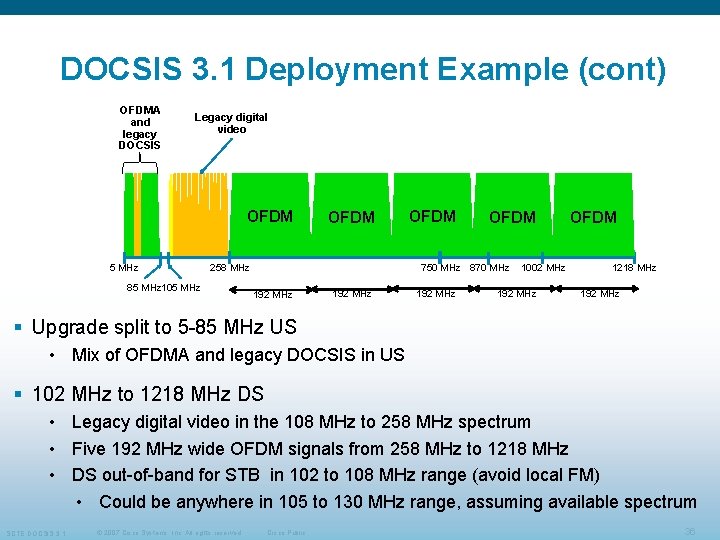
DOCSIS 3. 1 Deployment Example (cont) OFDMA and legacy DOCSIS Legacy digital video OFDM 5 MHz OFDM 750 MHz 870 MHz 258 MHz 85 MHz 105 MHz OFDM 192 MHz 1002 MHz 192 MHz OFDM 1218 MHz 192 MHz § Upgrade split to 5 -85 MHz US • Mix of OFDMA and legacy DOCSIS in US § 102 MHz to 1218 MHz DS • Legacy digital video in the 108 MHz to 258 MHz spectrum • Five 192 MHz wide OFDM signals from 258 MHz to 1218 MHz • DS out-of-band for STB in 102 to 108 MHz range (avoid local FM) • Could be anywhere in 105 to 130 MHz range, assuming available spectrum SCTE DOCSIS 3. 1 © 2007 Cisco Systems, Inc. All rights reserved. Cisco Public 36
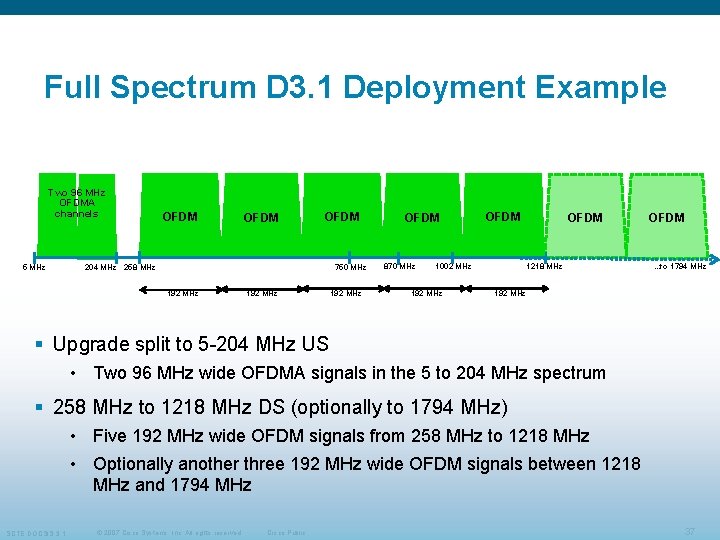
Full Spectrum D 3. 1 Deployment Example Two 96 MHz OFDMA channels 5 MHz OFDM 204 MHz 258 MHz 750 MHz 192 MHz OFDM 870 MHz OFDM 1002 MHz 192 MHz OFDM 1218 MHz OFDM . . . to 1794 MHz 192 MHz § Upgrade split to 5 -204 MHz US • Two 96 MHz wide OFDMA signals in the 5 to 204 MHz spectrum § 258 MHz to 1218 MHz DS (optionally to 1794 MHz) • Five 192 MHz wide OFDM signals from 258 MHz to 1218 MHz • Optionally another three 192 MHz wide OFDM signals between 1218 MHz and 1794 MHz SCTE DOCSIS 3. 1 © 2007 Cisco Systems, Inc. All rights reserved. Cisco Public 37
DOCSIS 3. 1 Deployment Thoughts § DOCSIS 3. 1 spec completed end of October 2013 § Products begin to appear in 2015 § Deployments take place in 2016 or 2017 § Cost for new DOCSIS 3. 1 CMs expected to be relatively close to DOCSIS 3. 0 (compared to 2. 0 / 3. 0) § Deployments might first focus on CPE then CMTS DS then CMTS US § Many options for cable operators • Continue on with D 3. 0 • Use new modulation of D 3. 1 in existing spectrum • Make spectrum changes and use new modulation of D 3. 1 on part or all of plant SCTE DOCSIS 3. 1 © 2007 Cisco Systems, Inc. All rights reserved. Cisco Public 38
Summary § Specifications from Cable. Labs enabling cable operators to continue to lead in offering IP-based services § DOCSIS 3. 1 provides faster speeds through higher order modulation, bigger ch with subcarriers, and more spectrum • Allows operators to offer services competitive with FTTH § LDPC FEC added for better error correction, OFDM very flexible for dealing with certain impairments • OFDM also drives down CPE cost – more chip options § DOCSIS 3. 1 will very likely require new hardware § Not all operators will need to move to DOCSIS 3. 1, but D 3. 1 can be deployed on today’s networks § Licensing still be worked out within industry SCTE DOCSIS 3. 1 © 2007 Cisco Systems, Inc. All rights reserved. Cisco Public 39
SCTE DOCSIS 3. 1 © 2007 Cisco Systems, Inc. All rights reserved. Cisco Public 40