
doc IEEE 802 21 04xxxr 0 Handover scenarios
- Slides: 8
doc. : IEEE 802. 21 -04/xxxr 0 Handover scenarios and requirements Cheng Hong, Tan Pek Yew (Panasonic) IEEE 802. 21 12 th May 2004 Submission 1 Tan Pek-Yew, Panasonic
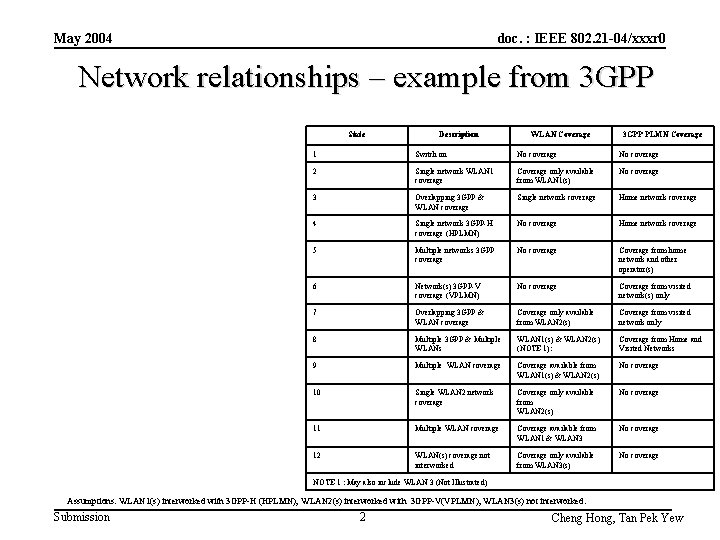
May 2004 doc. : IEEE 802. 21 -04/xxxr 0 Network relationships – example from 3 GPP State Description WLAN Coverage 3 GPP PLMN Coverage 1 Switch on No coverage 2 Single network WLAN 1 coverage Coverage only available from WLAN 1(s) No coverage 3 Overlapping 3 GPP & WLAN coverage Single network coverage Home network coverage 4 Single network 3 GPP-H coverage (HPLMN) No coverage Home network coverage 5 Multiple networks 3 GPP coverage No coverage Coverage from home network and other operator(s) 6 Network(s) 3 GPP-V coverage (VPLMN) No coverage Coverage from visited network(s) only 7 Overlapping 3 GPP & WLAN coverage Coverage only available from WLAN 2(s) Coverage from visited network only 8 Multiple 3 GPP & Multiple WLANs WLAN 1(s) & WLAN 2(s) (NOTE 1): Coverage from Home and Visited Networks 9 Multiple WLAN coverage Coverage available from WLAN 1(s) & WLAN 2(s) No coverage 10 Single WLAN 2 network coverage Coverage only available from WLAN 2(s) No coverage 11 Multiple WLAN coverage Coverage available from WLAN 1 & WLAN 3 No coverage 12 WLAN(s) coverage not interworked Coverage only available from WLAN 3(s) No coverage NOTE 1 : May also include WLAN 3 (Not Illustrated) Assumptions: WLAN 1(s) interworked with 3 GPP-H (HPLMN); WLAN 2(s) interworked with 3 GPP-V(VPLMN); WLAN 3(s) not interworked. Submission 2 Cheng Hong, Tan Pek Yew
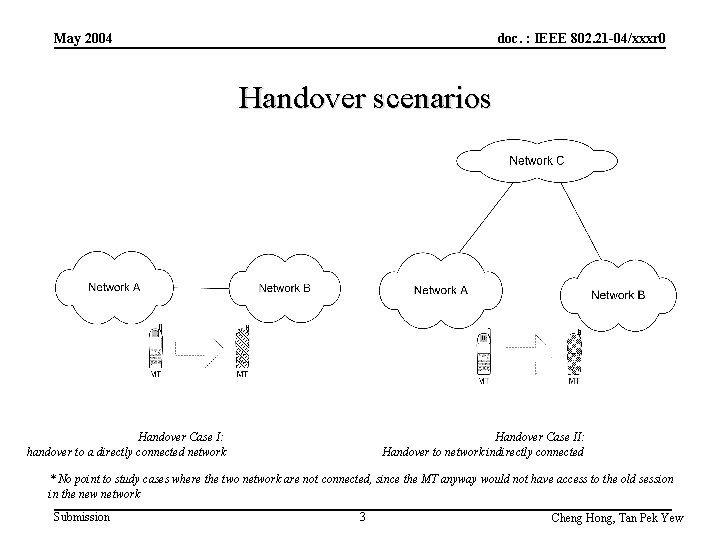
May 2004 doc. : IEEE 802. 21 -04/xxxr 0 Handover scenarios Handover Case I: handover to a directly connected network Handover Case II: Handover to network indirectly connected * No point to study cases where the two network are not connected, since the MT anyway would not have access to the old session in the new network Submission 3 Cheng Hong, Tan Pek Yew
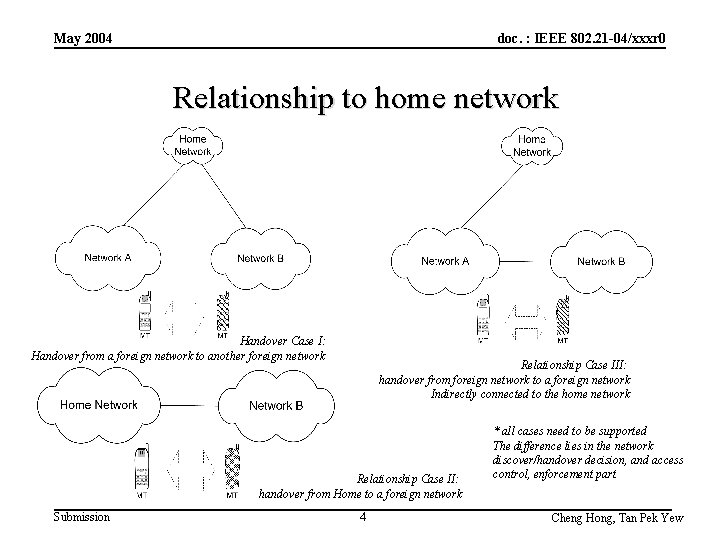
May 2004 doc. : IEEE 802. 21 -04/xxxr 0 Relationship to home network Handover Case I: Handover from a foreign network to another foreign network Relationship Case III: handover from foreign network to a foreign network Indirectly connected to the home network Relationship Case II: handover from Home to a foreign network Submission 4 * all cases need to be supported The difference lies in the network discover/handover decision, and access control, enforcement part Cheng Hong, Tan Pek Yew
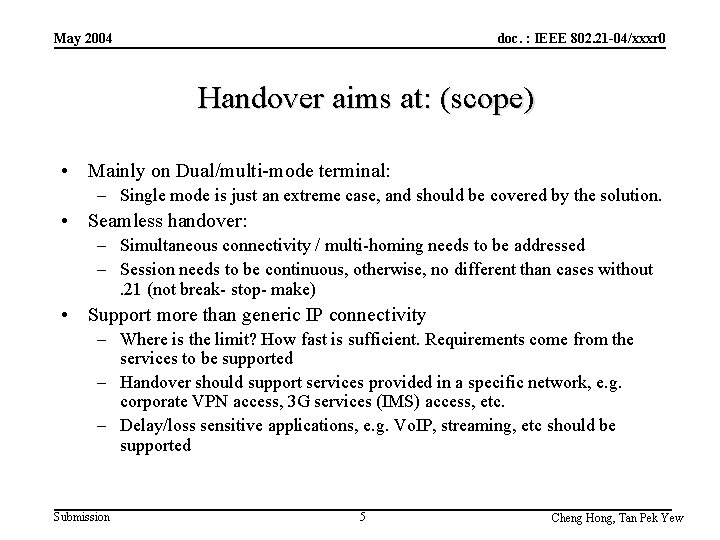
May 2004 doc. : IEEE 802. 21 -04/xxxr 0 Handover aims at: (scope) • Mainly on Dual/multi-mode terminal: – Single mode is just an extreme case, and should be covered by the solution. • Seamless handover: – Simultaneous connectivity / multi-homing needs to be addressed – Session needs to be continuous, otherwise, no different than cases without. 21 (not break- stop- make) • Support more than generic IP connectivity – Where is the limit? How fast is sufficient. Requirements come from the services to be supported – Handover should support services provided in a specific network, e. g. corporate VPN access, 3 G services (IMS) access, etc. – Delay/loss sensitive applications, e. g. Vo. IP, streaming, etc should be supported Submission 5 Cheng Hong, Tan Pek Yew
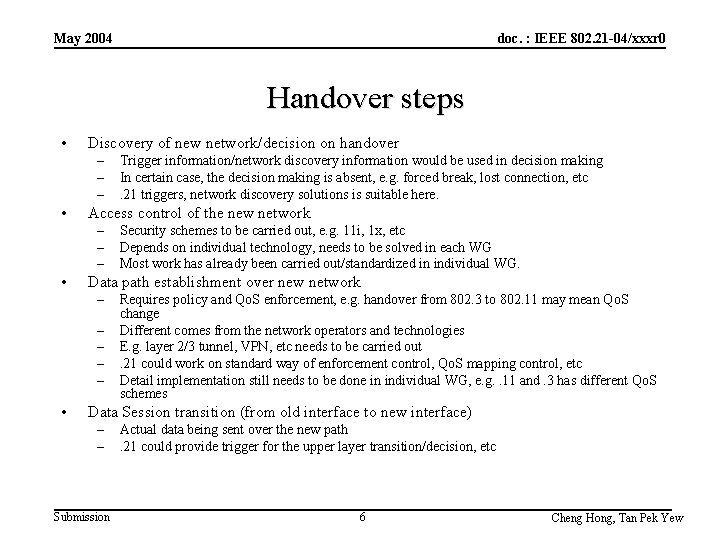
May 2004 doc. : IEEE 802. 21 -04/xxxr 0 Handover steps • Discovery of new network/decision on handover – – – • Access control of the new network – – – • Security schemes to be carried out, e. g. 11 i, 1 x, etc Depends on individual technology, needs to be solved in each WG Most work has already been carried out/standardized in individual WG. Data path establishment over new network – – – • Trigger information/network discovery information would be used in decision making In certain case, the decision making is absent, e. g. forced break, lost connection, etc. 21 triggers, network discovery solutions is suitable here. Requires policy and Qo. S enforcement, e. g. handover from 802. 3 to 802. 11 may mean Qo. S change Different comes from the network operators and technologies E. g. layer 2/3 tunnel, VPN, etc needs to be carried out. 21 could work on standard way of enforcement control, Qo. S mapping control, etc Detail implementation still needs to be done in individual WG, e. g. . 11 and. 3 has different Qo. S schemes Data Session transition (from old interface to new interface) – – Submission Actual data being sent over the new path. 21 could provide trigger for the upper layer transition/decision, etc 6 Cheng Hong, Tan Pek Yew
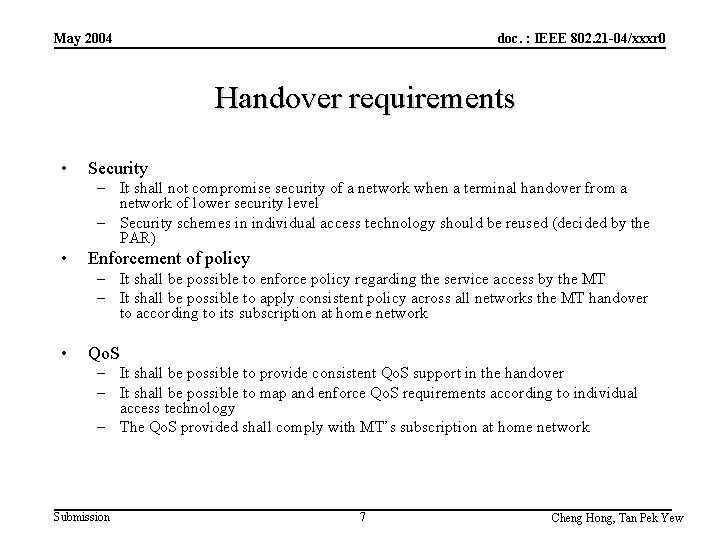
May 2004 doc. : IEEE 802. 21 -04/xxxr 0 Handover requirements • Security – It shall not compromise security of a network when a terminal handover from a network of lower security level – Security schemes in individual access technology should be reused (decided by the PAR) • Enforcement of policy – It shall be possible to enforce policy regarding the service access by the MT – It shall be possible to apply consistent policy across all networks the MT handover to according to its subscription at home network • Qo. S – It shall be possible to provide consistent Qo. S support in the handover – It shall be possible to map and enforce Qo. S requirements according to individual access technology – The Qo. S provided shall comply with MT’s subscription at home network Submission 7 Cheng Hong, Tan Pek Yew
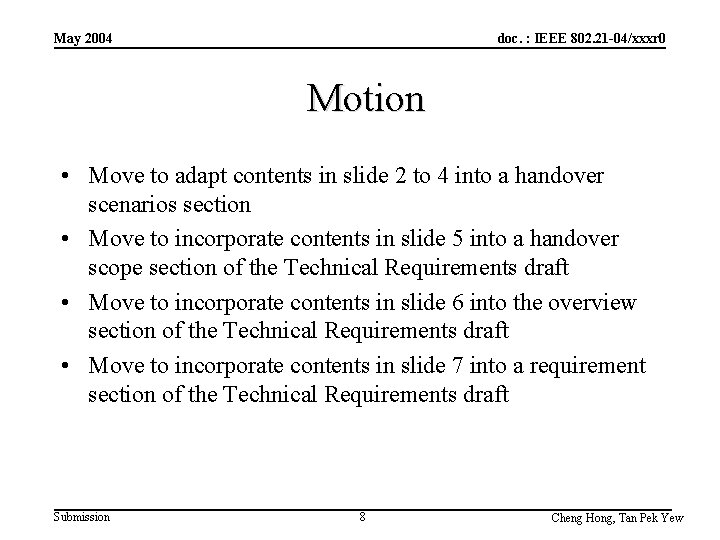
May 2004 doc. : IEEE 802. 21 -04/xxxr 0 Motion • Move to adapt contents in slide 2 to 4 into a handover scenarios section • Move to incorporate contents in slide 5 into a handover scope section of the Technical Requirements draft • Move to incorporate contents in slide 6 into the overview section of the Technical Requirements draft • Move to incorporate contents in slide 7 into a requirement section of the Technical Requirements draft Submission 8 Cheng Hong, Tan Pek Yew