
doc IEEE 802 11 151095 r 1 September
doc. : IEEE 802. 11 -15/1095 r 1 September 2015 OFDMA performance in 11 ax Date: 2015 -09 -14 Authors: Name Suhwook Kim Hyeyoung Choi Jeongki Kim Kiseon Ryu Han. Gyu Cho Submission Affiliations LG Electronics LG Electronics Address 19, Yangjea-daero 11 gil, Seocho-gu, Seoul 137 -130, Korea Slide 1 Phone +82 -2 -6912 -6589 Email suhwook. kim@lge. com hy 0117. choi@lge. com jeongki. kim@lge. com kiseon. ryu@lge. com hg. cho@lge. com Suhwook Kim, LG Electronics
doc. : IEEE 802. 11 -15/1095 r 1 September 2015 Introduction • The performance of OFDMA depends on both PHY and MAC, i. e. , OFDMA resource unit structure, traffic and scheduling, feedback and link adaptation, and etc. • This contribution addresses OFDMA performance using PHY/MAC integrated simulator – Based on the new PHY structure and numerology which have been agreed in specification framework document [1] – Based on three topologies • Topology 1, 2 is one BSS case and • Topology 3 is OBSS case (residential scenario (SS 1)) [2] Submission Slide 2 Suhwook Kim, LG Electronics
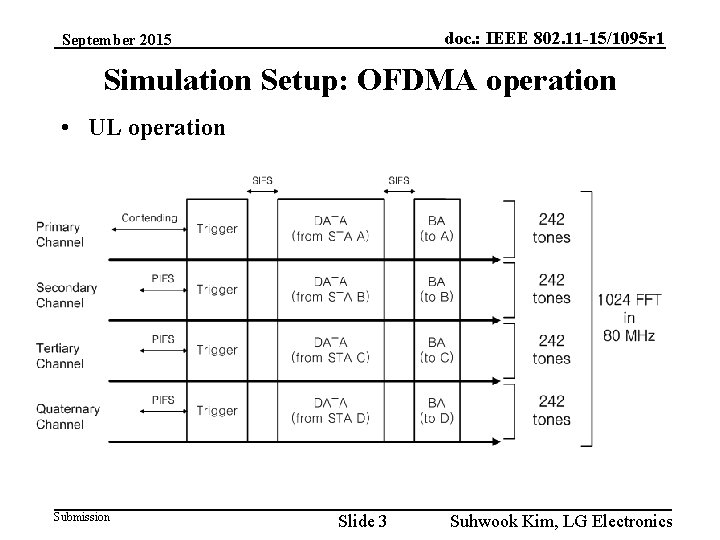
doc. : IEEE 802. 11 -15/1095 r 1 September 2015 Simulation Setup: OFDMA operation • UL operation Submission Slide 3 Suhwook Kim, LG Electronics
doc. : IEEE 802. 11 -15/1095 r 1 September 2015 Simulation Setup: OFDMA operation • UL operation – AP sends trigger frame by contending with AC_BE • Trigger frame is transmitted by MCS 0, duplicated format in every 20 MHz channels (assuming 74 bytes long) – STAs which are allocated by trigger frame send data frame • MCS, transmission subband, and maximum frame length of data frame are addressed in the trigger frame • If the station doesn’t have any queued data frame, it doesn’t send anything • If the station doesn’t have enough data frame to fill maximum frame length, it adds padding bits to data frame • STAs don’t perform CCA – AP sends each BA frame in same subband with its data frame • BA frame is transmitted by MCS 0 – Contending of STAs is not permitted Submission Slide 4 Suhwook Kim, LG Electronics
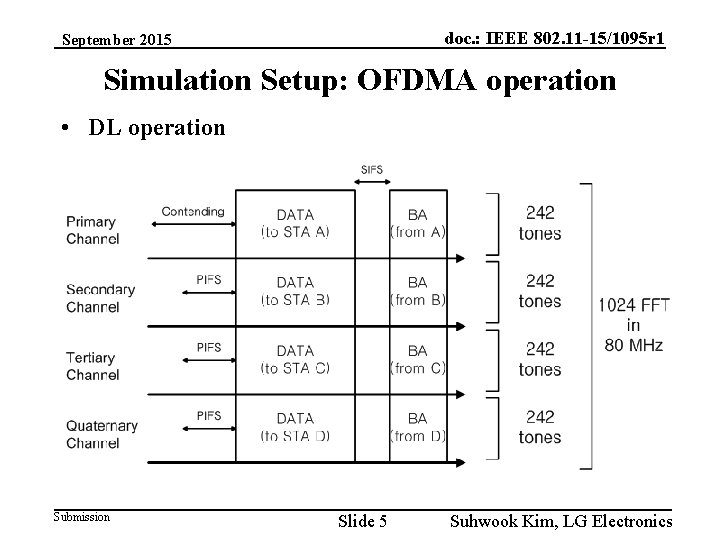
doc. : IEEE 802. 11 -15/1095 r 1 September 2015 Simulation Setup: OFDMA operation • DL operation Submission Slide 5 Suhwook Kim, LG Electronics
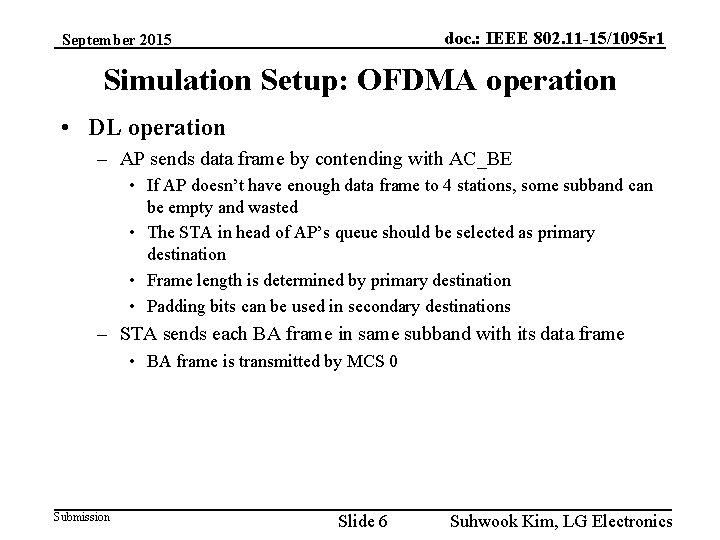
doc. : IEEE 802. 11 -15/1095 r 1 September 2015 Simulation Setup: OFDMA operation • DL operation – AP sends data frame by contending with AC_BE • If AP doesn’t have enough data frame to 4 stations, some subband can be empty and wasted • The STA in head of AP’s queue should be selected as primary destination • Frame length is determined by primary destination • Padding bits can be used in secondary destinations – STA sends each BA frame in same subband with its data frame • BA frame is transmitted by MCS 0 Submission Slide 6 Suhwook Kim, LG Electronics
doc. : IEEE 802. 11 -15/1095 r 1 September 2015 Simulation Setup: Scheduler • Scheduling resource – Maximum allocation per one station is 1 RU – 1 RU: 242 -tone (total 4 RUs in 80 MHz) • Two simple scheduling policy – Random • AP selects STAs randomly – Queue length • AP selects STAs in order of each queue’s length • In DL case, – primary destination is fixed (Head of AP’s queue) – frame length is determined by A-MPDU length to primary destination (legacy spec rule) Submission Slide 7 Suhwook Kim, LG Electronics
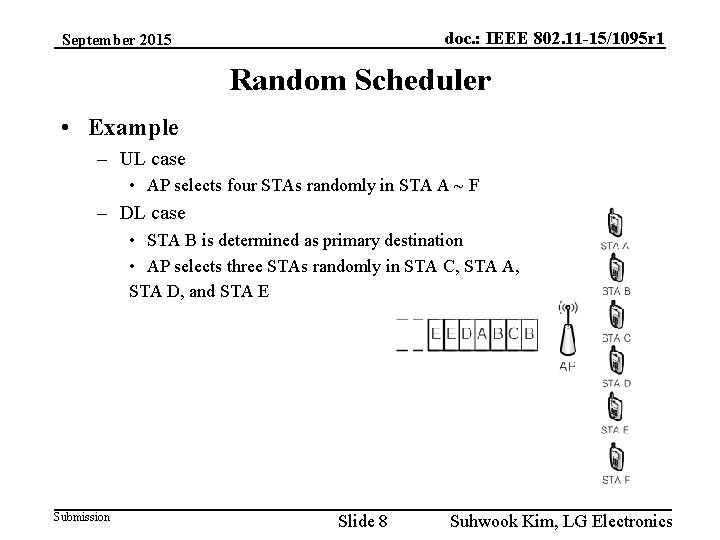
doc. : IEEE 802. 11 -15/1095 r 1 September 2015 Random Scheduler • Example – UL case • AP selects four STAs randomly in STA A ~ F – DL case • STA B is determined as primary destination • AP selects three STAs randomly in STA C, STA A, STA D, and STA E Submission Slide 8 Suhwook Kim, LG Electronics
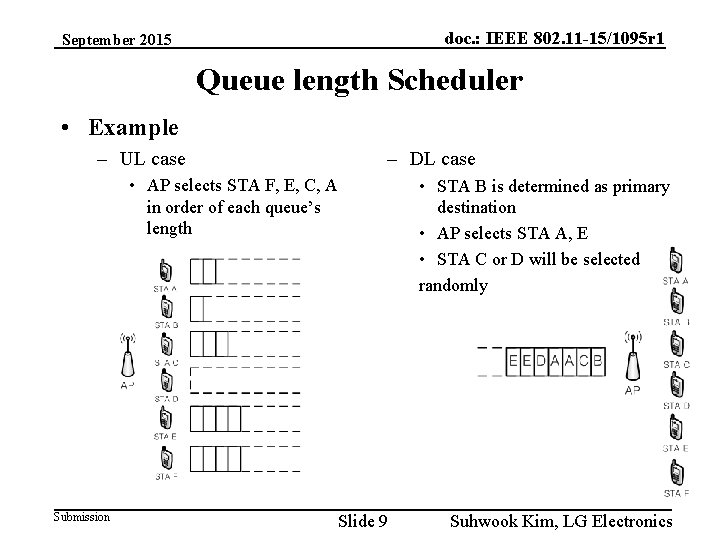
doc. : IEEE 802. 11 -15/1095 r 1 September 2015 Queue length Scheduler • Example – UL case – DL case • AP selects STA F, E, C, A in order of each queue’s length Submission Slide 9 • STA B is determined as primary destination • AP selects STA A, E • STA C or D will be selected randomly Suhwook Kim, LG Electronics
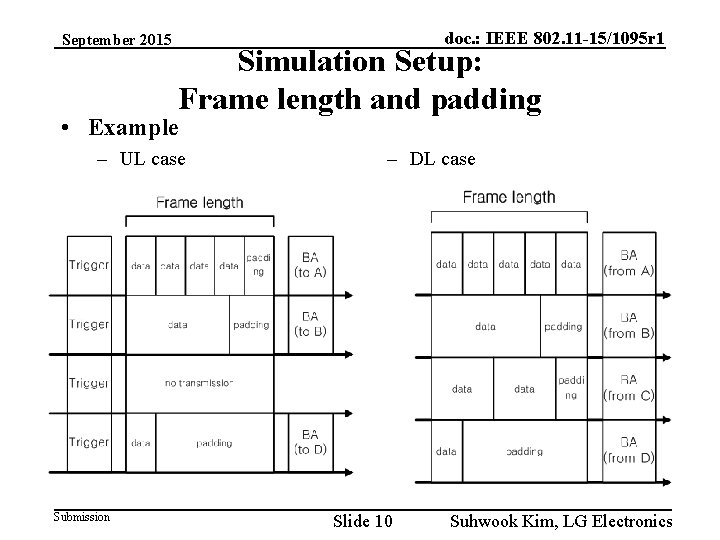
September 2015 doc. : IEEE 802. 11 -15/1095 r 1 Simulation Setup: Frame length and padding • Example – UL case Submission – DL case Slide 10 Suhwook Kim, LG Electronics
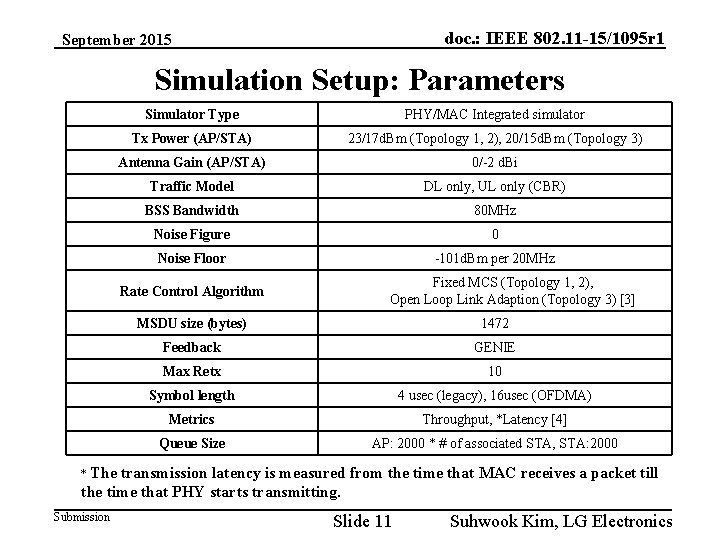
doc. : IEEE 802. 11 -15/1095 r 1 September 2015 Simulation Setup: Parameters Simulator Type PHY/MAC Integrated simulator Tx Power (AP/STA) 23/17 d. Bm (Topology 1, 2), 20/15 d. Bm (Topology 3) Antenna Gain (AP/STA) 0/-2 d. Bi Traffic Model DL only, UL only (CBR) BSS Bandwidth 80 MHz Noise Figure 0 Noise Floor -101 d. Bm per 20 MHz Rate Control Algorithm Fixed MCS (Topology 1, 2), Open Loop Link Adaption (Topology 3) [3] MSDU size (bytes) 1472 Feedback GENIE Max Retx 10 Symbol length 4 usec (legacy), 16 usec (OFDMA) Metrics Throughput, *Latency [4] Queue Size AP: 2000 * # of associated STA, STA: 2000 * The transmission latency is measured from the time that MAC receives a packet till the time that PHY starts transmitting. Submission Slide 11 Suhwook Kim, LG Electronics
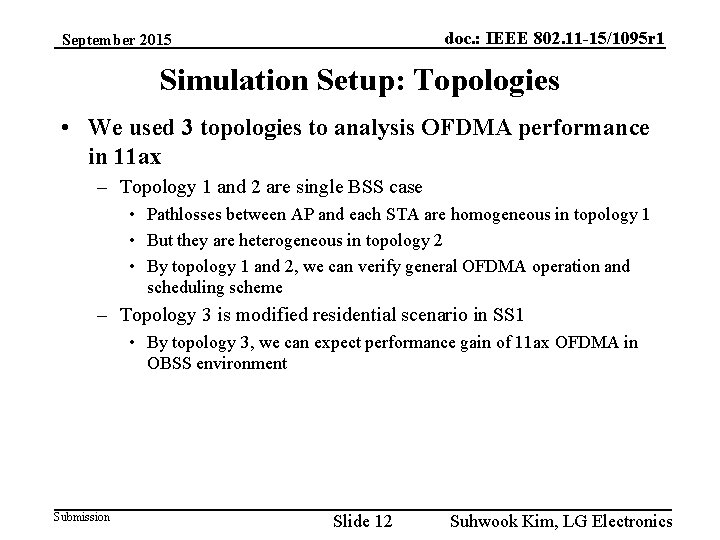
doc. : IEEE 802. 11 -15/1095 r 1 September 2015 Simulation Setup: Topologies • We used 3 topologies to analysis OFDMA performance in 11 ax – Topology 1 and 2 are single BSS case • Pathlosses between AP and each STA are homogeneous in topology 1 • But they are heterogeneous in topology 2 • By topology 1 and 2, we can verify general OFDMA operation and scheduling scheme – Topology 3 is modified residential scenario in SS 1 • By topology 3, we can expect performance gain of 11 ax OFDMA in OBSS environment Submission Slide 12 Suhwook Kim, LG Electronics
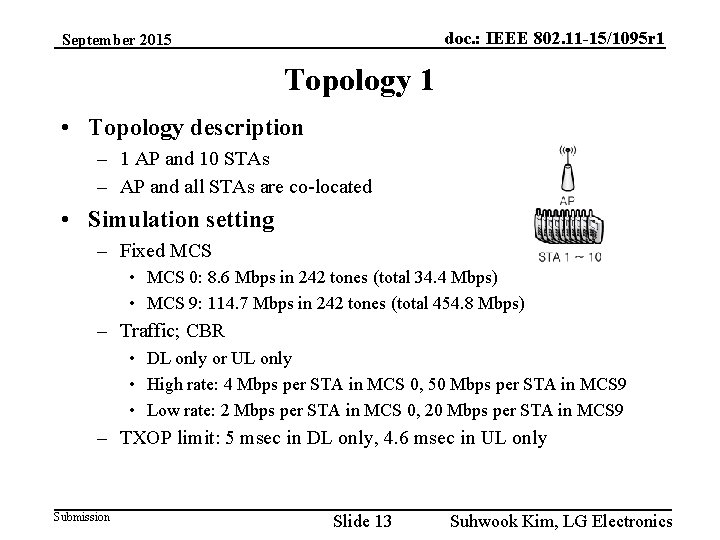
doc. : IEEE 802. 11 -15/1095 r 1 September 2015 Topology 1 • Topology description – 1 AP and 10 STAs – AP and all STAs are co-located • Simulation setting – Fixed MCS • MCS 0: 8. 6 Mbps in 242 tones (total 34. 4 Mbps) • MCS 9: 114. 7 Mbps in 242 tones (total 454. 8 Mbps) – Traffic; CBR • DL only or UL only • High rate: 4 Mbps per STA in MCS 0, 50 Mbps per STA in MCS 9 • Low rate: 2 Mbps per STA in MCS 0, 20 Mbps per STA in MCS 9 – TXOP limit: 5 msec in DL only, 4. 6 msec in UL only Submission Slide 13 Suhwook Kim, LG Electronics
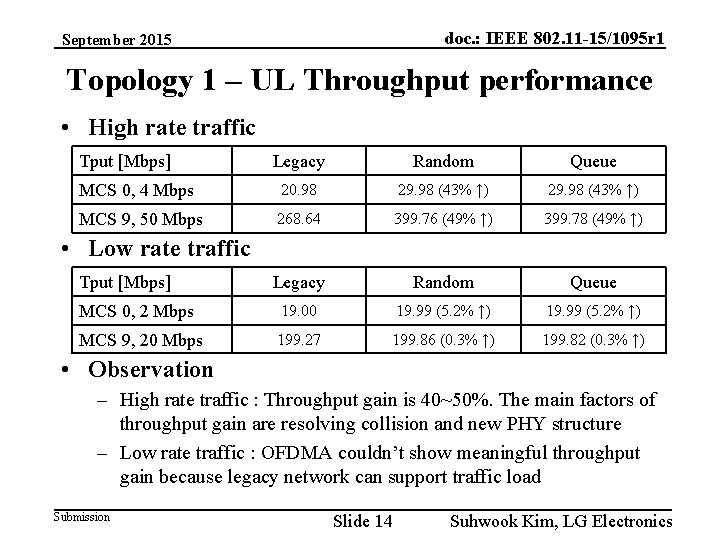
doc. : IEEE 802. 11 -15/1095 r 1 September 2015 Topology 1 – UL Throughput performance • High rate traffic Tput [Mbps] Legacy Random Queue MCS 0, 4 Mbps 20. 98 29. 98 (43% ↑) MCS 9, 50 Mbps 268. 64 399. 76 (49% ↑) 399. 78 (49% ↑) Legacy Random Queue MCS 0, 2 Mbps 19. 00 19. 99 (5. 2% ↑) MCS 9, 20 Mbps 199. 27 199. 86 (0. 3% ↑) 199. 82 (0. 3% ↑) • Low rate traffic Tput [Mbps] • Observation – High rate traffic : Throughput gain is 40~50%. The main factors of throughput gain are resolving collision and new PHY structure – Low rate traffic : OFDMA couldn’t show meaningful throughput gain because legacy network can support traffic load Submission Slide 14 Suhwook Kim, LG Electronics
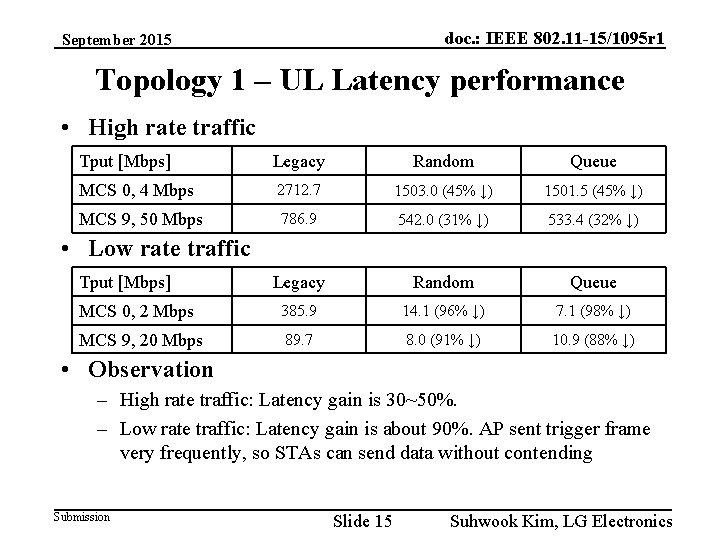
doc. : IEEE 802. 11 -15/1095 r 1 September 2015 Topology 1 – UL Latency performance • High rate traffic Tput [Mbps] Legacy Random Queue MCS 0, 4 Mbps 2712. 7 1503. 0 (45% ↓) 1501. 5 (45% ↓) MCS 9, 50 Mbps 786. 9 542. 0 (31% ↓) 533. 4 (32% ↓) Legacy Random Queue MCS 0, 2 Mbps 385. 9 14. 1 (96% ↓) 7. 1 (98% ↓) MCS 9, 20 Mbps 89. 7 8. 0 (91% ↓) 10. 9 (88% ↓) • Low rate traffic Tput [Mbps] • Observation – High rate traffic: Latency gain is 30~50%. – Low rate traffic: Latency gain is about 90%. AP sent trigger frame very frequently, so STAs can send data without contending Submission Slide 15 Suhwook Kim, LG Electronics
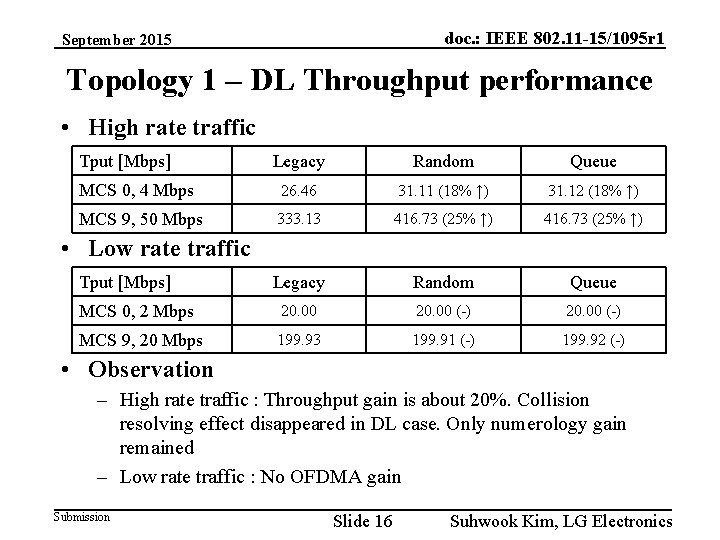
doc. : IEEE 802. 11 -15/1095 r 1 September 2015 Topology 1 – DL Throughput performance • High rate traffic Tput [Mbps] Legacy Random Queue MCS 0, 4 Mbps 26. 46 31. 11 (18% ↑) 31. 12 (18% ↑) MCS 9, 50 Mbps 333. 13 416. 73 (25% ↑) Legacy Random Queue MCS 0, 2 Mbps 20. 00 (-) MCS 9, 20 Mbps 199. 93 199. 91 (-) 199. 92 (-) • Low rate traffic Tput [Mbps] • Observation – High rate traffic : Throughput gain is about 20%. Collision resolving effect disappeared in DL case. Only numerology gain remained – Low rate traffic : No OFDMA gain Submission Slide 16 Suhwook Kim, LG Electronics
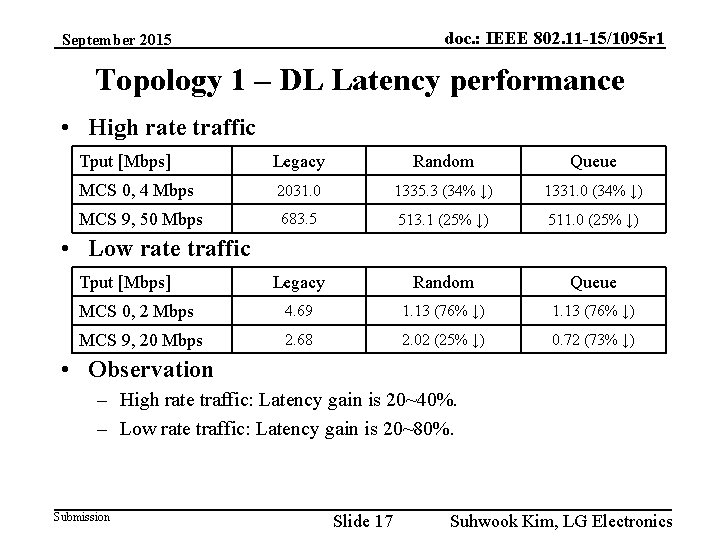
doc. : IEEE 802. 11 -15/1095 r 1 September 2015 Topology 1 – DL Latency performance • High rate traffic Tput [Mbps] Legacy Random Queue MCS 0, 4 Mbps 2031. 0 1335. 3 (34% ↓) 1331. 0 (34% ↓) MCS 9, 50 Mbps 683. 5 513. 1 (25% ↓) 511. 0 (25% ↓) Legacy Random Queue MCS 0, 2 Mbps 4. 69 1. 13 (76% ↓) MCS 9, 20 Mbps 2. 68 2. 02 (25% ↓) 0. 72 (73% ↓) • Low rate traffic Tput [Mbps] • Observation – High rate traffic: Latency gain is 20~40%. – Low rate traffic: Latency gain is 20~80%. Submission Slide 17 Suhwook Kim, LG Electronics
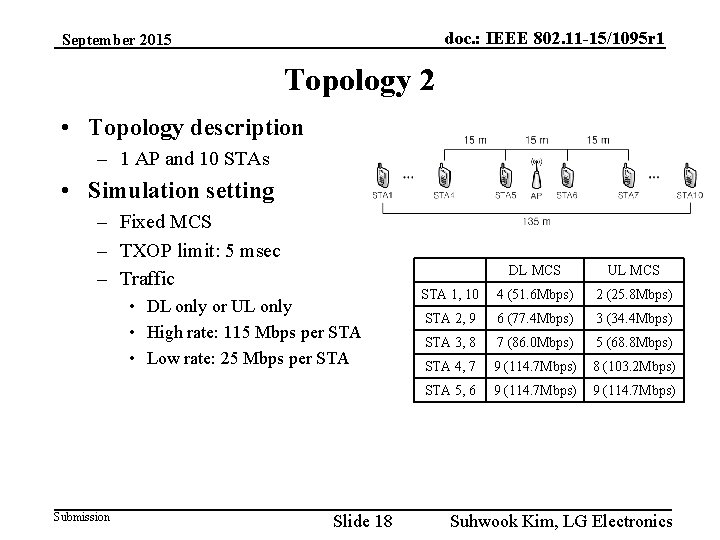
doc. : IEEE 802. 11 -15/1095 r 1 September 2015 Topology 2 • Topology description – 1 AP and 10 STAs • Simulation setting – Fixed MCS – TXOP limit: 5 msec – Traffic • DL only or UL only • High rate: 115 Mbps per STA • Low rate: 25 Mbps per STA Submission Slide 18 DL MCS UL MCS STA 1, 10 4 (51. 6 Mbps) 2 (25. 8 Mbps) STA 2, 9 6 (77. 4 Mbps) 3 (34. 4 Mbps) STA 3, 8 7 (86. 0 Mbps) 5 (68. 8 Mbps) STA 4, 7 9 (114. 7 Mbps) 8 (103. 2 Mbps) STA 5, 6 9 (114. 7 Mbps) Suhwook Kim, LG Electronics
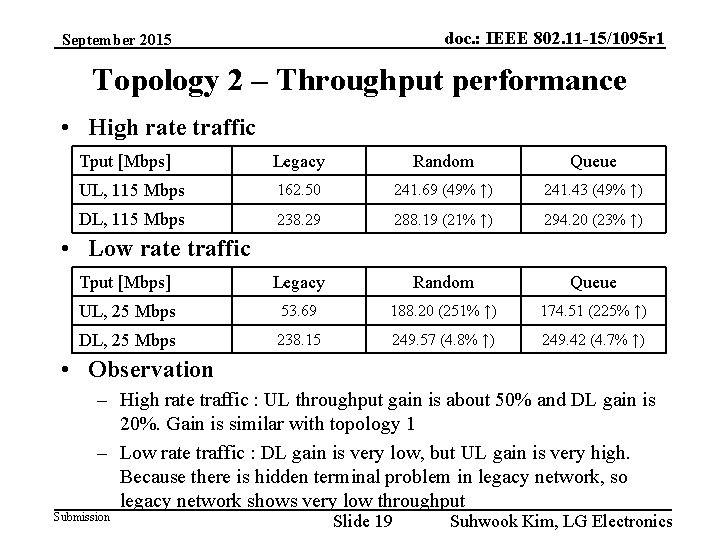
doc. : IEEE 802. 11 -15/1095 r 1 September 2015 Topology 2 – Throughput performance • High rate traffic Tput [Mbps] Legacy Random Queue UL, 115 Mbps 162. 50 241. 69 (49% ↑) 241. 43 (49% ↑) DL, 115 Mbps 238. 29 288. 19 (21% ↑) 294. 20 (23% ↑) Tput [Mbps] Legacy Random Queue UL, 25 Mbps 53. 69 188. 20 (251% ↑) 174. 51 (225% ↑) DL, 25 Mbps 238. 15 249. 57 (4. 8% ↑) 249. 42 (4. 7% ↑) • Low rate traffic • Observation – High rate traffic : UL throughput gain is about 50% and DL gain is 20%. Gain is similar with topology 1 – Low rate traffic : DL gain is very low, but UL gain is very high. Because there is hidden terminal problem in legacy network, so legacy network shows very low throughput Submission Slide 19 Suhwook Kim, LG Electronics
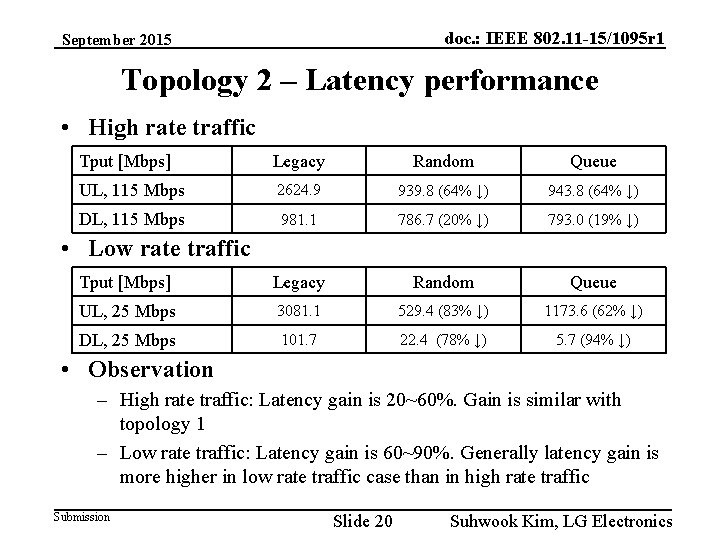
doc. : IEEE 802. 11 -15/1095 r 1 September 2015 Topology 2 – Latency performance • High rate traffic Tput [Mbps] Legacy Random Queue UL, 115 Mbps 2624. 9 939. 8 (64% ↓) 943. 8 (64% ↓) DL, 115 Mbps 981. 1 786. 7 (20% ↓) 793. 0 (19% ↓) Tput [Mbps] Legacy Random Queue UL, 25 Mbps 3081. 1 529. 4 (83% ↓) 1173. 6 (62% ↓) DL, 25 Mbps 101. 7 22. 4 (78% ↓) 5. 7 (94% ↓) • Low rate traffic • Observation – High rate traffic: Latency gain is 20~60%. Gain is similar with topology 1 – Low rate traffic: Latency gain is 60~90%. Generally latency gain is more higher in low rate traffic case than in high rate traffic Submission Slide 20 Suhwook Kim, LG Electronics
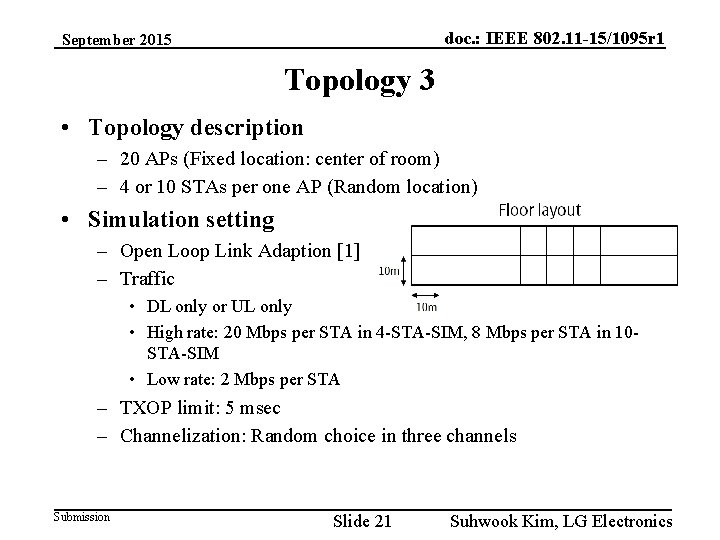
doc. : IEEE 802. 11 -15/1095 r 1 September 2015 Topology 3 • Topology description – 20 APs (Fixed location: center of room) – 4 or 10 STAs per one AP (Random location) • Simulation setting – Open Loop Link Adaption [1] – Traffic • DL only or UL only • High rate: 20 Mbps per STA in 4 -STA-SIM, 8 Mbps per STA in 10 STA-SIM • Low rate: 2 Mbps per STA – TXOP limit: 5 msec – Channelization: Random choice in three channels Submission Slide 21 Suhwook Kim, LG Electronics
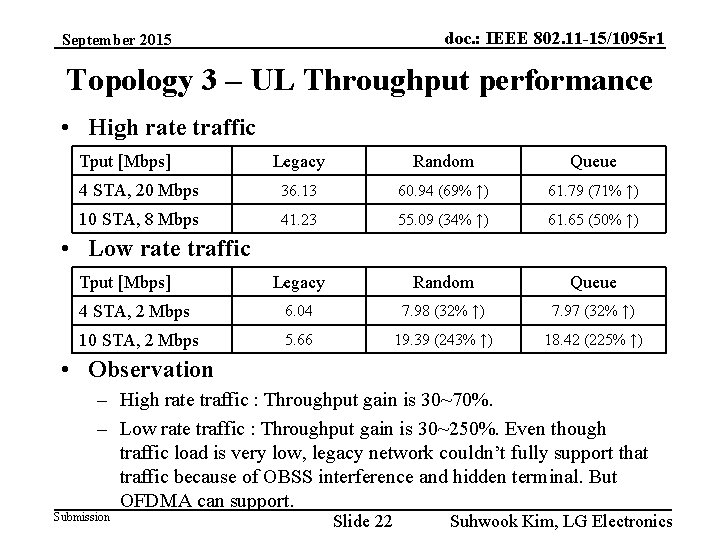
doc. : IEEE 802. 11 -15/1095 r 1 September 2015 Topology 3 – UL Throughput performance • High rate traffic Tput [Mbps] Legacy Random Queue 4 STA, 20 Mbps 36. 13 60. 94 (69% ↑) 61. 79 (71% ↑) 10 STA, 8 Mbps 41. 23 55. 09 (34% ↑) 61. 65 (50% ↑) Legacy Random Queue 4 STA, 2 Mbps 6. 04 7. 98 (32% ↑) 7. 97 (32% ↑) 10 STA, 2 Mbps 5. 66 19. 39 (243% ↑) 18. 42 (225% ↑) • Low rate traffic Tput [Mbps] • Observation – High rate traffic : Throughput gain is 30~70%. – Low rate traffic : Throughput gain is 30~250%. Even though traffic load is very low, legacy network couldn’t fully support that traffic because of OBSS interference and hidden terminal. But OFDMA can support. Submission Slide 22 Suhwook Kim, LG Electronics
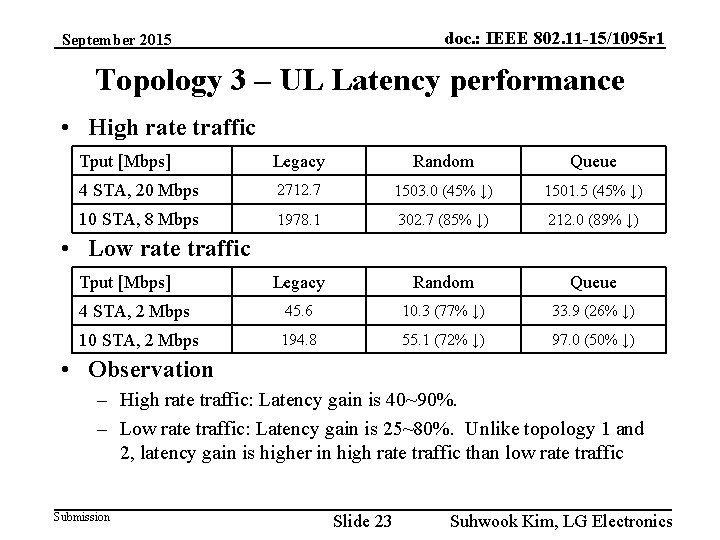
doc. : IEEE 802. 11 -15/1095 r 1 September 2015 Topology 3 – UL Latency performance • High rate traffic Tput [Mbps] Legacy Random Queue 4 STA, 20 Mbps 2712. 7 1503. 0 (45% ↓) 1501. 5 (45% ↓) 10 STA, 8 Mbps 1978. 1 302. 7 (85% ↓) 212. 0 (89% ↓) Legacy Random Queue 4 STA, 2 Mbps 45. 6 10. 3 (77% ↓) 33. 9 (26% ↓) 10 STA, 2 Mbps 194. 8 55. 1 (72% ↓) 97. 0 (50% ↓) • Low rate traffic Tput [Mbps] • Observation – High rate traffic: Latency gain is 40~90%. – Low rate traffic: Latency gain is 25~80%. Unlike topology 1 and 2, latency gain is higher in high rate traffic than low rate traffic Submission Slide 23 Suhwook Kim, LG Electronics
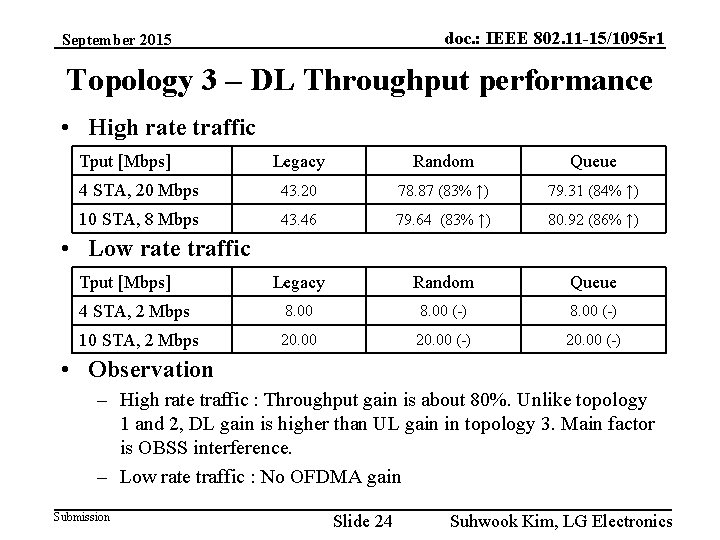
doc. : IEEE 802. 11 -15/1095 r 1 September 2015 Topology 3 – DL Throughput performance • High rate traffic Tput [Mbps] Legacy Random Queue 4 STA, 20 Mbps 43. 20 78. 87 (83% ↑) 79. 31 (84% ↑) 10 STA, 8 Mbps 43. 46 79. 64 (83% ↑) 80. 92 (86% ↑) Legacy Random Queue 4 STA, 2 Mbps 8. 00 (-) 10 STA, 2 Mbps 20. 00 (-) • Low rate traffic Tput [Mbps] • Observation – High rate traffic : Throughput gain is about 80%. Unlike topology 1 and 2, DL gain is higher than UL gain in topology 3. Main factor is OBSS interference. – Low rate traffic : No OFDMA gain Submission Slide 24 Suhwook Kim, LG Electronics
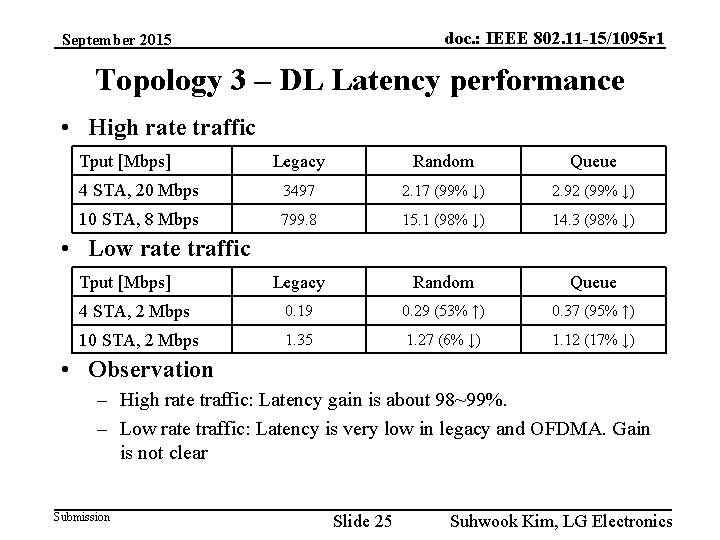
doc. : IEEE 802. 11 -15/1095 r 1 September 2015 Topology 3 – DL Latency performance • High rate traffic Tput [Mbps] Legacy Random Queue 4 STA, 20 Mbps 3497 2. 17 (99% ↓) 2. 92 (99% ↓) 10 STA, 8 Mbps 799. 8 15. 1 (98% ↓) 14. 3 (98% ↓) Legacy Random Queue 4 STA, 2 Mbps 0. 19 0. 29 (53% ↑) 0. 37 (95% ↑) 10 STA, 2 Mbps 1. 35 1. 27 (6% ↓) 1. 12 (17% ↓) • Low rate traffic Tput [Mbps] • Observation – High rate traffic: Latency gain is about 98~99%. – Low rate traffic: Latency is very low in legacy and OFDMA. Gain is not clear Submission Slide 25 Suhwook Kim, LG Electronics
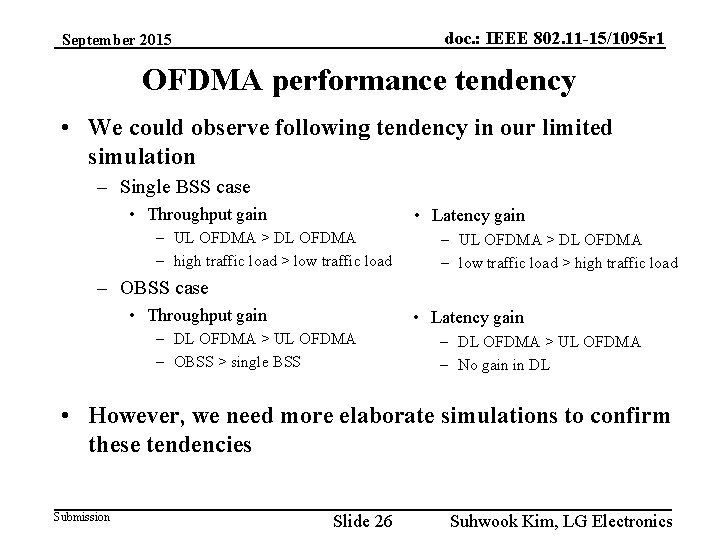
doc. : IEEE 802. 11 -15/1095 r 1 September 2015 OFDMA performance tendency • We could observe following tendency in our limited simulation – Single BSS case • Throughput gain • Latency gain – UL OFDMA > DL OFDMA – high traffic load > low traffic load – UL OFDMA > DL OFDMA – low traffic load > high traffic load – OBSS case • Throughput gain • Latency gain – DL OFDMA > UL OFDMA – OBSS > single BSS – DL OFDMA > UL OFDMA – No gain in DL • However, we need more elaborate simulations to confirm these tendencies Submission Slide 26 Suhwook Kim, LG Electronics
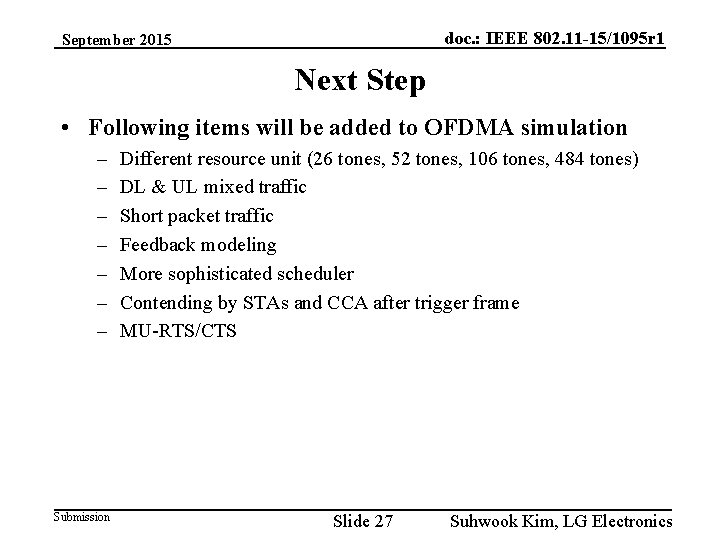
doc. : IEEE 802. 11 -15/1095 r 1 September 2015 Next Step • Following items will be added to OFDMA simulation – – – – Submission Different resource unit (26 tones, 52 tones, 106 tones, 484 tones) DL & UL mixed traffic Short packet traffic Feedback modeling More sophisticated scheduler Contending by STAs and CCA after trigger frame MU-RTS/CTS Slide 27 Suhwook Kim, LG Electronics
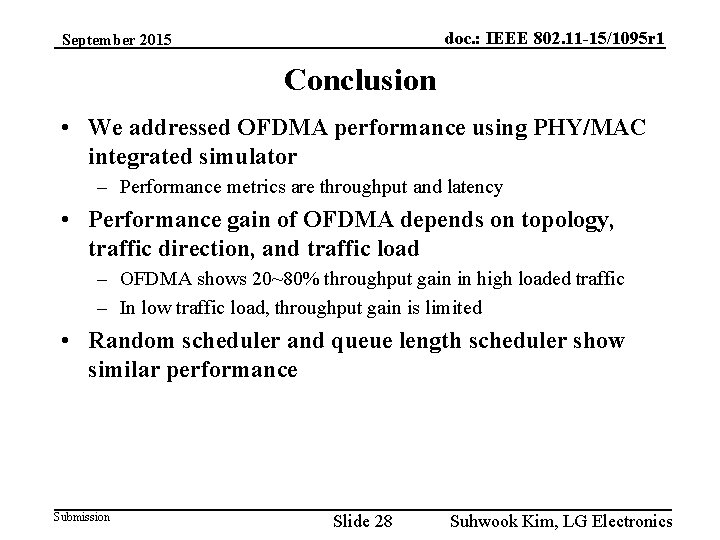
doc. : IEEE 802. 11 -15/1095 r 1 September 2015 Conclusion • We addressed OFDMA performance using PHY/MAC integrated simulator – Performance metrics are throughput and latency • Performance gain of OFDMA depends on topology, traffic direction, and traffic load – OFDMA shows 20~80% throughput gain in high loaded traffic – In low traffic load, throughput gain is limited • Random scheduler and queue length scheduler show similar performance Submission Slide 28 Suhwook Kim, LG Electronics
![doc. : IEEE 802. 11 -15/1095 r 1 September 2015 Reference • • [1]](http://slidetodoc.com/presentation_image_h2/dd4ade8b52ac260d8a4c3123ba052dc6/image-29.jpg "doc. : IEEE 802. 11 -15/1095 r 1 September 2015 Reference • • [1]")
doc. : IEEE 802. 11 -15/1095 r 1 September 2015 Reference • • [1] 11 -15/0132 r 7 Spec Framework [2] 11 -14/0980 r 14 Simulation Scenarios [3] 11 -14/620 r 0 link adaptation for PHY SLS calibration [4] 11 -14/0571 r 10 11 ax Evaluation Methodology Submission Slide 29 Suhwook Kim, LG Electronics
doc. : IEEE 802. 11 -15/1095 r 1 September 2015 Backup Slide - Topology 1 Submission Slide 30 Suhwook Kim, LG Electronics
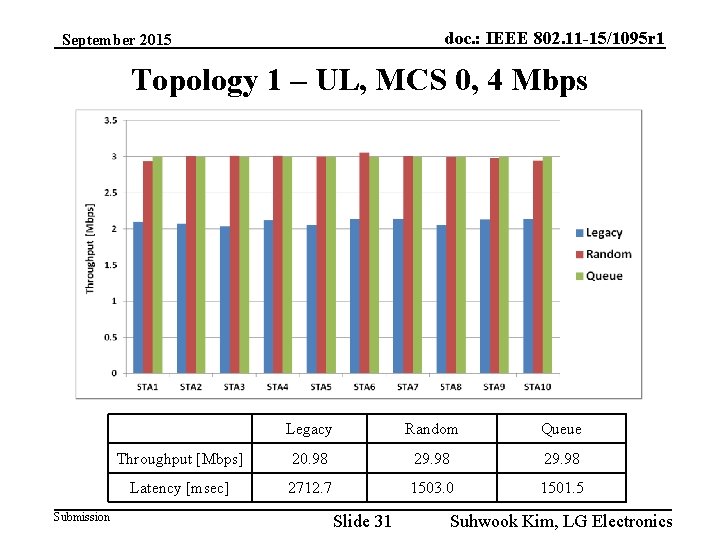
doc. : IEEE 802. 11 -15/1095 r 1 September 2015 Topology 1 – UL, MCS 0, 4 Mbps Submission Legacy Random Queue Throughput [Mbps] 20. 98 29. 98 Latency [msec] 2712. 7 1503. 0 1501. 5 Slide 31 Suhwook Kim, LG Electronics
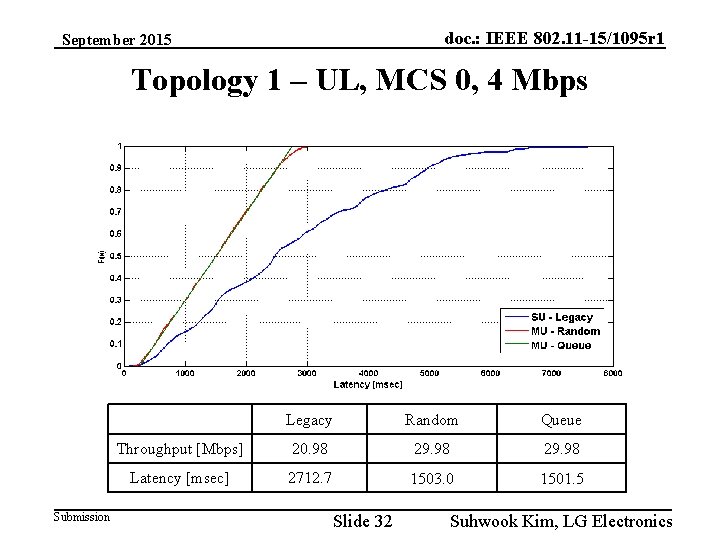
doc. : IEEE 802. 11 -15/1095 r 1 September 2015 Topology 1 – UL, MCS 0, 4 Mbps Submission Legacy Random Queue Throughput [Mbps] 20. 98 29. 98 Latency [msec] 2712. 7 1503. 0 1501. 5 Slide 32 Suhwook Kim, LG Electronics
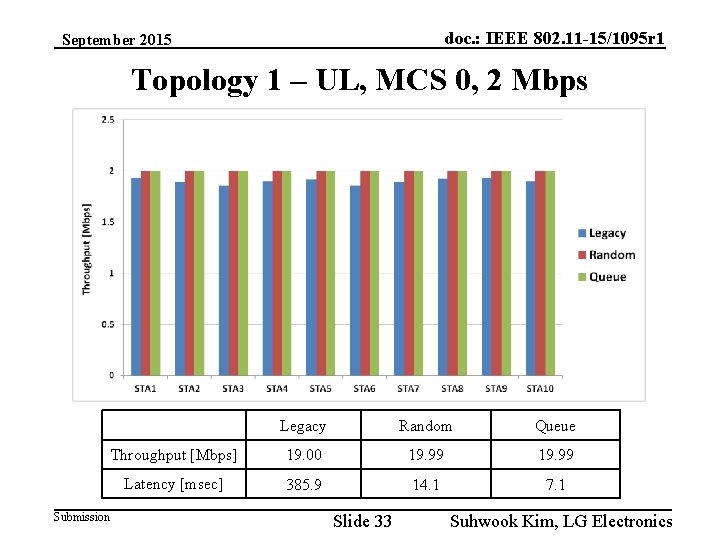
doc. : IEEE 802. 11 -15/1095 r 1 September 2015 Topology 1 – UL, MCS 0, 2 Mbps Submission Legacy Random Queue Throughput [Mbps] 19. 00 19. 99 Latency [msec] 385. 9 14. 1 7. 1 Slide 33 Suhwook Kim, LG Electronics
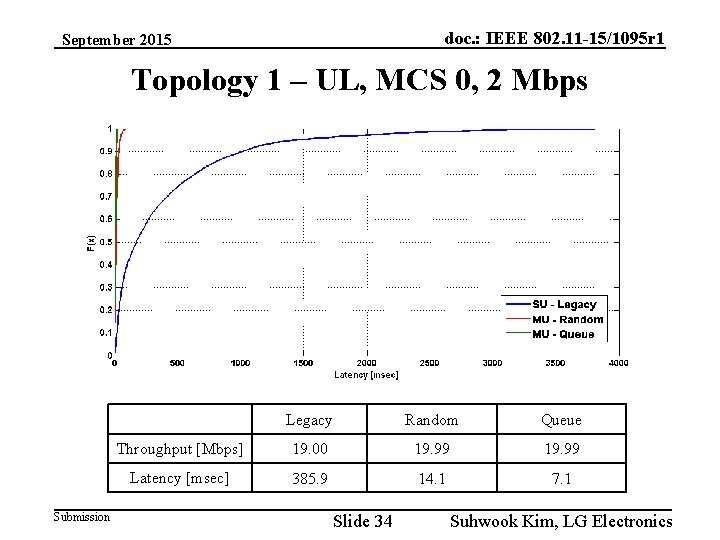
doc. : IEEE 802. 11 -15/1095 r 1 September 2015 Topology 1 – UL, MCS 0, 2 Mbps Submission Legacy Random Queue Throughput [Mbps] 19. 00 19. 99 Latency [msec] 385. 9 14. 1 7. 1 Slide 34 Suhwook Kim, LG Electronics
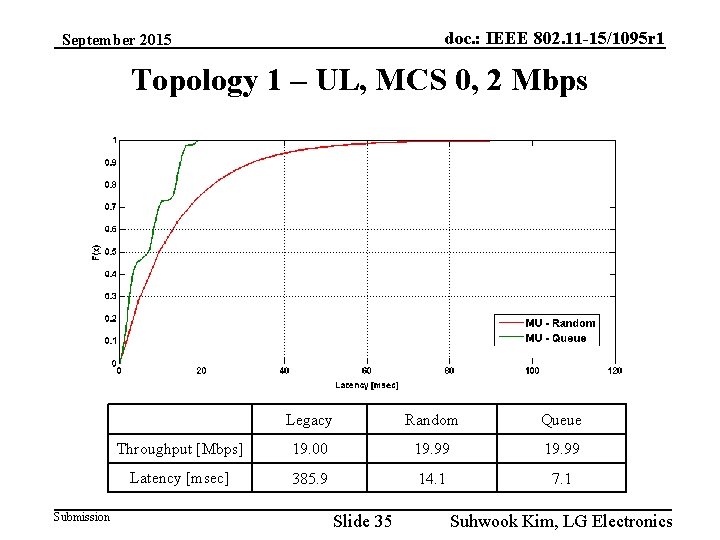
doc. : IEEE 802. 11 -15/1095 r 1 September 2015 Topology 1 – UL, MCS 0, 2 Mbps Submission Legacy Random Queue Throughput [Mbps] 19. 00 19. 99 Latency [msec] 385. 9 14. 1 7. 1 Slide 35 Suhwook Kim, LG Electronics
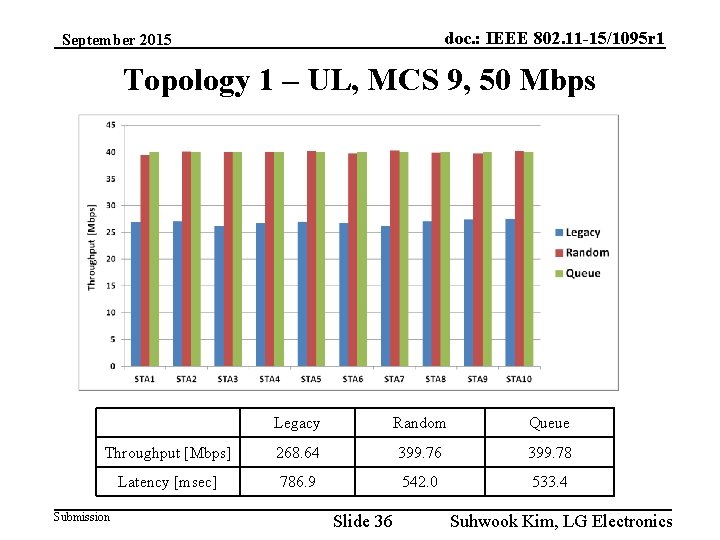
doc. : IEEE 802. 11 -15/1095 r 1 September 2015 Topology 1 – UL, MCS 9, 50 Mbps Legacy Random Queue Throughput [Mbps] 268. 64 399. 76 399. 78 Latency [msec] 786. 9 542. 0 533. 4 Submission Slide 36 Suhwook Kim, LG Electronics
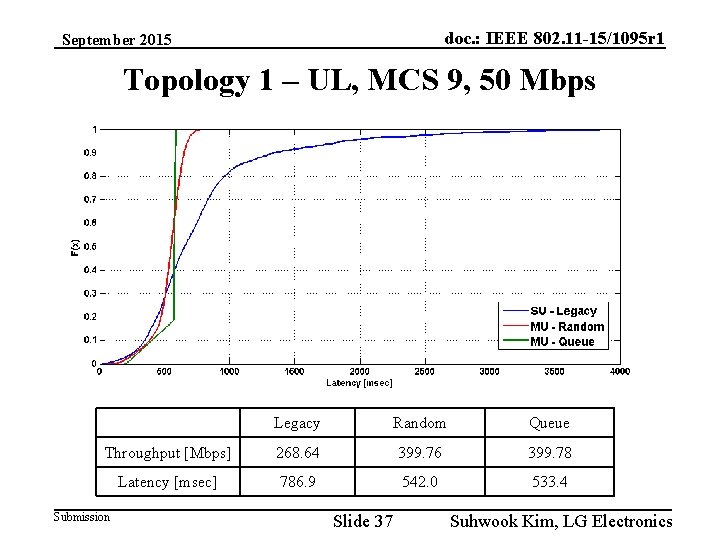
doc. : IEEE 802. 11 -15/1095 r 1 September 2015 Topology 1 – UL, MCS 9, 50 Mbps Legacy Random Queue Throughput [Mbps] 268. 64 399. 76 399. 78 Latency [msec] 786. 9 542. 0 533. 4 Submission Slide 37 Suhwook Kim, LG Electronics
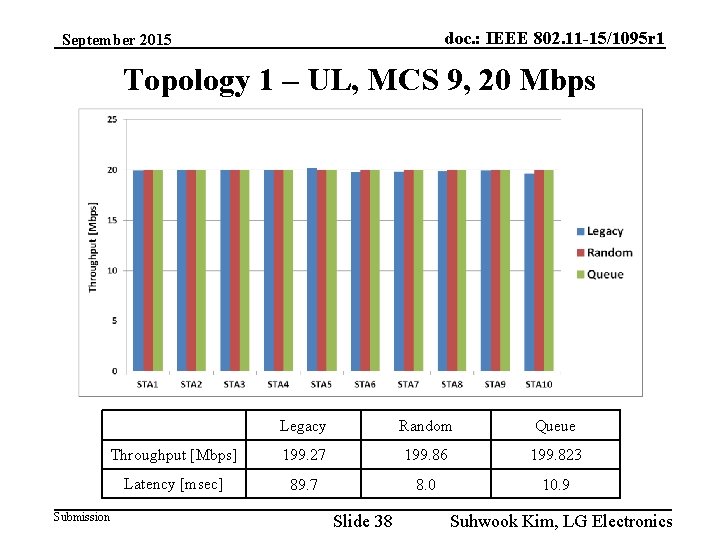
doc. : IEEE 802. 11 -15/1095 r 1 September 2015 Topology 1 – UL, MCS 9, 20 Mbps Submission Legacy Random Queue Throughput [Mbps] 199. 27 199. 86 199. 823 Latency [msec] 89. 7 8. 0 10. 9 Slide 38 Suhwook Kim, LG Electronics
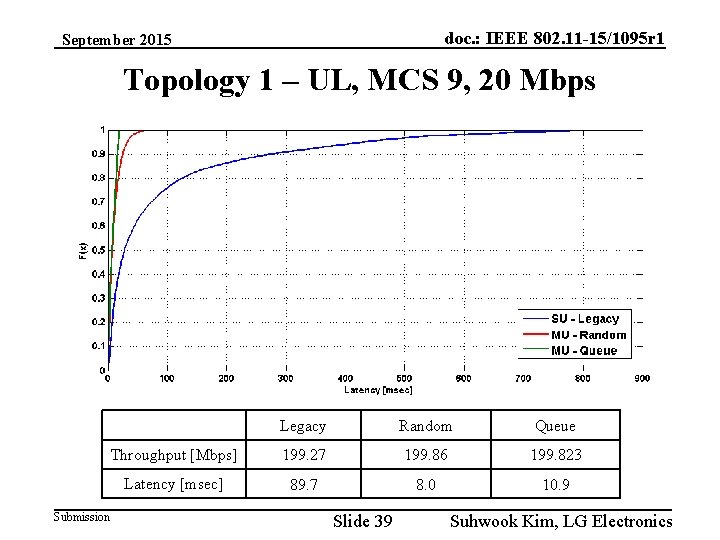
doc. : IEEE 802. 11 -15/1095 r 1 September 2015 Topology 1 – UL, MCS 9, 20 Mbps Submission Legacy Random Queue Throughput [Mbps] 199. 27 199. 86 199. 823 Latency [msec] 89. 7 8. 0 10. 9 Slide 39 Suhwook Kim, LG Electronics
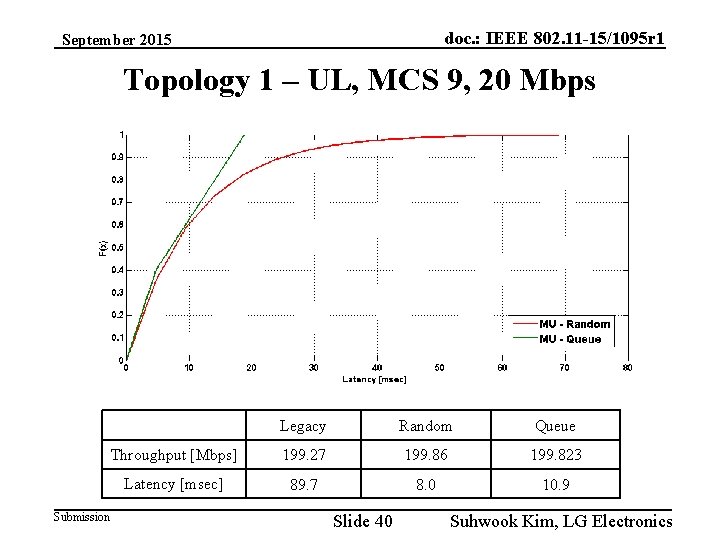
doc. : IEEE 802. 11 -15/1095 r 1 September 2015 Topology 1 – UL, MCS 9, 20 Mbps Submission Legacy Random Queue Throughput [Mbps] 199. 27 199. 86 199. 823 Latency [msec] 89. 7 8. 0 10. 9 Slide 40 Suhwook Kim, LG Electronics
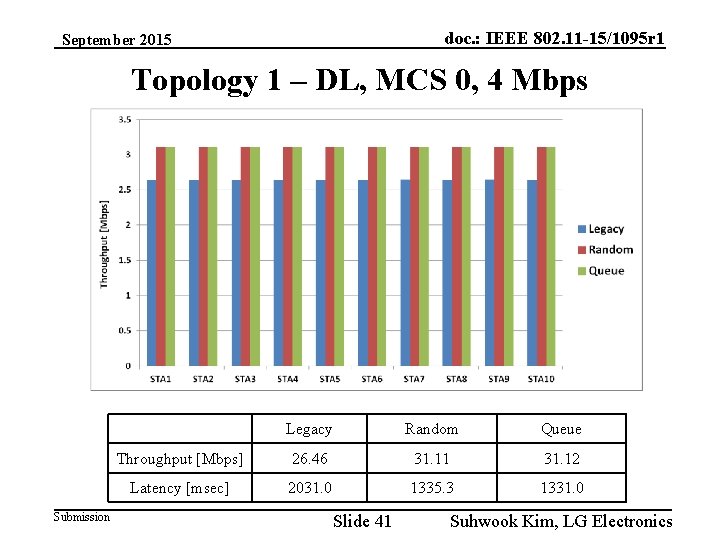
doc. : IEEE 802. 11 -15/1095 r 1 September 2015 Topology 1 – DL, MCS 0, 4 Mbps Submission Legacy Random Queue Throughput [Mbps] 26. 46 31. 11 31. 12 Latency [msec] 2031. 0 1335. 3 1331. 0 Slide 41 Suhwook Kim, LG Electronics
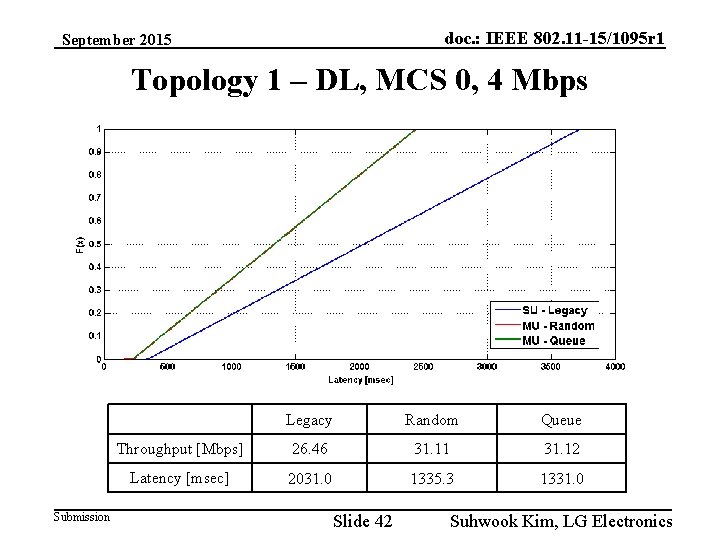
doc. : IEEE 802. 11 -15/1095 r 1 September 2015 Topology 1 – DL, MCS 0, 4 Mbps Submission Legacy Random Queue Throughput [Mbps] 26. 46 31. 11 31. 12 Latency [msec] 2031. 0 1335. 3 1331. 0 Slide 42 Suhwook Kim, LG Electronics
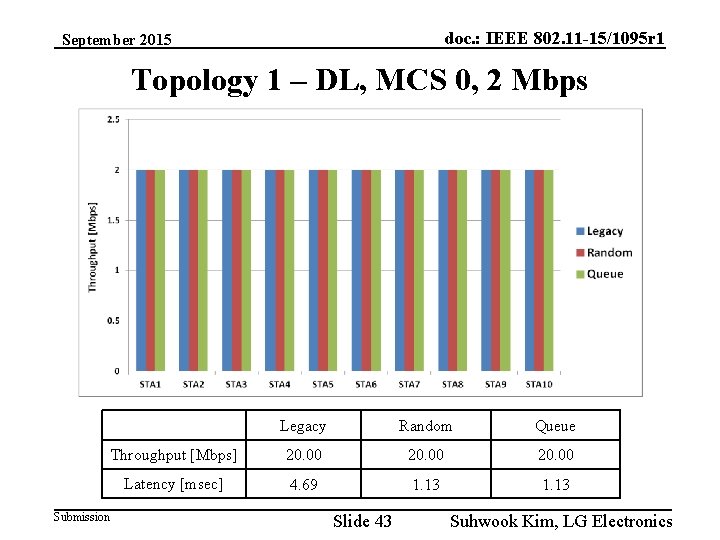
doc. : IEEE 802. 11 -15/1095 r 1 September 2015 Topology 1 – DL, MCS 0, 2 Mbps Submission Legacy Random Queue Throughput [Mbps] 20. 00 Latency [msec] 4. 69 1. 13 Slide 43 Suhwook Kim, LG Electronics
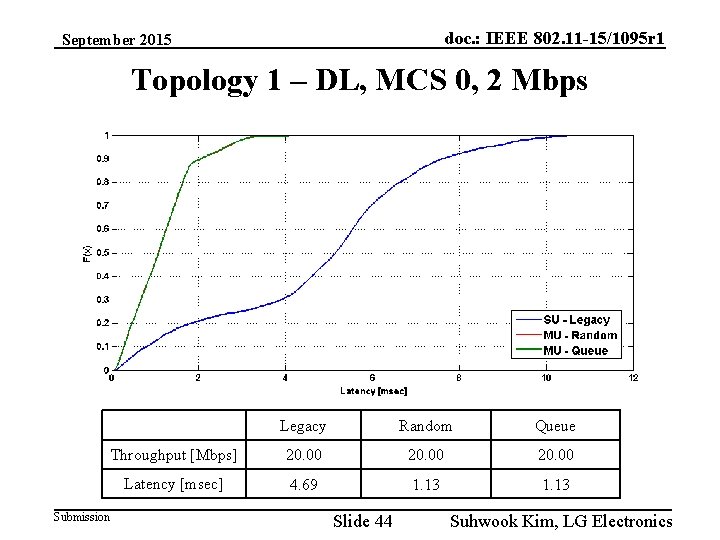
doc. : IEEE 802. 11 -15/1095 r 1 September 2015 Topology 1 – DL, MCS 0, 2 Mbps Submission Legacy Random Queue Throughput [Mbps] 20. 00 Latency [msec] 4. 69 1. 13 Slide 44 Suhwook Kim, LG Electronics
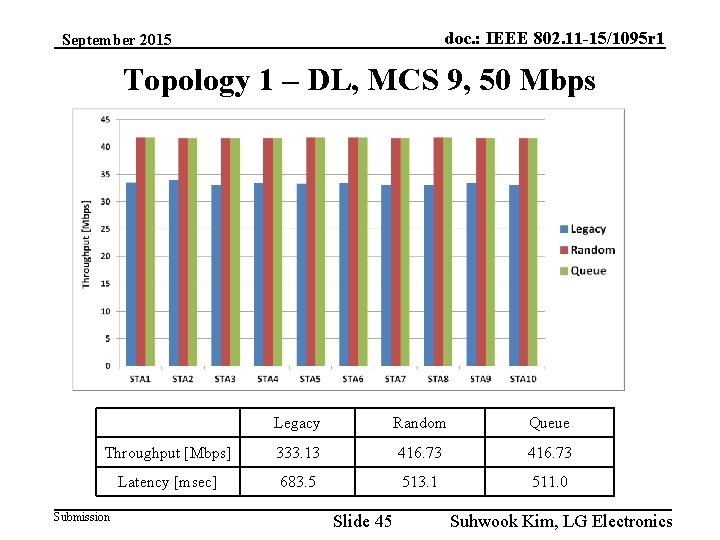
doc. : IEEE 802. 11 -15/1095 r 1 September 2015 Topology 1 – DL, MCS 9, 50 Mbps Legacy Random Queue Throughput [Mbps] 333. 13 416. 73 Latency [msec] 683. 5 513. 1 511. 0 Submission Slide 45 Suhwook Kim, LG Electronics
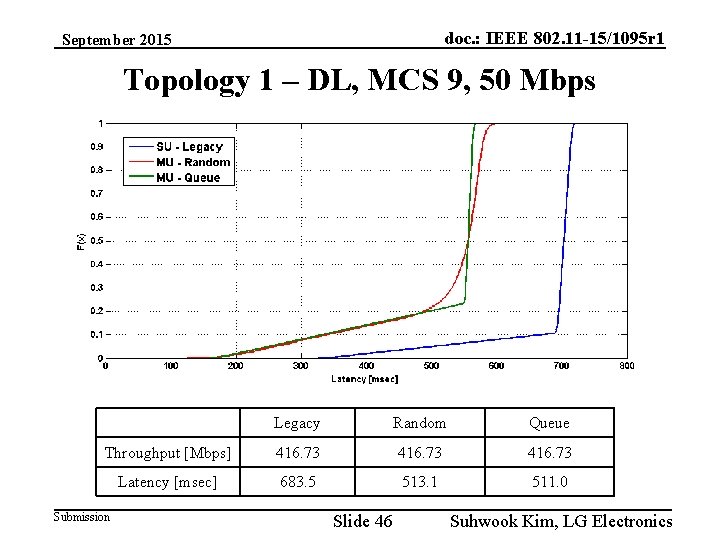
doc. : IEEE 802. 11 -15/1095 r 1 September 2015 Topology 1 – DL, MCS 9, 50 Mbps Legacy Random Queue Throughput [Mbps] 416. 73 Latency [msec] 683. 5 513. 1 511. 0 Submission Slide 46 Suhwook Kim, LG Electronics
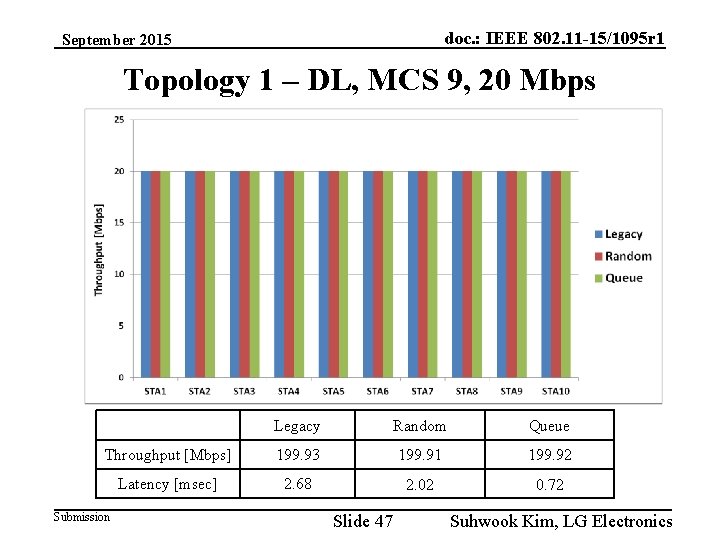
doc. : IEEE 802. 11 -15/1095 r 1 September 2015 Topology 1 – DL, MCS 9, 20 Mbps Legacy Random Queue Throughput [Mbps] 199. 93 199. 91 199. 92 Latency [msec] 2. 68 2. 02 0. 72 Submission Slide 47 Suhwook Kim, LG Electronics
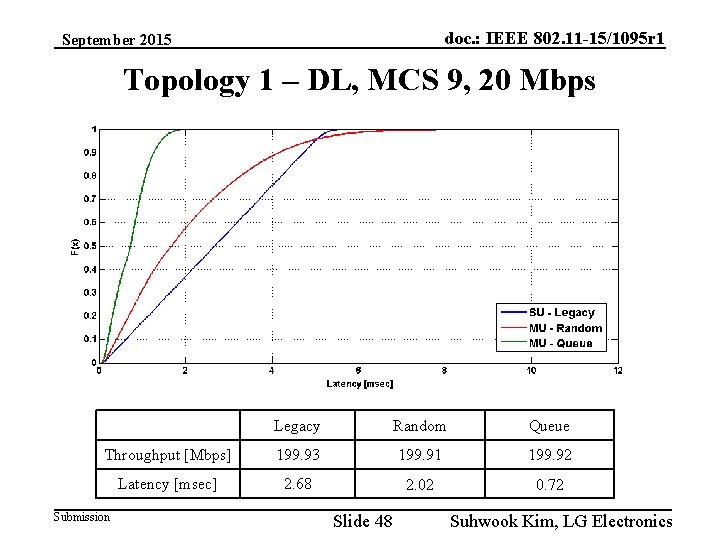
doc. : IEEE 802. 11 -15/1095 r 1 September 2015 Topology 1 – DL, MCS 9, 20 Mbps Legacy Random Queue Throughput [Mbps] 199. 93 199. 91 199. 92 Latency [msec] 2. 68 2. 02 0. 72 Submission Slide 48 Suhwook Kim, LG Electronics
doc. : IEEE 802. 11 -15/1095 r 1 September 2015 Backup Slide - Topology 2 Submission Slide 49 Suhwook Kim, LG Electronics
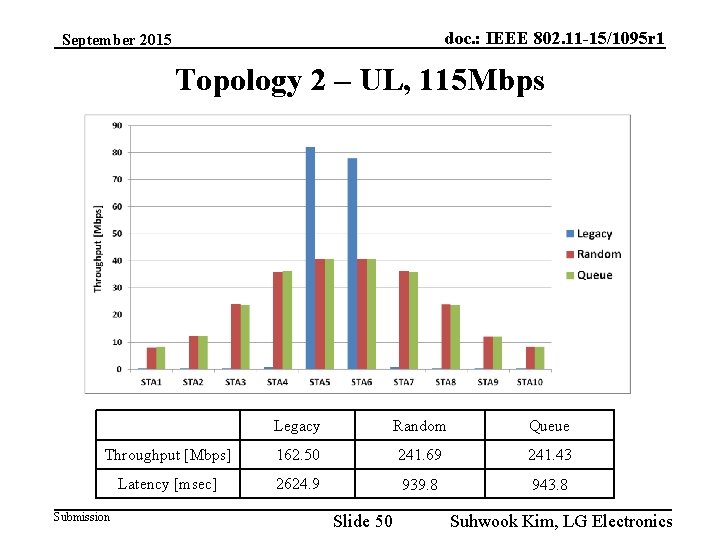
doc. : IEEE 802. 11 -15/1095 r 1 September 2015 Topology 2 – UL, 115 Mbps Legacy Random Queue Throughput [Mbps] 162. 50 241. 69 241. 43 Latency [msec] 2624. 9 939. 8 943. 8 Submission Slide 50 Suhwook Kim, LG Electronics
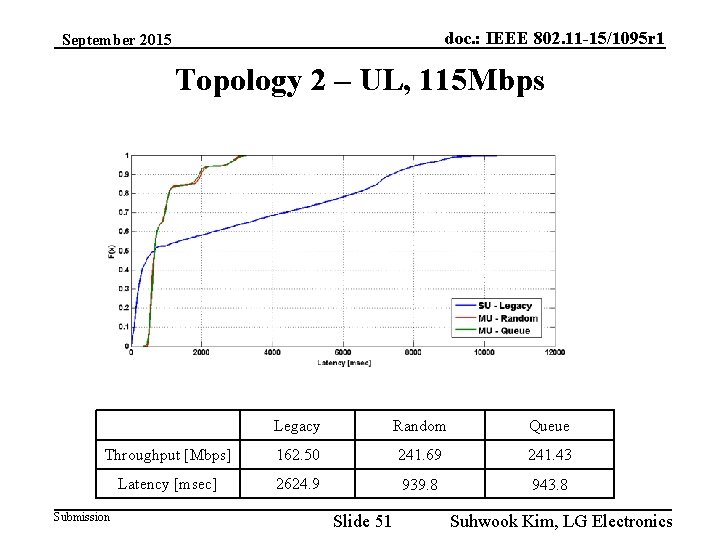
doc. : IEEE 802. 11 -15/1095 r 1 September 2015 Topology 2 – UL, 115 Mbps Legacy Random Queue Throughput [Mbps] 162. 50 241. 69 241. 43 Latency [msec] 2624. 9 939. 8 943. 8 Submission Slide 51 Suhwook Kim, LG Electronics
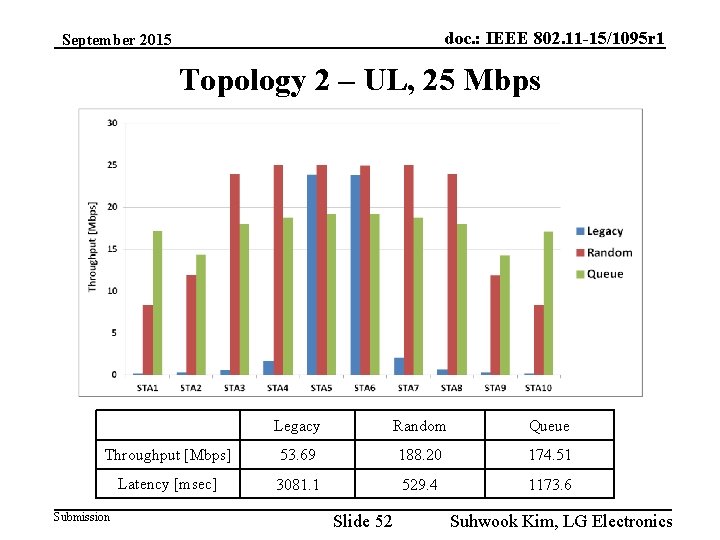
doc. : IEEE 802. 11 -15/1095 r 1 September 2015 Topology 2 – UL, 25 Mbps Legacy Random Queue Throughput [Mbps] 53. 69 188. 20 174. 51 Latency [msec] 3081. 1 529. 4 1173. 6 Submission Slide 52 Suhwook Kim, LG Electronics
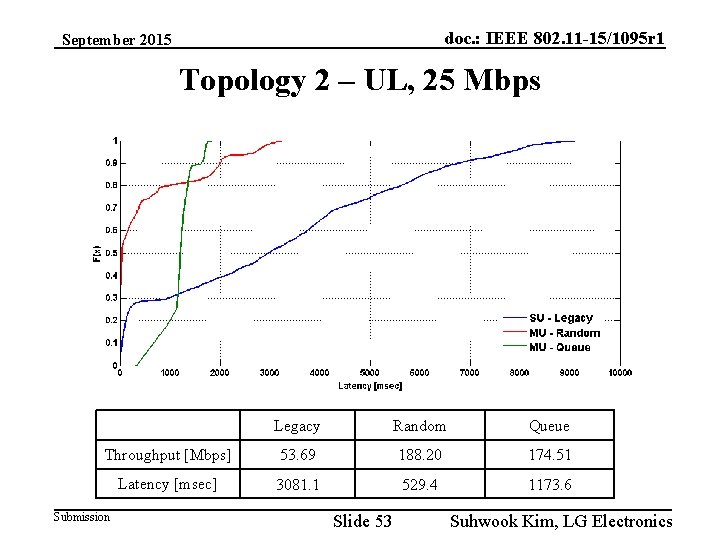
doc. : IEEE 802. 11 -15/1095 r 1 September 2015 Topology 2 – UL, 25 Mbps Legacy Random Queue Throughput [Mbps] 53. 69 188. 20 174. 51 Latency [msec] 3081. 1 529. 4 1173. 6 Submission Slide 53 Suhwook Kim, LG Electronics
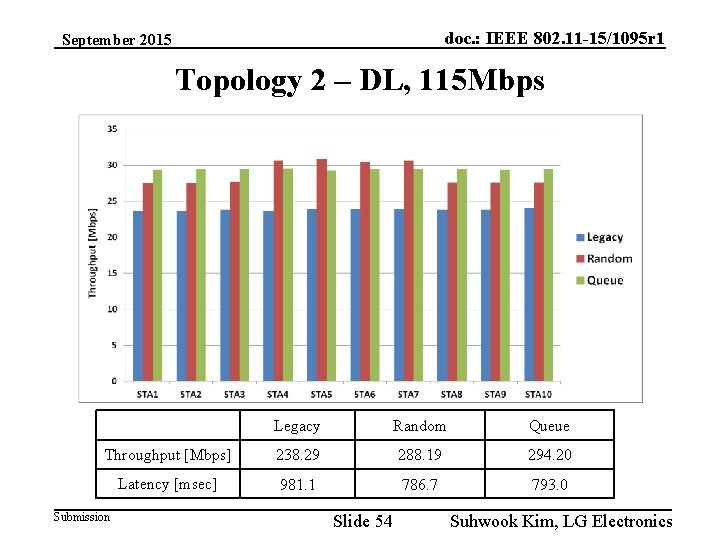
doc. : IEEE 802. 11 -15/1095 r 1 September 2015 Topology 2 – DL, 115 Mbps Legacy Random Queue Throughput [Mbps] 238. 29 288. 19 294. 20 Latency [msec] 981. 1 786. 7 793. 0 Submission Slide 54 Suhwook Kim, LG Electronics
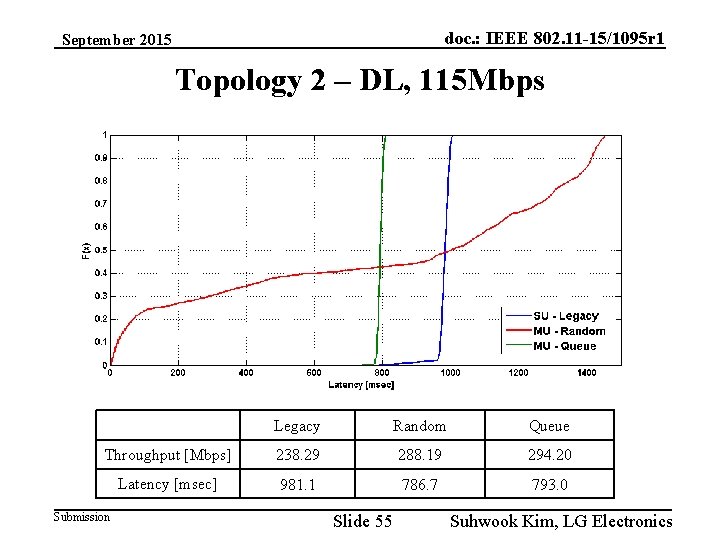
doc. : IEEE 802. 11 -15/1095 r 1 September 2015 Topology 2 – DL, 115 Mbps Legacy Random Queue Throughput [Mbps] 238. 29 288. 19 294. 20 Latency [msec] 981. 1 786. 7 793. 0 Submission Slide 55 Suhwook Kim, LG Electronics
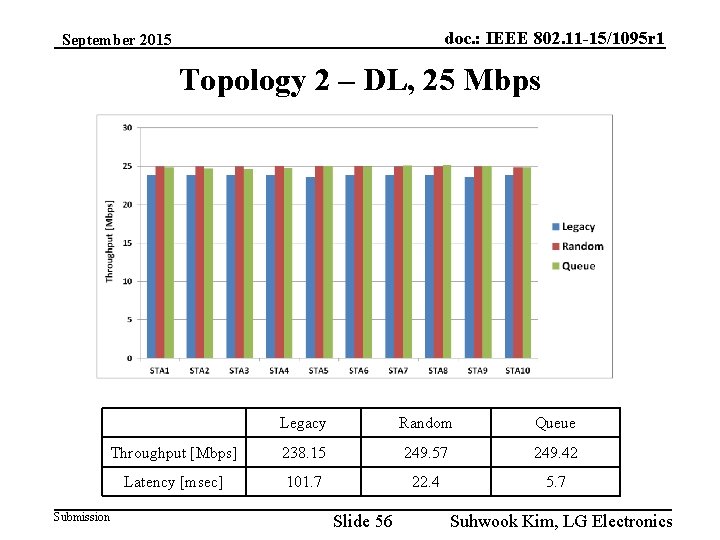
doc. : IEEE 802. 11 -15/1095 r 1 September 2015 Topology 2 – DL, 25 Mbps Submission Legacy Random Queue Throughput [Mbps] 238. 15 249. 57 249. 42 Latency [msec] 101. 7 22. 4 5. 7 Slide 56 Suhwook Kim, LG Electronics
doc. : IEEE 802. 11 -15/1095 r 1 September 2015 Backup Slide - Topology 3 Submission Slide 57 Suhwook Kim, LG Electronics
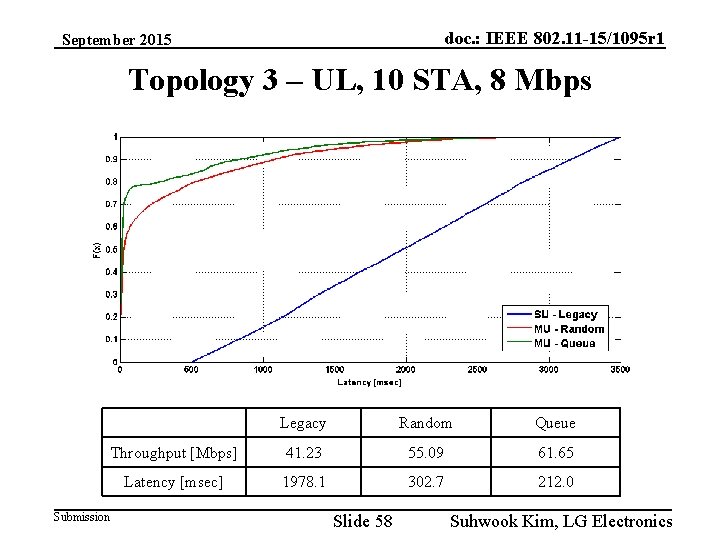
doc. : IEEE 802. 11 -15/1095 r 1 September 2015 Topology 3 – UL, 10 STA, 8 Mbps Submission Legacy Random Queue Throughput [Mbps] 41. 23 55. 09 61. 65 Latency [msec] 1978. 1 302. 7 212. 0 Slide 58 Suhwook Kim, LG Electronics
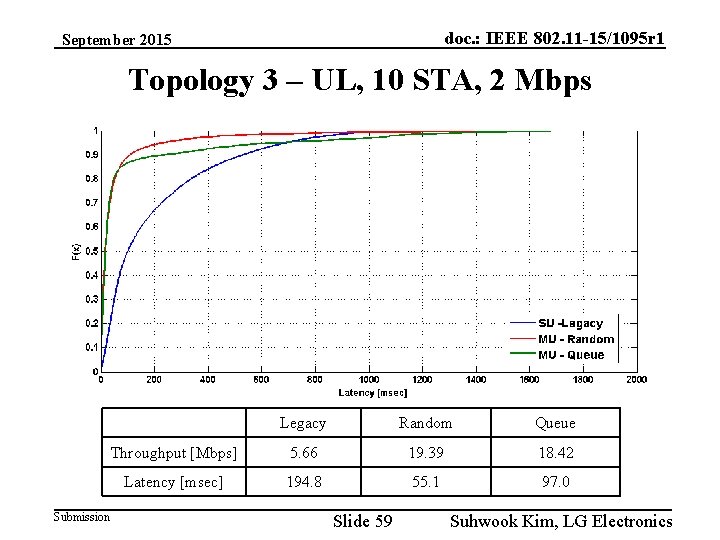
doc. : IEEE 802. 11 -15/1095 r 1 September 2015 Topology 3 – UL, 10 STA, 2 Mbps Submission Legacy Random Queue Throughput [Mbps] 5. 66 19. 39 18. 42 Latency [msec] 194. 8 55. 1 97. 0 Slide 59 Suhwook Kim, LG Electronics
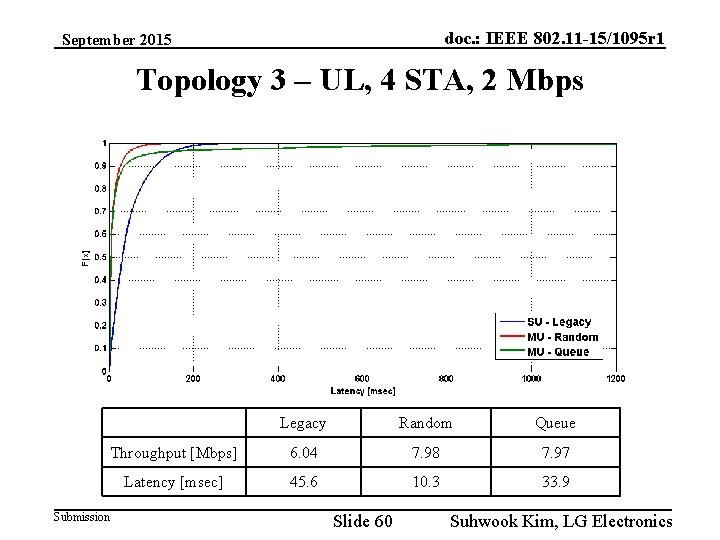
doc. : IEEE 802. 11 -15/1095 r 1 September 2015 Topology 3 – UL, 4 STA, 2 Mbps Submission Legacy Random Queue Throughput [Mbps] 6. 04 7. 98 7. 97 Latency [msec] 45. 6 10. 3 33. 9 Slide 60 Suhwook Kim, LG Electronics
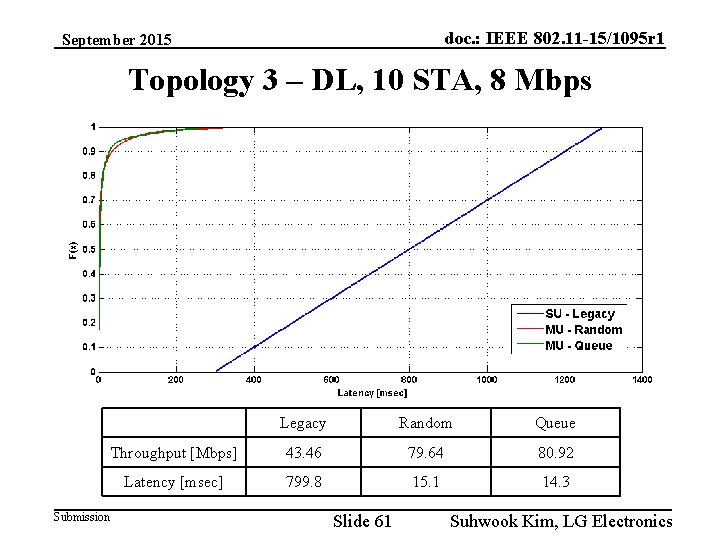
doc. : IEEE 802. 11 -15/1095 r 1 September 2015 Topology 3 – DL, 10 STA, 8 Mbps Submission Legacy Random Queue Throughput [Mbps] 43. 46 79. 64 80. 92 Latency [msec] 799. 8 15. 1 14. 3 Slide 61 Suhwook Kim, LG Electronics
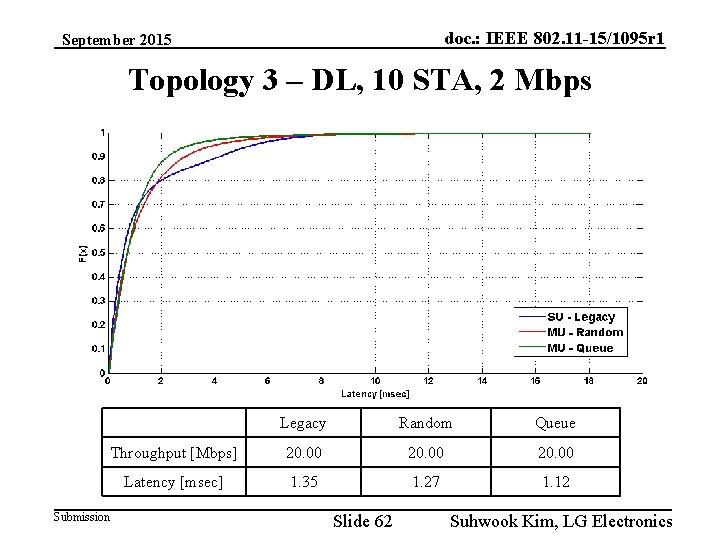
doc. : IEEE 802. 11 -15/1095 r 1 September 2015 Topology 3 – DL, 10 STA, 2 Mbps Submission Legacy Random Queue Throughput [Mbps] 20. 00 Latency [msec] 1. 35 1. 27 1. 12 Slide 62 Suhwook Kim, LG Electronics
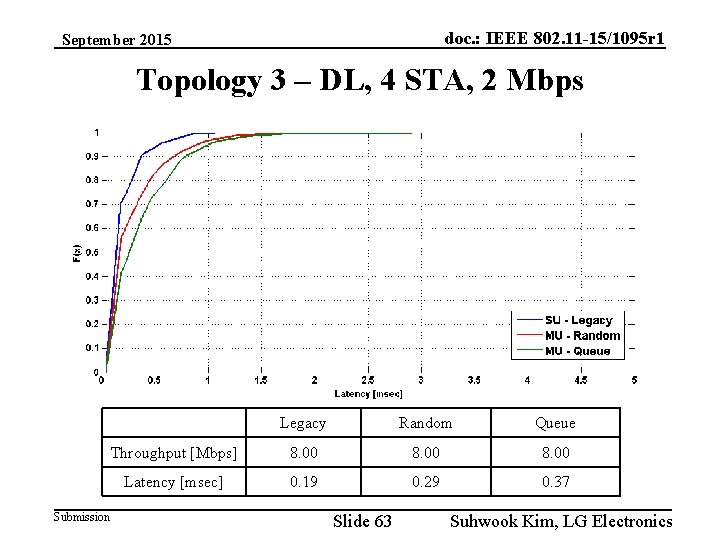
doc. : IEEE 802. 11 -15/1095 r 1 September 2015 Topology 3 – DL, 4 STA, 2 Mbps Submission Legacy Random Queue Throughput [Mbps] 8. 00 Latency [msec] 0. 19 0. 29 0. 37 Slide 63 Suhwook Kim, LG Electronics
- Slides: 63