
DOC DEMONSTRATION PROJECT PERFORMANCE MANAGEMENT WORKSHOP FOR MANAGERS



- Slides: 53
DOC DEMONSTRATION PROJECT PERFORMANCE MANAGEMENT WORKSHOP FOR MANAGERS
Pay for Performance System Key Questions 4 What is a pay for performance system? 4 What are the key drivers for a pay for performance system? 4 What are the benefits of a pay for performance system? 4 What can managers/supervisors do to make the pay for performance system a success? 2
Definition of a Pay for Performance System 4 Pay for performance systems are systems in which pay decisions are based on defined performance levels rather than entitlement, tenure, or other non-performance related factors 4 Pay decisions include: § Merit-based pay increases § Lump sum bonuses 3
Drivers of Pay for Performance Systems 4 Pay for performance systems emphasize achieving greater individual and organizational performance results 4 Need for more flexible compensation practices to Agency specific needs 4
Benefits of a Pay for Performance System 4 Rewards high performers 4 Allows greater flexibility for recruiting and hiring top talent 4 Provides opportunities for developing poor performing employees 4 Increases employee motivation 4 Contributes to employee retention 4 Deals more effectively with marginal employees 5
Pay for Performance Implementation Lessons Learned 1. Failing to make the pay for performance process transparent § Managers/supervisors can ensure that employees are informed about the pay for performance system, understand how the system will impact them, and what employee and management roles and responsibilities are under the new system 2. Providing inadequate training for managers/supervisors § While managers/supervisors cannot necessarily control the extent to which training is adequate, you can actively pursue information about the new system to make sure that you have the resources, tools, and skills needed to be successful 6
Pay for Performance Implementation Lessons Learned cont. 3. Managers/supervisors failing to truly distinguish employee performance § 4. Ensure success of this system by providing honest, accurate assessments of employee performance based on articulated performance objectives Managers/supervisors failing to evaluate employees solely on performance elements § Managers/supervisors have a responsibility to clearly articulate performance expectations to employees and to only evaluate them on those expectations 7
Understanding the Demo Project Performance Appraisal Process Key Questions 4 What is the Demonstration Project performance appraisal proces 4 What are the responsibilities of Rating Officials, Pay Pool Managers, and Employees? 4 What other pay-related interventions (other than performance-ba pay) are available to managers/supervisors to reward employees good performance? 4 How can managers/supervisors acclimate new employees to the performance appraisal process? 8
Intent of Demo Project’s Performance Appraisal System 4 Encourage high performance 4 Encourage continuous dialogue between supervisors and employees 4 Provide a basis for performance-related decisions (e. g. , pay increases, bonuses, PIPs) 9
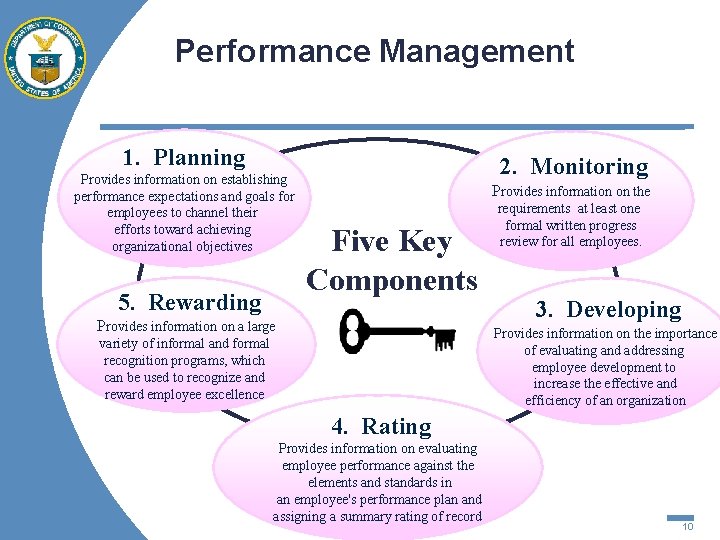
Performance Management 1. Planning Provides information on establishing performance expectations and goals for employees to channel their efforts toward achieving organizational objectives 5. Rewarding 2. Monitoring Provides information on the Five Key Components Provides information on a large requirements at least one formal written progress review for all employees. 3. Developing Provides information on the importance of evaluating and addressing employee development to increase the effective and efficiency of an organization variety of informal and formal recognition programs, which can be used to recognize and reward employee excellence 4. Rating Provides information on evaluating employee performance against the elements and standards in an employee's performance plan and assigning a summary rating of record 10
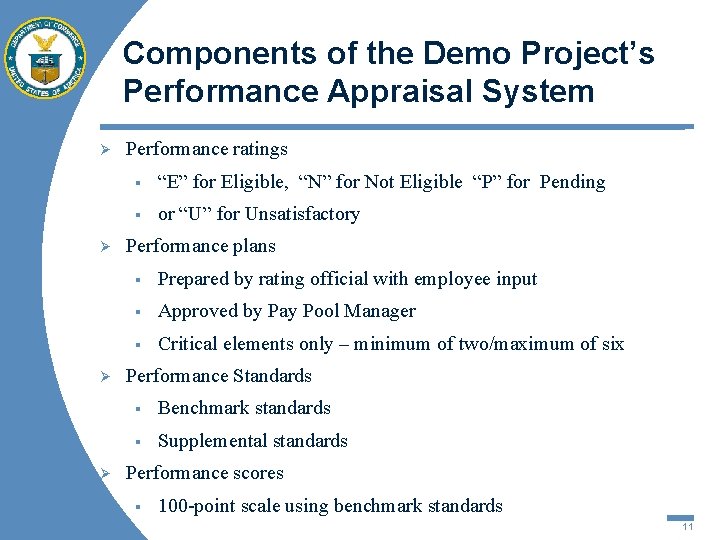
Components of the Demo Project’s Performance Appraisal System Ø Ø Performance ratings § “E” for Eligible, “N” for Not Eligible “P” for Pending § or “U” for Unsatisfactory Performance plans § Prepared by rating official with employee input § Approved by Pay Pool Manager § Critical elements only – minimum of two/maximum of six Performance Standards § Benchmark standards § Supplemental standards Performance scores § 100 -point scale using benchmark standards 11
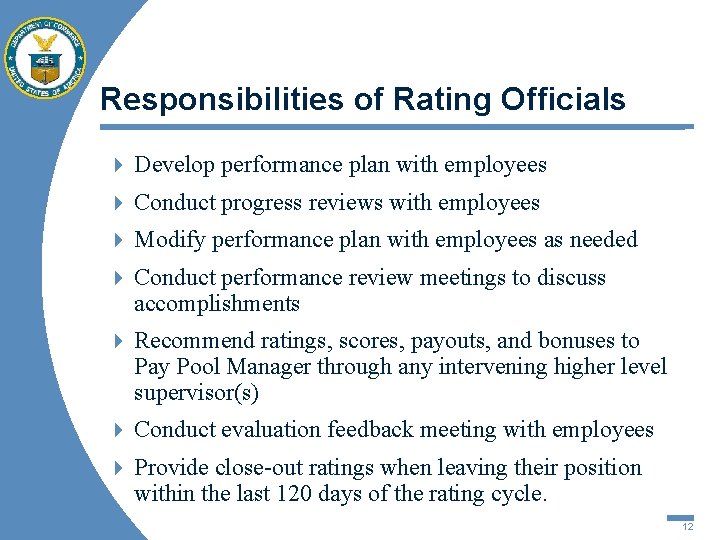
Responsibilities of Rating Officials 4 Develop performance plan with employees 4 Conduct progress reviews with employees 4 Modify performance plan with employees as needed 4 Conduct performance review meetings to discuss accomplishments 4 Recommend ratings, scores, payouts, and bonuses to Pay Pool Manager through any intervening higher level supervisor(s) 4 Conduct evaluation feedback meeting with employees 4 Provide close-out ratings when leaving their position within the last 120 days of the rating cycle. 12
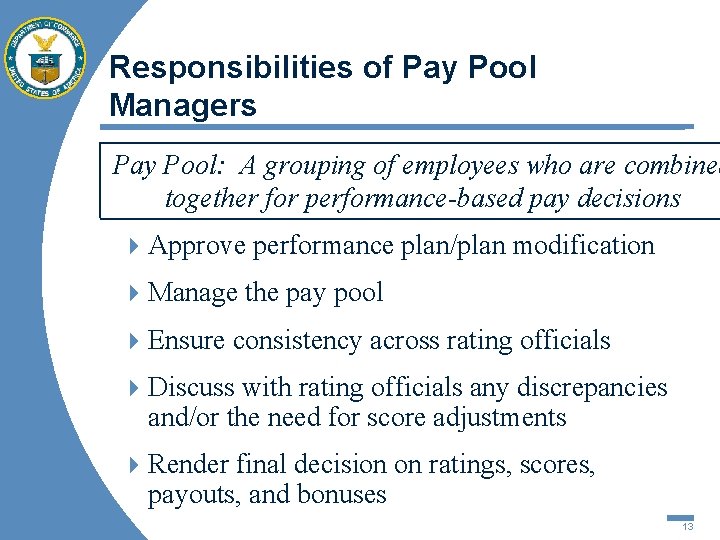
Responsibilities of Pay Pool Managers Pay Pool: A grouping of employees who are combined together for performance-based pay decisions 4 Approve performance plan/plan modification 4 Manage the pay pool 4 Ensure consistency across rating officials 4 Discuss with rating officials any discrepancies and/or the need for score adjustments 4 Render final decision on ratings, scores, payouts, and bonuses 13
Responsibilities of Employees 4 Create performance plan with Rating Official 4 Modify performance plan with Rating Official 4 Clearly, concisely, and accurately document accomplishments over past year 4 Seek out performance feedback throughout year 4 Respond to performance feedback 14
Pay for Performance Flexibility 4 Pay increases upon promotion § Managers/supervisors can set employee’s salary anywhere within the band when promoted 4 Performance bonuses § Rewards high performers, with intent to motivate performance 4 Supervisory performance pay § Managers/supervisors at band’s pay ceiling max can receive up to six percent higher 15
Comparability Increases All employees will receive the annual comparability increases except: 4 Employees with an “Unsatisfactory” rating 4 Employees on a PIP at time of comparability increase § § Employees on a PIP will receive comparability increase at the time they successfully complete a PIP Payment of ACI, not retroactive 16
Acclimating Employees to the Performance Appraisal Process 4 Employees must have a clear understanding of performance expectations 4 Employees will do well if they understand how performance is linked to success 4 Feedback provides employees with an understanding of level of performance 4 Employees want to understand if their performance is meeting management expectations 17
Managing and Evaluating Employee Performance Key Questions 4 How can managers/supervisors identify the linkage between organizational goals and work unit/team goals and objectives? 4 How can managers/supervisors help employees establish performance elements that are linked to organizational goals? 4 How are performance plans created? 4 How can managers/supervisors effectively evaluate performance? 18
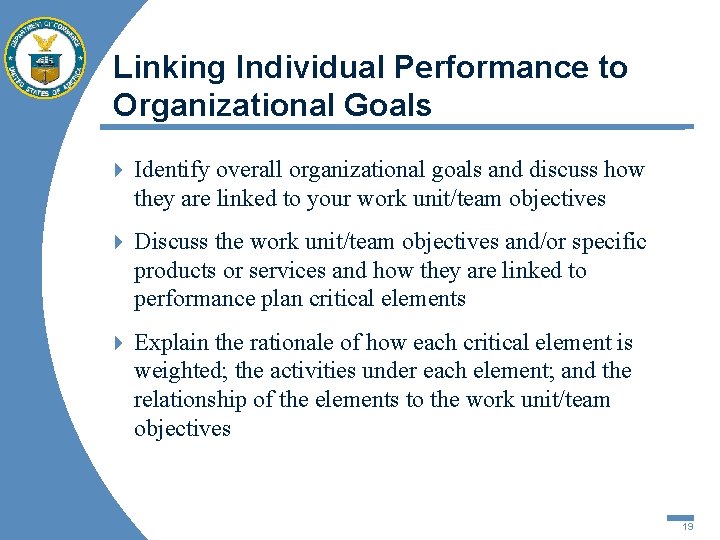
Linking Individual Performance to Organizational Goals 4 Identify overall organizational goals and discuss how they are linked to your work unit/team objectives 4 Discuss the work unit/team objectives and/or specific products or services and how they are linked to performance plan critical elements 4 Explain the rationale of how each critical element is weighted; the activities under each element; and the relationship of the elements to the work unit/team objectives 19
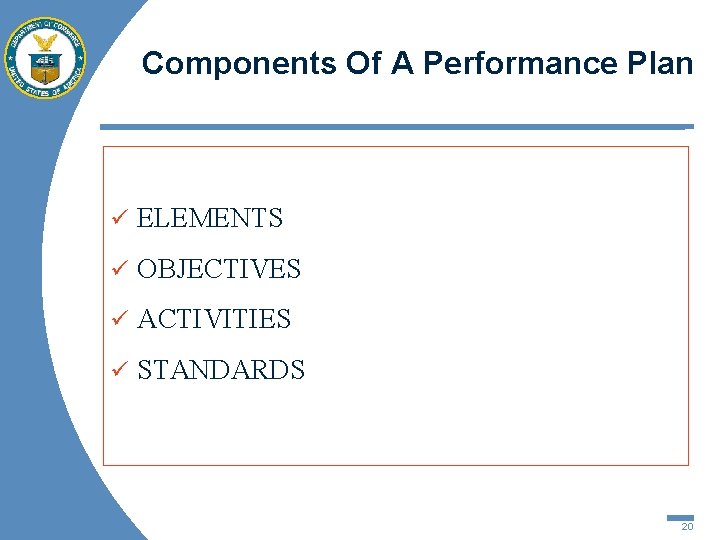
Components Of A Performance Plan ü ELEMENTS ü OBJECTIVES ü ACTIVITIES ü STANDARDS 20
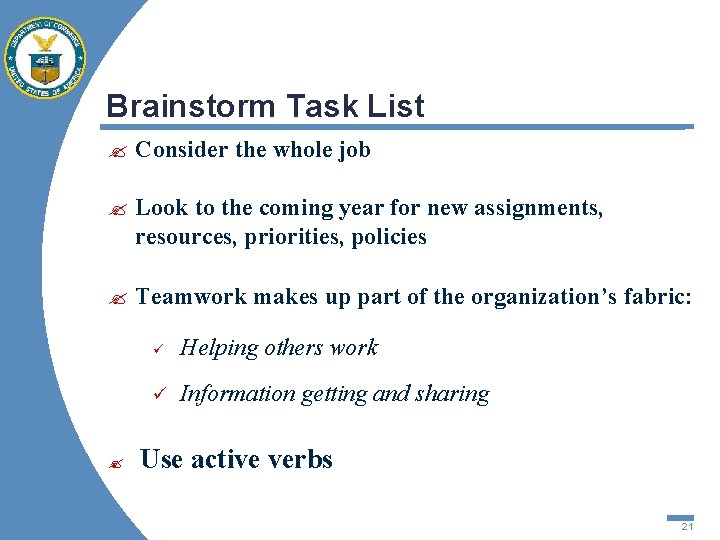
Brainstorm Task List ? Consider the whole job ? Look to the coming year for new assignments, resources, priorities, policies ? Teamwork makes up part of the organization’s fabric: ? ü Helping others work ü Information getting and sharing Use active verbs 21
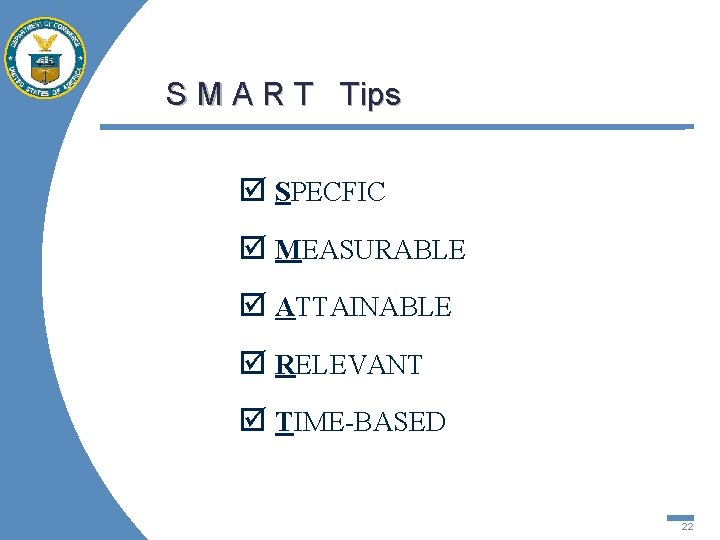
S M A R T Tips þ SPECFIC þ MEASURABLE þ ATTAINABLE þ RELEVANT þ TIME-BASED 22
Choose Measurements Quality Quantity Timeliness Cost-Effectiveness 23
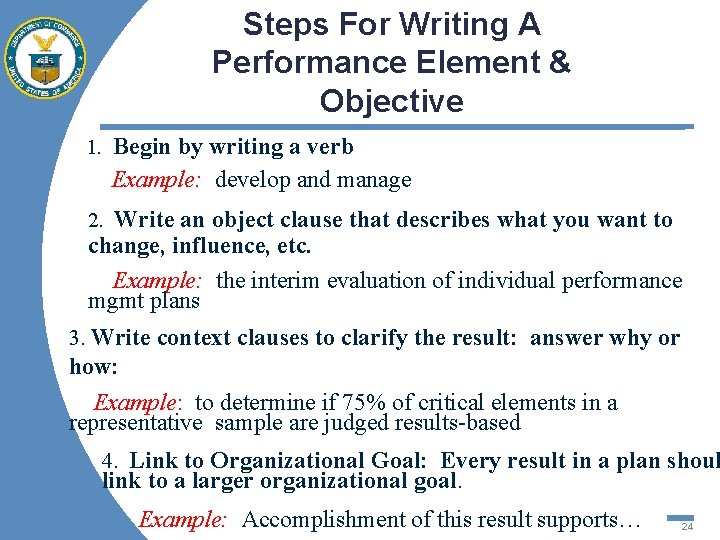
Steps For Writing A Performance Element & Objective 1. Begin by writing a verb Example: develop and manage 2. Write an object clause that describes what you want to change, influence, etc. Example: the interim evaluation of individual performance mgmt plans 3. Write context clauses to clarify the result: answer why or how: Example: to determine if 75% of critical elements in a representative sample are judged results-based 4. Link to Organizational Goal: Every result in a plan shoul link to a larger organizational goal. Example: Accomplishment of this result supports… 24
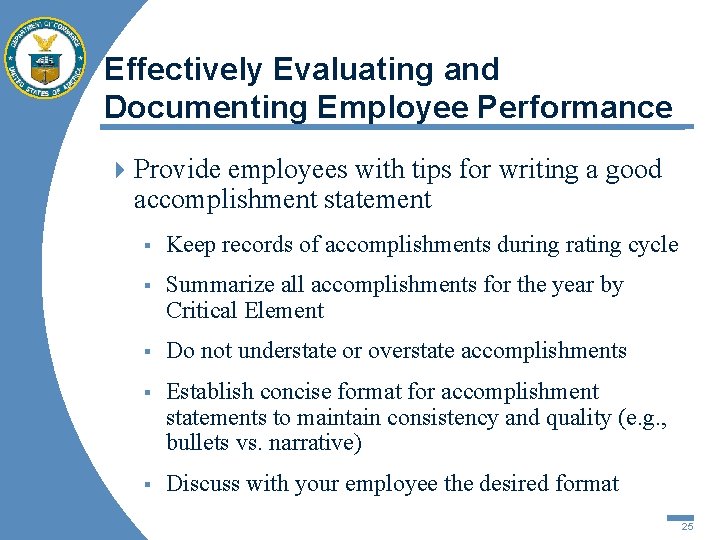
Effectively Evaluating and Documenting Employee Performance 4 Provide employees with tips for writing a good accomplishment statement § Keep records of accomplishments during rating cycle § Summarize all accomplishments for the year by Critical Element § Do not understate or overstate accomplishments § Establish concise format for accomplishment statements to maintain consistency and quality (e. g. , bullets vs. narrative) § Discuss with your employee the desired format 25
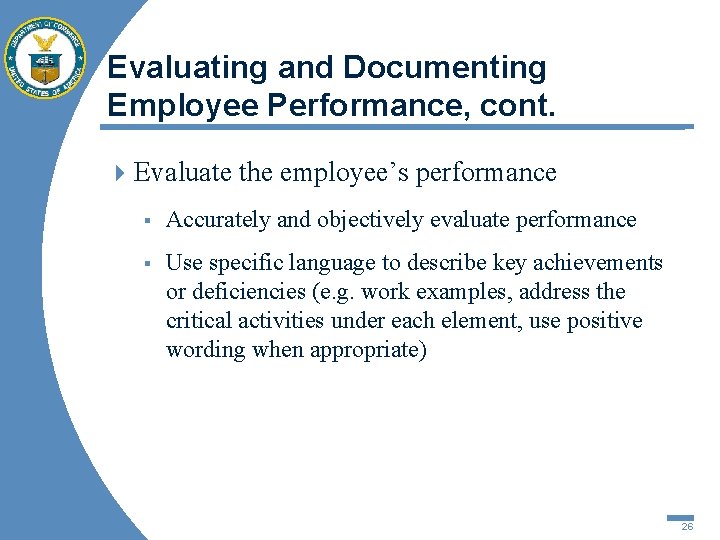
Evaluating and Documenting Employee Performance, cont. 4 Evaluate the employee’s performance § Accurately and objectively evaluate performance § Use specific language to describe key achievements or deficiencies (e. g. work examples, address the critical activities under each element, use positive wording when appropriate) 26
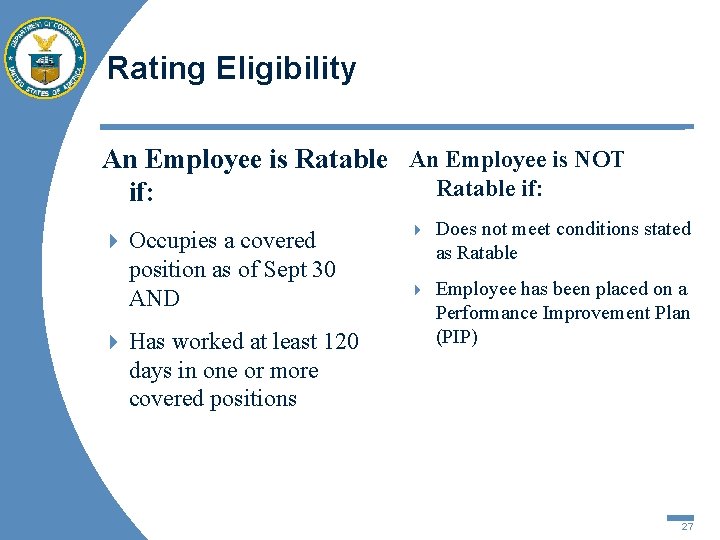
Rating Eligibility An Employee is Ratable An Employee is NOT Ratable if: 4 Occupies a covered position as of Sept 30 AND 4 Has worked at least 120 4 Does not meet conditions stated as Ratable 4 Employee has been placed on a Performance Improvement Plan (PIP) days in one or more covered positions 27
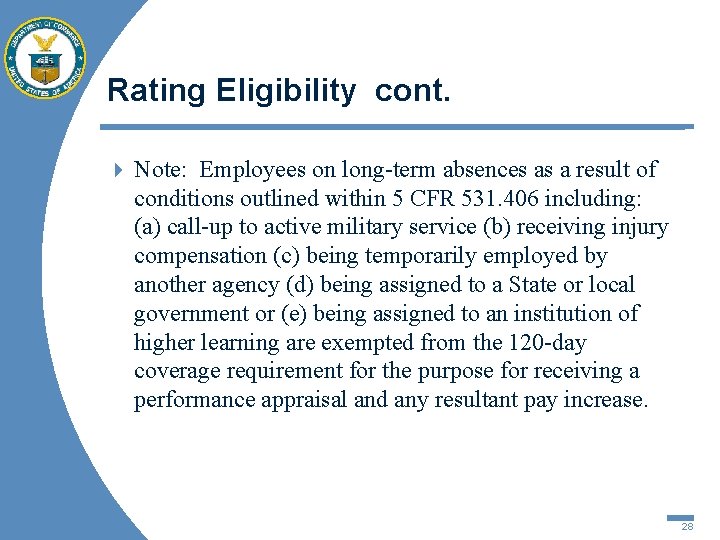
Rating Eligibility cont. 4 Note: Employees on long-term absences as a result of conditions outlined within 5 CFR 531. 406 including: (a) call-up to active military service (b) receiving injury compensation (c) being temporarily employed by another agency (d) being assigned to a State or local government or (e) being assigned to an institution of higher learning are exempted from the 120 -day coverage requirement for the purpose for receiving a performance appraisal and any resultant pay increase. 28
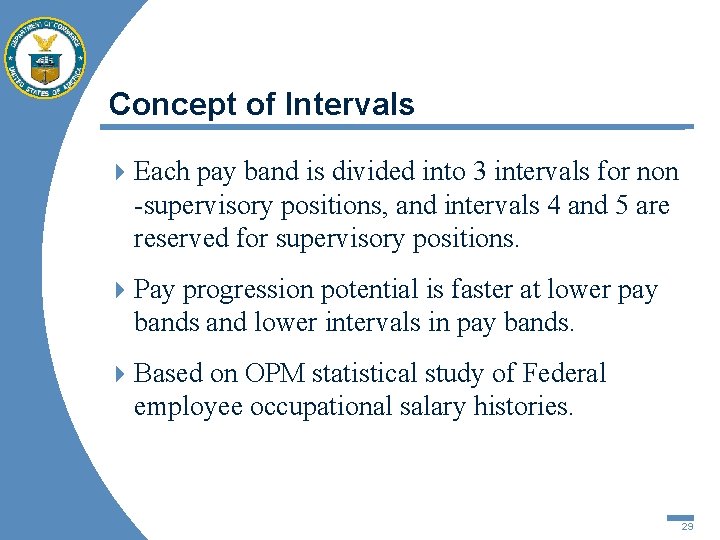
Concept of Intervals 4 Each pay band is divided into 3 intervals for non -supervisory positions, and intervals 4 and 5 are reserved for supervisory positions. 4 Pay progression potential is faster at lower pay bands and lower intervals in pay bands. 4 Based on OPM statistical study of Federal employee occupational salary histories. 29
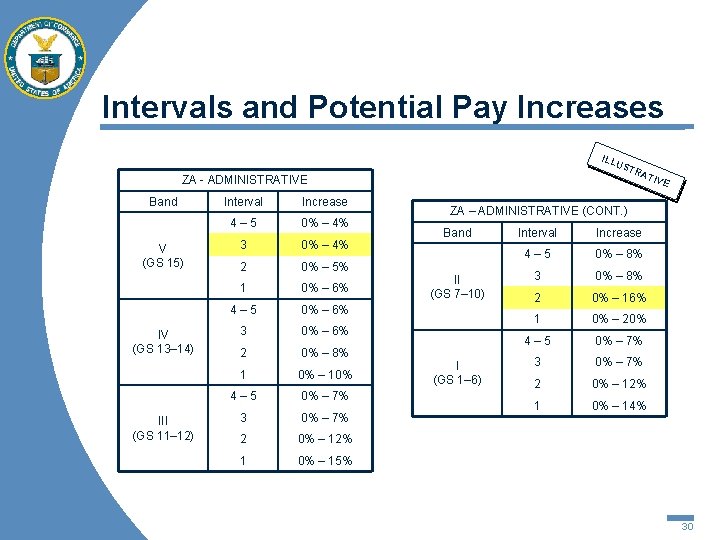
Intervals and Potential Pay Increases ILL US TRA ZA - ADMINISTRATIVE Band V (GS 15) IV (GS 13– 14) III (GS 11– 12) Interval Increase 4– 5 0% – 4% 3 0% – 4% 2 0% – 5% 1 0% – 6% 4– 5 0% – 6% 3 0% – 6% 2 0% – 8% 1 0% – 10% 4– 5 0% – 7% 3 0% – 7% 2 0% – 12% 1 0% – 15% TIV E ZA – ADMINISTRATIVE (CONT. ) Band II (GS 7– 10) I (GS 1– 6) Interval Increase 4– 5 0% – 8% 3 0% – 8% 2 0% – 16% 1 0% – 20% 4– 5 0% – 7% 3 0% – 7% 2 0% – 12% 1 0% – 14% 30
Payout Rules 4 Highest scored employee receives highest relative percentage payout 4 Lower scored employees cannot receive a greater relative percentage payout 4 Tied scores might not receive same relative percentage payout 31
Providing Effective Performance Feedback Key Questions 4 How can feedback improve employee performance? 4 What are strategies that managers/supervisors can use to provide effective feedback? 4 What are the ramifications of providing inadequate, poor, or untimely performance feedback? 4 What communication barriers may arise and what can managers/supervisors do to overcome them? 32
Performance Feedback Is An Ongoing Process 4 Reviewing Work 4 Conducting Progress Reviews and Annual Appraisals 4 Addressing Performance Issues 4 Maintaining open lines of communications 33
Performance Feedback Strategies 4 Provide continuous constructive feedback 4 Prepare the employee for the discussion in advance 4 Be clear on the purpose of the meeting 4 Have a clear message 4 Be specific 4 Emphasize the positive 34
Performance Feedback Strategies, cont. 4 Be timely 4 Focus on accomplishments 4 Respect the individual 4 Leave communication lines open 35
Consequences of Ineffective Feedback 4 Employees may not focus on performance goals and expectations. 4 Employees may lose motivation 4 Employees may become disgruntled 4 Low employee morale 4 Unexpected turnover 36
Communication Barriers 4 Communication styles 4 Use of verbal and non-verbal language 4 Lack of trust 37
Overcoming Communication Barriers 4 Familiarize yourself with communication styles of your employees 4 Understand what motivates your employees 4 Become aware of your communication style and modify as necessary to be effective 38
“Do’s” of Providing Feedback 4 Do establish a relaxed environment 4 Do engage in a 2 -way dialogue 4 Do highlight positive or good behavior 4 Do keep the conversation focused on performance issues 4 Do maintain control of the conversation 4 Do offer constructive criticism 39
“Don’ts” of Providing Feedback 4 Don’t be confrontational 4 Don’t be accusatory 4 Don’t only focus on faults or mistakes 4 Don’t bring personal issues into the discussion 4 Don’t become agitated or angry 40
Managing Marginal Performance Key Questions 4 How can managers/supervisors successfully identify a marginal performer? 4 How can managers/supervisors help marginal performers become high performing employees? 4 What options do managers/supervisors have for managing marginal performance? 41
Identifying Marginal Performance 4 Missed deadlines 4 Decreased productivity 4 Lack of dependability 4 Lack of proficiency 4 Failure to perform current work assignments 42
Understanding Causes of Marginal Performance Ask Yourself: 4 What is it about the person’s performance that has a negative effect on the work being done? 4 What are things I actually see and hear that indicate there is a problem? 4 Does the employee know that there is a performance issue? 43
Understanding Causes of Marginal Performance, cont. 4 Have I clearly communicated performance objectives and expectations ? 4 What aspects of the employee’s performance needs to change in order to convince me that the employee has improved? 4 Are there obstacles or barriers to the employee performing well (e. g. work environment, training)? 4 Is the problem marginal performance or misconduct? 44
The failure of an employee to do the job at an acceptable level. The failure to follow a workplace rule (whether written or unwritten). Examples of misconduct include tardiness and absenteeism, insubordination, and falsification. 45
Managing the Marginal Performer 4 Address marginal performance early 4 Document all evidence relating to that employee’s low performance level 4 Schedule performance review meetings with the employee 4 Be prepared to take appropriate action 46
Tips for the Meeting 4 Avoid referring to the situation beyond the impact it has on the employee’s performance 4 Engage the employee in the discussion to obtain their perspective on the matter 4 Limit the discussion to job related issues 47
Managing Continued Marginal Performance 4 Readdress the issue with the employee and discuss the causes for lack of progress 4 Continue to work with the employee to address and overcome performance issues 4 Determine whether or not the employee is still a good match for the position 4 Explore alternative options for managing the employee 48
Managing Marginal Performance Under the Demo Project 4 Managers/supervisors have more options available for managing a marginal performer (e. g. , developing a PIP, tailoring responsibilities, little or no pay increases) 4 Employees have a more vested interest in their performance throughout the year 49
How to Help Employees who are Failing N Develop and set specific expectations and standards N Closely monitor performance N Assign the employee a “mentor” N Give specific and timely feedback N Consider training, where appropriate N Provide work assignments that build confidence N Help employee plan and prioritize their work N Determine if the performance problem is a result of a non-work issue 50
Grievance Procedures 4 15 calendar days for employees to file a request for reconsideration (informal grievance) 4 15 calendar days for management to formally respond to informal grievance 4 10 calendar days for employee to file formal grievance 4 90 calendar days for management to respond to formal grievance 51
Grievance Rights • Grievable - Performance Score - Rating - Pay Increase Not Grievable - Performance Plan - Bonus decisions 52
DEMONSTRATION PROJECT REFERENCE WEB SITES http: //ohrm. os. doc. gov/Demo/index. htm http: //www. wfm. noaa. gov/performancemgmt/demoproject emo_training. html 53