
Do you think its possible to abolish war

Do you think it’s possible to abolish war? Turn & Talk!
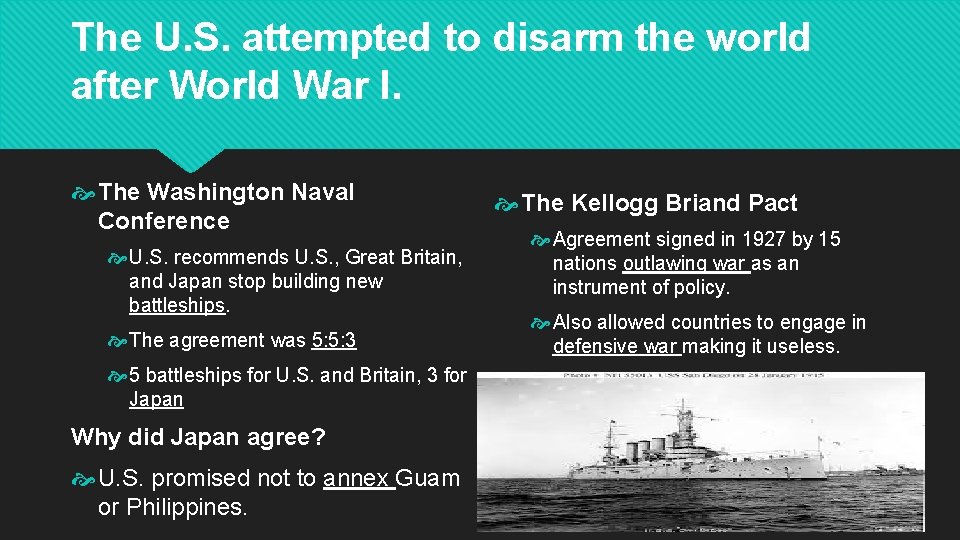
The U. S. attempted to disarm the world after World War I. The Washington Naval Conference U. S. recommends U. S. , Great Britain, and Japan stop building new battleships. The agreement was 5: 5: 3 5 battleships for U. S. and Britain, 3 for Japan Why did Japan agree? U. S. promised not to annex Guam or Philippines. The Kellogg Briand Pact Agreement signed in 1927 by 15 nations outlawing war as an instrument of policy. Also allowed countries to engage in defensive war making it useless.
Stabilizing the economy The Dawes Plan War debts caused serious issues in the early 1920 s. Britain, France, and Italy owed over $10 billion to U. S. Germany forced to pay $32 billion in reparations. Germany could not pay Charles Dawes came up with the plan in 1924 to stabilize the global economy.

The Dawes Plan U. S. investors loan Germany $200 million Germany uses money to pay reparations to Britain and France use German reparations to pay debt to U. S. Gives U. S. significant economic advantage and causes resentment.
Economic Policies of the 1920 s President Harding raised tariffs, lowered taxes of the wealthy, and loosened government enforcement of business regulations. President Coolidge reduced government spending but made no changes to Harding’s earlier policies leading to overproduction and under-consumption. President Hoover supported “rugged individualism”—the idea that a person’s effort is what made them successful. He was more willing to use the government in regulating business, and assisted farmers with government loans.

Practice Tasks Task 1: Task 2: Complete the handout on the attempts to avoid future wars. (25 mins) Complete the chart comparing and contrasting the different economic policies on President Harding, Coolidge, and Hoover. (30 mins) If you finish early, go back and double-check your work, review your notes, then practice your vocabulary.

What caused the “boom” of the 1920 s and how did it change life for Americans? What we will be able to answer
What caused the Boom? 1. Greater efficiency in manufacturing Henry Ford introduced the electric conveyor belt on his assembly line. Shortened production time and increased amount able to be produced. 2. The Automobile Higher production lowered the price of the car By 1930, 1 in 6 Americans owned a car Gave people more mobility and led to the development of the suburbs Cars could transport hidden alcohol
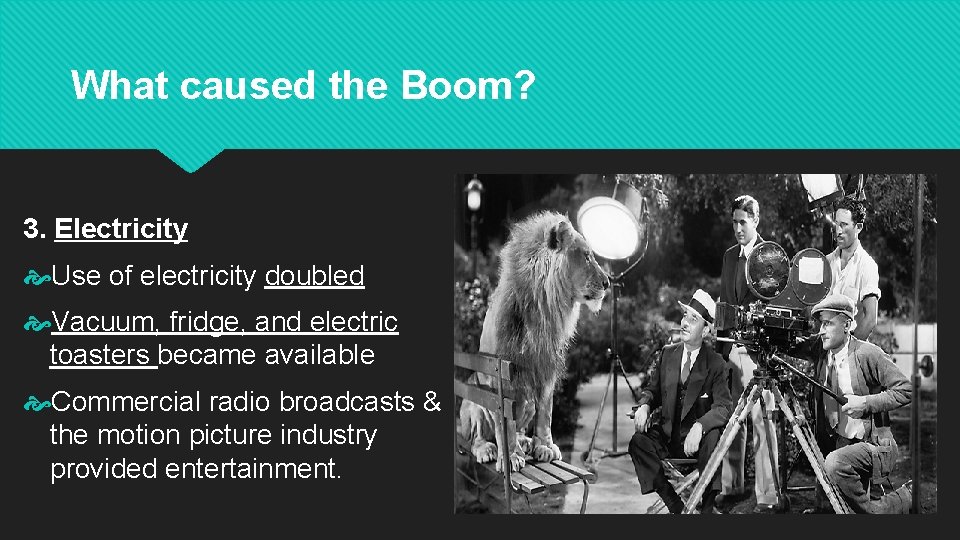
What caused the Boom? 3. Electricity Use of electricity doubled Vacuum, fridge, and electric toasters became available Commercial radio broadcasts & the motion picture industry provided entertainment.
Creating Consumerism Mass production requires mass consumption The BIG QUESTION: How is the government/companies going to convince people to buy products? Growth of advertising in newspapers, magazines, and on the radio Americans were receiving higher wages and had a shorter work week This allows for more free time and money to spend on products.
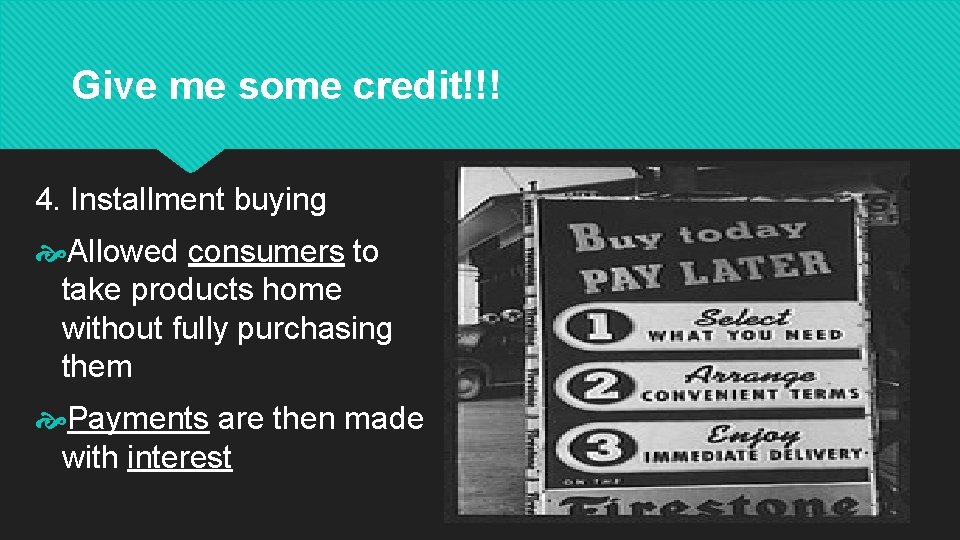
Give me some credit!!! 4. Installment buying Allowed consumers to take products home without fully purchasing them Payments are then made with interest

Speculation in the Stock Market 5. Speculation = buying an item, not for personal use, but with the hope of reselling it later at a higher price. As the demand for stocks rose, the price increased creating a bull market. Most people purchased stocks on “margin” another term for credit, paying only 10% of the actual cost.
Not about that Gatsby life Not all groups were prosperous in the 1920 s Increase in production led to large drop in prices of food for farmers. Railroads became unprofitable because of competition from cars and trucks. Coal industry faced new competition from oil and natural gas.
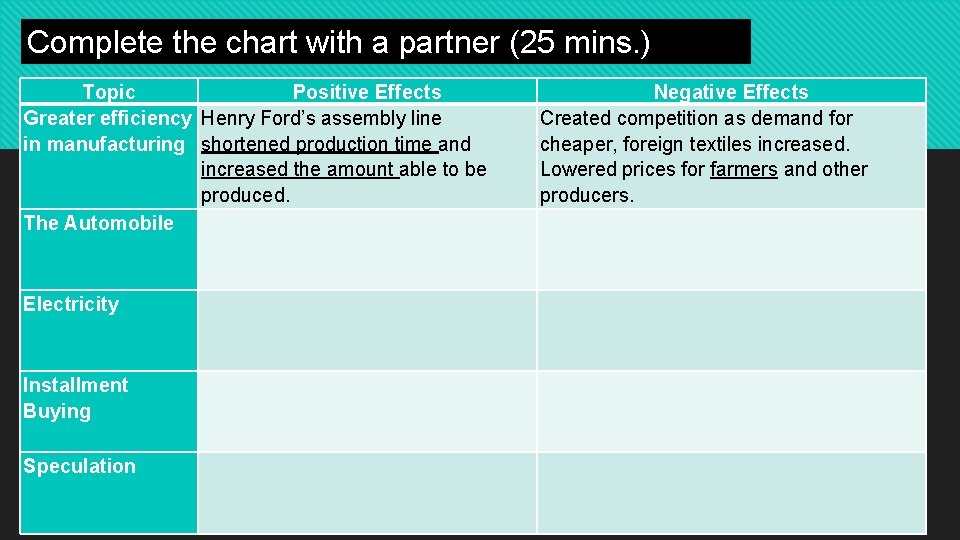
Complete the chart with a partner (25 mins. ) Topic Positive Effects Greater efficiency Henry Ford’s assembly line in manufacturing shortened production time and increased the amount able to be produced. The Automobile Electricity Installment Buying Speculation Negative Effects Created competition as demand for cheaper, foreign textiles increased. Lowered prices for farmers and other producers.

What caused the “boom” of the 1920 s and how did it change life for Americans? Answer the T. A. I. (Think About It!) on the front of your index card.
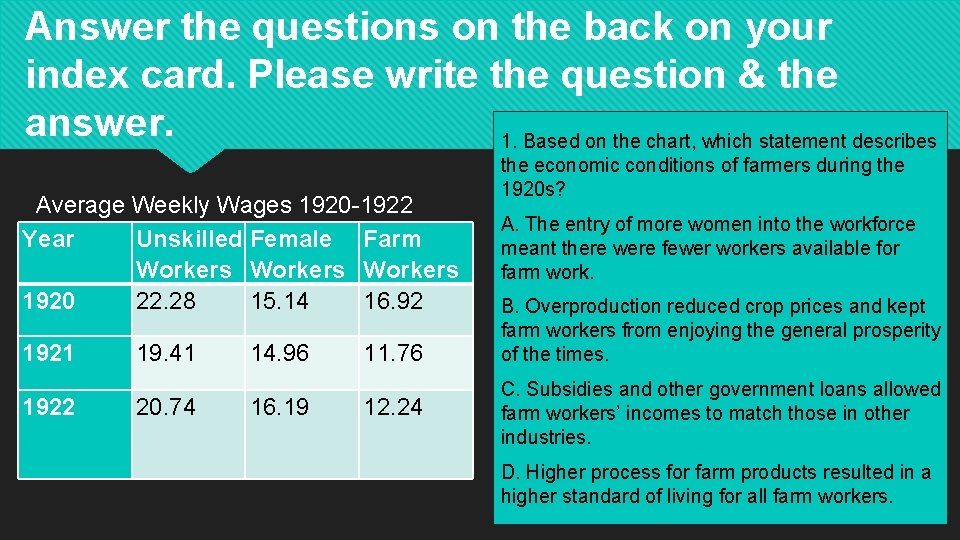
Answer the questions on the back on your index card. Please write the question & the answer. 1. Based on the chart, which statement describes Average Weekly Wages 1920 -1922 Year Unskilled Female Farm Workers 1920 22. 28 15. 14 16. 92 1921 1922 19. 41 20. 74 14. 96 16. 19 11. 76 12. 24 the economic conditions of farmers during the 1920 s? A. The entry of more women into the workforce meant there were fewer workers available for farm work. B. Overproduction reduced crop prices and kept farm workers from enjoying the general prosperity of the times. C. Subsidies and other government loans allowed farm workers’ incomes to match those in other industries. D. Higher process for farm products resulted in a higher standard of living for all farm workers.
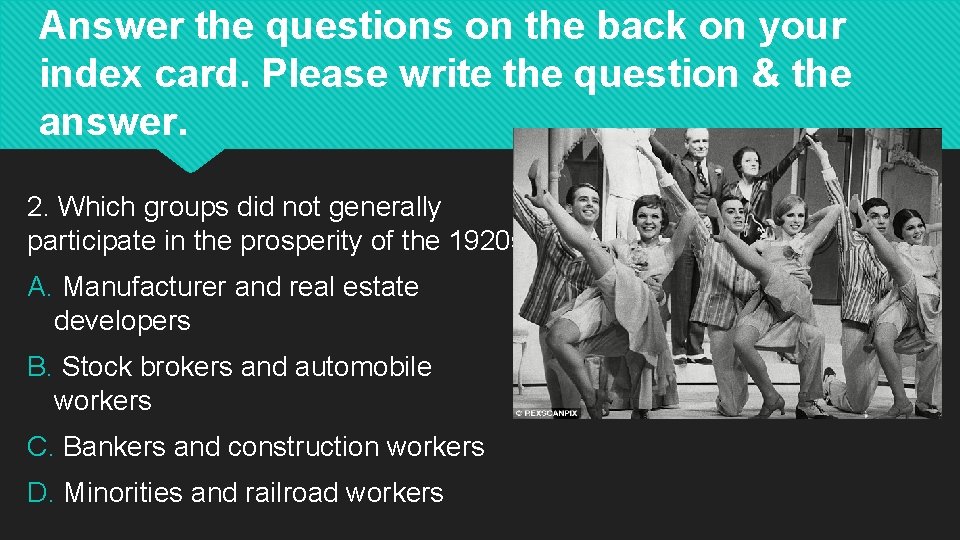
Answer the questions on the back on your index card. Please write the question & the answer. 2. Which groups did not generally participate in the prosperity of the 1920 s? A. Manufacturer and real estate developers B. Stock brokers and automobile workers C. Bankers and construction workers D. Minorities and railroad workers
- Slides: 17