
DO YOU KNOW WHAT TO DO EMERGENCY PREPAREDNESS







- Slides: 32
DO YOU KNOW WHAT TO DO? EMERGENCY PREPAREDNESS Funded by the U. S. Dept of Homeland Security under the Urban Area Security Initiative and the State and Local Government Coordination and Preparedness Program.
IN CASE OF EMERGENCY There are skilled and caring emergency professionals throughout North Central Texas ready to help if and when disaster strikes. But you are your own best protection. This helpful guide will teach you how to think, prepare and act to protect your personal safety and the safety of those around you. THINK PREPARE ACT
THINK TAKE THE EXTRA STEP TO PROTECT YOURSELF
SEVERE WEATHERING THE STORM In North America an average year has: In North Central Texas an average year has: • 100, 000 thunderstorms • 258 severe • 10, 000 severe thunderstorm events (large hail, damaging winds) • 68 flash flood events • 12 tornadoes • Less than 1 hurricane thunderstorms • 5, 000 floods • 1, 000 tornadoes • 2 deadly hurricanes
SEVERE WEATHER LIGHTNING SAFETY If you hear thunder, you are close enough to be struck by lightning— find safe shelter immediately. Move to a sturdy building and stay away from the windows (don’t take shelter in a shed, under isolated trees or in a convertible vehicle). If a sturdy shelter is not available, get inside a hardtop vehicle and keep the windows up. Get out of boats and away from water. Unplug appliances and avoid using the telephone except in an emergency (cell phones are okay, corded phones are not)
SEVERE WEATHER FLOOD SAFETY TURN AROUND DON’T DROWN!
SEVERE WEATHER FLOOD SAFETY Get out of areas subject to flooding, like dips, low spots, canyons, washes, etc. Avoid already flooded and high-velocity flow areas—don’t attempt to cross a flowing stream. Never drive through flooded roadways in case the roadbed is no longer intact.
SEVERE WEATHER FLOOD SAFETY If your vehicle stalls, leave it immediately and seek higher ground. Be cautious at night when it’s harder to recognize flood dangers. Don’t camp or park your vehicle along streams and washes, particularly during threatening conditions.
SEVERE WEATHER HAIL SAFETY If weather conditions are prime for a storm, move cars, boats, RVs and lawn and patio furniture into a covered area. During a storm, seek shelter. Hail of any size can be dangerous when pelted in high winds. Surfaces may become slick, so use caution if you’re outside. When driving into a hailstorm, find a safe place to pull over and turn your car so the hail is hitting the windshield. The safety glass will protect you. The hail could break the glass in other windows.
SEVERE WEATHER TORNADO SAFETY In a home or building, move to a pre-designated shelter, such as a basement. If underground shelter is not available, move to an interior room or hallway on the lowest floor and get under a sturdy piece of furniture. Stay away from windows.
SEVERE WEATHER TORNADO SAFETY Don’t try to outrun a tornado in your car—leave it immediately and seek shelter in a sturdy building. Mobile homes should always be abandoned. If no shelter is available, get out of vehicles and find the most low-lying area (ditch, ravine, etc. ), lay flat on your stomach and cover your head with your hands.
SEVERE WEATHER EXTREME HEAT SAFETY STAY OUT OF THE SUN. Use sunscreen (SPF 15 or higher). STAY HYDRATED. Drink plenty of non-alcoholic and caffeine-free fluids. INSULATE. Install window air conditioners snugly. Check air-conditioning ducts for proper insulation. Weather-strip doors and sills to keep cool air in.
SEVERE WEATHER EXTREME HEAT SAFETY HELP PREVENT DROUGHT. Water your lawn only when necessary and by adhering to local water restrictions. HELP PREVENT WILDFIRES. Respect ”no burn” days. AVOID FIRES. Dispose of cigarettes responsibly. Dispose of hot charcoal in a non-flammable container or hose down before dumping.
SPOT THE HAZARDS + INDUSTRIAL CHEMICALS + BIOLOGICAL + NUCLEAR/RADIOLOGICAL + TRANSPORTATION OF HAZARDOUS MATERIALS + HOUSEHOLD CHEMICALS + EPIDEMICS/PANDEMICS + CARBON MONOXIDE POISONING + WORKPLACE OR SCHOOL SHOOTINGS + GAS WELL & PIPELINES + TERRORISM + TRAVELING DURING THE HOLIDAYS + HOLIDAY HAZARDS + 9 -1 -1 EMERGENCY + HOUSE FIRES
SPOT THE HAZARDS HAZARDOUS MATERIALS Stay aware of your surroundings. Use your senses to help you decide how to act. (Do you see a gas cloud? Smell a sharp odor? Hear an explosion? ) Follow directions from officials about sheltering-in-place or evacuating.
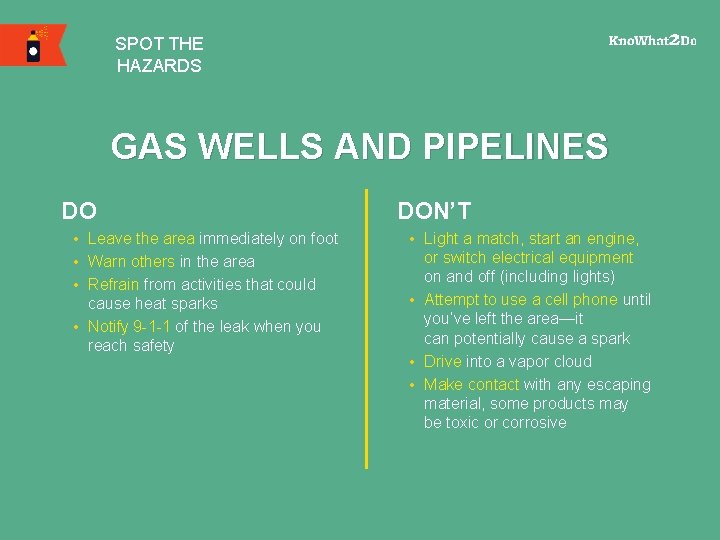
SPOT THE HAZARDS GAS WELLS AND PIPELINES There is typically little or no warning with incidents involving gas wells and/or pipelines. Because of this, it’s critical that you be prepared in the event of an emergency.
SPOT THE HAZARDS GAS WELLS AND PIPELINES DO DON’T • Leave the area immediately on foot • Light a match, start an engine, • Warn others in the area or switch electrical equipment on and off (including lights) • Attempt to use a cell phone until you’ve left the area—it can potentially cause a spark • Drive into a vapor cloud • Make contact with any escaping material, some products may be toxic or corrosive • Refrain from activities that could cause heat sparks • Notify 9 -1 -1 of the leak when you reach safety
SPOT THE HAZARDS TERRORISM Develop a disaster plan. Make sure your Emergency Supply Kit is ready. Identify an internal room that you can shelter in and block out contaminated air in case of a chemical or biological attack. In the case of a nuclear attack, your three best tools are time, distance, and shielding to minimize your exposure to radioactive material. Follow directions from officials. Stay alert and informed at all times!
SPOT THE HAZARDS MASS VIOLENCE Remain calm and quiet. Be aware of your environment and any possible dangers. Take note of the two nearest exits in any facility you visit. If you are unable to leave the area, block and secure the door. As a last resort, protect yourself and attempt to take the active shooter down.
SPOT THE HAZARDS EPIDEMICS AND PANDEMICS Make sure your Emergency Supply Kit is ready. Educate yourself about types of epidemics and how they may affect you. Follow directions from officials about sheltering-in-place or evacuating. Practice healthy habits that may protect you and others later: wash your hands, cover coughs and sneezes, and stay home from work or school if you are sick.
PREPARE A LITTLE PREPARATION CAN MAKE ALL THE DIFFERENCE
MAKE A PLAN GET READY Emergency Supply Kit Create a Communications Plan Caring for Those with Functional Needs Planning for Pets Register for Local Alerts Purchase a NOAA All Hazards Radio
BUILD A KIT GET READY FOOD & WATER FIRST AID KIT RADIO & PHONE CASH AND I. D.
BUILD A KIT GET READY
ACT YOU ARE YOUR OWN BEST PROTECTION
GET INVOLVED Personal Responsibility Volunteer Service Training Citizen Corps Radio Amateur Civil Emergency Service SKYWARN Storm Spotters Neighborhood Watch The National Crime Prevention Council
AFTER DISASTER Sheltering-In-Place Evacuating Disaster Recovery – Finding Hope Health and Safety Guidelines Returning Home Seeking Disaster Assistance
RESOURCE S Local County Emergency Management Directory Texas Division of Emergency Management (TDEM) www. dps. texas. gov Federal Emergency Management Agency (FEMA) www. fema. gov Department of Homeland Security www. dhs. gov Knowhat 2 do. com
THINK PREPARE ACT
QUESTIONS?