
DO Now What is a Crime Write your



- Slides: 45
DO Now What is a Crime? Write your own definition and give three examples .
Do now • Besides incarceration list other punishments for crimes.
Siegel’s police academy: Criminal Law
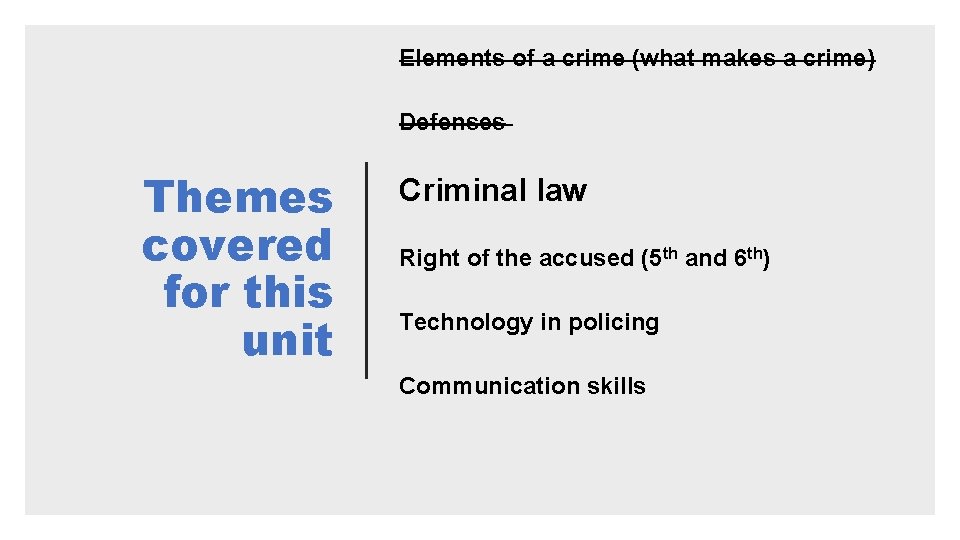
Elements of a crime (what makes a crime) Defenses Themes covered for this unit Criminal law Right of the accused (5 th and 6 th) Technology in policing Communication skills
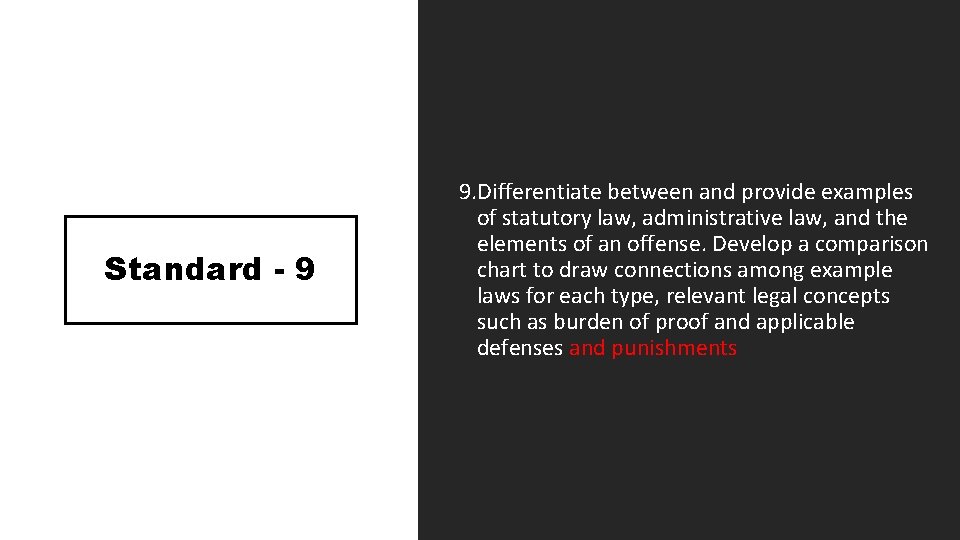
Standard - 9 9. Differentiate between and provide examples of statutory law, administrative law, and the elements of an offense. Develop a comparison chart to draw connections among example laws for each type, relevant legal concepts such as burden of proof and applicable defenses and punishments
Standard - 10 Analyze selected laws and rules listed in the Tennessee Code Annotated. Compare a law and/or rule with similar ones from other states. Explain findings in a written, oral, or digital presentation, citing references and including title of the section, chapter, who or what the code is directed at, code numbers and name of code, when the code was originally written, and when it was last updated.
Objective I will be able to distinguish the crime categories, Mala Se & Mala Prohibita. Agenda: DO now Lecture
Criminal Law
• Police officers must respond to various calls. They must be able to distinguish the particular crime described in the call-in order to file the appropriate charges.
Criminal Law What Is Crime? • “[A]n intentional act in violation of the criminal law committed without defense or excuse, and penalized by the state” (Tappan 1947, 100) • An act in violation of a criminal law for which 3. A punishment is prescribed; 4. The person committing this action must have intended to do so 5. And to have done so without any legally acceptable defenses or justifications
Sources Criminal Law • State and federal constitutions • State and federal statutes • Common law • codified in most states mid-1800 s
Sources of Criminal Law • Statutes define elements (various parts) of a crime more specifically than common law
Mala in se & Mala Prohibita Not every crime is equal. For instance, robbing a bank is a very different crime than violating a traffic rule. Though both are technically against the law, these crimes still fall into two very distinct categories. These categories are see in all cultures.
Mala In Se - evil in itself • The first category constitutes the basis for the common law, or the system of law established by customs in England prior to the colonization of the United States. • These are actions that are deemed evil because of the nature of the action and are well recognized as crimes even if a person has not read the law. • Crimes like this are mala in se crimes - those which violate society's view of morality. Often these are more serious crimes, such as felonies, which can result in a prison sentence. An armed robbery would fall into this category.
Mala In Se • Mala in se crimes are more easily recognized. • For example, children learn at a young age that they should not steal, hurt someone, or commit murder, no matter where they live.
Mala prohibita - wrong because prohibited The second category consists of crimes that are not inherently evil in themselves, but rather are crimes because they violate a law instituted in a particular society. These crimes are mala prohibita. A person may be unaware that he is committing a crime mala prohibita because those actions are not obviously wrong.
Mala prohibita - wrong because prohibited For instance, someone unaware of certain traffic rules in a region might violate those rules without meaning to do so. Mala prohibita crimes are usually considered less serious and are often charged as misdemeanor crimes or infractions where prison is not a possible penalty.
Objective I will be able to distinguish constitutes a felony crime, and their punishments Agenda: DO now Lecture
Felony & Misdemeanor & Status The fundamental distinction between felonies and misdemeanors rests with the penalty and the power of imprisonment.
Misdemeanors • Less serious than felony crimes. • Usually, the punishment for a misdemeanor crime is one year or less imprisonment in jail • Some misdemeanor crimes include: • • Disturbing the peace Theft less than $500 Simple assault Writing bad checks
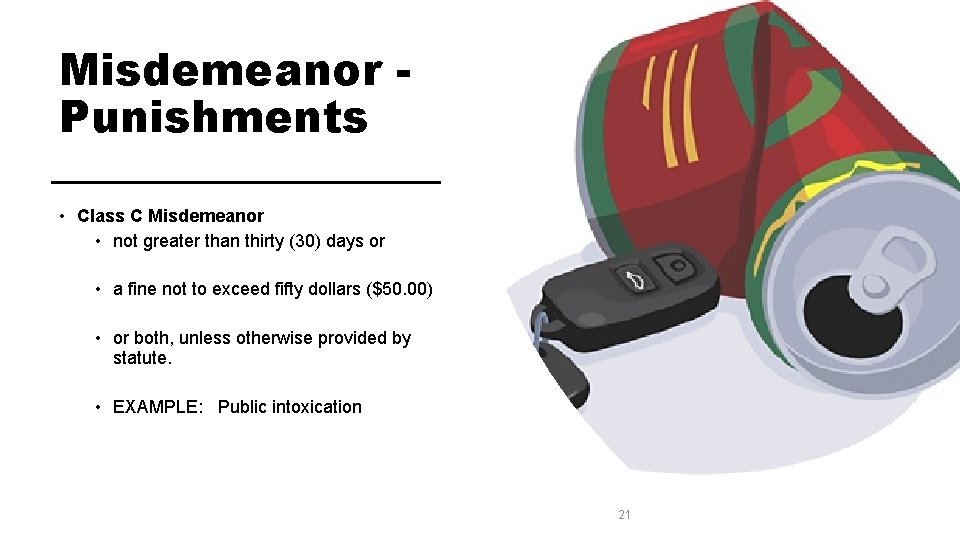
Misdemeanor Punishments • Class C Misdemeanor • not greater than thirty (30) days or • a fine not to exceed fifty dollars ($50. 00) • or both, unless otherwise provided by statute. • EXAMPLE: Public intoxication 21
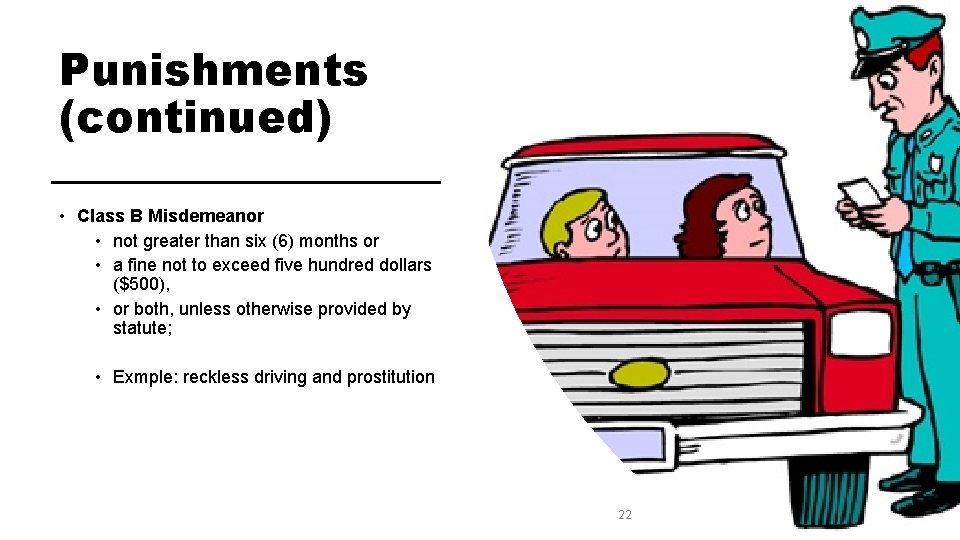
Punishments (continued) • Class B Misdemeanor • not greater than six (6) months or • a fine not to exceed five hundred dollars ($500), • or both, unless otherwise provided by statute; • Exmple: reckless driving and prostitution 22
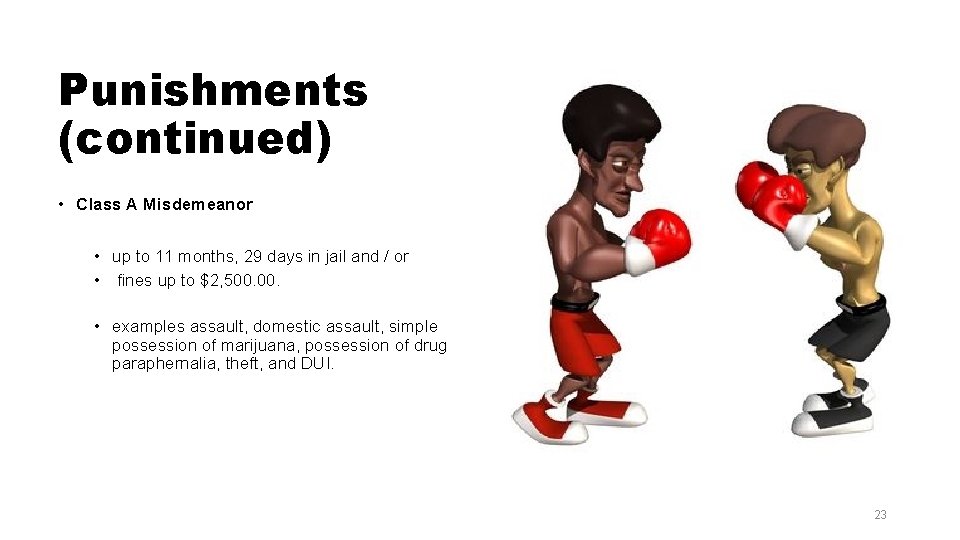
Punishments (continued) • Class A Misdemeanor • up to 11 months, 29 days in jail and / or • fines up to $2, 500. • examples assault, domestic assault, simple possession of marijuana, possession of drug paraphernalia, theft, and DUI. 23
Felony • A felony is a crime that is punishable by a prison sentence of over one year. • A person can also be sentenced to the death penalty for a felony if the state where one committed the crime has a statute which authorizes the death penalty. • Usually, felonies are highly serious crimes. In the United States, felony crimes are the most serious crimes that exist.
Felony Punishments • Class E felonies • the least serious felonies in Tennessee, • are punishable by one to six years in prison, as well as a fine of up to $3, 000. • Examples Theft of property worth more than $500 but less than $1, 000 25
Felony Punishments • A class D felony • is punishable by two to 12 years’ imprisonment, • and a fine of up to $5, 000. • Example Possession of between ten and 70 pounds of marijuana 26
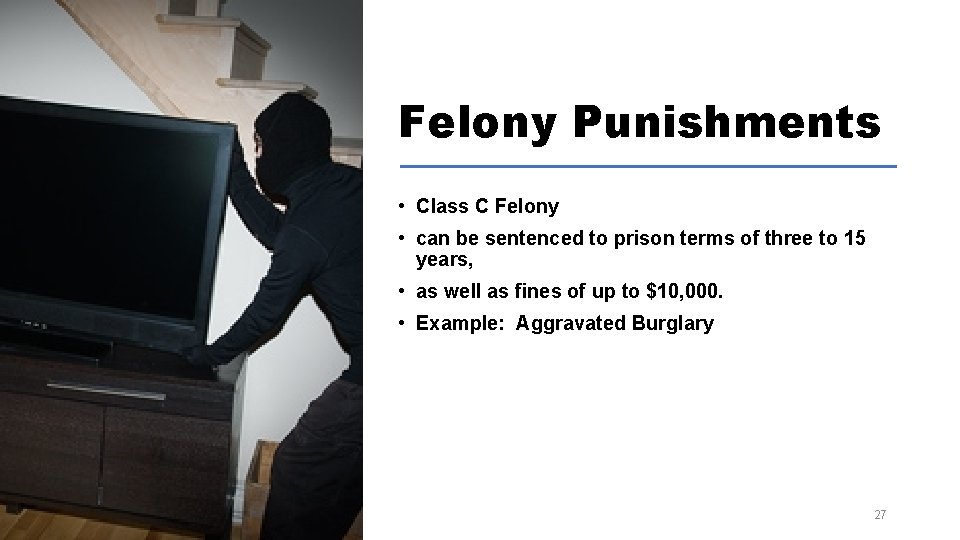
Felony Punishments • Class C Felony • can be sentenced to prison terms of three to 15 years, • as well as fines of up to $10, 000. • Example: Aggravated Burglary 27
Felony Punishments • class B felony • is punishable by eight to 30 years’ imprisonment, • as well as a fine of up to $25, 000. • Example Causing or allowing a child to engage in sexual acts for the purpose of making child pornography is an 28
Felony Punishments • Class A felonies • Not counting those crimes punishable by death the most serious felonies in Tennessee. • They are punishable by 15 to 60 years in prison and a fine of up to $50, 000 • example, aggravated rape 29
Felony Punishments • Capital Crime • Death • life imprisonment • Commonly referred to as the death penalty, capital punishment remains a legal sentence under Tennessee laws. • The Volunteer State has had a long history with executions dating back to the 19 th century, but had a 40 -year hiatus from 1960 to 2000. Since then, Tennessee has only put six people to death. 30
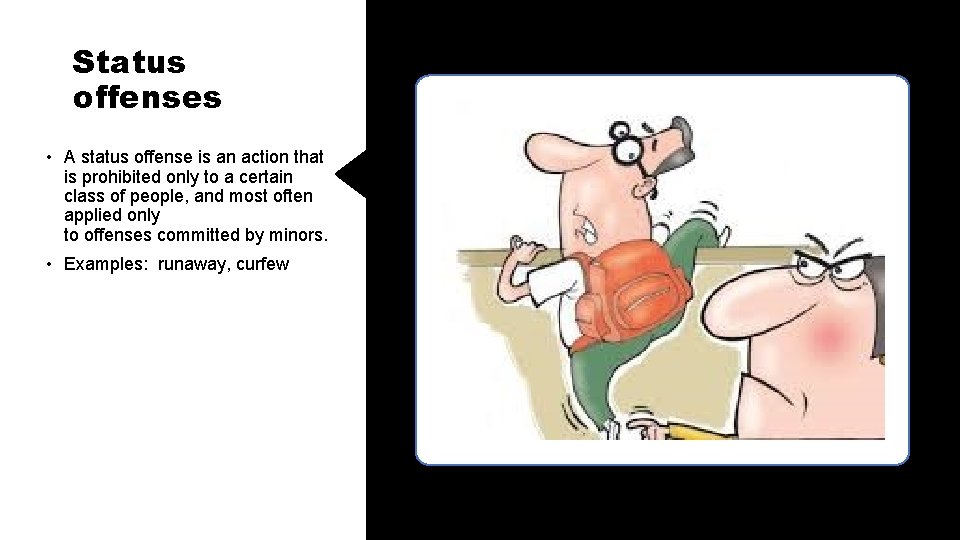
Status offenses • A status offense is an action that is prohibited only to a certain class of people, and most often applied only to offenses committed by minors. • Examples: runaway, curfew
CRIMES and CONSEQUENCES
Types of crimes
I will be able to define key terminology of crimes against persons, differentiate the various types of violent crimes, and relate the proper charge to the criminal offense.
TCA CODE BOOK
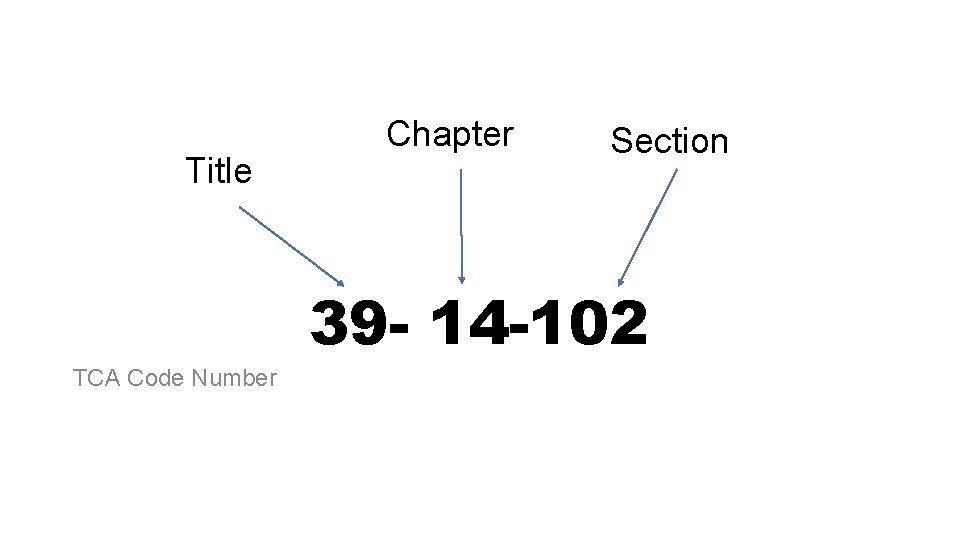
Title Chapter Section 39 - 14 -102 TCA Code Number
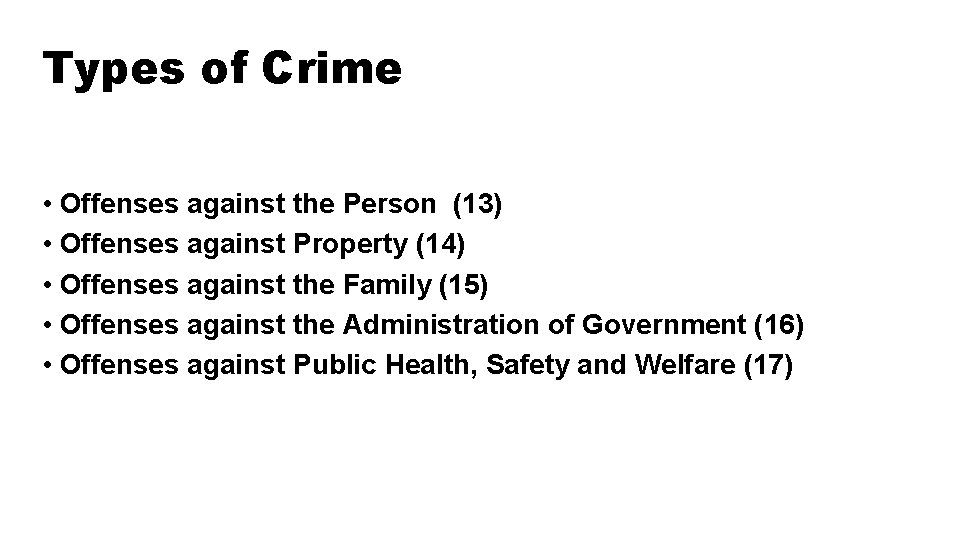
Types of Crime • Offenses against the Person (13) • Offenses against Property (14) • Offenses against the Family (15) • Offenses against the Administration of Government (16) • Offenses against Public Health, Safety and Welfare (17)
TCA CODE BOOK
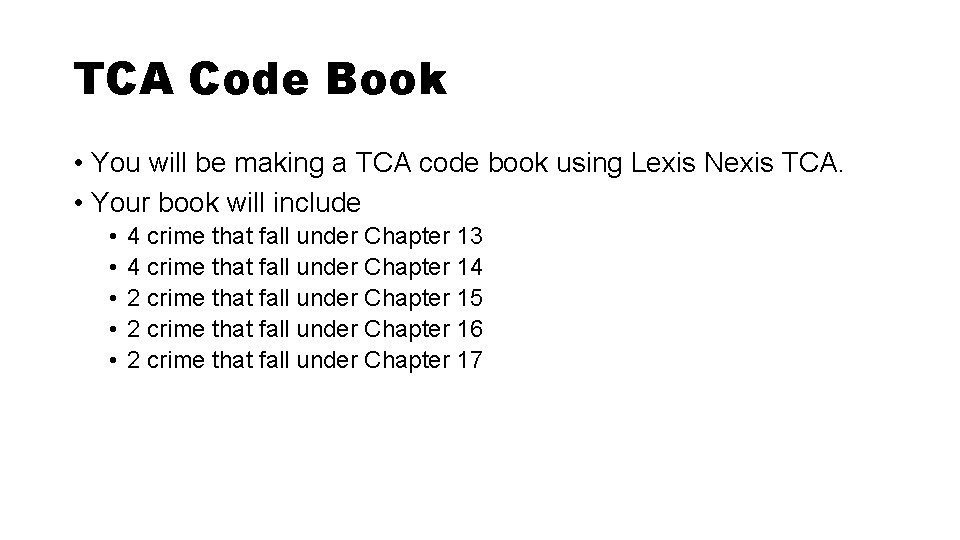
TCA Code Book • You will be making a TCA code book using Lexis Nexis TCA. • Your book will include • • • 4 crime that fall under Chapter 13 4 crime that fall under Chapter 14 2 crime that fall under Chapter 15 2 crime that fall under Chapter 16 2 crime that fall under Chapter 17
Let practice …. Follow along with the TCA worksheet as we use Lexis Nexis to find the answers.
Crimes Against Persons © 2004 Pearson Education, Inc.
Crimes against a person • Also called - Assaultive Offenses or violent crime • Direct harm to a person inflicted by the actor include: • assault and battery • robbery • sexual offenses • child sexual abuse
Homicide Different forms, based on state and federal statutes © 2004 Pearson Education, Inc.
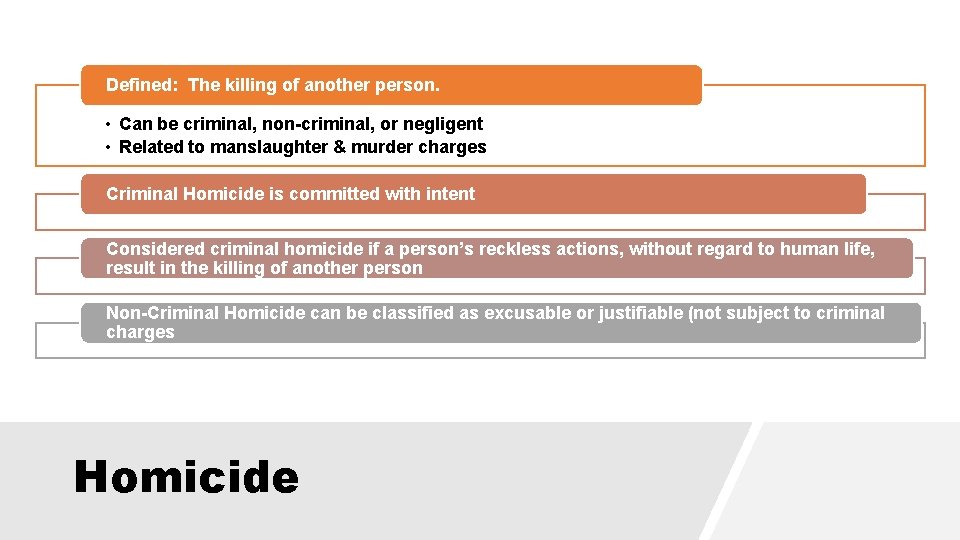
Defined: The killing of another person. • Can be criminal, non-criminal, or negligent • Related to manslaughter & murder charges Criminal Homicide is committed with intent Considered criminal homicide if a person’s reckless actions, without regard to human life, result in the killing of another person Non-Criminal Homicide can be classified as excusable or justifiable (not subject to criminal charges Homicide
TCA Code Book • You will be making a TCA code book using Lexis Nexis TCA. • Your book will include • • • 4 crime that fall under Chapter 13 4 crime that fall under Chapter 14 2 crime that fall under Chapter 15 2 crime that fall under Chapter 16 2 crime that fall under Chapter 17