
Do Now Solve the inequality Academy Algebra IITrig
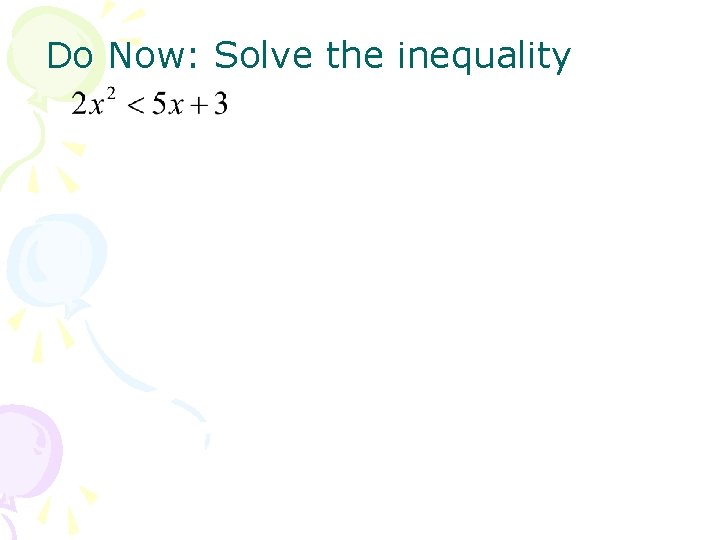
Do Now: Solve the inequality
Academy Algebra II/Trig 5. 1: Polynomial Functions and Models HW: p. 340 (12, 13, 17 -20, 41, 43, 45 -47 – parts a, d, e only) Test 4. 3 -4. 5, 5. 1, 5. 5 -5. 6:
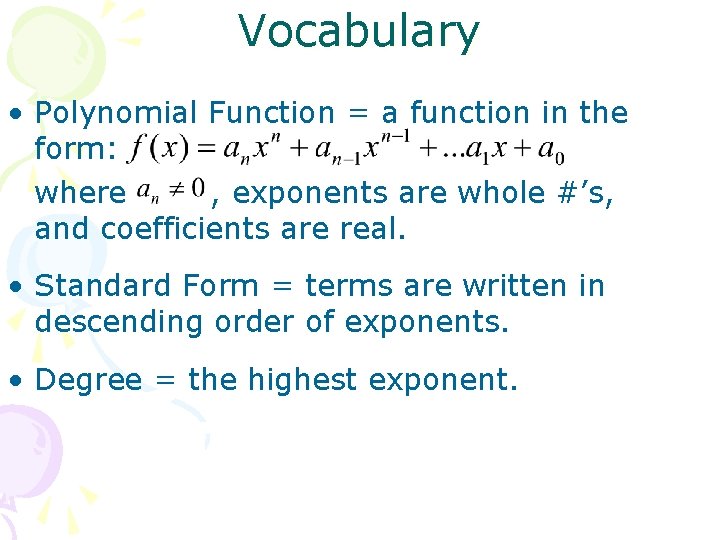
Vocabulary • Polynomial Function = a function in the form: where , exponents are whole #’s, and coefficients are real. • Standard Form = terms are written in descending order of exponents. • Degree = the highest exponent.
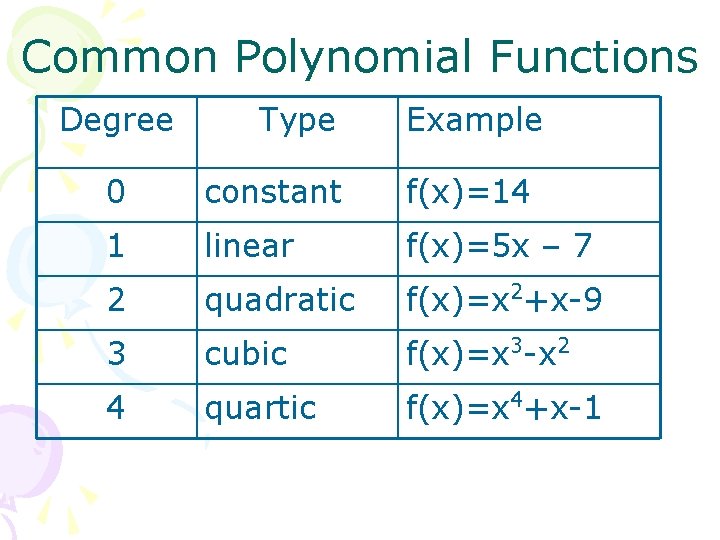
Common Polynomial Functions Degree Type Example 0 constant f(x)=14 1 linear f(x)=5 x – 7 2 quadratic f(x)=x 2+x-9 3 cubic f(x)=x 3 -x 2 4 quartic f(x)=x 4+x-1
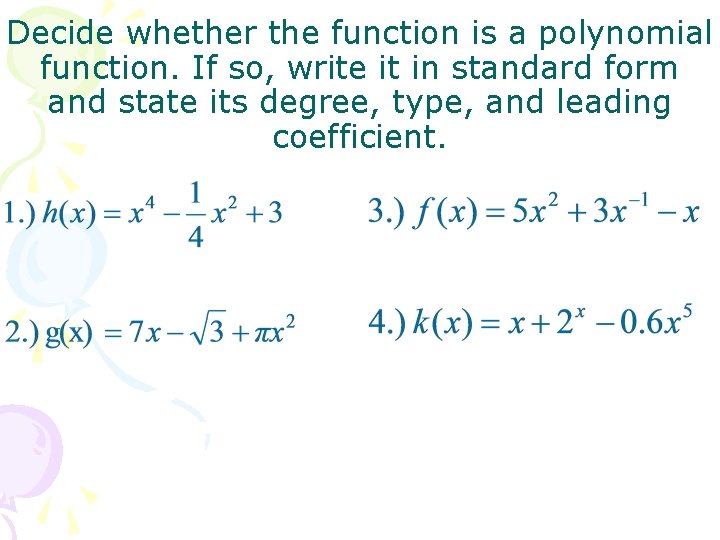
Decide whether the function is a polynomial function. If so, write it in standard form and state its degree, type, and leading coefficient.
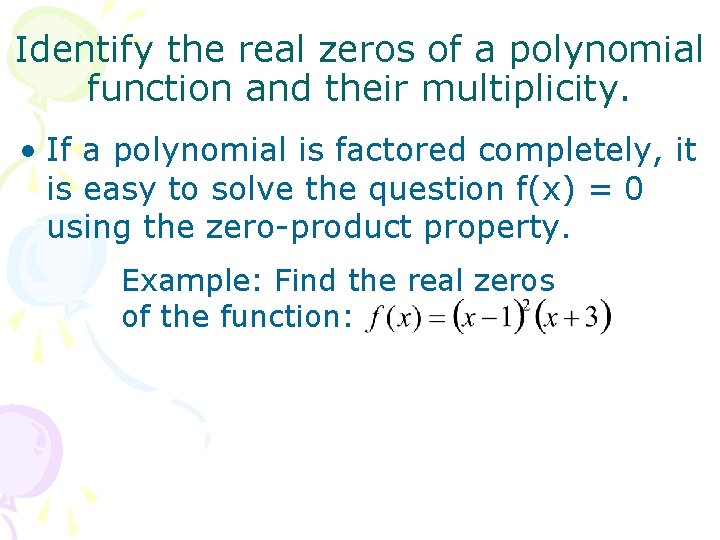
Identify the real zeros of a polynomial function and their multiplicity. • If a polynomial is factored completely, it is easy to solve the question f(x) = 0 using the zero-product property. Example: Find the real zeros of the function:
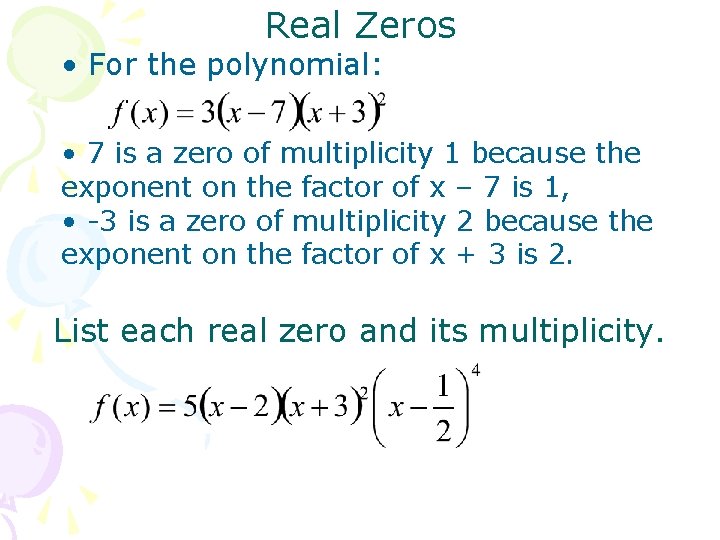
Real Zeros • For the polynomial: • 7 is a zero of multiplicity 1 because the exponent on the factor of x – 7 is 1, • -3 is a zero of multiplicity 2 because the exponent on the factor of x + 3 is 2. List each real zero and its multiplicity.
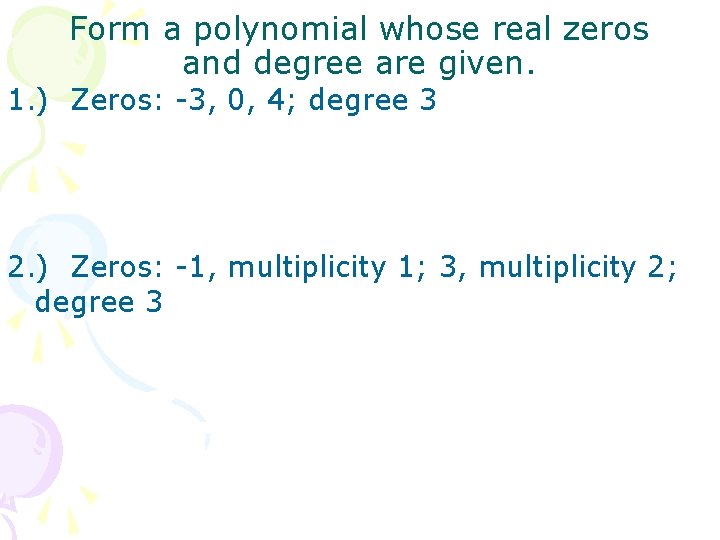
Form a polynomial whose real zeros and degree are given. 1. ) Zeros: -3, 0, 4; degree 3 2. ) Zeros: -1, multiplicity 1; 3, multiplicity 2; degree 3
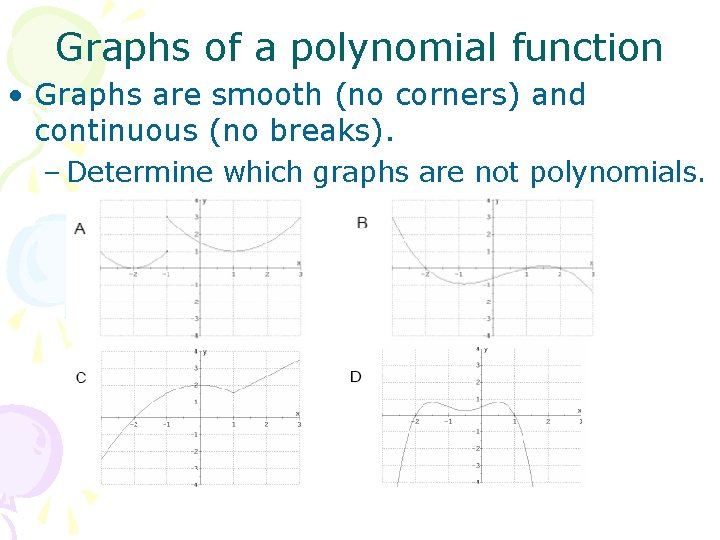
Graphs of a polynomial function • Graphs are smooth (no corners) and continuous (no breaks). – Determine which graphs are not polynomials.
Graphs of a polynomial function – turning points. • If f is a polynomial function of degree n, then f has at most n – 1 turning points.
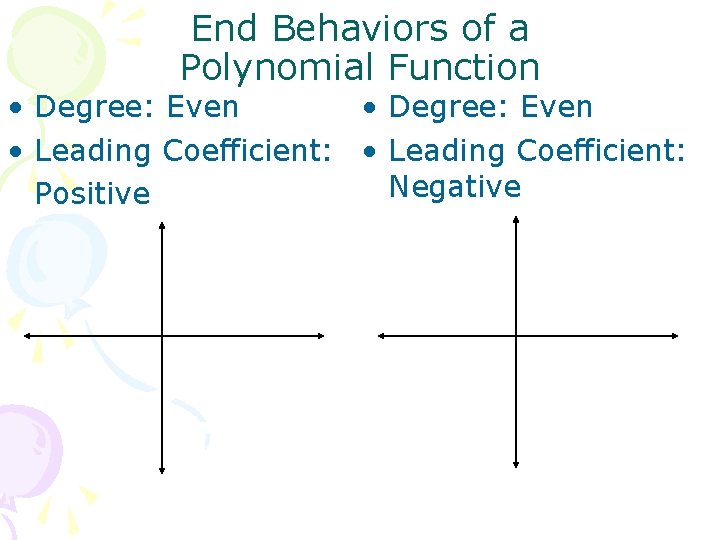
End Behaviors of a Polynomial Function • Degree: Even • Leading Coefficient: Negative Positive
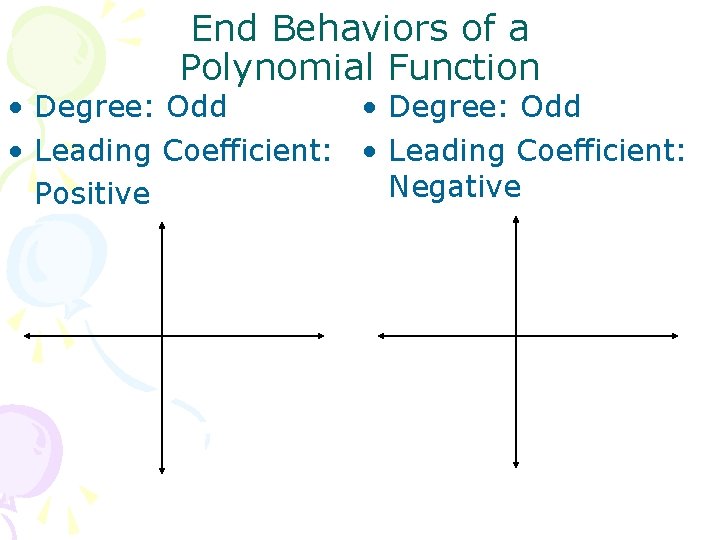
End Behaviors of a Polynomial Function • Degree: Odd • Leading Coefficient: Negative Positive
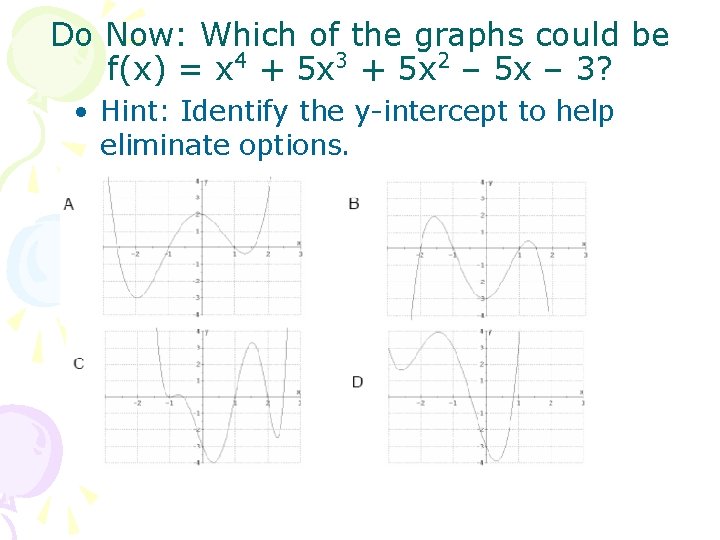
Do Now: Which of the graphs could be 4 3 2 f(x) = x + 5 x – 3? • Hint: Identify the y-intercept to help eliminate options.
Academy Algebra II/Trig 5. 1: Finish HW: p. 341 -342 (57 -60 all; 65, 70, 74 – part f: like class work)
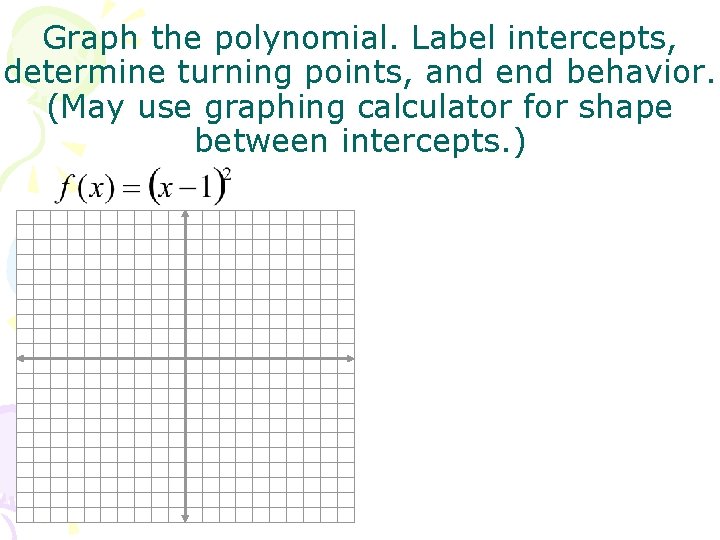
Graph the polynomial. Label intercepts, determine turning points, and end behavior. (May use graphing calculator for shape between intercepts. )
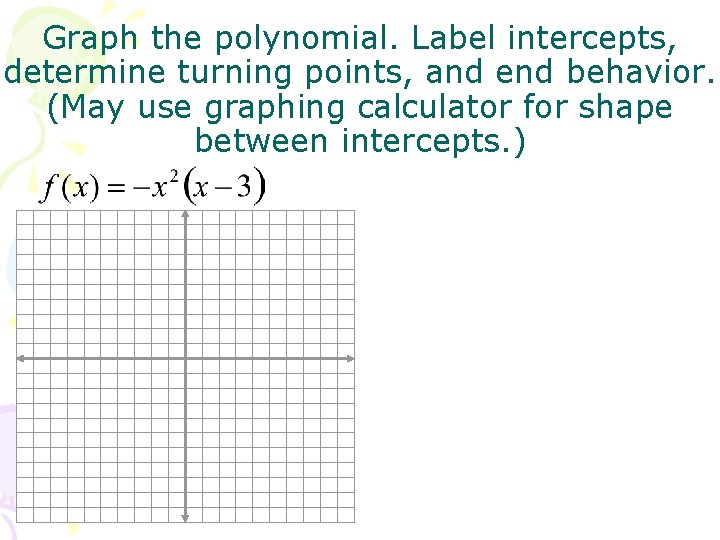
Graph the polynomial. Label intercepts, determine turning points, and end behavior. (May use graphing calculator for shape between intercepts. )
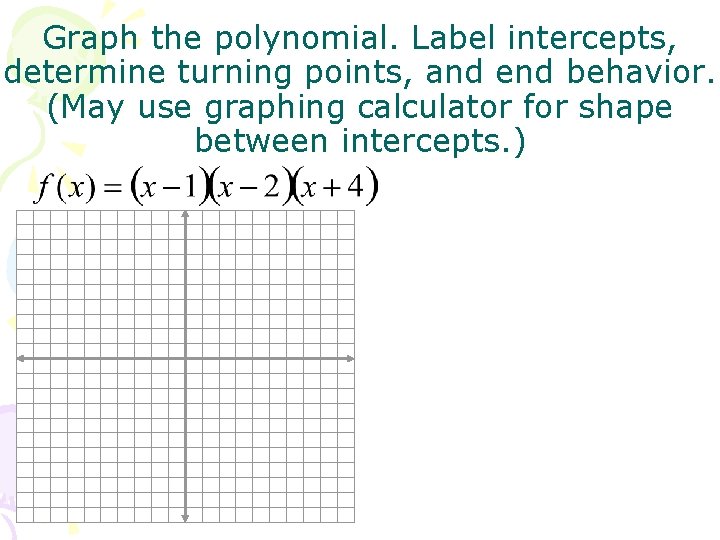
Graph the polynomial. Label intercepts, determine turning points, and end behavior. (May use graphing calculator for shape between intercepts. )
- Slides: 17