
Do now read below The first thing to

Do now: read below The first thing to remember about poetry is that it is all around you. How about the jingles from the advertisements we see and hear—can you name the product that is associated with these ads? The words written in a great book or a famous quote from a person you admire can have elements of poetry in them. The feelings you have when you are at the top of the tallest hill of a roller coaster or when you view a beautiful sunset can inspire a poem. Poetry helps us express our thoughts, feelings, and ideas as we relate to the world around us. As we read the poetry of other authors, we understand who they are, what they think, and what we might have in common. Poetry is the “Great Communicator!” It can “talk” to our heads and our hearts.
Activity In your group assign the following roles: Scribe Materials Speaker Timer
Rhyming race When the timer starts, pull an object out of the bag and list as many words that rhyme with the object. When you can think of no more rhyming words, pull out another object and begin again. When the timer ends, you will get 5 points for each object taken out of the bag and 1 point for each item on the list under each object.
“Poetry and Prose: What’s the Difference” In your notebook, generate a list of qualities that distinguish poetry from ordinary language (prose).
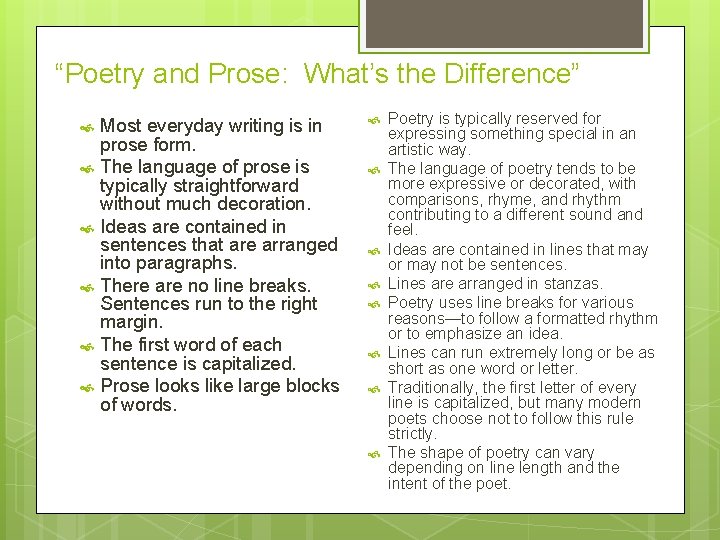
“Poetry and Prose: What’s the Difference” Most everyday writing is in prose form. The language of prose is typically straightforward without much decoration. Ideas are contained in sentences that are arranged into paragraphs. There are no line breaks. Sentences run to the right margin. The first word of each sentence is capitalized. Prose looks like large blocks of words. Poetry is typically reserved for expressing something special in an artistic way. The language of poetry tends to be more expressive or decorated, with comparisons, rhyme, and rhythm contributing to a different sound and feel. Ideas are contained in lines that may or may not be sentences. Lines are arranged in stanzas. Poetry uses line breaks for various reasons—to follow a formatted rhythm or to emphasize an idea. Lines can run extremely long or be as short as one word or letter. Traditionally, the first letter of every line is capitalized, but many modern poets choose not to follow this rule strictly. The shape of poetry can vary depending on line length and the intent of the poet.
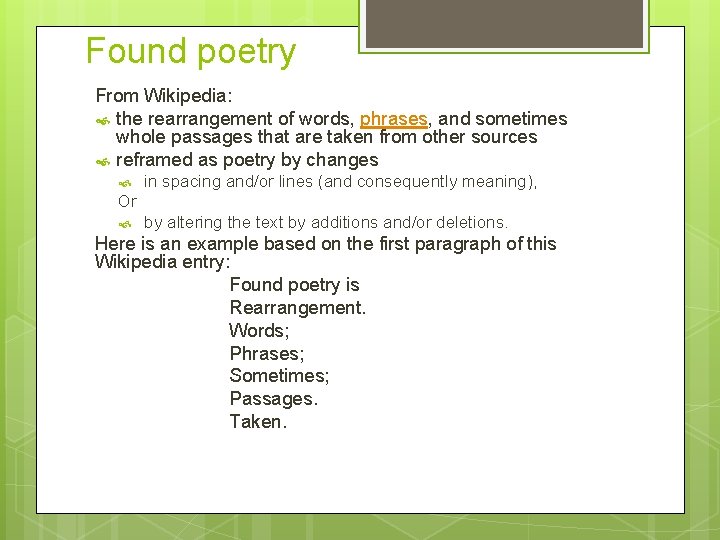
Found poetry From Wikipedia: the rearrangement of words, phrases, and sometimes whole passages that are taken from other sources reframed as poetry by changes in spacing and/or lines (and consequently meaning), Or by altering the text by additions and/or deletions. Here is an example based on the first paragraph of this Wikipedia entry: Found poetry is Rearrangement. Words; Phrases; Sometimes; Passages. Taken.
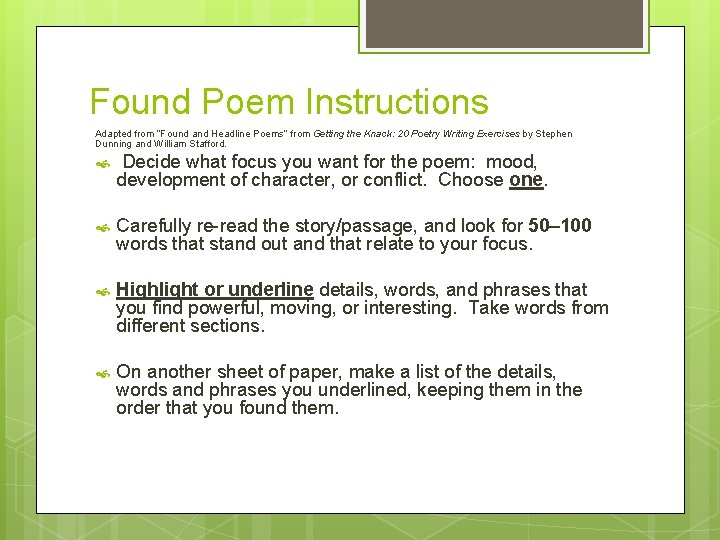
Found Poem Instructions Adapted from “Found and Headline Poems” from Getting the Knack: 20 Poetry Writing Exercises by Stephen Dunning and William Stafford. Decide what focus you want for the poem: mood, development of character, or conflict. Choose one. Carefully re-read the story/passage, and look for 50– 100 words that stand out and that relate to your focus. Highlight or underline details, words, and phrases that you find powerful, moving, or interesting. Take words from different sections. On another sheet of paper, make a list of the details, words and phrases you underlined, keeping them in the order that you found them.
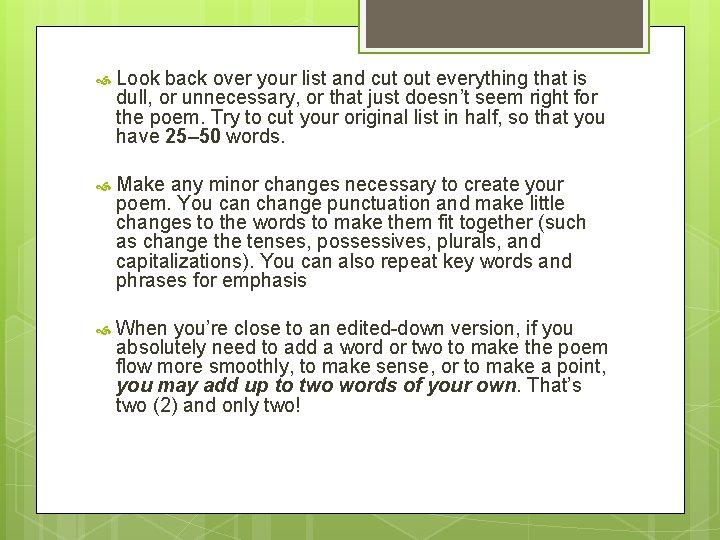
Look back over your list and cut out everything that is dull, or unnecessary, or that just doesn’t seem right for the poem. Try to cut your original list in half, so that you have 25– 50 words. Make any minor changes necessary to create your poem. You can change punctuation and make little changes to the words to make them fit together (such as change the tenses, possessives, plurals, and capitalizations). You can also repeat key words and phrases for emphasis When you’re close to an edited-down version, if you absolutely need to add a word or two to make the poem flow more smoothly, to make sense, or to make a point, you may add up to two words of your own. That’s two (2) and only two!
Read back over your edited draft one more time and make any deletions or minor changes. Check your words, and choose a title—one that is better than “Found Poem”, “Mood”, “Rainsford” or “Conflict”.
Copy the words and phrases onto a piece of paper or type them. Space or arrange the words so that they’re poem-like. Pay attention to line breaks, layout, and other elements that will emphasize important words or significant ideas in the poem. • Read aloud as you arrange the words! Test the possible line breaks by pausing slightly. If it sounds good, it’s probably right. • Arrange the words so that they make a rhythm you like. You can space words out so that they are all alone or allruntogether. • You can also put key words on lines by themselves. • You can shape the entire poem so that it’s wide or tall or shaped like an object. • Emphasize words by playing with boldface and italics, different sizes of letters, and so forth. At the bottom of the poem, tell where the words in the poem came from. For example, From “A kind word goes a long way” by Rachel Yoder, on Stories of Love Page on The Mystery of Love Web Site.
Found Poetry Found poetry examples
homework Write a found poem using a book you are currently reading or a newspaper article of your choice
- Slides: 13