
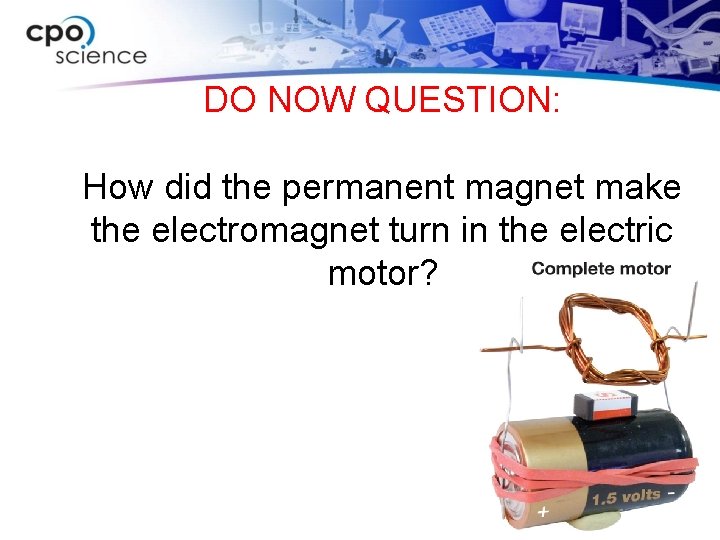
DO NOW QUESTION How did the permanent magnet


- Slides: 29
DO NOW QUESTION: How did the permanent magnet make the electromagnet turn in the electric motor? Unit
Unit 6: Magnetism Chapter 16: Electromagnets and Induction n 16. 1 Electric Current and Magnetism n 16. 2 Electric Motors n 16. 3 Electric Generators and Transformers
Objective: 3/24 SWBAT describe how mechanical energy transfers to electrical energy.
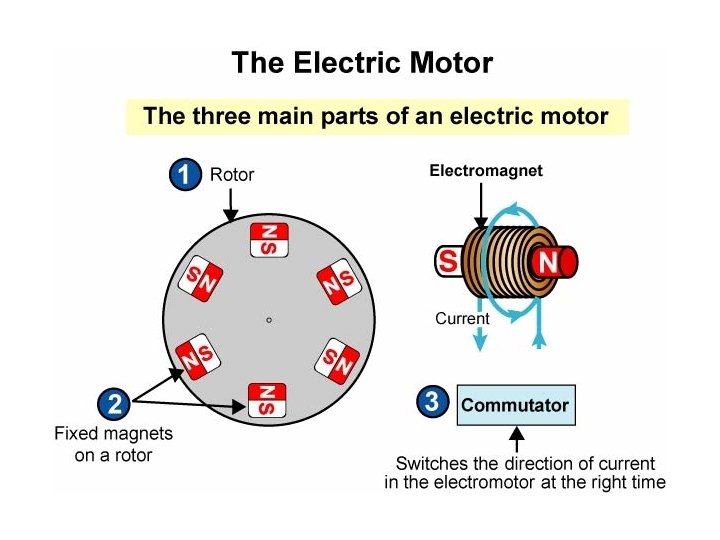
Electric motors n. An electric motor is a machine that convert electrical energy into mechanical energy. n. The disk in the motor is called the rotor because it can rotate.
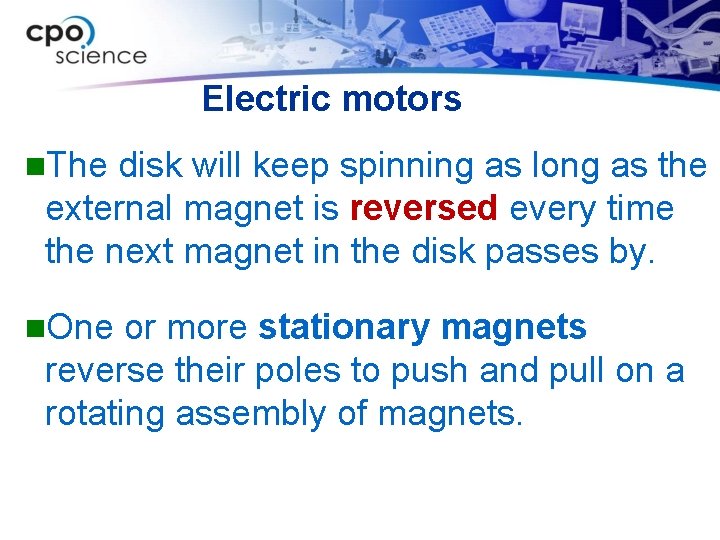
Electric motors n. The disk will keep spinning as long as the external magnet is reversed every time the next magnet in the disk passes by. n. One or more stationary magnets reverse their poles to push and pull on a rotating assembly of magnets.
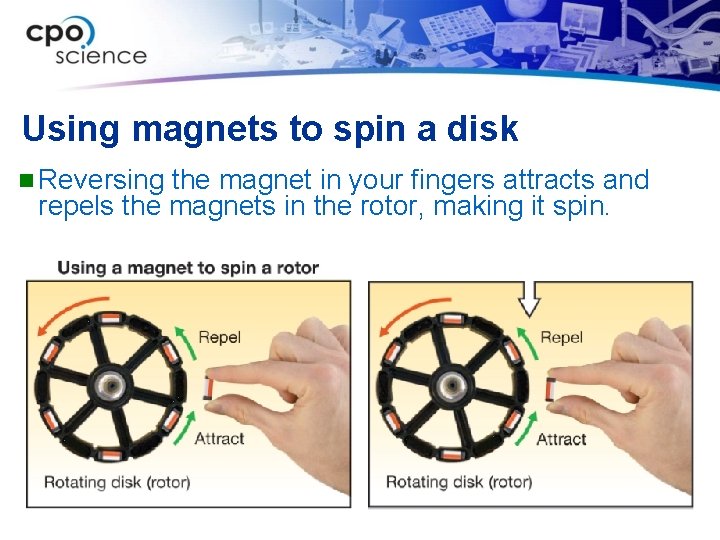
Using magnets to spin a disk n Reversing the magnet in your fingers attracts and repels the magnets in the rotor, making it spin.
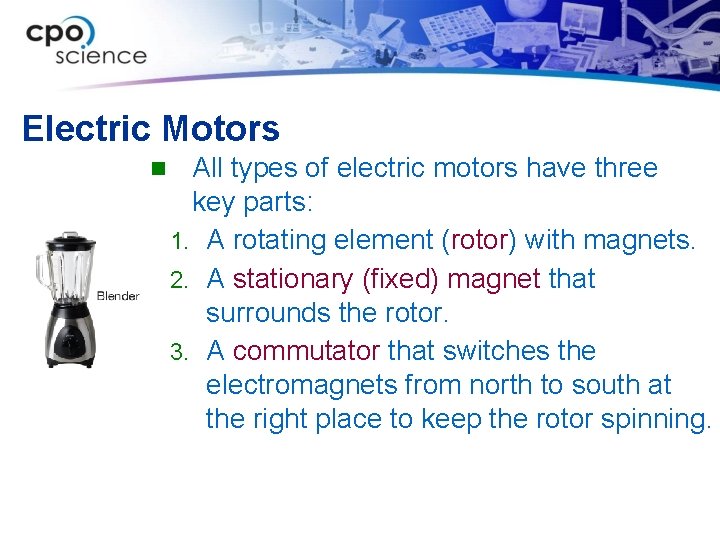
Electric Motors n All types of electric motors have three key parts: 1. A rotating element (rotor) with magnets. 2. A stationary (fixed) magnet that surrounds the rotor. 3. A commutator that switches the electromagnets from north to south at the right place to keep the rotor spinning.
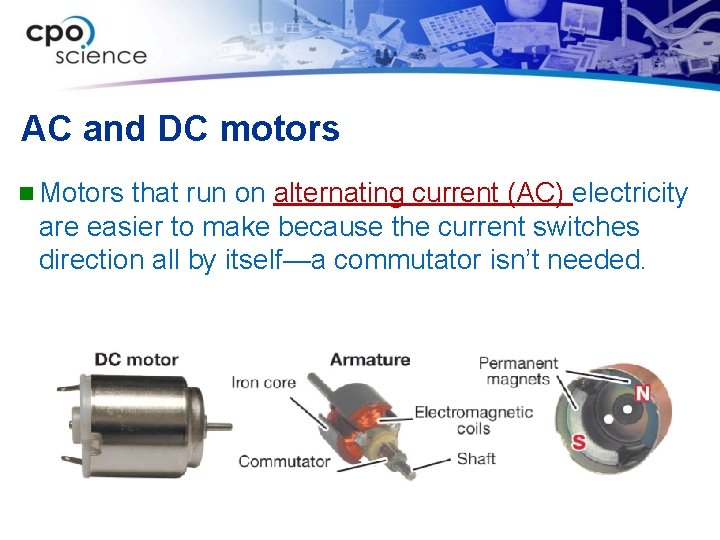
AC and DC motors n Motors that run on alternating current (AC) electricity are easier to make because the current switches direction all by itself—a commutator isn’t needed.
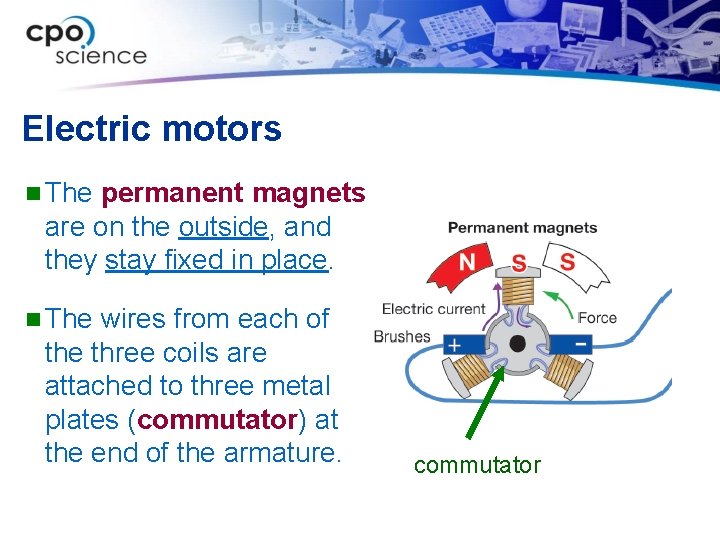
Electric motors n. The rotating part of the motor, including the electromagnets, is called the armature. n. It has 3 electromagnets that correspond to the 3 coils.
Electric motors n The permanent magnets are on the outside, and they stay fixed in place. n The wires from each of the three coils are attached to three metal plates (commutator) at the end of the armature. commutator
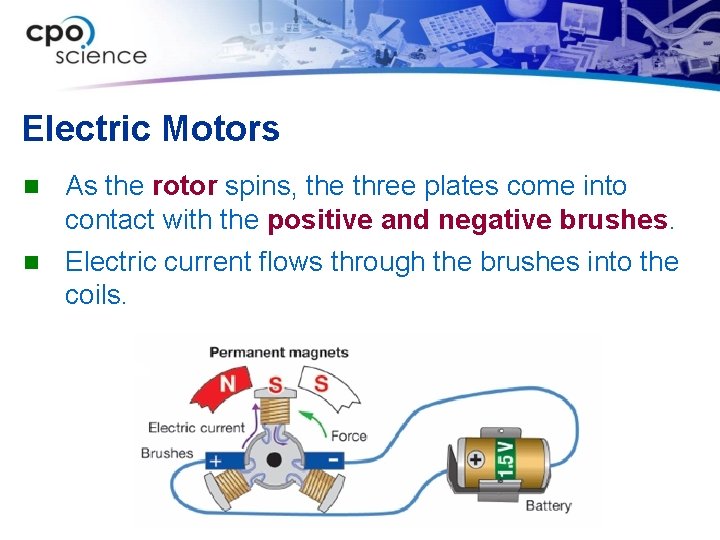
Electric Motors n As the rotor spins, the three plates come into contact with the positive and negative brushes. n Electric current flows through the brushes into the coils.
Unit 6: Magnetism Chapter 16: Electromagnets and Induction n 16. 1 Electric Current and Magnetism n 16. 2 Electric Motors n 16. 3 Electric Generators and Transformers
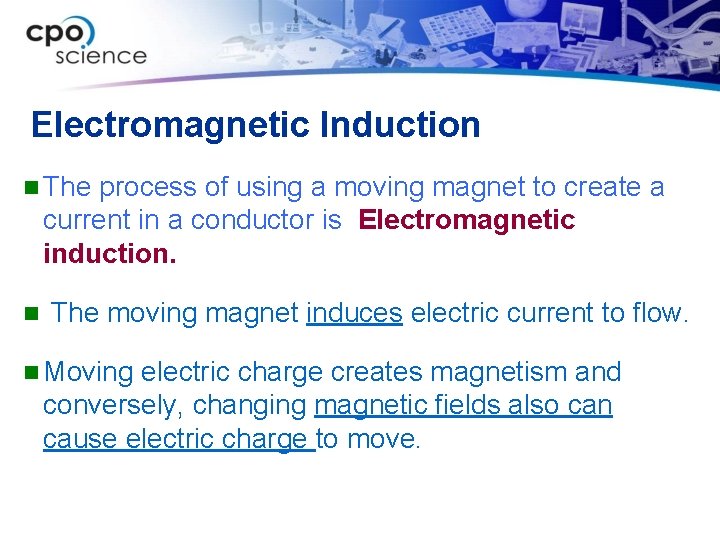
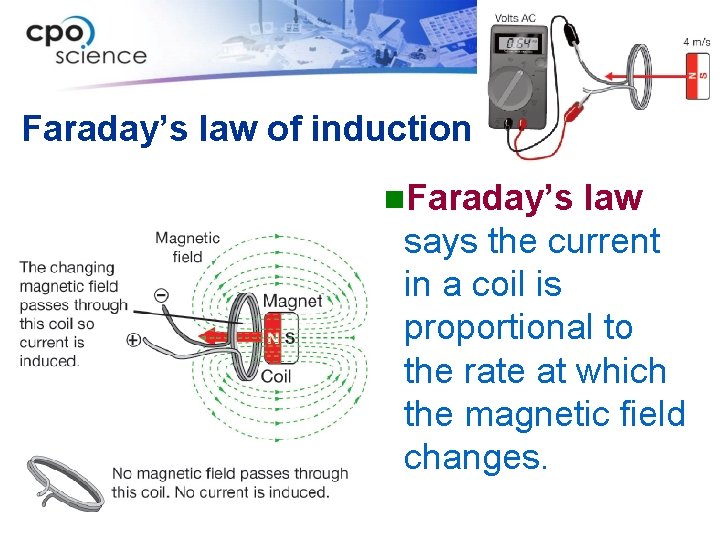
Electromagnetic Induction n The process of using a moving magnet to create a current in a conductor is Electromagnetic induction. n The moving magnet induces electric current to flow. n Moving electric charge creates magnetism and conversely, changing magnetic fields also can cause electric charge to move.
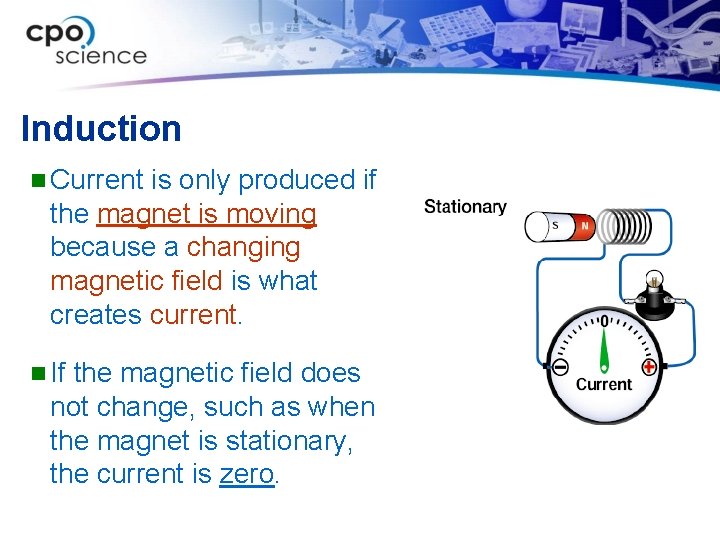
Induction n Current is only produced if the magnet is moving because a changing magnetic field is what creates current. n If the magnetic field does not change, such as when the magnet is stationary, the current is zero.
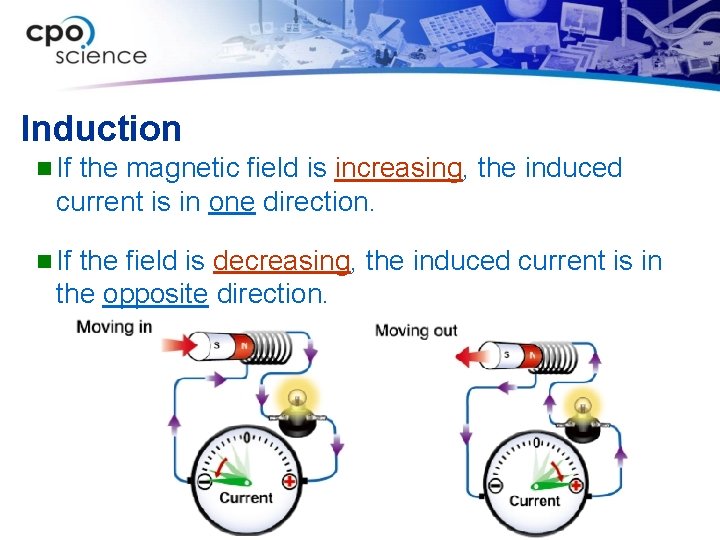
Induction n If the magnetic field is increasing, the induced current is in one direction. n If the field is decreasing, the induced current is in the opposite direction.
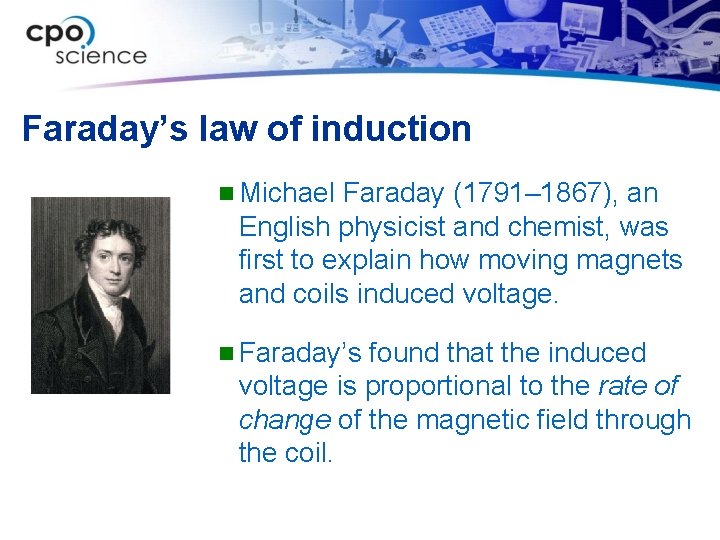
Faraday’s law of induction n Michael Faraday (1791– 1867), an English physicist and chemist, was first to explain how moving magnets and coils induced voltage. n Faraday’s found that the induced voltage is proportional to the rate of change of the magnetic field through the coil.
Faraday’s law of induction n. Faraday’s law says the current in a coil is proportional to the rate at which the magnetic field changes.
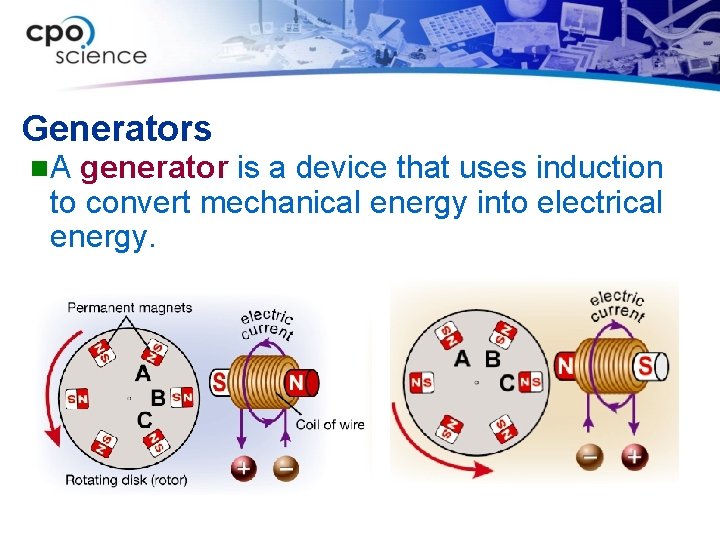
Generators n. A generator is a device that uses induction to convert mechanical energy into electrical energy.
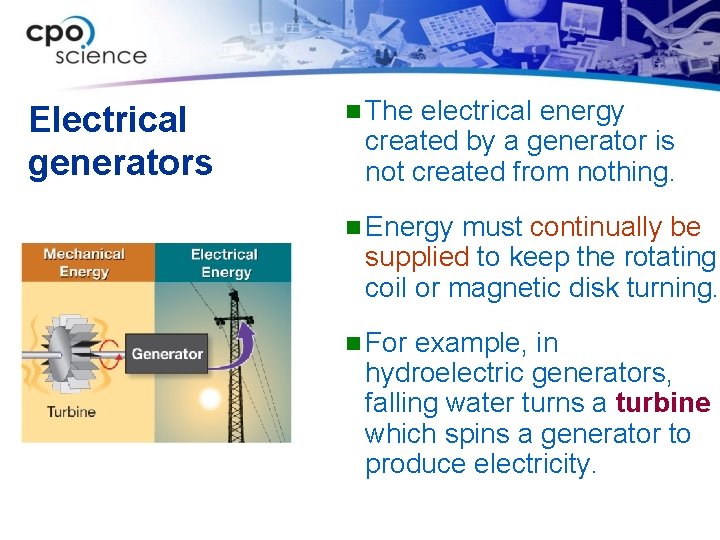
Electrical generators n The electrical energy created by a generator is not created from nothing. n Energy must continually be supplied to keep the rotating coil or magnetic disk turning. n For example, in hydroelectric generators, falling water turns a turbine which spins a generator to produce electricity.
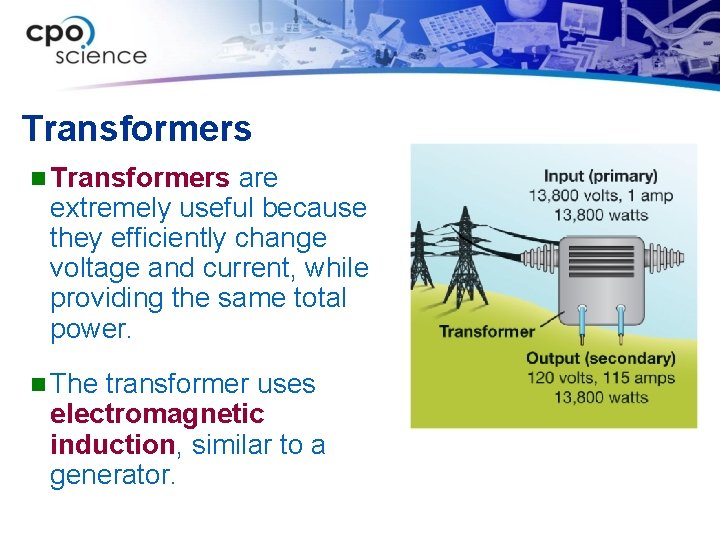
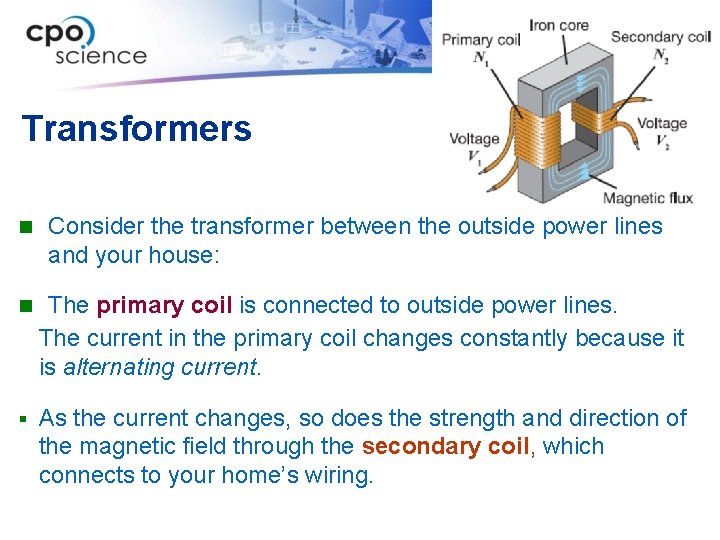
Transformers n Transformers are extremely useful because they efficiently change voltage and current, while providing the same total power. n The transformer uses electromagnetic induction, similar to a generator.
Transformers n Consider the transformer between the outside power lines and your house: n The primary coil is connected to outside power lines. The current in the primary coil changes constantly because it is alternating current. § As the current changes, so does the strength and direction of the magnetic field through the secondary coil, which connects to your home’s wiring.
Energy flow n With each transformation (green arrows), some energy is lost to the system in the form of heat (red arrows).
Electricity from different resources n. A nonrenewable resource is not replaced as it is used. n. Any fossil fuel is an good example of nonrenewable resource.
Three major fossil fuels are n. Coal n. Oil (Petroleum) n. Natural Gas
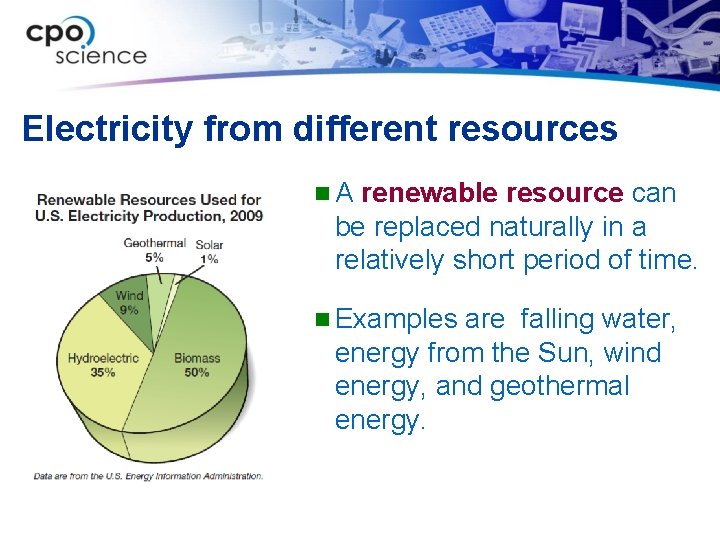
Electricity from different resources n. A renewable resource can be replaced naturally in a relatively short period of time. n Examples are falling water, energy from the Sun, wind energy, and geothermal energy.
Geothermal, biomass and hydroelectric energy n Geothermal power plants use Earth’s internal heat in the form of water or steam, to produce electricity. n Biomass, such as organic material from plants or animals or municipal waste, can be burned to produce steam for a turbine. n Impoundment and pumped storage hydroelectric power plants use falling water differently to generate electricity.
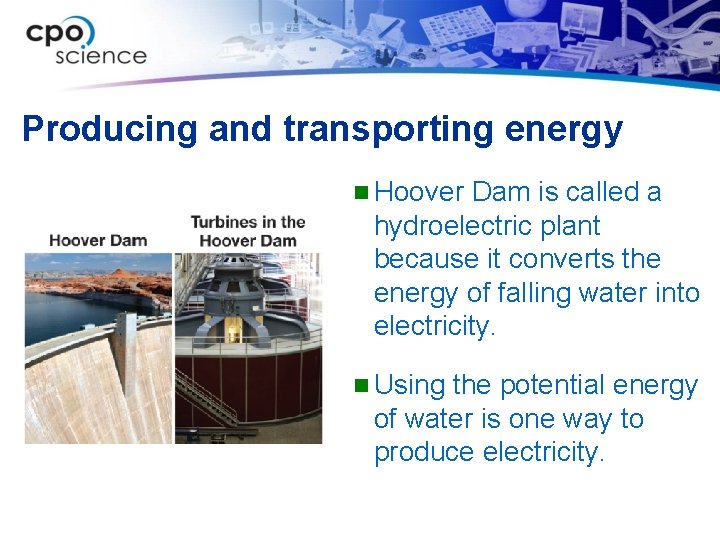
Producing and transporting energy n Hoover Dam is called a hydroelectric plant because it converts the energy of falling water into electricity. n Using the potential energy of water is one way to produce electricity.
16. 2 Investigation: Electromagnetic Induction Key Question: How does an electric generator work? Objectives: n Explain how an electric generator works. n Describe the relationship between the voltage output of a generator and the speed of the rotor. n Modify the design of a generator to test the effects of different factors, such as the number of magnets and the orientation of the magnets.