
Do Now Put homework in the red basket
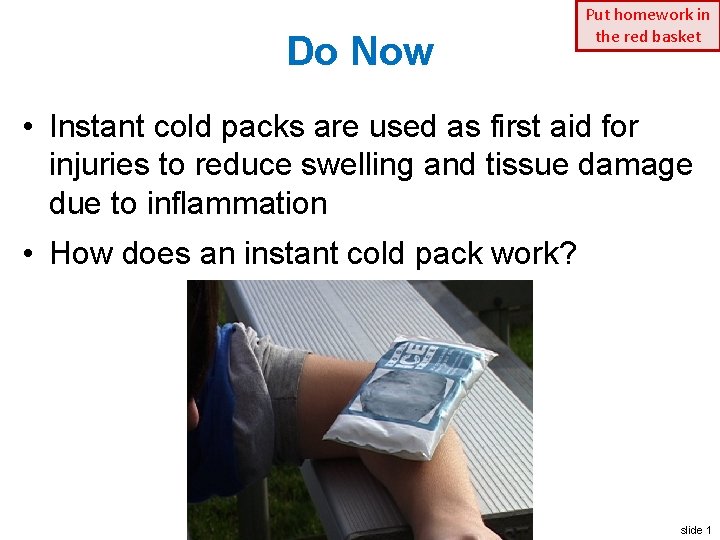
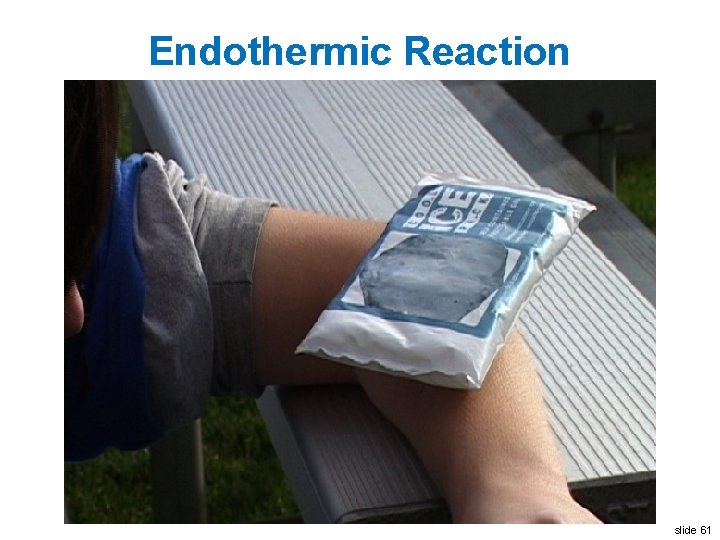
Do Now Put homework in the red basket • Instant cold packs are used as first aid for injuries to reduce swelling and tissue damage due to inflammation • How does an instant cold pack work? slide 1
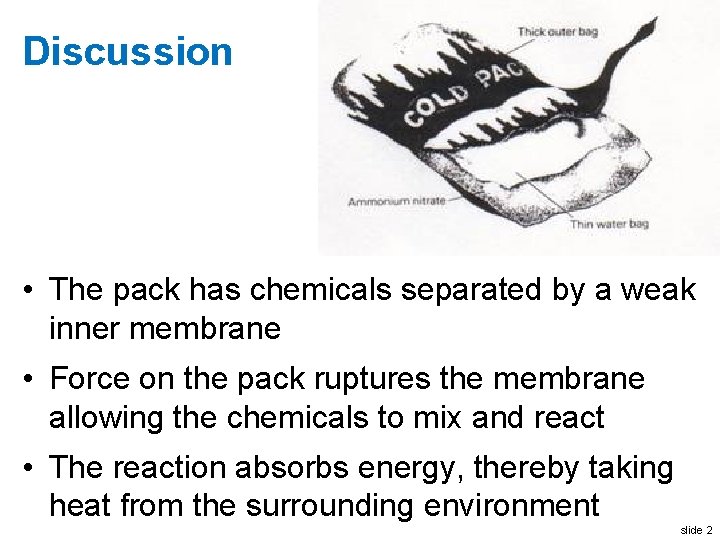
Discussion • The pack has chemicals separated by a weak inner membrane • Force on the pack ruptures the membrane allowing the chemicals to mix and react • The reaction absorbs energy, thereby taking heat from the surrounding environment slide 2
Early Enrollment Program • Application forms in black basket • This is a 4 credit class • Call #: 12361 • Course Title: General Chemistry I • Application deadline is October 15 • Return application form to Mrs. Nobrega slide 3
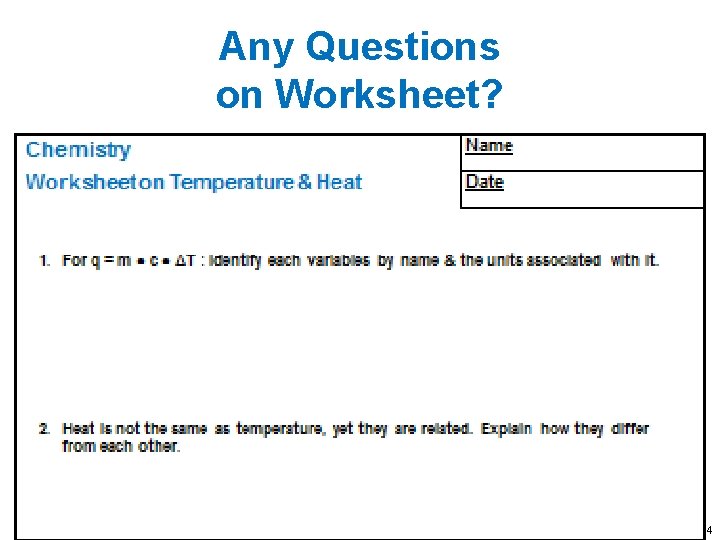
Any Questions on Worksheet? slide 4
Previously slide 5
The Study of Energy & Heat • We have learned about the heat associated with temperature changes • What about the heat associated with chemical reactions? slide 6
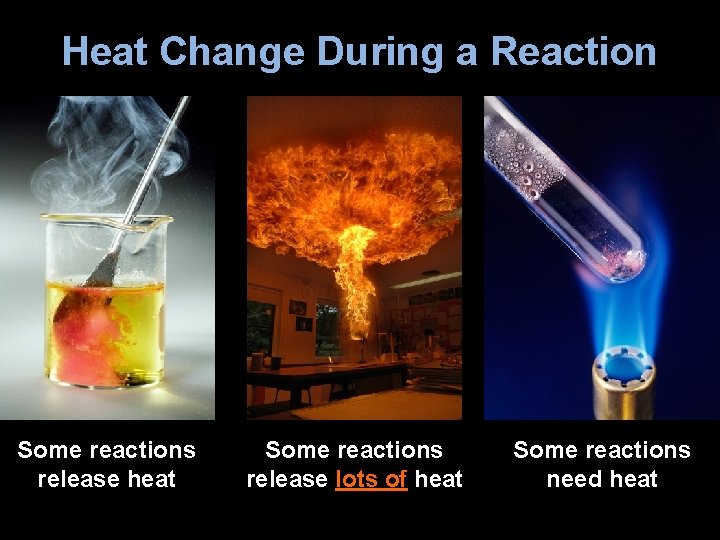
Heat Change During a Reaction Some reactions release heat Some reactions release lots of heat Some reactions need heat slide 7
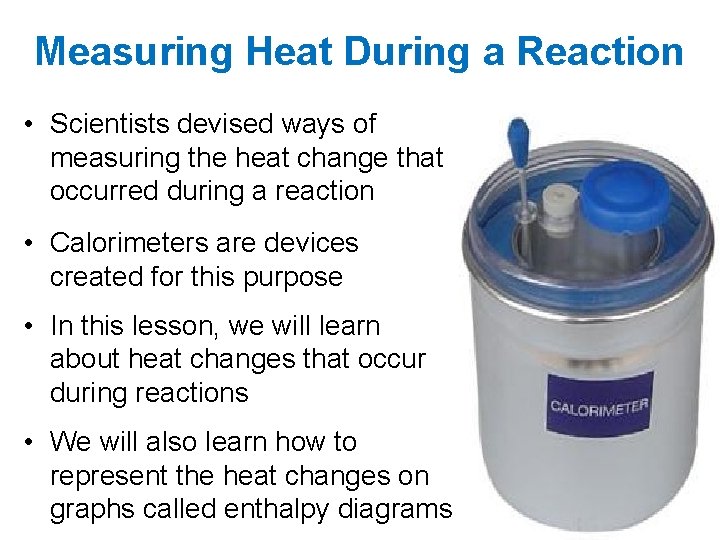
Measuring Heat During a Reaction • Scientists devised ways of measuring the heat change that occurred during a reaction • Calorimeters are devices created for this purpose • In this lesson, we will learn about heat changes that occur during reactions • We will also learn how to represent the heat changes on graphs called enthalpy diagrams slide 8
Enthalpy of Reactions SWBAT explain the concept of enthalpy of reaction, as well as interpret and create enthalpy diagrams of chemical reactions Write this in your notes slide 9
Enthalpy Write red text in your notes • When measuring heat changes during a reaction, a quantity called "enthalpy" is used. • Enthalpy = heat content of a system at constant pressure • Very complicated explanation why this stipulation about pressure is necessary • Symbol is "H" • Units can be joules, joules/mol or joules/gram • Because pressure often stays constant, people often use "enthalpy", "heat", and "energy" interchangeably. • Nonetheless, you need to know the definition of enthalpy and the difference between enthalpy, heat & energy slide 10
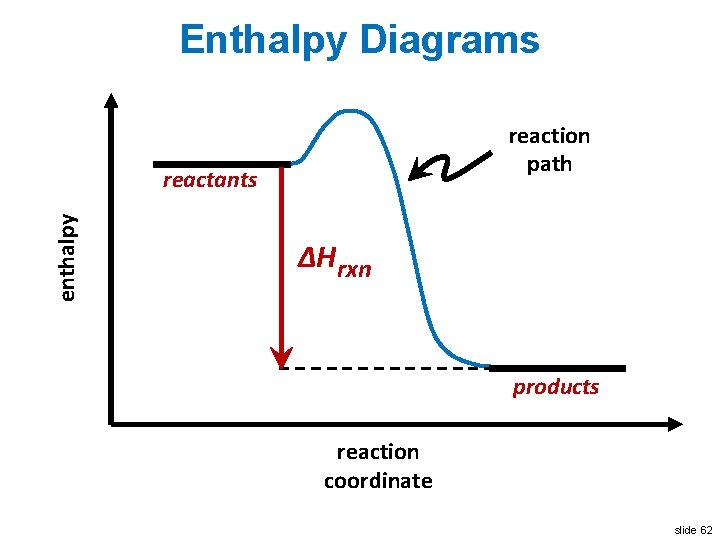
Enthalpy (Heat) of a Reaction reactants Write this in your notes products The enthalpy (heat) of reaction • defined as the amount of heat released or absorbed by a chemical reaction • symbol is "ΔHrxn" • units can be joules, joules/mol or joules/gram • determined by the following equation ΔHrxn = Hproducts – Hreactants slide 11
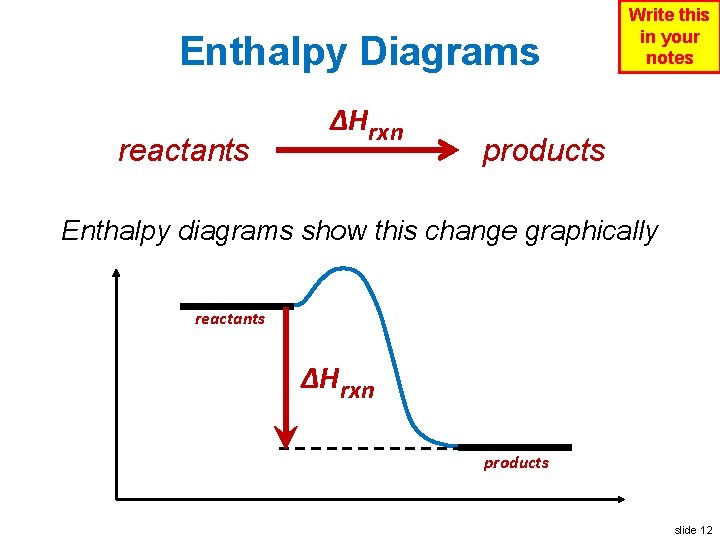
Enthalpy Diagrams reactants ΔHrxn Write this in your notes products Enthalpy diagrams show this change graphically reactants ΔHrxn products slide 12
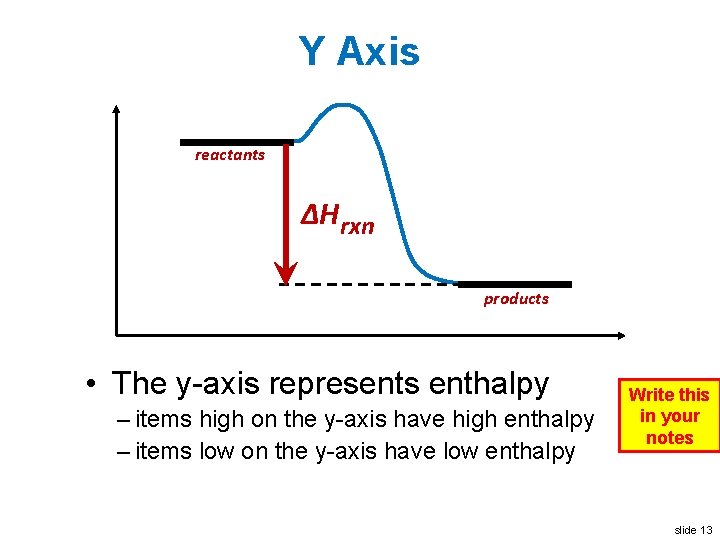
Y Axis reactants ΔHrxn products • The y-axis represents enthalpy – items high on the y-axis have high enthalpy – items low on the y-axis have low enthalpy Write this in your notes slide 13
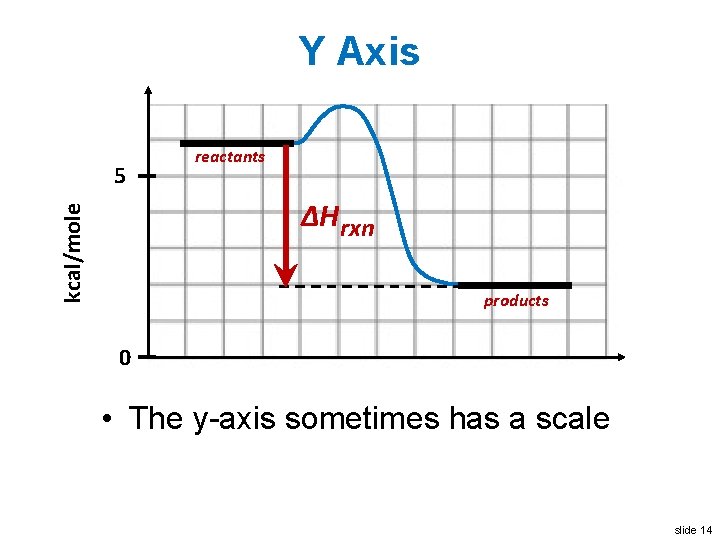
Y Axis 5 reactants kcal/mole ΔHrxn products 0 • The y-axis sometimes has a scale slide 14
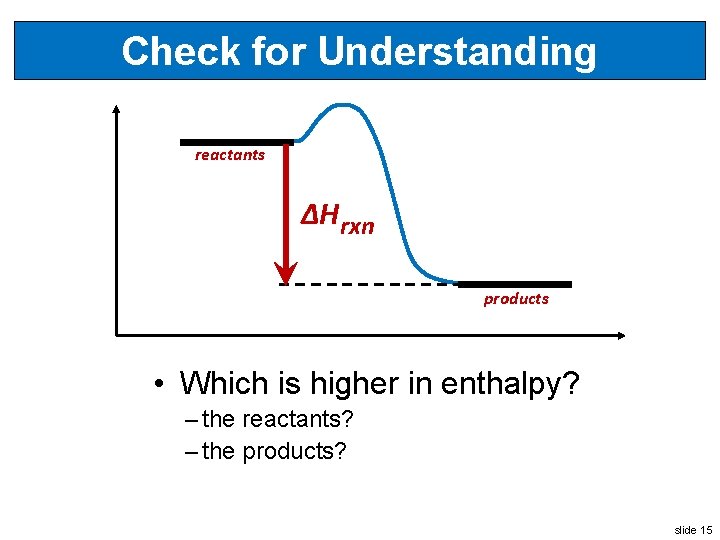
Check for Understanding reactants ΔHrxn products • Which is higher in enthalpy? – the reactants? – the products? slide 15
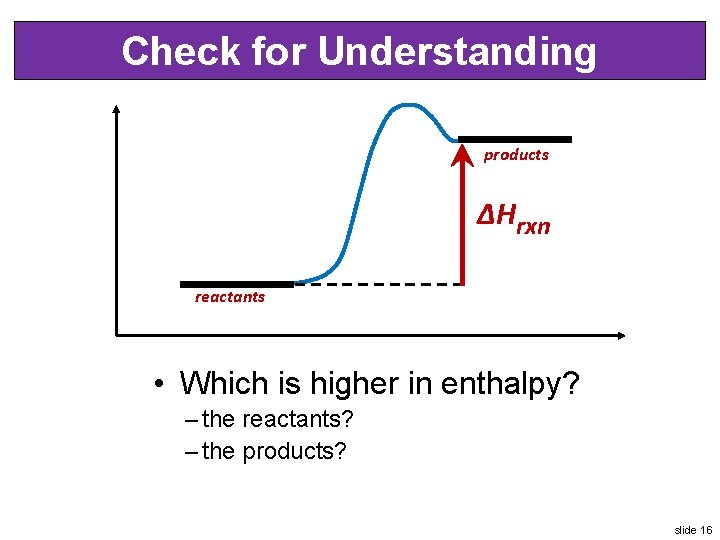
Check for Understanding products ΔHrxn reactants • Which is higher in enthalpy? – the reactants? – the products? slide 16
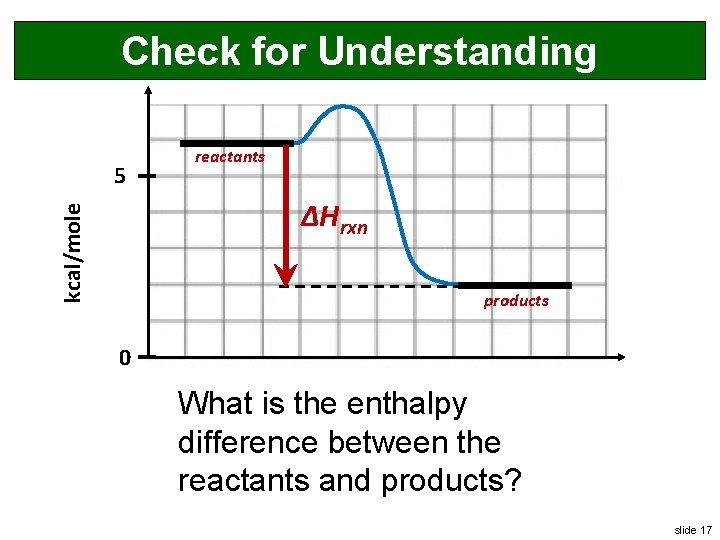
Check for Understanding 5 reactants kcal/mole ΔHrxn products 0 What is the enthalpy difference between the reactants and products? slide 17
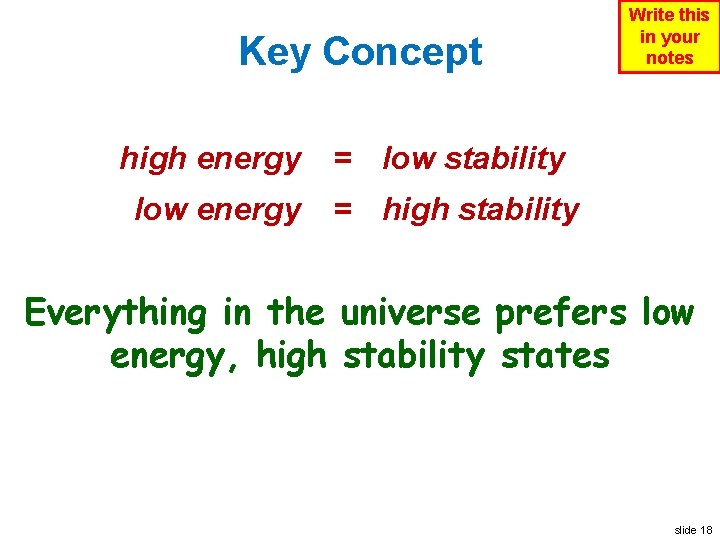
Key Concept Write this in your notes high energy = low stability low energy = high stability Everything in the universe prefers low energy, high stability states slide 18
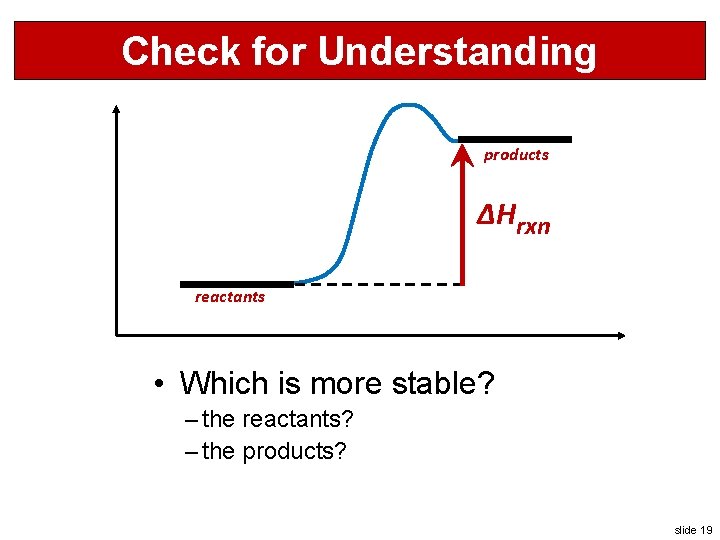
Check for Understanding products ΔHrxn reactants • Which is more stable? – the reactants? – the products? slide 19
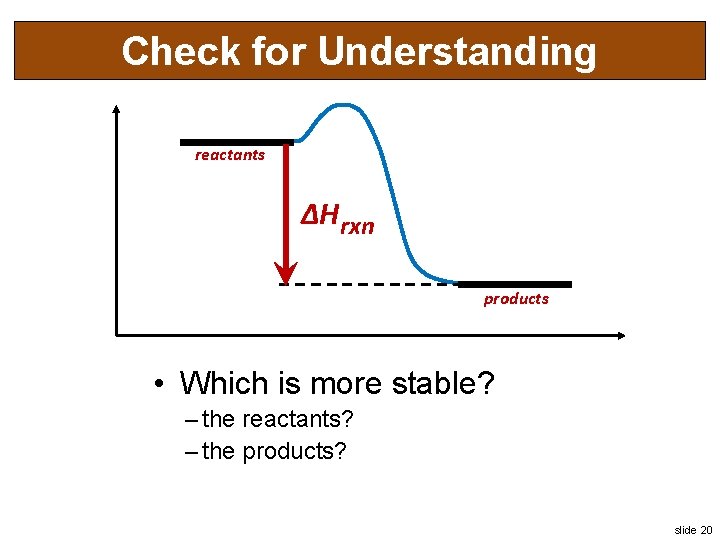
Check for Understanding reactants ΔHrxn products • Which is more stable? – the reactants? – the products? slide 20
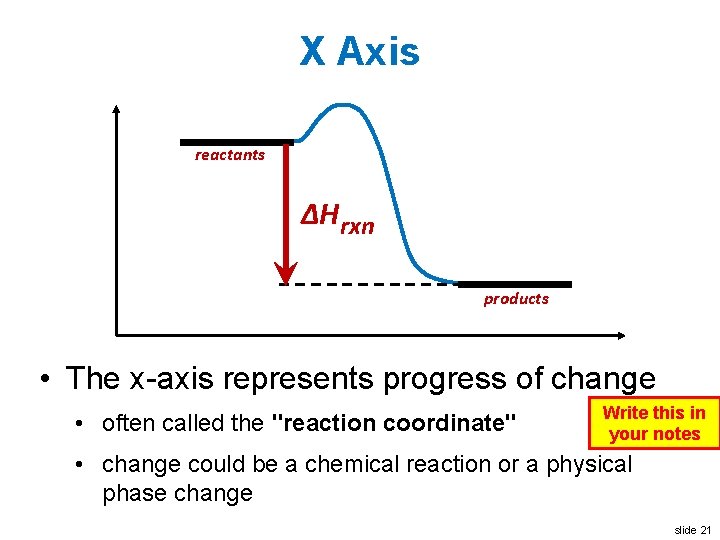
X Axis reactants ΔHrxn products • The x-axis represents progress of change • often called the "reaction coordinate" Write this in your notes • change could be a chemical reaction or a physical phase change slide 21
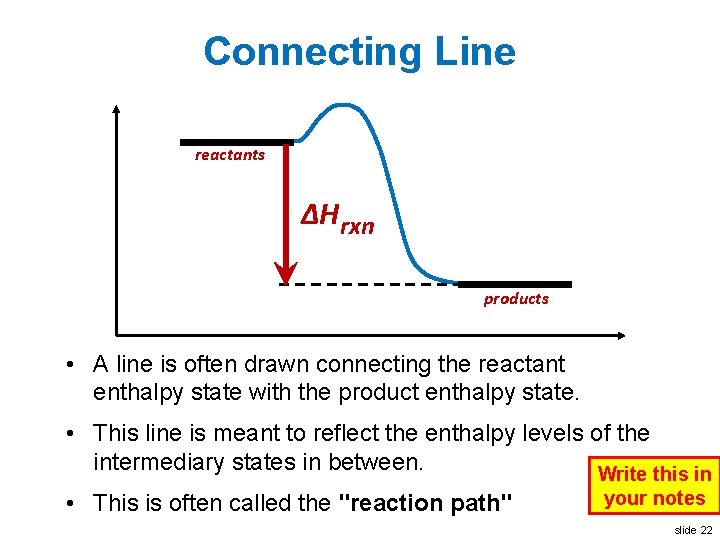
Connecting Line reactants ΔHrxn products • A line is often drawn connecting the reactant enthalpy state with the product enthalpy state. • This line is meant to reflect the enthalpy levels of the intermediary states in between. Write this in • This is often called the "reaction path" your notes slide 22
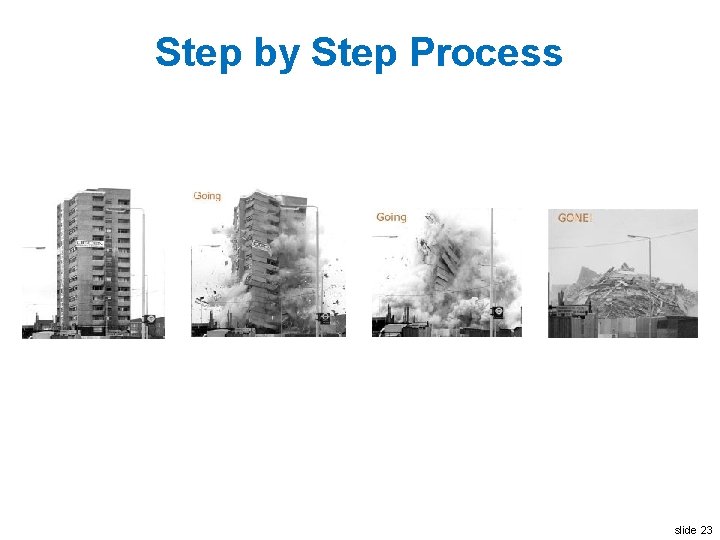
Step by Step Process slide 23
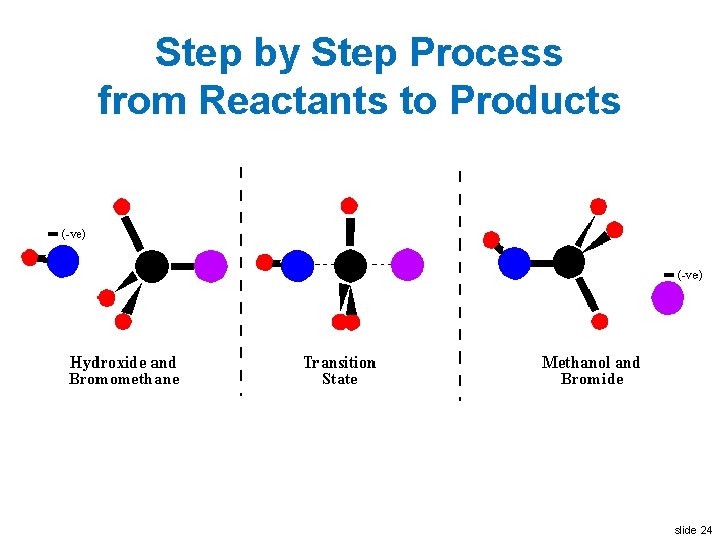
Step by Step Process from Reactants to Products slide 24
Check for Understanding Write down 5 steps you take in going to lunch slide 25
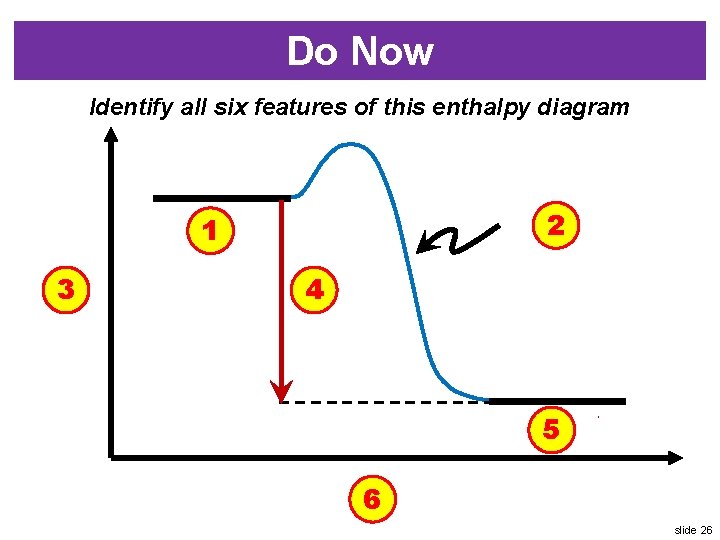
Do Now Identify all six features of this enthalpy diagram reaction 2 path enthalpy reactants 3 1 4 ΔE products 5 reaction 6 coordinate slide 26
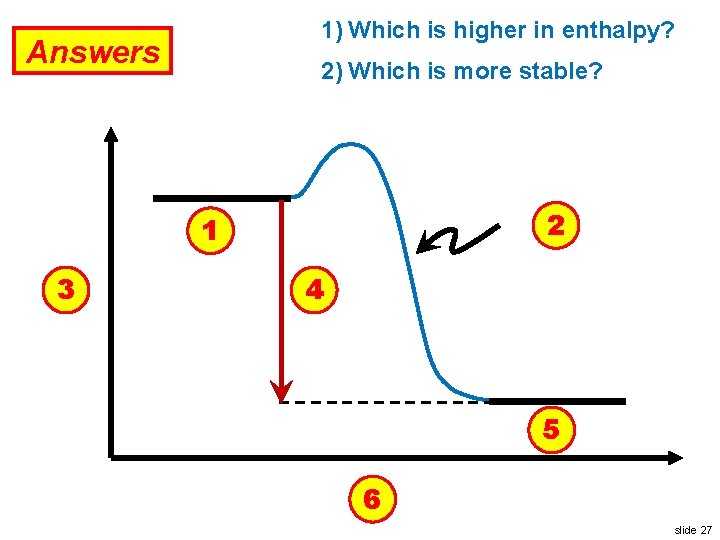
1) Which is higher in enthalpy? Answers 2) Which is more stable? reaction 2 path enthalpy reactants 3 1 4 rxn ΔE ΔH products 5 reaction 6 coordinate slide 27
Enthalpy Consumed or Released • In some cases, enthalpy must be consumed in order for the reaction to proceed forward – endothermic reaction • In other cases, enthalpy is released when the reaction proceeds forward – exothermic reaction slide 28
The Sign of ΔHrxn If the reaction. . . then the reaction is. . . Write this in your notes and ΔHrxn is. . . slide 29
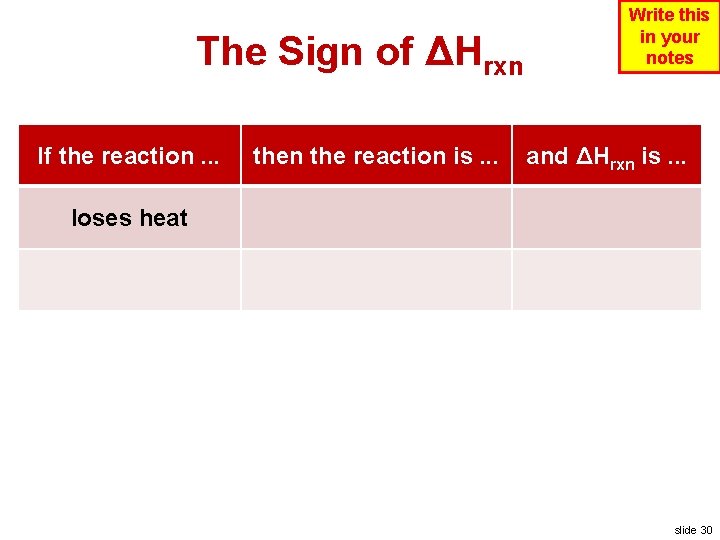
The Sign of ΔHrxn If the reaction. . . then the reaction is. . . Write this in your notes and ΔHrxn is. . . loses heat slide 30
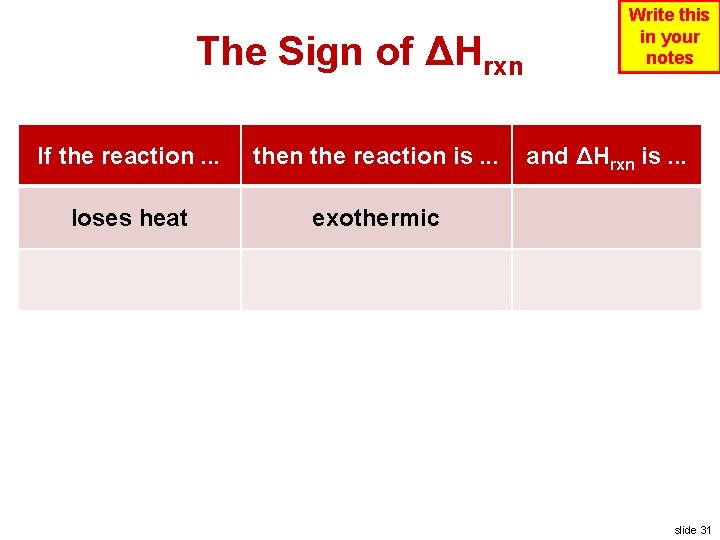
The Sign of ΔHrxn If the reaction. . . then the reaction is. . . loses heat exothermic Write this in your notes and ΔHrxn is. . . slide 31
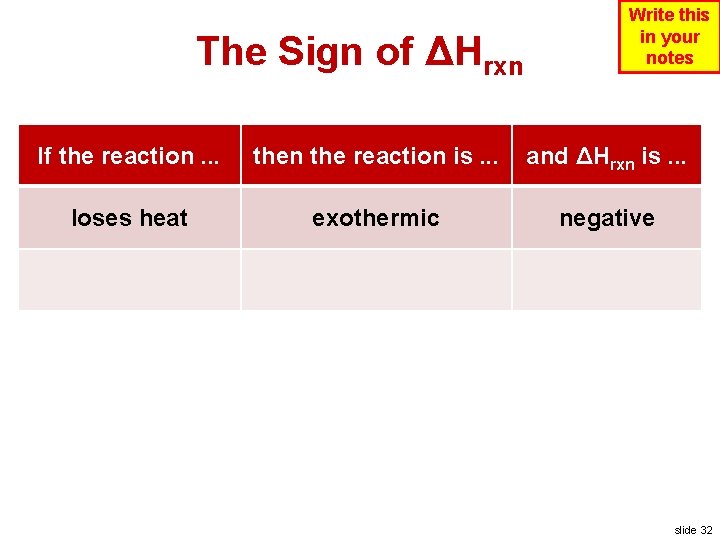
The Sign of ΔHrxn Write this in your notes If the reaction. . . then the reaction is. . . and ΔHrxn is. . . loses heat exothermic negative slide 32
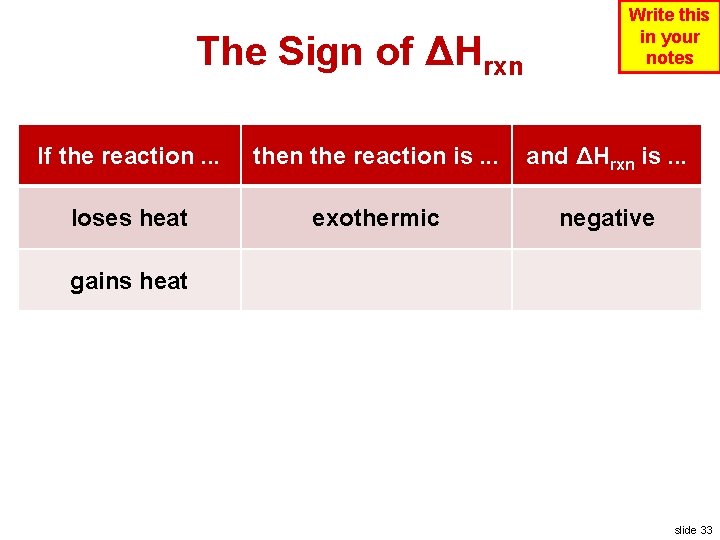
The Sign of ΔHrxn Write this in your notes If the reaction. . . then the reaction is. . . and ΔHrxn is. . . loses heat exothermic negative gains heat slide 33
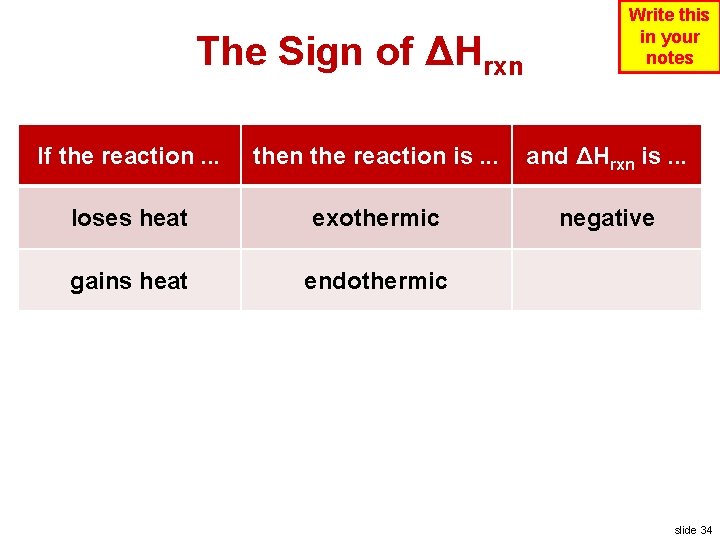
The Sign of ΔHrxn Write this in your notes If the reaction. . . then the reaction is. . . and ΔHrxn is. . . loses heat exothermic negative gains heat endothermic slide 34
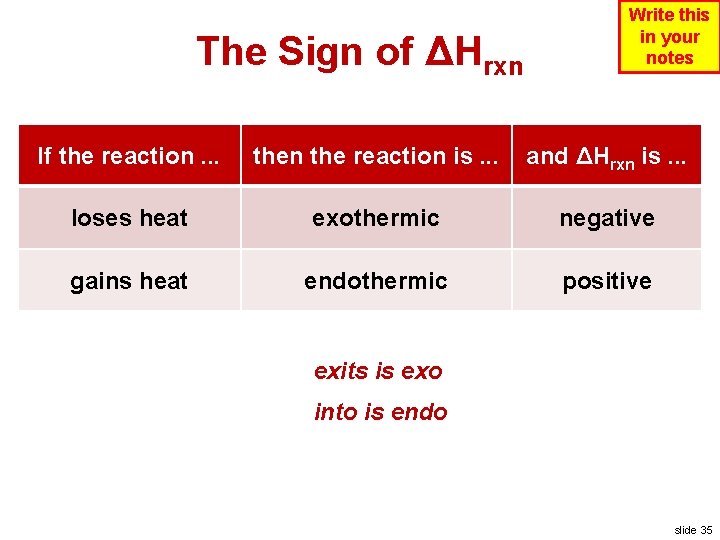
The Sign of ΔHrxn Write this in your notes If the reaction. . . then the reaction is. . . and ΔHrxn is. . . loses heat exothermic negative gains heat endothermic positive exits is exo into is endo slide 35
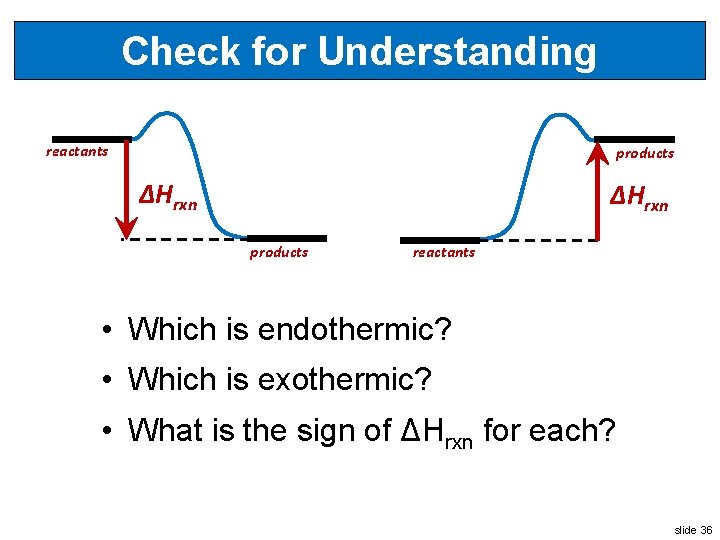
Check for Understanding reactants products ΔHrxn products reactants • Which is endothermic? • Which is exothermic? • What is the sign of ΔHrxn for each? slide 36
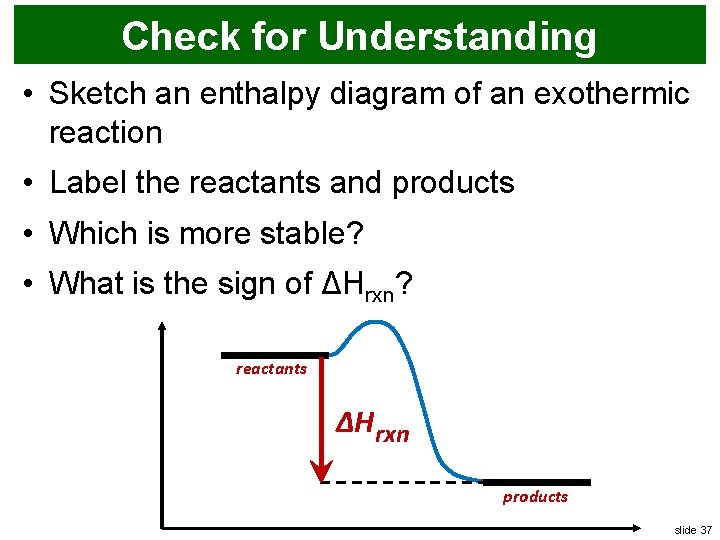
Check for Understanding • Sketch an enthalpy diagram of an exothermic reaction • Label the reactants and products • Which is more stable? • What is the sign of ΔHrxn? reactants ΔHrxn products slide 37
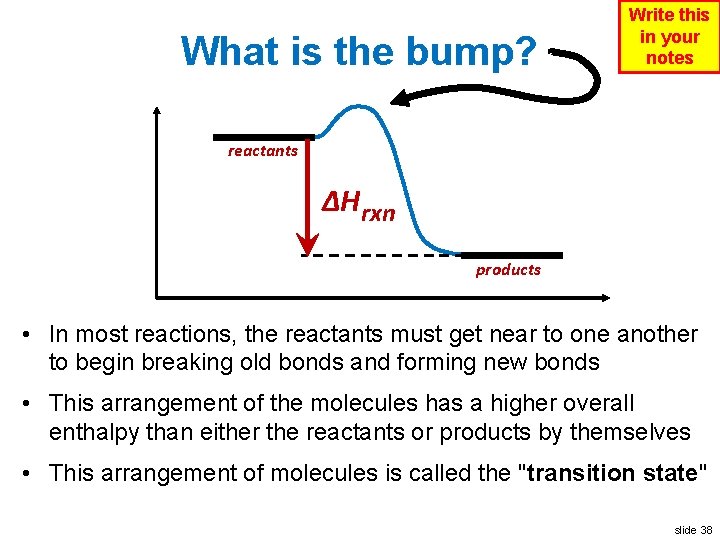
What is the bump? Write this in your notes reactants ΔHrxn products • In most reactions, the reactants must get near to one another to begin breaking old bonds and forming new bonds • This arrangement of the molecules has a higher overall enthalpy than either the reactants or products by themselves • This arrangement of molecules is called the "transition state" slide 38
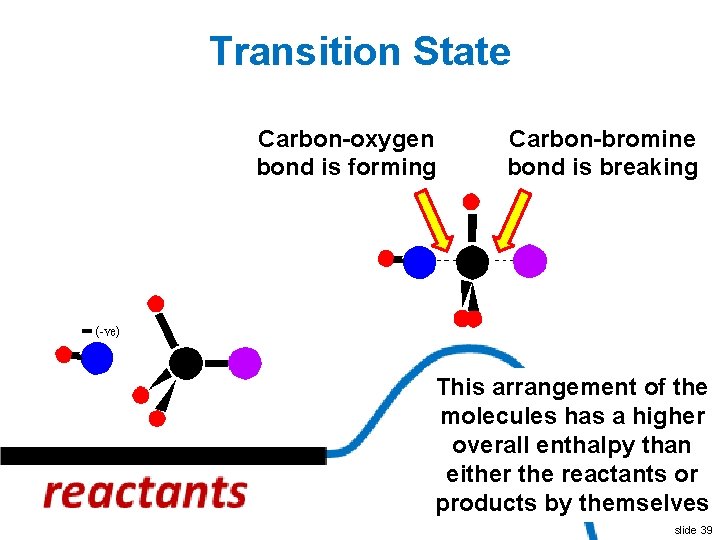
Transition State Carbon-oxygen bond is forming Carbon-bromine bond is breaking This arrangement of the molecules has a higher overall enthalpy than either the reactants or products by themselves slide 39
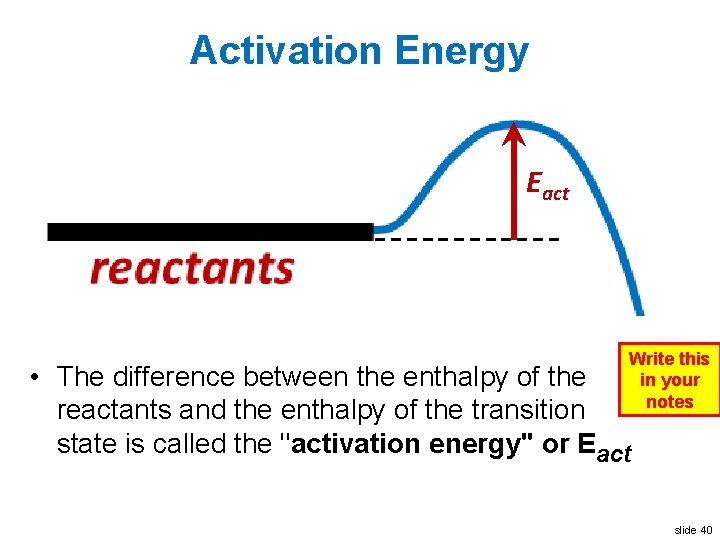
Activation Energy Eact Write this in your notes • The difference between the enthalpy of the reactants and the enthalpy of the transition state is called the "activation energy" or Eact slide 40
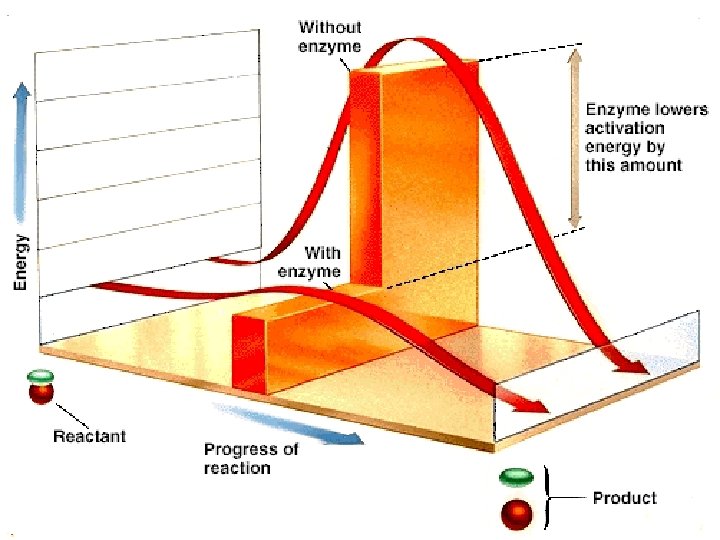
Eact is Important Write this in your notes • For a reaction to happen, the reaction must get enough energy to get over the bump. – exothermic reactions would occur spontaneously without the bump • Activation energy determines how easily the reaction can occur. – high activation energy = hard to get over bump – low activation energy = easy to get over bump • Catalyst, such as enzymes, act by stabilizing the transition states and lowering the activation energy of reactions slide 41
slide 42
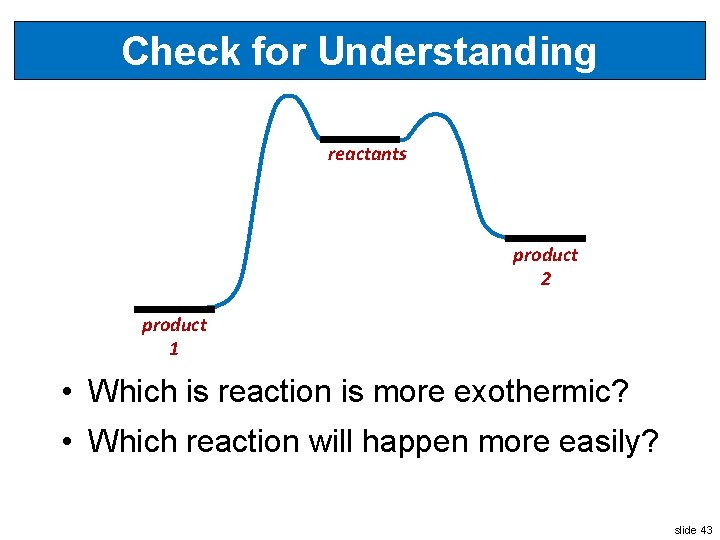
Check for Understanding reactants product 2 product 1 • Which is reaction is more exothermic? • Which reaction will happen more easily? slide 43
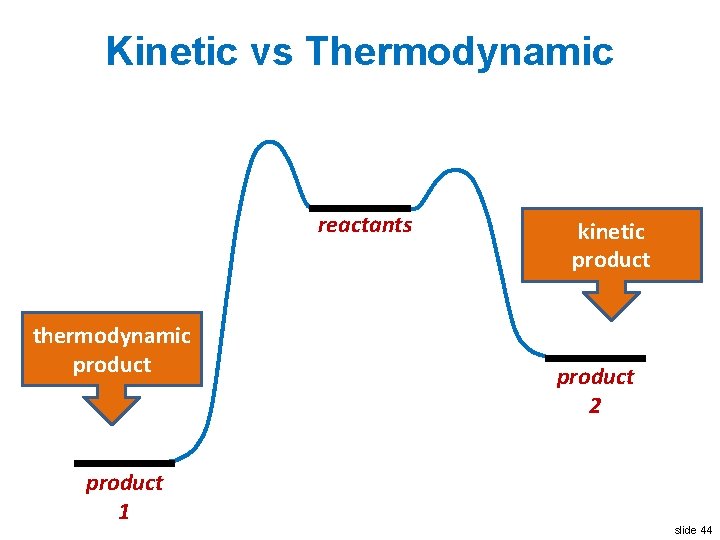
Kinetic vs Thermodynamic reactants thermodynamic product 1 kinetic product 2 slide 44
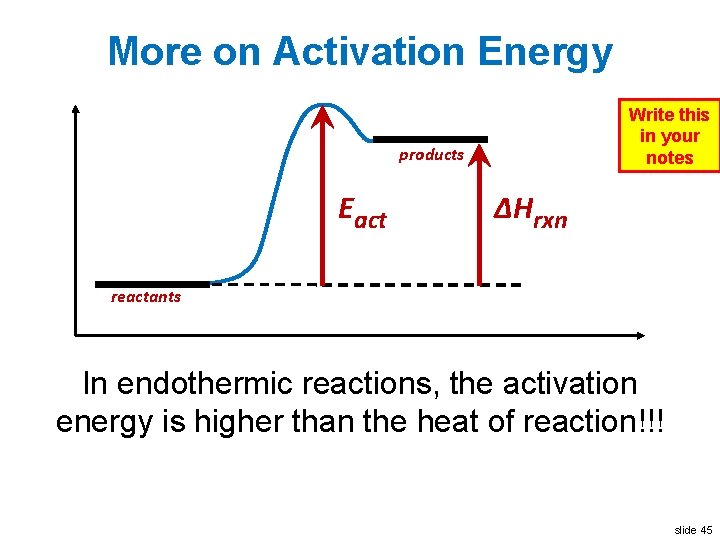
More on Activation Energy Write this in your notes products Eact ΔHrxn reactants In endothermic reactions, the activation energy is higher than the heat of reaction!!! slide 45
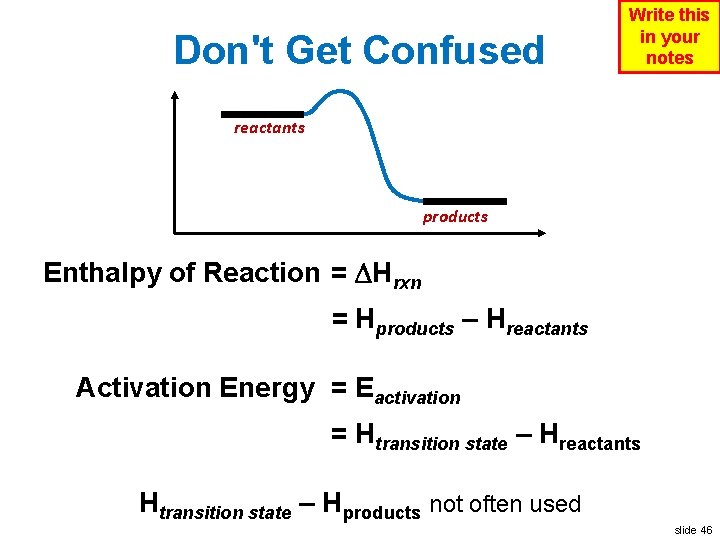
Don't Get Confused Write this in your notes reactants products Enthalpy of Reaction = DHrxn = Hproducts – Hreactants Activation Energy = Eactivation = Htransition state – Hreactants Htransition state – Hproducts not often used slide 46
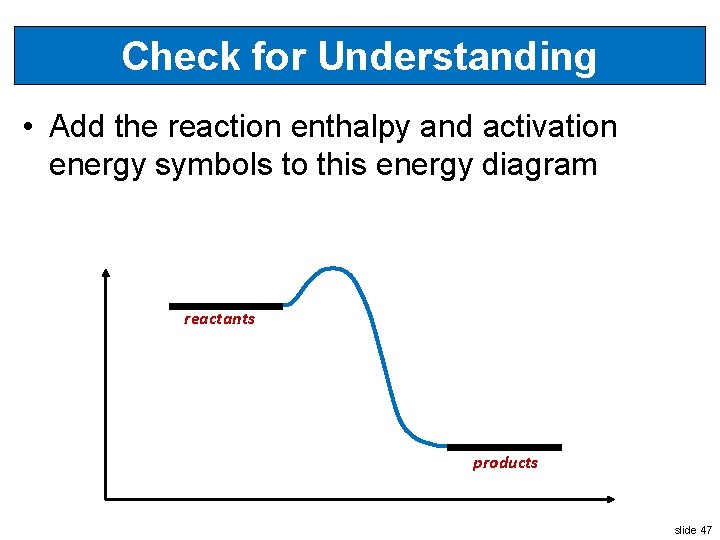
Exit. Understanding Ticket Check for • Add the reaction enthalpy and activation energy symbols to this energy diagram reactants products slide 47
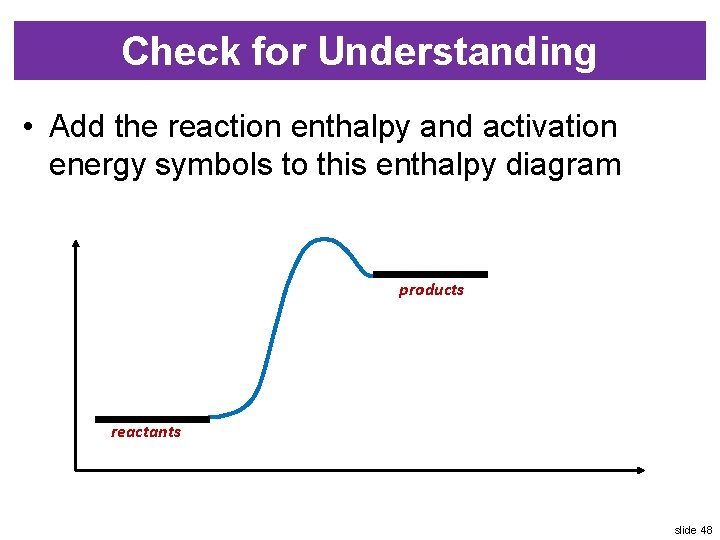
Check for Understanding • Add the reaction enthalpy and activation energy symbols to this enthalpy diagram products reactants slide 48
Check for Understanding • In your notebook, sketch the enthalpy diagram for a reaction which is exothermic and has a high activation energy. • Be sure your diagram includes – reactants and products with correct relative enthalpy – a reaction path – labeled x and y axes – indication of enthalpy (heat) of reaction – indication of the activation energy slide 49
Do Now • In your notebook, sketch the enthalpy diagram for a reaction which is endothermic and has a high activation energy. • Be sure your diagram includes – reactants and products with correct relative enthalpy – a reaction path – labeled x and y axes – indication of enthalpy (heat) of reaction – indication of the activation energy slide 50
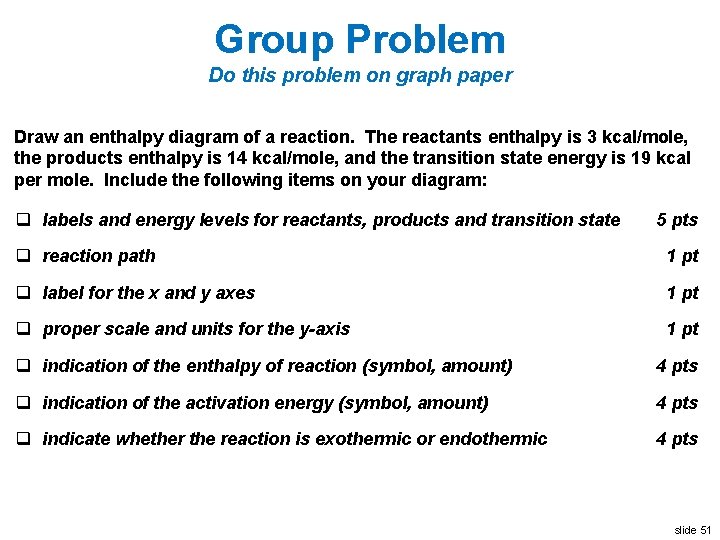
Group Problem Do this problem on graph paper Draw an enthalpy diagram of a reaction. The reactants enthalpy is 3 kcal/mole, the products enthalpy is 14 kcal/mole, and the transition state energy is 19 kcal per mole. Include the following items on your diagram: q labels and energy levels for reactants, products and transition state 5 pts q reaction path 1 pt q label for the x and y axes 1 pt q proper scale and units for the y-axis 1 pt q indication of the enthalpy of reaction (symbol, amount) 4 pts q indication of the activation energy (symbol, amount) 4 pts q indicate whether the reaction is exothermic or endothermic 4 pts slide 51

slide 52
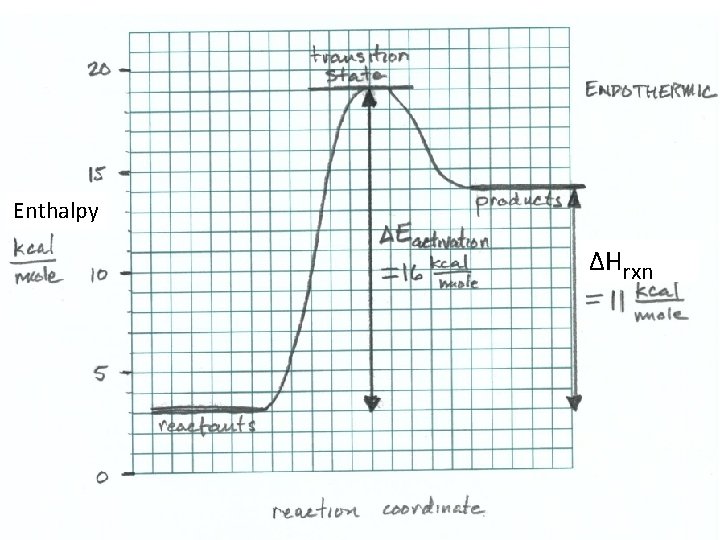
Enthalpy ΔHrxn slide 53
Homework • Worksheet on Enthalpy Diagrams • Get 2 -4 pieces of graph paper • We will work the rest of the period on this worksheet • It will be due to me by the beginning of next class • It will be graded as a homework assignment. • If you fail to finish it during class, you will have to complete it for homework slide 54

Backup Slides slide 55

Not Covered slide 56
Thermochemistry • The study of heat changes that accompany chemical reactions or physical changes • For thermochemistry, the following definitions are used – universe - everything – system - the part of the universe we are studying, usually a chemical reaction or physical change – surroundings - everything in the universe except for the system slide 57
Enthalpy of Combustion • Enthalpy (heat) of combustion ΔHcomb = enthalpy change for the complete burning of one mole of a substance • Standard enthalpy (heat) of combustion ΔH°comb = enthalpy of combustion measured at 1 atm pressure and 25°C temperature (standard conditions) • Practice calculating overall heat of combustions based on stand slide 58
Representing Change before after reactants products A B M(t = 0) M(t = 1) Write this in your notes • These are all examples of a short hand notation used to represent change. • The change can be a chemical reaction, a phase change or any other change. slide 59
Delta Δ Write this in your notes • Greek letter equivalent to our "D" • Delta is a symbol that means "change" – Δx means "change in x" or "x 2 - x 1" – Δt means "change in t" or "t 2 - t 1" • Delta is used frequently in math and science to indicate change. slide 60
Endothermic Reaction slide 61
Enthalpy Diagrams reaction path enthalpy reactants ΔHrxn products reaction coordinate slide 62
Check for Understanding slide 63
- Slides: 63