
DO NOW Map Skills Worksheet How are Fossil


- Slides: 43
DO NOW Map Skills Worksheet
How are Fossil Fuels Formed and Used?
What is a Fossil Fuel? A fossil fuel is formed from the remains of plants and animals that lived millions of years ago.
What is a Fossil Fuel? A fossil fuel is formed from the remains of plants and animals that lived millions of years ago. The gasoline we use is from ‘dead dinosaurs’
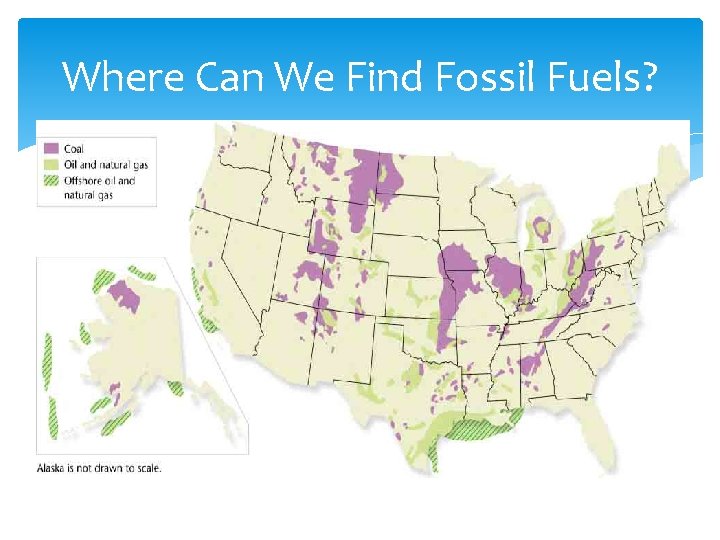
Where Can We Find Fossil Fuels?
How Fossil Fuels Form Coal Formation Remains of swamp plants Formed about 300 – 320 million years ago
How Fossil Fuels Form Coal Formation As the ocean tides changed, sediments compressed the remains, and the same process of intense heat and pressure that forms metamorphic rock, transformed the remains into coal.
How Fossil Fuels Form Coal Formation As the ocean tides changed, sediments compressed the remains, and the same process of intense heat and pressure that forms metamorphic rock, transformed the remains into coal. West Coast coal deposits are much younger than East Coast deposits
How Fossil Fuels Form Oil and Natural Gas Form from the decay of tiny marine organisms that accumulated on the ocean floor.
How Fossil Fuels Form Oil and Natural Gas The same metamorphic process as the plant remains underwent to become coal, transforms the remains of the marine organisms into oil and natural gas.
How Fossil Fuels Form Oil and Natural Gas The same metamorphic process as the plant remains underwent to become coal, transforms the remains of the marine organisms into oil and natural gas. Over time, the molecules migrated into the porous rocks where we find them.
Coal Most of the world’s fossil-fuel reserves are in the form of coal.
Coal Most of the world’s fossil-fuel reserves are in the form of coal. Major advantages of coal:
Coal Most of the world’s fossil-fuel reserves are in the form of coal. Major advantages of coal: It needs little refining after it is mined
Coal Most of the world’s fossil-fuel reserves are in the form of coal. Major advantages of coal: It needs little refining after it is mined It is relatively inexpensive to mine (lot’s of profit to be made)
Coal mining has many detrimental effects to the environment:
Coal mining has many detrimental effects to the environment: Strip mining (destroying ecosystems)
Coal mining has many detrimental effects to the environment: Strip mining (destroying ecosystems) Toxic chemicals from waste can leech into the water supply if not contained or treated.
Coal Different types of coal will release different pollutants
Coal Different types of coal will release different pollutants High grade coal (bituminous coal) produces more heat and less pollution than a lower grade coal (lignite)
Coal Different types of coal will release different pollutants Sulfur, found in all coal, is a major pollutant
Coal Different types of coal will release different pollutants Sulfur, found in all coal, is a major pollutant The more sulfur that is released in an area, the higher the acid rain concentration becomes
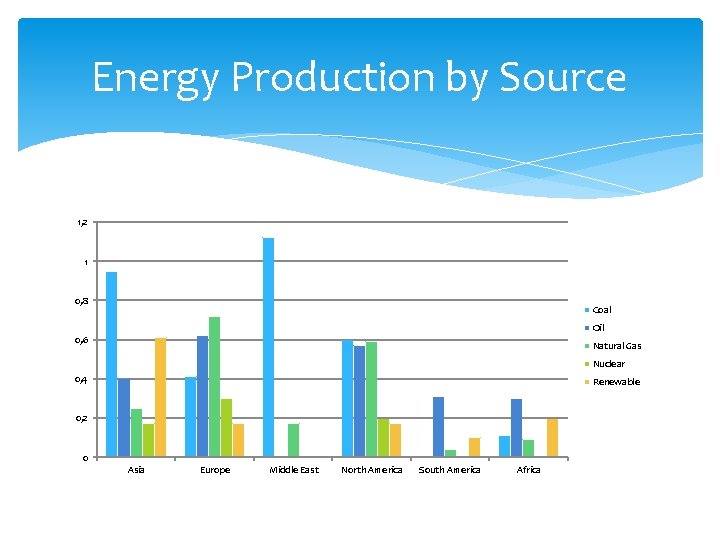
Energy Production by Source 1, 2 1 0, 8 Coal Oil 0, 6 Natural Gas Nuclear 0, 4 Renewable 0, 2 0 Asia Europe Middle East North America South America Africa
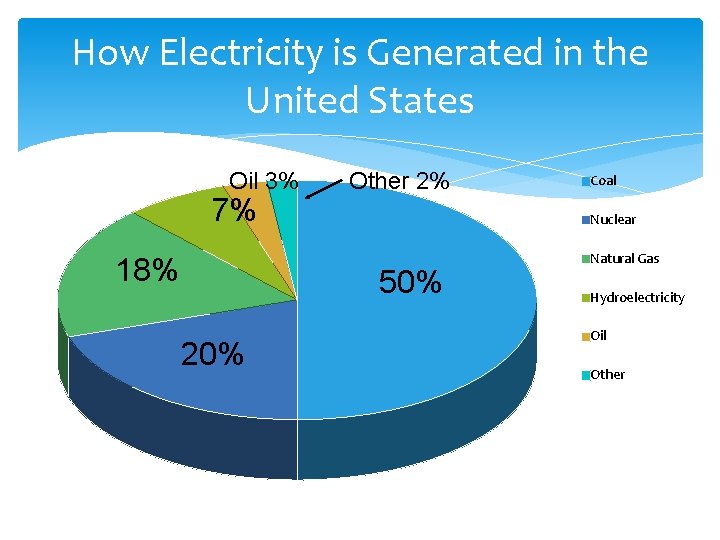
How Electricity is Generated in the United States Oil 3% 7% 18% Other 2% Nuclear 50% 20% Coal Natural Gas Hydroelectricity Oil Other
Petroleum Oil that is pumped from the ground is called petroleum (crude oil).
Petroleum Oil that is pumped from the ground is called petroleum (crude oil). Petroleum accounts for 45% of the world’s commercial energy use.
Petroleum Oil is most often found around major geologic features like faults, folds and salt domes.
Petroleum Oil is most often found around major geologic features like faults, folds and salt domes. The Middle East has the most oil deposits worldwide.
Environmental Effects of Using Oil Burning petroleum releases pollutants.
Environmental Effects of Using Oil Burning petroleum releases pollutants. Internal combustion engines (like cars have) burn gasoline releasing pollutants into the atmosphere.
Environmental Effects of Using Oil Burning petroleum releases pollutants.
Environmental Effects of Using Oil Burning petroleum releases pollutants. Internal combustion engines (like cars have) burn gasoline releasing pollutants into the atmosphere.
Environmental Effects of Using Oil Emissions regulations and technology have helped to reduce the pollutants being put into the atmosphere.
Environmental Effects of Using Oil spills Can burn on the water Can harm marine life
Natural Gas About 20% of the world’s nonrenewable energy is natural gas.
Natural Gas About 20% of the world’s nonrenewable energy is natural gas. Also known as methane (CH 4).
Natural Gas Often found in the same place as oil, so it is very inexpensive to collect since there is already equipment in place.
Natural Gas Often found in the same place as oil, so it is very inexpensive to collect since there is already equipment in place. Much cleaner-burning than petroleum products…fewer environmental problems.
The Future of Fossil Fuels We are still drilling for oil/natural gas, but more slowly than in the past.
The Future of Fossil Fuels We are still drilling for oil/natural gas, but more slowly than in the past. Predictions of our current energy usage doubling by 2050 give us a need to find alternative energy sources or new reserves of fossil fuels.
Hydrofracking Short for hydrofracturing. Hydraulic fracturing is a practice used to coax oil and natural gas from hard rock formations.
Hydrofracking It involves forcing large amounts of pressurized water, a proppant (usually sand), and very small amounts of chemicals down the wellbore to create tiny fissures in the rock so the oil and gas can flow through the wellbore to the surface.
Homework Active Reading Worksheet