
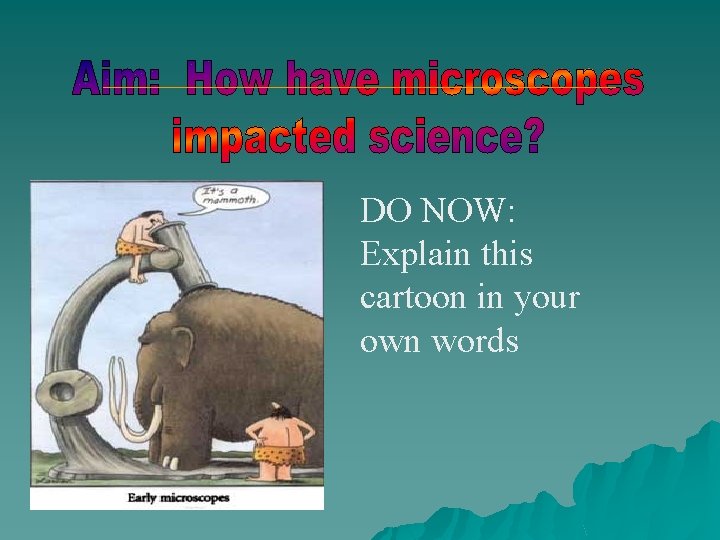
DO NOW Explain this cartoon in your own




- Slides: 44
DO NOW: Explain this cartoon in your own words
Microscopes Microscopy is the art of producing images for microscopic things that are not visible to the human eye.
Robert Hooke's microscope (1665)
The first useful microscope was developed in the Netherlands in the early 1600 s
1. Compound Light Microscope • Models found in most schools, uses compound lenses and light to magnify objects. The lenses bend or refract the light, which makes the object beneath them appear closer.
2. Stereoscope – this microscope allows for binocular (two eyes) viewing of larger specimens.
Polychaete worm (aquatic) Parasite that causes disease in your liver!
3. Scanning Electron Microscope – allow scientists to view a universe too small to be seen with a light microscope. SEMs do not use light waves; they use electrons
4. Transmission Electron Microscope also uses electrons, but instead of scanning the surface (as with SEM's) electrons are passed through very thin specimens.
Due to the powerful laser beam, anything living would die!
A mosquito An ant
Threaded needle Scales of a moth wing
Stinger of a mosquito
DO NOW: Hand-out
Parts of a Compound light microscope
The structure of a cell nucleus would be seen in the greatest detail by use of 1. 2. 3. 4. a compound light microscope an ultracentrifuge a dissecting microscope an electron microscope
Which is the correct sequence of historical developments leading to our present knowledge of cells? 1. 2. 3. 4. electron microscope – cell theory – compound light microscope – cell theory – electron microscope – compound light microscope – cell theory
Bodytube Eyepiece/ ocular nosepiece Objective lens Stage clips Diaphragm arm stage Coarse adj. knob Fine adj. knob Light source base
Eyepiece (Ocular lens): magnifies the image 10 x
Stage Clips & Objectives (4 x, 10 x & 40 x magnification)
Objective lens Attached to the nosepiece Usually three magnifications Examples: 4 X, 10 X, 40 X Referred to as low and high powers
Low power objective = uused to locate the specimen on the slide u. Larger field of view (See more of the slide, but less details) High power objective = u. More magnification u. Smaller field of view but more details
Deer Tick 41 X Magnification Deer Tick 164 X Magnification
Deer Tick 657 X Magnification
Used to adjust the amount of light entering the scope Located beneath the stage
Coarse (big) and Fine (small) adjustment knobs
ARM
Remember!! u. ALWAYS USE TWO HANDS TO CARRY THE MICROSCOPE!!!
1. ) Diaphragm
2. 3.
4. 5
5.
Which structure is best observed using a compound light microscope? 1. 2. 3. 4. a cell a virus a DNA sequence the inner surface of a mitochondrion
After switching from the highpower to the low-power objective lens of a compound light microscope, the area of the low-power field will appear 1. 2. 3. 4. larger and brighter smaller and brighter larger and darker smaller and darker
• Is numeric value that quantifies how much a specimen has been magnified.
• Is calculated by multiplying the eyepiece power (usually 10 x) by the objective lens in place.
magnification that can be obtained using the microscope shown? 1. 2. 3. 4. 20 x 200 x 40 x 800 x
Total magnification: Ocular X (eyepiece) Ex. ) Objective = total magnification Objective lens 4 x 10 x 43 x Total magnification
When viewed with a compound light microscope under low power, the letter "p" will appear as 1. 2. 3. 4. q p d b
How have microscopes impacted science? THE END