
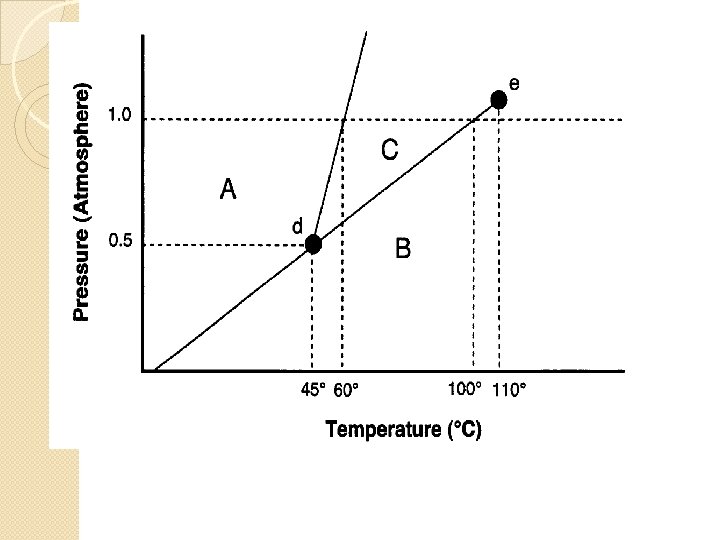
Do Now Announcements Work on Phase diagram practice


- Slides: 18
Do Now & Announcements �Work on Phase diagram practice �Unit 5 Quest TUES 10/20 �Midterm FRI 10/23 (we will review Tues, Wed, and Thurs)
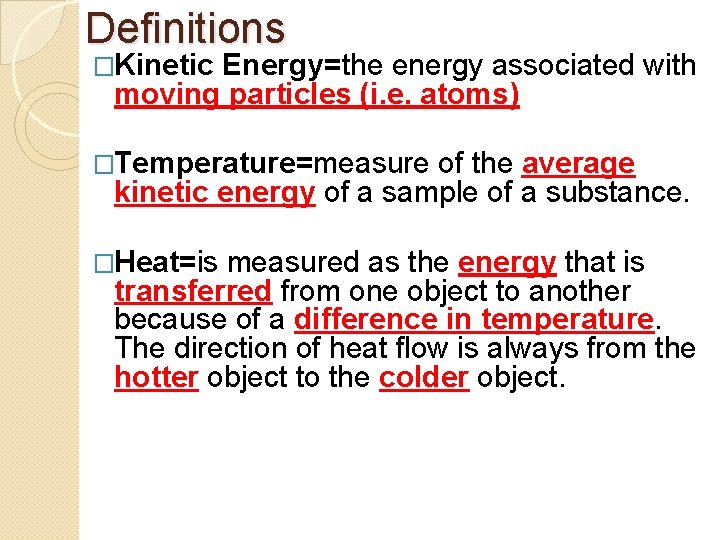
Definitions �Kinetic Energy=the energy associated with moving particles (i. e. atoms) �Temperature=measure of the average kinetic energy of a sample of a substance. �Heat=is measured as the energy that is transferred from one object to another because of a difference in temperature. The direction of heat flow is always from the hotter object to the colder object.
Demo
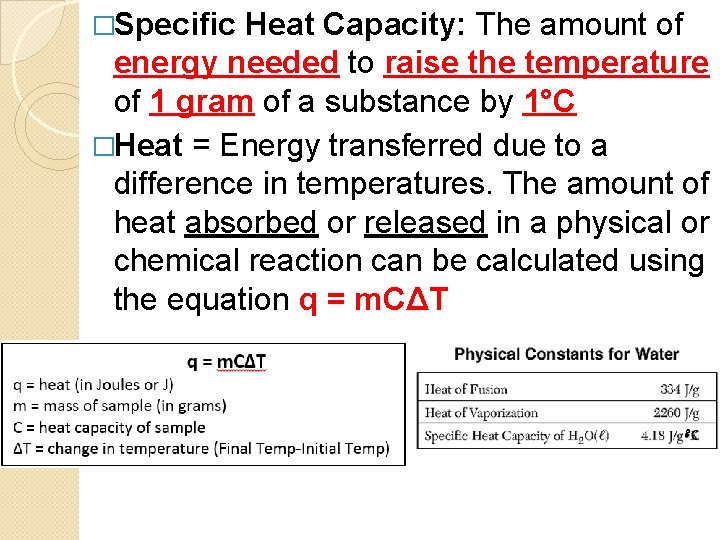
�Specific Heat Capacity: The amount of energy needed to raise the temperature of 1 gram of a substance by 1°C �Heat = Energy transferred due to a difference in temperatures. The amount of heat absorbed or released in a physical or chemical reaction can be calculated using the equation q = m. CΔT
Example �How much heat is required to raise the temperature of 5 grams of water from 20°C to 100°C? The specific heat of water is 4. 18 J/g°C.
Answer practice questions
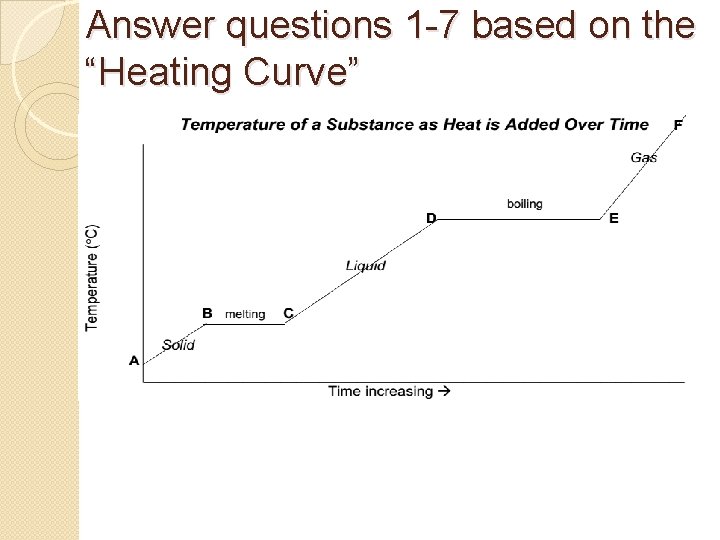
Answer questions 1 -7 based on the “Heating Curve”
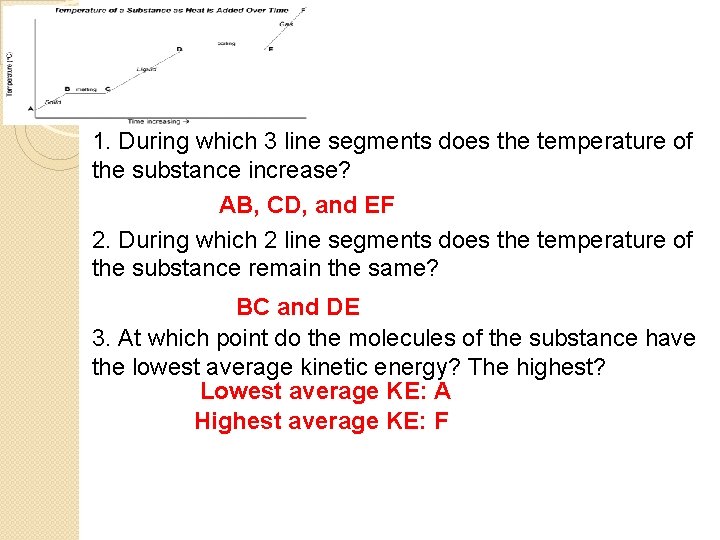
1. During which 3 line segments does the temperature of the substance increase? AB, CD, and EF 2. During which 2 line segments does the temperature of the substance remain the same? BC and DE 3. At which point do the molecules of the substance have the lowest average kinetic energy? The highest? Lowest average KE: A Highest average KE: F
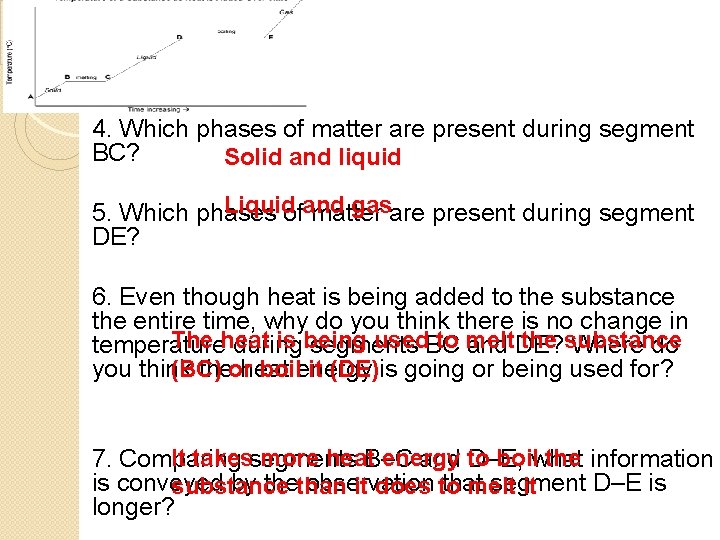
4. Which phases of matter are present during segment BC? Solid and liquid Liquid gasare present during segment 5. Which phases ofand matter DE? 6. Even though heat is being added to the substance the entire time, why do you think there is no change in The heat is being used. BC to melt the substance temperature during segments and DE? Where do (BC) boilenergy it (DE)is going or being used for? you think theorheat It takessegments more heat. B–C energy boilwhat the information 7. Comparing and to D–E, is conveyed by thethan observation that segment D–E is substance it does to melt it longer?
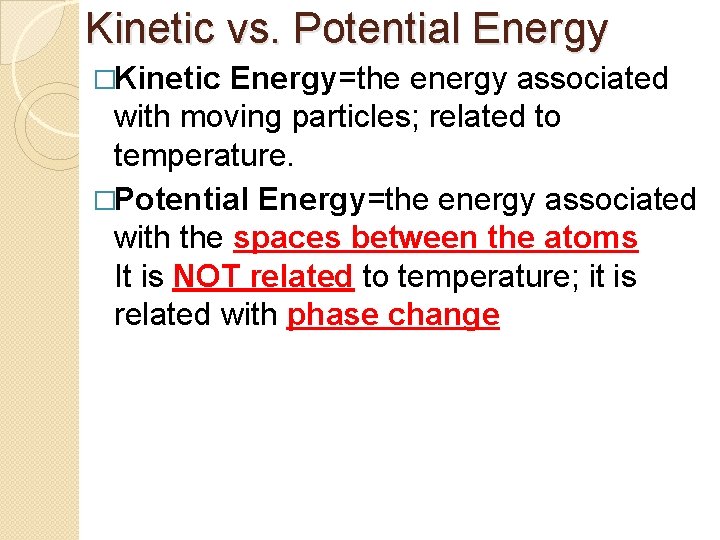
Kinetic vs. Potential Energy �Kinetic Energy=the energy associated with moving particles; related to temperature. �Potential Energy=the energy associated with the spaces between the atoms It is NOT related to temperature; it is related with phase change
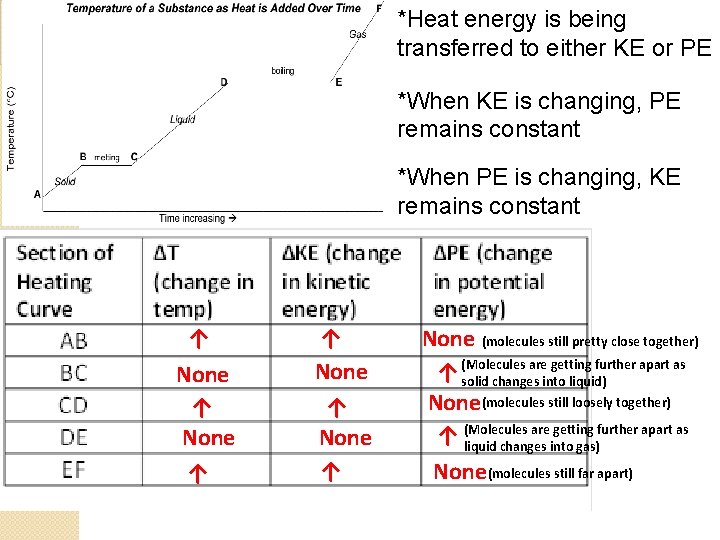
*Heat energy is being transferred to either KE or PE *When KE is changing, PE remains constant *When PE is changing, KE remains constant ↑ None ↑ None (molecules still pretty close together) are getting further apart as ↑ (Molecules solid changes into liquid) None(molecules still loosely together) are getting further apart as ↑ (Molecules liquid changes into gas) None (molecules still far apart)
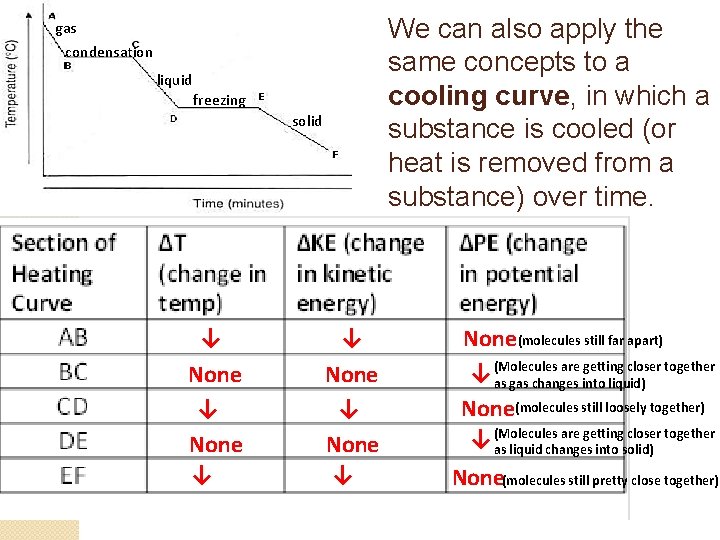
We can also apply the same concepts to a cooling curve, in which a substance is cooled (or heat is removed from a substance) over time. gas condensation liquid freezing solid ↓ ↓ None ↓ None (molecules still far apart) are getting closer together ↓ (Molecules as gas changes into liquid) None(molecules still loosely together) are getting closer together ↓ (Molecules as liquid changes into solid) None(molecules still pretty close together)
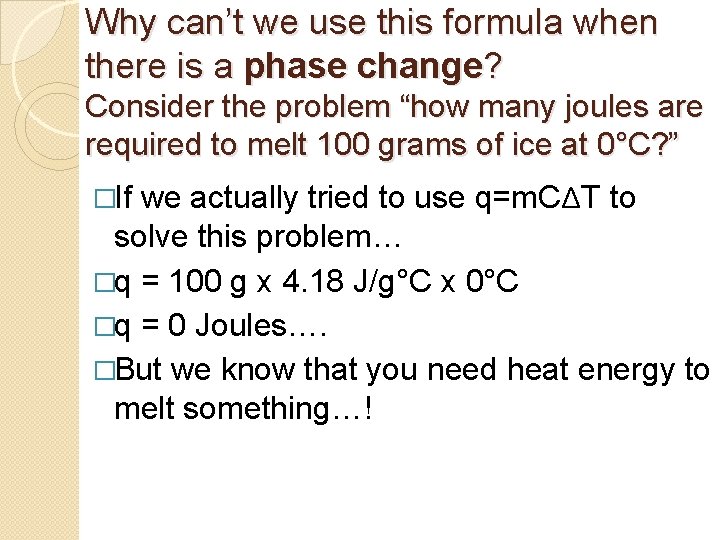
Why can’t we use this formula when there is a phase change? Consider the problem “how many joules are required to melt 100 grams of ice at 0°C? ” �If we actually tried to use q=m. CΔT to solve this problem… �q = 100 g x 4. 18 J/g°C x 0°C �q = 0 Joules…. �But we know that you need heat energy to melt something…!
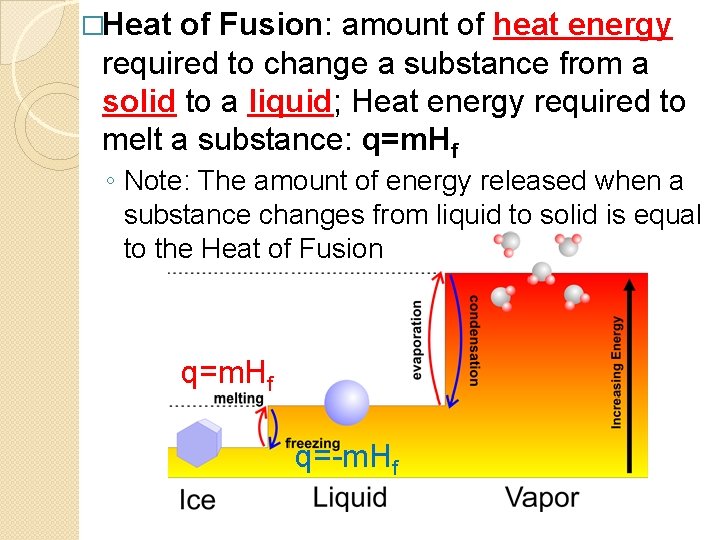
�Heat of Fusion: amount of heat energy required to change a substance from a solid to a liquid; Heat energy required to melt a substance: q=m. Hf ◦ Note: The amount of energy released when a substance changes from liquid to solid is equal to the Heat of Fusion q=m. Hf q=-m. Hf
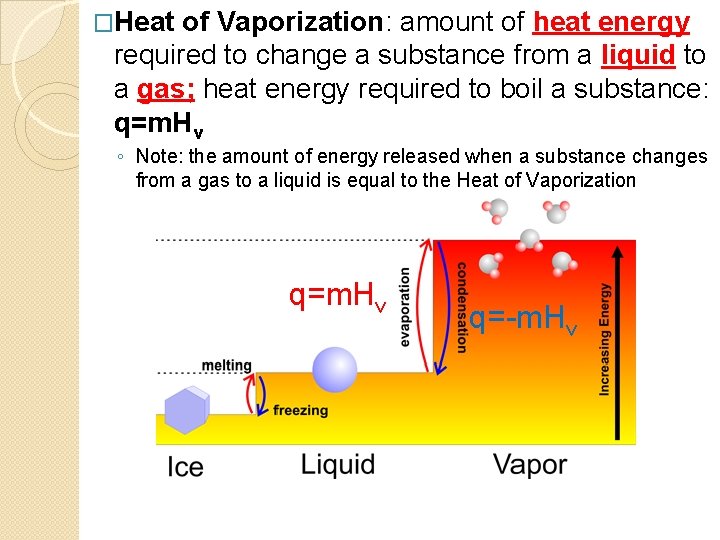
�Heat of Vaporization: amount of heat energy required to change a substance from a liquid to a gas; heat energy required to boil a substance: q=m. Hv ◦ Note: the amount of energy released when a substance changes from a gas to a liquid is equal to the Heat of Vaporization q=m. Hv q=-m. Hv
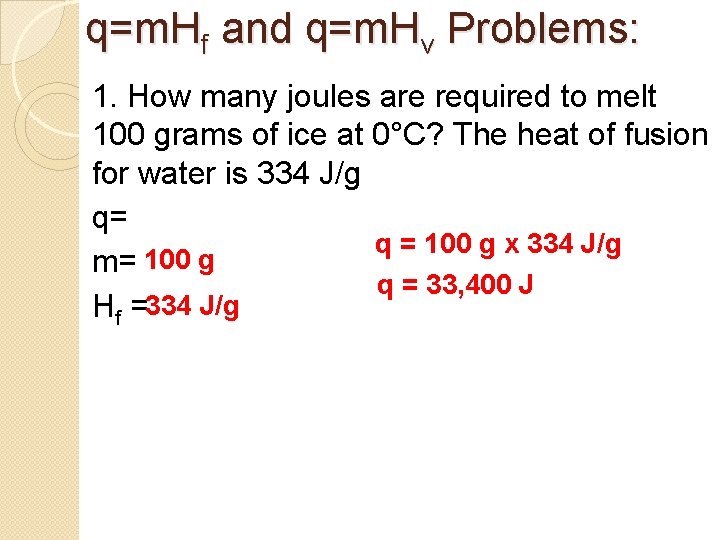
q=m. Hf and q=m. Hv Problems: 1. How many joules are required to melt 100 grams of ice at 0°C? The heat of fusion for water is 334 J/g q= q = 100 g x 334 J/g m= 100 g q = 33, 400 J Hf =334 J/g
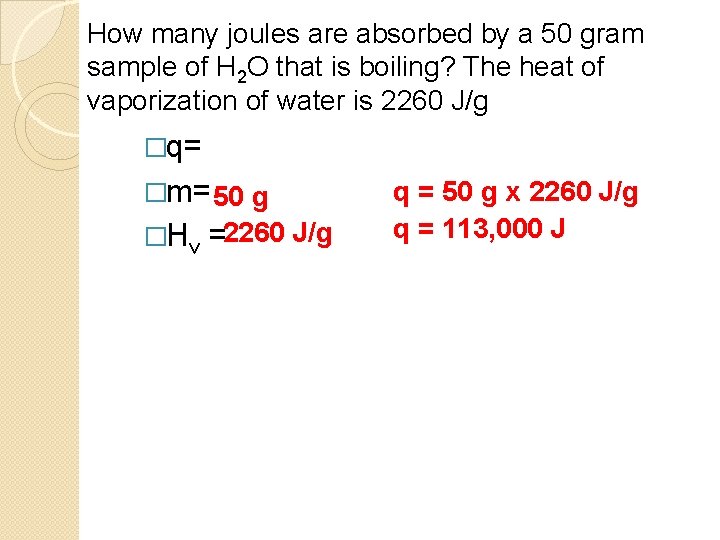
How many joules are absorbed by a 50 gram sample of H 2 O that is boiling? The heat of vaporization of water is 2260 J/g �q= �m= 50 g �Hv =2260 J/g q = 50 g x 2260 J/g q = 113, 000 J