
DO NOW 930 Chapter 2 1 Carbohydrates 12
DO NOW 9/30 Chapter 2. 1: Carbohydrates 12 Make sure your INB is complete through page 11 • 1. 3 Quiz retake/corrections deadline 10/7, no exceptions. Remember, you must independently schedule or discuss with me when you plan on doing retakes. If you just show up after school, I might not be available, and you will NOT be granted an extension
CHAPTER 2. 1: CARBOHYDRATES INB PG 12
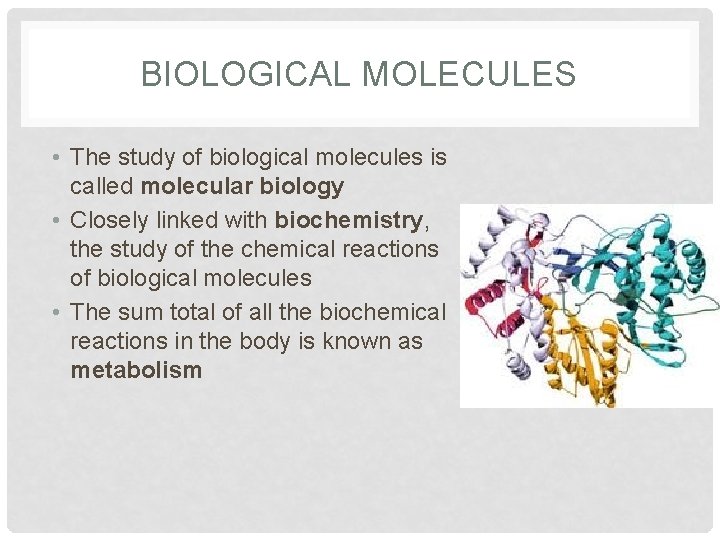
BIOLOGICAL MOLECULES • The study of biological molecules is called molecular biology • Closely linked with biochemistry, the study of the chemical reactions of biological molecules • The sum total of all the biochemical reactions in the body is known as metabolism
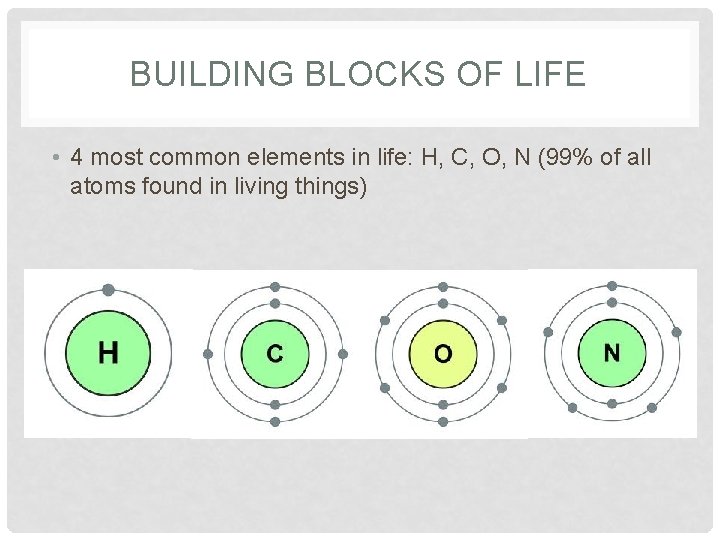
BUILDING BLOCKS OF LIFE • 4 most common elements in life: H, C, O, N (99% of all atoms found in living things)

CARBON • Particularly important because carbon atoms can join together to form long chains or ring structures • Basic skeletons of all organic molecules, to which other groups of atoms attach • Organic molecule = carbon containing C-H bonds
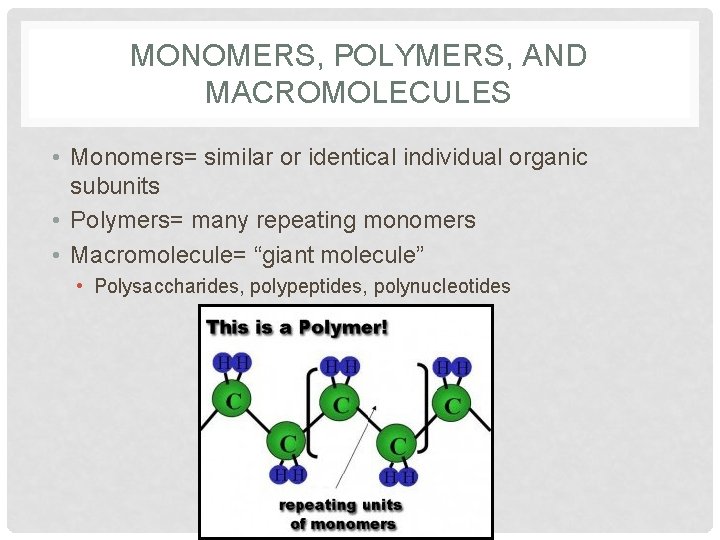
MONOMERS, POLYMERS, AND MACROMOLECULES • Monomers= similar or identical individual organic subunits • Polymers= many repeating monomers • Macromolecule= “giant molecule” • Polysaccharides, polypeptides, polynucleotides
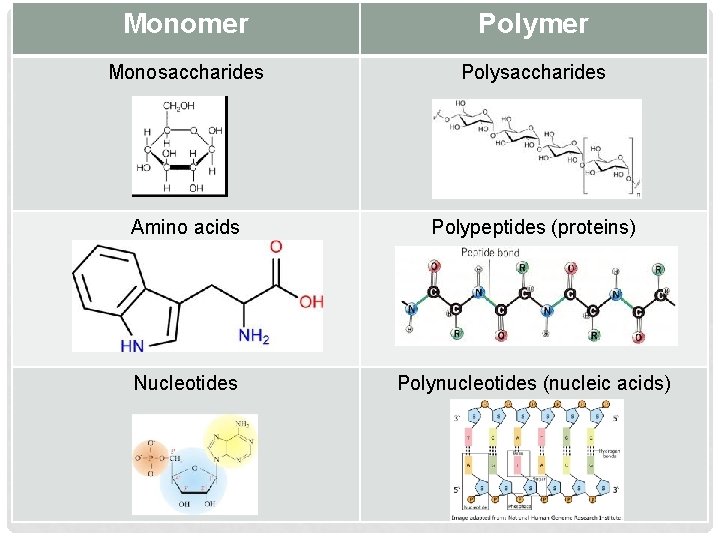
Monomer Polymer Monosaccharides Polysaccharides Amino acids Polypeptides (proteins) Nucleotides Polynucleotides (nucleic acids)
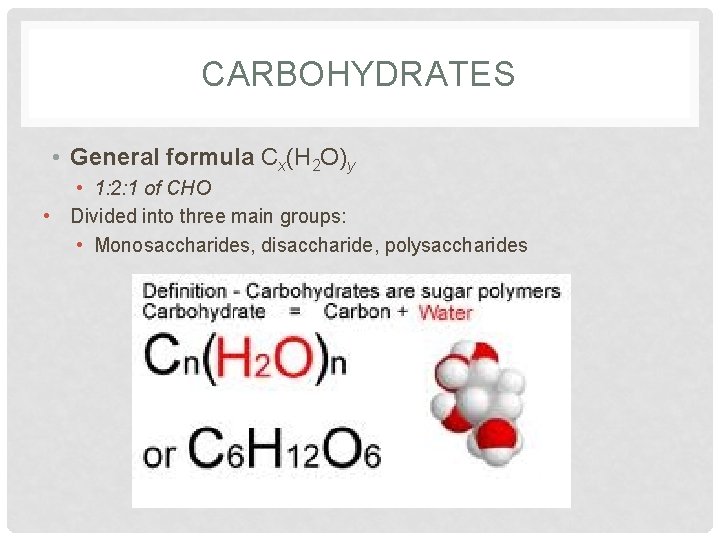
CARBOHYDRATES • General formula Cx(H 2 O)y • 1: 2: 1 of CHO • Divided into three main groups: • Monosaccharides, disaccharide, polysaccharides
MONOSACCHARIDES • Monosaccharides are single sugars (mono=1) • Dissolve easily in water to produce sweet tasting solutions • General formula (CH 2 O)n • Classified according to number of C atoms • Trioses (3 C) Ex: glyceraldehydes • Pentoses (5 C) Ex: ribose, deoxyribose • Hexoses (6 C) Ex: glucose, fructose, galactose
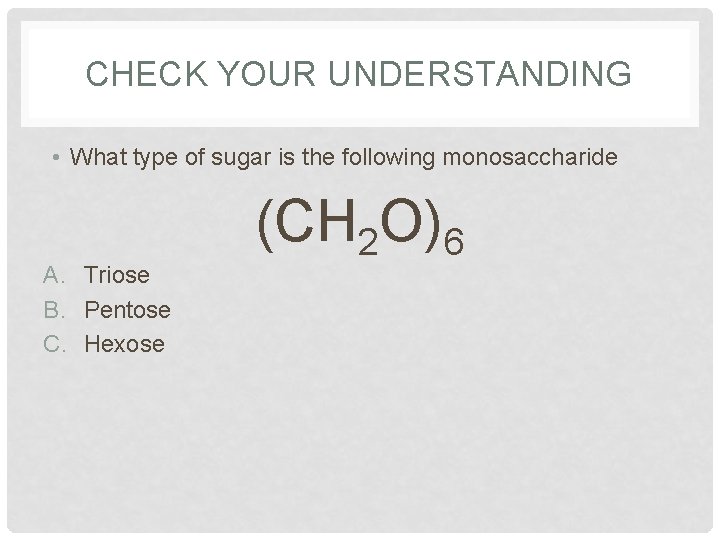
CHECK YOUR UNDERSTANDING • What type of sugar is the following monosaccharide A. Triose B. Pentose C. Hexose (CH 2 O)6
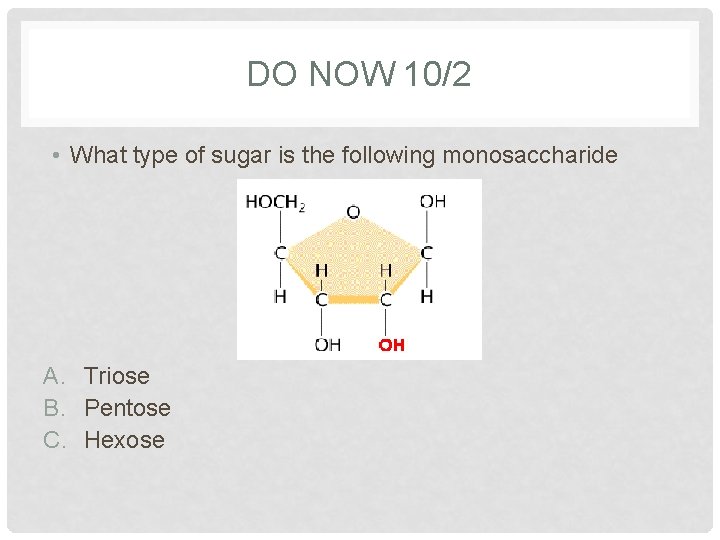
DO NOW 10/2 • What type of sugar is the following monosaccharide A. Triose B. Pentose C. Hexose
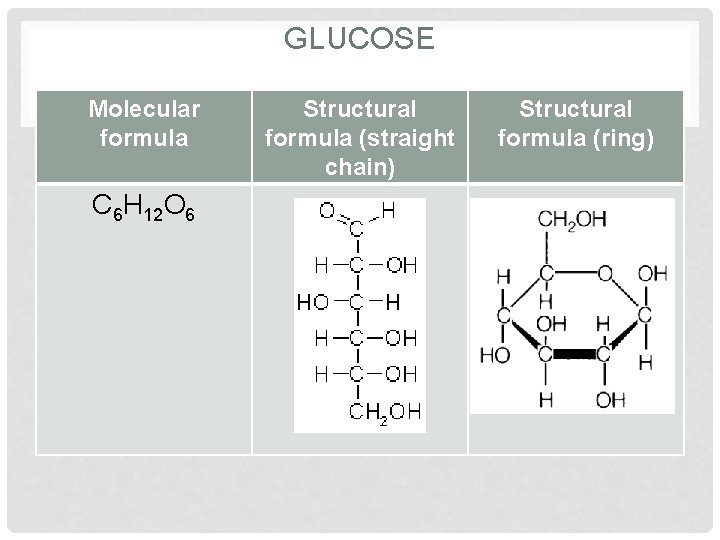
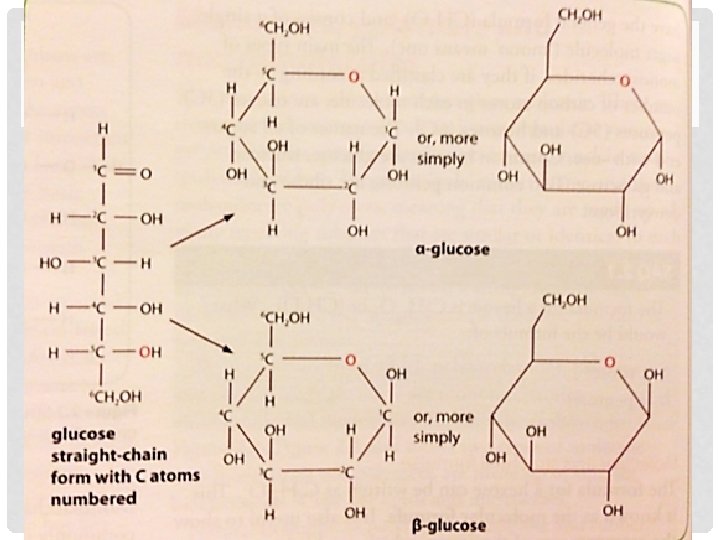
GLUCOSE Molecular formula C 6 H 12 O 6 Structural formula (straight chain) Structural formula (ring)
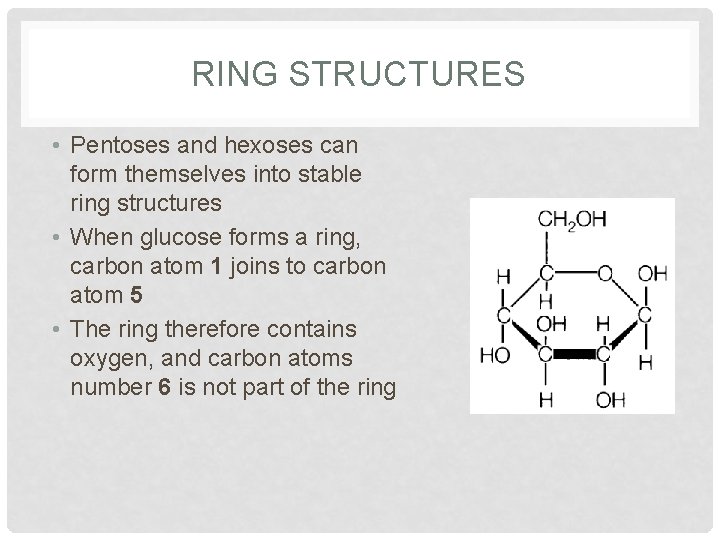
RING STRUCTURES • Pentoses and hexoses can form themselves into stable ring structures • When glucose forms a ring, carbon atom 1 joins to carbon atom 5 • The ring therefore contains oxygen, and carbon atoms number 6 is not part of the ring
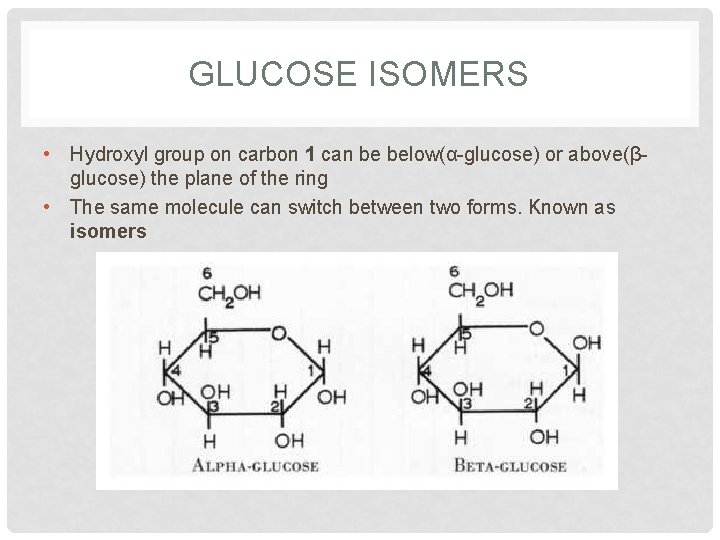
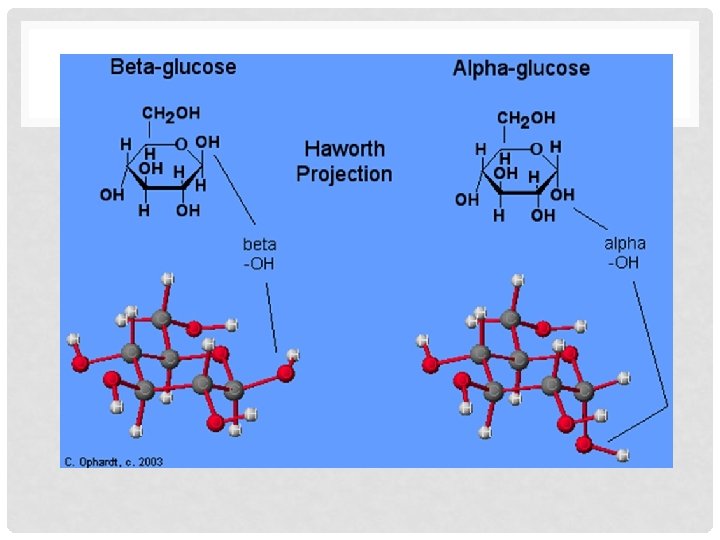
GLUCOSE ISOMERS • Hydroxyl group on carbon 1 can be below(α-glucose) or above(βglucose) the plane of the ring • The same molecule can switch between two forms. Known as isomers
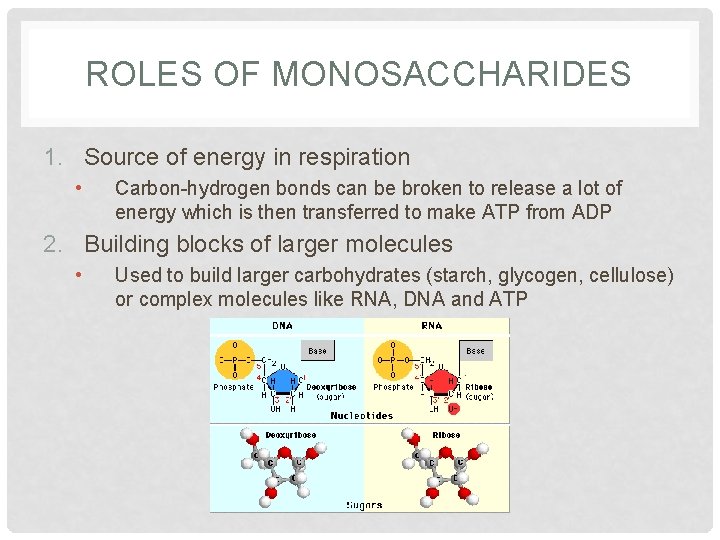
ROLES OF MONOSACCHARIDES 1. Source of energy in respiration • Carbon-hydrogen bonds can be broken to release a lot of energy which is then transferred to make ATP from ADP 2. Building blocks of larger molecules • Used to build larger carbohydrates (starch, glycogen, cellulose) or complex molecules like RNA, DNA and ATP
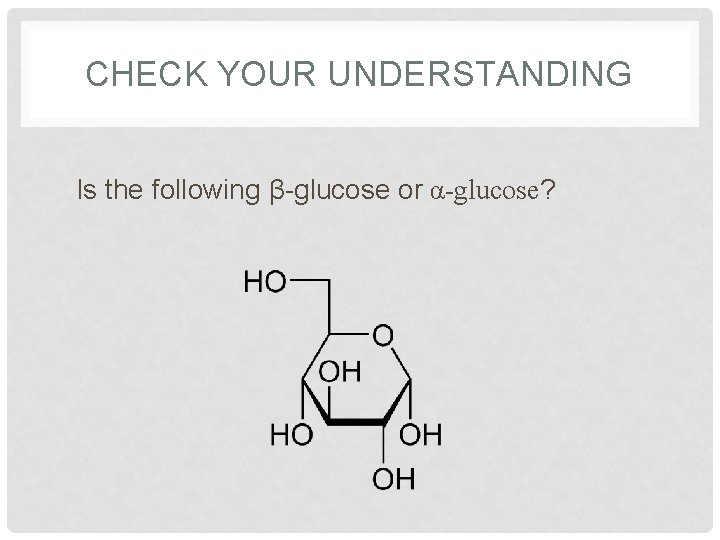
CHECK YOUR UNDERSTANDING Is the following β-glucose or α-glucose?
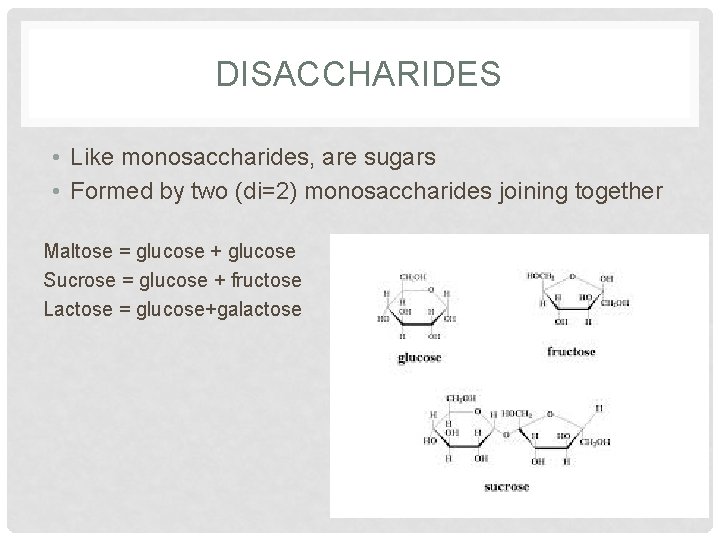
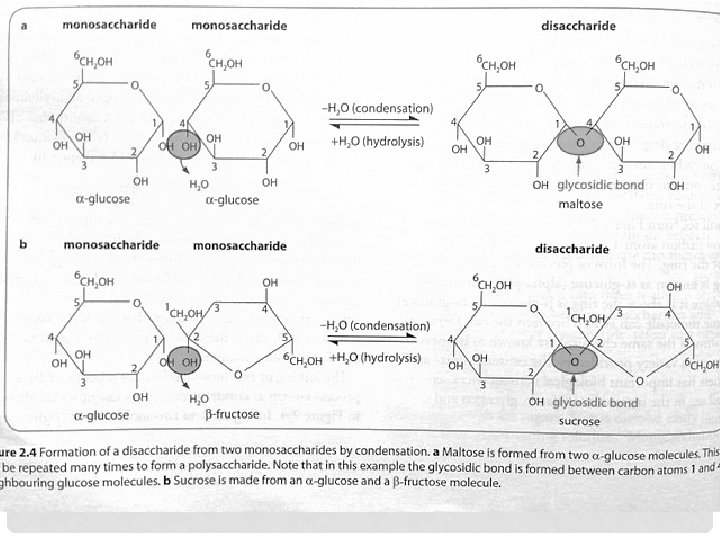
DISACCHARIDES • Like monosaccharides, are sugars • Formed by two (di=2) monosaccharides joining together Maltose = glucose + glucose Sucrose = glucose + fructose Lactose = glucose+galactose
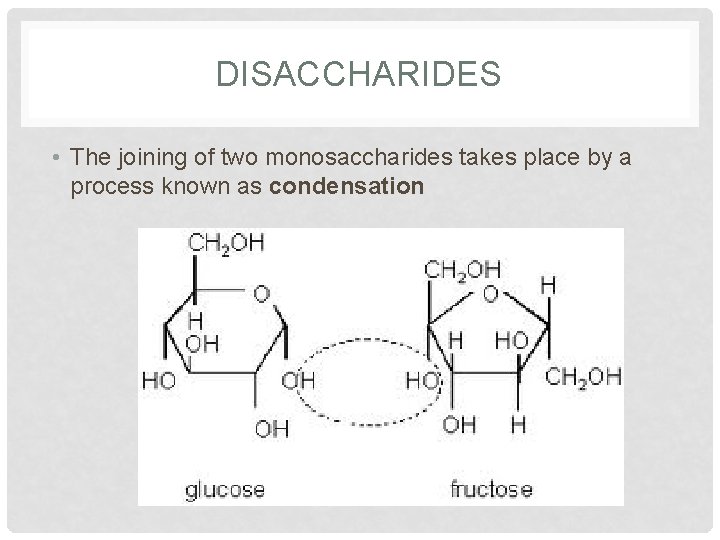
DISACCHARIDES • The joining of two monosaccharides takes place by a process known as condensation
CONDENSATION 1. For the reaction, two hydroxyl (-OH) groups line up alongside each other 2. One combined with a hydrogen atom from the other to form a water molecule 3. This allows an oxygen “bridge” to form between the two molecules, forming disaccharide 4. This bridge is called a glycosidic bond http: //www. youtube. com/watch? v=b 7 Td. WLNh. Mt. M
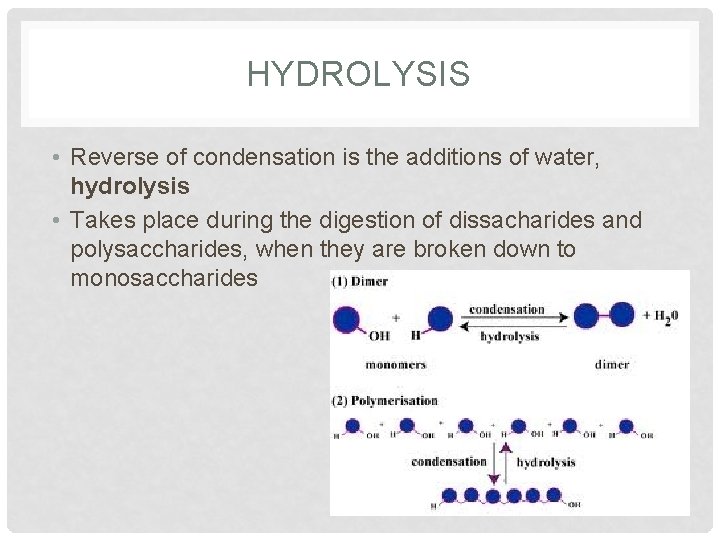
HYDROLYSIS • Reverse of condensation is the additions of water, hydrolysis • Takes place during the digestion of dissacharides and polysaccharides, when they are broken down to monosaccharides
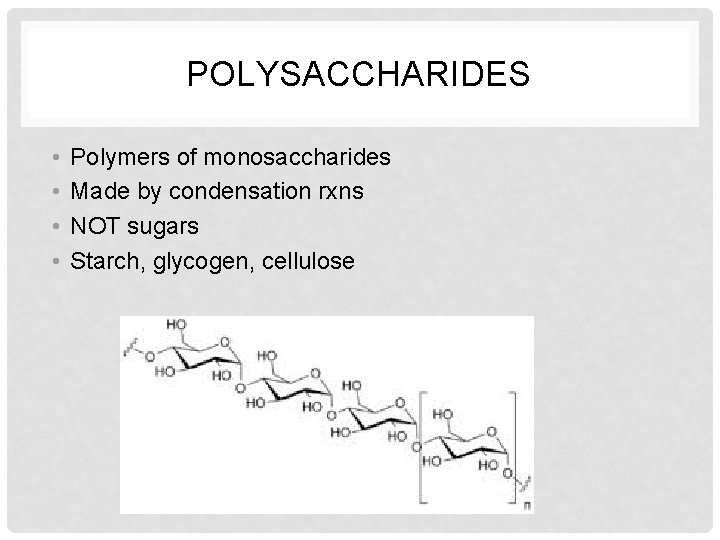
POLYSACCHARIDES • • Polymers of monosaccharides Made by condensation rxns NOT sugars Starch, glycogen, cellulose
POLYSACCHARIDES Condensation/dehydration synthesis • Glucose cannot accumulate in the cell • Dissolve and affect osmosis • Reactive: interfere with cell chemistry • Store as polysaccharides • Compact, inert + insoluble • Glycogen: animals, starch: plants
CHECK YOUR UNDERSTANDING • What type of reaction would be involved in the formation of glucose from starch or glycogen?
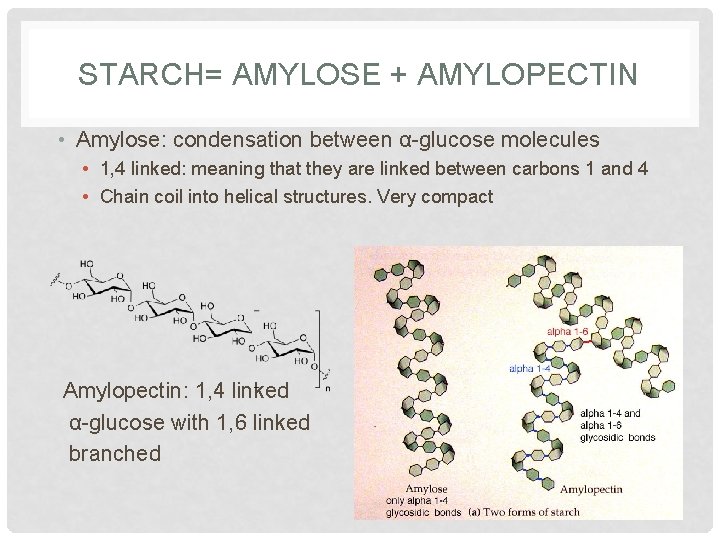
STARCH= AMYLOSE + AMYLOPECTIN • Amylose: condensation between α-glucose molecules • 1, 4 linked: meaning that they are linked between carbons 1 and 4 • Chain coil into helical structures. Very compact Amylopectin: 1, 4 linked α-glucose with 1, 6 linked branched
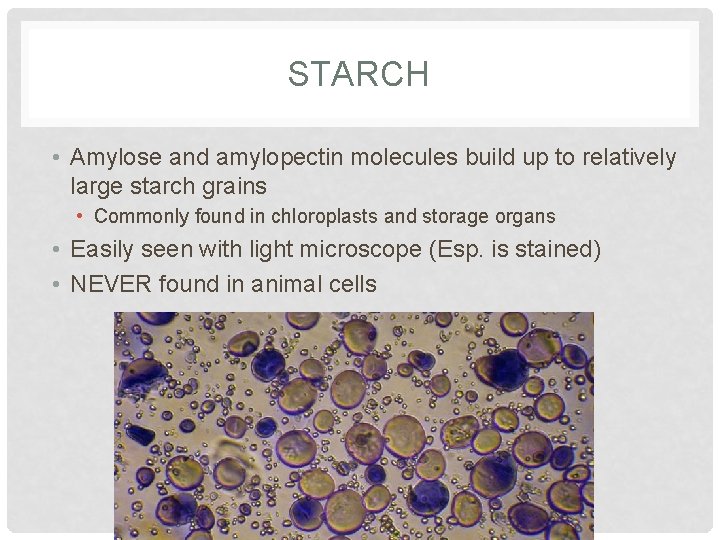
STARCH • Amylose and amylopectin molecules build up to relatively large starch grains • Commonly found in chloroplasts and storage organs • Easily seen with light microscope (Esp. is stained) • NEVER found in animal cells
DO NOW 10/6 • Compare the cellular structures of amylose and amylopectin
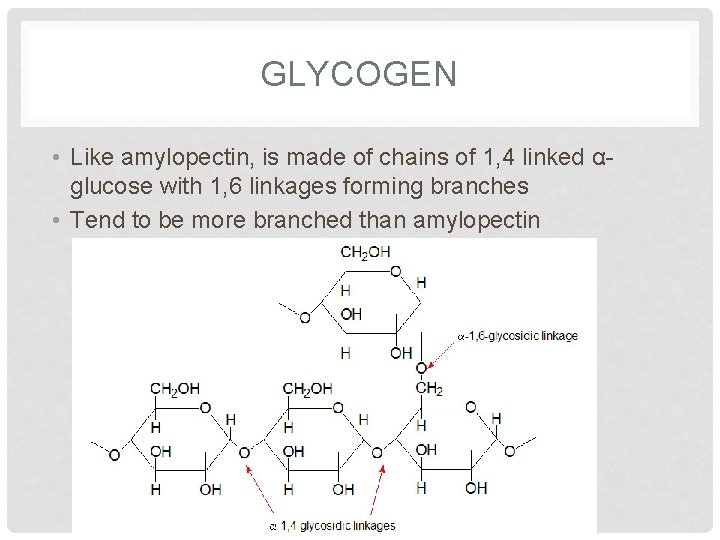
GLYCOGEN • Like amylopectin, is made of chains of 1, 4 linked αglucose with 1, 6 linkages forming branches • Tend to be more branched than amylopectin
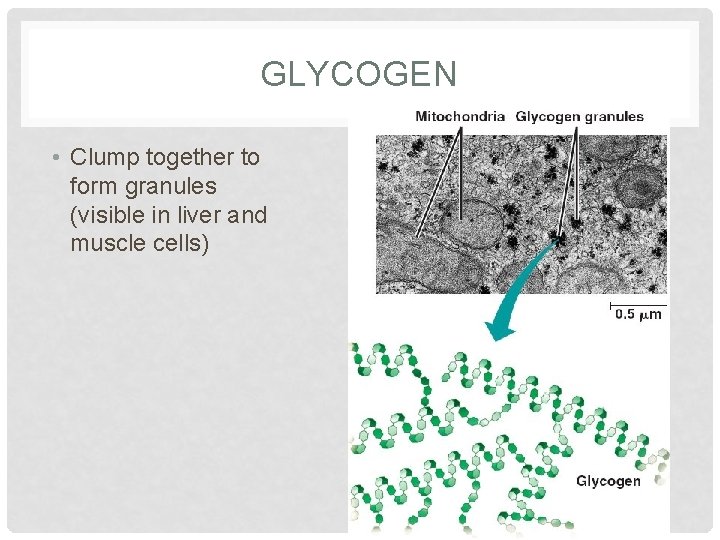
GLYCOGEN • Clump together to form granules (visible in liver and muscle cells)
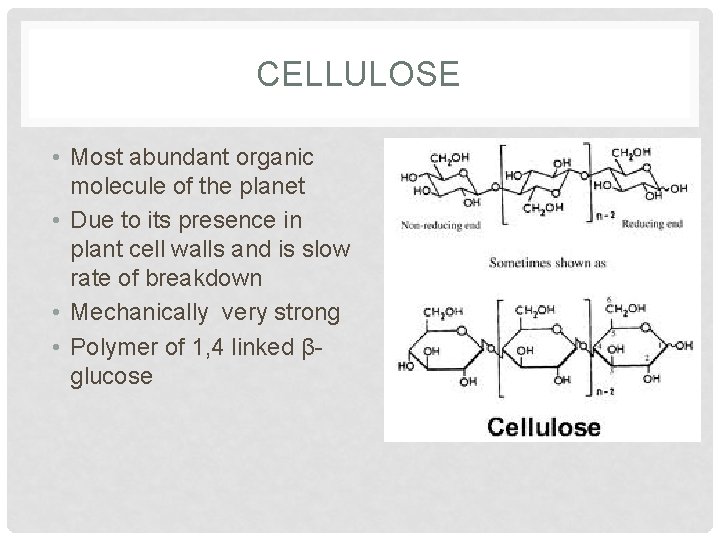
CELLULOSE • Most abundant organic molecule of the planet • Due to its presence in plant cell walls and is slow rate of breakdown • Mechanically very strong • Polymer of 1, 4 linked βglucose
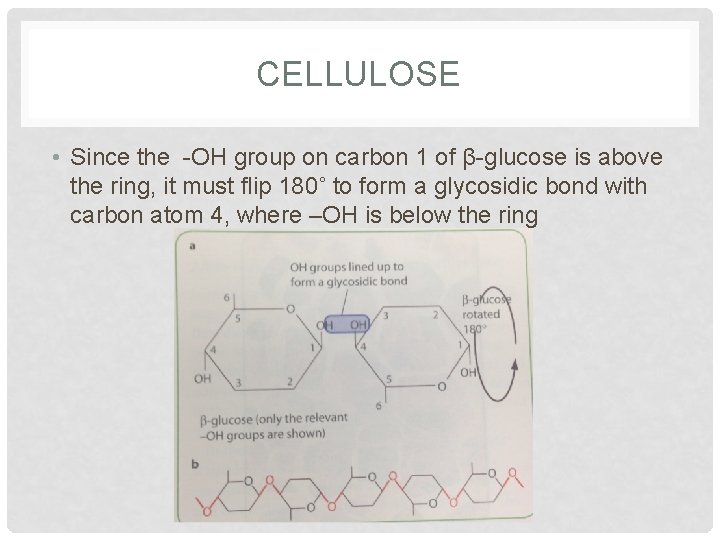
CELLULOSE • Since the -OH group on carbon 1 of β-glucose is above the ring, it must flip 180˚ to form a glycosidic bond with carbon atom 4, where –OH is below the ring
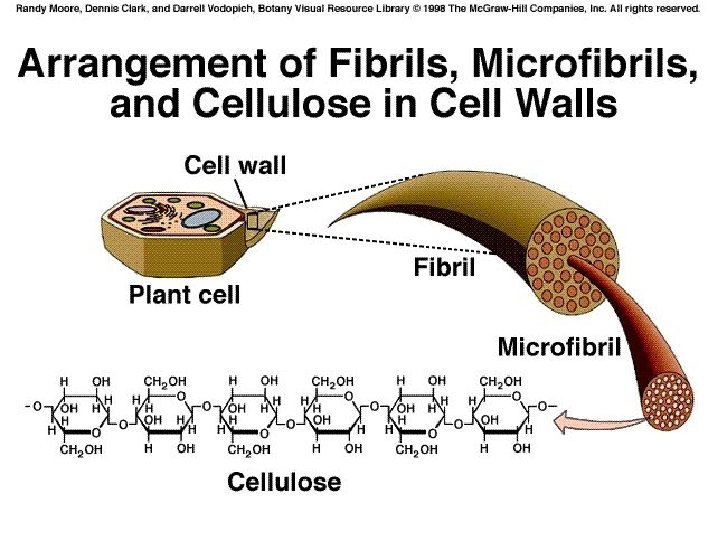
CELLULOSE • 60 -70 cellulose molecules cross-link to form microfibrils, held together as fibers by hydrogen bonding • Cellulose: 20 -40% cell wall • High tensile strength (almost ~steel) • Fiber arrangement determines shape • Freely permeable: water + solutes can reach plasma membrane
- Slides: 35