
Do Now 1 How does a Newtons Cradle


- Slides: 13
Do Now: 1. How does a Newton’s Cradle represent all 3 of Newton’s Laws of motion? Explain for each law!
Free Body Diagram • Vector Diagram • Shows ALL FORCES on an object FN • Must be properly LABELLED. Fg
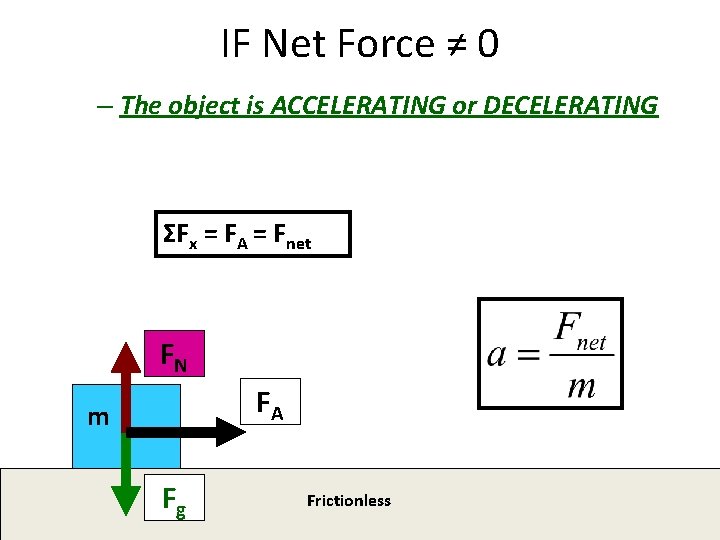
IF Net Force ≠ 0 – The object is ACCELERATING or DECELERATING ΣFx = FA = Fnet FN FA m Fg Frictionless
4 Steps for Newton’s Law Problem 1. Draw a Free Body Diagram 2. Sum up vertical and horizontal forces SEPERATELY. 1. Write Newton’s Second Law for vertical and horizontal! 2. Solve for Unknown *** A 1. 0 kg hokey puck is smacked with a 50 N force to the right on frictionless ice. What is the puck’s acceleration?
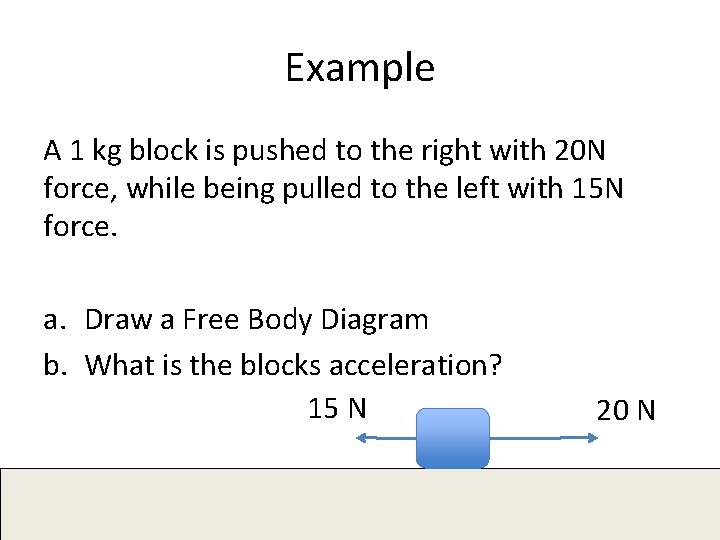
Example A 1 kg block is pushed to the right with 20 N force, while being pulled to the left with 15 N force. a. Draw a Free Body Diagram b. What is the blocks acceleration? 15 N 20 N
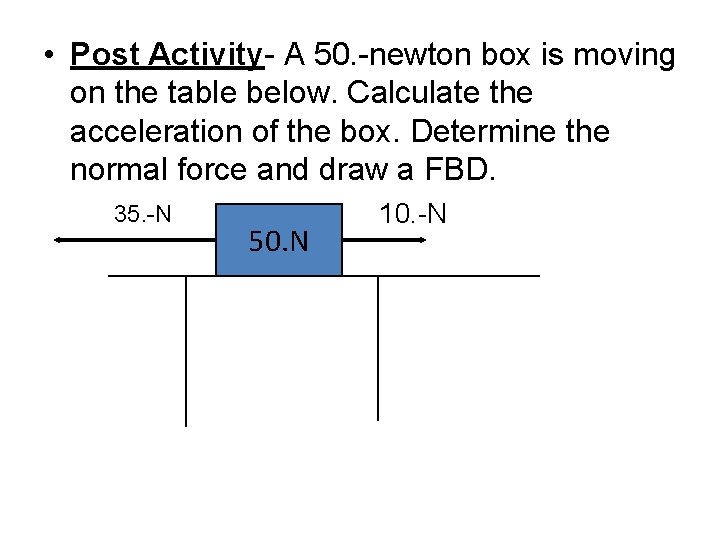
• Post Activity- A 50. -newton box is moving on the table below. Calculate the acceleration of the box. Determine the normal force and draw a FBD. 35. -N 50. N 10. -N
Envelope Activity • Draw the free body diagram for each scenario described.
• A 10 kg block is suspended in the air at rest, while being pulled to the right and left by two forces. What do we know about the two forces? • A 50 kg ice skater is pushed onto frictionless ice with a force of 10 N. What is her acceleration? • A 5 kg crate is pushed down on with a force of 10 N. What is the normal force?
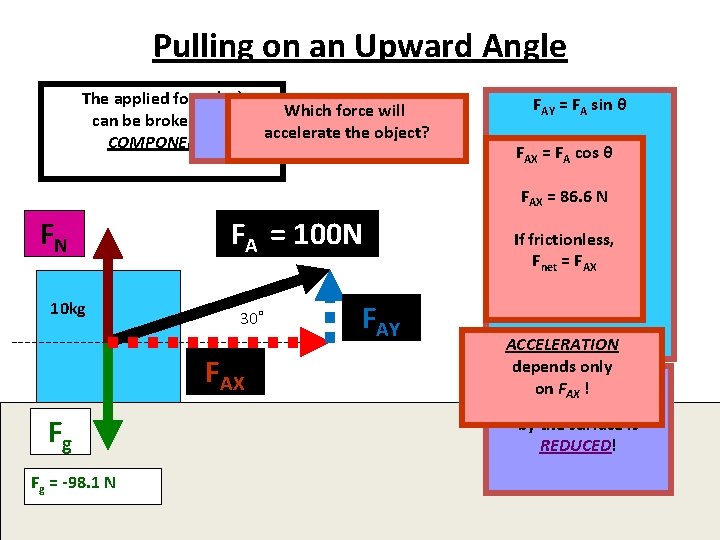
Pulling on an Upward Angle The applied force (FA) How will. Which this affect force will can be broken into the Normal accelerate Force? the object? COMPONENTS FAY = FA sin θ 50 N FAX =FAY FA =cos θ Y=0 FAX =ΣF 86. 6 N FN 10 kg FA = 100 N 30˚ FAX Fg Fg = -98. 1 N FAY g + FN + FAY = 0 If. Ffrictionless, Fnet = FAX FN = 48. 1 N ACCELERATION depends only The on FNORMAL AX ! force supplied by the surface is REDUCED!
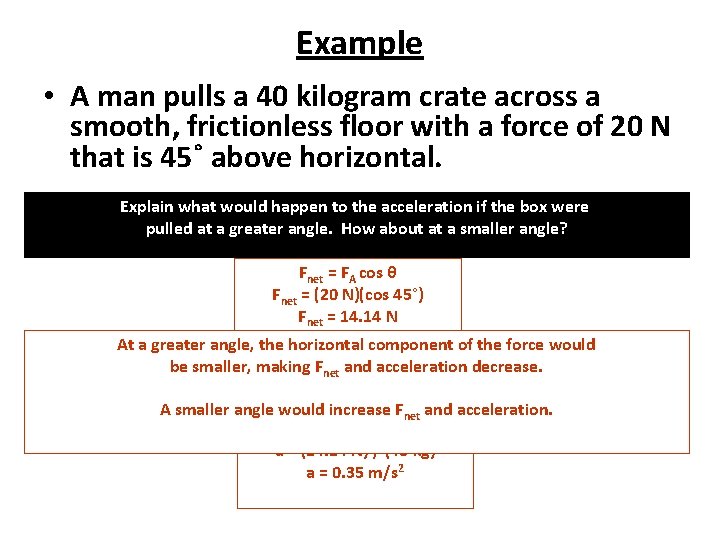
Example • A man pulls a 40 kilogram crate across a smooth, frictionless floor with a force of 20 N that is 45˚ above horizontal. Explain what would happen to the acceleration if the box were the net force on the pulled at a Calculate greater angle. How about at asled. smaller angle? Fnet = FA cos θ Fnet = (20 N)(cos 45°) Fnet = 14. 14 N At a greater angle, the horizontal component of the force would be smaller, making Fnet and acceleration decrease. Calculate the crate’s acceleration. A smaller angle would increase Fnet and acceleration. a = Fnet / m a = (14. 14 N) / (40 kg) a = 0. 35 m/s 2
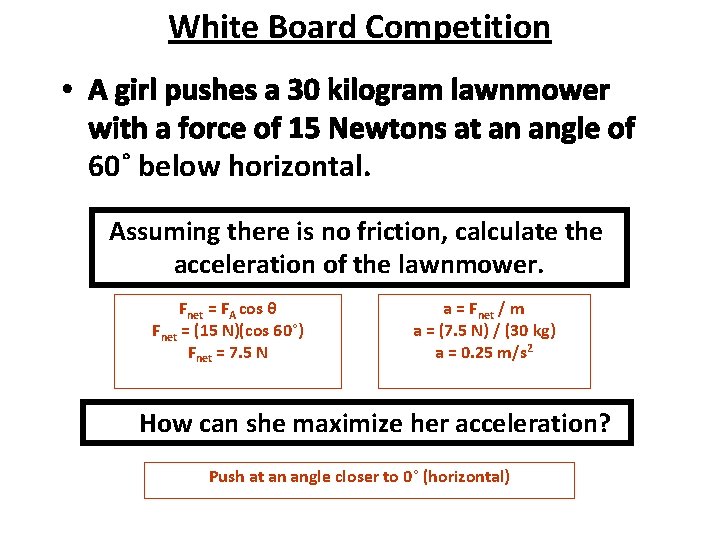
White Board Competition • A girl pushes a 30 kilogram lawnmower with a force of 15 Newtons at an angle of 60˚ below horizontal. Assuming there is no friction, calculate the acceleration of the lawnmower. Fnet = FA cos θ Fnet = (15 N)(cos 60°) Fnet = 7. 5 N a = Fnet / m a = (7. 5 N) / (30 kg) a = 0. 25 m/s 2 How can she maximize her acceleration? Push at an angle closer to 0° (horizontal)
Exit Card 1. What are the 4 steps for solving a Newton’s law problem? 2. What does it mean for a force to be applied at an angle?