
Do It Strategically with Microsoft Business Intelligence Bojan

Do It Strategically with Microsoft Business Intelligence! Bojan Ciric Strategic Consultant
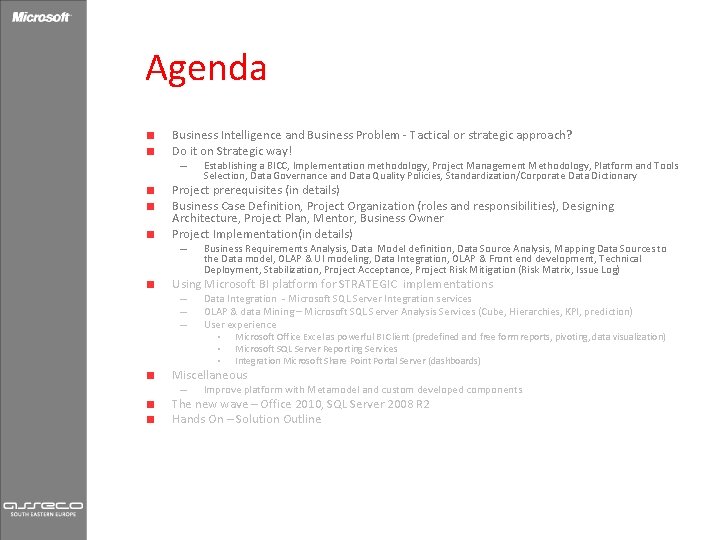
Agenda Business Intelligence and Business Problem - Tactical or strategic approach? Do it on Strategic way! – Establishing a BICC, Implementation methodology, Project Management Methodology, Platform and Tools Selection, Data Governance and Data Quality Policies, Standardization/Corporate Data Dictionary Project prerequisites (in details) Business Case Definition, Project Organization (roles and responsibilities), Designing Architecture, Project Plan, Mentor, Business Owner Project Implementation(in details) – Business Requirements Analysis, Data Model definition, Data Source Analysis, Mapping Data Sources to the Data model, OLAP & UI modeling, Data Integration, OLAP & Front end development, Technical Deployment, Stabilization, Project Acceptance, Project Risk Mitigation (Risk Matrix, Issue Log) Using Microsoft BI platform for STRATEGIC implementations – – – Data Integration - Microsoft SQL Server Integration services OLAP & data Mining – Microsoft SQL Server Analysis Services (Cube, Hierarchies, KPI, prediction) User experience • Microsoft Office Excel as powerful BI Client (predefined and free form reports, pivoting, data visualization) • Microsoft SQL Server Reporting Services • Integration Microsoft Share Point Portal Server (dashboards) Miscellaneous – Improve platform with Metamodel and custom developed components The new wave – Office 2010, SQL Server 2008 R 2 Hands On – Solution Outline
IMPLEMENTATION PREREQUISITES
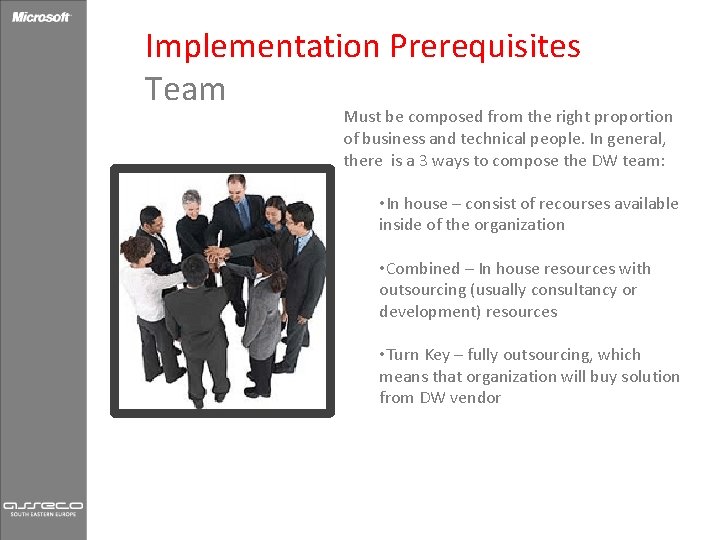
Implementation Prerequisites Team Must be composed from the right proportion of business and technical people. In general, there is a 3 ways to compose the DW team: • In house – consist of recourses available inside of the organization • Combined – In house resources with outsourcing (usually consultancy or development) resources • Turn Key – fully outsourcing, which means that organization will buy solution from DW vendor
Implementation Prerequisites Roles and Responsibilities Once project team has defined, you be required to define roles and responsibilities on the project. Project roles are: Project manager, technical leader, business analyst, data modeler, developers (ETL, OLAP, front end), technical stuff (for platform deployment)
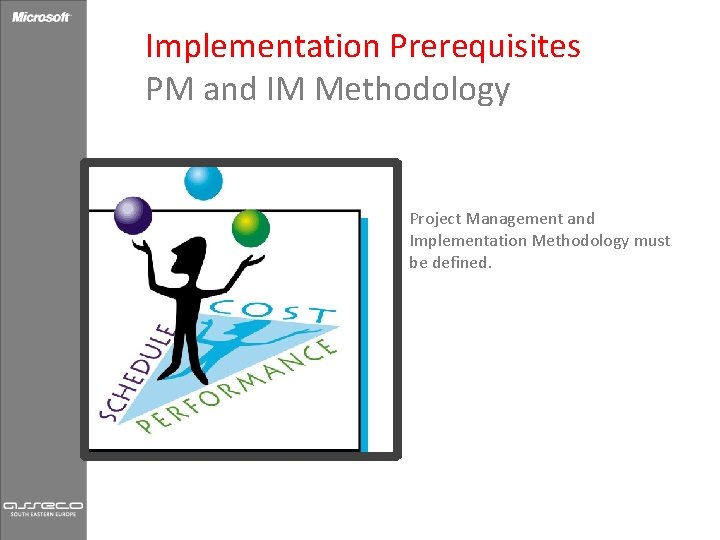
Implementation Prerequisites PM and IM Methodology Project Management and Implementation Methodology must be defined.
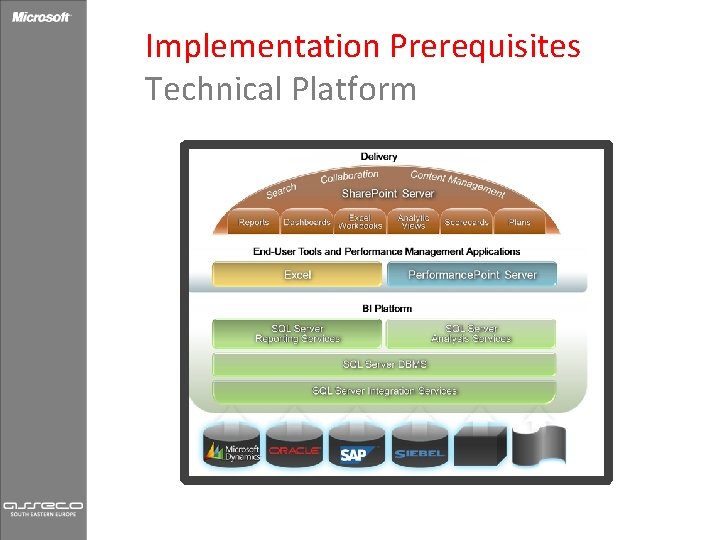
Implementation Prerequisites Technical Platform
Implementation Prerequisites Mentor Must be chosen among most influential persons in the organization (member of top management group) in order to preserve authority required to solve the project obstacles
Implementation Prerequisites Business Owner Person within the organization who has crucial interest in business deliverables of DW (usually head of department – e. g. Head of Risk department in case of implementing Risk management on top of DW)
Implementation Prerequisites Business Intelligence Competence Center Formal or informal organization, which must be permanent, consist of BI team, Mentor, Business Owner and other people within or outside of organization interested in current or further usage of benefits of DW. BICC mission is to establish strategically deployment of DW within the organization
Implementation Prerequisites Project Scope From technical perspective (initial scope of data warehouse, could be wider then business deliverables) and from business perspective (what deliverables will get business users as a result of the project). Scope of the project must be defined as detail as possible in order to minimize risk of misunderstanding. In order to estimate scope feasibility you must consider results of preliminary analysis

Implementation Prerequisites Project Plan Timeline consist of all project phases and activities, milestones, resources used, deliverables deadlines
Implementation Prerequisites Budget/Sponsor Budget of the project has significant influence on other factors mention above.
BUSINESS INTELLIGENCE COMPETENCE CENTER
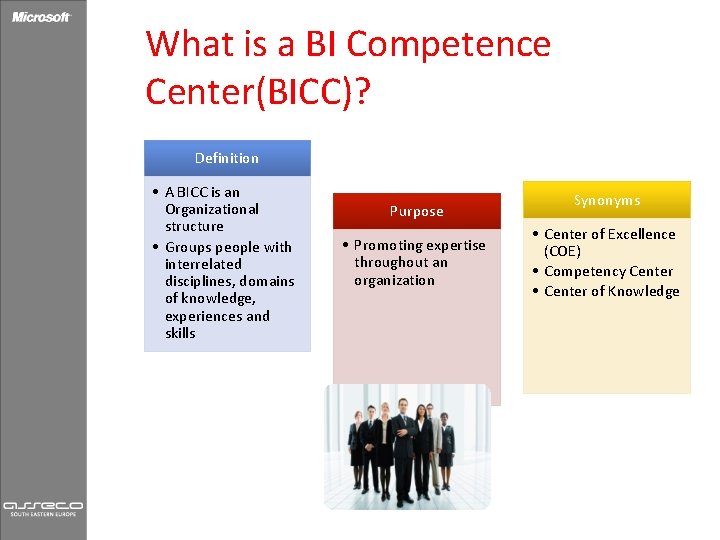
What is a BI Competence Center(BICC)? Definition • A BICC is an Organizational structure • Groups people with interrelated disciplines, domains of knowledge, experiences and skills Purpose • Promoting expertise throughout an organization Synonyms • Center of Excellence (COE) • Competency Center • Center of Knowledge
BI Strategy model
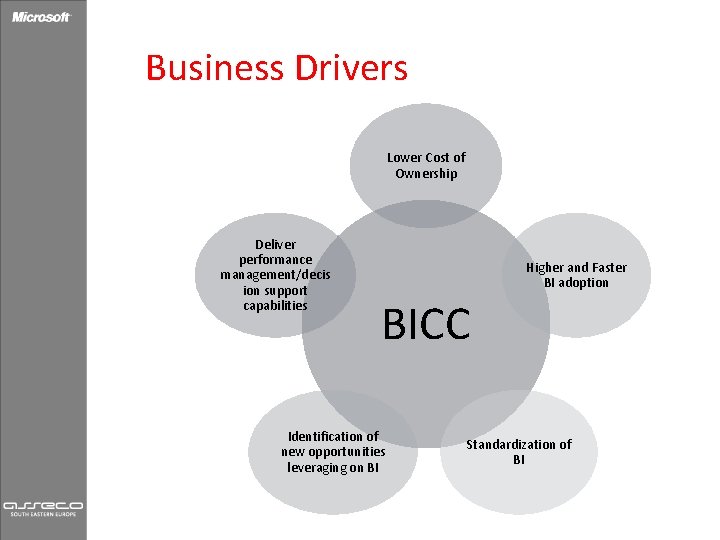
Business Drivers Lower Cost of Ownership Deliver performance management/decis ion support capabilities Higher and Faster BI adoption BICC Identification of new opportunities leveraging on BI Standardization of BI
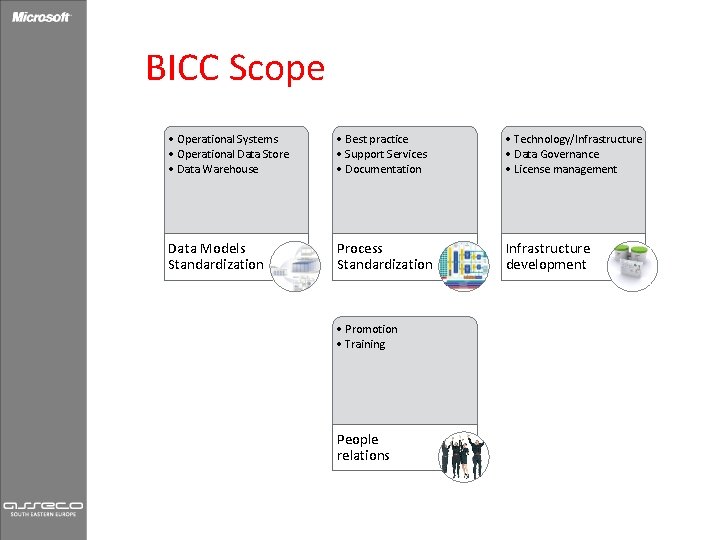
BICC Scope • Operational Systems • Operational Data Store • Data Warehouse • Best practice • Support Services • Documentation • Technology/Infrastructure • Data Governance • License management Data Models Standardization Process Standardization Infrastructure development • Promotion • Training People relations
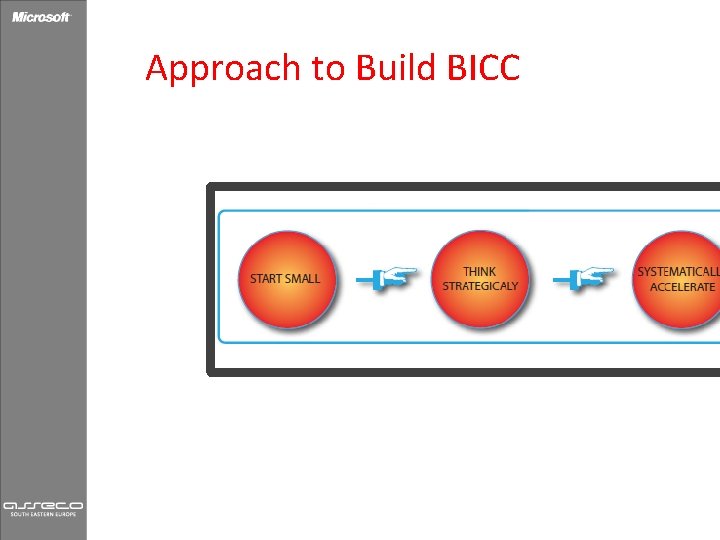
Approach to Build BICC
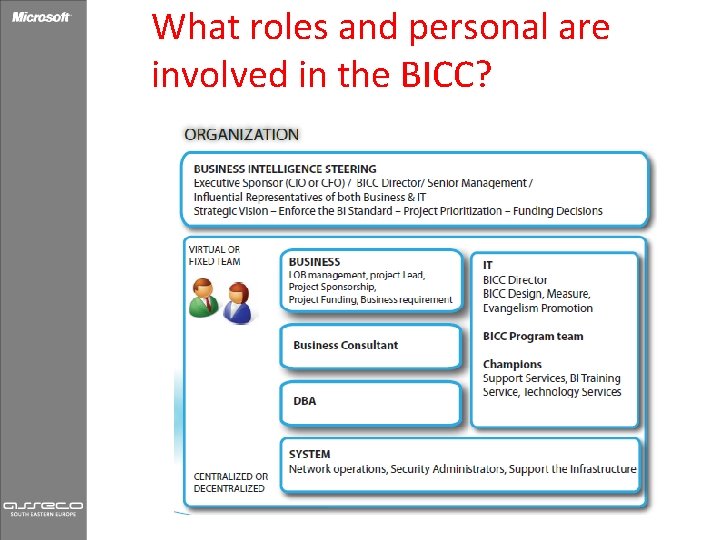
What roles and personal are involved in the BICC?
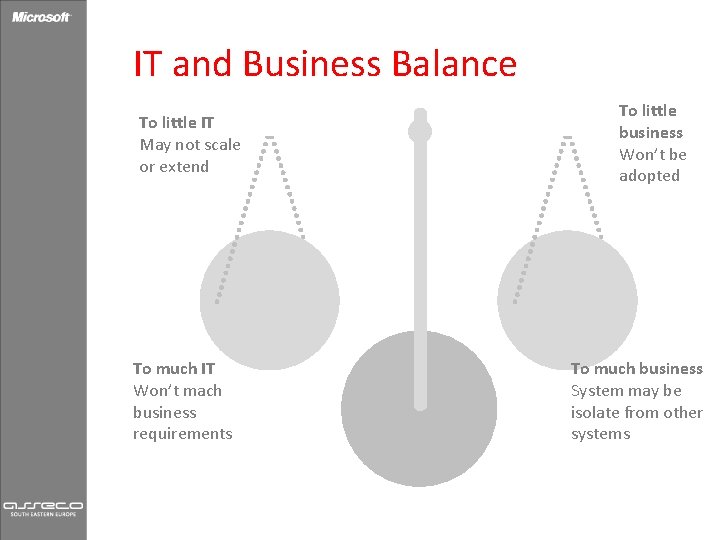
IT and Business Balance To little IT May not scale or extend To much IT Won’t mach business requirements To little business Won’t be adopted To much business System may be isolate from other systems

Maturity of the BICC • Typically funding per project Tactical BI Strategic BI with early BICC • Funding still at the project level BICC funded as an overhead budget line item • Project level funding with a consolidated BI roadmap, BICC budgetary line item Strategic BI with a maturing BICC
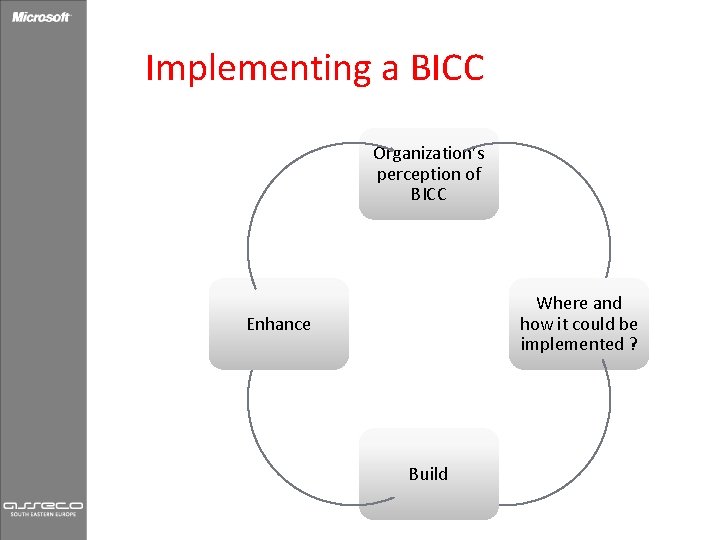
Implementing a BICC Organization’s perception of BICC Where and how it could be implemented ? Enhance Build
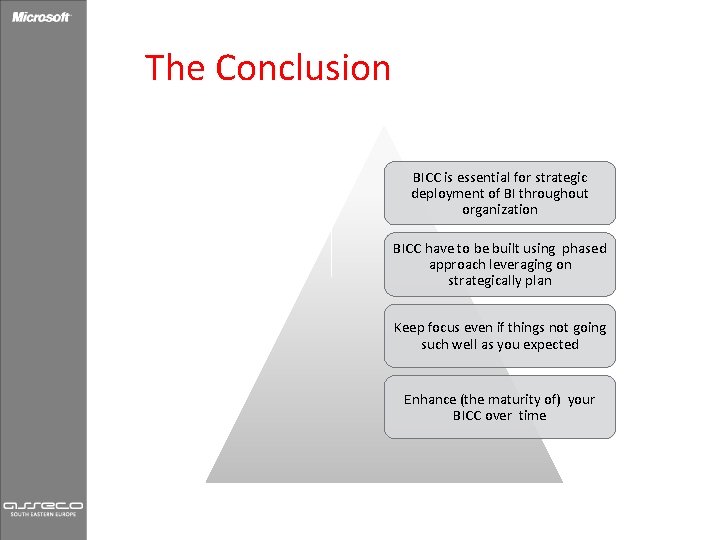
The Conclusion BICC is essential for strategic deployment of BI throughout organization BICC have to be built using phased approach leveraging on strategically plan Keep focus even if things not going such well as you expected Enhance (the maturity of) your BICC over time

THE ARCHITECTURE
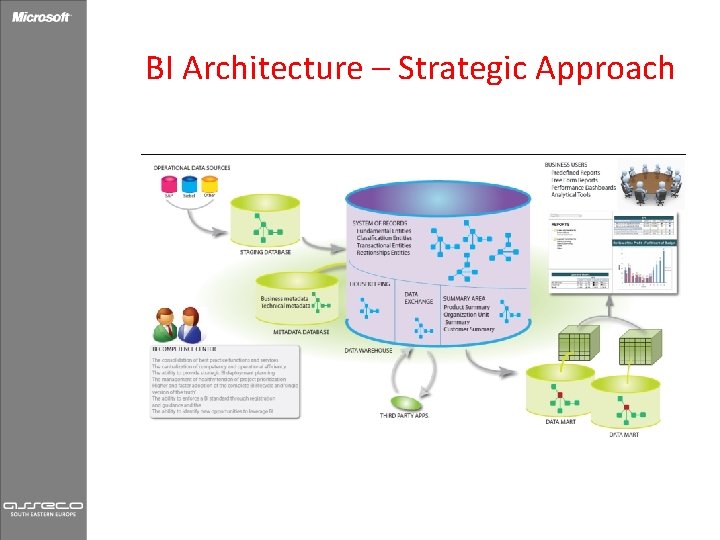
BI Architecture – Strategic Approach
IMPLEMENTATION
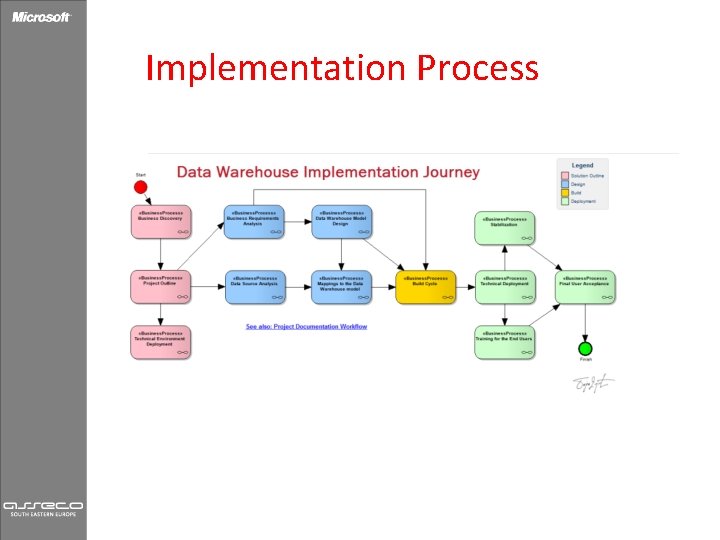
Implementation Process
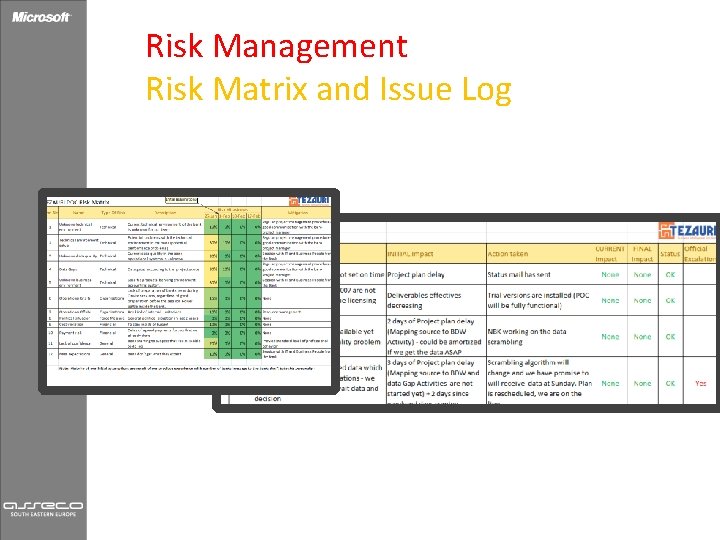
Risk Management Risk Matrix and Issue Log
DATA GOVERNANCE AND DATA QUALITY
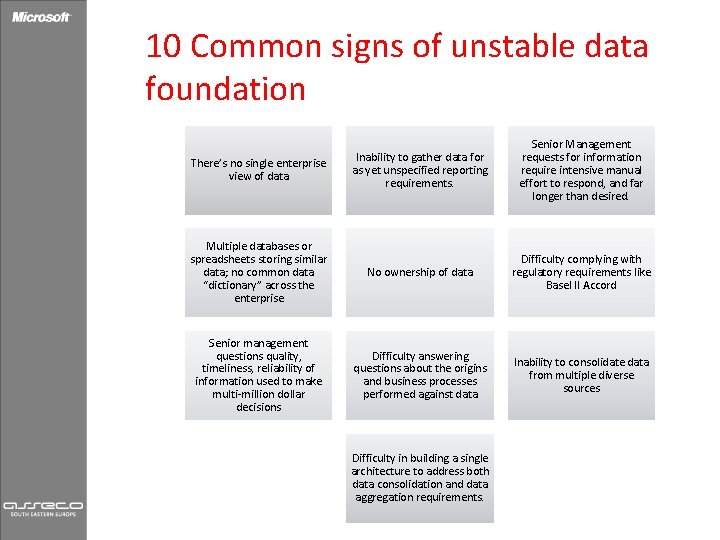
10 Common signs of unstable data foundation Inability to gather data for as yet unspecified reporting requirements. Senior Management requests for information require intensive manual effort to respond, and far longer than desired. Multiple databases or spreadsheets storing similar data; no common data “dictionary” across the enterprise No ownership of data Difficulty complying with regulatory requirements like Basel II Accord Senior management questions quality, timeliness, reliability of information used to make multi-million dollar decisions Difficulty answering questions about the origins and business processes performed against data Inability to consolidate data from multiple diverse sources There’s no single enterprise view of data Difficulty in building a single architecture to address both data consolidation and data aggregation requirements.
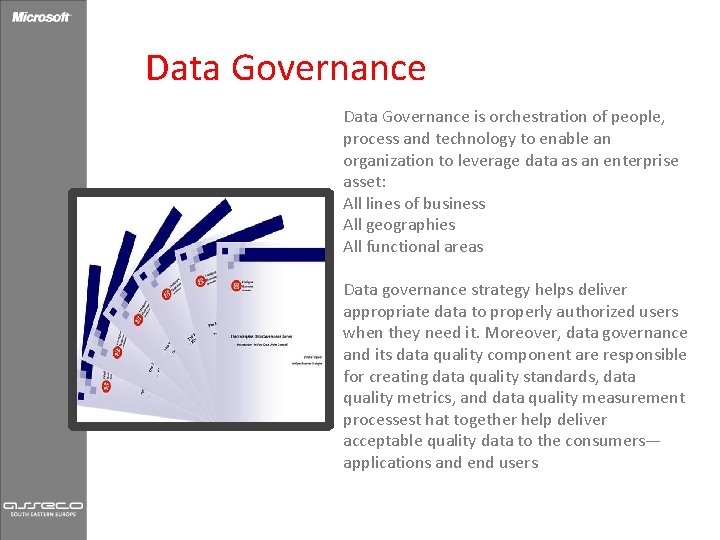
Data Governance is orchestration of people, process and technology to enable an organization to leverage data as an enterprise asset: All lines of business All geographies All functional areas Data governance strategy helps deliver appropriate data to properly authorized users when they need it. Moreover, data governance and its data quality component are responsible for creating data quality standards, data quality metrics, and data quality measurement processest hat together help deliver acceptable quality data to the consumers— applications and end users
Data Governance Requirements What data exists in the environment? In what form it exists and how it is transformed from system to system across the enterprise? Where it comes from? How one data element relates to another? Where it is resides? How business terms and data elements should commonly be defined and used across the enterprise? How it got there? How and why a data element does or does not vary from the accepted and common corporate definition (if one exists)?
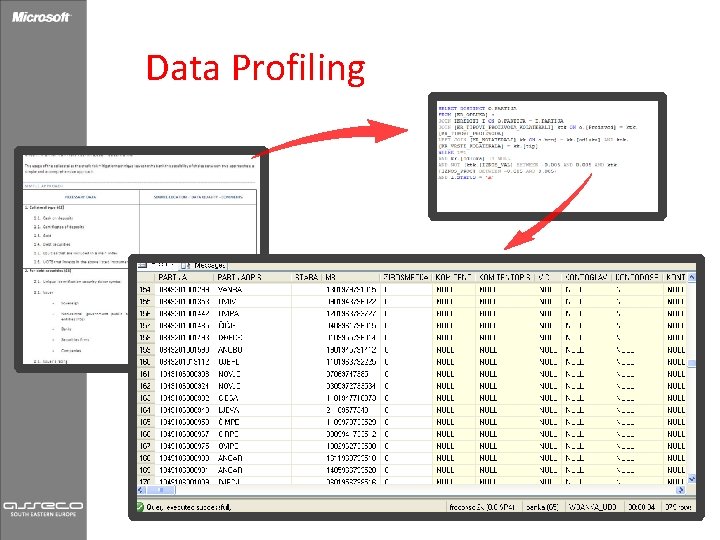
Data Profiling
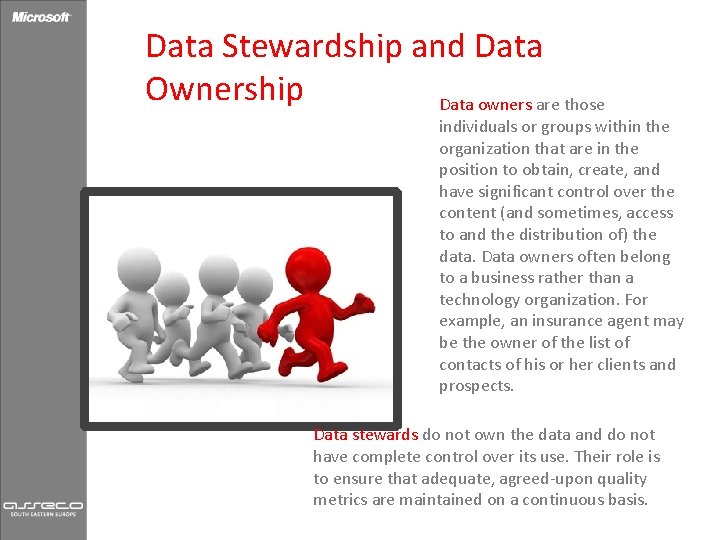
Data Stewardship and Data Ownership Data owners are those individuals or groups within the organization that are in the position to obtain, create, and have significant control over the content (and sometimes, access to and the distribution of) the data. Data owners often belong to a business rather than a technology organization. For example, an insurance agent may be the owner of the list of contacts of his or her clients and prospects. Data stewards do not own the data and do not have complete control over its use. Their role is to ensure that adequate, agreed-upon quality metrics are maintained on a continuous basis.

DQ Management Process
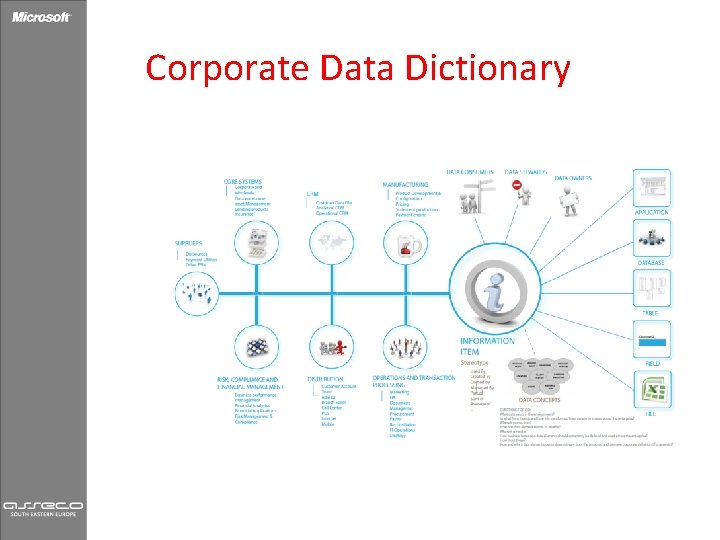
Corporate Data Dictionary

Data Continuum
PERFORMANCE MANAGEMENT

Performance Management Drivers
Well Designed Dashboards
Tips for Effective Performance Dashboards
UNSTRUCTURED DATA
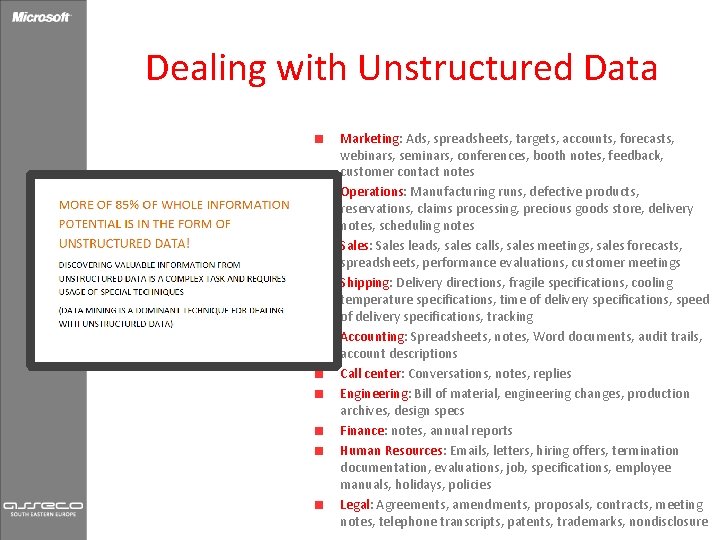
Dealing with Unstructured Data Marketing: Ads, spreadsheets, targets, accounts, forecasts, webinars, seminars, conferences, booth notes, feedback, customer contact notes Operations: Manufacturing runs, defective products, reservations, claims processing, precious goods store, delivery notes, scheduling notes Sales: Sales leads, sales calls, sales meetings, sales forecasts, spreadsheets, performance evaluations, customer meetings Shipping: Delivery directions, fragile specifications, cooling temperature specifications, time of delivery specifications, speed of delivery specifications, tracking Accounting: Spreadsheets, notes, Word documents, audit trails, account descriptions Call center: Conversations, notes, replies Engineering: Bill of material, engineering changes, production archives, design specs Finance: notes, annual reports Human Resources: Emails, letters, hiring offers, termination documentation, evaluations, job, specifications, employee manuals, holidays, policies Legal: Agreements, amendments, proposals, contracts, meeting notes, telephone transcripts, patents, trademarks, nondisclosure
PROJECT MANAGEMENT
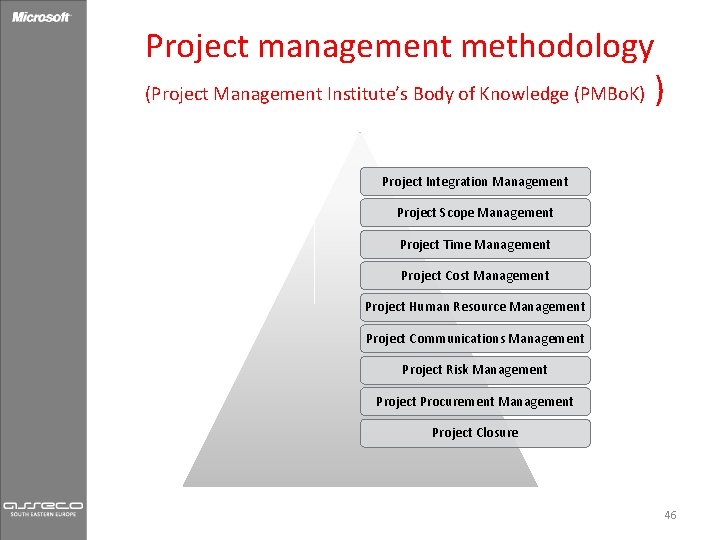
Project management methodology (Project Management Institute’s Body of Knowledge (PMBo. K) ) Project Integration Management Project Scope Management Project Time Management Project Cost Management Project Human Resource Management Project Communications Management Project Risk Management Project Procurement Management Project Closure 46
BUSINESS INTELLIGENCE EVOLUTION
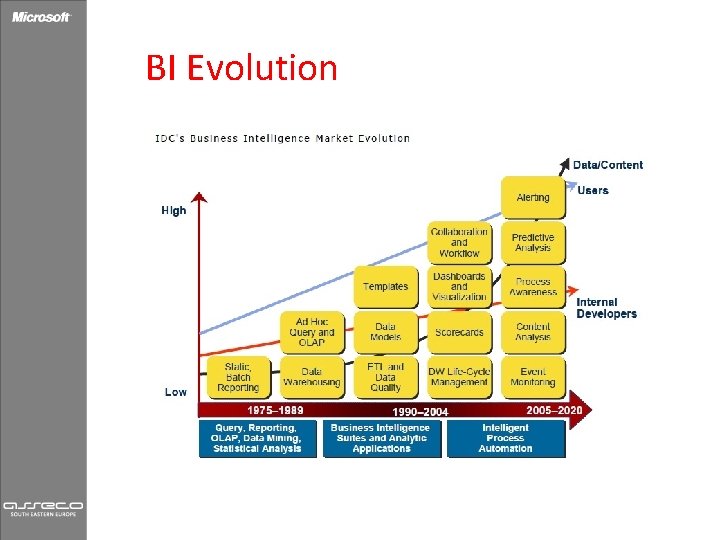
BI Evolution
Snapshot Linked. In discussions CRITICAL SUCCESS FACTORS
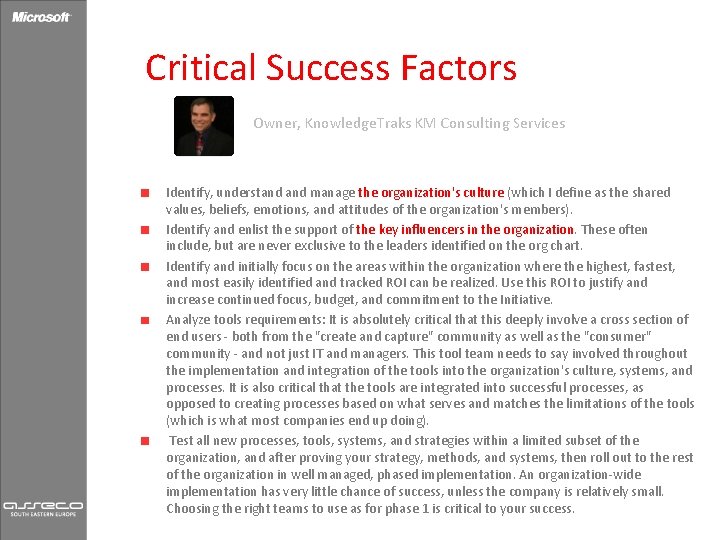
Critical Success Factors Tom Fuhriman Owner, Knowledge. Traks KM Consulting Services Identify, understand manage the organization's culture (which I define as the shared values, beliefs, emotions, and attitudes of the organization's members). Identify and enlist the support of the key influencers in the organization. These often include, but are never exclusive to the leaders identified on the org chart. Identify and initially focus on the areas within the organization where the highest, fastest, and most easily identified and tracked ROI can be realized. Use this ROI to justify and increase continued focus, budget, and commitment to the Initiative. Analyze tools requirements: It is absolutely critical that this deeply involve a cross section of end users - both from the "create and capture" community as well as the "consumer" community - and not just IT and managers. This tool team needs to say involved throughout the implementation and integration of the tools into the organization's culture, systems, and processes. It is also critical that the tools are integrated into successful processes, as opposed to creating processes based on what serves and matches the limitations of the tools (which is what most companies end up doing). Test all new processes, tools, systems, and strategies within a limited subset of the organization, and after proving your strategy, methods, and systems, then roll out to the rest of the organization in well managed, phased implementation. An organization-wide implementation has very little chance of success, unless the company is relatively small. Choosing the right teams to use as for phase 1 is critical to your success.
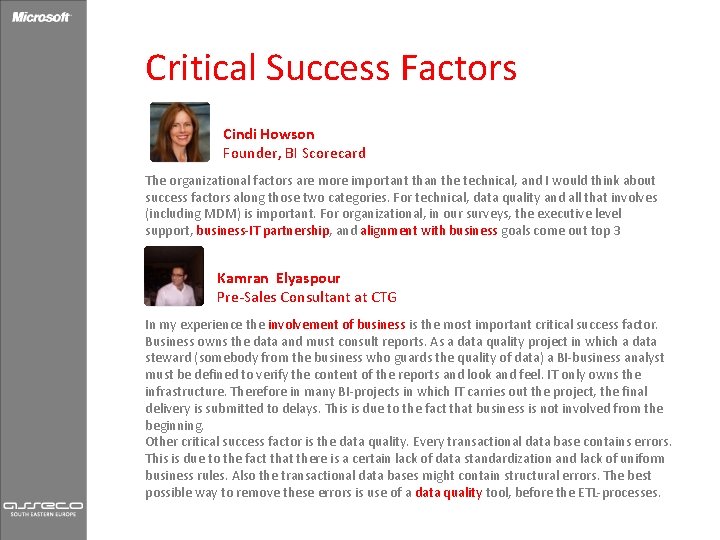
Critical Success Factors Cindi Howson Founder, BI Scorecard The organizational factors are more important than the technical, and I would think about success factors along those two categories. For technical, data quality and all that involves (including MDM) is important. For organizational, in our surveys, the executive level support, business-IT partnership, and alignment with business goals come out top 3 Kamran Elyaspour Pre-Sales Consultant at CTG In my experience the involvement of business is the most important critical success factor. Business owns the data and must consult reports. As a data quality project in which a data steward (somebody from the business who guards the quality of data) a BI-business analyst must be defined to verify the content of the reports and look and feel. IT only owns the infrastructure. Therefore in many BI-projects in which IT carries out the project, the final delivery is submitted to delays. This is due to the fact that business is not involved from the beginning. Other critical success factor is the data quality. Every transactional data base contains errors. This is due to the fact that there is a certain lack of data standardization and lack of uniform business rules. Also the transactional data bases might contain structural errors. The best possible way to remove these errors is use of a data quality tool, before the ETL-processes.
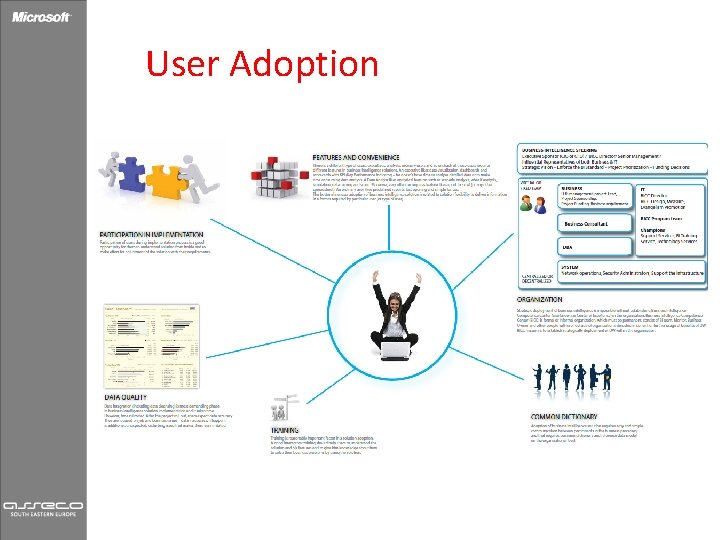
Critical Success Factors John Wilson CEO Claim Insights Success at the end of the day for a BI initiative should only be measured in terms of does the BI solution give the business the tools to get as much value out of the data as possible and are they using it to drive strategy and results? The technical pieces, while essential to wringing as much value out of the data as possible are simply creating process. Others have mentioned but IT can't sound the success bell if they deliver but the business side can't use it to derive value. There needs to be full alignment between IT and Business regarding how success is measured. A BI initiative should not be a project that traditionally has a beginning and an end. BI, to be successful, has to become a way of thinking, a means of driving the business, and a way of developing and directing strategy to achieve desired results. Without that all that has happened is a lot of money is being flushed down the toilet. Matthew Geise Senior Director, Services Technology The number one factor in any technology project (including BI) is user adoption. With this understanding, the importance of the contributing factors roll out much more clearly.
Critical Success Factors Mauricio Campos Suarez IT PROJECT MANAGER at Merck Sharp & Dohme In my personal experience the five main success factors are: 1. Business ownership (real ownership of the solution) 2. Business needs understanding (including hidden needs like those related with political aspects in the organization or personal managers needs) 3. Clear workflow, oriented to answer business question (How. . . ? How much. . . ? When. . ? , etc) and communication to all the users as part of the training 4. 'You mustn't start building the house with the roof' - Data are the foundations of our building, any BI solution will fail if data are not clean, structure, documented and complete 5. Keep it as simple as possible Neil Raden President Hired Brains: Consultant/Analyst/Author in Business Intelligence and Decision Management There are too many concepts here that have never been rigorously investigated and are just accepted as truth. "Identify, understand manage the organization's culture? " How can a BI consultant manage a company's culture? Executive buy-in? What does that mean exactly? BI isn't about expectations or requirements because no one know what they are until you get into it. I agree with Dan Vesset about a BI program, not a project. BI should be woven into the fabric by now.
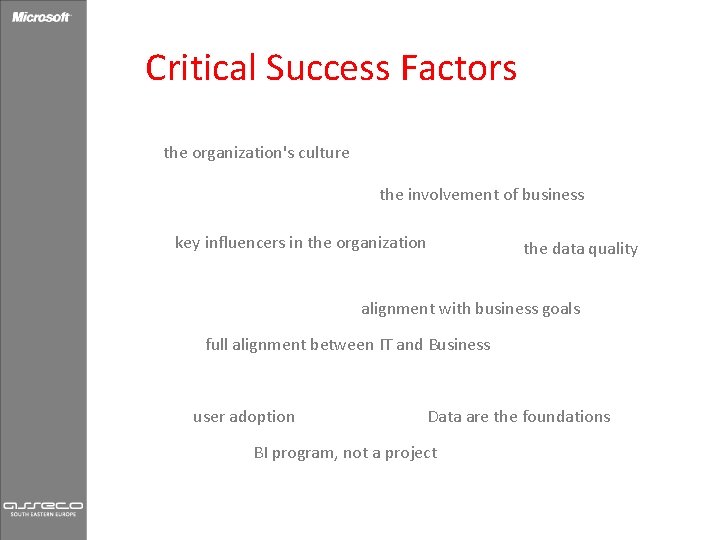
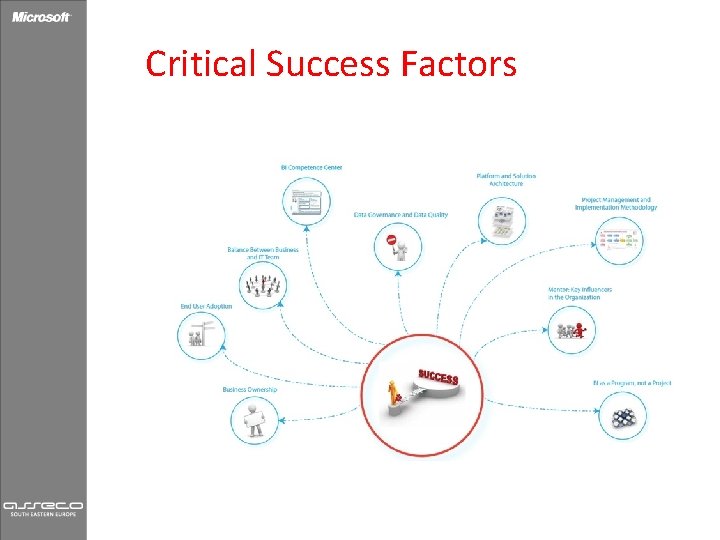
Critical Success Factors the organization's culture the involvement of business key influencers in the organization the data quality alignment with business goals full alignment between IT and Business user adoption Data are the foundations BI program, not a project
Critical Success Factors
User Adoption

© 2010 Asseco SEE. All rights reserved. The information herein is for informational purposes only and represents the opinions and views of Asseco SEE and/or Bojan Ciric. The material presented is not certain and may vary based on several factors. Portions © 2009 Asseco SEE & entire material © 2009 Microsoft Corp. Some slides contain quotations from copyrighted materials by other authors, as individually attributed or as already covered by Microsoft Copyright ownerships. All rights reserved. Microsoft, Windows Vista and other product names are or may be registered trademarks and/or trademarks in the U. S. and/or other countries. The information herein is for informational purposes only and represents the current view Asseco SEE as of the date of this presentation. Because Asseco SEE & Microsoft must respond to changing market conditions, it should not be interpreted to be a commitment on the part of Microsoft, and Microsoft and Asseco SEE cannot guarantee the accuracy of any information provided after the date of this presentation. Asseco SEE makes no warranties, express, implied or statutory, as to the information in this presentation. E&OE.
- Slides: 57