
Do D Net Centric Data Strategy DS and
- Slides: 36
Do. D Net Centric Data Strategy (DS) and Community of Interest (COI) Training Executive Overview Do. D Transformation to Net-Centric Operations via Net-Centric Strategies Version 1. 1 – February 16, 2008 For further information email OSD at: COI_Help. Desk@osd. mil Connecting People With Information
Purpose • Describe key enablers for Do. D transformation to Network Centric Operations – Do. D Net Centric Data and Services Strategies – Community of Interest (COI) Approach • Illustrate how use of these enablers can lead to Do. D Transformation • Solicit your help to achieve effective military and government operations through a Network-Centric approach 2
Outline • Call for Enterprise Transformation & Net-Centric Operations • Do. D Net-Centric Data and Services Strategies • Community of Interest (COI) – Definition – The COI’s Relationship to the Enterprise – What COIs do • • OASD(NII)/Do. D CIO Facilitated COIs & their Lessons COI Strategic Rhythm COIs Enable Do. D Transformation Conclusions 3
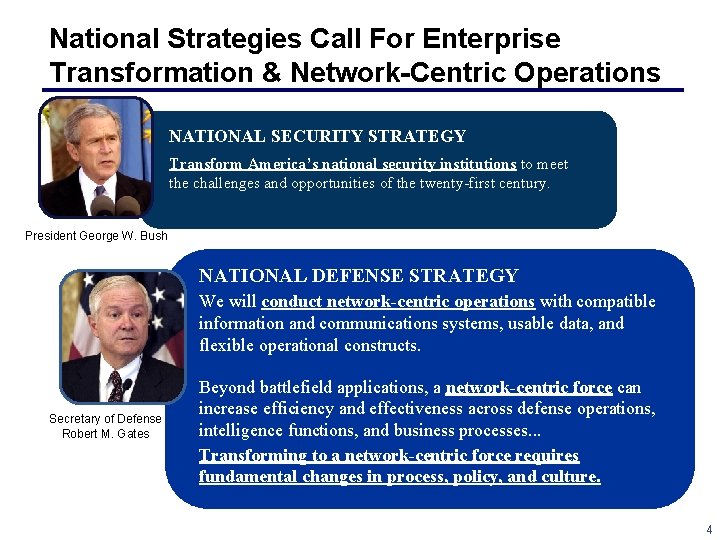
National Strategies Call For Enterprise Transformation & Network-Centric Operations NATIONAL SECURITY STRATEGY Transform America’s national security institutions to meet the challenges and opportunities of the twenty-first century. President George W. Bush NATIONAL DEFENSE STRATEGY We will conduct network-centric operations with compatible information and communications systems, usable data, and flexible operational constructs. Secretary of Defense Robert M. Gates Beyond battlefield applications, a network-centric force can increase efficiency and effectiveness across defense operations, intelligence functions, and business processes. . . Transforming to a network-centric force requires fundamental changes in process, policy, and culture. 4
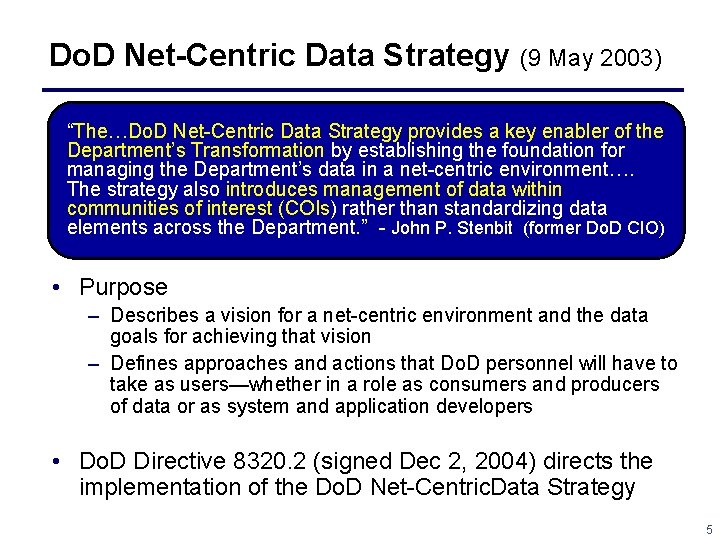
Do. D Net-Centric Data Strategy (9 May 2003) “The…Do. D Net Centric Data Strategy provides a key enabler of the Department’s Transformation by establishing the foundation for managing the Department’s data in a net centric environment…. The strategy also introduces management of data within communities of interest (COIs) rather than standardizing data elements across the Department. ” John P. Stenbit (former Do. D CIO) • Purpose – Describes a vision for a net centric environment and the data goals for achieving that vision – Defines approaches and actions that Do. D personnel will have to take as users—whether in a role as consumers and producers of data or as system and application developers • Do. D Directive 8320. 2 (signed Dec 2, 2004) directs the implementation of the Do. D Net Centric Data Strategy 5
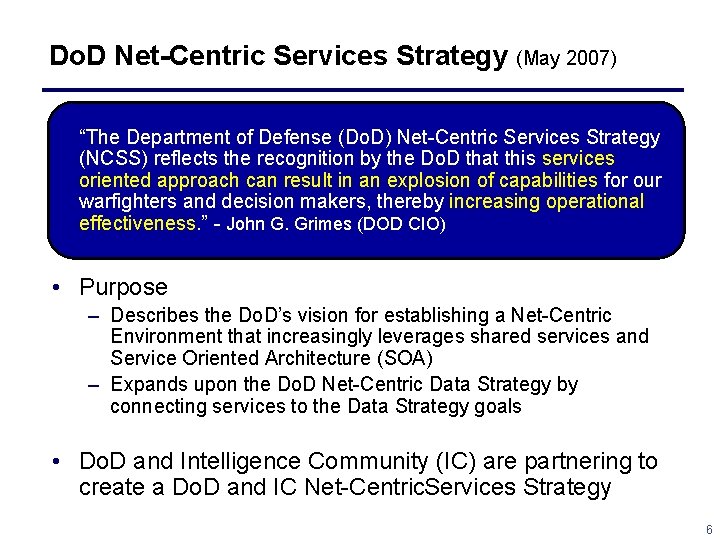
Do. D Net-Centric Services Strategy (May 2007) “The Department of Defense (Do. D) Net Centric Services Strategy (NCSS) reflects the recognition by the Do. D that this services oriented approach can result in an explosion of capabilities for our warfighters and decision makers, thereby increasing operational effectiveness. ” John G. Grimes (DOD CIO) • Purpose – Describes the Do. D’s vision for establishing a Net Centric Environment that increasingly leverages shared services and Service Oriented Architecture (SOA) – Expands upon the Do. D Net Centric Data Strategy by connecting services to the Data Strategy goals • Do. D and Intelligence Community (IC) are partnering to create a Do. D and IC Net Centric Services Strategy 6
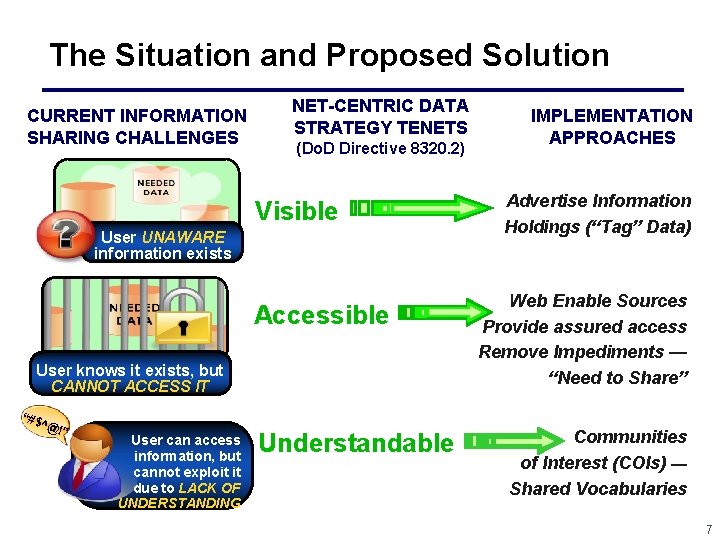
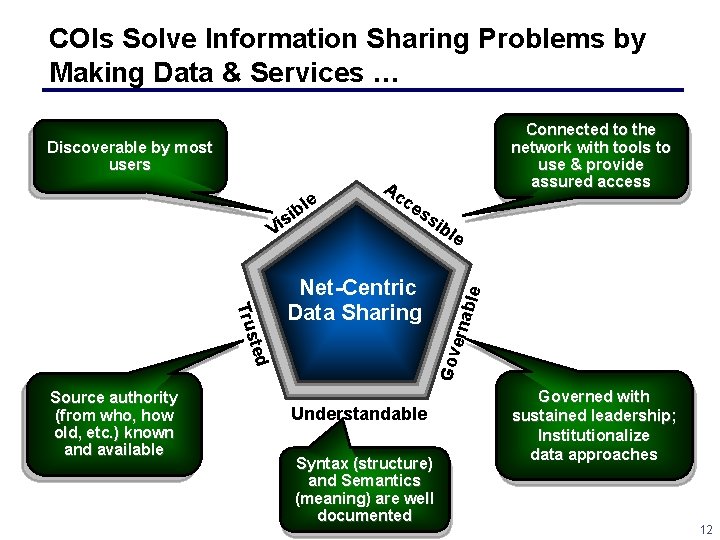
The Situation and Proposed Solution CURRENT INFORMATION SHARING CHALLENGES NET-CENTRIC DATA STRATEGY TENETS (Do. D Directive 8320. 2) Visible User UNAWARE information exists Accessible User knows it exists, but CANNOT ACCESS IT “#$ ^@ !” User can access information, but cannot exploit it due to LACK OF UNDERSTANDING Understandable IMPLEMENTATION APPROACHES Advertise Information Holdings (“Tag” Data) Web Enable Sources Provide assured access Remove Impediments — “Need to Share” Communities of Interest (COIs) — Shared Vocabularies 7
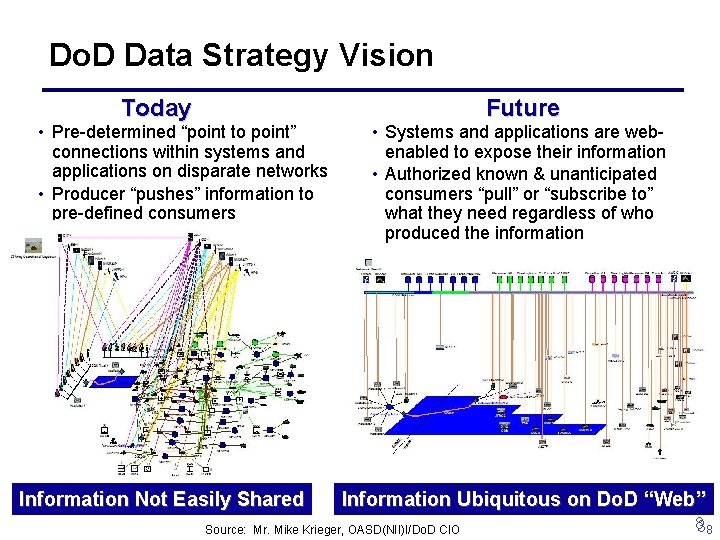
Do. D Data Strategy Vision Today • Pre determined “point to point” connections within systems and applications on disparate networks • Producer “pushes” information to pre defined consumers Information Not Easily Shared Future • Systems and applications are web enabled to expose their information • Authorized known & unanticipated consumers “pull” or “subscribe to” what they need regardless of who produced the information Information Ubiquitous on Do. D “Web” Source: Mr. Mike Krieger, OASD(NII)I/Do. D CIO 838
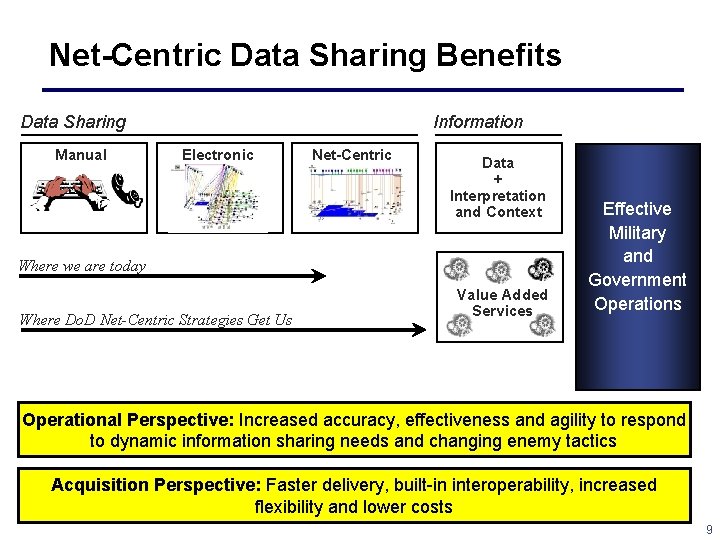
Net-Centric Data Sharing Benefits Data Sharing Manual Information Electronic Net-Centric Data + Interpretation and Context Where we are today Where Do. D Net-Centric Strategies Get Us Value Added Services Effective Military and Government Operations Operational Perspective: Increased accuracy, effectiveness and agility to respond to dynamic information sharing needs and changing enemy tactics Acquisition Perspective: Faster delivery, built in interoperability, increased flexibility and lower costs 9
Outline • Call for Enterprise Transformation & Net-Centric Operations • Do. D Net-Centric Data and Services Strategies • Community of Interest (COI) – Definition – The COI’s Relationship to the Enterprise – What COIs do • • OASD(NII)/Do. D CIO Facilitated COIs & their Lessons COI Strategic Rhythm COIs Enable Do. D Transformation Conclusions 10
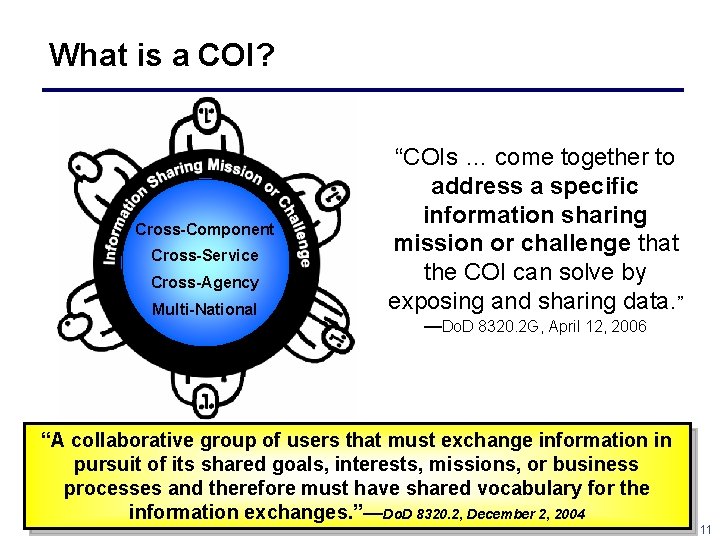
What is a COI? Cross-Component Cross-Service Cross-Agency Multi-National “COIs … come together to address a specific information sharing mission or challenge that the COI can solve by exposing and sharing data. ” —Do. D 8320. 2 G, April 12, 2006 “A collaborative group of users that must exchange information in pursuit of its shared goals, interests, missions, or business processes and therefore must have shared vocabulary for the information exchanges. ”—Do. D 8320. 2, December 2, 2004 11
COIs Solve Information Sharing Problems by Making Data & Services … Connected to the network with tools to use & provide assured access Discoverable by most users le b si ce ss ib Source authority (from who, how old, etc. ) known and available Gov ted Trus Net-Centric Data Sharing le erna Vi Ac Understandable Syntax (structure) and Semantics (meaning) are well documented Governed with sustained leadership; Institutionalize data approaches 12
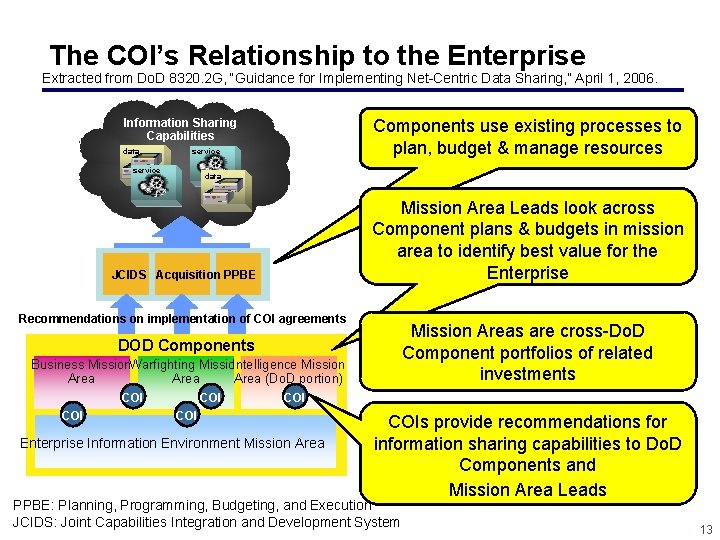
The COI’s Relationship to the Enterprise Extracted from Do. D 8320. 2 G, “Guidance for Implementing Net Centric Data Sharing, ” April 1, 2006. Components use existing processes to plan, budget & manage resources Information Sharing Capabilities data service data Mission Area Leads look across Component plans & budgets in mission area to identify best value for the Enterprise JCIDS Acquisition PPBE Recommendations on implementation of COI agreements Mission Areas are cross Do. D Component portfolios of related investments DOD Components Business Mission. Warfighting Mission Intelligence Mission Area (Do. D portion) COI COI COI Enterprise Information Environment Mission Area COIs provide recommendations for information sharing capabilities to Do. D Components and Mission Area Leads PPBE: Planning, Programming, Budgeting, and Execution JCIDS: Joint Capabilities Integration and Development System 13
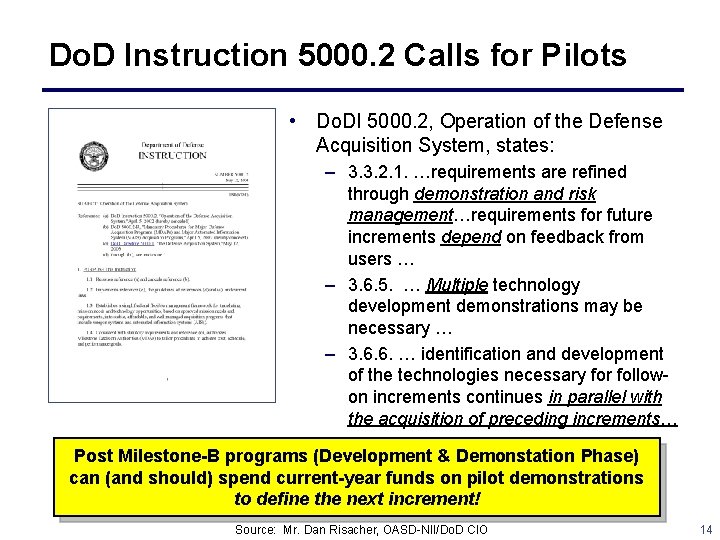
Do. D Instruction 5000. 2 Calls for Pilots • Do. DI 5000. 2, Operation of the Defense Acquisition System, states: – 3. 3. 2. 1. …requirements are refined through demonstration and risk management…requirements for future increments depend on feedback from users … – 3. 6. 5. … Multiple technology development demonstrations may be necessary … – 3. 6. 6. … identification and development of the technologies necessary for follow on increments continues in parallel with the acquisition of preceding increments… Post Milestone-B programs (Development & Demonstation Phase) can (and should) spend current-year funds on pilot demonstrations to define the next increment! Source: Mr. Dan Risacher, OASD NII/Do. D CIO 14
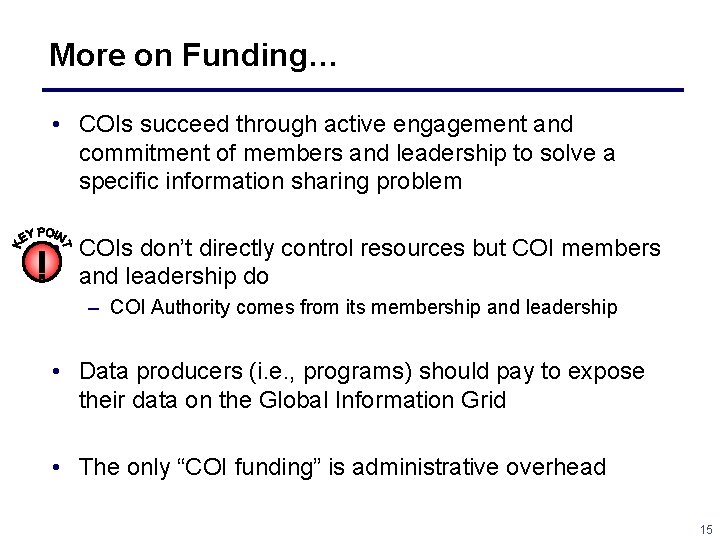
More on Funding… • COIs succeed through active engagement and commitment of members and leadership to solve a specific information sharing problem • COIs don’t directly control resources but COI members ! and leadership do – COI Authority comes from its membership and leadership • Data producers (i. e. , programs) should pay to expose their data on the Global Information Grid • The only “COI funding” is administrative overhead 15
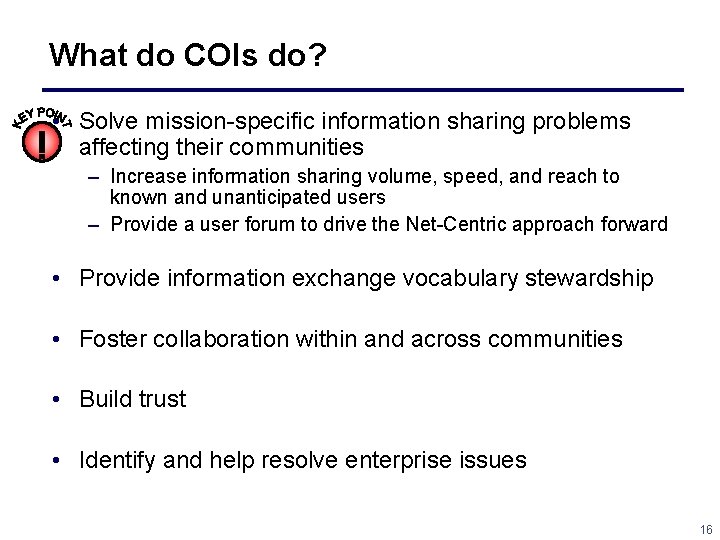
What do COIs do? • Solve mission specific information sharing problems ! affecting their communities – Increase information sharing volume, speed, and reach to known and unanticipated users – Provide a user forum to drive the Net Centric approach forward • Provide information exchange vocabulary stewardship • Foster collaboration within and across communities • Build trust • Identify and help resolve enterprise issues 16
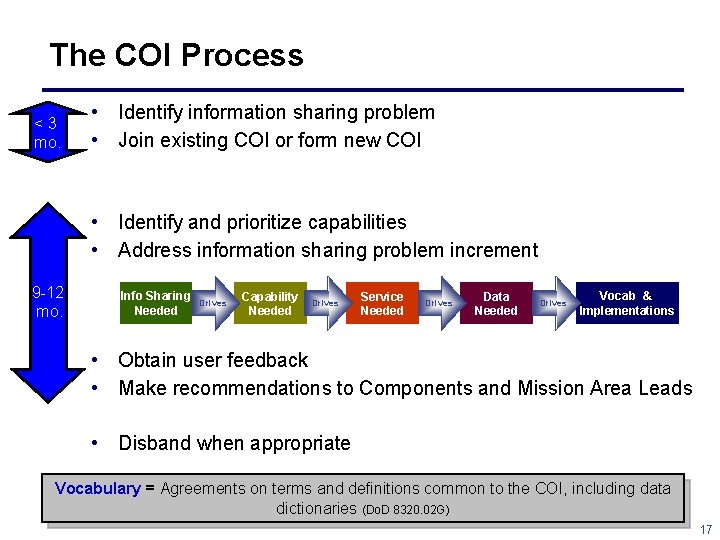
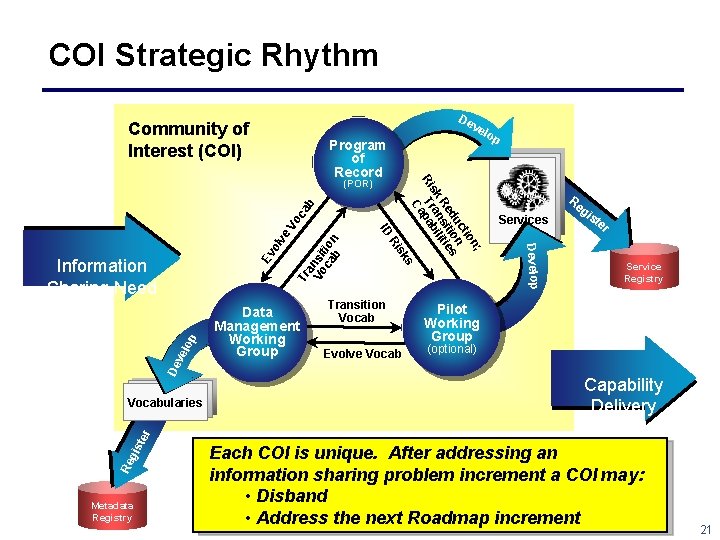
The COI Process < 3 mo. • Identify information sharing problem • Join existing COI or form new COI • Identify and prioritize capabilities • Address information sharing problem increment 9 12 mo. Info Sharing Needed Drives Capability Needed Drives Service Needed Drives Data Needed Drives Vocab & Implementations • Obtain user feedback • Make recommendations to Components and Mission Area Leads • Disband when appropriate Vocabulary = Agreements on terms and definitions common to the COI, including data dictionaries (Do. D 8320. 02 G) 17
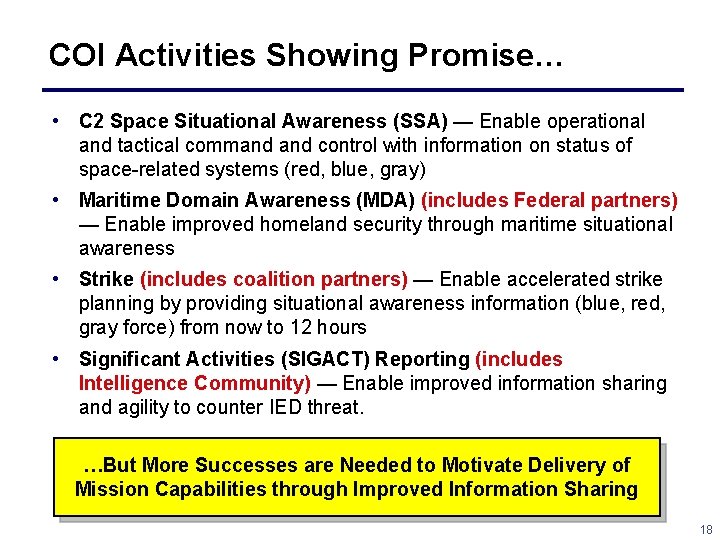
COI Activities Showing Promise… • C 2 Space Situational Awareness (SSA) — Enable operational and tactical command control with information on status of space related systems (red, blue, gray) • Maritime Domain Awareness (MDA) (includes Federal partners) — Enable improved homeland security through maritime situational awareness • Strike (includes coalition partners) — Enable accelerated strike planning by providing situational awareness information (blue, red, gray force) from now to 12 hours • Significant Activities (SIGACT) Reporting (includes Intelligence Community) — Enable improved information sharing and agility to counter IED threat. …But More Successes are Needed to Motivate Delivery of Mission Capabilities through Improved Information Sharing 18
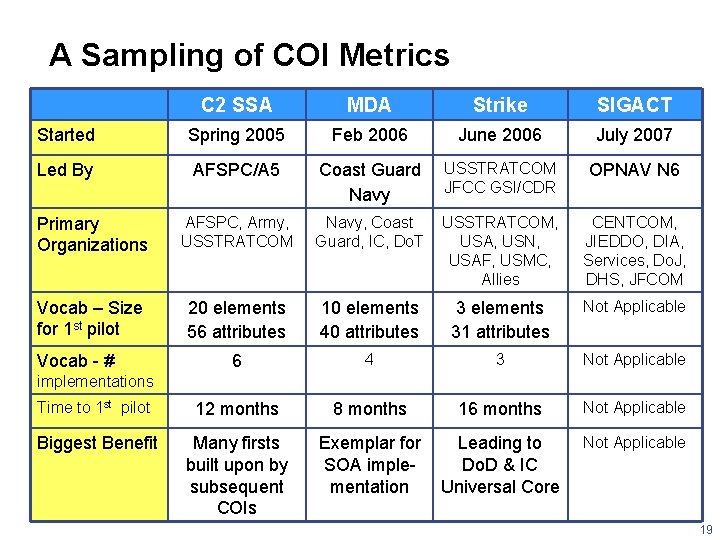
A Sampling of COI Metrics C 2 SSA MDA Strike SIGACT Started Spring 2005 Feb 2006 June 2006 July 2007 Led By AFSPC/A 5 Coast Guard Navy USSTRATCOM JFCC GSI/CDR OPNAV N 6 Primary Organizations AFSPC, Army, USSTRATCOM Navy, Coast Guard, IC, Do. T USSTRATCOM, USA, USN, USAF, USMC, Allies CENTCOM, JIEDDO, DIA, Services, Do. J, DHS, JFCOM Vocab – Size for 1 st pilot 20 elements 56 attributes 10 elements 40 attributes 3 elements 31 attributes Not Applicable 6 4 3 Not Applicable Time to 1 st pilot 12 months 8 months 16 months Not Applicable Biggest Benefit Many firsts built upon by subsequent COIs Vocab # implementations Exemplar for Leading to SOA imple Do. D & IC mentation Universal Core Not Applicable 19
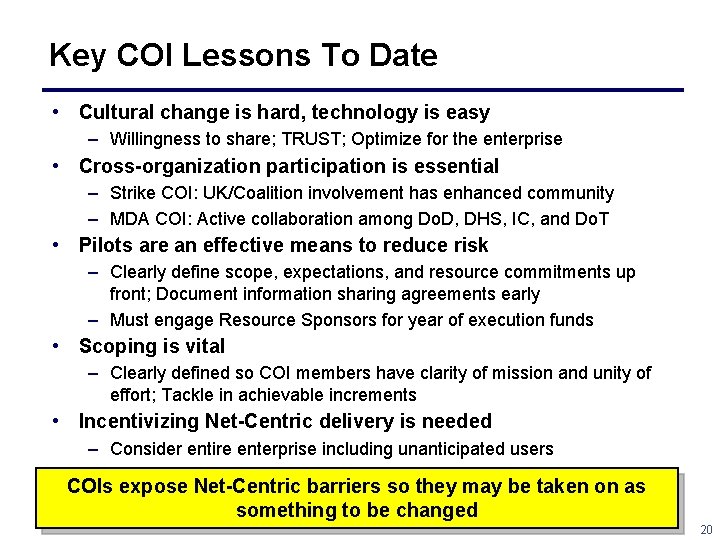
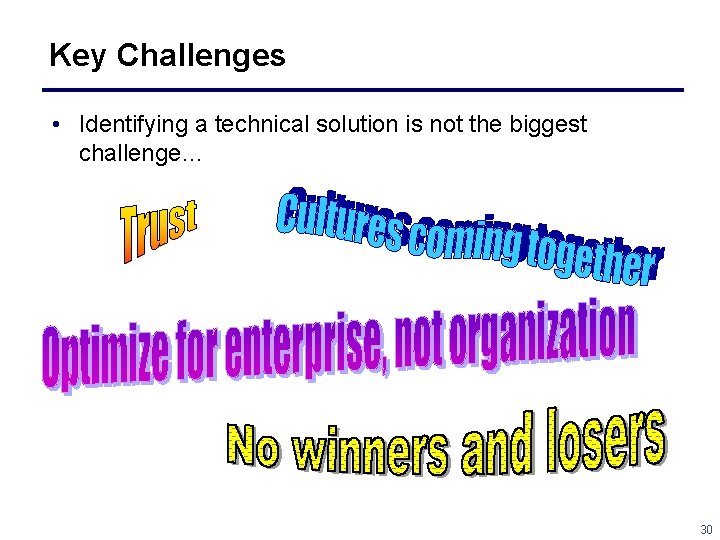
Key COI Lessons To Date • Cultural change is hard, technology is easy – Willingness to share; TRUST; Optimize for the enterprise • Cross-organization participation is essential – Strike COI: UK/Coalition involvement has enhanced community – MDA COI: Active collaboration among Do. D, DHS, IC, and Do. T • Pilots are an effective means to reduce risk – Clearly define scope, expectations, and resource commitments up front; Document information sharing agreements early – Must engage Resource Sponsors for year of execution funds • Scoping is vital – Clearly defined so COI members have clarity of mission and unity of effort; Tackle in achievable increments • Incentivizing Net-Centric delivery is needed – Consider entire enterprise including unanticipated users COIs expose Net-Centric barriers so they may be taken on as something to be changed 20
COI Strategic Rhythm De ve Community of Interest (COI) Program of Record ab Vo c Tr a Vo nsi ca tion b ve ol Ev ve lop De ter gis Re s Metadata Registry sk Ri Vocabularies Data Management Working Group ID Information Sharing Need Transition Vocab Evolve Vocab Services Develop n; io ct du tion s Re si litie sk ran bi Ri T apa C (POR) lop Re g is te r Service Registry Pilot Working Group (optional) Capability Delivery Each COI is unique. After addressing an information sharing problem increment a COI may: • Disband • Address the next Roadmap increment 21
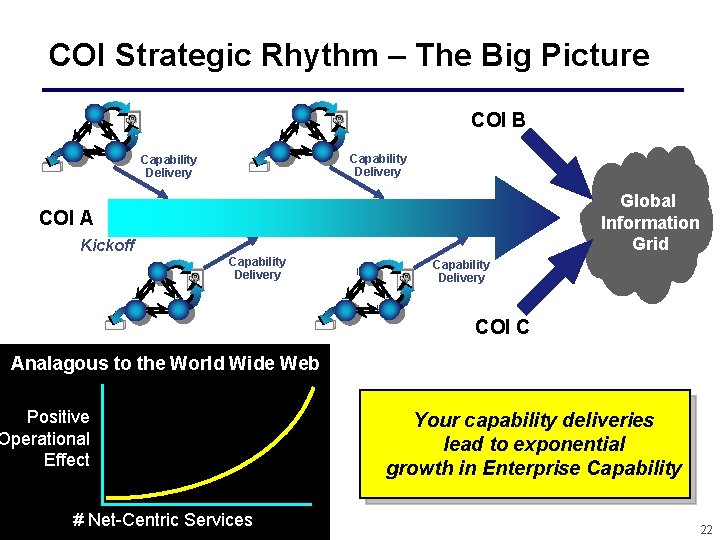
COI Strategic Rhythm – The Big Picture COI B Capability Delivery Global Information Grid COI A Kickoff Capability Delivery COI C Analagous to the World Wide Web Positive Operational Effect # Net Centric Services Your capability deliveries lead to exponential growth in Enterprise Capability 22
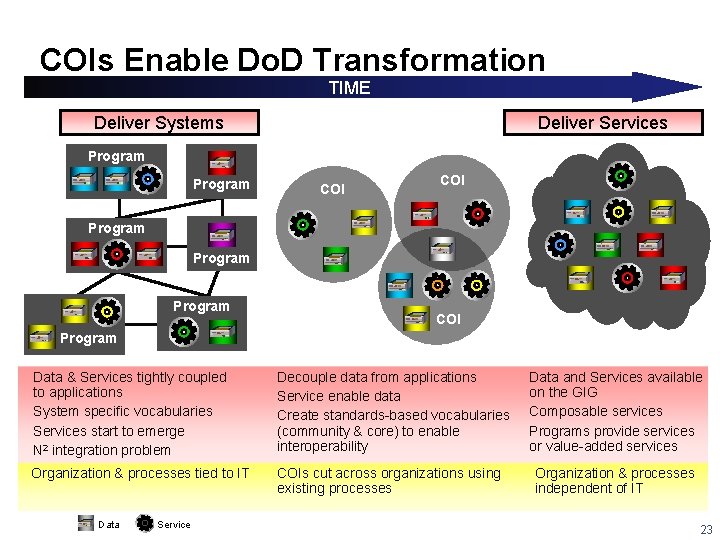
COIs Enable Do. D Transformation TIME Deliver Systems Deliver Services Program COI Program Data & Services tightly coupled to applications System specific vocabularies Services start to emerge N 2 integration problem Decouple data from applications Service enable data Create standards based vocabularies (community & core) to enable interoperability Organization & processes tied to IT COIs cut across organizations using existing processes Data Service Data and Services available on the GIG Composable services Programs provide services or value added services Organization & processes independent of IT 23
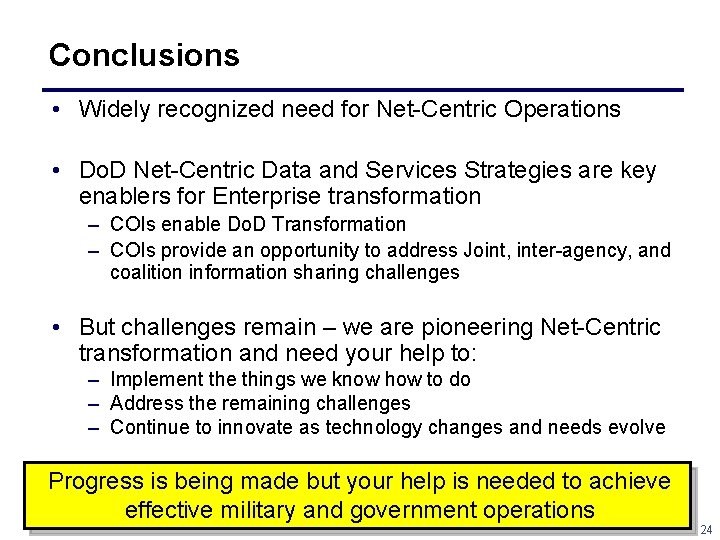
Conclusions • Widely recognized need for Net Centric Operations • Do. D Net Centric Data and Services Strategies are key enablers for Enterprise transformation – COIs enable Do. D Transformation – COIs provide an opportunity to address Joint, inter agency, and coalition information sharing challenges • But challenges remain – we are pioneering Net Centric transformation and need your help to: – Implement the things we know how to do – Address the remaining challenges – Continue to innovate as technology changes and needs evolve Progress is being made but your help is needed to achieve effective military and government operations 24
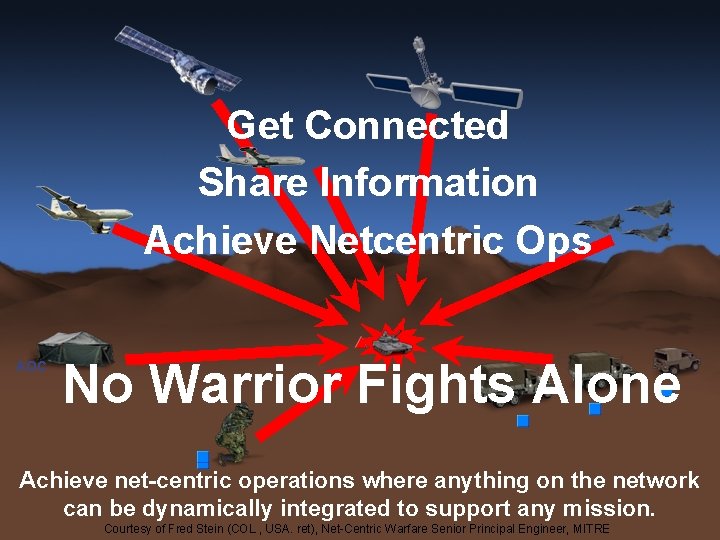
Get Connected Share Information Achieve Netcentric Ops AOC No Warrior Fights Alone Achieve net-centric operations where anything on the network Connecting People With Information can be dynamically integrated to support any mission. Courtesy of Fred Stein (COL , USA. ret), Net Centric Warfare Senior Principal Engineer, MITRE
Backup Charts 26
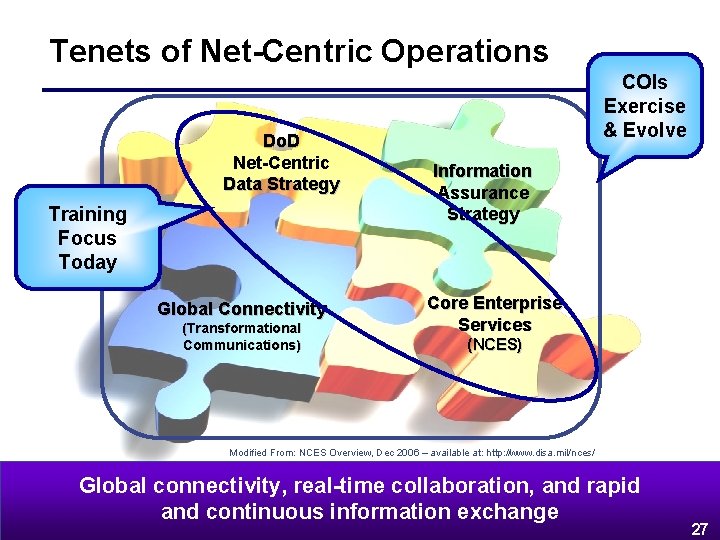
Tenets of Net-Centric Operations Do. D Net-Centric Data Strategy Training Focus Today Global Connectivity (Transformational Communications) COIs Exercise & Evolve Information Assurance Strategy Core Enterprise Services (NCES) Modified From: NCES Overview, Dec 2006 – available at: http: //www. disa. mil/nces/ Global connectivity, real-time collaboration, and rapid and continuous information exchange 27 27
COIs Support Portfolio Management • QDR 2006 moved Do. D toward the use of “joint capability portfolios” to change how the department does business • Do. D Deputy’s Advisory Working Group (DAWG) – A body of the Department’s senior civilian and military leaders co chaired by the Vice Chairman of the Joint Chiefs of Staff (CJCS) and the Deputy Secretary of Defense (DSD) – Established four pilot portfolios to evolve the Department’s business practices and methodologies • COIs and COI pilots address information sharing problems and – Continuously refine the Department’s business processes – Inform acquisition programs to make them more effective “The goal is better effectiveness and, through it, better efficiency – we have to do the right things, and we have to do them right. I can tell you that our work is still not finished. The DAWG is continuing to debate and refine our approach. ” Gordon England, DSD 28
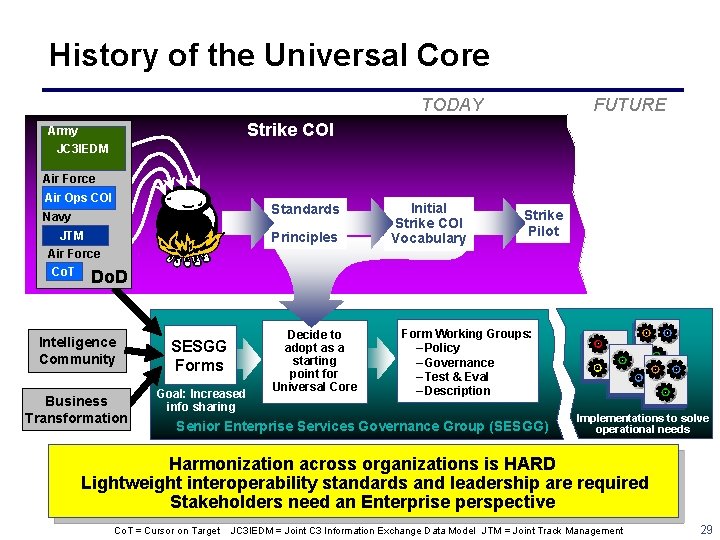
History of the Universal Core TODAY FUTURE Strike COI Army JC 3 IEDM Air Force Air Ops COI Standards Navy JTM Principles Initial Strike COI Vocabulary Strike Pilot Air Force Co. T Do. D Intelligence Community Business Transformation SESGG Forms Goal: Increased info sharing Decide to adopt as a starting point for Universal Core Form Working Groups: – Policy – Governance – Test & Eval – Description Senior Enterprise Services Governance Group (SESGG) Implementations to solve operational needs Harmonization across organizations is HARD Lightweight interoperability standards and leadership are required Stakeholders need an Enterprise perspective Co. T = Cursor on Target JC 3 IEDM = Joint C 3 Information Exchange Data Model JTM = Joint Track Management 29
Key Challenges • Identifying a technical solution is not the biggest challenge… 30
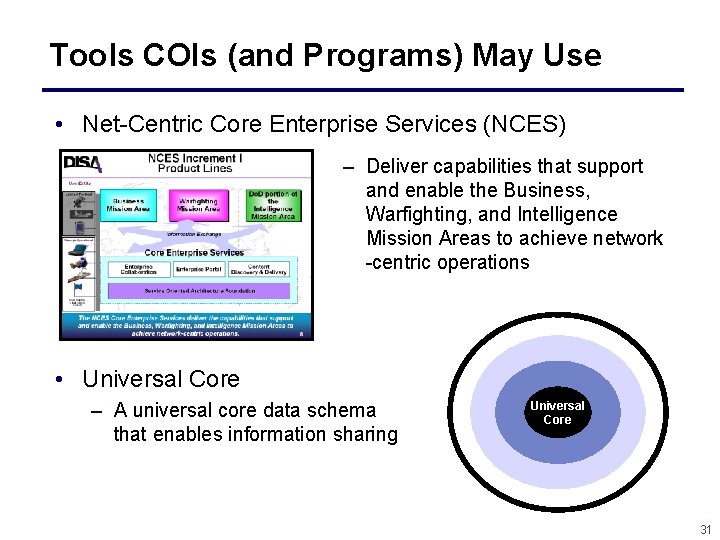
Tools COIs (and Programs) May Use • Net Centric Core Enterprise Services (NCES) – Deliver capabilities that support and enable the Business, Warfighting, and Intelligence Mission Areas to achieve network centric operations • Universal Core – A universal core data schema that enables information sharing Universal Core Task/Mission 31
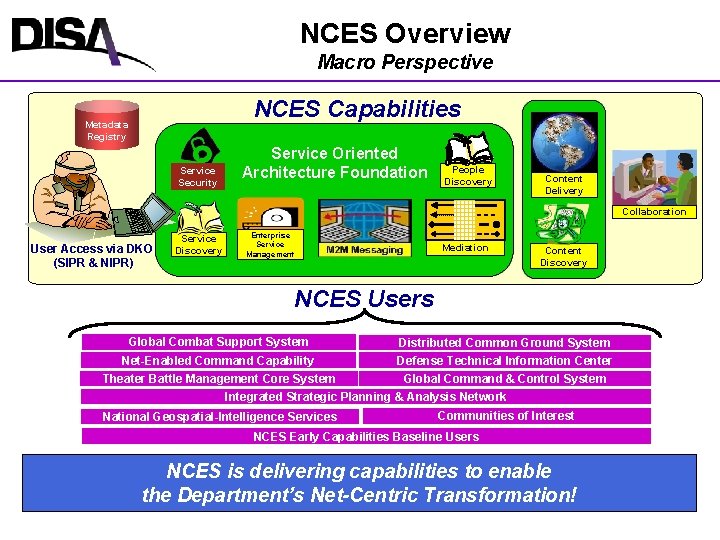
NCES Overview Macro Perspective NCES Capabilities Metadata Registry Service Security Service Oriented Architecture Foundation People Discovery Content Delivery Collaboration User Access via DKO (SIPR & NIPR) Service Discovery Enterprise Service Management Mediation Content Discovery NCES Users Global Combat Support System Net-Enabled Command Capability Distributed Common Ground System Defense Technical Information Center Theater Battle Management Core System Global Command & Control System Integrated Strategic Planning & Analysis Network National Geospatial-Intelligence Services Communities of Interest NCES Early Capabilities Baseline Users NCES is delivering capabilities to enable the Department’s Net-Centric Transformation!
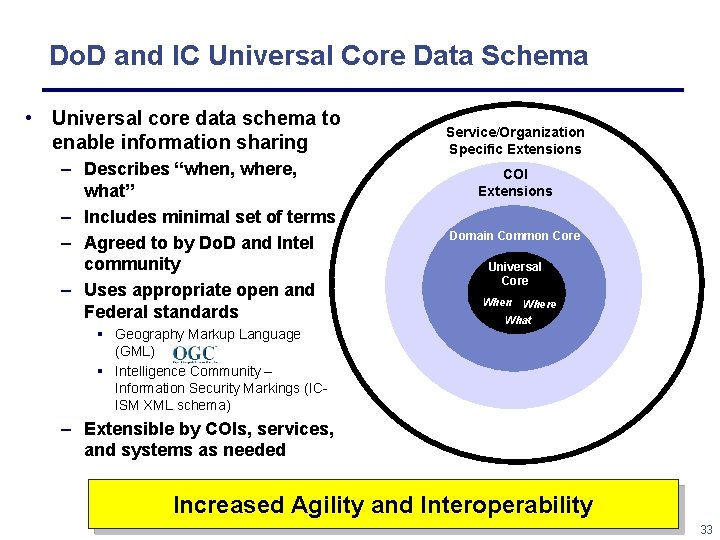
Do. D and IC Universal Core Data Schema • Universal core data schema to enable information sharing – Describes “when, where, what” – Includes minimal set of terms – Agreed to by Do. D and Intel community – Uses appropriate open and Federal standards § Geography Markup Language (GML) § Intelligence Community – Information Security Markings (IC ISM XML schema) Service/Organization Specific Extensions COI Extensions Domain Common Core Universal Core When Where What Task/Mission – Extensible by COIs, services, and systems as needed Increased Agility and Interoperability 33
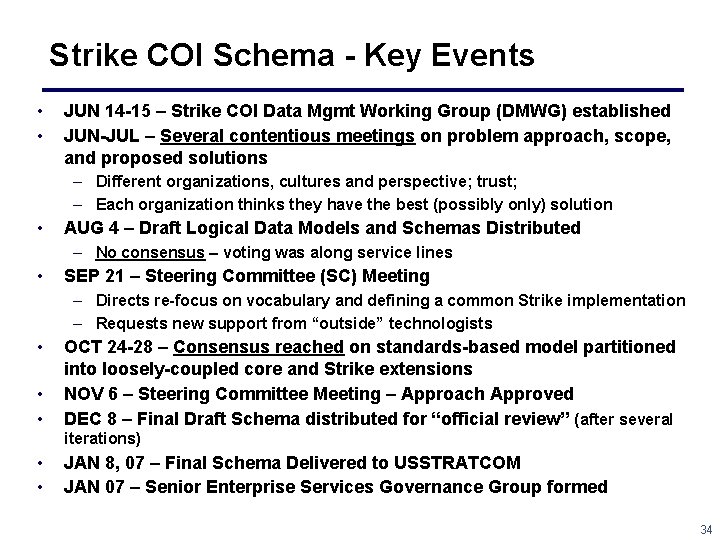
Strike COI Schema - Key Events • • JUN 14 -15 – Strike COI Data Mgmt Working Group (DMWG) established JUN-JUL – Several contentious meetings on problem approach, scope, and proposed solutions – Different organizations, cultures and perspective; trust; – Each organization thinks they have the best (possibly only) solution • AUG 4 – Draft Logical Data Models and Schemas Distributed – No consensus – voting was along service lines • SEP 21 – Steering Committee (SC) Meeting – Directs re-focus on vocabulary and defining a common Strike implementation – Requests new support from “outside” technologists • • • OCT 24 -28 – Consensus reached on standards-based model partitioned into loosely-coupled core and Strike extensions NOV 6 – Steering Committee Meeting – Approach Approved DEC 8 – Final Draft Schema distributed for “official review” (after several iterations) • • JAN 8, 07 – Final Schema Delivered to USSTRATCOM JAN 07 – Senior Enterprise Services Governance Group formed 34
Universal Core Background • Senior Enterprise Services Governance Group (SESGG) formed in January 2007: – To increase collaboration on information sharing between Do. D and the Intelligence Community (IC) – By the Do. D CIO and the Associate Director of National Intelligence and Chief Information Officer (ADNI CIO) • SESGG Chairs: – Mr. Mike Krieger, Office of the Do. D CIO – Mr. Steve Selwyn, Office of the ADNI CIO • SESGG Members: From each of the Services, USD(AT&L), DISA, and DIA • First Undertaking: Review and adopt a Do. D and IC Universal Core data schema Increased Do. D & IC Info Sharing & Agility 35
SESGG Vision and Purpose • SESGG Vision – Ensure that the Do. D and IC Net Centric Environment (NCE) evolves to an enterprise services based architecture that improves the joint community’s ability to respond to evolving operations and mission through increased information sharing and agility. • SESGG Purpose – To drive a Do. D and IC implementation of a joint Net Centric Services and Data Strategy in support of mission requirements – Ensure that recommendations on data and enterprise services policies, implementation guidance, standards, and processes align with interoperability and information sharing objectives and are made in the best interests of the joint Enterprise – An advisory body to the § Director, Information Policy (IP), § Office of Do. D Chief Information Officer (CIO), and the § Deputy Associate Director of National Intelligence for IC Enterprise Architecture, Office ADNI Chief Information Officer (CIO). Increased Do. D & IC Info Sharing & Agility Reference: Senior Enterprise Service Governance Group Charter – January 2007 36