
Do D Information Enterprise Architecture v 2 0
- Slides: 14
Do. D Information Enterprise Architecture v 2. 0 Briefing for Do. D Architecture Framework (Do. DAF) 2. 0 Plenary Do. D CIO/Architecture and Infrastructure Directorate January 2012
Agenda • Do. D IEA v 2. 0 Purpose, Scope, and General Content • Architecture Descriptions • Reference Architecture • Use of Do. DAF 2. 0 and Tools 2 UNCLASSIFIED
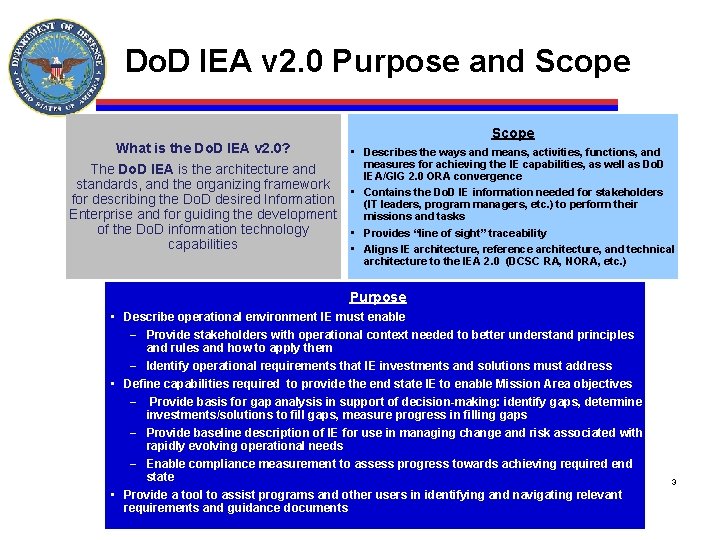
Do. D IEA v 2. 0 Purpose and Scope What is the Do. D IEA v 2. 0? The Do. D IEA is the architecture and standards, and the organizing framework for describing the Do. D desired Information Enterprise and for guiding the development of the Do. D information technology capabilities Scope • Describes the ways and means, activities, functions, and measures for achieving the IE capabilities, as well as Do. D IEA/GIG 2. 0 ORA convergence • Contains the Do. D IE information needed for stakeholders (IT leaders, program managers, etc. ) to perform their missions and tasks • Provides “line of sight” traceability • Aligns IE architecture, reference architecture, and technical architecture to the IEA 2. 0 (DCSC RA, NORA, etc. ) Purpose • Describe operational environment IE must enable Provide stakeholders with operational context needed to better understand principles and rules and how to apply them Identify operational requirements that IE investments and solutions must address • Define capabilities required to provide the end state IE to enable Mission Area objectives Provide basis for gap analysis in support of decision-making: identify gaps, determine investments/solutions to fill gaps, measure progress in filling gaps Provide baseline description of IE for use in managing change and risk associated with rapidly evolving operational needs Enable compliance measurement to assess progress towards achieving required end state • Provide a tool to assist programs and other users in identifying and navigating relevant requirements and guidance documents 3
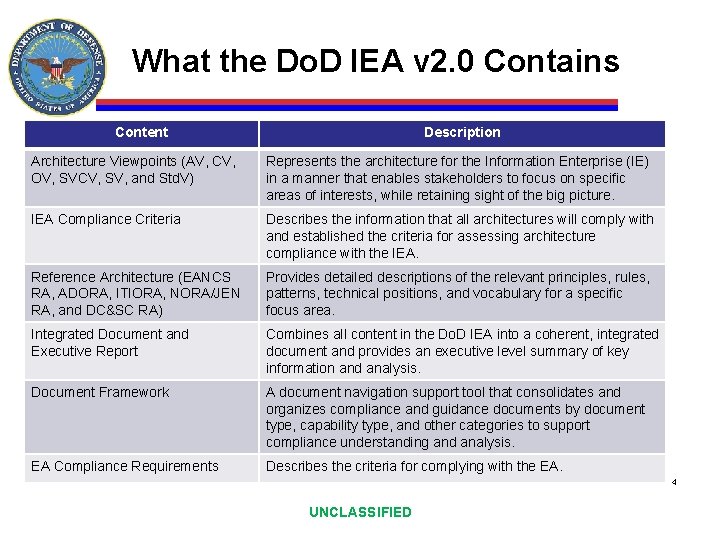
What the Do. D IEA v 2. 0 Contains Content Description Architecture Viewpoints (AV, CV, OV, SVCV, SV, and Std. V) Represents the architecture for the Information Enterprise (IE) in a manner that enables stakeholders to focus on specific areas of interests, while retaining sight of the big picture. IEA Compliance Criteria Describes the information that all architectures will comply with and established the criteria for assessing architecture compliance with the IEA. Reference Architecture (EANCS RA, ADORA, ITIORA, NORA/JEN RA, and DC&SC RA) Provides detailed descriptions of the relevant principles, rules, patterns, technical positions, and vocabulary for a specific focus area. Integrated Document and Executive Report Combines all content in the Do. D IEA into a coherent, integrated document and provides an executive level summary of key information and analysis. Document Framework A document navigation support tool that consolidates and organizes compliance and guidance documents by document type, capability type, and other categories to support compliance understanding and analysis. EA Compliance Requirements Describes the criteria for complying with the EA. 4 UNCLASSIFIED
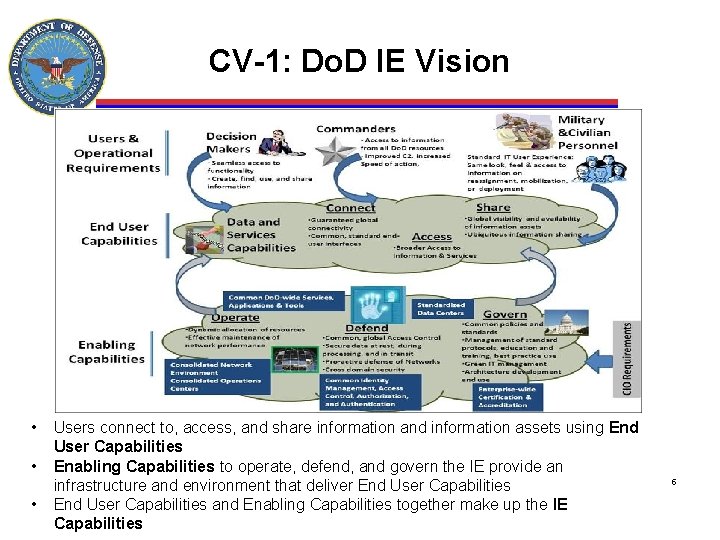
CV-1: Do. D IE Vision • • • Users connect to, access, and share information and information assets using End User Capabilities Enabling Capabilities to operate, defend, and govern the IE provide an infrastructure and environment that deliver End User Capabilities and Enabling Capabilities together make up the IE Capabilities 5
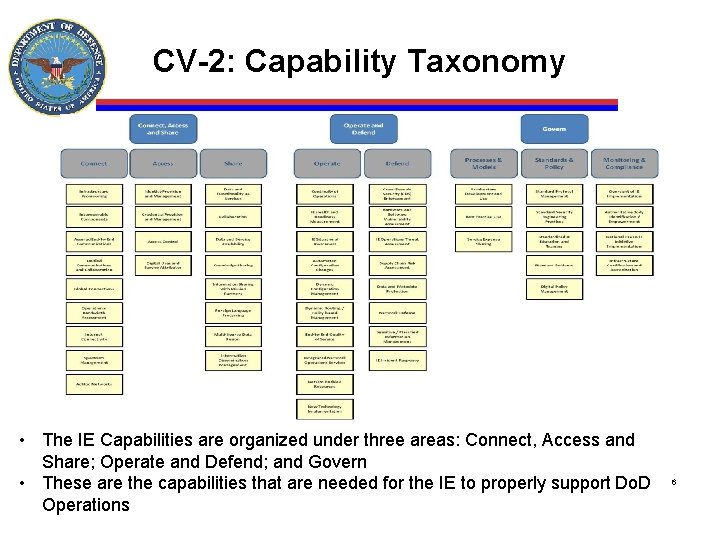
CV-2: Capability Taxonomy • The IE Capabilities are organized under three areas: Connect, Access and Share; Operate and Defend; and Govern • These are the capabilities that are needed for the IE to properly support Do. D Operations 6
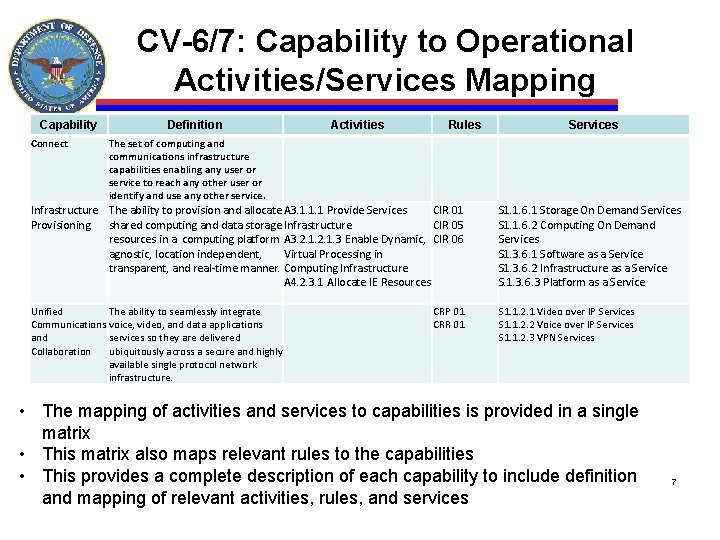
CV-6/7: Capability to Operational Activities/Services Mapping Capability Connect Definition Activities Rules Services The set of computing and communications infrastructure capabilities enabling any user or service to reach any other user or identify and use any other service. Infrastructure The ability to provision and allocate A 3. 1. 1. 1 Provide Services CIR 01 Provisioning shared computing and data storage Infrastructure CIR 05 resources in a computing platform A 3. 2. 1. 3 Enable Dynamic, CIR 06 agnostic, location independent, Virtual Processing in transparent, and real-time manner. Computing Infrastructure A 4. 2. 3. 1 Allocate IE Resources S 1. 1. 6. 1 Storage On Demand Services S 1. 1. 6. 2 Computing On Demand Services S 1. 3. 6. 1 Software as a Service S 1. 3. 6. 2 Infrastructure as a Service S. 1. 3. 6. 3 Platform as a Service Unified The ability to seamlessly integrate Communications voice, video, and data applications and services so they are delivered Collaboration ubiquitously across a secure and highly available single protocol network infrastructure. S 1. 1. 2. 1 Video over IP Services S 1. 1. 2. 2 Voice over IP Services S 1. 1. 2. 3 VPN Services CRP 01 CRR 01 • The mapping of activities and services to capabilities is provided in a single matrix • This matrix also maps relevant rules to the capabilities • This provides a complete description of each capability to include definition and mapping of relevant activities, rules, and services 7
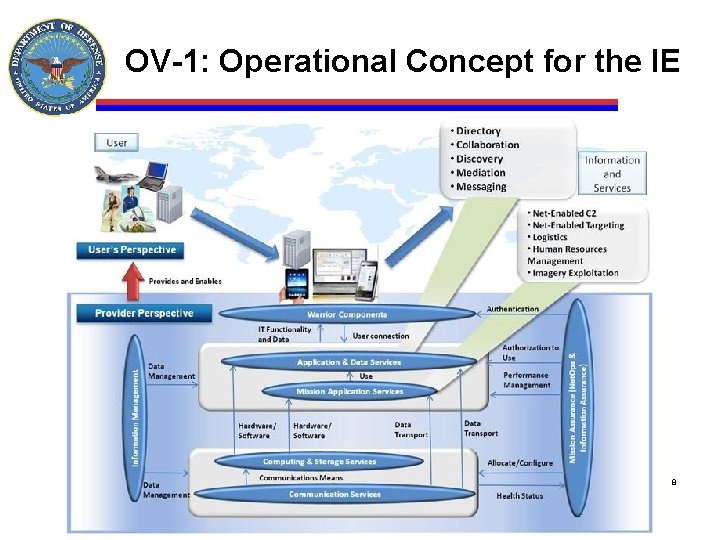
OV-1: Operational Concept for the IE 8 UNCLASSIFIED
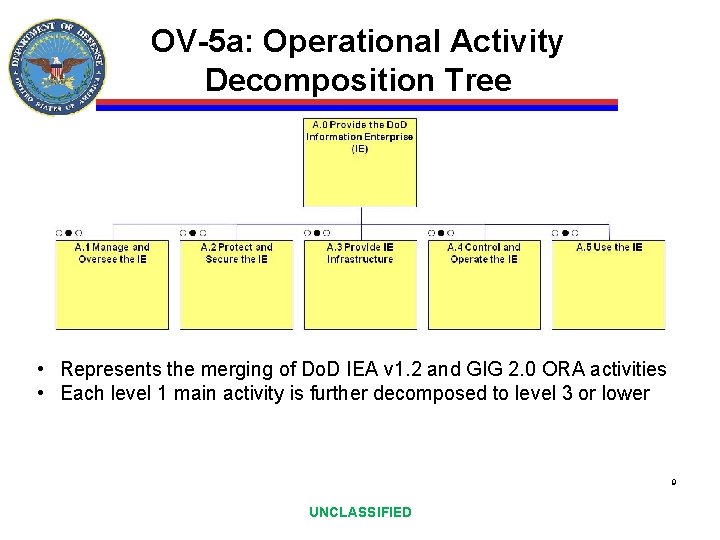
OV-5 a: Operational Activity Decomposition Tree • Represents the merging of Do. D IEA v 1. 2 and GIG 2. 0 ORA activities • Each level 1 main activity is further decomposed to level 3 or lower 9 UNCLASSIFIED
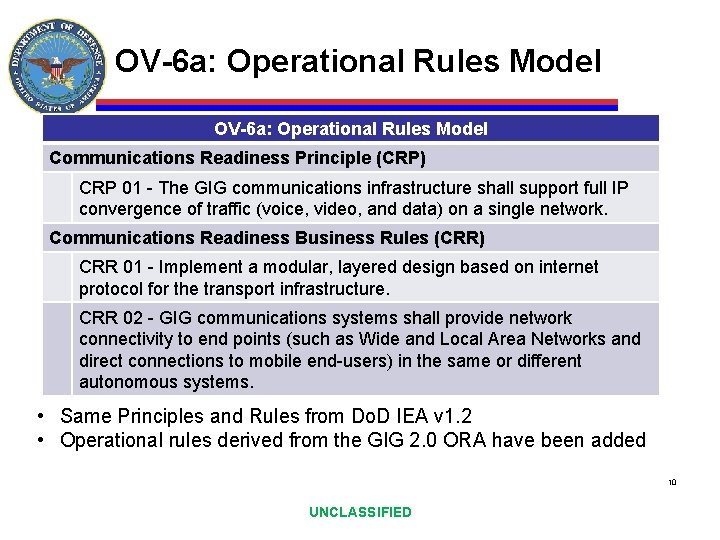
OV-6 a: Operational Rules Model Communications Readiness Principle (CRP) CRP 01 - The GIG communications infrastructure shall support full IP convergence of traffic (voice, video, and data) on a single network. Communications Readiness Business Rules (CRR) CRR 01 - Implement a modular, layered design based on internet protocol for the transport infrastructure. CRR 02 - GIG communications systems shall provide network connectivity to end points (such as Wide and Local Area Networks and direct connections to mobile end-users) in the same or different autonomous systems. • Same Principles and Rules from Do. D IEA v 1. 2 • Operational rules derived from the GIG 2. 0 ORA have been added 10 UNCLASSIFIED
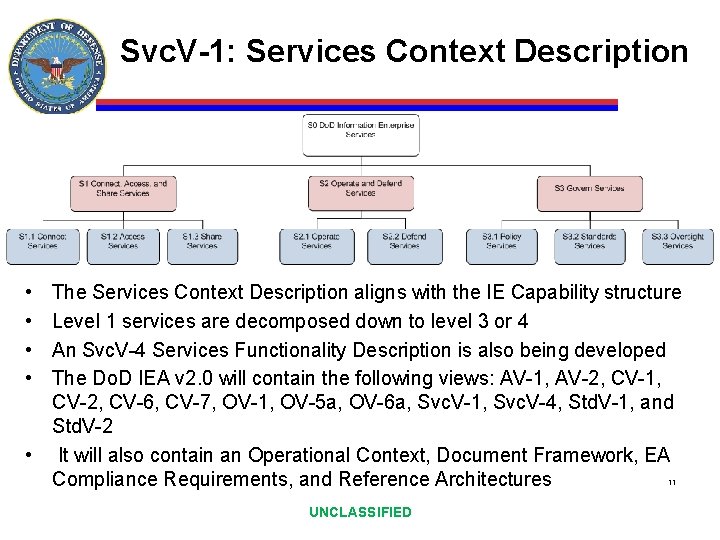
Svc. V-1: Services Context Description • • The Services Context Description aligns with the IE Capability structure Level 1 services are decomposed down to level 3 or 4 An Svc. V-4 Services Functionality Description is also being developed The Do. D IEA v 2. 0 will contain the following views: AV-1, AV-2, CV-1, CV-2, CV-6, CV-7, OV-1, OV-5 a, OV-6 a, Svc. V-1, Svc. V-4, Std. V-1, and Std. V-2 • It will also contain an Operational Context, Document Framework, EA Compliance Requirements, and Reference Architectures 11 UNCLASSIFIED
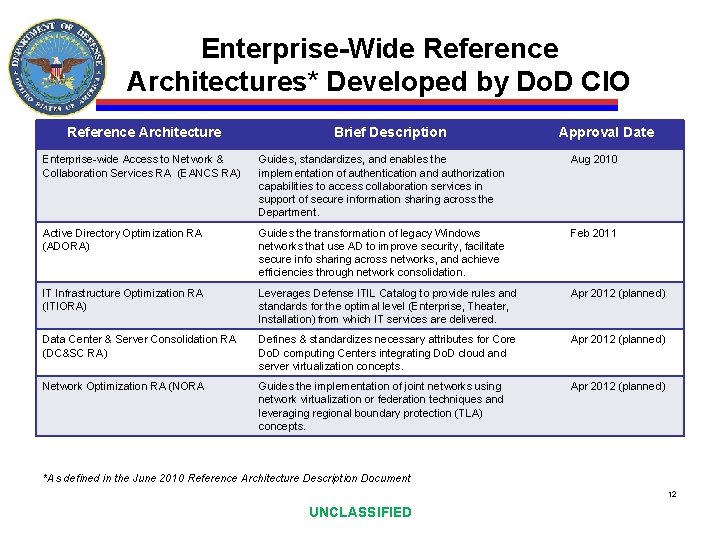
Enterprise-Wide Reference Architectures* Developed by Do. D CIO Reference Architecture Brief Description Approval Date Enterprise-wide Access to Network & Collaboration Services RA (EANCS RA) Guides, standardizes, and enables the implementation of authentication and authorization capabilities to access collaboration services in support of secure information sharing across the Department. Aug 2010 Active Directory Optimization RA (ADORA) Guides the transformation of legacy Windows networks that use AD to improve security, facilitate secure info sharing across networks, and achieve efficiencies through network consolidation. Feb 2011 IT Infrastructure Optimization RA (ITIORA) Leverages Defense ITIL Catalog to provide rules and standards for the optimal level (Enterprise, Theater, Installation) from which IT services are delivered. Apr 2012 (planned) Data Center & Server Consolidation RA (DC&SC RA) Defines & standardizes necessary attributes for Core Do. D computing Centers integrating Do. D cloud and server virtualization concepts. Apr 2012 (planned) Network Optimization RA (NORA Guides the implementation of joint networks using network virtualization or federation techniques and leveraging regional boundary protection (TLA) concepts. Apr 2012 (planned) *As defined in the June 2010 Reference Architecture Description Document 12 UNCLASSIFIED
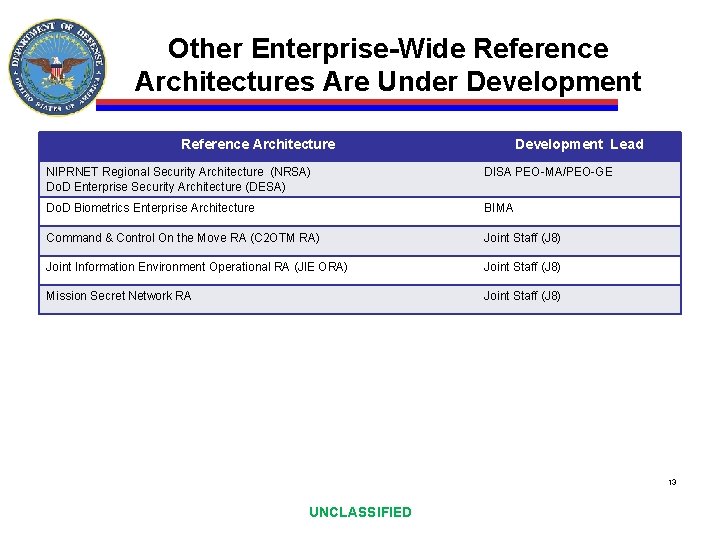
Other Enterprise-Wide Reference Architectures Are Under Development Reference Architecture Development Lead NIPRNET Regional Security Architecture (NRSA) Do. D Enterprise Security Architecture (DESA) DISA PEO-MA/PEO-GE Do. D Biometrics Enterprise Architecture BIMA Command & Control On the Move RA (C 2 OTM RA) Joint Staff (J 8) Joint Information Environment Operational RA (JIE ORA) Joint Staff (J 8) Mission Secret Network RA Joint Staff (J 8) 13 UNCLASSIFIED
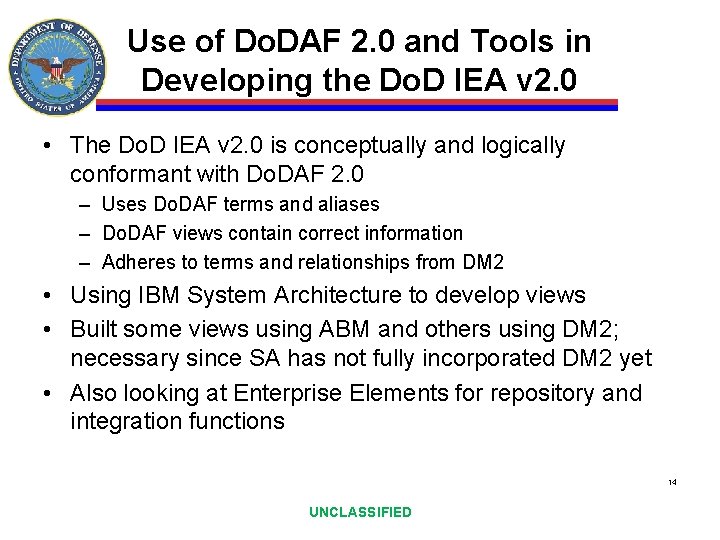
Use of Do. DAF 2. 0 and Tools in Developing the Do. D IEA v 2. 0 • The Do. D IEA v 2. 0 is conceptually and logically conformant with Do. DAF 2. 0 – Uses Do. DAF terms and aliases – Do. DAF views contain correct information – Adheres to terms and relationships from DM 2 • Using IBM System Architecture to develop views • Built some views using ABM and others using DM 2; necessary since SA has not fully incorporated DM 2 yet • Also looking at Enterprise Elements for repository and integration functions 14 UNCLASSIFIED