
Do Animals Think Common cognitive skills in humans
- Slides: 18
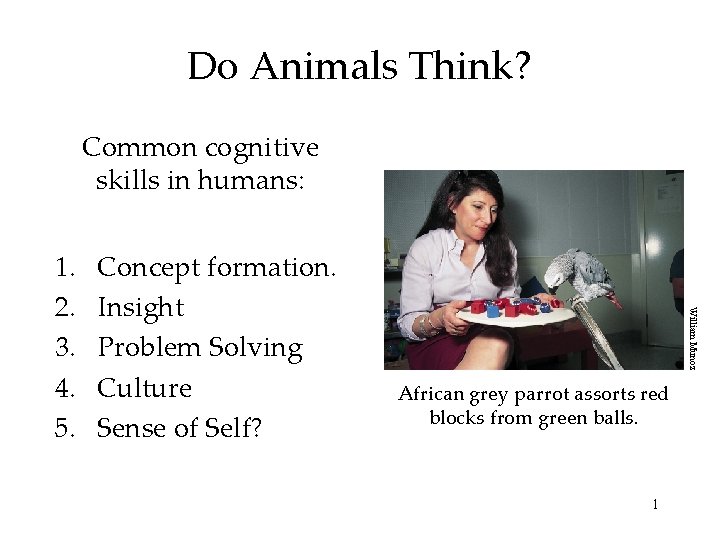
Do Animals Think? Common cognitive skills in humans: Concept formation. Insight Problem Solving Culture Sense of Self? William Munoz 1. 2. 3. 4. 5. African grey parrot assorts red blocks from green balls. 1
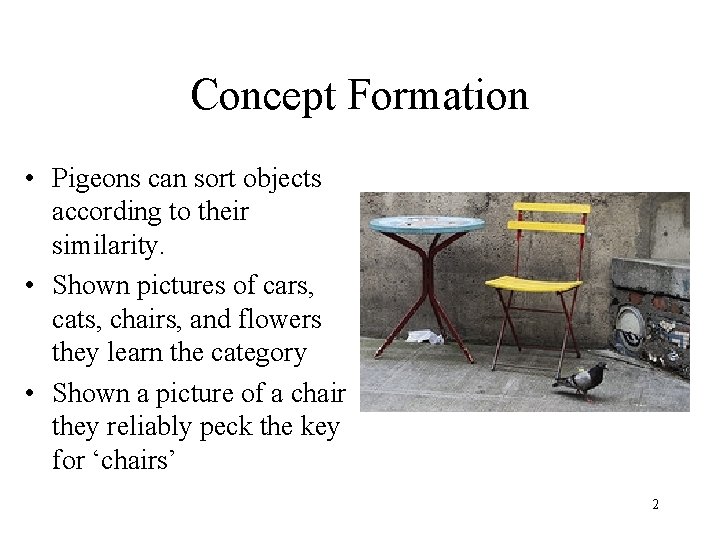
Concept Formation • Pigeons can sort objects according to their similarity. • Shown pictures of cars, cats, chairs, and flowers they learn the category • Shown a picture of a chair they reliably peck the key for ‘chairs’ 2
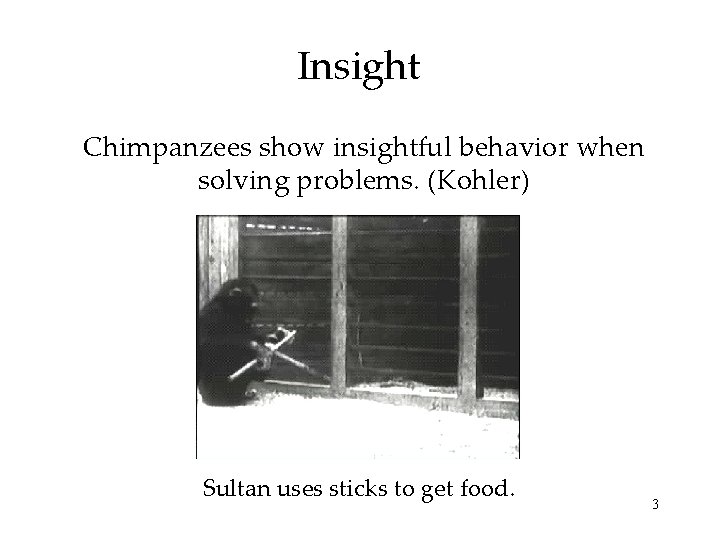
Insight Chimpanzees show insightful behavior when solving problems. (Kohler) Sultan uses sticks to get food. 3
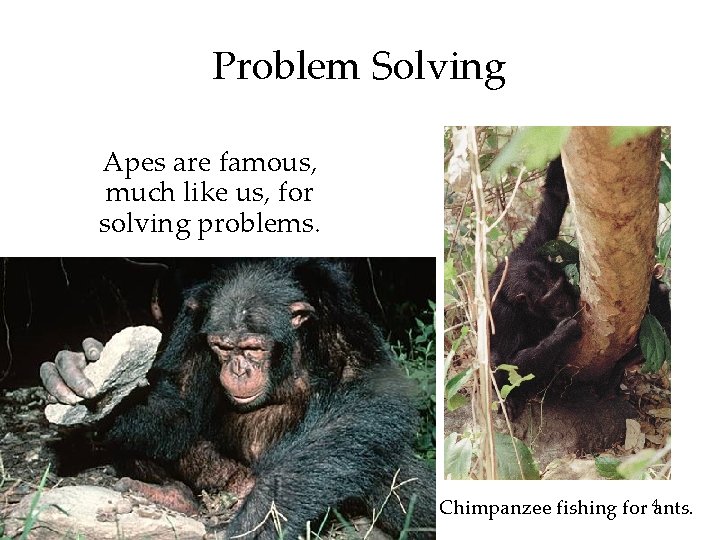
Problem Solving Apes are famous, much like us, for solving problems. Chimpanzee fishing for 4 ants.
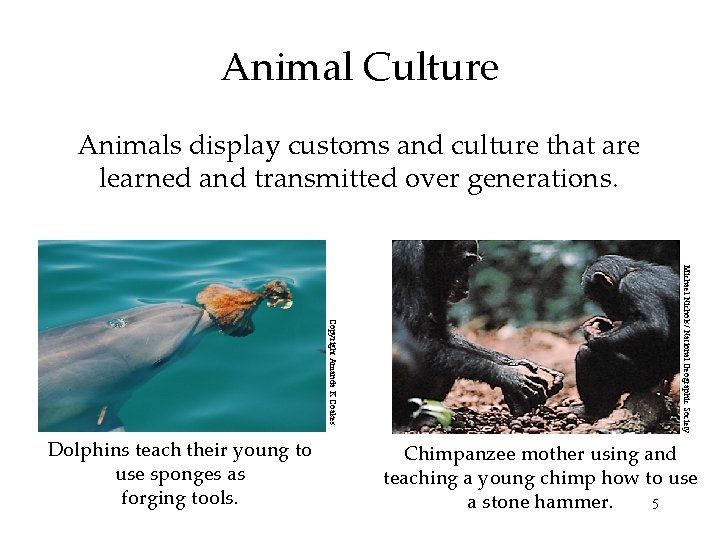
Animal Culture Animals display customs and culture that are learned and transmitted over generations. Michael Nichols/ National Geographic Society Copyright Amanda K Coakes Dolphins teach their young to use sponges as forging tools. Chimpanzee mother using and teaching a young chimp how to use a stone hammer. 5
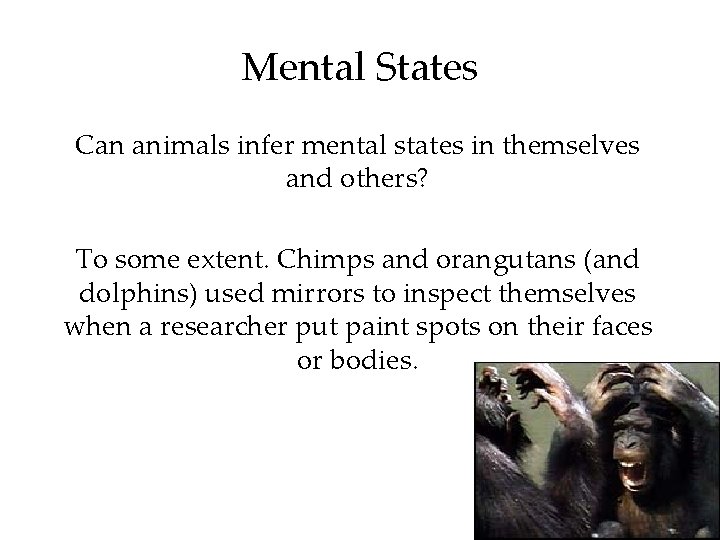
Mental States Can animals infer mental states in themselves and others? To some extent. Chimps and orangutans (and dolphins) used mirrors to inspect themselves when a researcher put paint spots on their faces or bodies. 6
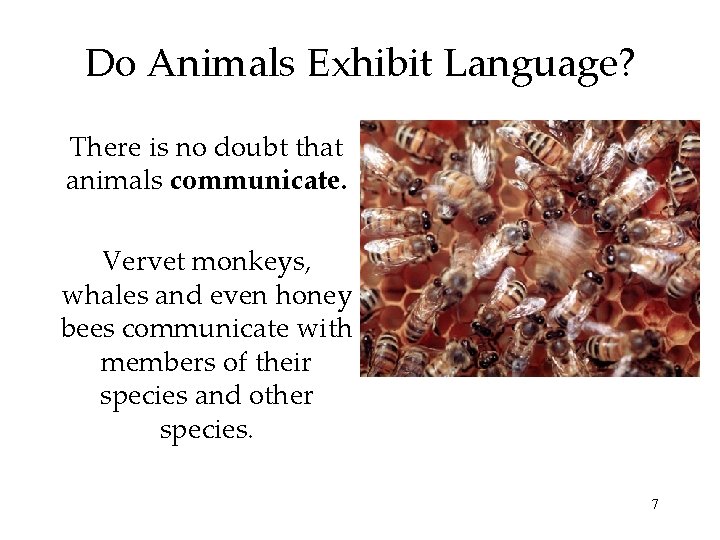
Do Animals Exhibit Language? There is no doubt that animals communicate. Vervet monkeys, whales and even honey bees communicate with members of their species and other species. 7
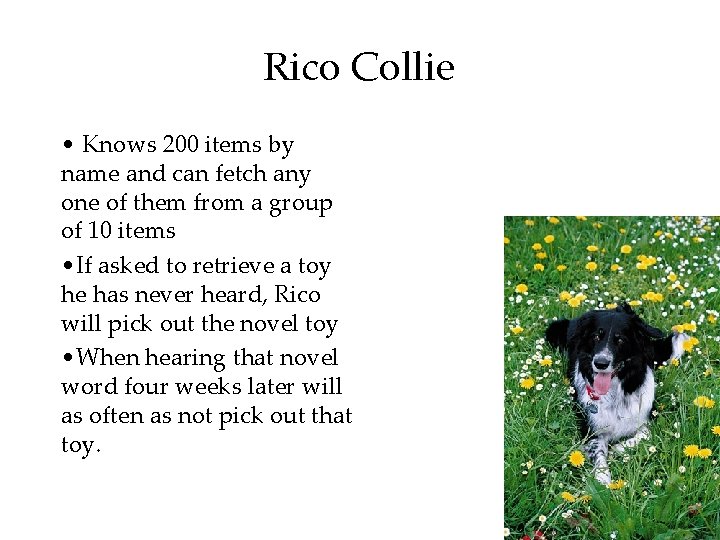
Rico Collie • Knows 200 items by name and can fetch any one of them from a group of 10 items • If asked to retrieve a toy he has never heard, Rico will pick out the novel toy • When hearing that novel word four weeks later will as often as not pick out that toy. 8
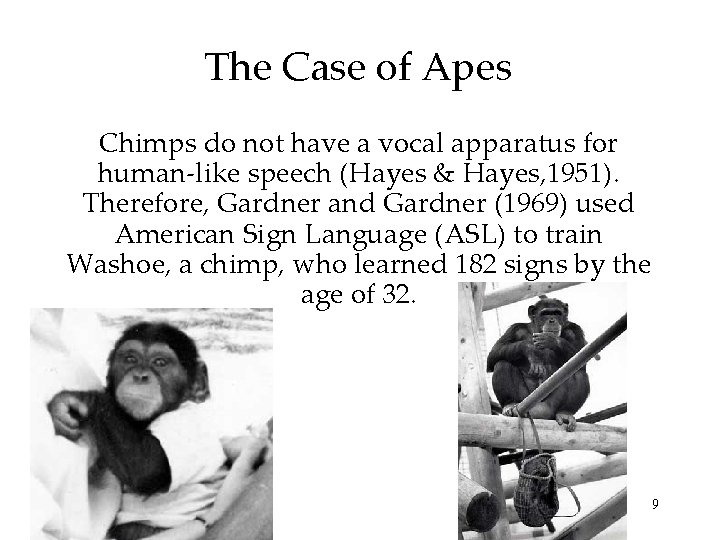
The Case of Apes Chimps do not have a vocal apparatus for human-like speech (Hayes & Hayes, 1951). Therefore, Gardner and Gardner (1969) used American Sign Language (ASL) to train Washoe, a chimp, who learned 182 signs by the age of 32. 9
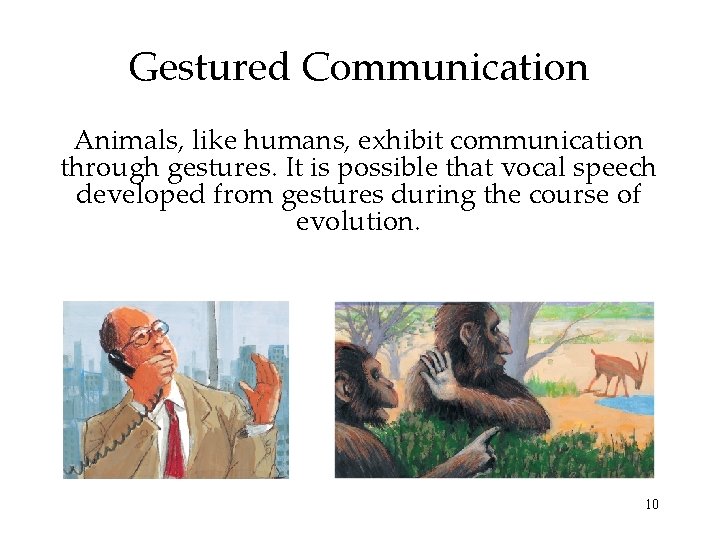
Gestured Communication Animals, like humans, exhibit communication through gestures. It is possible that vocal speech developed from gestures during the course of evolution. 10
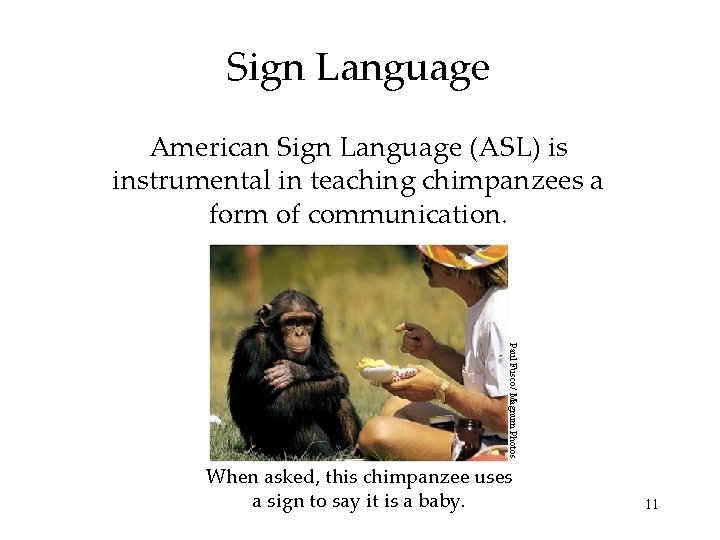
Sign Language American Sign Language (ASL) is instrumental in teaching chimpanzees a form of communication. Paul Fusco/ Magnum Photos When asked, this chimpanzee uses a sign to say it is a baby. 11
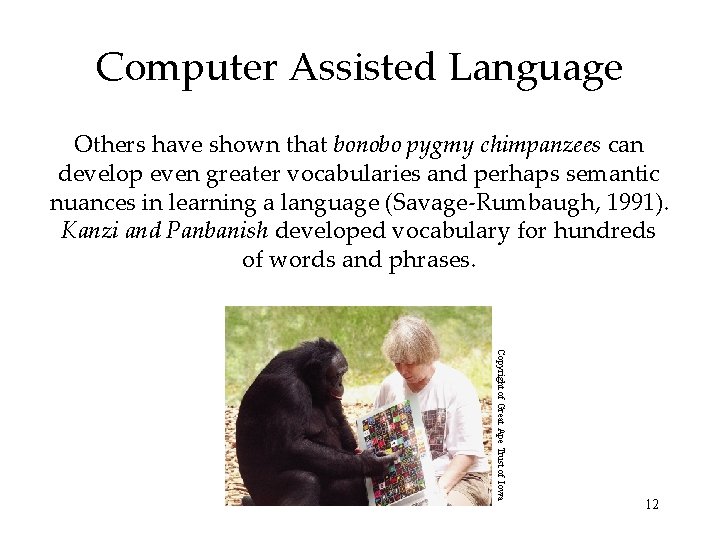
Computer Assisted Language Others have shown that bonobo pygmy chimpanzees can develop even greater vocabularies and perhaps semantic nuances in learning a language (Savage-Rumbaugh, 1991). Kanzi and Panbanish developed vocabulary for hundreds of words and phrases. Copyright of Great Ape Trust of Iowa 12
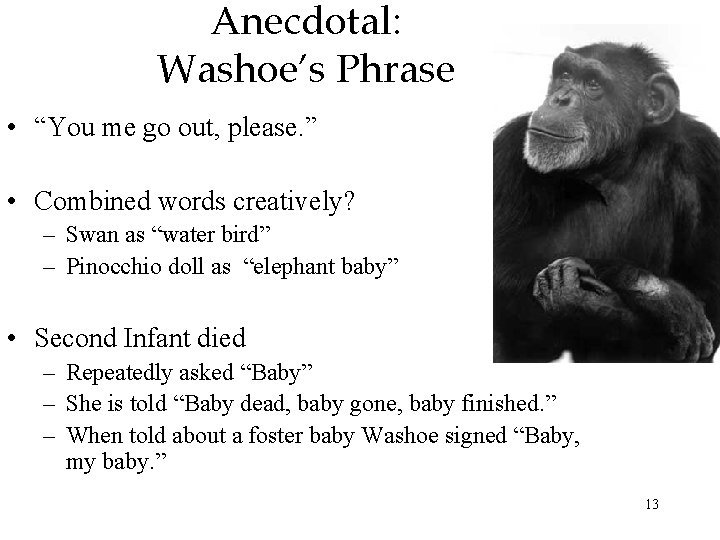
Anecdotal: Washoe’s Phrase • “You me go out, please. ” • Combined words creatively? – Swan as “water bird” – Pinocchio doll as “elephant baby” • Second Infant died – Repeatedly asked “Baby” – She is told “Baby dead, baby gone, baby finished. ” – When told about a foster baby Washoe signed “Baby, my baby. ” 13
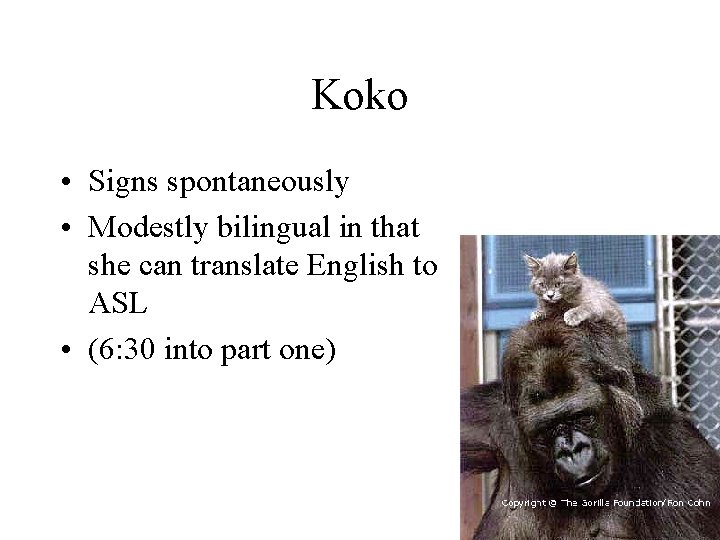
Koko • Signs spontaneously • Modestly bilingual in that she can translate English to ASL • (6: 30 into part one) 14
Criticism 1. 2. 3. 4. Apes acquire their limited vocabularies with a great deal of difficulty, unlike children who develop vocabularies at amazing rates. Chimpanzees can make signs to receive a reward, just as a pigeon who pecks at the key receives a reward. However, pigeons have not learned a language. Chimpanzees use signs meaningfully but lack syntax. Presented with ambiguous information, people tend to see what they want to see. (Washoe was just separately naming water and bird. ) 15
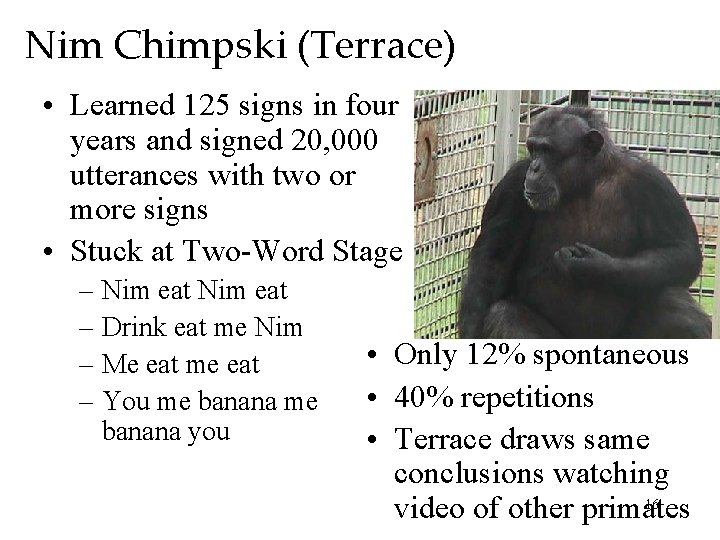
Nim Chimpski (Terrace) • Learned 125 signs in four years and signed 20, 000 utterances with two or more signs • Stuck at Two-Word Stage – Nim eat – Drink eat me Nim – Me eat me eat – You me banana you • Only 12% spontaneous • 40% repetitions • Terrace draws same conclusions watching 16 video of other primates
Conclusions • If by language we mean the ability to communicate through a meaningful sequence of symbols. . . than YES • If by language we mean verbal or signed expression of complex grammar. . . than NO 17
Conclusions If we say that animals can use meaningful sequences of signs to communicate a capability for language, our understanding would be naive… Steven Pinker (1995) concludes, “chimps do not develop language. ” 18