
DNSSEC made simple eninj 4 v 9 whoami


- Slides: 49
DNSSEC made simple
[e@ninj 4 v 9 ~]$ whoami Emil Natan, CTO, ISOC-IL
DNS
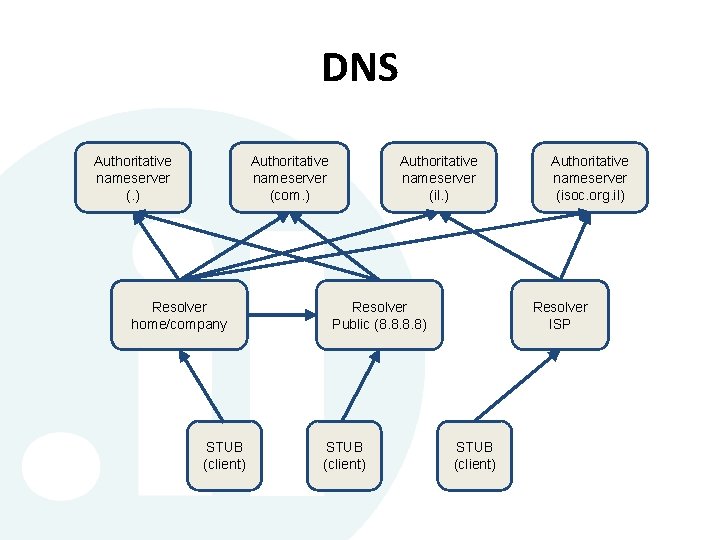
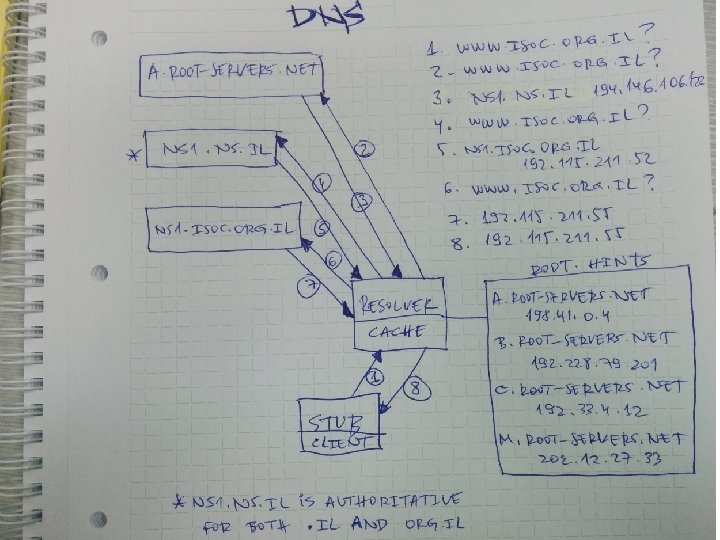
DNS Authoritative nameserver (. ) Authoritative nameserver (com. ) Resolver home/company STUB (client) Authoritative nameserver (il. ) Resolver Public (8. 8) STUB (client) Authoritative nameserver (isoc. org. il) Resolver ISP STUB (client)
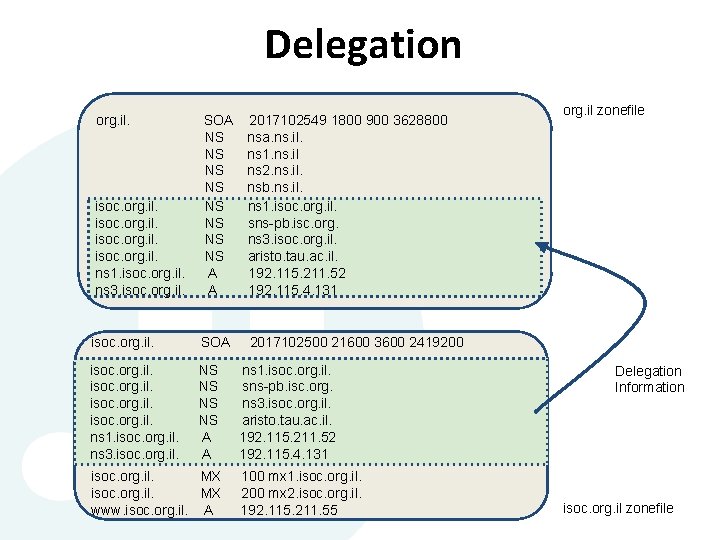
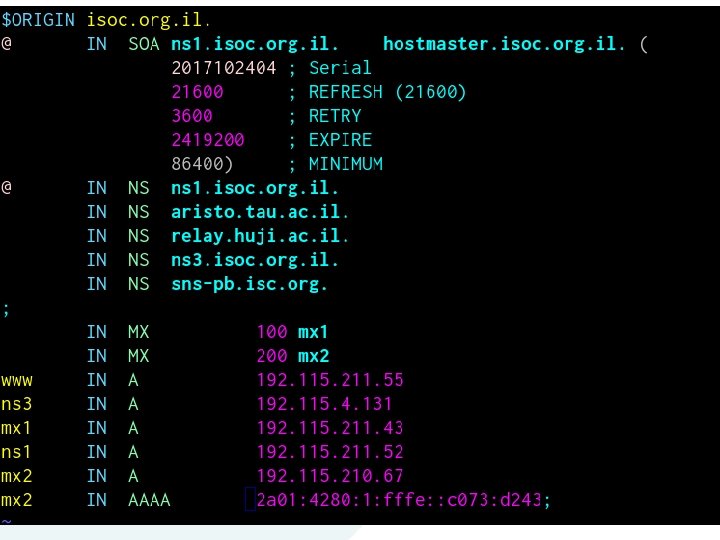
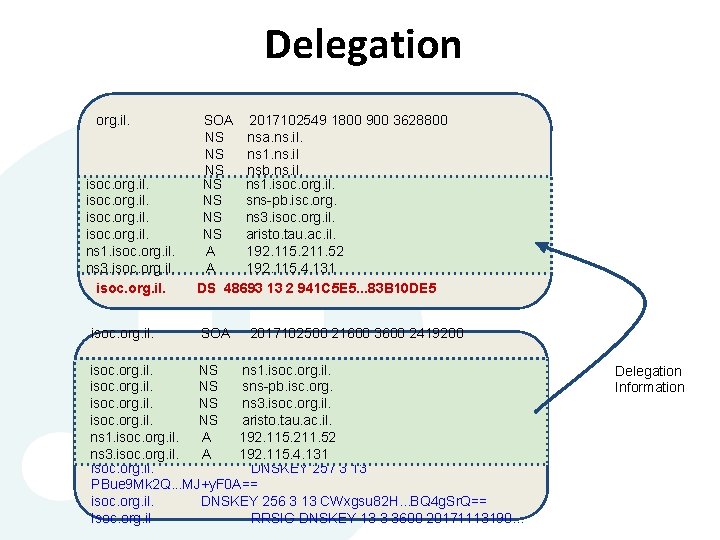
Delegation org. il. isoc. org. il. ns 1. isoc. org. il. ns 3. isoc. org. il. SOA NS NS A A 2017102549 1800 900 3628800 nsa. ns. il. ns 1. ns. il ns 2. ns. il. nsb. ns. il. ns 1. isoc. org. il. sns-pb. isc. org. ns 3. isoc. org. il. aristo. tau. ac. il. 192. 115. 211. 52 192. 115. 4. 131 isoc. org. il. SOA 2017102500 21600 3600 2419200 isoc. org. il. ns 1. isoc. org. il. ns 3. isoc. org. il. NS NS A A isoc. org. il. MX www. isoc. org. il. A ns 1. isoc. org. il. sns-pb. isc. org. ns 3. isoc. org. il. aristo. tau. ac. il. 192. 115. 211. 52 192. 115. 4. 131 100 mx 1. isoc. org. il. 200 mx 2. isoc. org. il. 192. 115. 211. 55 org. il zonefile Delegation Information isoc. org. il zonefile
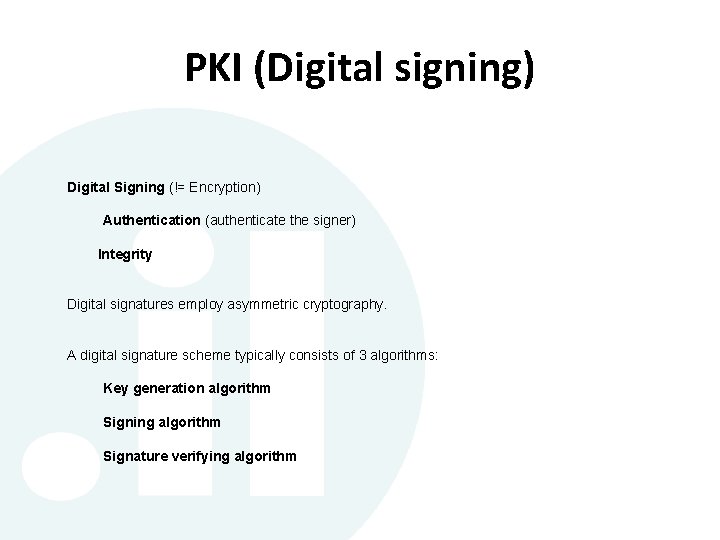
PKI (Digital signing) Digital Signing (!= Encryption) Authentication (authenticate the signer) Integrity Digital signatures employ asymmetric cryptography. A digital signature scheme typically consists of 3 algorithms: Key generation algorithm Signing algorithm Signature verifying algorithm
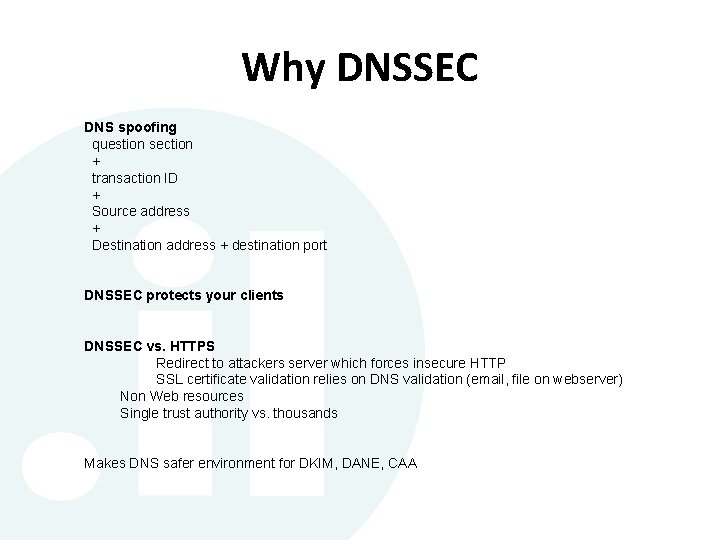
Why DNSSEC DNS spoofing question section + transaction ID + Source address + Destination address + destination port DNSSEC protects your clients DNSSEC vs. HTTPS Redirect to attackers server which forces insecure HTTP SSL certificate validation relies on DNS validation (email, file on webserver) Non Web resources Single trust authority vs. thousands Makes DNS safer environment for DKIM, DANE, CAA
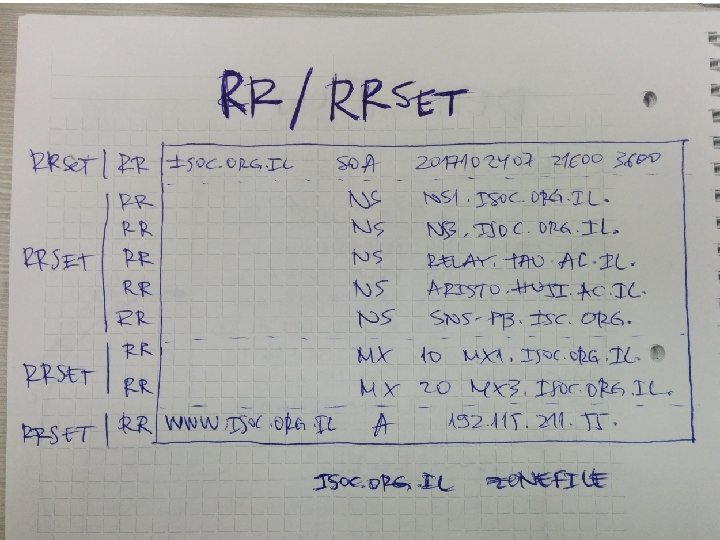
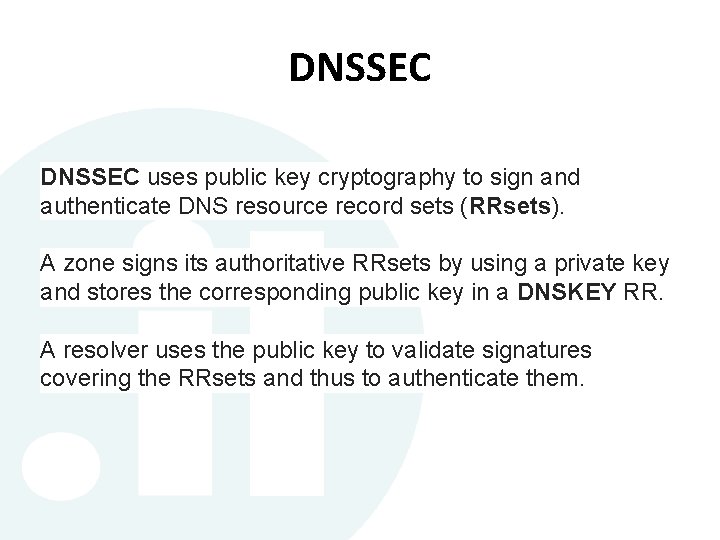
DNSSEC uses public key cryptography to sign and authenticate DNS resource record sets (RRsets). A zone signs its authoritative RRsets by using a private key and stores the corresponding public key in a DNSKEY RR. A resolver uses the public key to validate signatures covering the RRsets and thus to authenticate them.
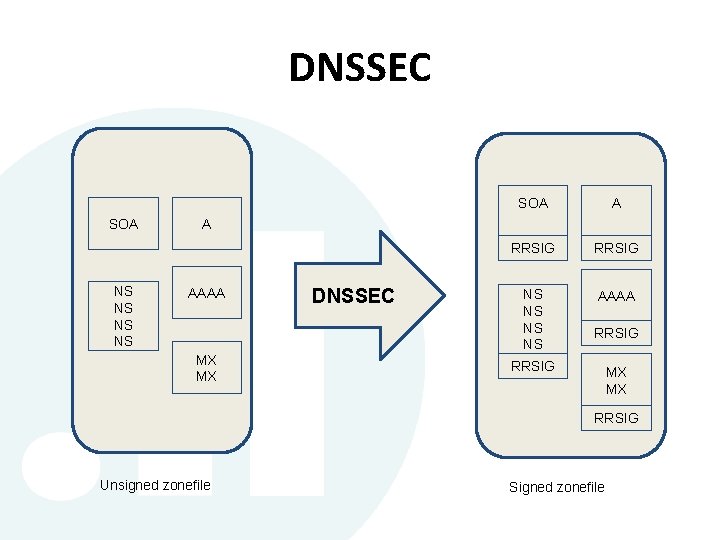
DNSSEC SOA NS NS SOA A RRSIG NS NS AAAA A AAAA MX MX DNSSEC RRSIG MX MX RRSIG Unsigned zonefile Signed zonefile
DNSSEC The first time I’m confronted with DNSSEC
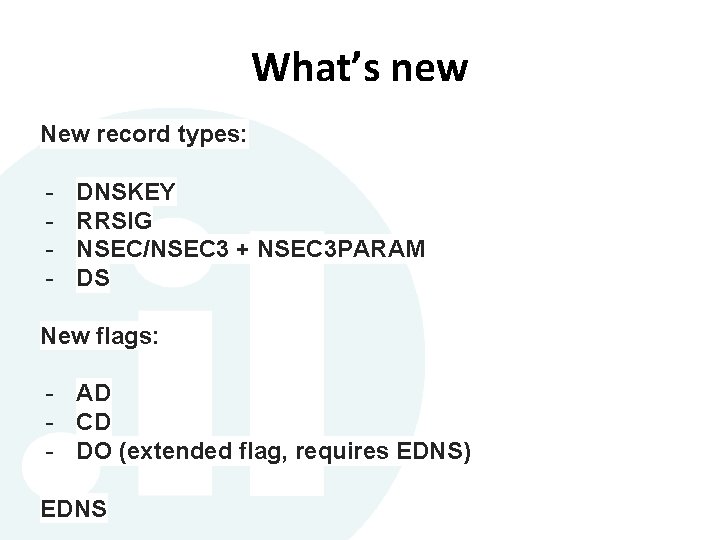
What’s new New record types: - DNSKEY RRSIG NSEC/NSEC 3 + NSEC 3 PARAM DS New flags: - AD - CD - DO (extended flag, requires EDNS) EDNS
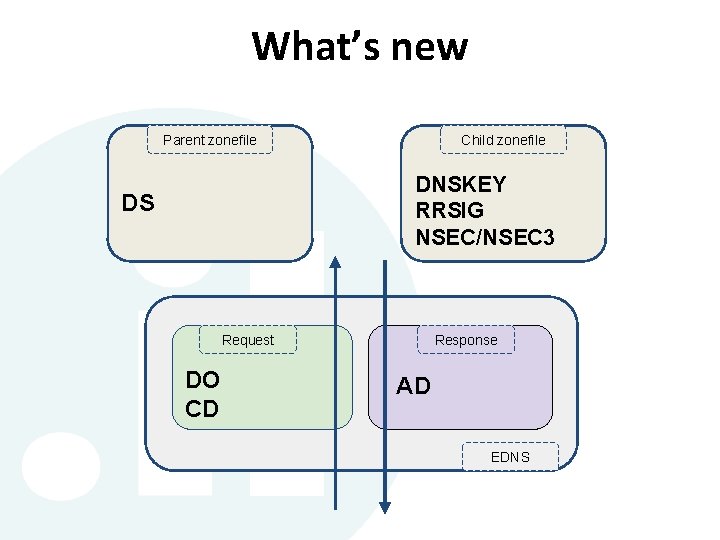
What’s new Parent zonefile Child zonefile DNSKEY RRSIG NSEC/NSEC 3 DS Request DO CD Response AD EDNS
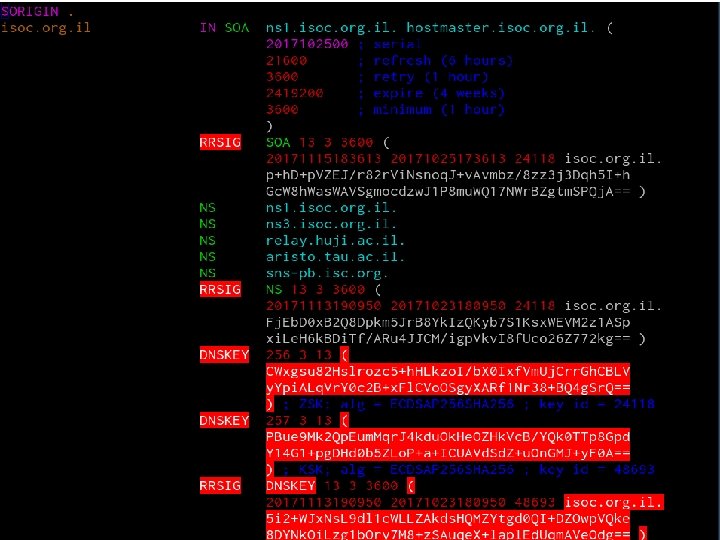
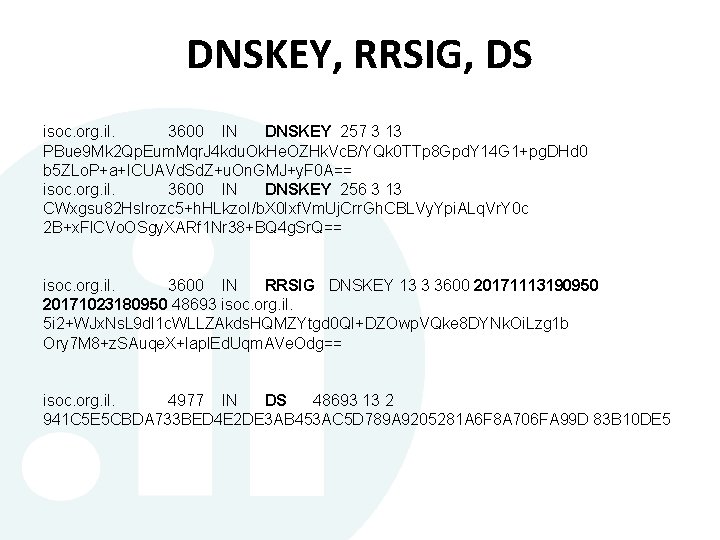
DNSKEY, RRSIG, DS isoc. org. il. 3600 IN DNSKEY 257 3 13 PBue 9 Mk 2 Qp. Eum. Mqr. J 4 kdu. Ok. He. OZHk. Vc. B/YQk 0 TTp 8 Gpd. Y 14 G 1+pg. DHd 0 b 5 ZLo. P+a+ICUAVd. Sd. Z+u. On. GMJ+y. F 0 A== isoc. org. il. 3600 IN DNSKEY 256 3 13 CWxgsu 82 Hslrozc 5+h. HLkzo. I/b. X 0 Ixf. Vm. Uj. Crr. Gh. CBLVy. Ypi. ALq. Vr. Y 0 c 2 B+x. Fl. CVo. OSgy. XARf 1 Nr 38+BQ 4 g. Sr. Q== isoc. org. il. 3600 IN RRSIG DNSKEY 13 3 3600 20171113190950 20171023180950 48693 isoc. org. il. 5 i 2+WJx. Ns. L 9 dl 1 c. WLLZAkds. HQMZYtgd 0 QI+DZOwp. VQke 8 DYNk. Oi. Lzg 1 b Ory 7 M 8+z. SAuqe. X+lapl. Ed. Uqm. AVe. Odg== isoc. org. il. 4977 IN DS 48693 13 2 941 C 5 E 5 CBDA 733 BED 4 E 2 DE 3 AB 453 AC 5 D 789 A 9205281 A 6 F 8 A 706 FA 99 D 83 B 10 DE 5
Delegation org. il. isoc. org. il. ns 1. isoc. org. il. ns 3. isoc. org. il. SOA 2017102549 1800 900 3628800 NS nsa. ns. il. NS ns 1. ns. il NS nsb. ns. il. NS ns 1. isoc. org. il. NS sns-pb. isc. org. NS ns 3. isoc. org. il. NS aristo. tau. ac. il. A 192. 115. 211. 52 A 192. 115. 4. 131 DS 48693 13 2 941 C 5 E 5. . . 83 B 10 DE 5 SOA 2017102500 21600 3600 2419200 isoc. org. il. NS ns 1. isoc. org. il. NS sns-pb. isc. org. isoc. org. il. NS ns 3. isoc. org. il. NS aristo. tau. ac. il. ns 1. isoc. org. il. A 192. 115. 211. 52 ns 3. isoc. org. il. A 192. 115. 4. 131 isoc. org. il. DNSKEY 257 3 13 PBue 9 Mk 2 Q. . . MJ+y. F 0 A== isoc. org. il. DNSKEY 256 3 13 CWxgsu 82 H. . . BQ 4 g. Sr. Q== Isoc. org. il RRSIG DNSKEY 13 3 3600 20171113190. . . Delegation Information
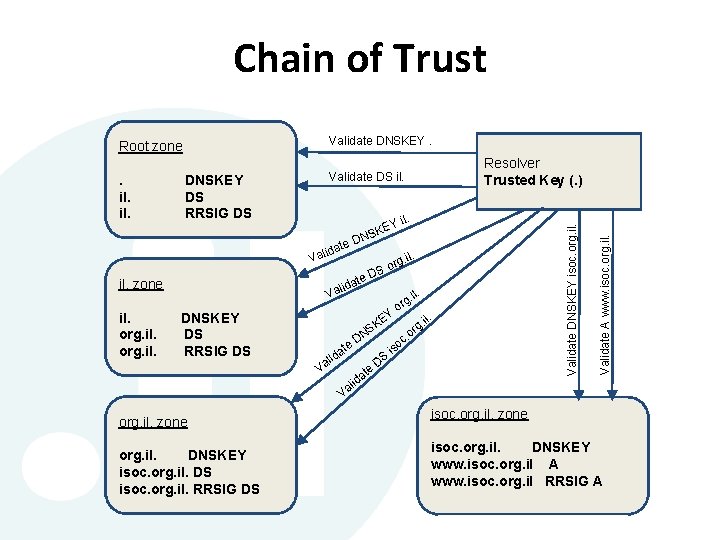
Chain of Trust Root zone Validate DNSKEY. . il. Validate DS il. t ida Val . il. rg So te D il. zone il. org. il. e lida Va . il. Y DNSKEY DS RRSIG DS E SK V d ali te a DN e at id al DS g or . il. g or. c iso Validate A www. isoc. org. il. . Y il E SK DN Validate DNSKEY isoc. org. il. DNSKEY DS RRSIG DS Resolver Trusted Key (. ) V org. il. zone org. il. DNSKEY isoc. org. il. DS isoc. org. il. RRSIG DS isoc. org. il. zone isoc. org. il. DNSKEY www. isoc. org. il A www. isoc. org. il RRSIG A
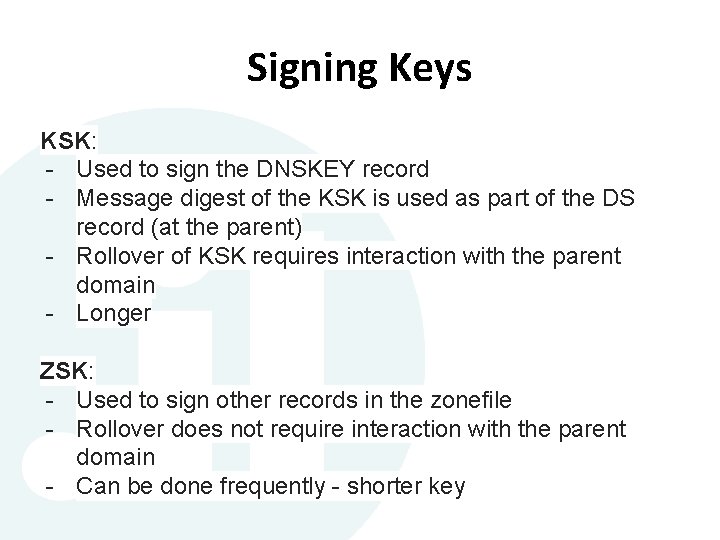
Signing Keys KSK: - Used to sign the DNSKEY record - Message digest of the KSK is used as part of the DS record (at the parent) - Rollover of KSK requires interaction with the parent domain - Longer ZSK: - Used to sign other records in the zonefile - Rollover does not require interaction with the parent domain - Can be done frequently - shorter key
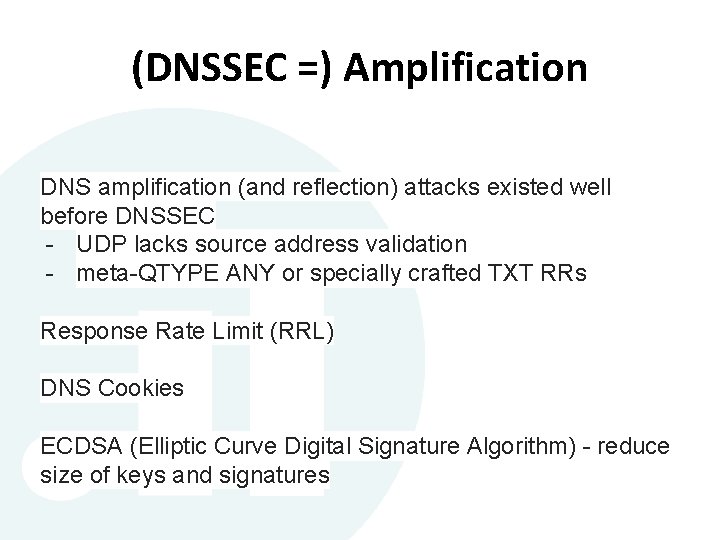
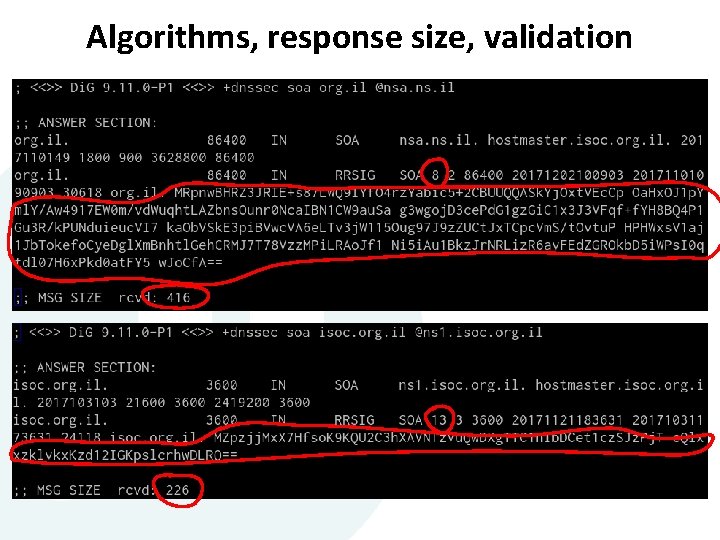
(DNSSEC =) Amplification DNS amplification (and reflection) attacks existed well before DNSSEC - UDP lacks source address validation - meta-QTYPE ANY or specially crafted TXT RRs Response Rate Limit (RRL) DNS Cookies ECDSA (Elliptic Curve Digital Signature Algorithm) - reduce size of keys and signatures
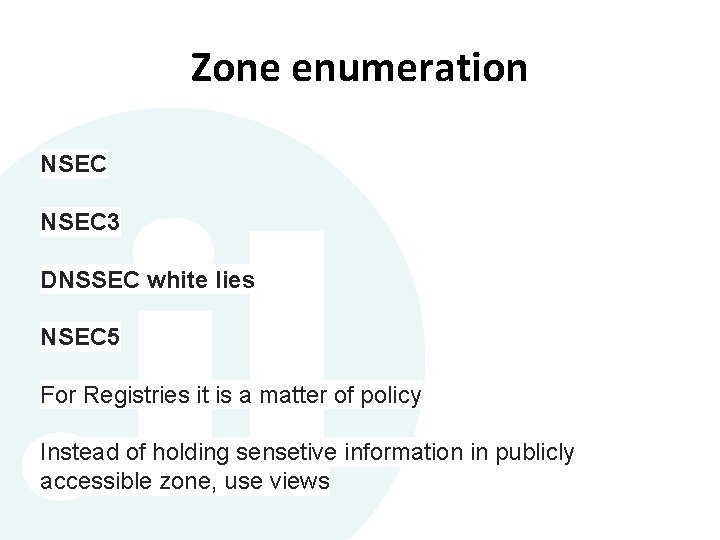
Zone enumeration NSEC 3 DNSSEC white lies NSEC 5 For Registries it is a matter of policy Instead of holding sensetive information in publicly accessible zone, use views
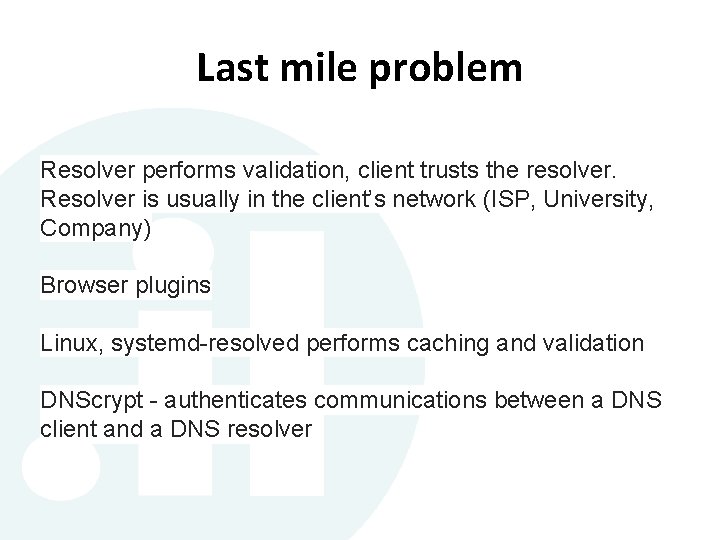
Last mile problem Resolver performs validation, client trusts the resolver. Resolver is usually in the client’s network (ISP, University, Company) Browser plugins Linux, systemd-resolved performs caching and validation DNScrypt - authenticates communications between a DNS client and a DNS resolver
“Resolvers must feel sad, nobody calls them by their name. "
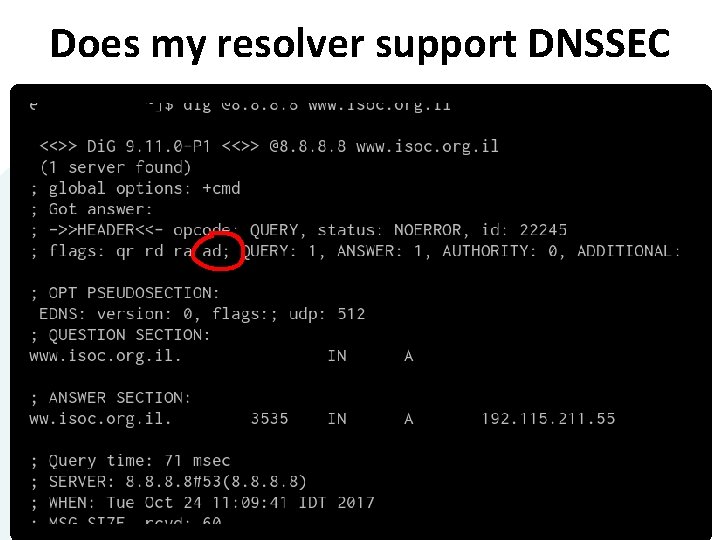
Does my resolver support DNSSEC
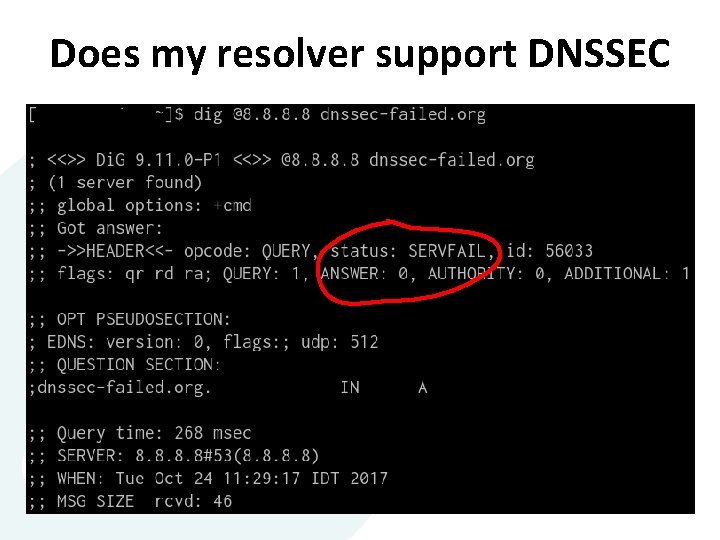
Does my resolver support DNSSEC
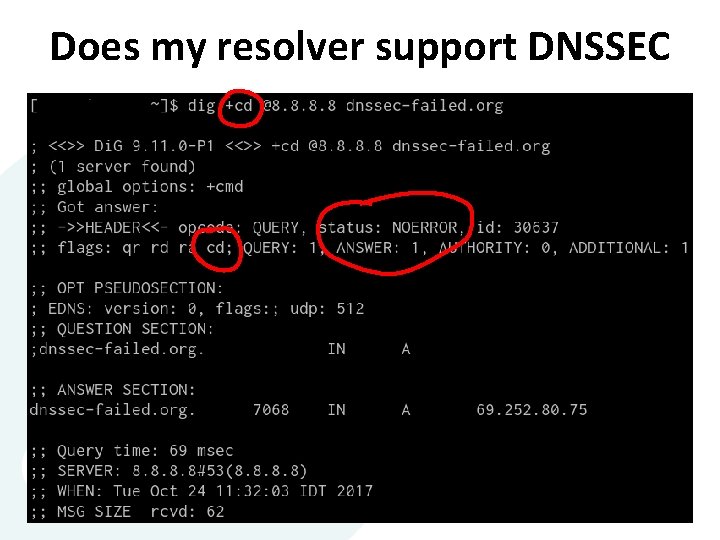
Does my resolver support DNSSEC
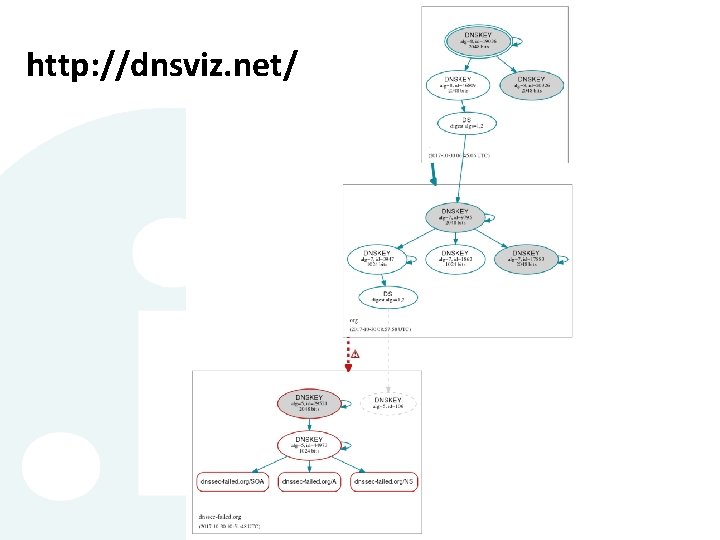
http: //dnsviz. net/
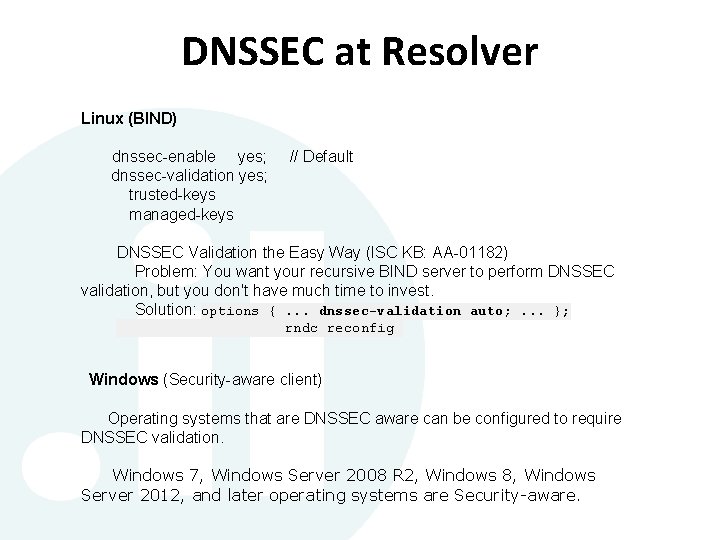
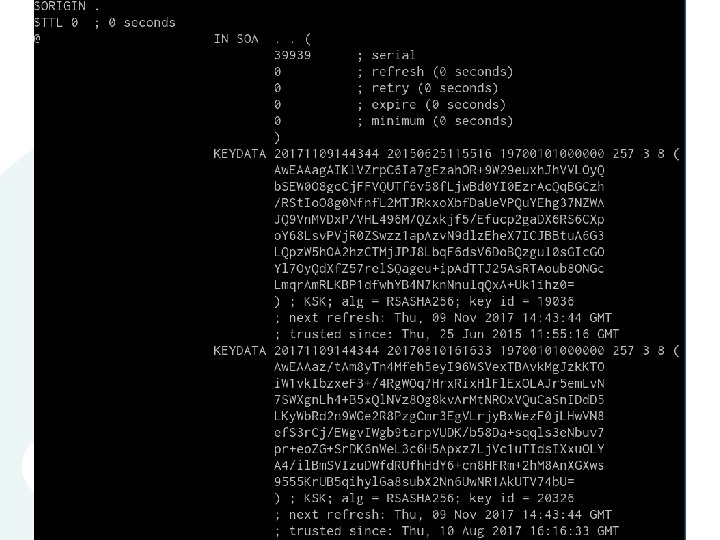
DNSSEC at Resolver Linux (BIND) dnssec-enable yes; dnssec-validation yes; trusted-keys managed-keys // Default DNSSEC Validation the Easy Way (ISC KB: AA-01182) Problem: You want your recursive BIND server to perform DNSSEC validation, but you don't have much time to invest. Solution: options {. . . dnssec-validation auto; . . . }; rndc reconfig Windows (Security-aware client) Operating systems that are DNSSEC aware can be configured to require DNSSEC validation. Windows 7, Windows Server 2008 R 2, Windows 8, Windows Server 2012, and later operating systems are Security-aware.
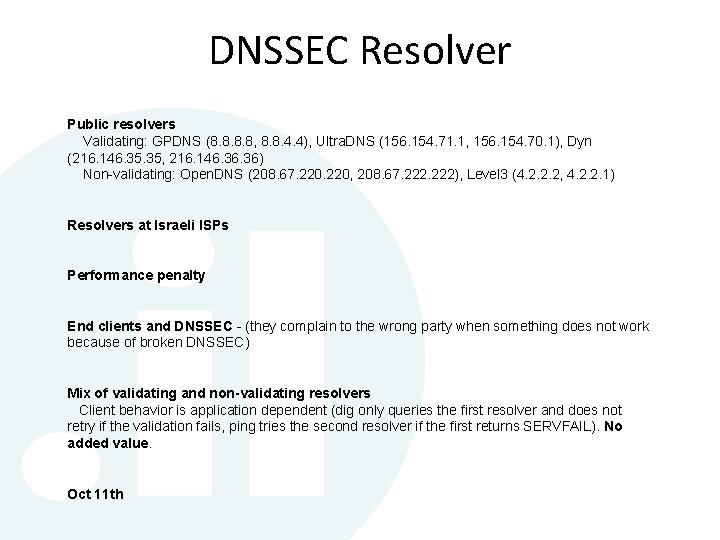
DNSSEC Resolver Public resolvers Validating: GPDNS (8. 8, 8. 8. 4. 4), Ultra. DNS (156. 154. 71. 1, 156. 154. 70. 1), Dyn (216. 146. 35, 216. 146. 36) Non-validating: Open. DNS (208. 67. 220, 208. 67. 222), Level 3 (4. 2. 2. 2, 4. 2. 2. 1) Resolvers at Israeli ISPs Performance penalty End clients and DNSSEC - (they complain to the wrong party when something does not work because of broken DNSSEC) Mix of validating and non-validating resolvers Client behavior is application dependent (dig only queries the first resolver and does not retry if the validation fails, ping tries the second resolver if the first returns SERVFAIL). No added value. Oct 11 th
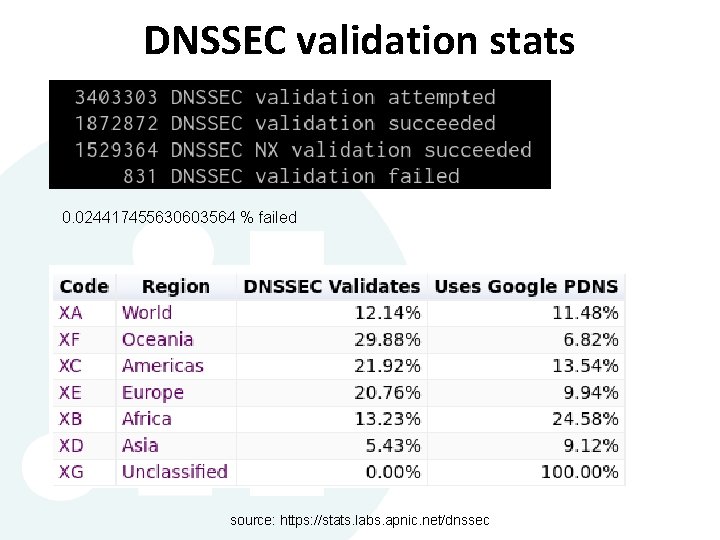
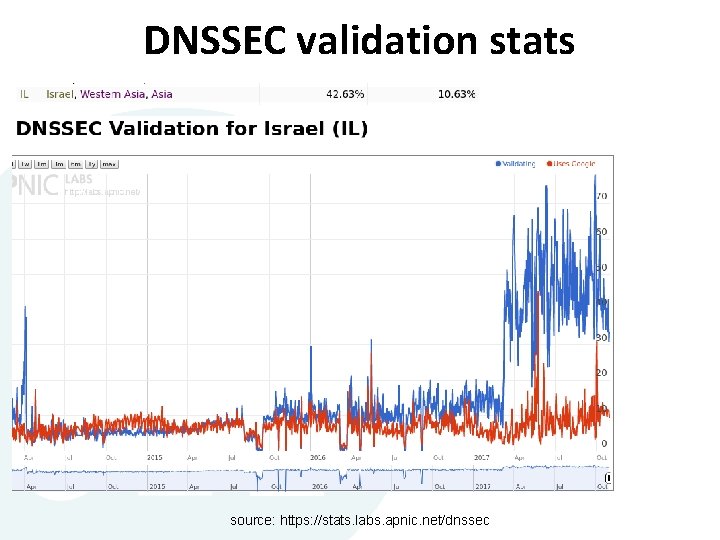
DNSSEC validation stats 0. 024417455630603564 % failed source: https: //stats. labs. apnic. net/dnssec
DNSSEC validation stats source: https: //stats. labs. apnic. net/dnssec
Implementing DNSSEC (Homegrown signing stacks with full key roll support)
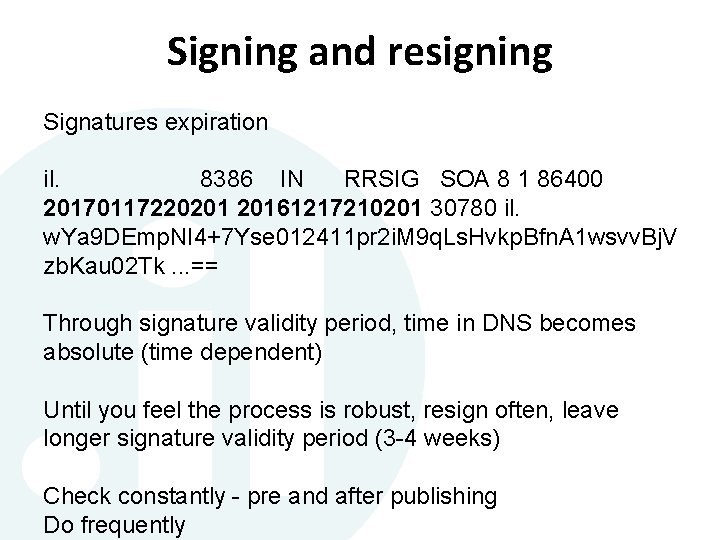
Signing and resigning Signatures expiration il. 8386 IN RRSIG SOA 8 1 86400 20170117220201 20161217210201 30780 il. w. Ya 9 DEmp. NI 4+7 Yse 012411 pr 2 i. M 9 q. Ls. Hvkp. Bfn. A 1 wsvv. Bj. V zb. Kau 02 Tk. . . == Through signature validity period, time in DNS becomes absolute (time dependent) Until you feel the process is robust, resign often, leave longer signature validity period (3 -4 weeks) Check constantly - pre and after publishing Do frequently
Key rollover Why key rollover Compromise of existing key(s) Management policy (security and operational reasons) Algorithm/key length change HSM failure/ unrecoverable keys Written procedures in place Caching makes the process complicated “Offline” DS update Propagation delay Going Insecure Algorithm rollovers
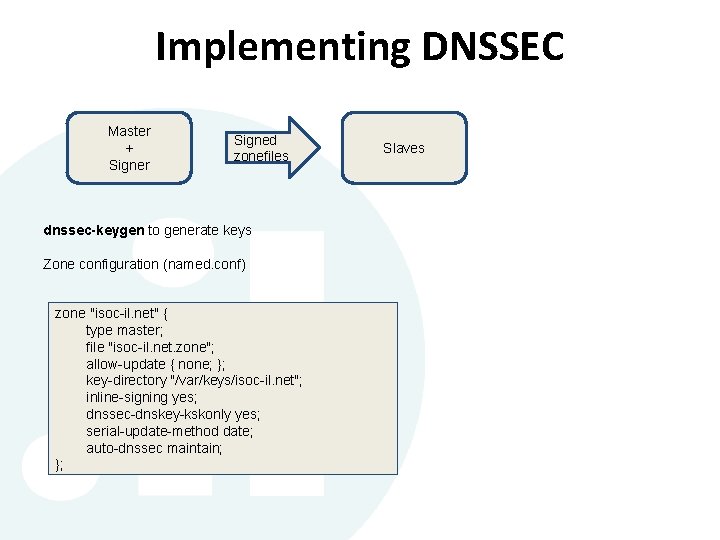
Implementing DNSSEC Master + Signer Signed zonefiles dnssec-keygen to generate keys Zone configuration (named. conf) zone "isoc-il. net" { type master; file "isoc-il. net. zone"; allow-update { none; }; key-directory "/var/keys/isoc-il. net"; inline-signing yes; dnssec-dnskey-kskonly yes; serial-update-method date; auto-dnssec maintain; }; Slaves
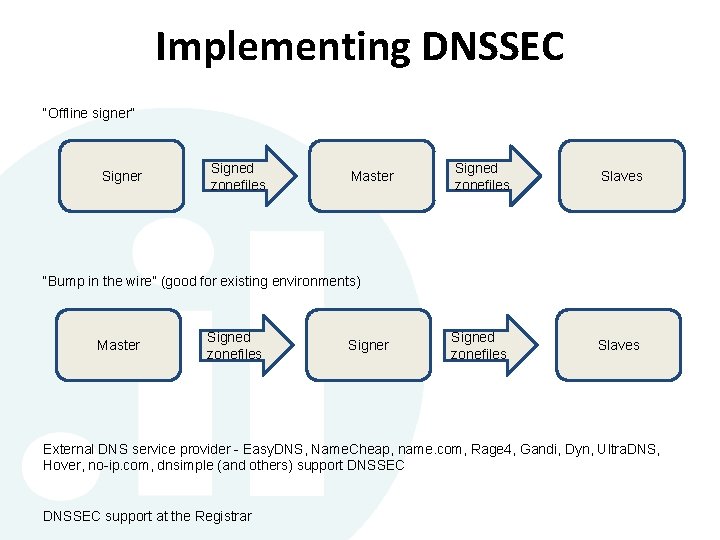
Implementing DNSSEC “Offline signer” Signer Signed zonefiles Master Signed zonefiles Slaves “Bump in the wire” (good for existing environments) Master Signed zonefiles Signer External DNS service provider - Easy. DNS, Name. Cheap, name. com, Rage 4, Gandi, Dyn, Ultra. DNS, Hover, no-ip. com, dnsimple (and others) support DNSSEC support at the Registrar
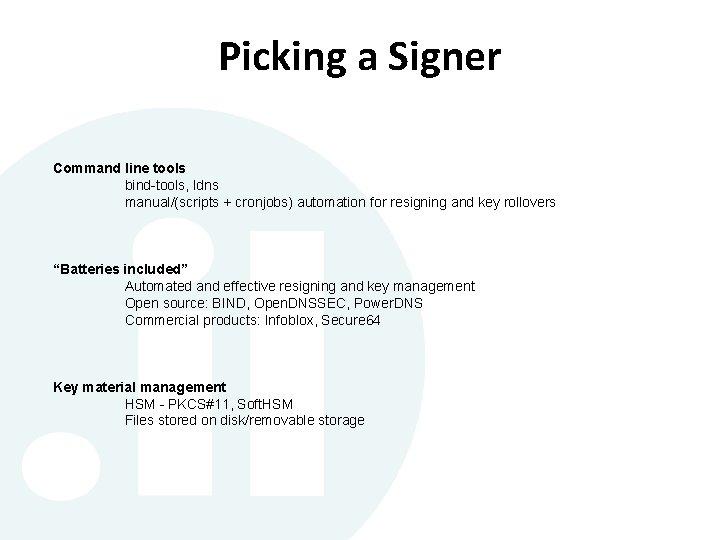
Picking a Signer Command line tools bind-tools, ldns manual/(scripts + cronjobs) automation for resigning and key rollovers “Batteries included” Automated and effective resigning and key management Open source: BIND, Open. DNSSEC, Power. DNS Commercial products: Infoblox, Secure 64 Key material management HSM - PKCS#11, Soft. HSM Files stored on disk/removable storage
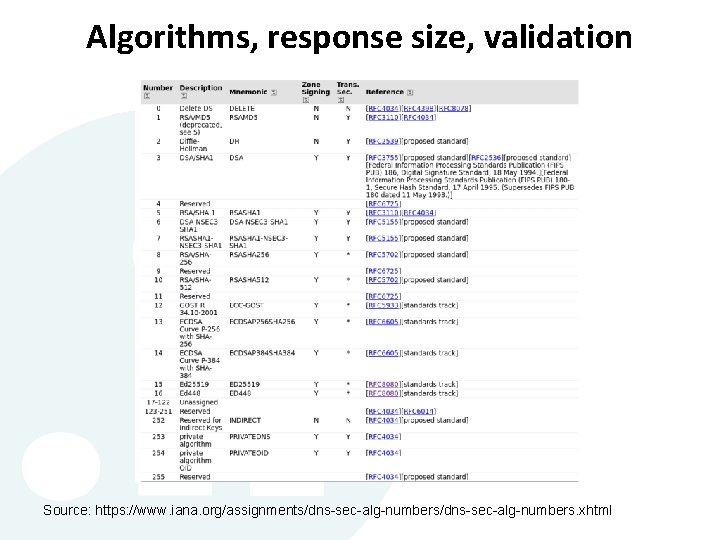
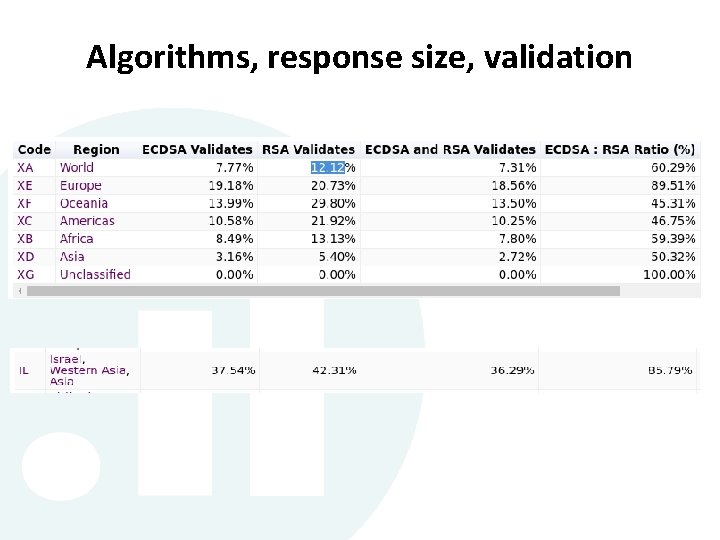
Algorithms, response size, validation Source: https: //www. iana. org/assignments/dns-sec-alg-numbers. xhtml
Algorithms, response size, validation
Algorithms, response size, validation
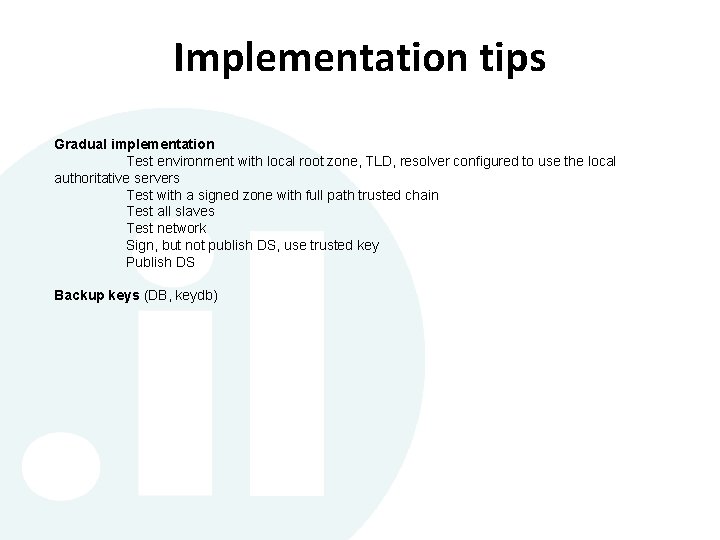
Implementation tips Gradual implementation Test environment with local root zone, TLD, resolver configured to use the local authoritative servers Test with a signed zone with full path trusted chain Test all slaves Test network Sign, but not publish DS, use trusted key Publish DS Backup keys (DB, keydb)
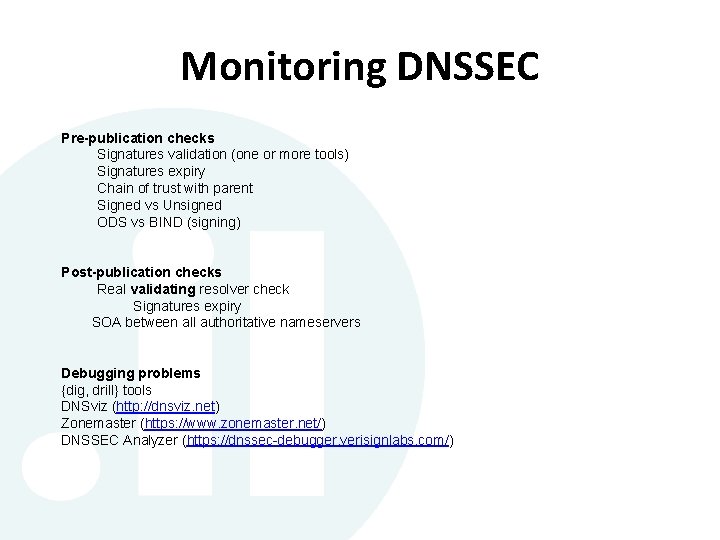
Monitoring DNSSEC Pre-publication checks Signatures validation (one or more tools) Signatures expiry Chain of trust with parent Signed vs Unsigned ODS vs BIND (signing) Post-publication checks Real validating resolver check Signatures expiry SOA between all authoritative nameservers Debugging problems {dig, drill} tools DNSviz (http: //dnsviz. net) Zonemaster (https: //www. zonemaster. net/) DNSSEC Analyzer (https: //dnssec-debugger. verisignlabs. com/)
What the future holds? CDNSKEY, CDS (automating delegation) DANE, CAA, etc Validating STUB resolvers Secure the last mile (DNS over TLS)
“The best thing about DNSSEC jokes is that you can check if they were told wrong. ”
QUESTIONS ?