
DNS CachePoisoning New Vulnerabilities and Implications or DNSSEC
DNS Cache-Poisoning: New Vulnerabilities and Implications, or: DNSSEC, the time has come! Amir Herzberg and Haya Shulman Dept. of Computer Science Bar Ilan University 8/1/2013
About us Bar Ilan University Net. Sec group Haya Shulman: Amir Herzberg: Fresh Graduate Ph. D Thesis: DNS Security (and more. . . ) Net. Sec/Crypto Researcher Attacks: DNS, TCP/IP, Do. S, … 8/1/2013 Herzberg and Shulman: DNSSEC, the time has come!
2013… DNSSEC, IPSEC: 15 yrs old Yet: < 6% of traffic encrypted, … Insecure against Mit. M attacker WHY? ? ? Can send spoofed packets but not intercept False hope: attackers are `off-path` Reality: Mit. M attackers are common Open Wi. Fi, route hijacking, mal-devices, DNS poisoning False belief: DNS, TCP immune to off-path attacks 8/1/2013 Herzberg and Shulman: DNSSEC, the time has come! Reality: TCP hijacking, DNS poisoning
Outline Attack model: Mit. M vs. Off-path DNS poisoning: Background Source-port de-randomization attacks Resolver-behind-NAT, proxy-using-upstream 1 st-fragment piggybacking attacks Implications and defenses 8/1/2013 Patches: to resolvers, name-servers, registrars Deploy DNSSEC – correctly… [and fix it, too? ? ] Herzberg and Shulman: DNSSEC, the time has come!
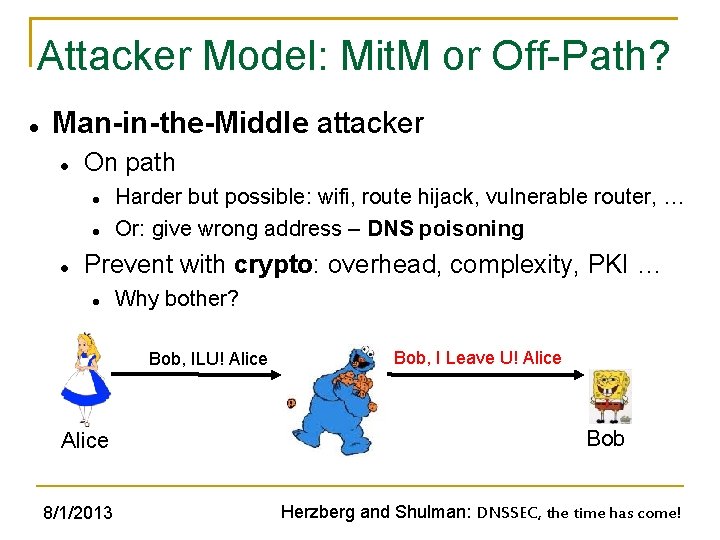
Attacker Model: Mit. M or Off-Path? Man-in-the-Middle attacker On path Harder but possible: wifi, route hijack, vulnerable router, … Or: give wrong address – DNS poisoning Prevent with crypto: overhead, complexity, PKI … Why bother? Bob, ILU! Alice 8/1/2013 Bob, I Leave U! Alice Bob Herzberg and Shulman: DNSSEC, the time has come!
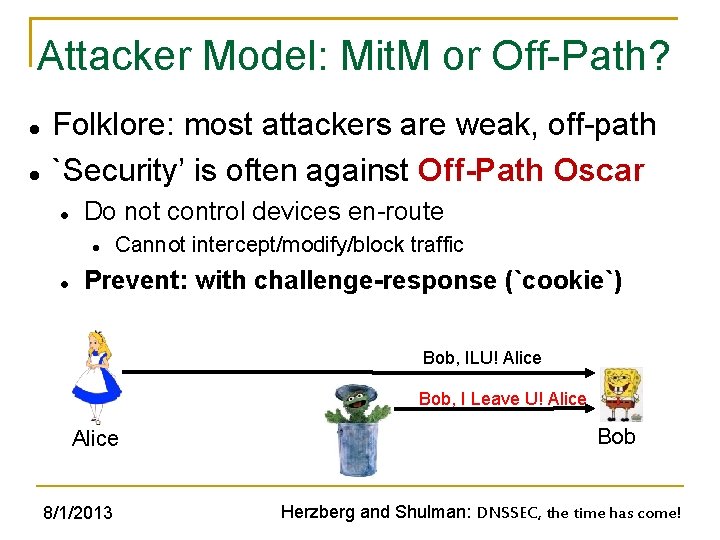
Attacker Model: Mit. M or Off-Path? Folklore: most attackers are weak, off-path `Security’ is often against Off-Path Oscar Do not control devices en-route Cannot intercept/modify/block traffic Prevent: with challenge-response (`cookie`) Bob, ILU! Alice Bob, I Leave U! Alice 8/1/2013 Bob Herzberg and Shulman: DNSSEC, the time has come!
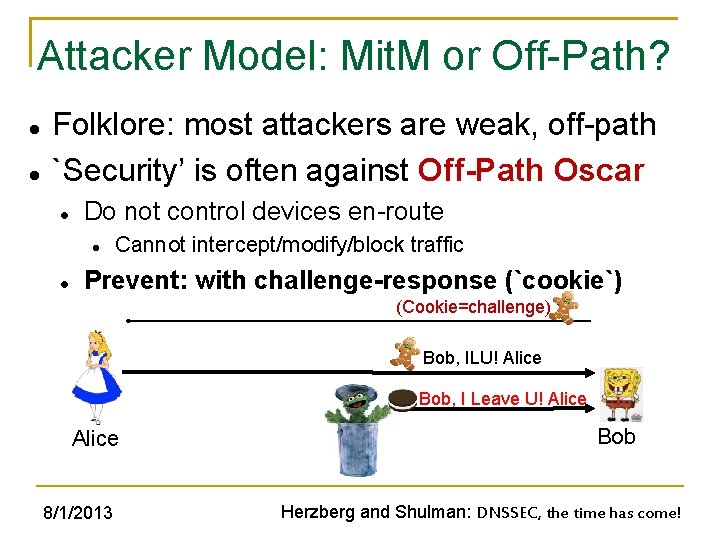
Attacker Model: Mit. M or Off-Path? Folklore: most attackers are weak, off-path `Security’ is often against Off-Path Oscar Do not control devices en-route Cannot intercept/modify/block traffic Prevent: with challenge-response (`cookie`) (Cookie=challenge) Bob, ILU! Alice Bob, I Leave U! Alice 8/1/2013 Bob Herzberg and Shulman: DNSSEC, the time has come!
Challenge-Response: What Can Go Wrong? Attacker has Mit. M capabilities Insufficient entropy: too short or non-uniform Side-channel: reused field (source port) TCP [Zalewski 01, Watson 04] DNS [Klein 03, Kaminsky 08] DNS [HS 12, HS 13], TCP [GH 12, GH 13, QM(X)12] Cut-&-paste: use real cookie in spoofed packet 8/1/2013 DNS [HS 13]
Outline Attack model: Mit. M vs. Off-path DNS poisoning: Background Source-port de-randomization attacks Resolver-behind-NAT, proxy-using-upstream 1 st-fragment piggybacking attacks Implications and defenses 8/1/2013 Patches: to resolvers, name-servers, registrars Deploy DNSSEC – correctly… [and fix it, too? ? ] Herzberg and Shulman: DNSSEC, the time has come!
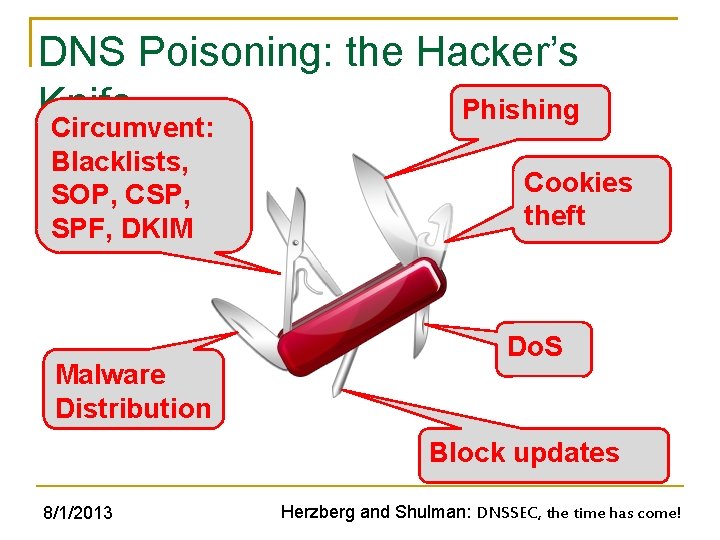
DNS Poisoning: the Hacker’s Knife Phishing Circumvent: Blacklists, SOP, CSP, SPF, DKIM Malware Distribution Cookies theft Do. S Block updates 8/1/2013 Herzberg and Shulman: DNSSEC, the time has come!
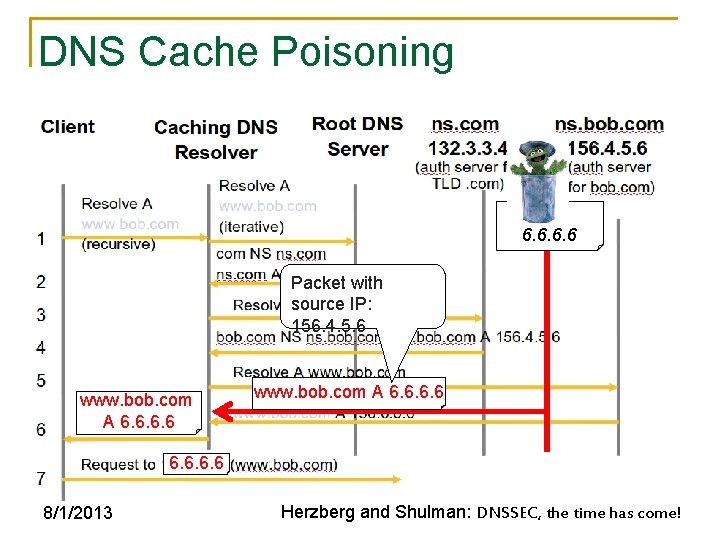
DNS Cache Poisoning 6. 6 Packet with source IP: 156. 4. 5. 6 www. bob. com A 6. 6 8/1/2013 Herzberg and Shulman: DNSSEC, the time has come!
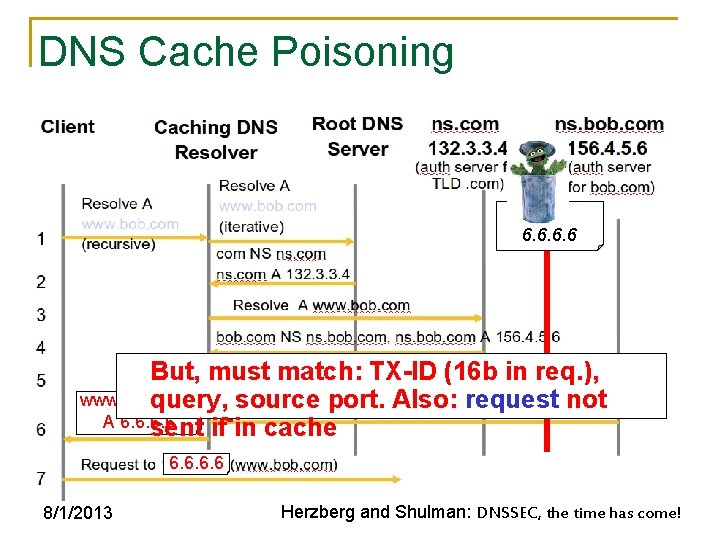
DNS Cache Poisoning 6. 6 • But, must match: TX-ID (16 b in req. ), www. bob. com A 6. 6 www. bob. com query, source port. Also: request not A 6. 6 sent if in cache 6. 6 8/1/2013 Herzberg and Shulman: DNSSEC, the time has come!
Defenses against DNS Poisoning Currently, mostly Challenge-response defenses: – Unilateral (in resolver): `challenges’ using existing request fields echoed in responses – TX-ID (16 b), Source port (16 b), Query [0 x 20] Cryptographic defenses (DNSSEC): limited use Root and many TLDs signed Many resolvers request signatures, but few validate Why? Myths (rare Mit. M, weak Oscar) 8/1/2013 Herzberg and Shulman: DNSSEC, the time has come!
Outline Attack model: Mit. M vs. Off-path DNS poisoning: Background Source-port de-randomization attacks Resolver-behind-NAT, proxy-using-upstream 1 st-fragment piggybacking attacks Implications and defenses 8/1/2013 Patches: to resolvers, name-servers, registrars Deploy DNSSEC – correctly… [and fix it, too? ? ] Herzberg and Shulman: DNSSEC, the time has come!
Source Port De-Randomisation Attacks • Learn source-port via side channel • Attacks on two common configurations: • Resolver-behind-NAT [Esorics’ 12] • • Attacks for most types of NATs (only one was secure) Upstream resolver (e. g. , Open. DNS) [Esorics’ 13] • 8/1/2013 Learn resolver’s IP address, too [often enough for Do. S !] Herzberg and Shulman: DNSSEC, the time has come!
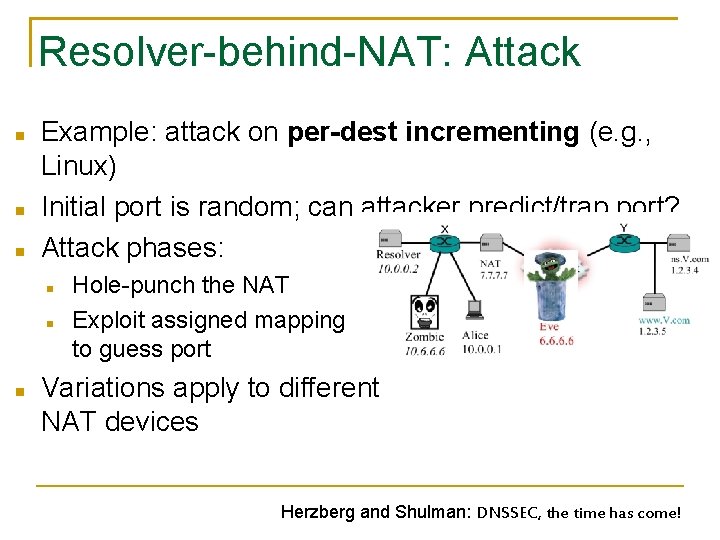
Resolver-behind-NAT: Attack Example: attack on per-dest incrementing (e. g. , Linux) Initial port is random; can attacker predict/trap port? Attack phases: Hole-punch the NAT Exploit assigned mapping to guess port Variations apply to different NAT devices Herzberg and Shulman: DNSSEC, the time has come!
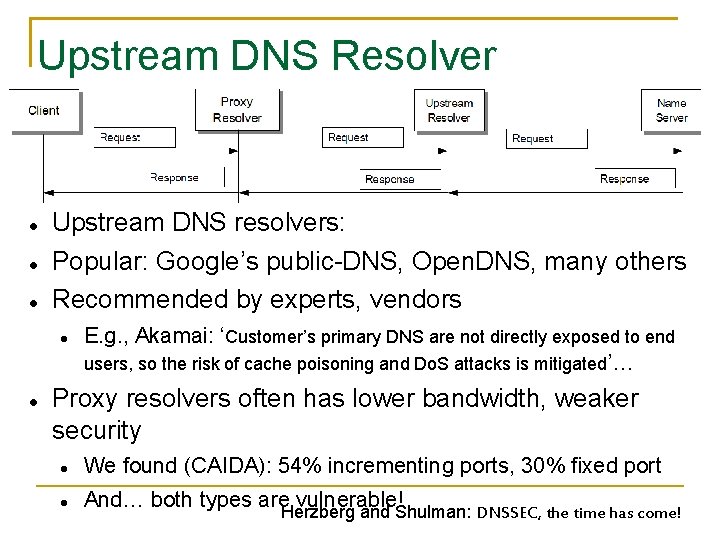
Upstream DNS Resolver Upstream DNS resolvers: Popular: Google’s public-DNS, Open. DNS, many others Recommended by experts, vendors E. g. , Akamai: ‘Customer’s primary DNS are not directly exposed to end users, so the risk of cache poisoning and Do. S attacks is mitigated’… Proxy resolvers often has lower bandwidth, weaker security We found (CAIDA): 54% incrementing ports, 30% fixed port And… both types are. Herzberg vulnerable! and Shulman: DNSSEC, the time has come!
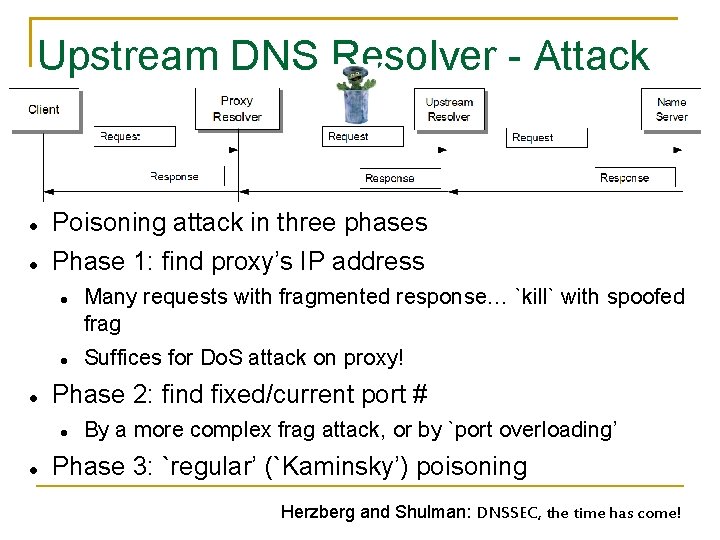
Upstream DNS Resolver - Attack Poisoning attack in three phases Phase 1: find proxy’s IP address Suffices for Do. S attack on proxy! Phase 2: find fixed/current port # Many requests with fragmented response… `kill` with spoofed frag By a more complex frag attack, or by `port overloading’ Phase 3: `regular’ (`Kaminsky’) poisoning Herzberg and Shulman: DNSSEC, the time has come!
Outline Attack model: Mit. M vs. Off-path DNS poisoning: Background Source-port de-randomization attacks Resolver-behind-NAT, proxy-using-upstream 1 st-fragment piggybacking attacks Implications and defenses 8/1/2013 Patches: to resolvers, name-servers, registrars Deploy DNSSEC – correctly… [and fix it, too? ? ] Herzberg and Shulman: DNSSEC, the time has come!
1 st-fragment piggybacking attacks • Cut’n’Paste attack: • Poison a long, fragmented DNS response • Source fragmentation will do [works even for IPv 6] • All `challenges’ are in the first fragment! • TXID, “src” port, even query [e. g. , 0 x 20 defense] • Replace 2 nd fragment with a fake one! • Few details and quick recap on IP fragmentation 8/1/2013 Herzberg and Shulman: DNSSEC, the time has come!
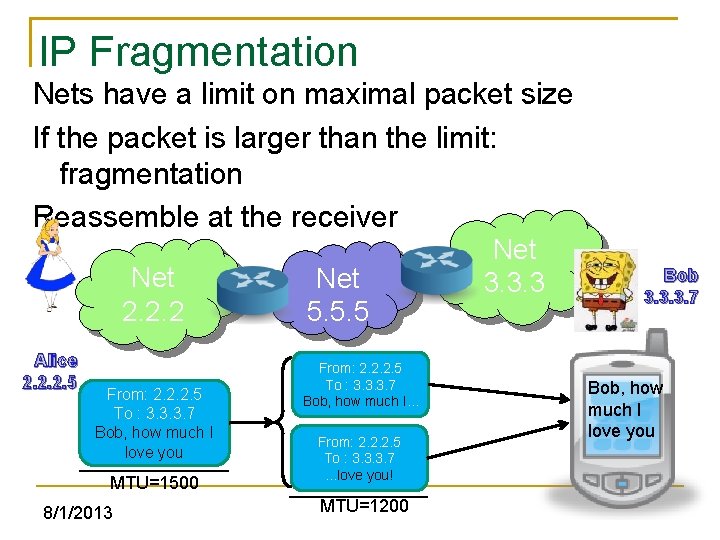
IP Fragmentation Nets have a limit on maximal packet size If the packet is larger than the limit: fragmentation Reassemble at the receiver Net 2. 2. 2 Alice 2. 2. 2. 5 From: 2. 2. 2. 5 To : 3. 3. 3. 7 Bob, how much I love you MTU=1500 8/1/2013 Net 5. 5. 5 From: 2. 2. 2. 5 To : 3. 3. 3. 7 Bob, how much I. . . From: 2. 2. 2. 5 To : 3. 3. 3. 7. . . love you! MTU=1200 Net 3. 3. 3 Bob 3. 3. 3. 7 Bob, how much I love you
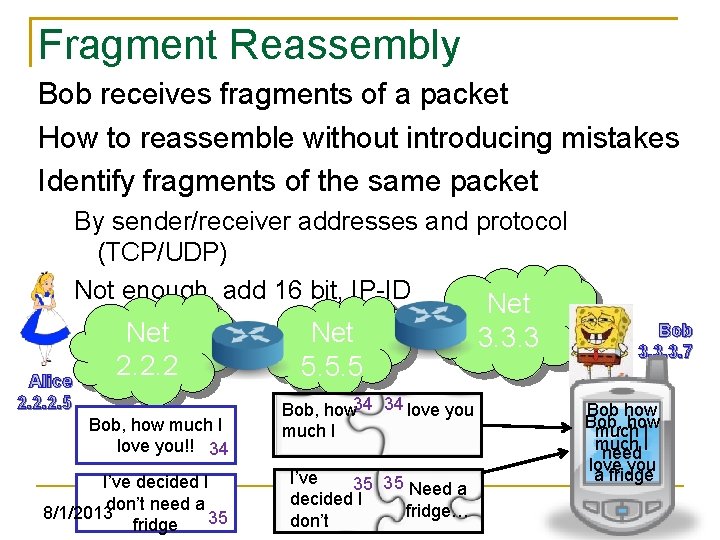
Fragment Reassembly Bob receives fragments of a packet How to reassemble without introducing mistakes Identify fragments of the same packet By sender/receiver addresses and protocol (TCP/UDP) Not enough, add 16 bit, IP-ID Alice 2. 2. 2. 5 Net 2. 2. 2 Bob, how much I love you!! 34 I’ve decided I don’t need a 8/1/2013 35 fridge Net 5. 5. 5 Bob, how 34 34 love you much I I’ve 35 35 Need a decided I fridge… don’t Net 3. 3. 3 Bob 3. 3. 3. 7 Bob how Bob, how much I need love you a fridge
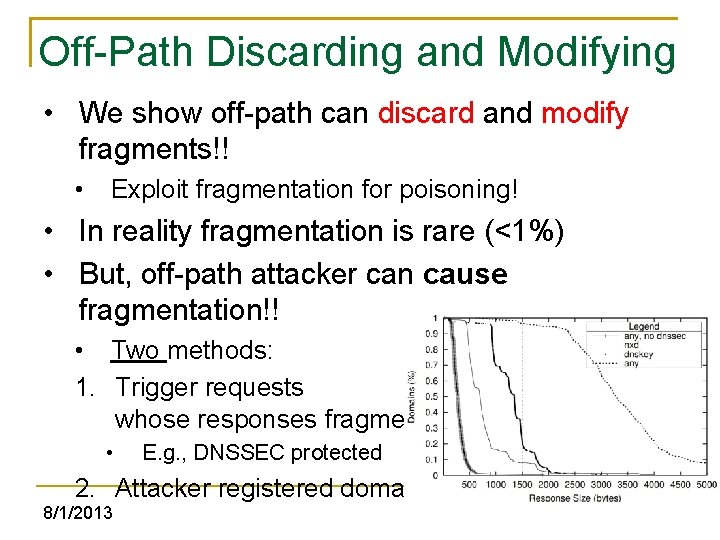
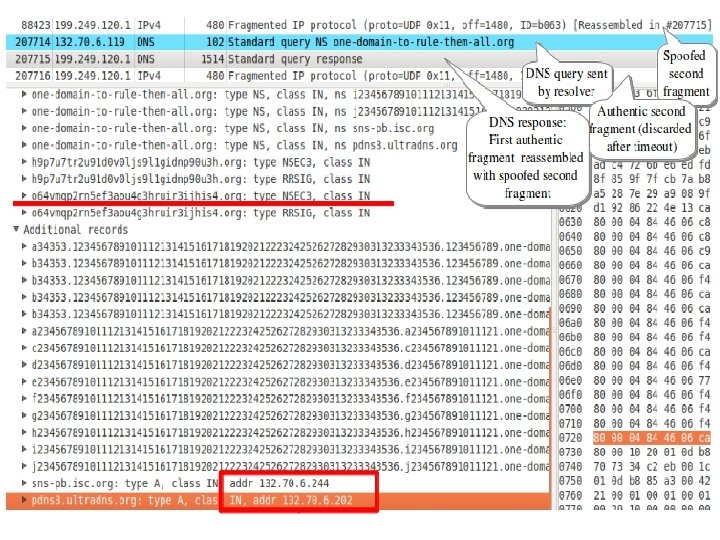
Off-Path Discarding and Modifying • We show off-path can discard and modify fragments!! • Exploit fragmentation for poisoning! • In reality fragmentation is rare (<1%) • But, off-path attacker can cause fragmentation!! • Two methods: 1. Trigger requests whose responses fragment • E. g. , DNSSEC protected 2. Attacker registered domain 8/1/2013
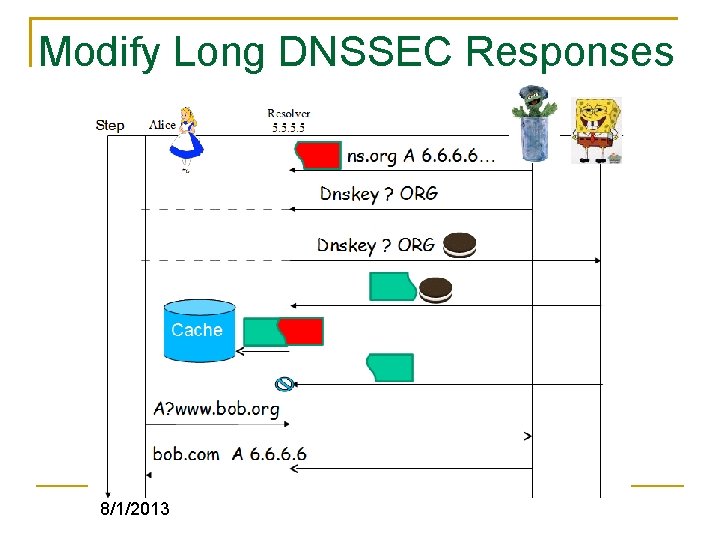
Modify Long DNSSEC Responses 8/1/2013
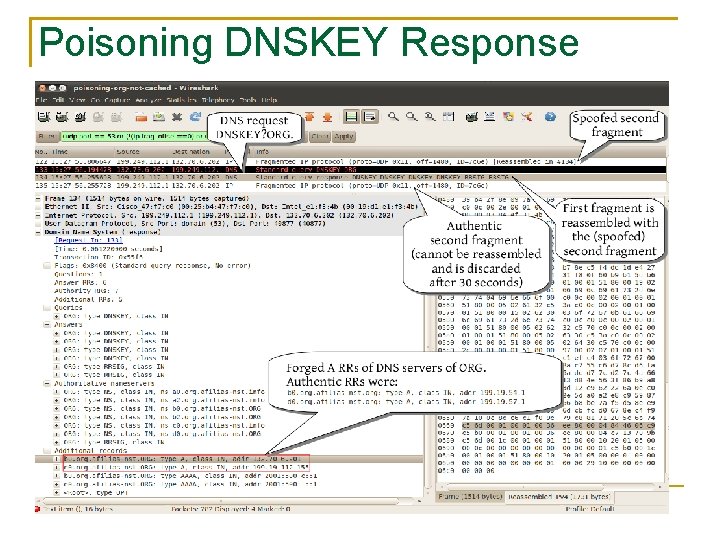
Poisoning DNSKEY Response
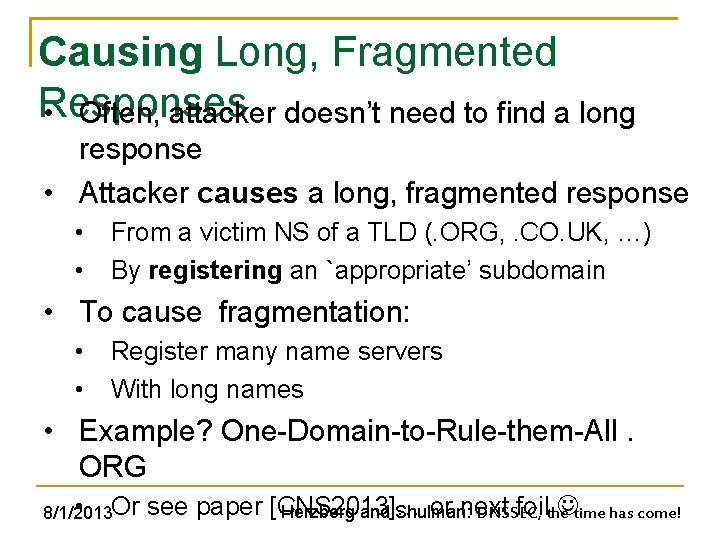
Causing Long, Fragmented Responses • Often, attacker doesn’t need to find a long response • Attacker causes a long, fragmented response • • From a victim NS of a TLD (. ORG, . CO. UK, …) By registering an `appropriate’ subdomain • To cause fragmentation: • • Register many name servers With long names • Example? One-Domain-to-Rule-them-All. ORG • Or 8/1/2013 see paper [CNS 2013]… or next foilthe time has come! Herzberg and Shulman: DNSSEC,
Outline Attack model: Mit. M vs. Off-path DNS poisoning: Background Source-port de-randomization attacks Resolver-behind-NAT, proxy-using-upstream 1 st-fragment piggybacking attacks Implications and defenses 8/1/2013 Patches: to resolvers, name-servers, registrars Deploy DNSSEC – correctly… [and fix it, too? ? ] Herzberg and Shulman: DNSSEC, the time has come!
Still patching after all these • All attacks: real, practical, validated (by years… others too) • Resolvers • • (Smart) pseudo-random port allocation (see paper) Prepend random-length prefix to referral queries • Name servers: • Append random RR • • Or send random value of EDNS buffer size from NS But…advanced frag attacks may change checksum field – see Esorics’ 13 paper • Either: small (non-frag) limit on EDNS (use Herzberg and Shulman: DNSSEC, the time has come! 8/1/2013 TCP)
Or… can we just use SSL/TLS ? • Tempting: forget DNS, just use secure connection! • Using secure connection is a good idea, sure • But not complete solution: • Is web’s PKI secure? Hmm… • Overhead • Unrealistic to expect all web to be fixed • Phishing • Denial-of-service • Non-web applications: SMTP, P 2 P, …the time has come! Herzberg and Shulman: DNSSEC, 8/1/2013
DNSSEC, the time has come! • These patches are too much, too complex, and: • • Maybe there’s another vulnerability/attack? And what about Mit. M attacker? Like, is BGP secure? • And… who said they’ll suffice? ? • We say: time to properly use DNSSEC • But… some improvements may be needed, too • Abolish (insecure) NSEC 3 OPT-OUT • Add crypto-agility, esp. critical DNSSEC, to adopt ECDSA Herzberg and Shulman: the time has come! 8/1/2013 !
Questions ? Thank you! Herzberg and Shulman: DNSSEC, the time has come!
- Slides: 32