
DNS 1 2 3 4 5 6 Name

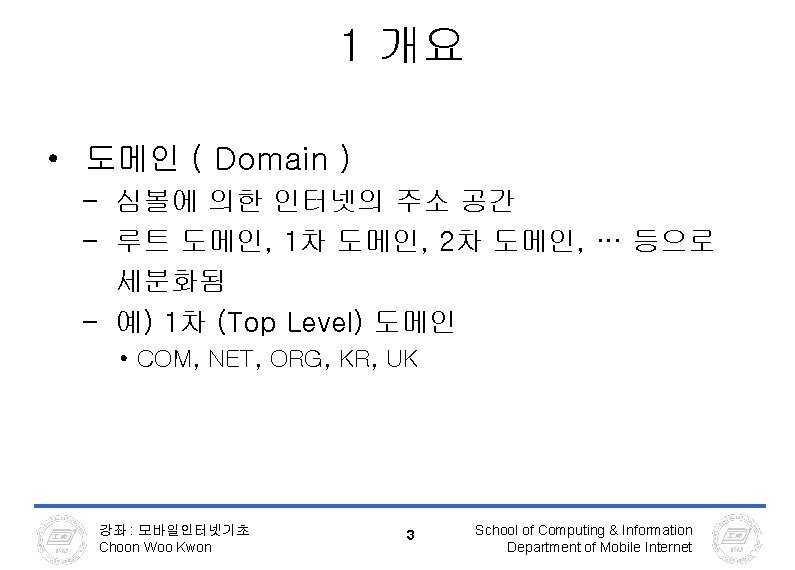
- Slides: 28
(보충) 도메인 네임 시스템(DNS) 1 2 3 4 5 6 개요 Name Space Domain Name Space 네임 공간의 분배 인터넷에서의 DNS 해결방안 강좌 : 모바일인터넷기초 Choon Woo Kwon 2 School of Computing & Information Department of Mobile Internet
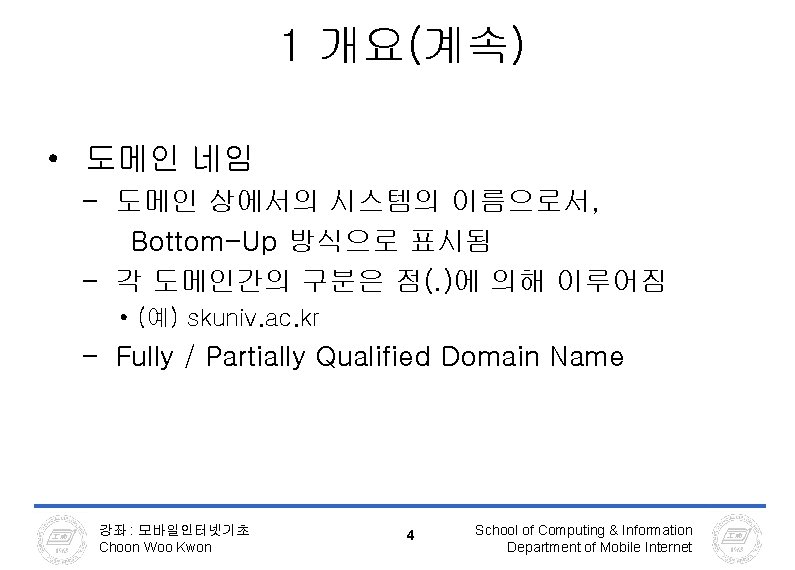
1 개요(계속) • 도메인 네임 – 도메인 상에서의 시스템의 이름으로서, Bottom-Up 방식으로 표시됨 – 각 도메인간의 구분은 점(. )에 의해 이루어짐 • (예) skuniv. ac. kr – Fully / Partially Qualified Domain Name 강좌 : 모바일인터넷기초 Choon Woo Kwon 4 School of Computing & Information Department of Mobile Internet
1 개요 • Mapping a name to an address or address to a name • Information for mapping is stored in host file – in each computer – the entire host file in a single computer – dividing the information into smaller parts and storing each part on a different computer • The host that needs mapping can contact the closest computer • This method is used by the Domain Name System 강좌 : 모바일인터넷기초 Choon Woo Kwon 6 School of Computing & Information Department of Mobile Internet
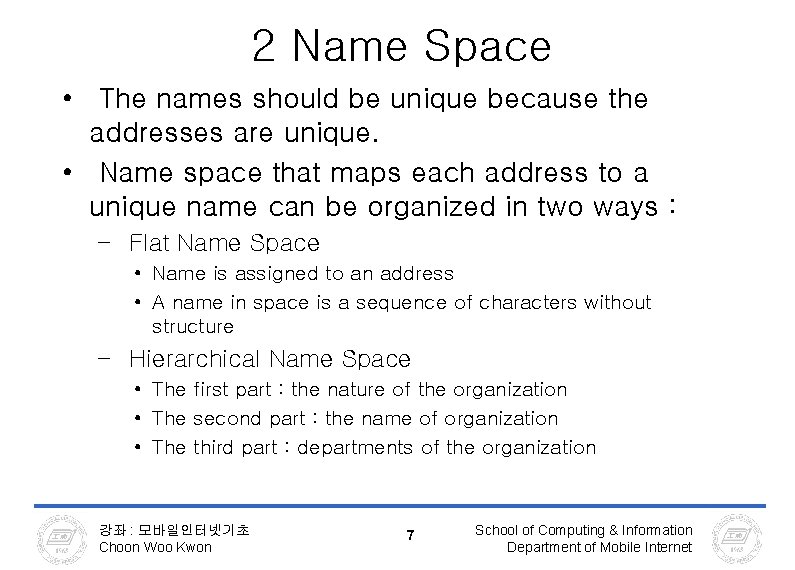
2 Name Space • The names should be unique because the addresses are unique. • Name space that maps each address to a unique name can be organized in two ways : – Flat Name Space • Name is assigned to an address • A name in space is a sequence of characters without structure – Hierarchical Name Space • The first part : the nature of the organization • The second part : the name of organization • The third part : departments of the organization 강좌 : 모바일인터넷기초 Choon Woo Kwon 7 School of Computing & Information Department of Mobile Internet
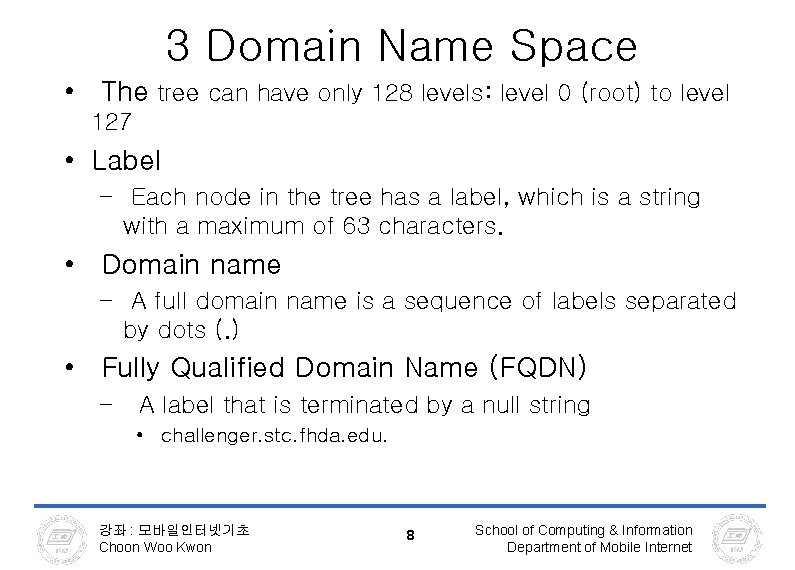
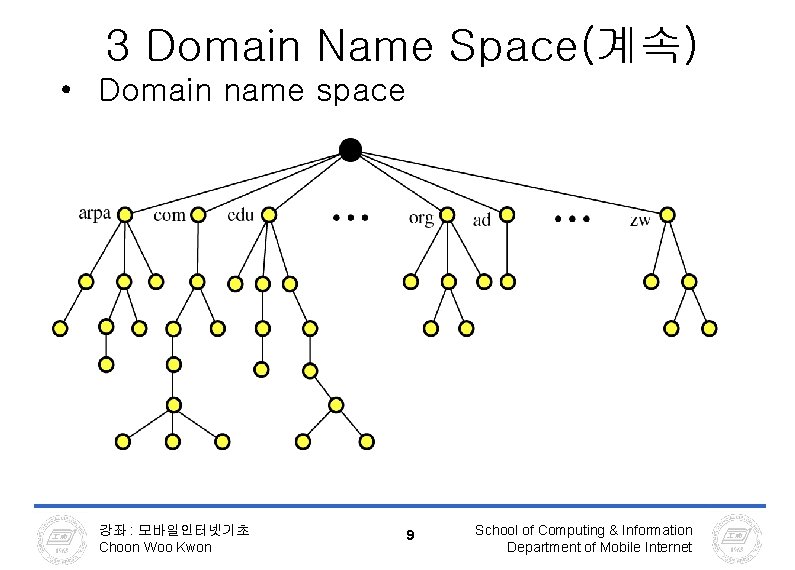
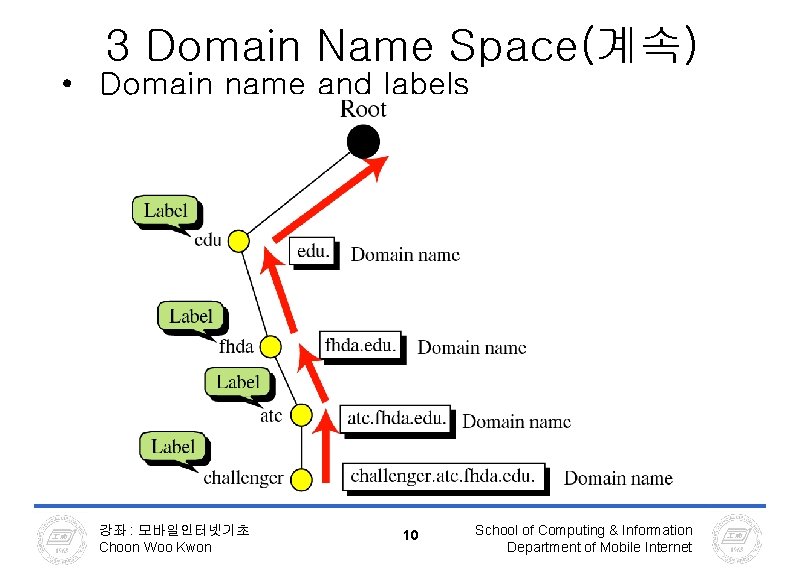
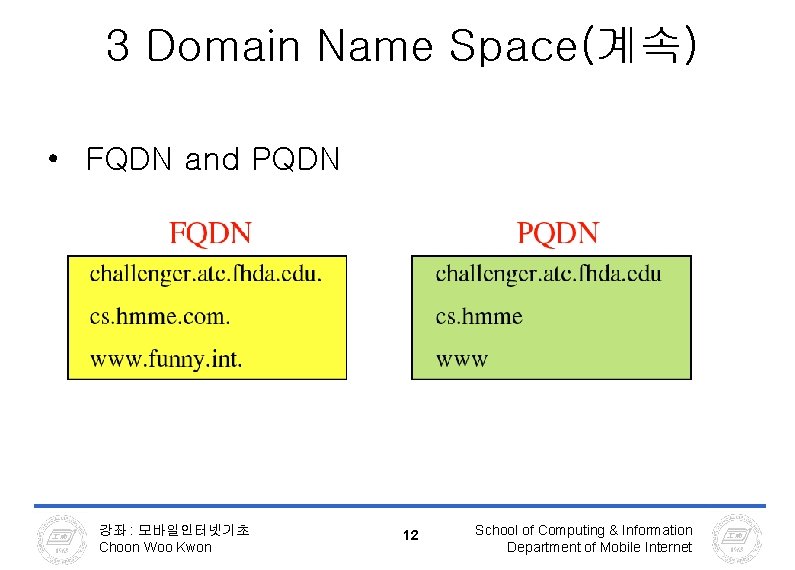
3 Domain Name Space • The tree can have only 128 levels: level 0 (root) to level 127 • Label – Each node in the tree has a label, which is a string with a maximum of 63 characters. • Domain name – A full domain name is a sequence of labels separated by dots (. ) • Fully Qualified Domain Name (FQDN) – A label that is terminated by a null string • challenger. stc. fhda. edu. 강좌 : 모바일인터넷기초 Choon Woo Kwon 8 School of Computing & Information Department of Mobile Internet
3 Domain Name Space(계속) • Domain name space 강좌 : 모바일인터넷기초 Choon Woo Kwon 9 School of Computing & Information Department of Mobile Internet
3 Domain Name Space(계속) • Domain name and labels 강좌 : 모바일인터넷기초 Choon Woo Kwon 10 School of Computing & Information Department of Mobile Internet
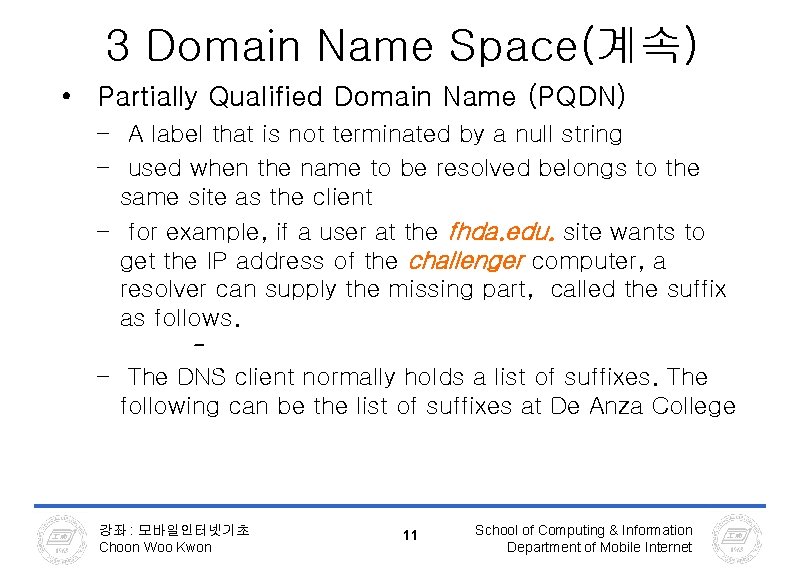
3 Domain Name Space(계속) • Partially Qualified Domain Name (PQDN) – A label that is not terminated by a null string – used when the name to be resolved belongs to the same site as the client – for example, if a user at the fhda. edu. site wants to get the IP address of the challenger computer, a resolver can supply the missing part, called the suffix as follows. - challenger. atc. fhda. edu – The DNS client normally holds a list of suffixes. The following can be the list of suffixes at De Anza College atc. fhda. edu null 강좌 : 모바일인터넷기초 Choon Woo Kwon 11 School of Computing & Information Department of Mobile Internet
3 Domain Name Space(계속) • FQDN and PQDN 강좌 : 모바일인터넷기초 Choon Woo Kwon 12 School of Computing & Information Department of Mobile Internet
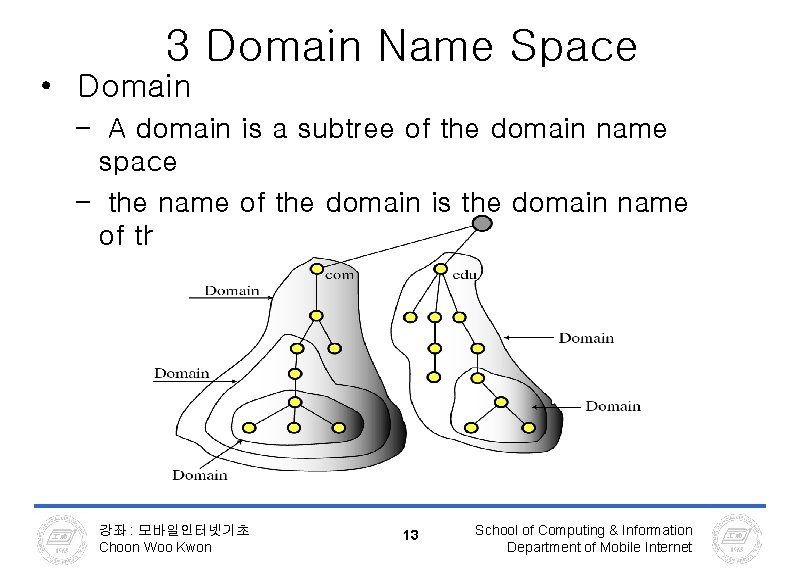
3 Domain Name Space • Domain – A domain is a subtree of the domain name space – the name of the domain is the domain name of the node at the top of the subtree 강좌 : 모바일인터넷기초 Choon Woo Kwon 13 School of Computing & Information Department of Mobile Internet
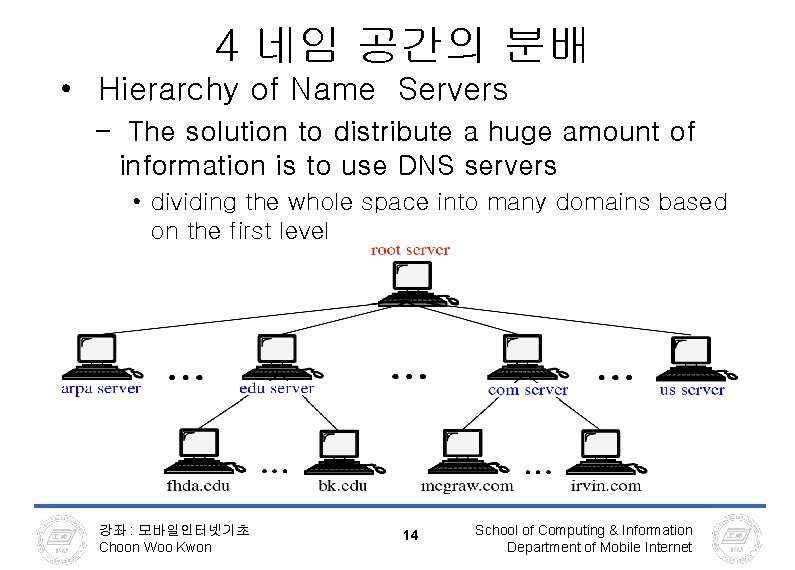
4 네임 공간의 분배 • Hierarchy of Name Servers – The solution to distribute a huge amount of information is to use DNS servers • dividing the whole space into many domains based on the first level 강좌 : 모바일인터넷기초 Choon Woo Kwon 14 School of Computing & Information Department of Mobile Internet
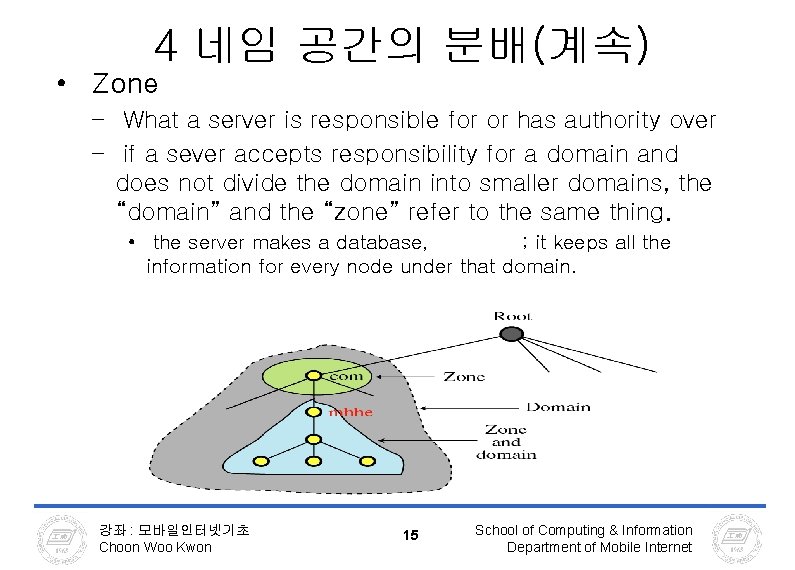
4 네임 공간의 분배(계속) • Zone – What a server is responsible for or has authority over – if a sever accepts responsibility for a domain and does not divide the domain into smaller domains, the “domain” and the “zone” refer to the same thing. • the server makes a database, zone file ; it keeps all the information for every node under that domain. 강좌 : 모바일인터넷기초 Choon Woo Kwon 15 School of Computing & Information Department of Mobile Internet
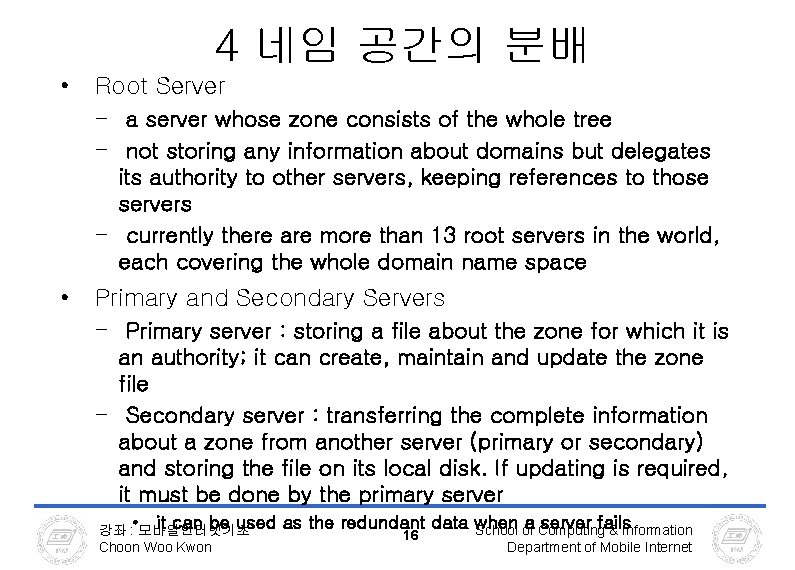
4 네임 공간의 분배 • Root Server – a server whose zone consists of the whole tree – not storing any information about domains but delegates its authority to other servers, keeping references to those servers – currently there are more than 13 root servers in the world, each covering the whole domain name space • Primary and Secondary Servers – Primary server : storing a file about the zone for which it is an authority; it can create, maintain and update the zone file – Secondary server : transferring the complete information about a zone from another server (primary or secondary) and storing the file on its local disk. If updating is required, it must be done by the primary server it can be used 강좌 : • 모바일인터넷기초 Choon Woo Kwon as the redundant data when a Computing server fails School of & Information 16 Department of Mobile Internet
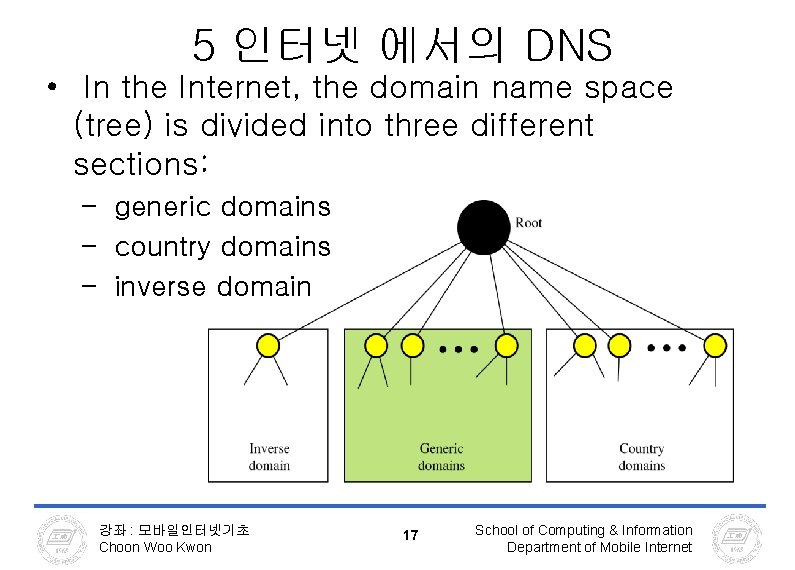
5 인터넷 에서의 DNS • In the Internet, the domain name space (tree) is divided into three different sections: – generic domains – country domains – inverse domain 강좌 : 모바일인터넷기초 Choon Woo Kwon 17 School of Computing & Information Department of Mobile Internet
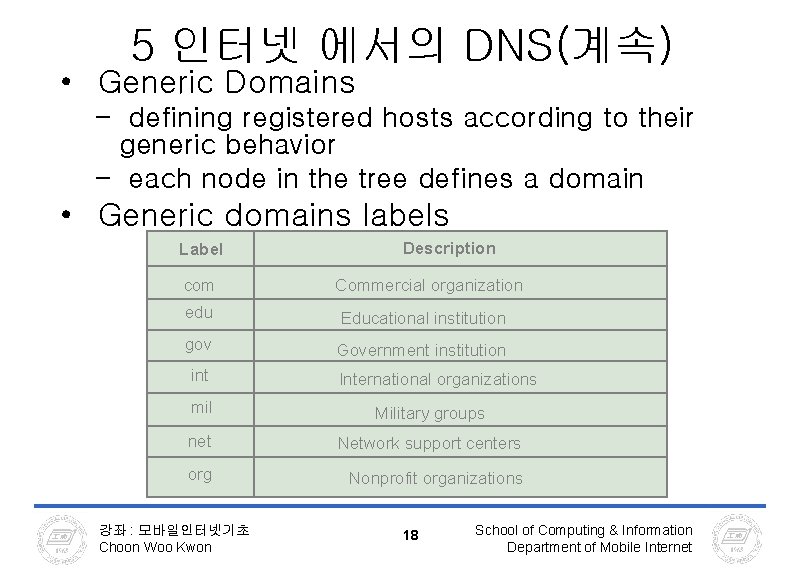
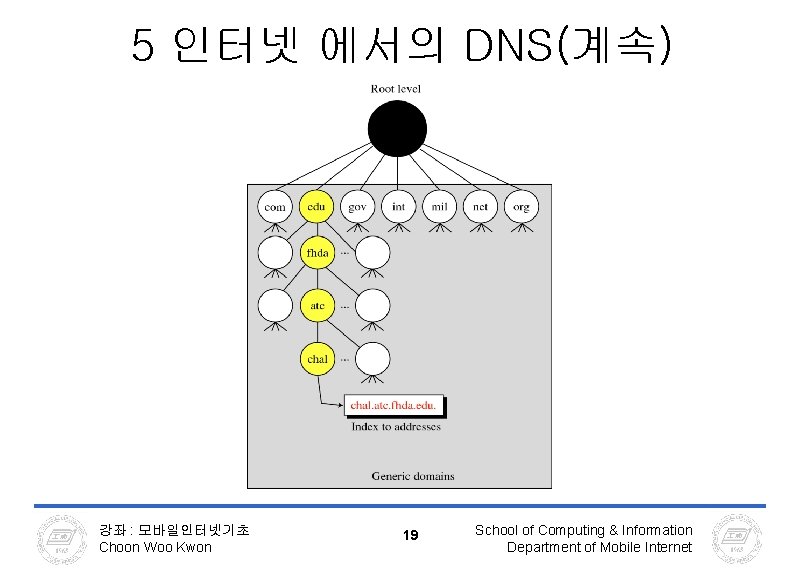
5 인터넷 에서의 DNS(계속) • Generic Domains – defining registered hosts according to their generic behavior – each node in the tree defines a domain • Generic domains labels Label com Description Commercial organization edu Educational institution gov Government institution int International organizations mil Military groups net Network support centers org Nonprofit organizations 강좌 : 모바일인터넷기초 Choon Woo Kwon 18 School of Computing & Information Department of Mobile Internet
5 인터넷 에서의 DNS(계속) 강좌 : 모바일인터넷기초 Choon Woo Kwon 19 School of Computing & Information Department of Mobile Internet
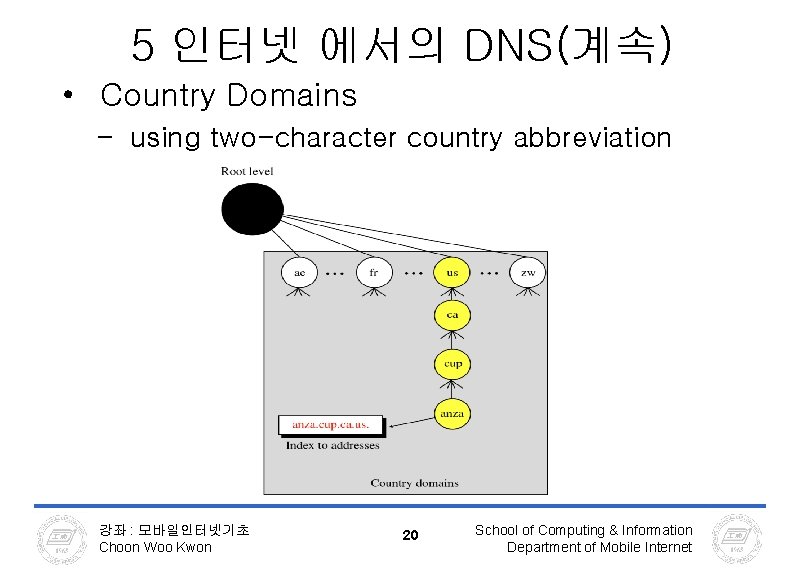
5 인터넷 에서의 DNS(계속) • Country Domains – using two-character country abbreviation 강좌 : 모바일인터넷기초 Choon Woo Kwon 20 School of Computing & Information Department of Mobile Internet
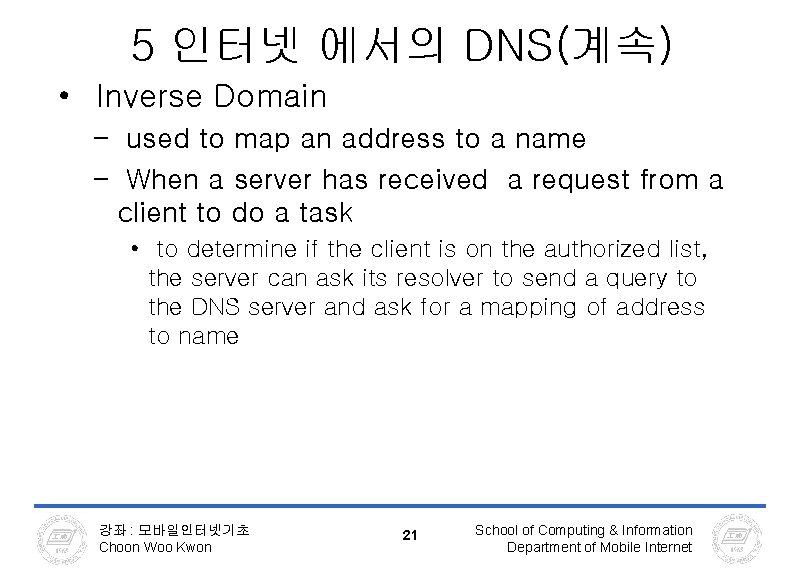
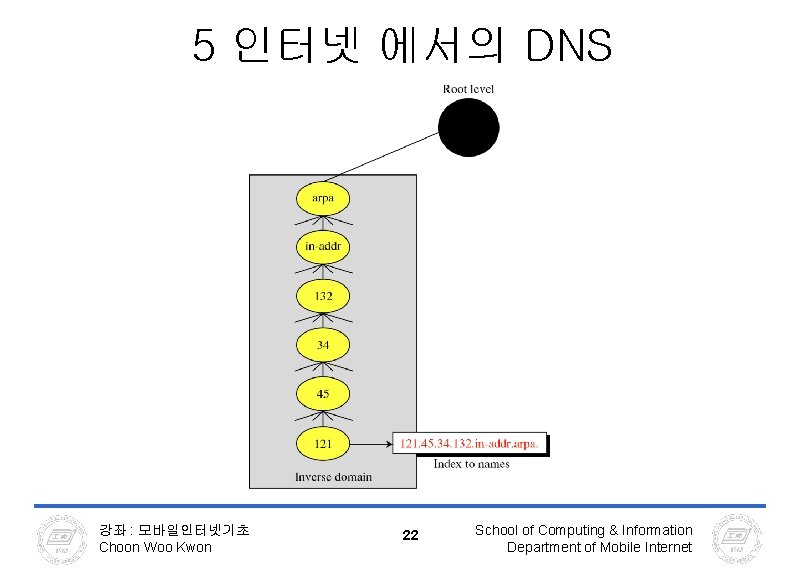
5 인터넷 에서의 DNS(계속) • Inverse Domain – used to map an address to a name – When a server has received a request from a client to do a task • to determine if the client is on the authorized list, the server can ask its resolver to send a query to the DNS server and ask for a mapping of address to name 강좌 : 모바일인터넷기초 Choon Woo Kwon 21 School of Computing & Information Department of Mobile Internet
5 인터넷 에서의 DNS 강좌 : 모바일인터넷기초 Choon Woo Kwon 22 School of Computing & Information Department of Mobile Internet
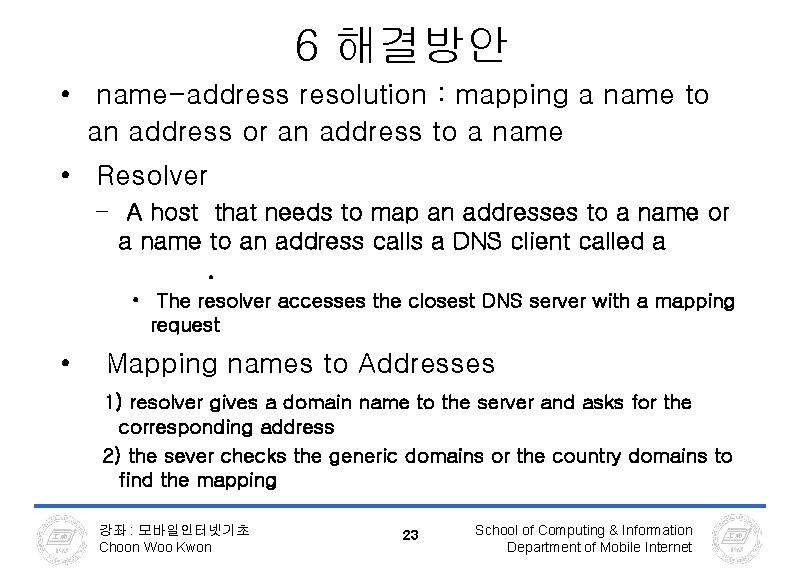
6 해결방안 • name-address resolution : mapping a name to an address or an address to a name • Resolver – A host that needs to map an addresses to a name or a name to an address calls a DNS client called a resolver. • The resolver accesses the closest DNS server with a mapping request • Mapping names to Addresses 1) resolver gives a domain name to the server and asks for the corresponding address 2) the sever checks the generic domains or the country domains to find the mapping 강좌 : 모바일인터넷기초 Choon Woo Kwon 23 School of Computing & Information Department of Mobile Internet
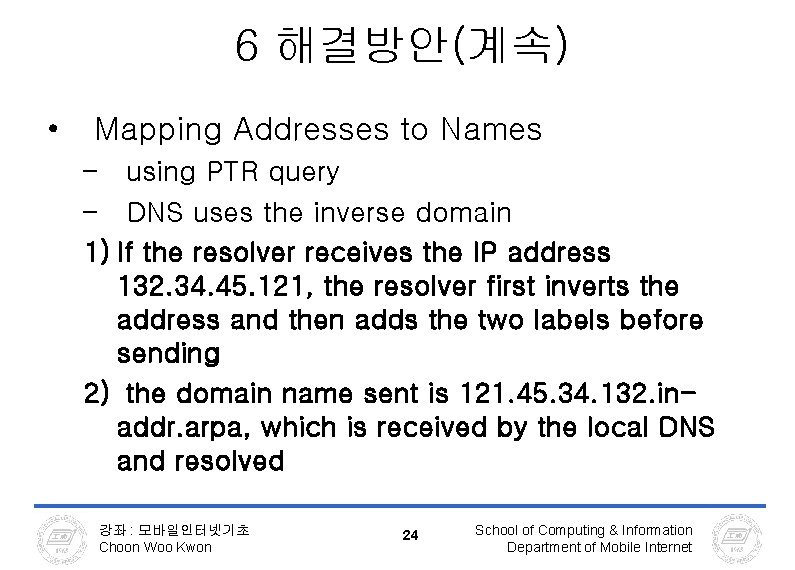
6 해결방안(계속) • Mapping Addresses to Names – using PTR query – DNS uses the inverse domain 1) If the resolver receives the IP address 132. 34. 45. 121, the resolver first inverts the address and then adds the two labels before sending 2) the domain name sent is 121. 45. 34. 132. inaddr. arpa, which is received by the local DNS and resolved 강좌 : 모바일인터넷기초 Choon Woo Kwon 24 School of Computing & Information Department of Mobile Internet
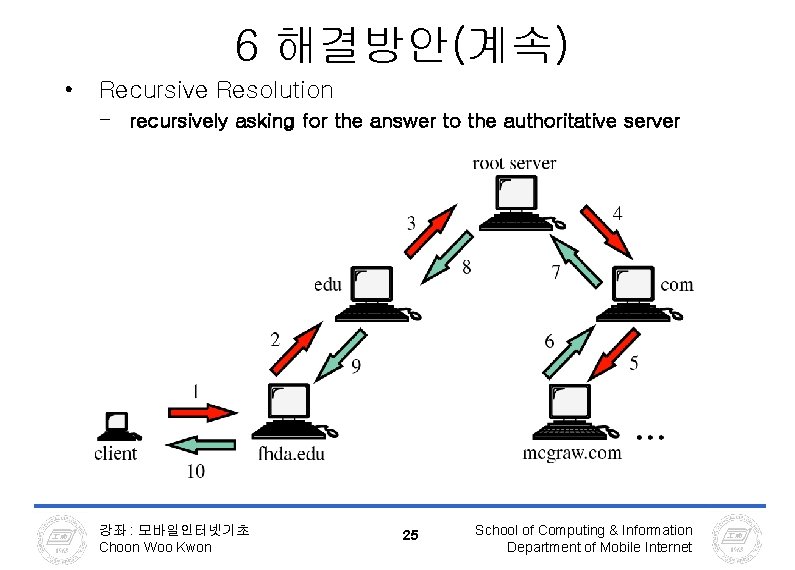
6 해결방안(계속) • Recursive Resolution – recursively asking for the answer to the authoritative server 강좌 : 모바일인터넷기초 Choon Woo Kwon 25 School of Computing & Information Department of Mobile Internet
6 해결방안(계속) • Iterative Resolution – if the server is an authority fir the name, it send the answer, it sends the answer. If it is not, it returns (to the client) the IP address f the server that it thinks can resolve the query – the client is responsible for repeating the query to this second server – if the newly addressed server can resolve the problem, it answers the query with the IP address; otherwise, it returns the IP address of a new server to the client 강좌 : 모바일인터넷기초 Choon Woo Kwon 26 School of Computing & Information Department of Mobile Internet
6 해결방안(계속) 강좌 : 모바일인터넷기초 Choon Woo Kwon 27 School of Computing & Information Department of Mobile Internet
6 해결방안 • Cashing – to reduce the search time – When a sever asks for a mapping from another sever and receives the response, it stores this information in its cache memory before sending it to the client – using TTL 강좌 : 모바일인터넷기초 Choon Woo Kwon 28 School of Computing & Information Department of Mobile Internet