
DNMS Resource Development Protocol Origins n Developmental Needs







- Slides: 134
DNMS Resource Development Protocol
Origins n Developmental Needs Meeting Strategy is a therapy model consisting of several protocols n Resource Development Protocol is one of them n I’ll briefly introduce the whole model n I’ll explore the Resource development part in detail 2
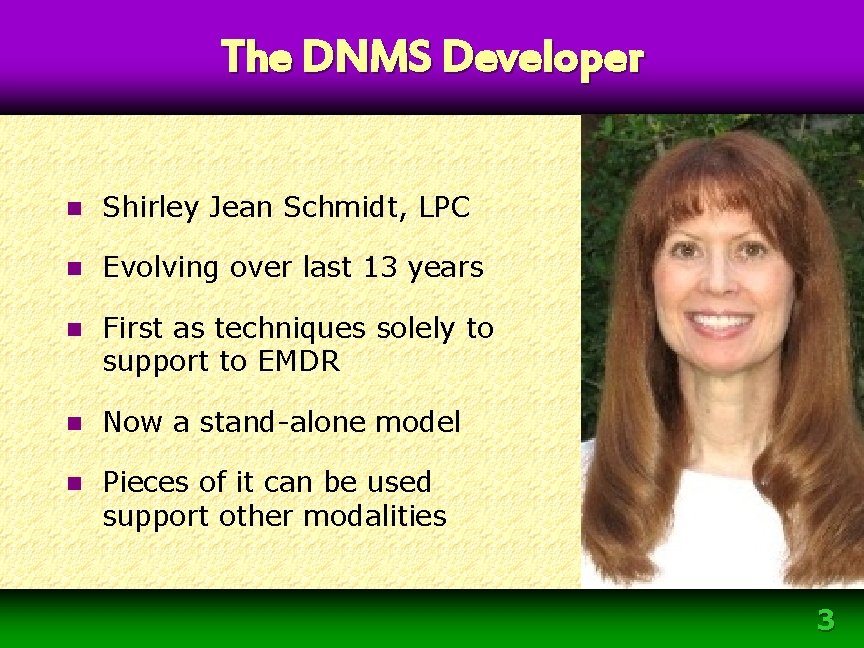
The DNMS Developer n Shirley Jean Schmidt, LPC n Evolving over last 13 years n First as techniques solely to support to EMDR n Now a stand-alone model n Pieces of it can be used support other modalities 3
My Story n Use this slide to tell about your experiences using the Resource Development Protocol 4
This Presentation DNMS Overview RDP Introduction Client Preparation Resource Mobilization Provisional Resources RDP Complications DNMS Training 5
DNMS Overview The DNMS Underpinnings n Children grow and develop in stages n Each stage involves a set of needs n Degree to which developmental needs were not adequately met… n …is the degree to which a person may be stuck in childhood 6
DNMS Overview DNMS Underpinnings n Being stuck means you can be fine one minute n Then suddenly see the world through the eyes of a sad, angry, or fearful child 7
DNMS Overview DNMS Underpinnings n A child may become stuck after n n significant abuse, neglect, rejection, or enmeshment simple parenting failures 8
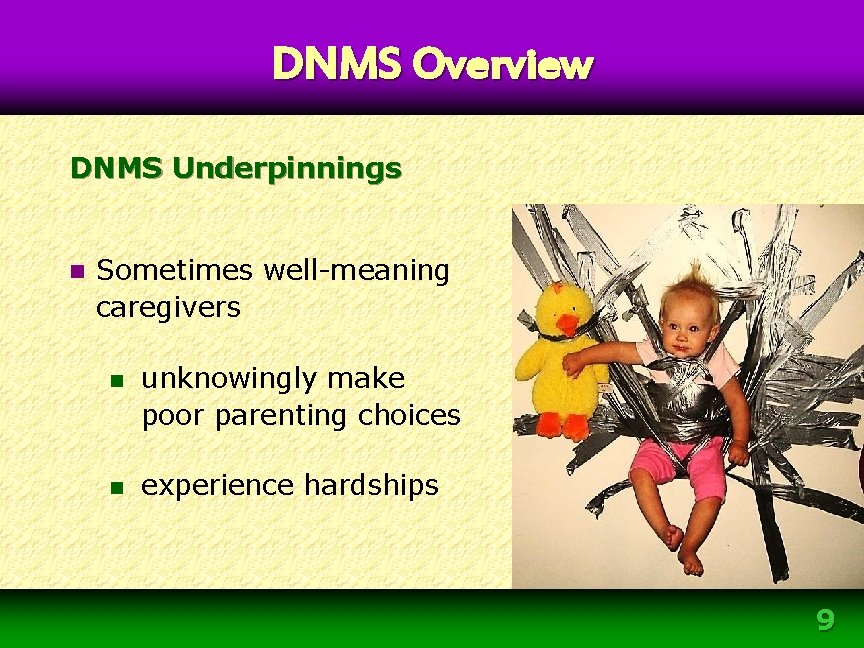
DNMS Overview DNMS Underpinnings n Sometimes well-meaning caregivers n n unknowingly make poor parenting choices experience hardships 9
DNMS Overview DNMS Underpinnings n Some child parts of self are stuck in reaction to wounding people from the past n Some child parts of self are stuck mimicking wounding people from the past n The parts mimicking wounding people constantly retraumatize those reacting to wounding people 10
DNMS Overview What is the DNMS? n The DNMS is an ego state therapy n Endeavors to help adult clients get wounded parts of self unstuck from the past n Providing relief for a wide range of symptoms and issues 11
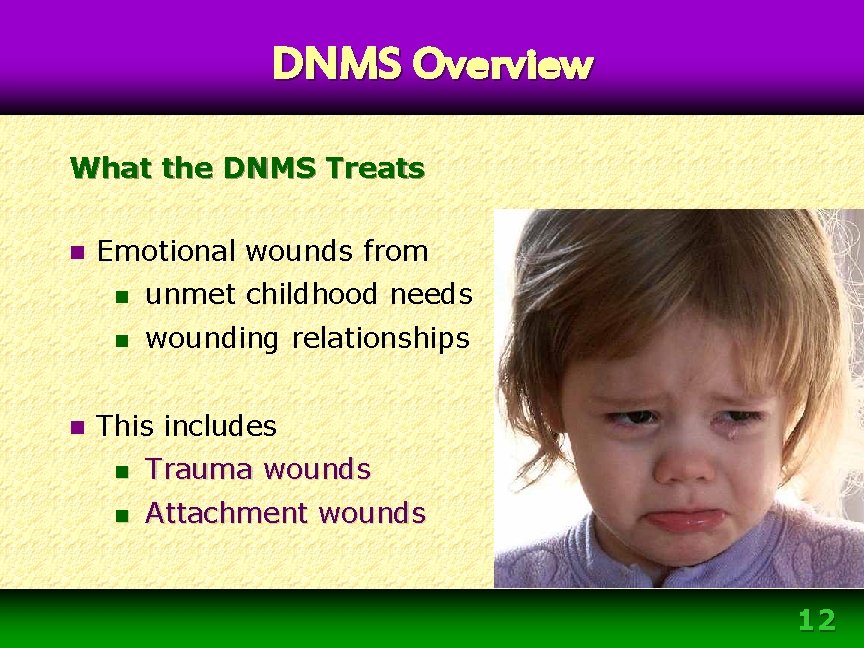
DNMS Overview What the DNMS Treats n n Emotional wounds from n unmet childhood needs n wounding relationships This includes n Trauma wounds n Attachment wounds 12
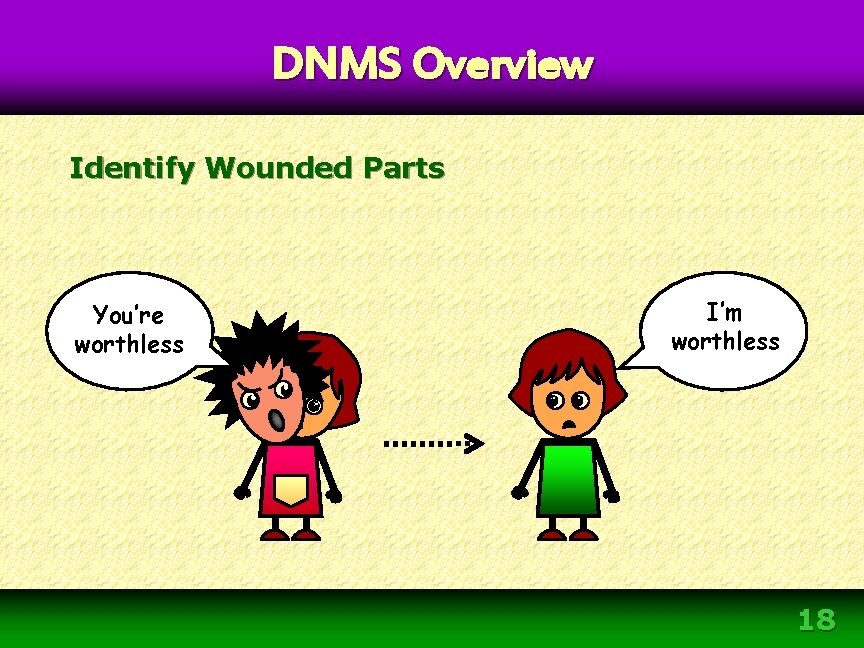
DNMS Overview Wounded Parts of Self n DNMS classifies wounded parts as n Reactive parts n Maladaptive introjects 13
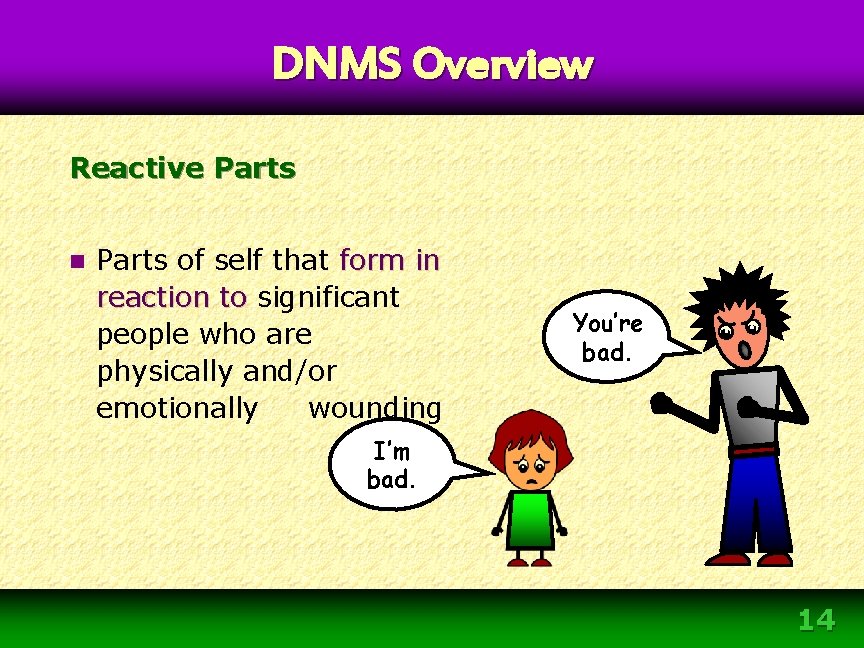
DNMS Overview Reactive Parts n Parts of self that form in reaction to significant people who are physically and/or emotionally wounding You’re bad. I’m bad. 14
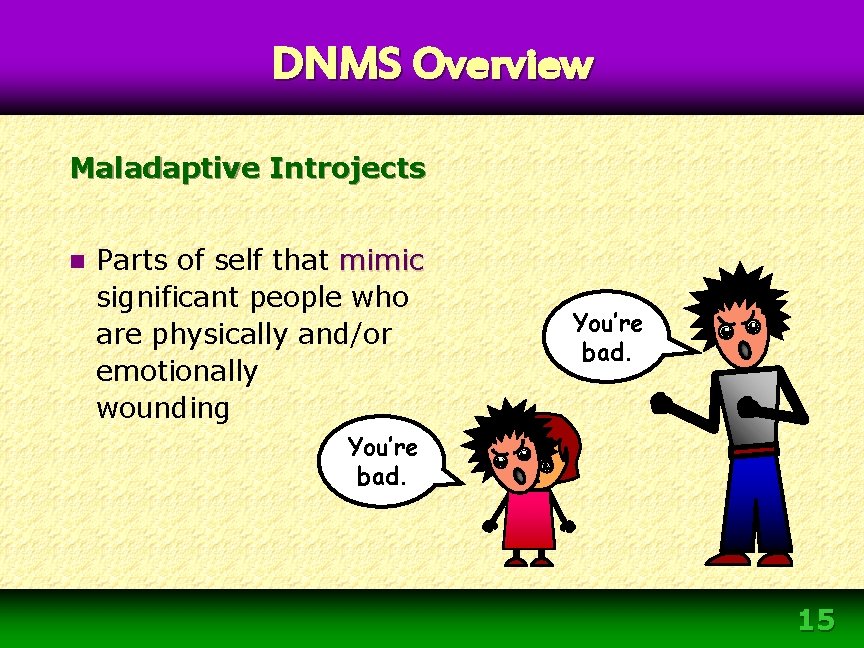
DNMS Overview Maladaptive Introjects n Parts of self that mimic significant people who are physically and/or emotionally wounding You’re bad. 15
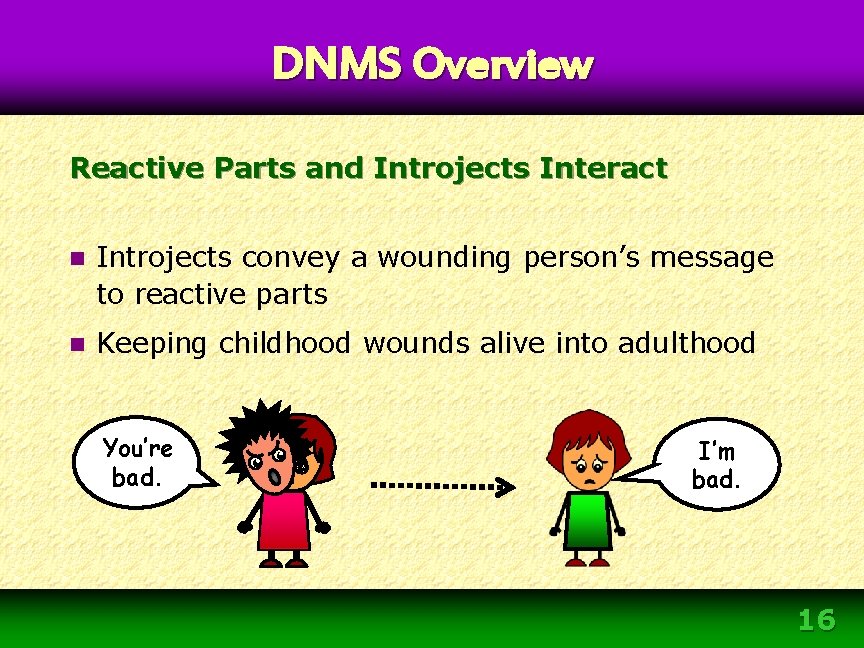
DNMS Overview Reactive Parts and Introjects Interact n Introjects convey a wounding person’s message to reactive parts n Keeping childhood wounds alive into adulthood You’re bad. I’m bad. 16
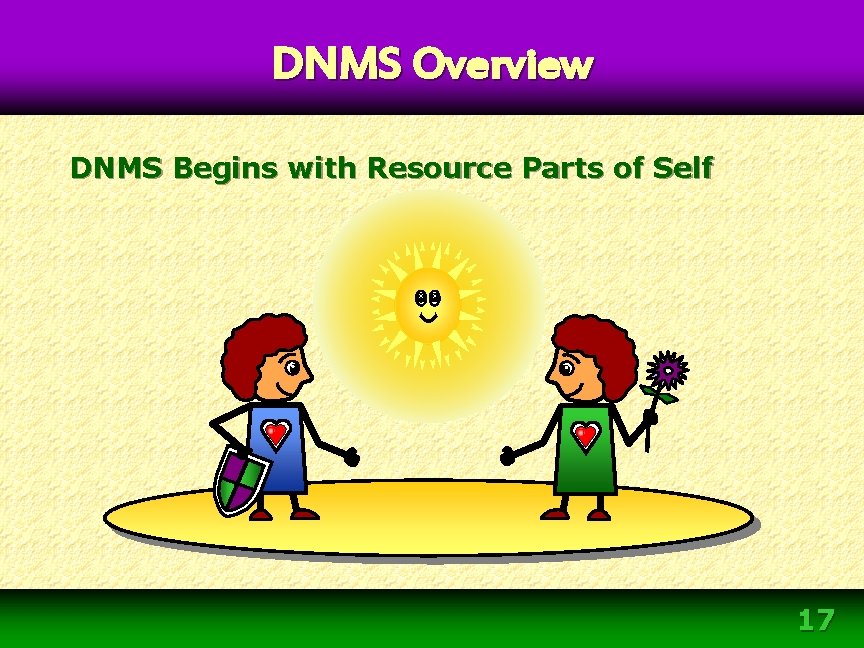
DNMS Overview DNMS Begins with Resource Parts of Self 17
DNMS Overview Identify Wounded Parts You’re worthless I’m worthless 18
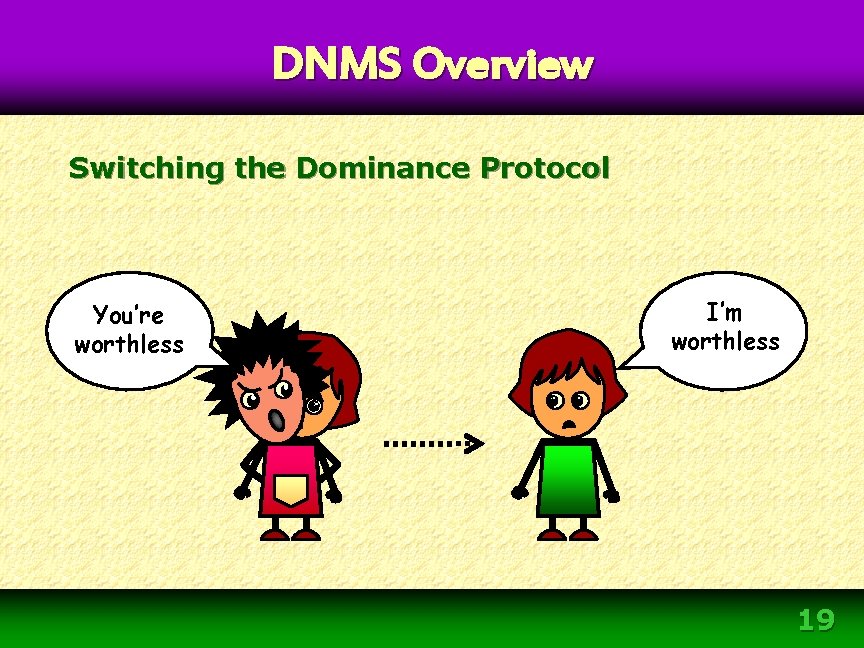
DNMS Overview Switching the Dominance Protocol You’re worthless I’m worthless 19
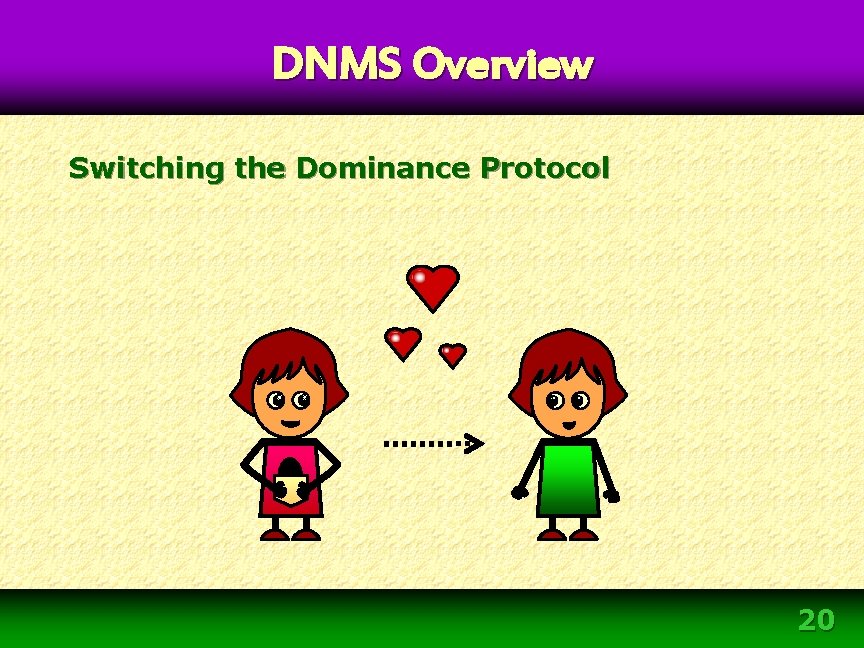
DNMS Overview Switching the Dominance Protocol 20
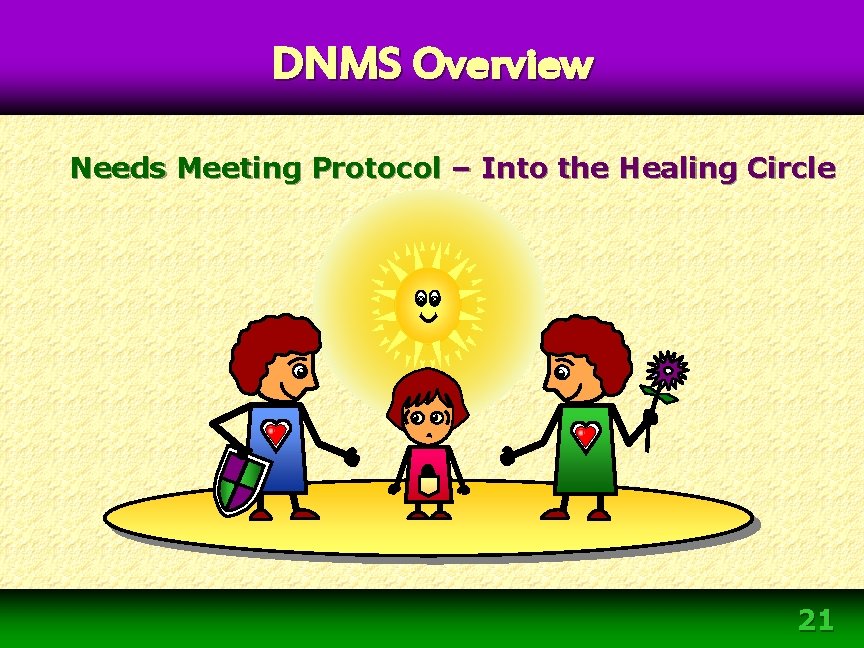
DNMS Overview Needs Meeting Protocol – Into the Healing Circle 21
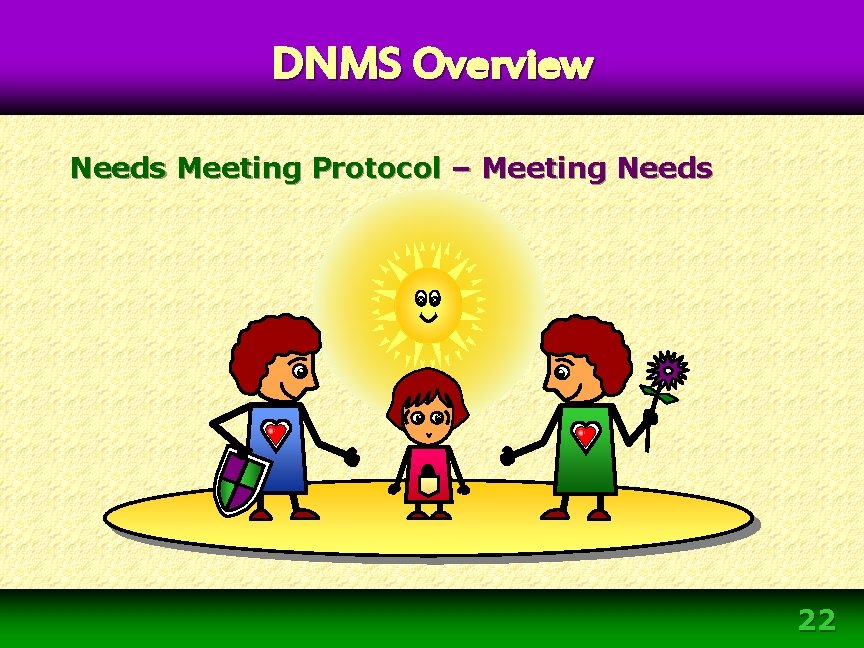
DNMS Overview Needs Meeting Protocol – Meeting Needs 22
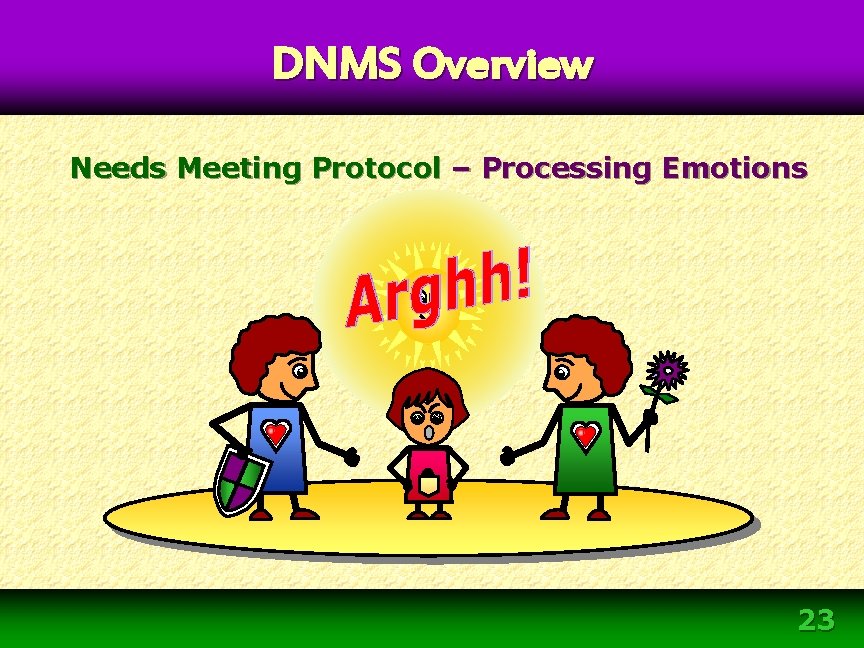
DNMS Overview Needs Meeting Protocol – Processing Emotions 23
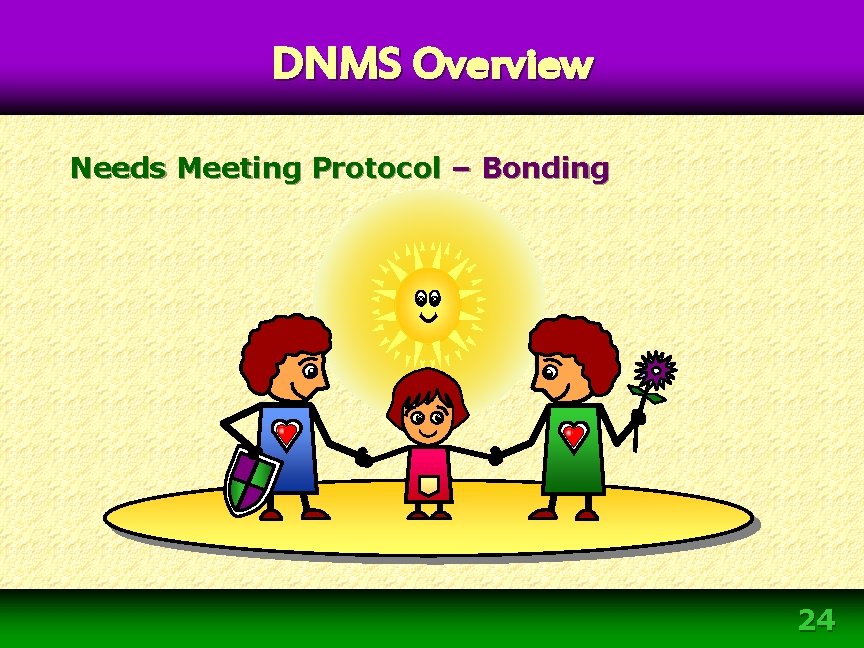
DNMS Overview Needs Meeting Protocol – Bonding 24
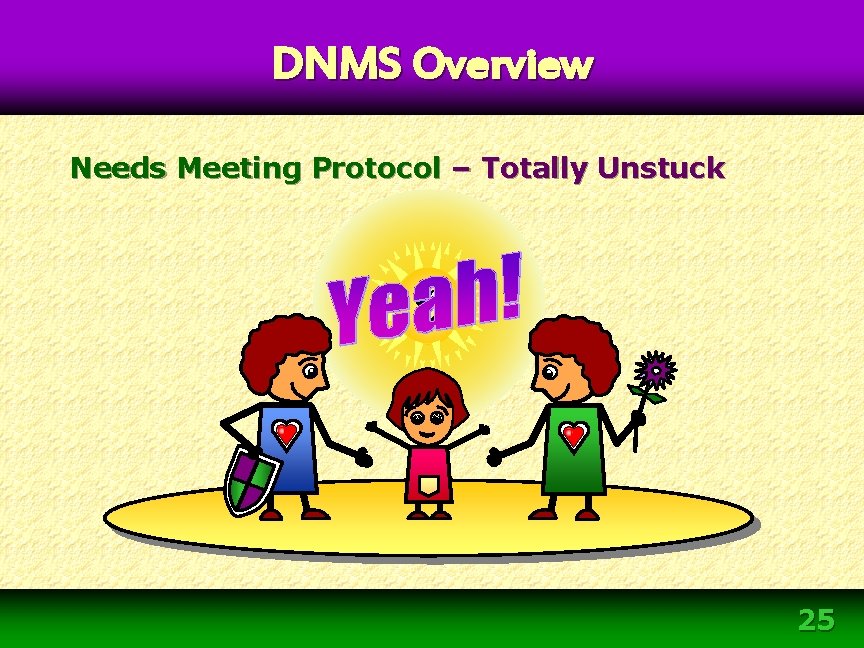
DNMS Overview Needs Meeting Protocol – Totally Unstuck 25
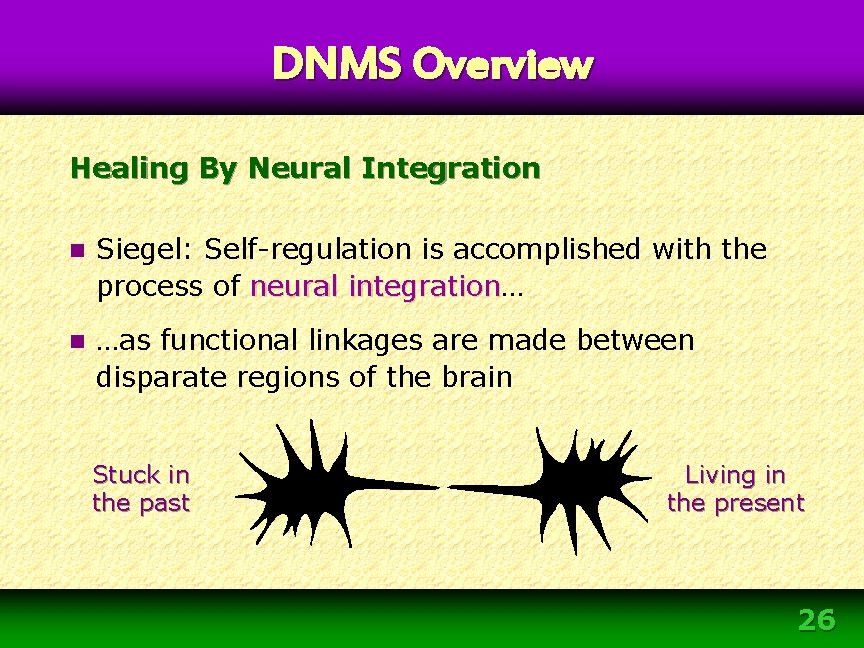
DNMS Overview Healing By Neural Integration n Siegel: Self-regulation is accomplished with the process of neural integration… integration n …as functional linkages are made between disparate regions of the brain Stuck in the past Living in the present 26
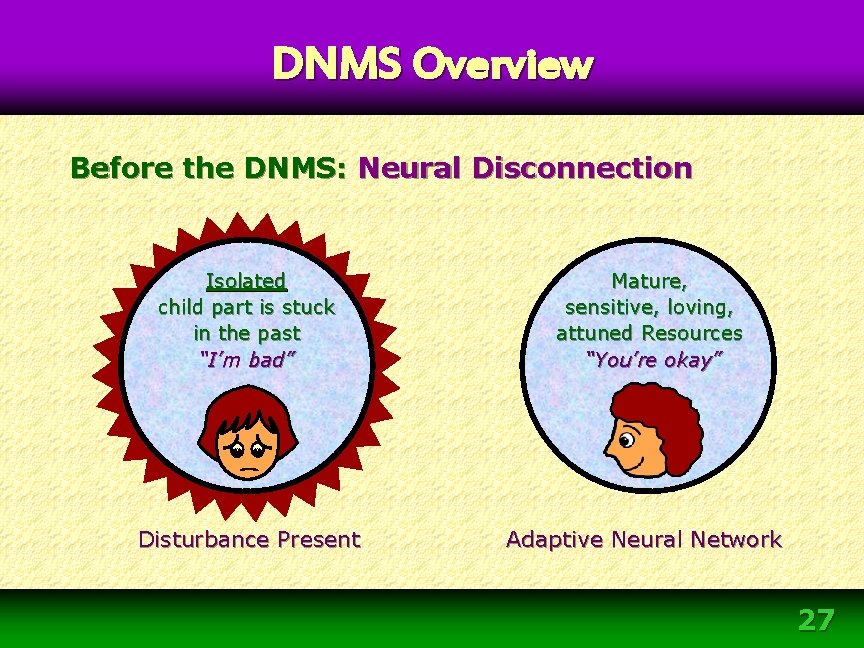
DNMS Overview Before the DNMS: Neural Disconnection Isolatede daptiv A child part is stuck in the past “I’m bad” Mature, sensitive, loving, attuned Resources “You’re okay” Disturbance Present Adaptive Neural Network 27
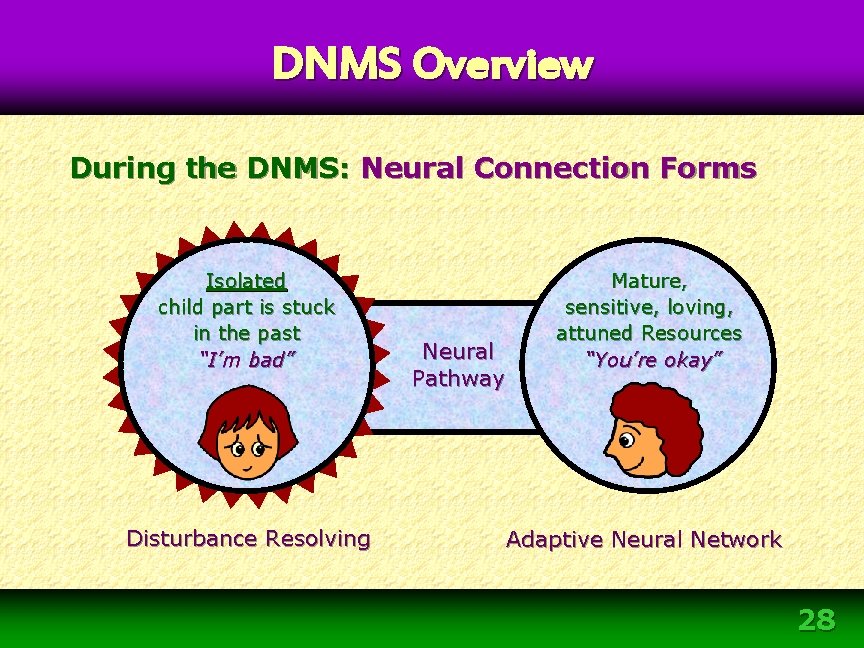
DNMS Overview During the DNMS: Neural Connection Forms Isolated child part is stuck in the past “I’m bad” Disturbance Resolving Neural Pathway Mature, sensitive, loving, attuned Resources “You’re okay” Adaptive Neural Network 28
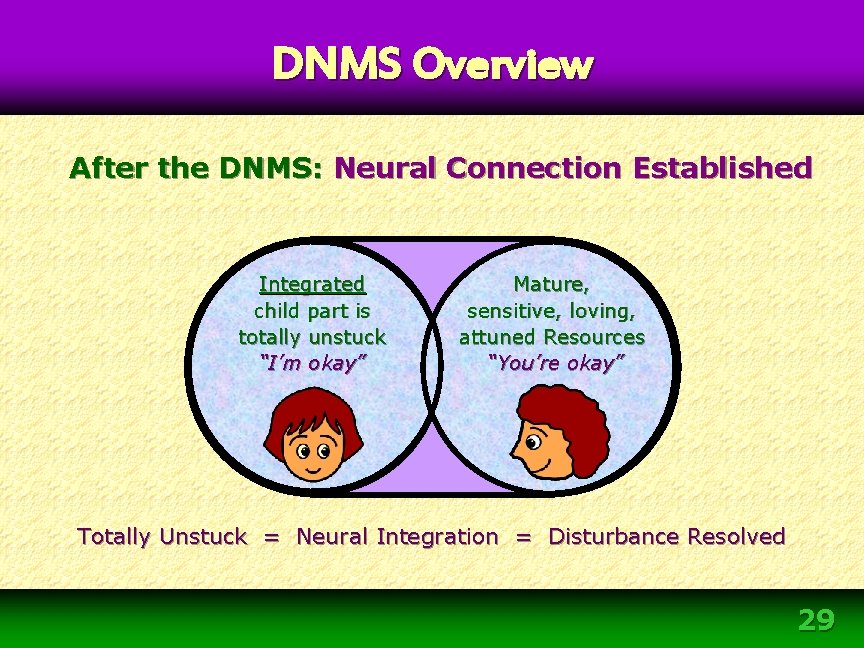
DNMS Overview After the DNMS: Neural Connection Established Integrated child part is totally unstuck “I’m okay” Mature, sensitive, loving, attuned Resources “You’re okay” Totally Unstuck = Neural Integration = Disturbance Resolved 29
DNMS Overview Neural Architecture n Many clients lack the neural architecture to regulate emotions well n DNMS endeavors to develop/strengthen the n neural networks n neural pathways n for self-regulation of emotion 30
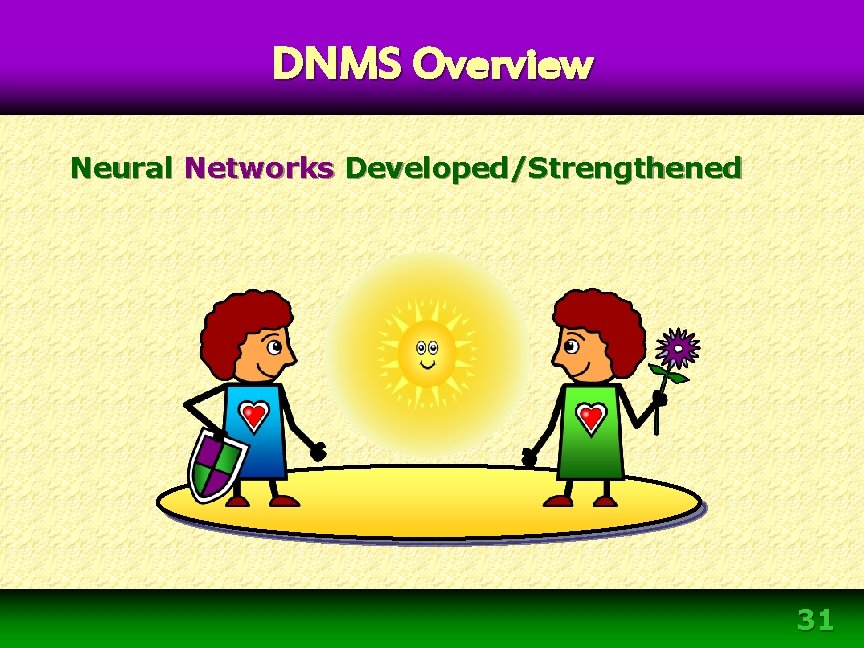
DNMS Overview Neural Networks Developed/Strengthened 31
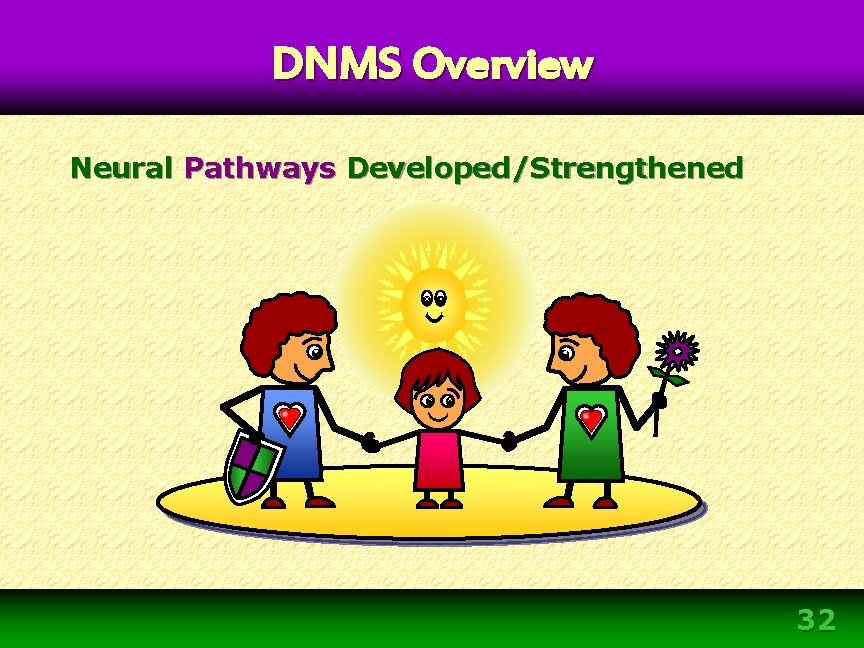
DNMS Overview Neural Pathways Developed/Strengthened 32
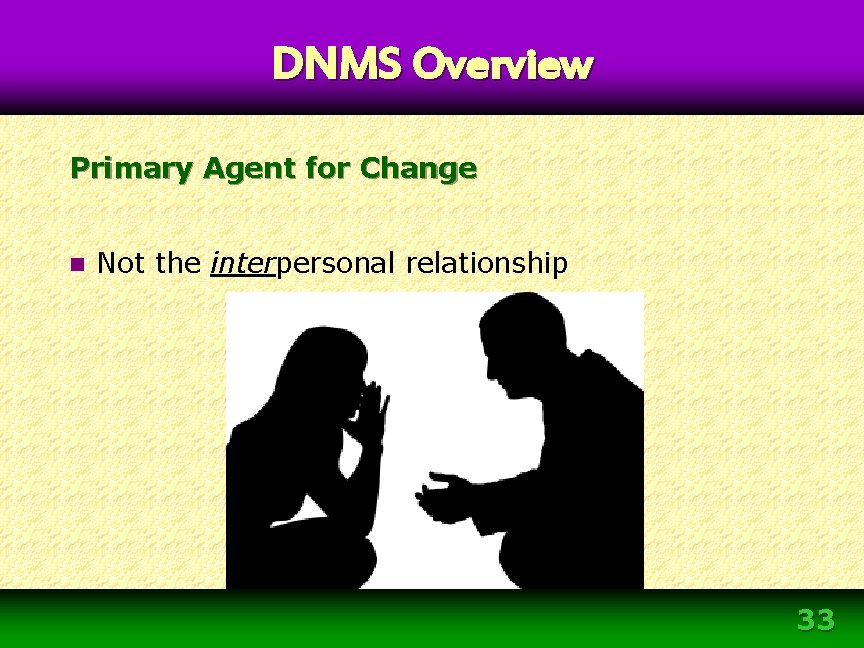
DNMS Overview Primary Agent for Change n Not the interpersonal relationship 33
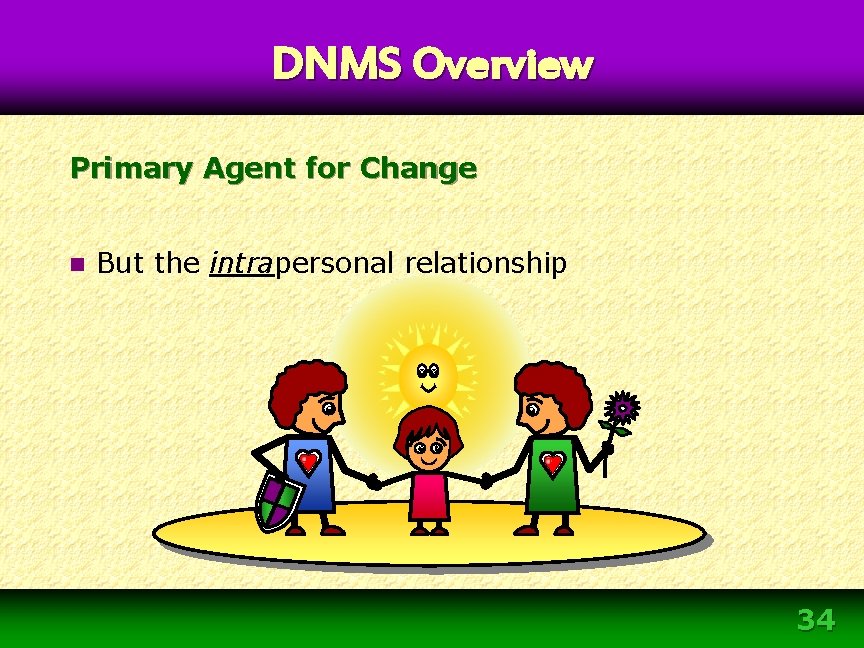
DNMS Overview Primary Agent for Change n But the intrapersonal relationship 34
DNMS Overview Alternating Bilateral Stimulation (ABS) n First used in EMDR therapy n Applied with n rapid back and forth eye movements n alternating auditory stimulation n alternating bilateral tactile 35
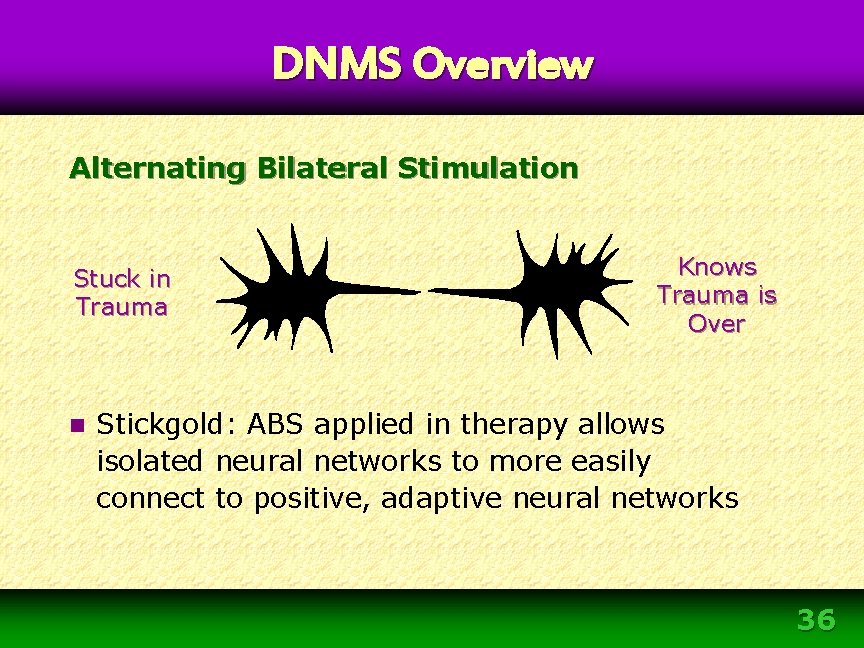
DNMS Overview Alternating Bilateral Stimulation Stuck in Trauma n Knows Trauma is Over Stickgold: ABS applied in therapy allows isolated neural networks to more easily connect to positive, adaptive neural networks 36
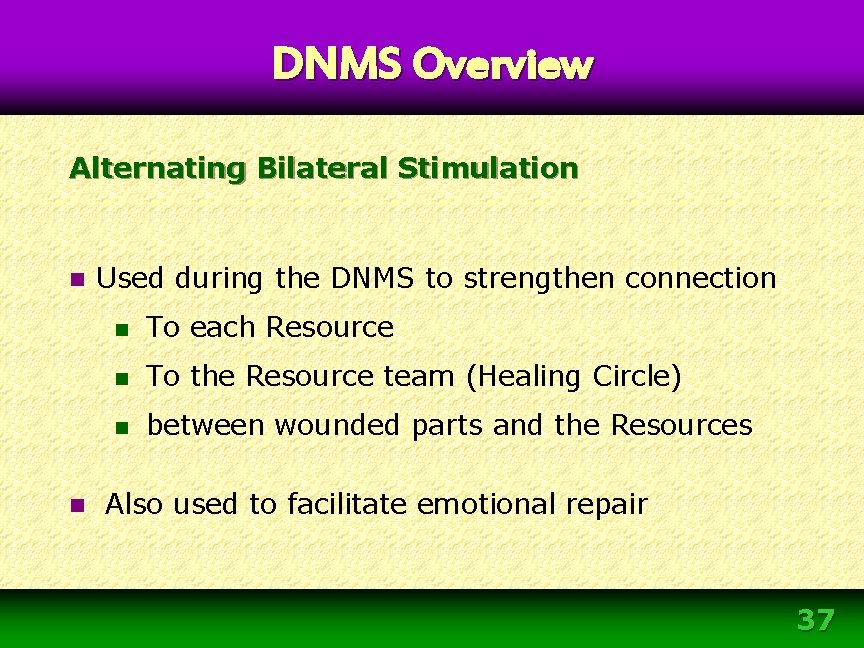
DNMS Overview Alternating Bilateral Stimulation n n Used during the DNMS to strengthen connection n To each Resource n To the Resource team (Healing Circle) n between wounded parts and the Resources Also used to facilitate emotional repair 37
Questions? 38
This Presentation DNMS Overview RDP Introduction Client Preparation Resource Mobilization Provisional Resources RDP Complications DNMS Training 39
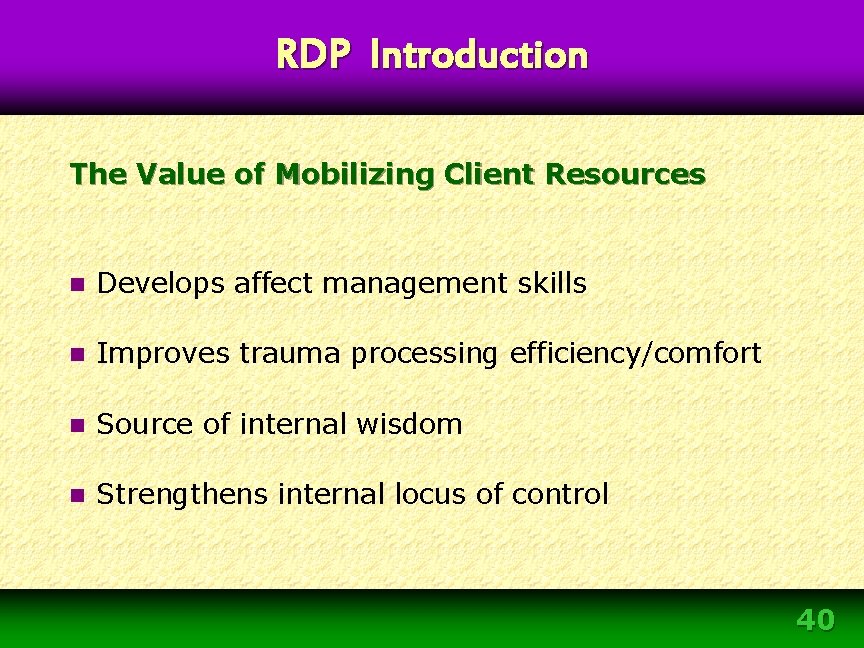
RDP Introduction The Value of Mobilizing Client Resources n Develops affect management skills n Improves trauma processing efficiency/comfort n Source of internal wisdom n Strengthens internal locus of control 40
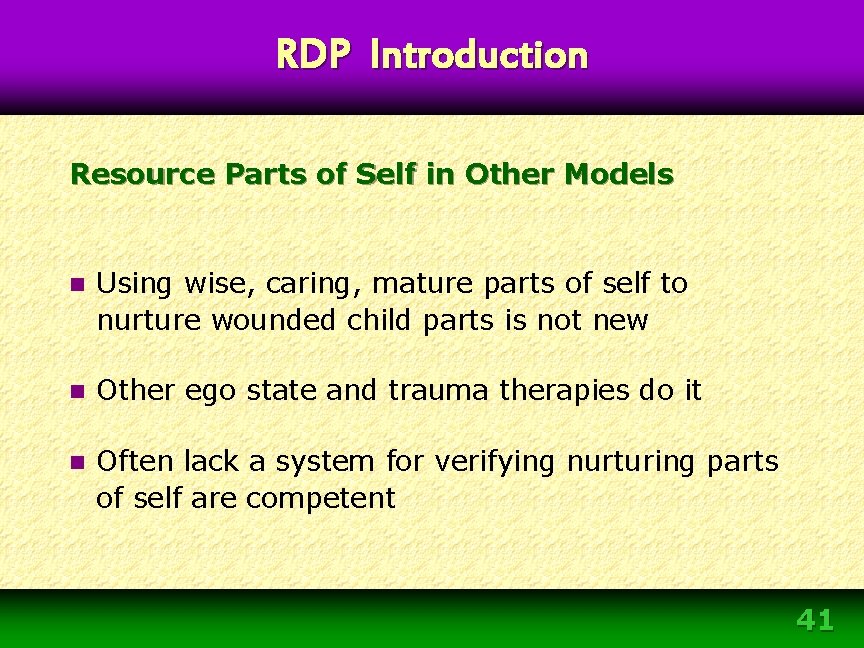
RDP Introduction Resource Parts of Self in Other Models n Using wise, caring, mature parts of self to nurture wounded child parts is not new n Other ego state and trauma therapies do it n Often lack a system for verifying nurturing parts of self are competent 41
RDP Introduction Resource Parts of Self in Other Models n Incompetent “Resources” are not helpful n Some cannot readily mobilize Resources n May feel shame that they cannot “do it right” n Can exacerbate a sense of inadequacy 42
RDP Introduction Importance of Robust Resources n DNMS success depends on robust Resources n Protocol described here designed to: n n Establish robust Resources n Verify they are robust n Signal when processing blocks are present Later I’ll describe how blocks are cleared 43
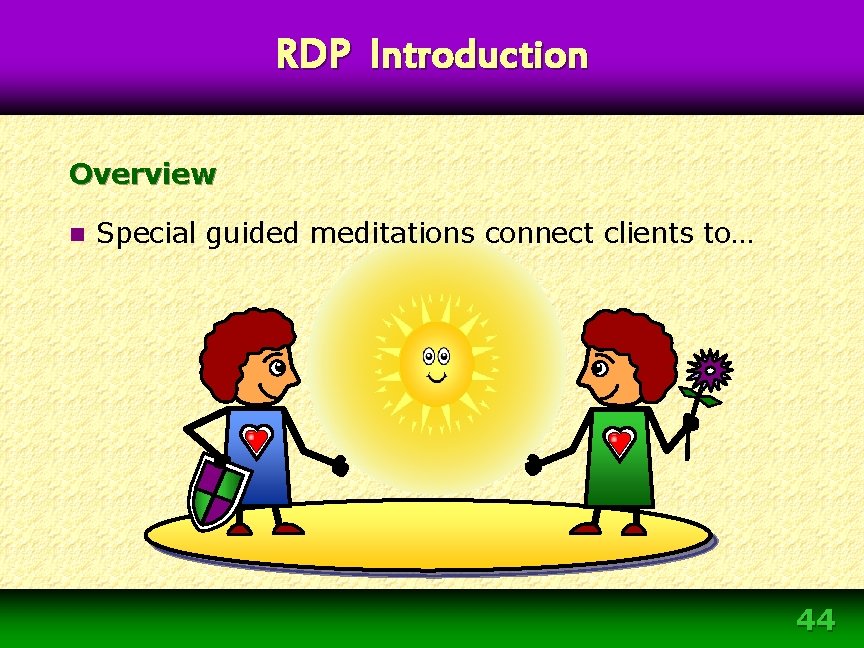
RDP Introduction Overview n Special guided meditations connect clients to… 44
RDP Introduction Benefits of Resources n Can provide compassion, wisdom, empathy, reassurance, and advice, at any time, for any topic… n during sessions n between sessions 45
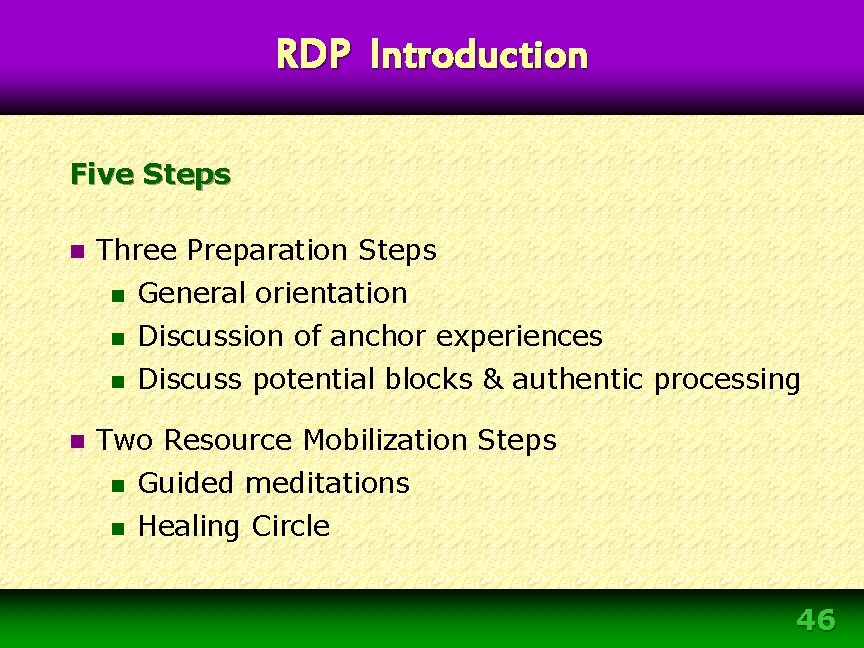
RDP Introduction Five Steps n n Three Preparation Steps n General orientation n Discussion of anchor experiences n Discuss potential blocks & authentic processing Two Resource Mobilization Steps n Guided meditations n Healing Circle 46
This Presentation DNMS Overview RDP Introduction Client Preparation Resource Mobilization Provisional Resources RDP Complications DNMS Training 47
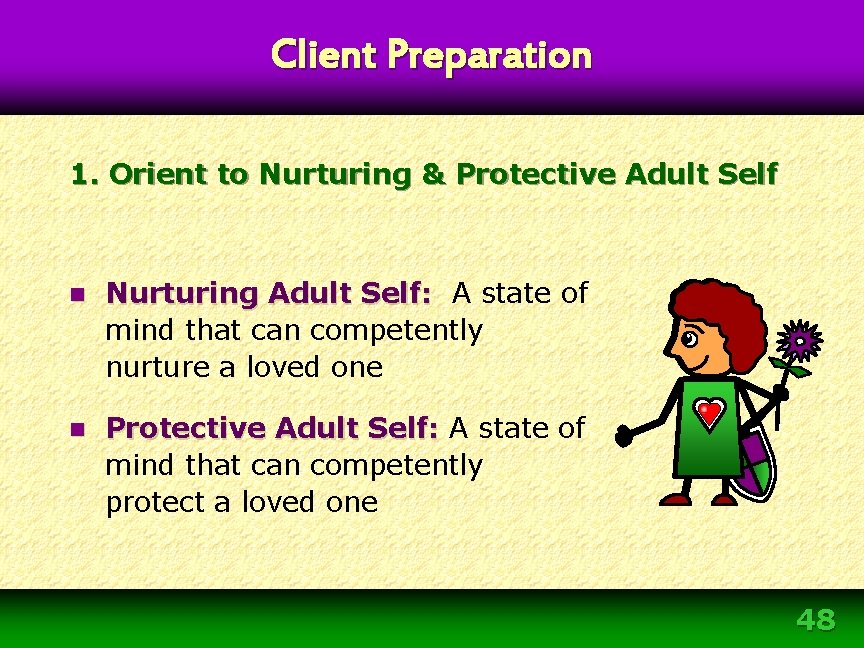
Client Preparation 1. Orient to Nurturing & Protective Adult Self n Nurturing Adult Self: A state of mind that can competently nurture a loved one n Protective Adult Self: A state of mind that can competently protect a loved one 48
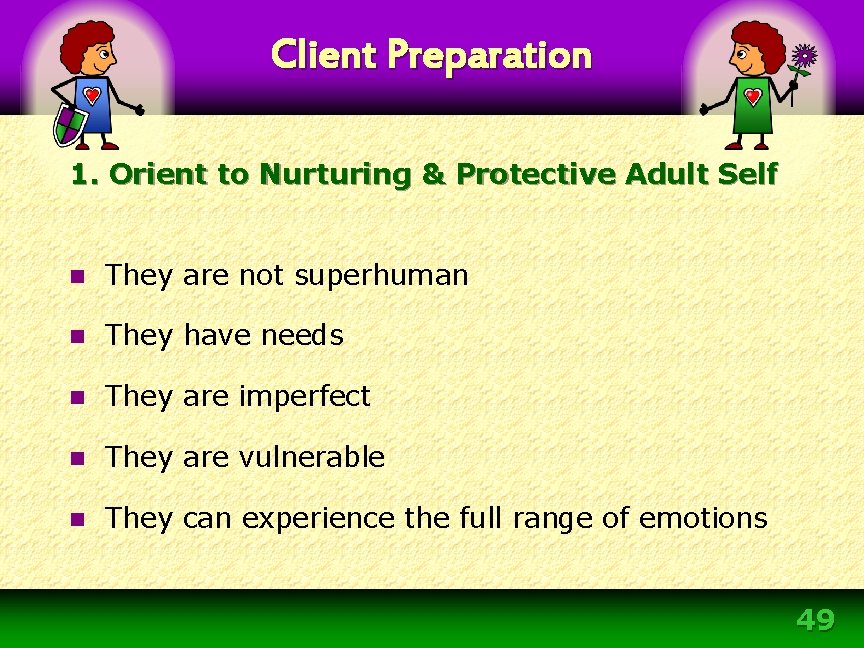
Client Preparation 1. Orient to Nurturing & Protective Adult Self n They are not superhuman n They have needs n They are imperfect n They are vulnerable n They can experience the full range of emotions 49
Client Preparation 1. Orient to Nurturing & Protective Adult Self n They can n meet their own needs n regulate their own emotions n manage their own vulnerabilities n learn and grow from their mistakes 50
Client Preparation 1. Orient to Nurturing & Protective Adult Self n Two guided meditations are used to connect to these Resources n Both are based on a single list of 24 caregiver skills and traits 51
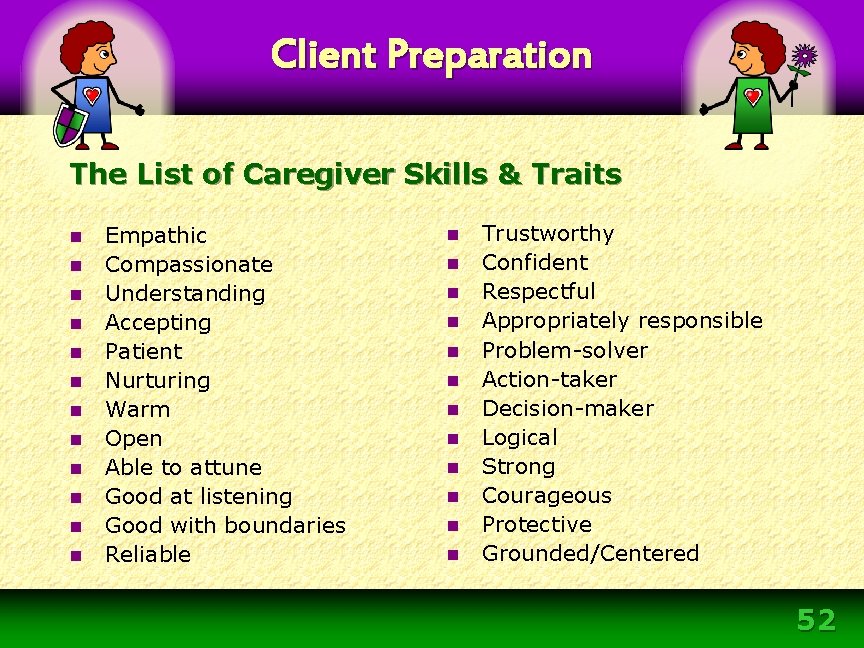
Client Preparation The List of Caregiver Skills & Traits n n n Empathic Compassionate Understanding Accepting Patient Nurturing Warm Open Able to attune Good at listening Good with boundaries Reliable n n n Trustworthy Confident Respectful Appropriately responsible Problem-solver Action-taker Decision-maker Logical Strong Courageous Protective Grounded/Centered 52
Client Preparation 1. Orient to Nurturing & Protective Adult Self n The Nurturing Adult Self meditation n begins with the most nurturing traits n n ends with the protective traits The Protective Adult Self meditation n begins with the most protective traits n ends with the nurturing traits 53
Client Preparation 1. Orient to Spiritual Core Self n Considered the core of one’s being n Some call it the soul n May have existed before the body arrived n May exist after the body dies 54
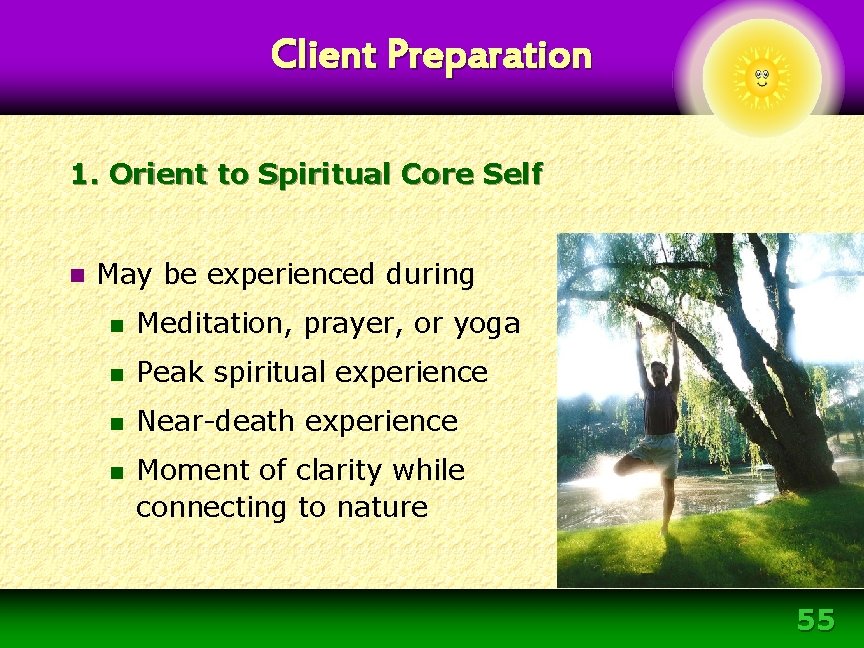
Client Preparation 1. Orient to Spiritual Core Self n May be experienced during n Meditation, prayer, or yoga n Peak spiritual experience n Near-death experience n Moment of clarity while connecting to nature 55
Client Preparation 1. Orient to Spiritual Core Self n A sense of interconnectedness to all beings n A sense of completeness and wholeness n A sense of safety and invulnerability n No ego, no struggles n No desires or aversions n Unconditional, effortless kindness and compassion n Timeless, cosmic wisdom, and understanding 56
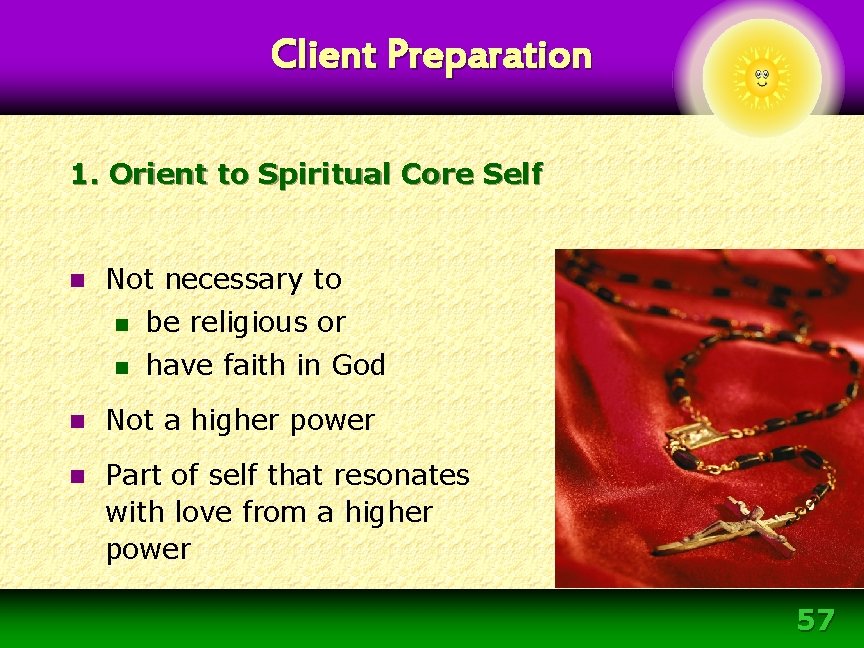
Client Preparation 1. Orient to Spiritual Core Self n Not necessary to n be religious or n have faith in God n Not a higher power n Part of self that resonates with love from a higher power 57
Client Preparation 1. Orient to Spiritual Core Self n Not just a feel-good state of mind n Transcendent state that’s unwoundable n A place of inner peace in spite of life’s struggles 58
Client Preparation 1. Orient to Spiritual Core Self n n Some are averse to anything “spiritual” n Atheists n Unresolved religious wounds Several meditations - only one uses the word spiritual 59
Client Preparation 2. Finding the Anchors n An anchor is a positive personal experience n Connects client to a Resource state of mind n Reflect on anchor experiences during meditations n This facilitates the connection to each Resource 60
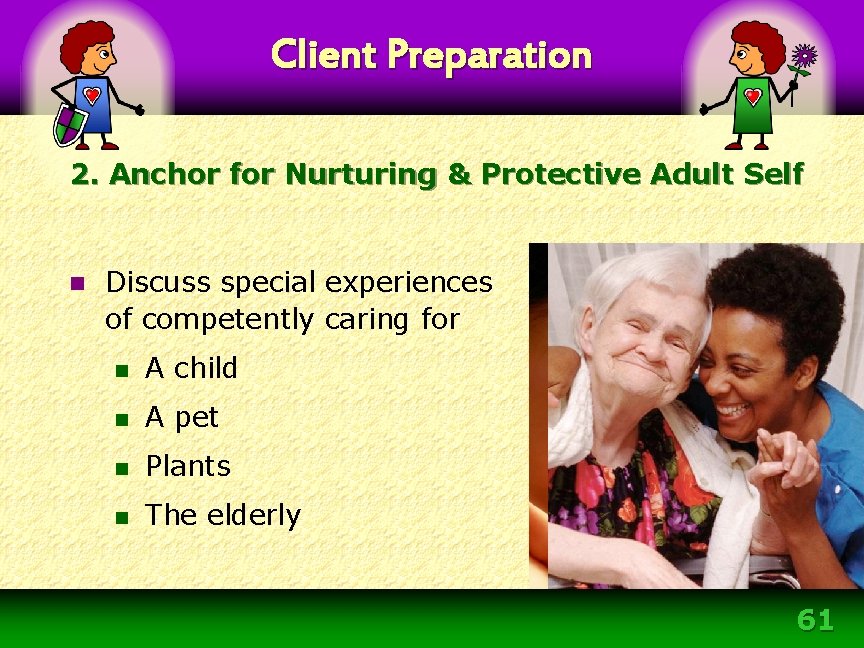
Client Preparation 2. Anchor for Nurturing & Protective Adult Self n Discuss special experiences of competently caring for n A child n A pet n Plants n The elderly 61
Client Preparation 2. Anchor for Nurturing & Protective Adult Self n A familiar relationship or event when caregiver skills are (or were) n naturally, effortlessly, appropriately applied n at the same time n while in an adult state of mind 62
Client Preparation 2. Anchor for Nurturing & Protective Adult Self n With that in mind, have client look at skill list n Is there a skill on list not present in this relationship/event? n If so, discuss it 63
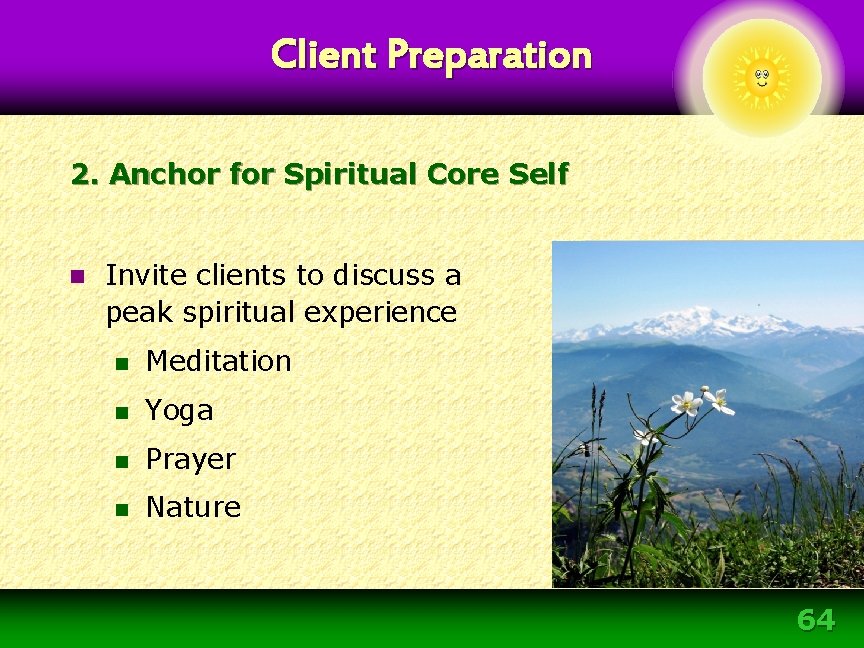
Client Preparation 2. Anchor for Spiritual Core Self n Invite clients to discuss a peak spiritual experience n Meditation n Yoga n Prayer n Nature 64
Client Preparation 2. Anchor for Spiritual Core Self n Good anchor is not just a feel-good experience n Should evoke a spiritual state of mind (list) n Most will have an anchoring experience n Some will not 65
Client Preparation 3. Prepare Clients for Potential Blocks n n It helps to prepare clients for n for potential blocks that might arise n to process authentically Here are sample scripts for that 66
Client Preparation 3. Prepare Clients for Potential Blocks Sometimes while connecting to Resources, concerns or fears about the processing will arise. Unconscious fears may be expressed by the sudden arrival of a body disturbance such as unpleasant sensations, dissociation, distracting thoughts, numbness, or sleepiness. That may or may not happen to you, but if it does, please tell me about it, even if it doesn’t seem important. You’re welcome to have concerns or fears – just let me know if they come up. I’ll want to address them right away. 67
Client Preparation 3. Prepare Clients for Authentic Processing Be sure to tell me about whatever comes up, even if you think its wrong – even if you’re confused. It might not make sense to you, but it might make sense to me. If it doesn’t – together we’ll figure it out. We will not successfully complete this protocol if we do this over unexpressed fears or concerns, or if you don’t authentically disclose what’s coming up. 68
Questions? 69
This Presentation DNMS Overview RDP Introduction Client Preparation Resource Mobilization Provisional Resources RDP Complications DNMS Training 70
Resource Mobilization Guided Meditations n Start with easiest Resource to connect to n Check for blocks When you think about beginning the meditation to connect you to your _____ now, what do you notice in your body? n Investigate any disturbances reported 71
Resource Mobilization Guided Meditations n DNMS model contains special protocols for identifying and clearing blocks n Clear any blocks that are found n Then ask again… When you think about beginning the meditation… n When clear, begin the meditation 72
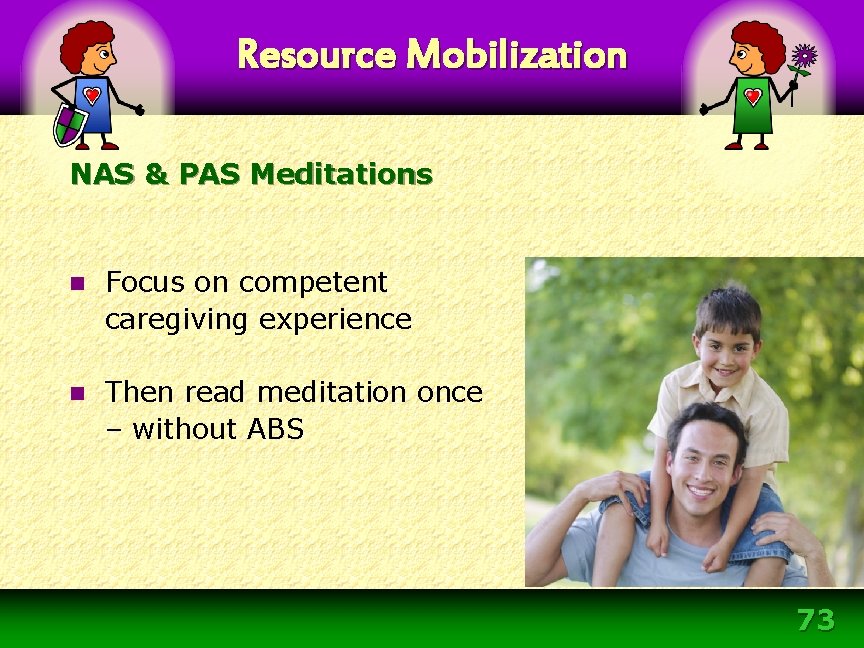
Resource Mobilization NAS & PAS Meditations n Focus on competent caregiving experience n Then read meditation once – without ABS 73
Resource Mobilization Nurturing Adult Self Meditation Think about _____ as I name each skill on the list. Nod or say “yes” with each skill you know you have. Stop me if I name a skill you believe you don’t have, or if you feel any discomfort that suggests a block is arising. Close your eyes (if that’s comfortable) and take a deep breath. Now get in touch with the following skills and traits, which you already have, including your ability to be empathic… compassionate… understanding… accepting… patient… 74
Resource Mobilization Nurturing Adult Self Meditation nurturing… warm… open… able to attune… good at listening… good with boundaries… reliable… trustworthy… confident… respectful… appropriately responsible… problem-solver… action-taker… decisionmaker… logical… strong… courageous… protective… and grounded. Now, bring all these skills together into a single sense of self, your Nurturing Adult Self, and when you’re ready, tell me what you notice. 75
Resource Mobilization Nurturing Adult Self Meditation n If the body feels good, apply ABS n Read list again to let it strengthen n This time not interactive n Afterwards should feel strong and positive 76
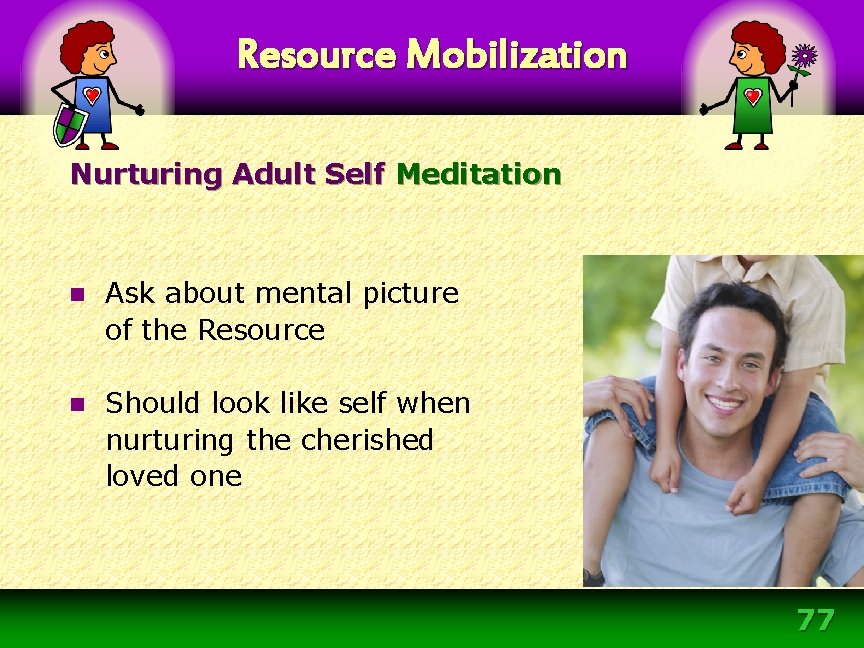
Resource Mobilization Nurturing Adult Self Meditation n Ask about mental picture of the Resource n Should look like self when nurturing the cherished loved one 77
Resource Mobilization Protective Adult Self Meditation n Follow same steps to mobilize the Protective Adult Self n Read meditation words in reverse order n Strengthen good feeling with ABS n Ask about a mental picture 78
Resource Mobilization Spiritual Core Self Meditation n n Four meditation options n Regular Spiritual Core Self Meditation n Breath Meditation n List Meditation If one doesn’t work, try another 79
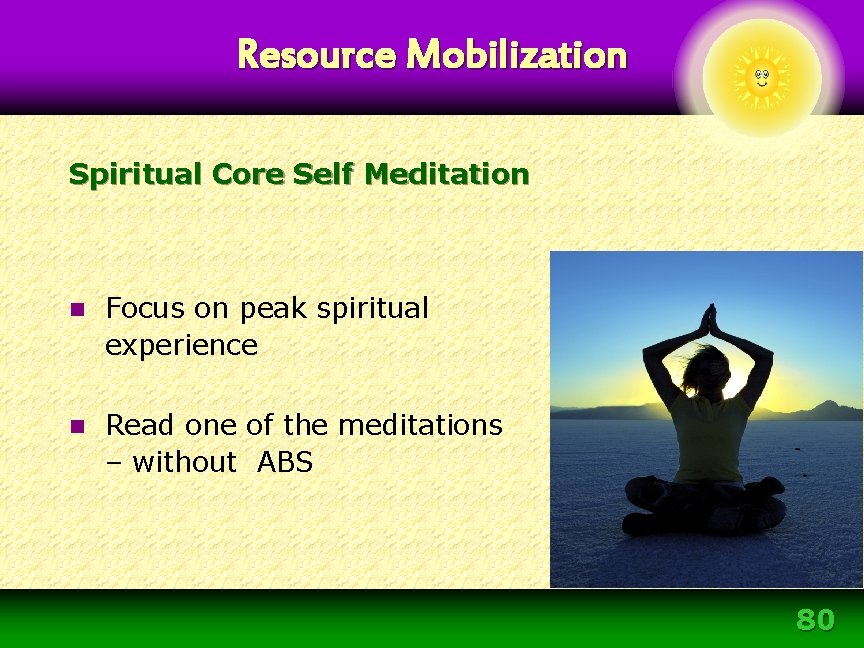
Resource Mobilization Spiritual Core Self Meditation n Focus on peak spiritual experience n Read one of the meditations – without ABS 80
Resource Mobilization Regular Spiritual Core Self Meditation Close your eyes and take a deep breath. Think about your ______ experience. Now get in touch with the center of your being… that place within you that’s quiet… peaceful… and still. And in this place… it’s possible you’ll connect to your Spiritual Core. Your Spiritual Core has been with you from the beginning… it’s the essence of who you are… your core of goodness. Pure… resilient… and whole. And your body knows exactly how to connect you. Notice as you connect to this part of you, and when you’re ready, tell me what you notice. 81
Resource Mobilization The Core Self Meditation Close your eyes and take a deep breath. Think about your ______ experience. Now get in touch with the center of your being… that place within you that’s quiet… peaceful… and still. And in this place… it’s possible you’ll connect to your Core Self. Your Core Self has been with you from the beginning… it’s the essence of who you are… your core of goodness. Pure… resilient… and whole. And your body knows exactly how to connect you. Notice as you connect to this part of you, and when you’re ready, tell me what you notice. 82
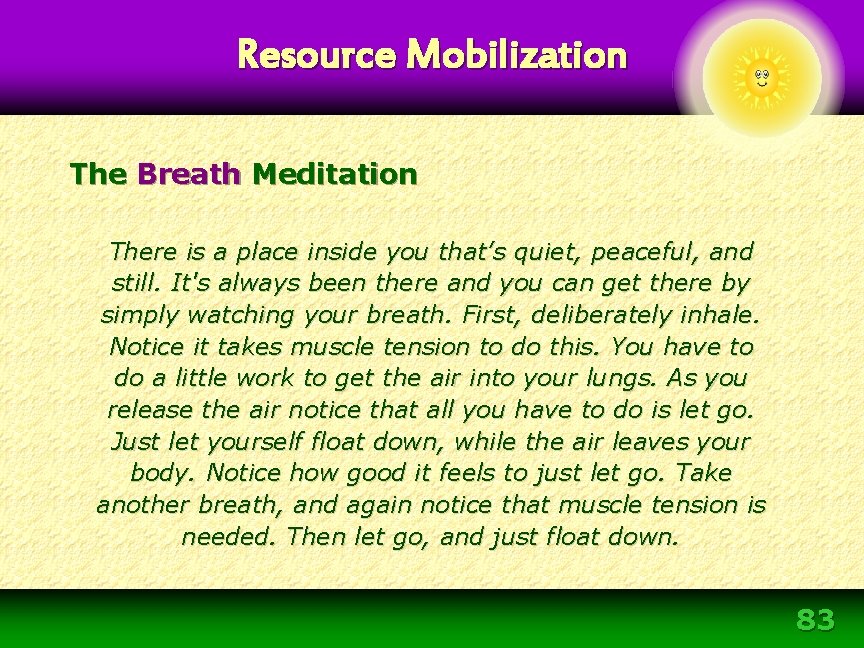
Resource Mobilization The Breath Meditation There is a place inside you that’s quiet, peaceful, and still. It's always been there and you can get there by simply watching your breath. First, deliberately inhale. Notice it takes muscle tension to do this. You have to do a little work to get the air into your lungs. As you release the air notice that all you have to do is let go. Just let yourself float down, while the air leaves your body. Notice how good it feels to just let go. Take another breath, and again notice that muscle tension is needed. Then let go, and just float down. 83
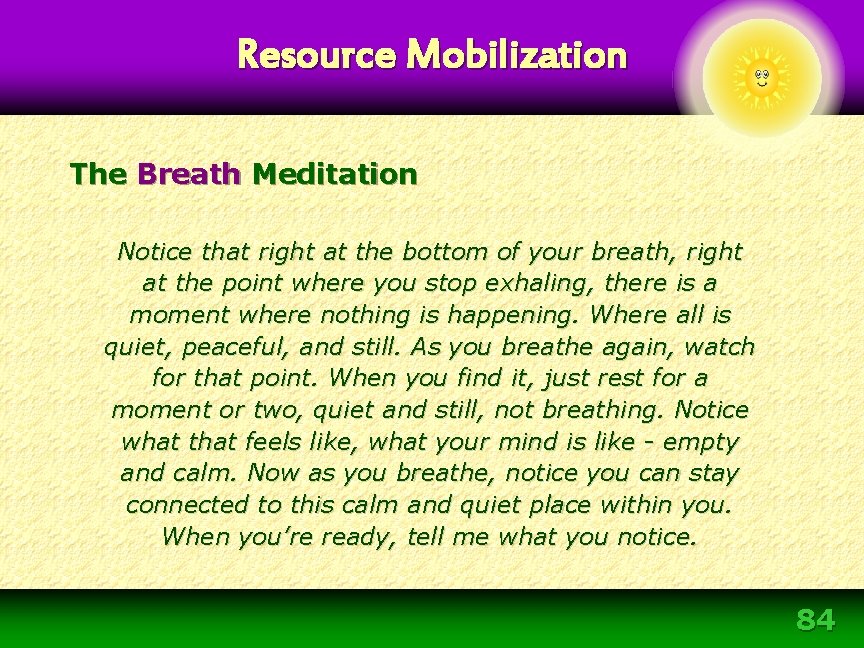
Resource Mobilization The Breath Meditation Notice that right at the bottom of your breath, right at the point where you stop exhaling, there is a moment where nothing is happening. Where all is quiet, peaceful, and still. As you breathe again, watch for that point. When you find it, just rest for a moment or two, quiet and still, not breathing. Notice what that feels like, what your mind is like - empty and calm. Now as you breathe, notice you can stay connected to this calm and quiet place within you. When you’re ready, tell me what you notice. 84
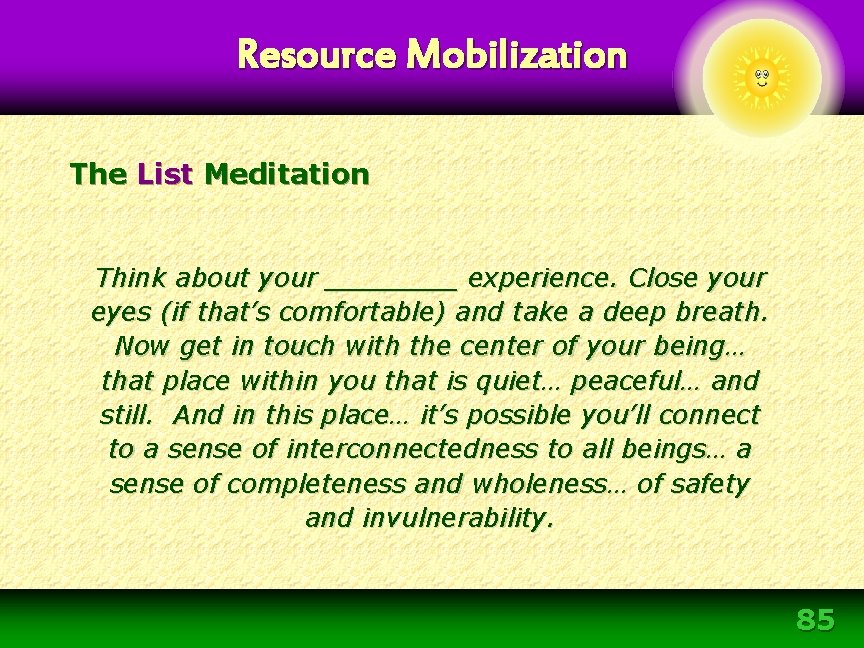
Resource Mobilization The List Meditation Think about your ____ experience. Close your eyes (if that’s comfortable) and take a deep breath. Now get in touch with the center of your being… that place within you that is quiet… peaceful… and still. And in this place… it’s possible you’ll connect to a sense of interconnectedness to all beings… a sense of completeness and wholeness… of safety and invulnerability. 85
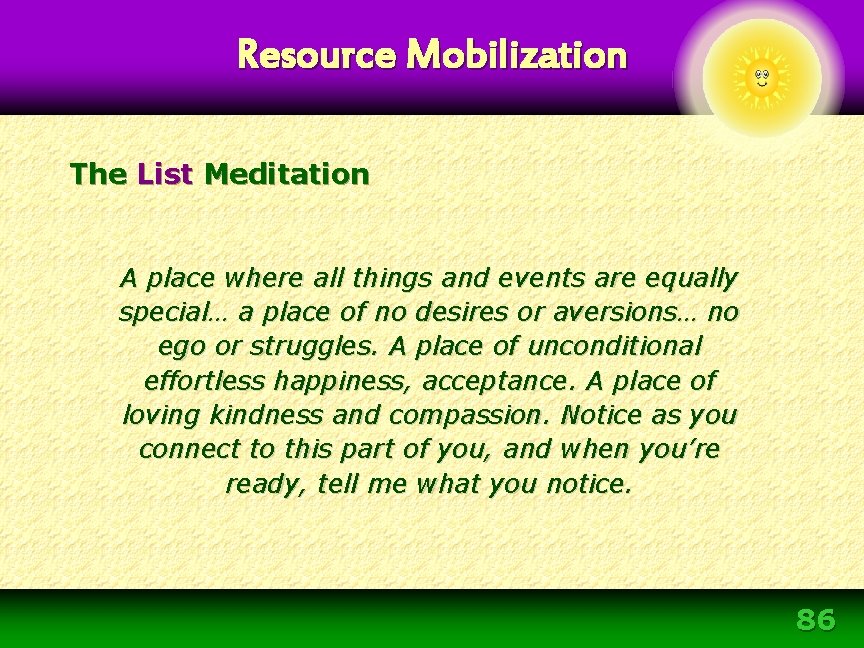
Resource Mobilization The List Meditation A place where all things and events are equally special… a place of no desires or aversions… no ego or struggles. A place of unconditional effortless happiness, acceptance. A place of loving kindness and compassion. Notice as you connect to this part of you, and when you’re ready, tell me what you notice. 86
Resource Mobilization Spiritual Core Self Meditation n If it feels good, apply ABS n Ask about a mental picture n SCS should appear as luminous energy 87
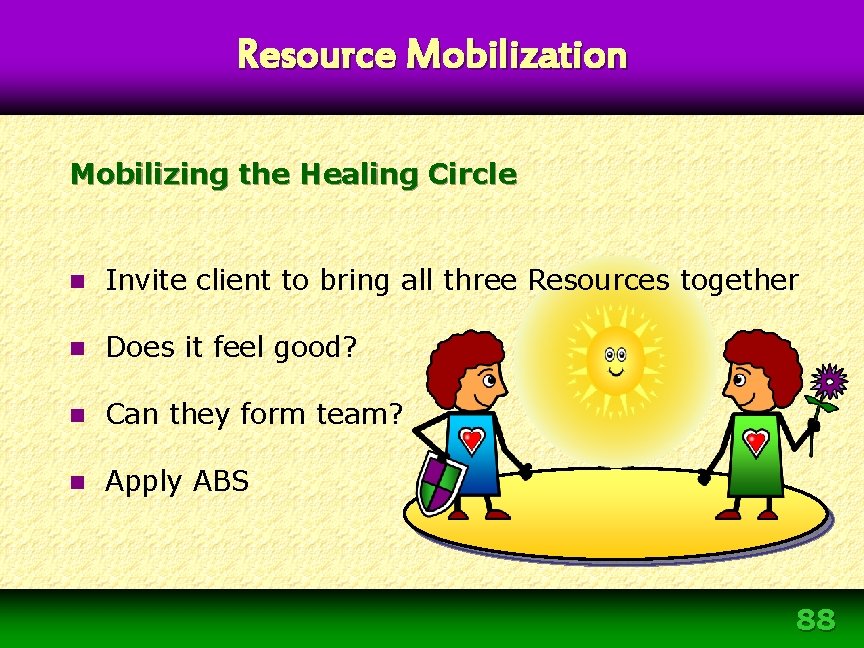
Resource Mobilization Mobilizing the Healing Circle n Invite client to bring all three Resources together n Does it feel good? n Can they form team? n Apply ABS 88
Resource Mobilization Mobilizing the Healing Circle n Then say… You now have a team of Resources to provide comfort, reassurance, and soothing. In the future these Resources will be able to help wounded child parts get all their needs met and get completely unstuck from the past. 89
Questions? 90
This Presentation DNMS Overview RDP Introduction Client Preparation Resource Mobilization Provisional Resources RDP Complications DNMS Training 91
Provisional Resources What is a Provisional Resource (PR)? n A Resource you can use temporarily, until your Healing Circle team is established n Not as robust as NAS, PAS, & SCS n Like a spare tire – can carry a light load 92
Provisional Resources Why Connect to a Provisional Resource? n Some clients encounter deep-seated blocks when they mobilize these Resources n It helps to have at least one Resource to call on to help clear such blocks n For example, a NAS can help you clear a block to connecting to a PAS 93
Provisional Resources Why Connect to a Provisional Resource? n But client may blocked from connecting to all three Resources n A PR can help clear those blocks n Usually very easy to connect to 94
Provisional Resources Connecting to Provisional Resources n Can be drawn from experiences with any entity perceived as supportive and kind n Self n Other n Real n Imaginary 95
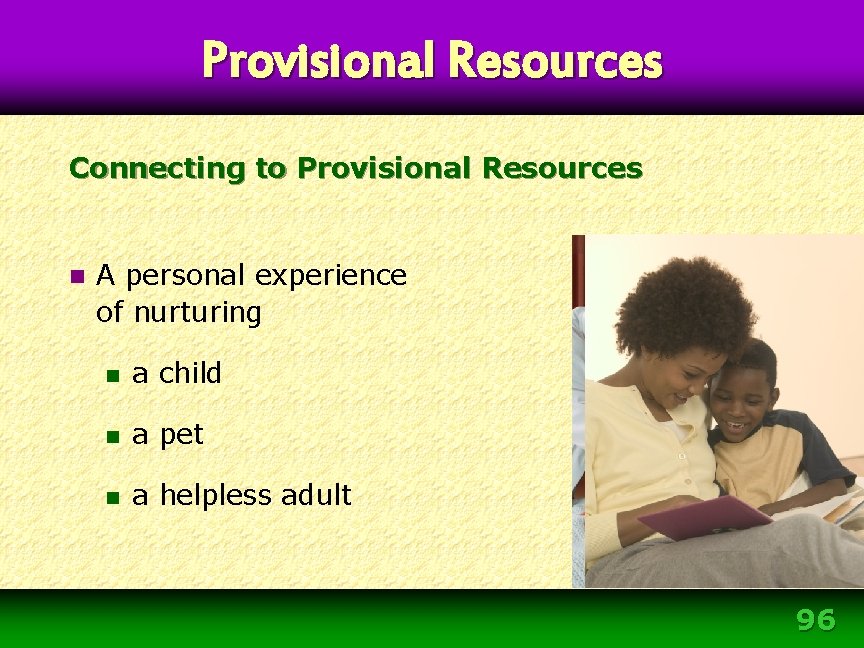
Provisional Resources Connecting to Provisional Resources n A personal experience of nurturing n a child n a pet n a helpless adult 96
Provisional Resources Connecting to Provisional Resources n Experience of being supported by: n someone nurturing n a deceased loved one n a spirit guide n a fictional character n a mythical archetype n a religious figure 97
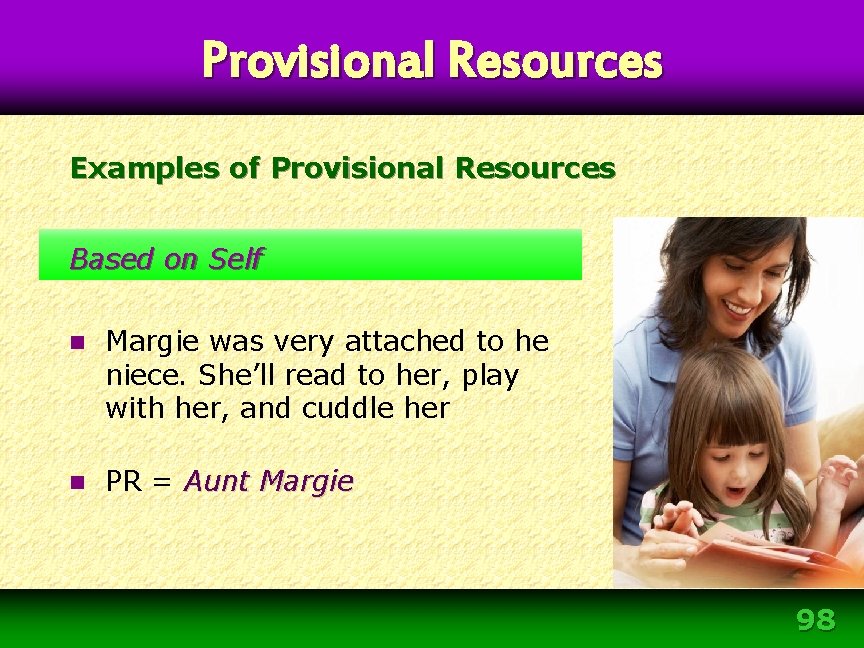
Provisional Resources Examples of Provisional Resources Based on Self n Margie was very attached to he niece. She’ll read to her, play with her, and cuddle her n PR = Aunt Margie 98
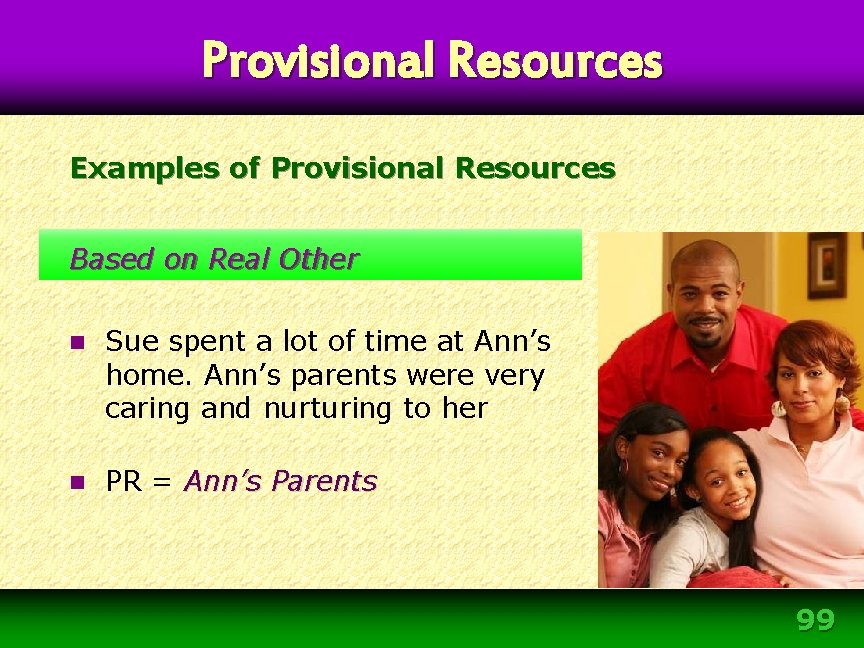
Provisional Resources Examples of Provisional Resources Based on Real Other n Sue spent a lot of time at Ann’s home. Ann’s parents were very caring and nurturing to her n PR = Ann’s Parents 99
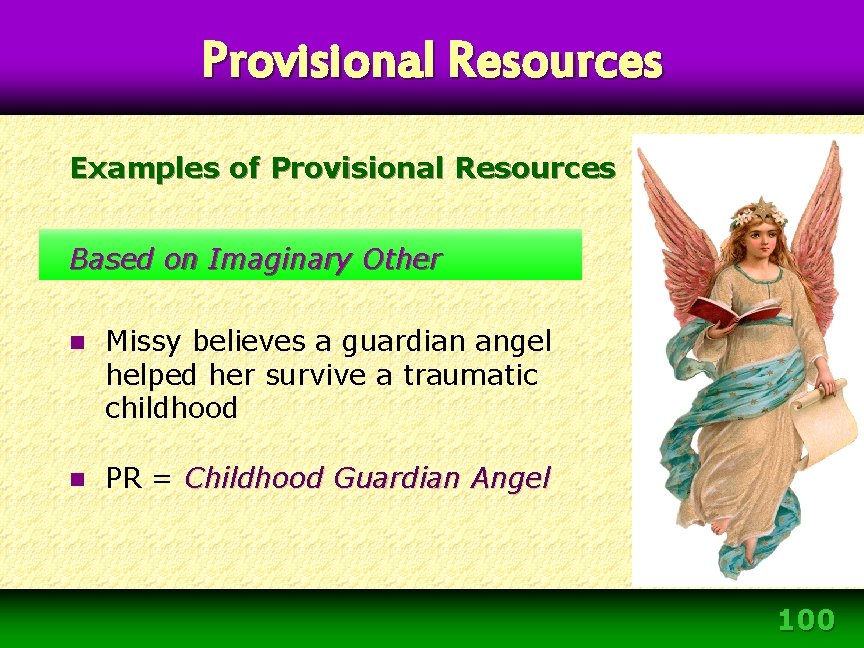
Provisional Resources Examples of Provisional Resources Based on Imaginary Other n Missy believes a guardian angel helped her survive a traumatic childhood n PR = Childhood Guardian Angel 100
Provisional Resources Finding Provisional Resources n Invite your client to discuss experiences of n feeling supported by others n being supportive of others n Narrow down to one or more key experiences n Assign Provisional Resource(s) name 101
Provisional Resources Exercise n Find a partner n Discuss experiences of n feeling supported by others n being supportive of others n Identify a Provisional Resource n Give it a name n Time yourself 102
Questions? 103
This Presentation DNMS Overview RDP Introduction Client Preparation Resource Mobilization Provisional Resources RDP Complications DNMS Training 104
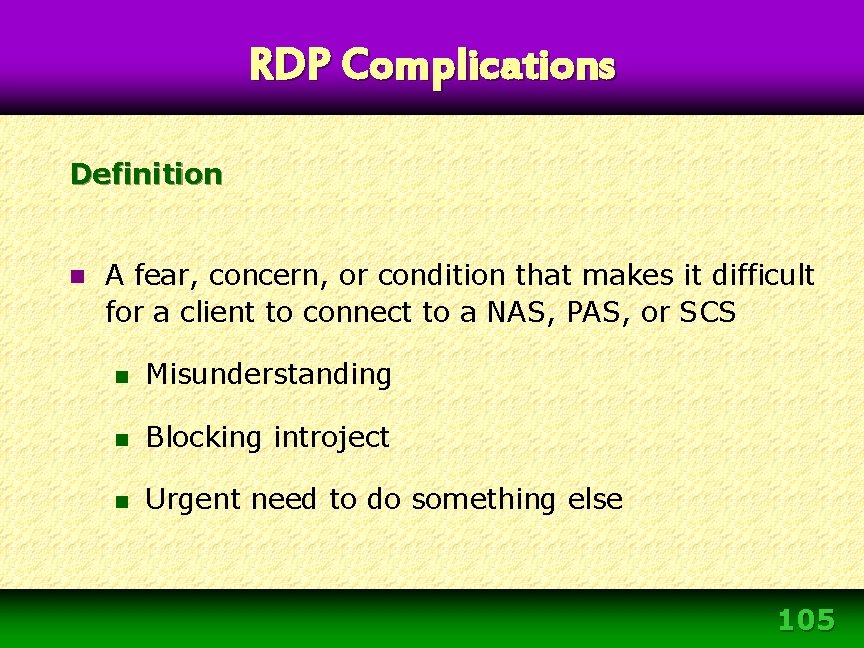
RDP Complications Definition n A fear, concern, or condition that makes it difficult for a client to connect to a NAS, PAS, or SCS n Misunderstanding n Blocking introject n Urgent need to do something else 105
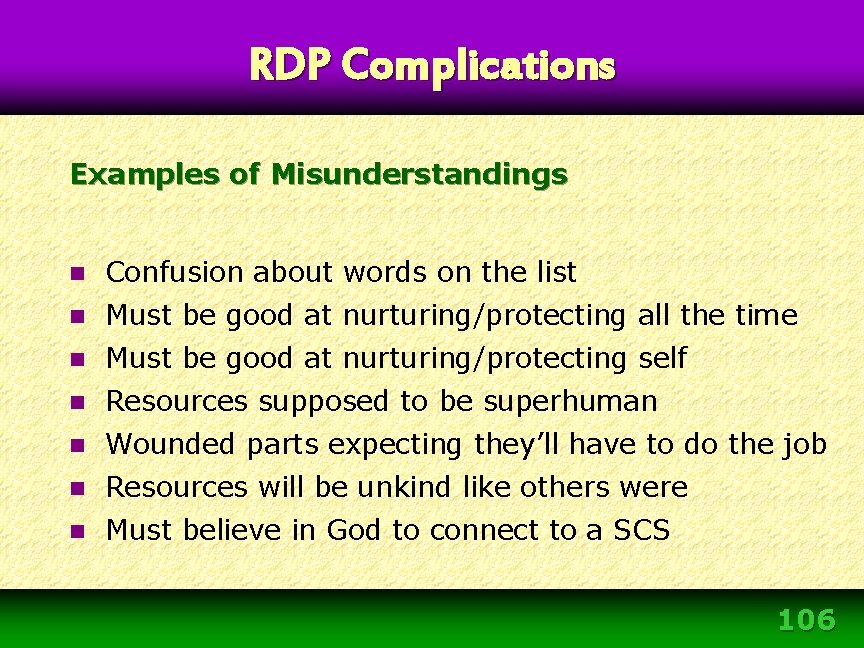
RDP Complications Examples of Misunderstandings n Confusion about words on the list n Must be good at nurturing/protecting all the time n Must be good at nurturing/protecting self n Resources supposed to be superhuman n Wounded parts expecting they’ll have to do the job n Resources will be unkind like others were n Must believe in God to connect to a SCS 106
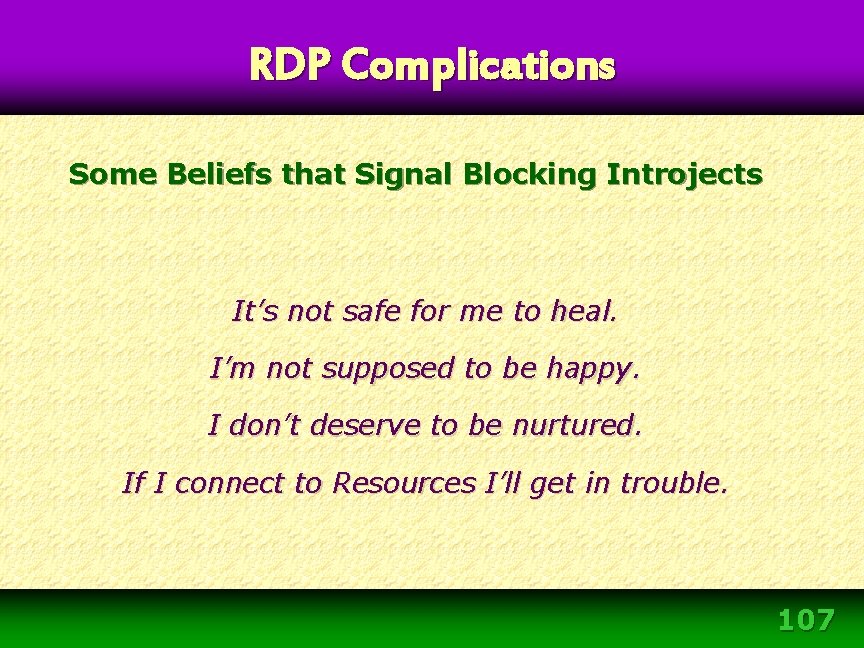
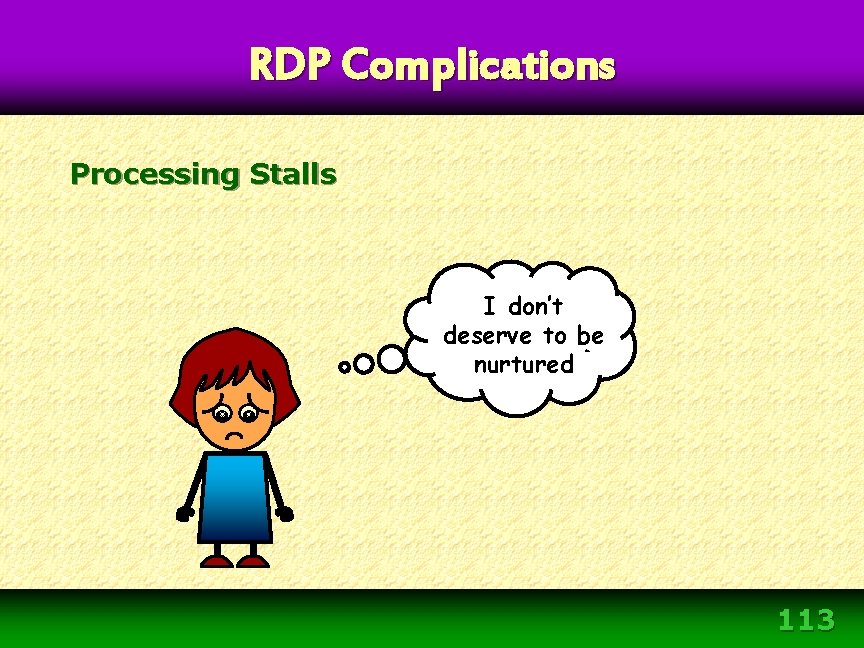
RDP Complications Some Beliefs that Signal Blocking Introjects It’s not safe for me to heal. I’m not supposed to be happy. I don’t deserve to be nurtured. If I connect to Resources I’ll get in trouble. 107
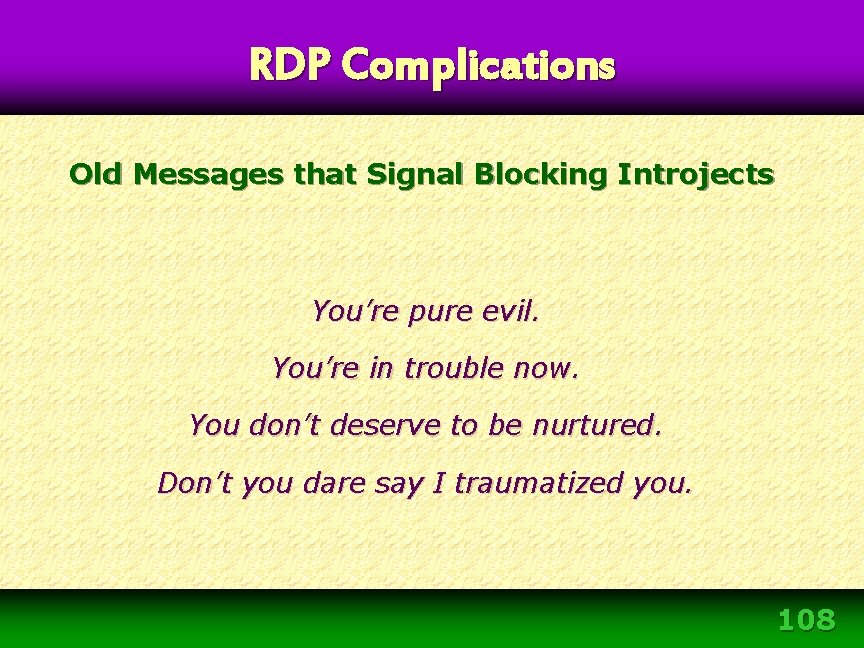
RDP Complications Old Messages that Signal Blocking Introjects You’re pure evil. You’re in trouble now. You don’t deserve to be nurtured. Don’t you dare say I traumatized you. 108
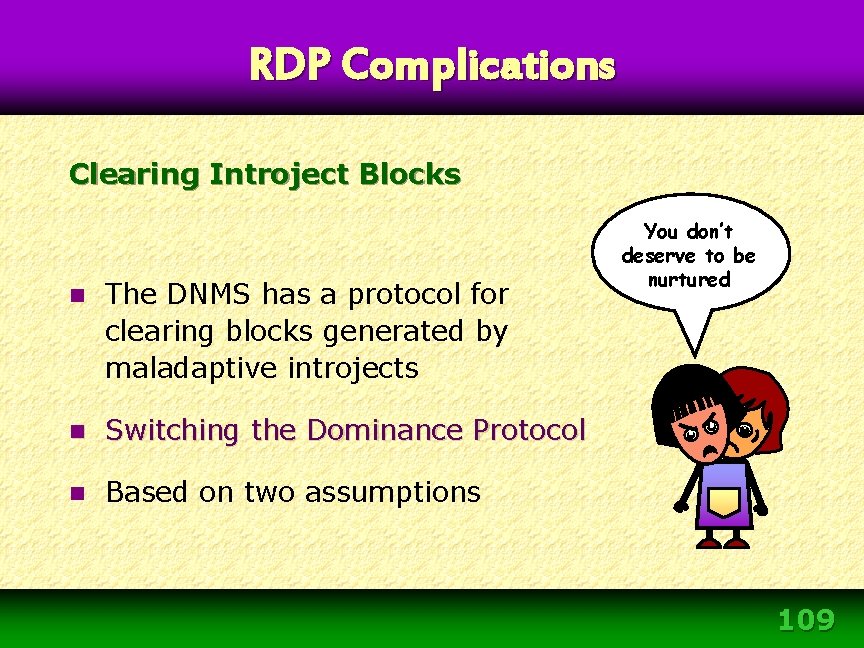
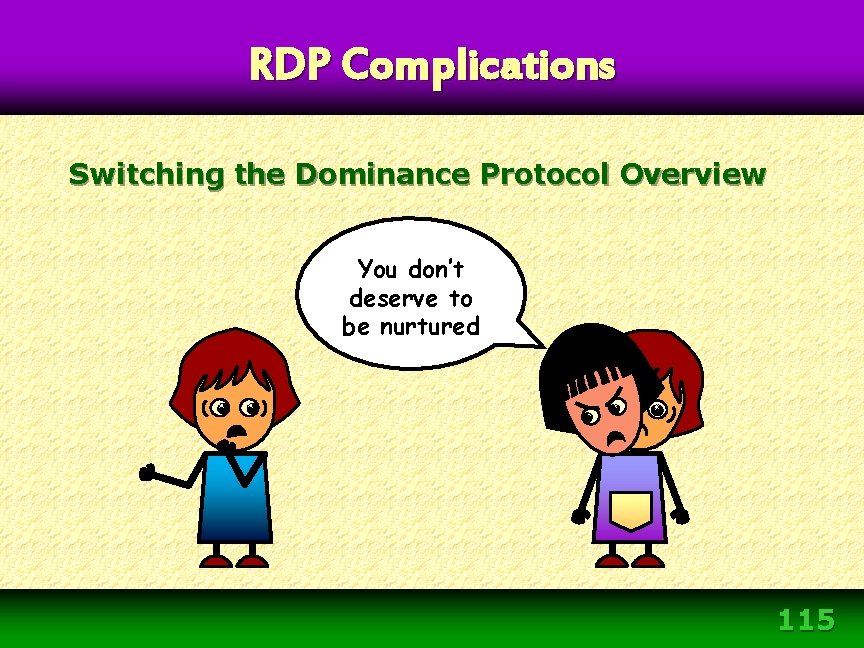
RDP Complications Clearing Introject Blocks n The DNMS has a protocol for clearing blocks generated by maladaptive introjects n Switching the Dominance Protocol n Based on two assumptions You don’t deserve to be nurtured 109
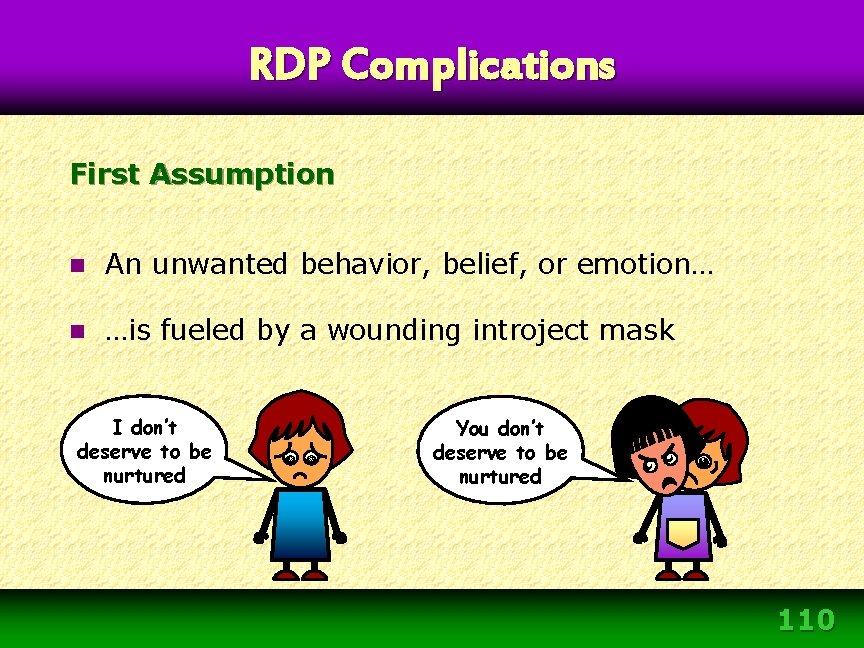
RDP Complications First Assumption n An unwanted behavior, belief, or emotion… n …is fueled by a wounding introject mask I don’t deserve to be nurtured You don’t deserve to be nurtured 110
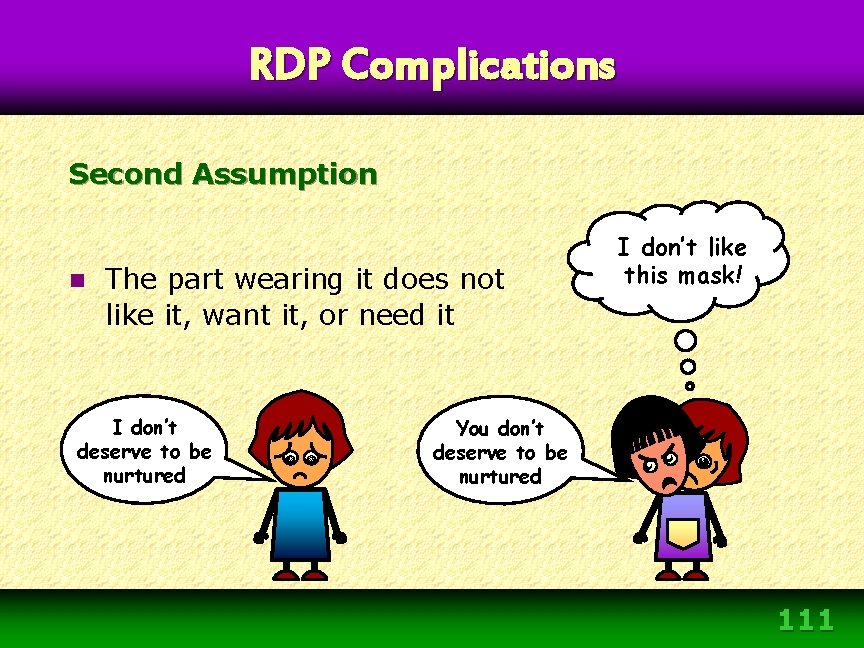
RDP Complications Second Assumption n The part wearing it does not like it, want it, or need it I don’t deserve to be nurtured I don’t like this mask! You don’t deserve to be nurtured 111
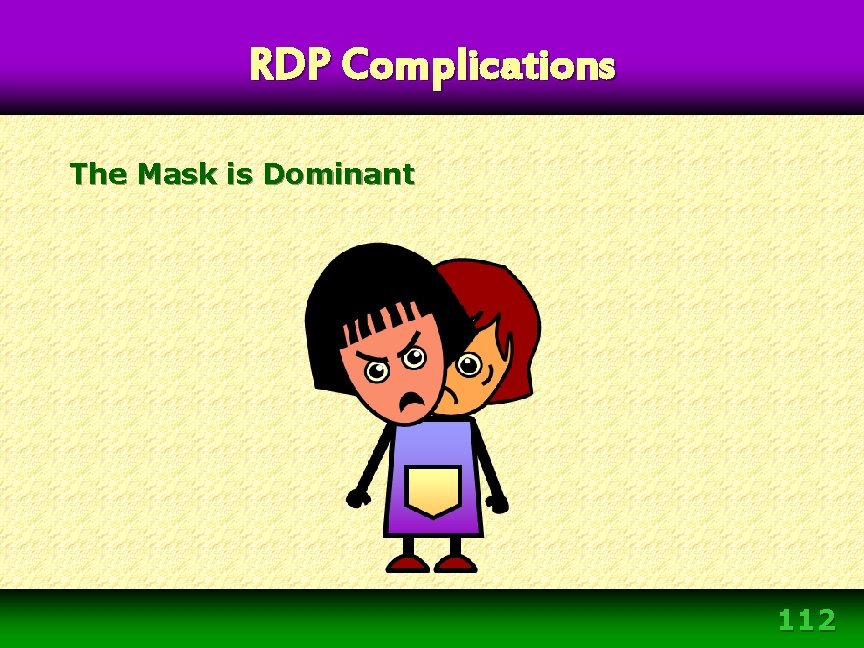
RDP Complications The Mask is Dominant 112
RDP Complications Processing Stalls I don’t deserve to be nurtured 113
RDP Complications Processing Stalls 114
RDP Complications Switching the Dominance Protocol Overview You don’t deserve to be nurtured 115
RDP Complications Switching the Dominance Protocol Overview 116
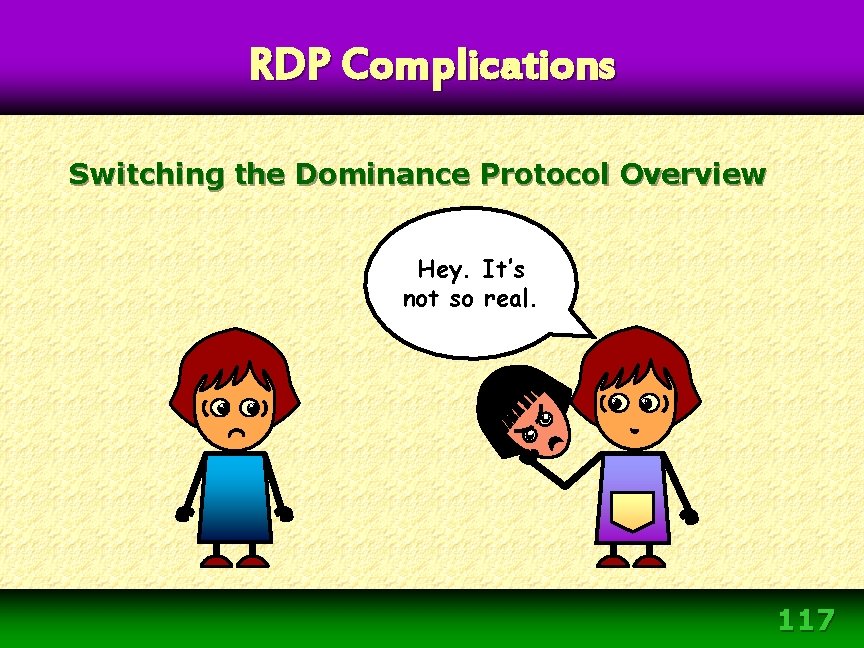
RDP Complications Switching the Dominance Protocol Overview Hey. It’s not so real. 117
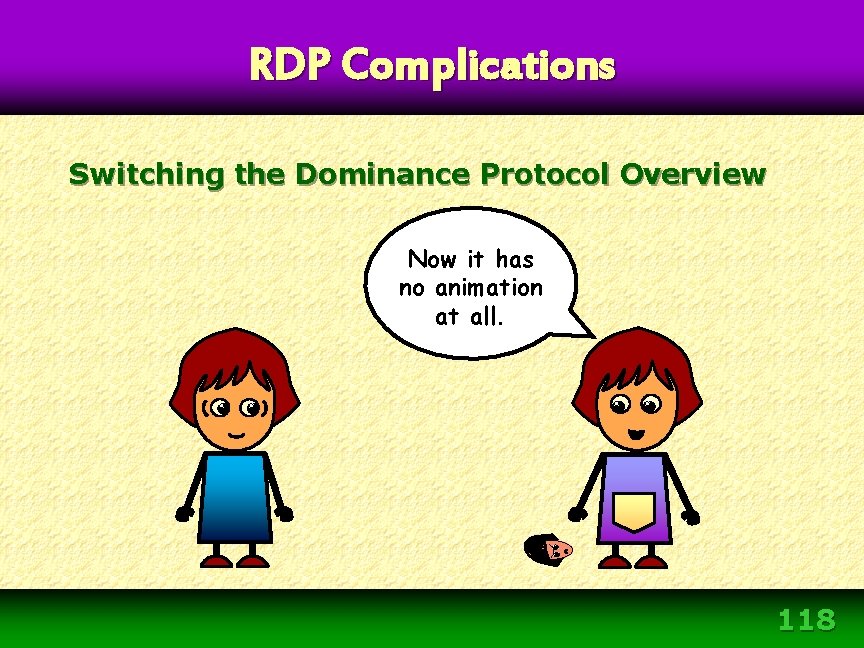
RDP Complications Switching the Dominance Protocol Overview Now it has no animation at all. 118
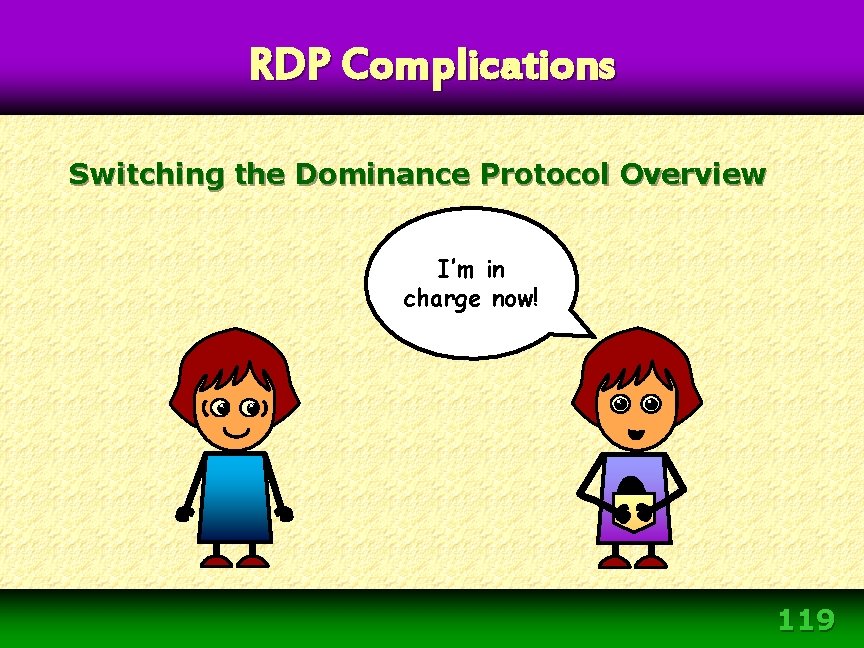
RDP Complications Switching the Dominance Protocol Overview I’m in charge now! 119
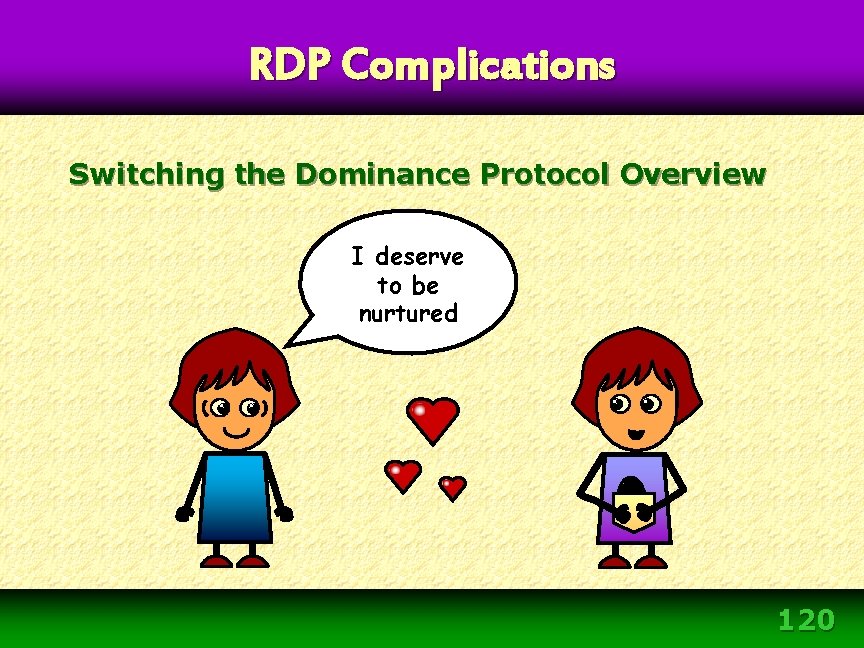
RDP Complications Switching the Dominance Protocol Overview I deserve to be nurtured 120
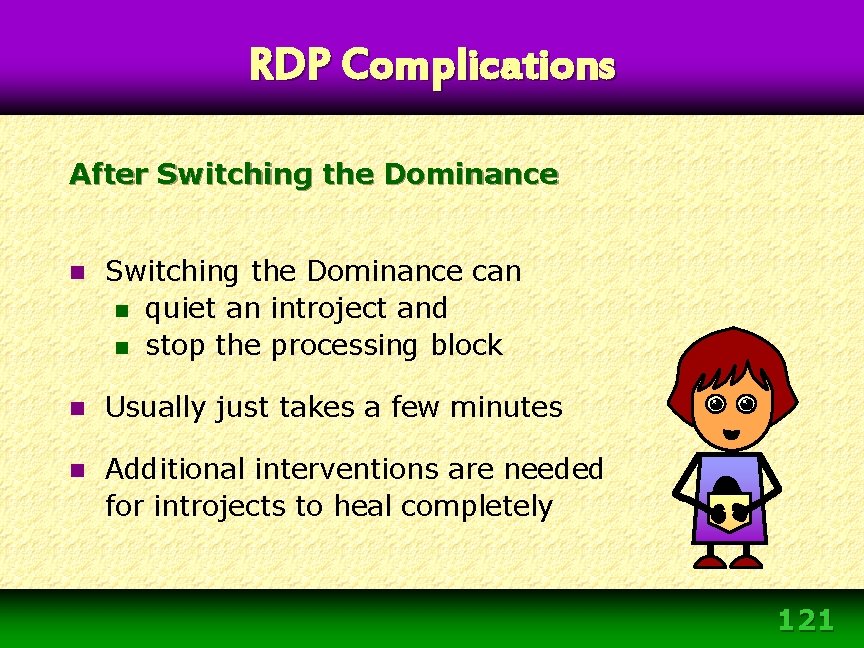
RDP Complications After Switching the Dominance n Switching the Dominance can n quiet an introject and n stop the processing block n Usually just takes a few minutes n Additional interventions are needed for introjects to heal completely 121
RDP Complications Urgent Need to Do Something Else n Here and now concern n Client may need to n Discuss a current crisis n Create more rapport with therapist n Better manage upset parts of self 122
RDP Complications Resolving Processing Complications n The DNMS book explains exactly how to identify and resolve RDP complications n Clearing blocks… n Can be very healing n Can resolve internal conflicts n Can be very ego strengthening n Can lead to better affect management 123
Questions? 124
This Presentation DNMS Overview RDP Introduction Client Preparation Resource Mobilization Provisional Resources RDP Complications DNMS Training 125
DNMS Training & Support Three Options for Learning the DNMS n DNMS Book n Home Study Course n Live Training n Get details at www. DNMSInstitute. com 126
DNMS Training & Support The DNMS Book n Provides background material n Detailed steps for applying all the protocols for clearing blocks n Appendix has client handouts and therapist worksheets and forms n Costs $35 127
DNMS Training & Support The Home Study Course n Seven module slide show (16 hrs) n Colorful, animated, narrated n Includes recordings of real sessions n Study guide with quizzes n 20 optional CEs n Costs $375 128
DNMS Training & Support Live Trainings n Part 1 n General Background n DNMS Background n Resource Development Protocol n Switching the Dominance Protocol n Overcoming Processing Blocks n Four Days, 32 CEUs available 129
DNMS Training & Support Live Trainings n Part 2 n Attachment Needs Ladder n Conference Room Protocol n Needs Meeting Protocol n Four Days, 32 CEUs 130
DNMS Training & Support Other Support n DNMS Listserv n Free with purchase of book n Over 700 members n Local study group n Group phone consultation n Individual consultation 131
DNMS Training & Support Published Research n n Case studies about the DNMS have been published in two peer-review journals n The Journal of Trauma and Dissociation n Traumatology Both articles are available on the DNMS web site www. dnmsinstitute. com 132
Questions? 133
End of Slide Show