
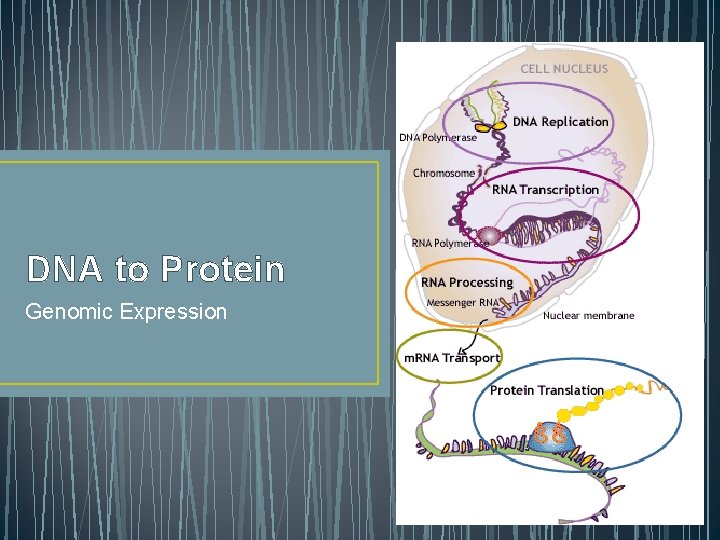
DNA to Protein Genomic Expression DNA to Protein
- Slides: 58
DNA to Protein Genomic Expression
DNA to Protein • DNA acts as a “manager” in the process of making proteins • DNA is the template or starting sequence that is copied into RNA that is then used to make the protein • Nobel Prize website: • http: //www. nobelprize. org/educa tional/medicine/dna/
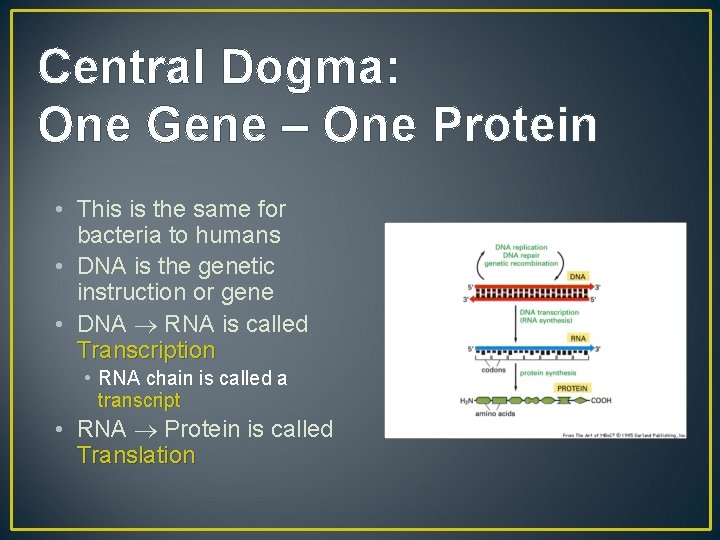
Central Dogma: One Gene – One Protein • This is the same for bacteria to humans • DNA is the genetic instruction or gene • DNA RNA is called Transcription • RNA chain is called a transcript • RNA Protein is called Translation
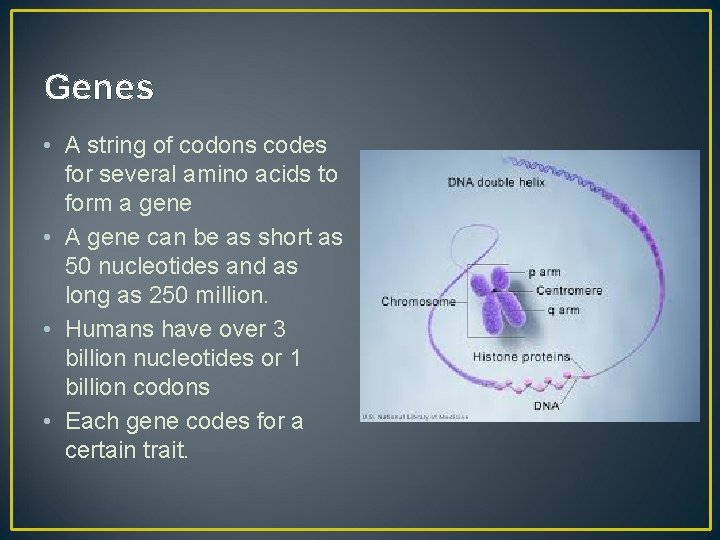
Genes • A string of codons codes for several amino acids to form a gene • A gene can be as short as 50 nucleotides and as long as 250 million. • Humans have over 3 billion nucleotides or 1 billion codons • Each gene codes for a certain trait.
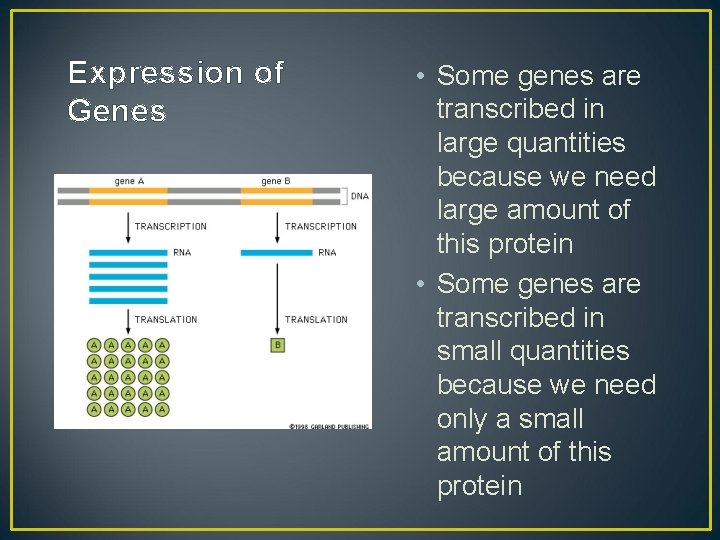
Expression of Genes • Some genes are transcribed in large quantities because we need large amount of this protein • Some genes are transcribed in small quantities because we need only a small amount of this protein
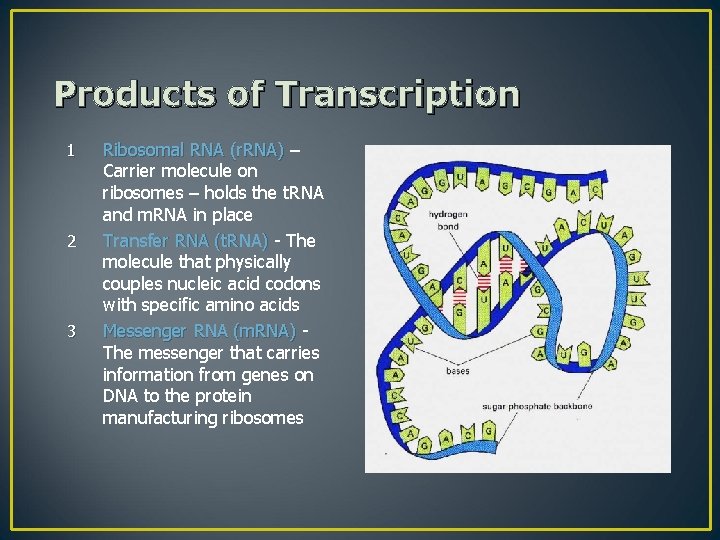
Products of Transcription 1 2 3 Ribosomal RNA (r. RNA) – Carrier molecule on ribosomes – holds the t. RNA and m. RNA in place Transfer RNA (t. RNA) - The molecule that physically couples nucleic acid codons with specific amino acids Messenger RNA (m. RNA) The messenger that carries information from genes on DNA to the protein manufacturing ribosomes
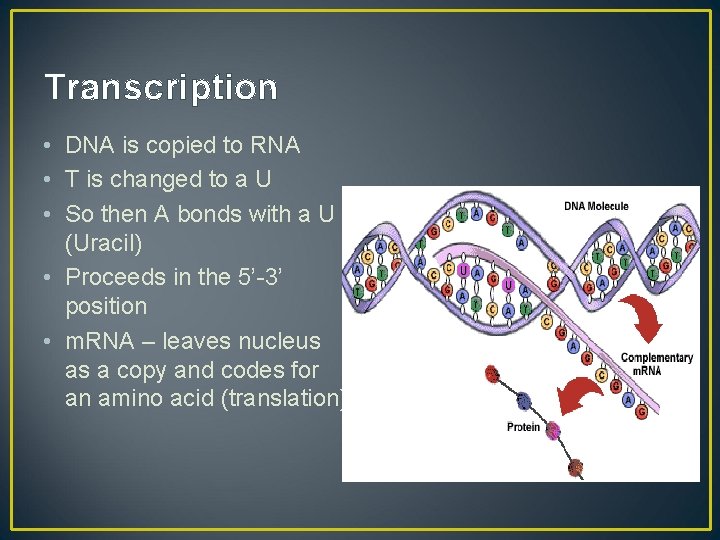
Transcription • DNA is copied to RNA • T is changed to a U • So then A bonds with a U (Uracil) • Proceeds in the 5’-3’ position • m. RNA – leaves nucleus as a copy and codes for an amino acid (translation)
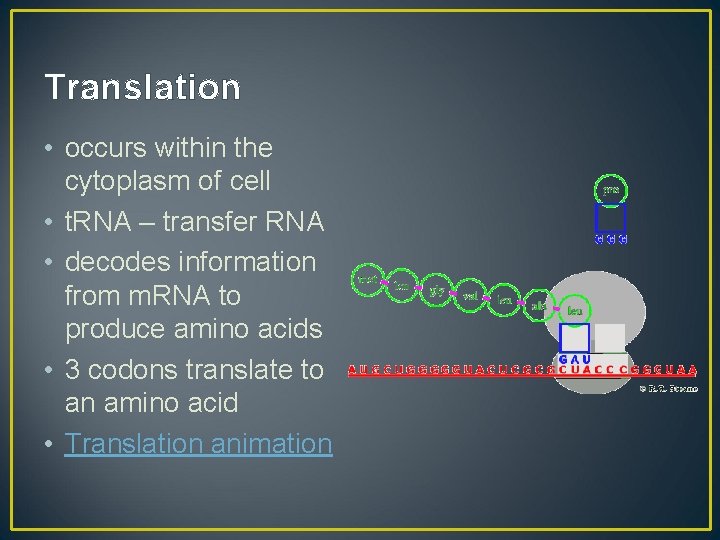
Translation • occurs within the cytoplasm of cell • t. RNA – transfer RNA • decodes information from m. RNA to produce amino acids • 3 codons translate to an amino acid • Translation animation
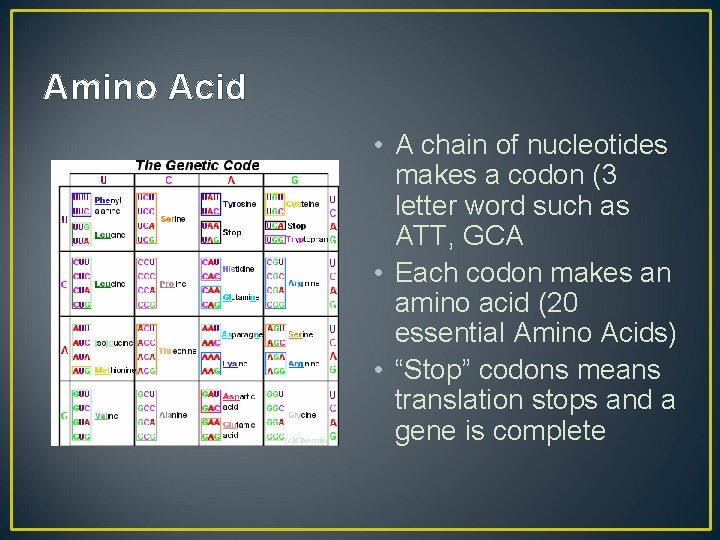
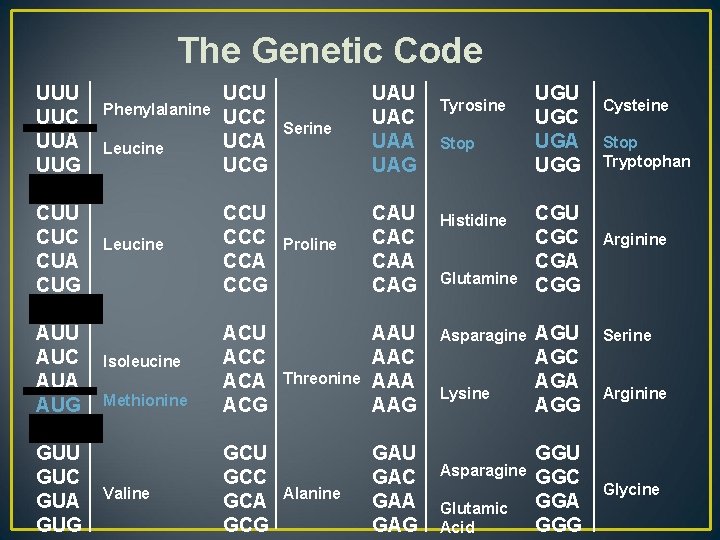
Amino Acid • A chain of nucleotides makes a codon (3 letter word such as ATT, GCA • Each codon makes an amino acid (20 essential Amino Acids) • “Stop” codons means translation stops and a gene is complete
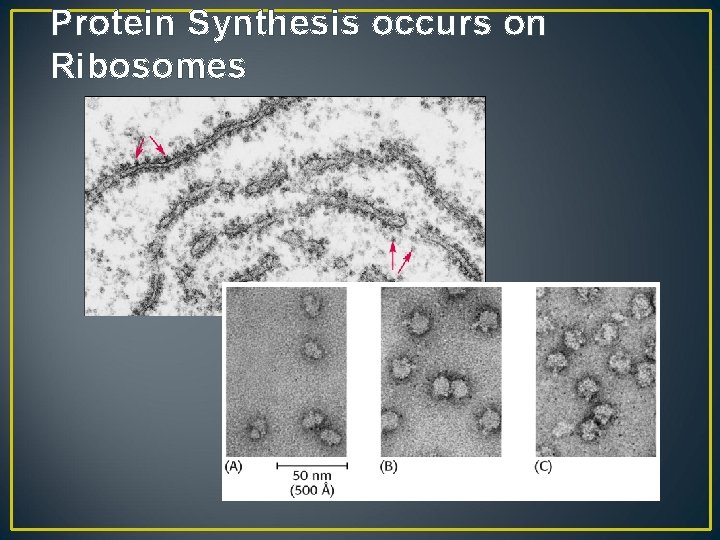
Protein Synthesis occurs on Ribosomes
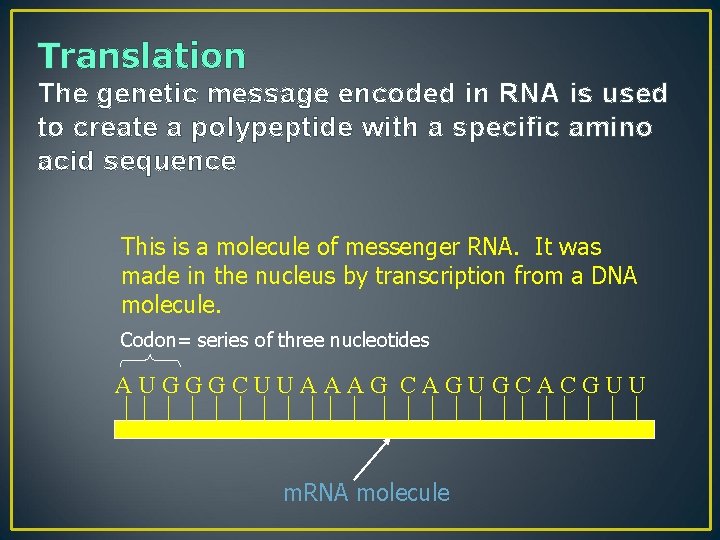
Translation The genetic message encoded in RNA is used to create a polypeptide with a specific amino acid sequence This is a molecule of messenger RNA. It was made in the nucleus by transcription from a DNA molecule. Codon= series of three nucleotides AUGGGCUUAAAG CAGUGCACGUU m. RNA molecule
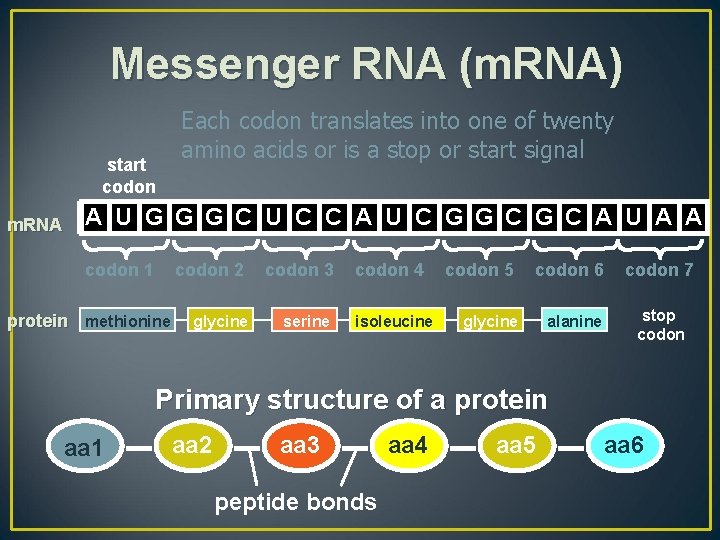
Messenger RNA (m. RNA) start codon m. RNA Each codon translates into one of twenty amino acids or is a stop or start signal A U G G G C U C C A U C G G C A U A A codon 1 protein methionine codon 2 codon 3 glycine serine codon 4 isoleucine codon 5 codon 6 glycine alanine codon 7 stop codon Primary structure of a protein aa 1 aa 2 aa 3 peptide bonds aa 4 aa 5 aa 6
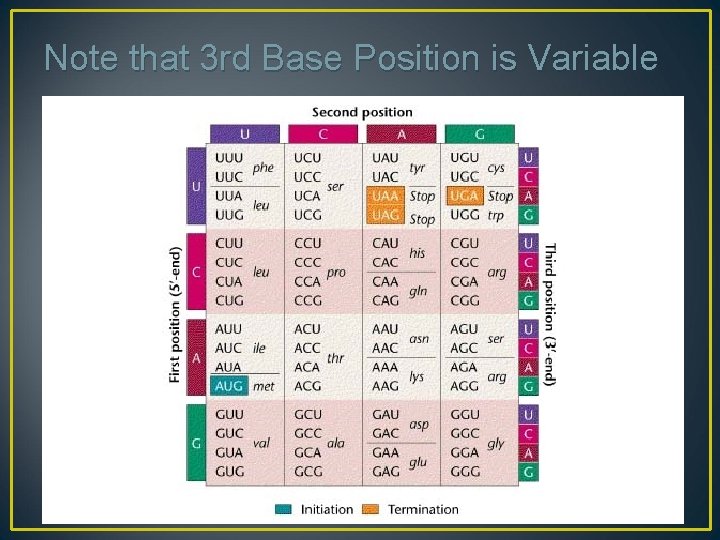
The Genetic Code UUU UUC UUA UUG CUU CUC CUA CUG AUU AUC AUA AUG GUU GUC GUA GUG Phenylalanine Leucine Isoleucine Methionine Valine UCU UCC UCA UCG CCU CCC CCA CCG ACU ACC ACA ACG GCU GCC GCA GCG Serine UAU UAC UAA UAG Proline CAU CAC CAA CAG Threonine Alanine AAU AAC AAA AAG GAU GAC GAA GAG Tyrosine Stop Histidine Glutamine Asparagine Lysine Asparagine Glutamic Acid UGU UGC UGA UGG CGU CGC CGA CGG AGU AGC AGA AGG GGU GGC GGA GGG Cysteine Stop Tryptophan Arginine Serine Arginine Glycine
Note that 3 rd Base Position is Variable
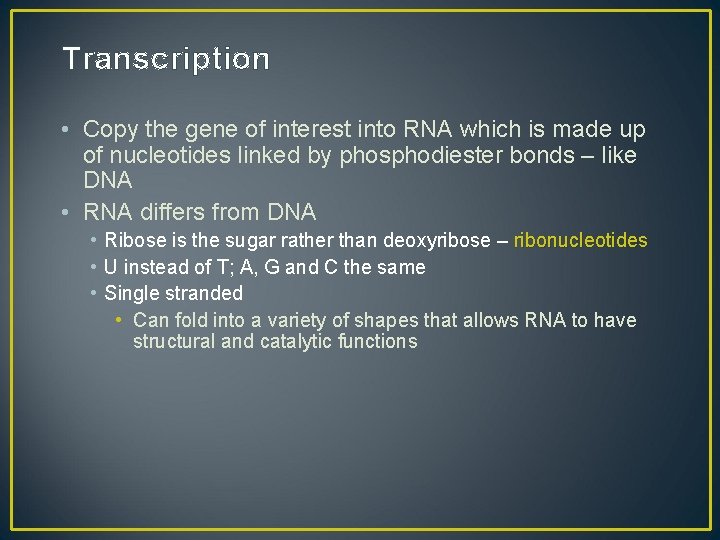
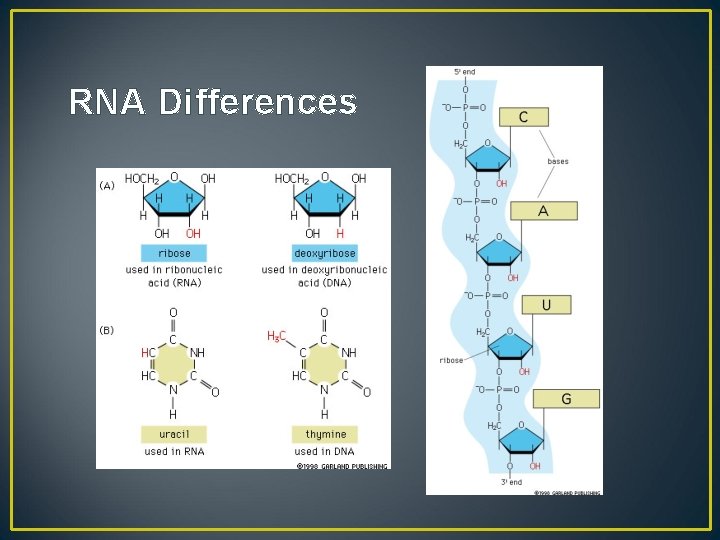
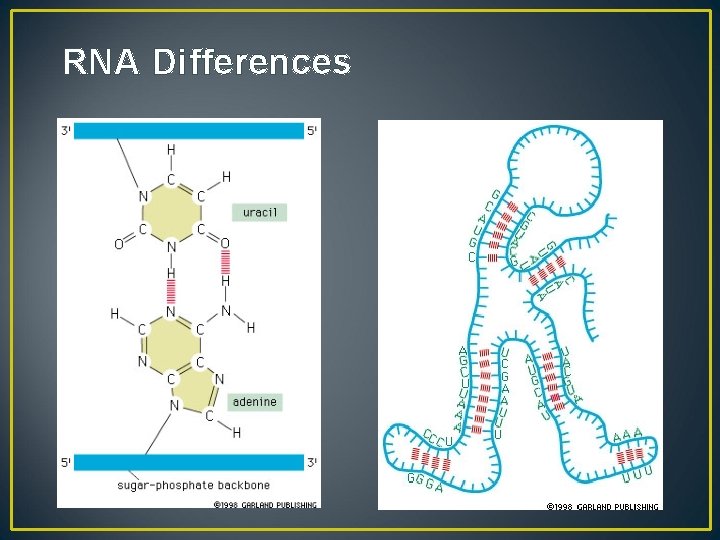
Transcription • Copy the gene of interest into RNA which is made up of nucleotides linked by phosphodiester bonds – like DNA • RNA differs from DNA • Ribose is the sugar rather than deoxyribose – ribonucleotides • U instead of T; A, G and C the same • Single stranded • Can fold into a variety of shapes that allows RNA to have structural and catalytic functions
RNA Differences
RNA Differences
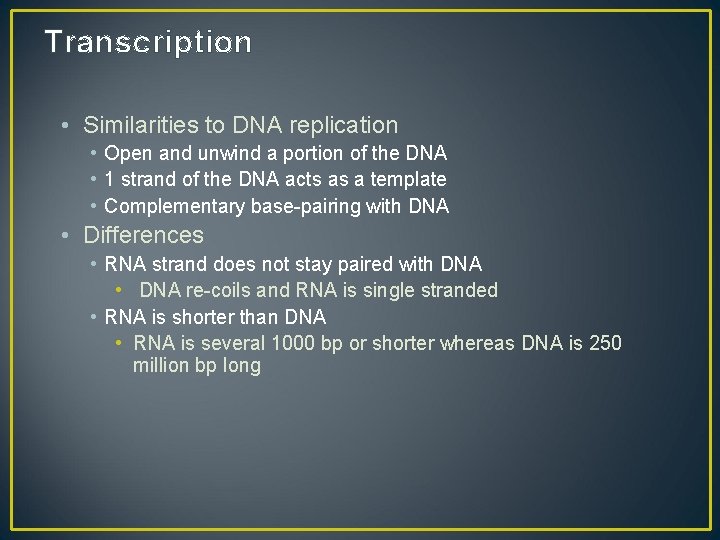
Transcription • Similarities to DNA replication • Open and unwind a portion of the DNA • 1 strand of the DNA acts as a template • Complementary base-pairing with DNA • Differences • RNA strand does not stay paired with DNA • DNA re-coils and RNA is single stranded • RNA is shorter than DNA • RNA is several 1000 bp or shorter whereas DNA is 250 million bp long
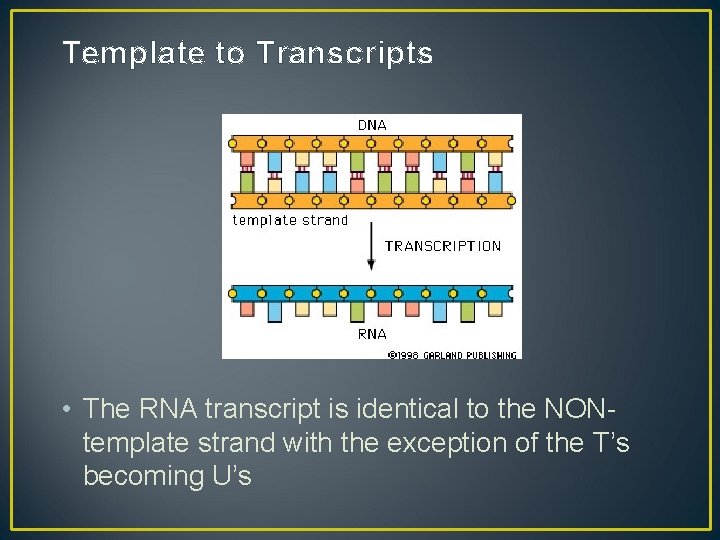
Template to Transcripts • The RNA transcript is identical to the NONtemplate strand with the exception of the T’s becoming U’s
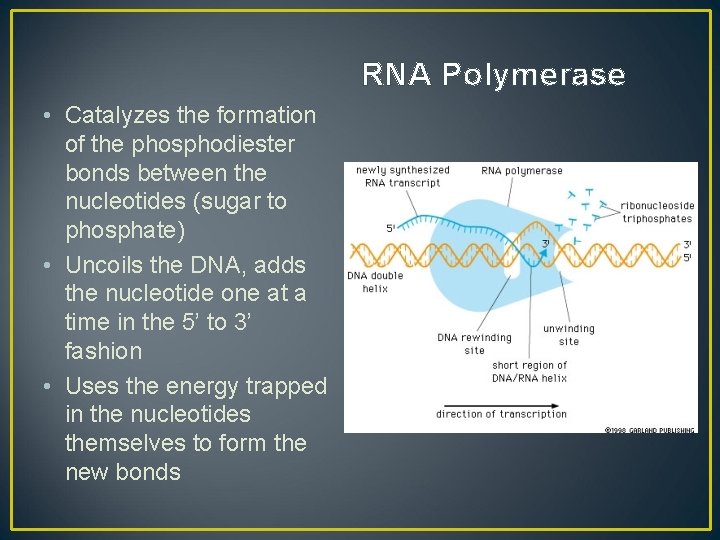
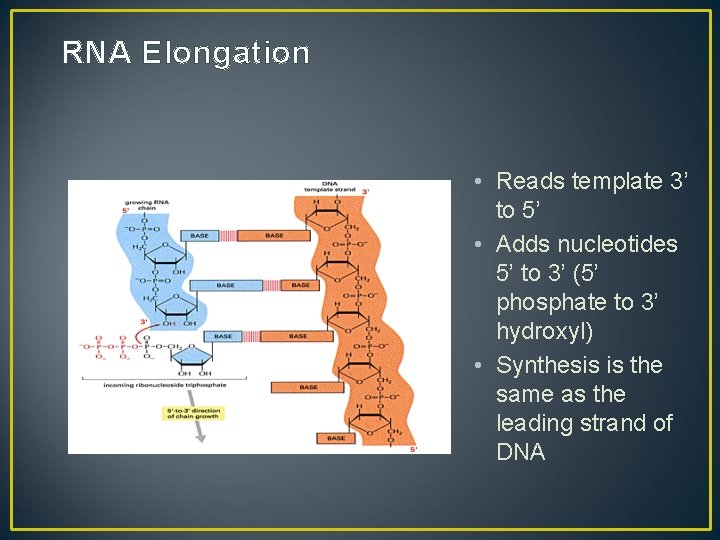
RNA Polymerase • Catalyzes the formation of the phosphodiester bonds between the nucleotides (sugar to phosphate) • Uncoils the DNA, adds the nucleotide one at a time in the 5’ to 3’ fashion • Uses the energy trapped in the nucleotides themselves to form the new bonds
RNA Elongation • Reads template 3’ to 5’ • Adds nucleotides 5’ to 3’ (5’ phosphate to 3’ hydroxyl) • Synthesis is the same as the leading strand of DNA
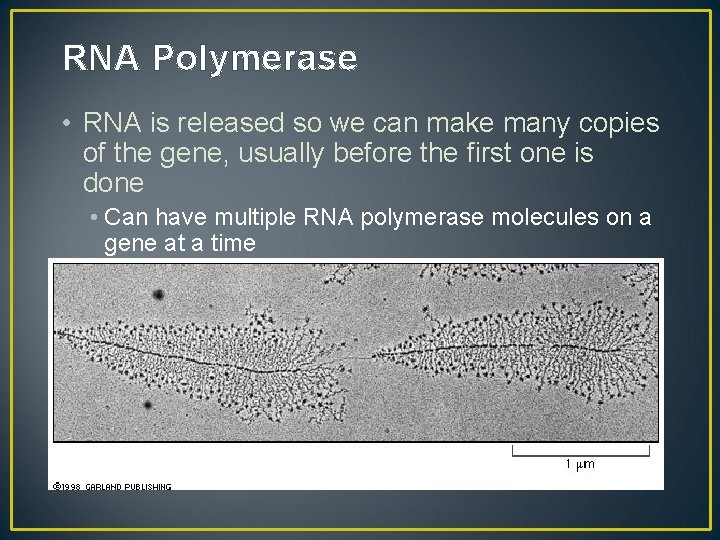
RNA Polymerase • RNA is released so we can make many copies of the gene, usually before the first one is done • Can have multiple RNA polymerase molecules on a gene at a time
Differences in DNA and RNA Polymerases • RNA polymerase adds ribonucleotides not deoxynucleotides • RNA polymerase does not have the ability to proofread what they transcribe • RNA polymerase can work without a primer • RNA will have an error 1 in every 10, 000 nucleotides (DNA is 1 in 10, 000 nucleotides)
Types of RNA • messenger RNA (m. RNA) – codes for proteins • ribosomal RNA (r. RNA) – forms the core of the ribosomes, machinery for making proteins • transfer RNA (t. RNA) – carries the amino acid for the growing protein chain
DNA Transcription in Bacteria • RNA polymerase must know where the start of a gene is in order to copy it • RNA polymerase has weak interactions with the DNA unless it encounters a promoter • A promoter is a specific sequence of nucleotides that indicate the start site for RNA synthesis
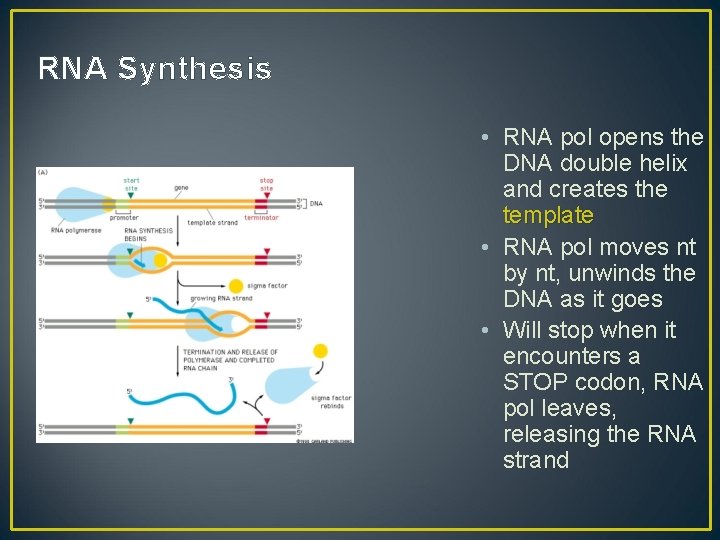
RNA Synthesis • RNA pol opens the DNA double helix and creates the template • RNA pol moves nt by nt, unwinds the DNA as it goes • Will stop when it encounters a STOP codon, RNA pol leaves, releasing the RNA strand
Sigma ( ) Factor • Part of the bacterial RNA polymerase that helps it recognize the promoter • Released after about 10 nucleotides of RNA are linked together • Rejoins with a released RNA polymerase to look for a new promoter
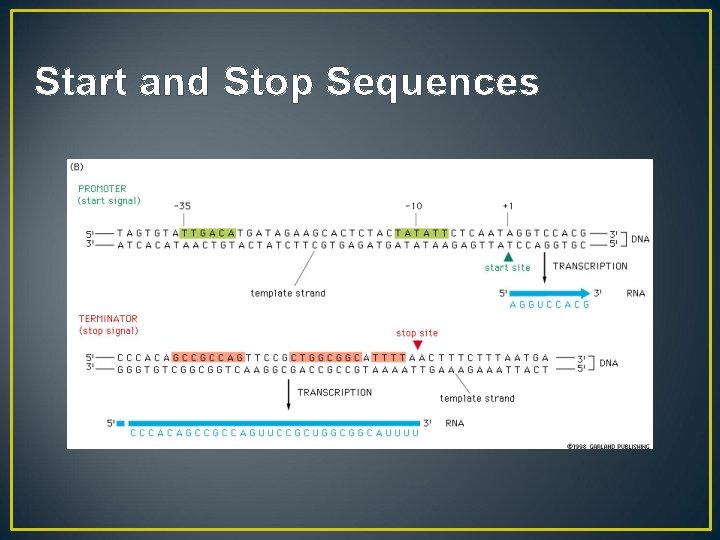
Start and Stop Sequences
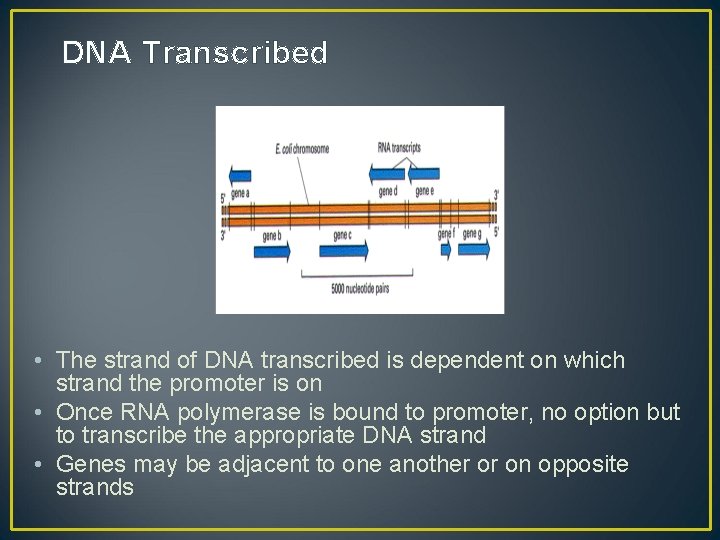
DNA Transcribed • The strand of DNA transcribed is dependent on which strand the promoter is on • Once RNA polymerase is bound to promoter, no option but to transcribe the appropriate DNA strand • Genes may be adjacent to one another or on opposite strands
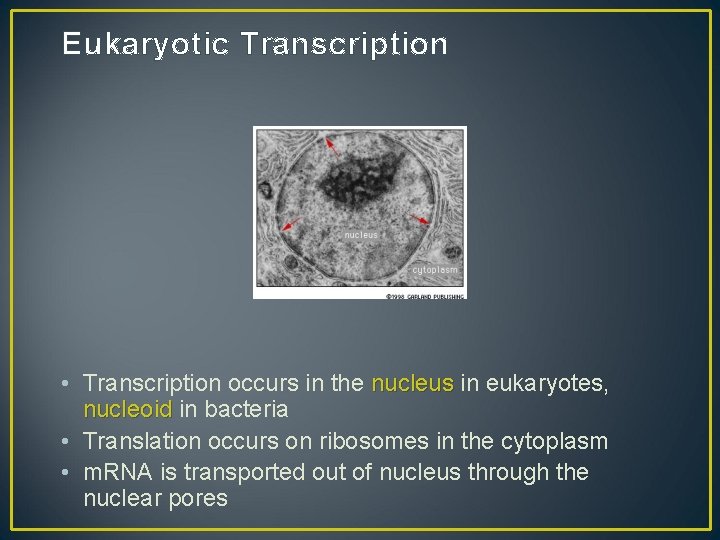
Eukaryotic Transcription • Transcription occurs in the nucleus in eukaryotes, nucleoid in bacteria • Translation occurs on ribosomes in the cytoplasm • m. RNA is transported out of nucleus through the nuclear pores
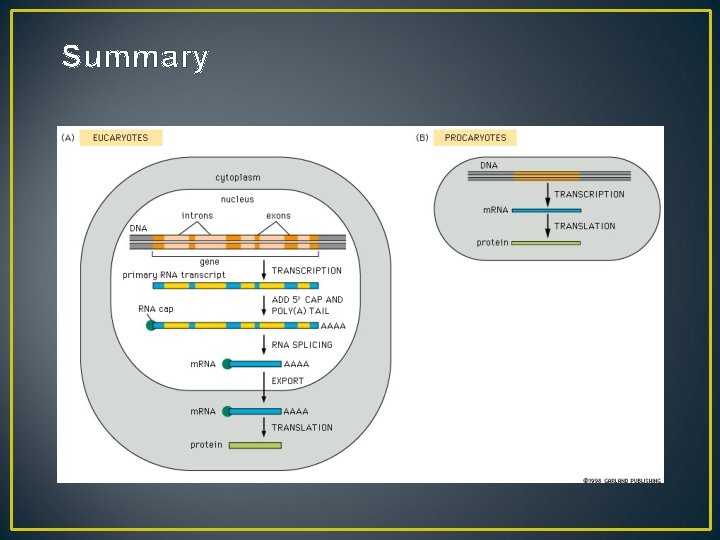
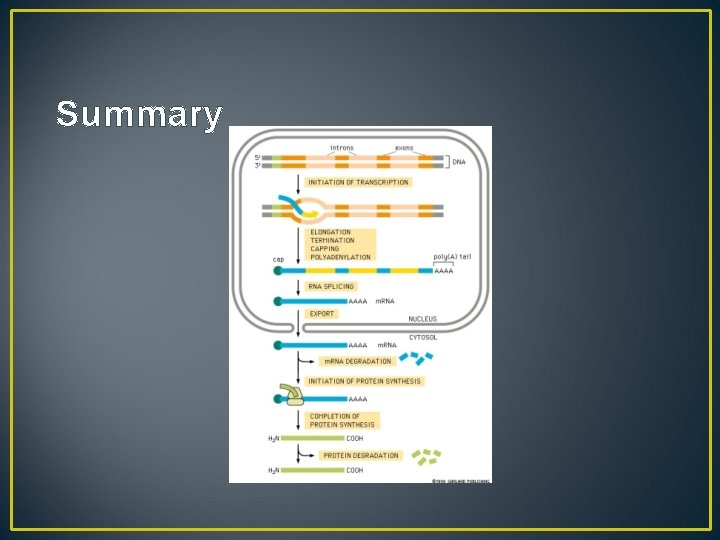
RNA Processing • Eukaryotic cells process the RNA in the nucleus before it is moved to the cytoplasm for protein synthesis • The RNA that is the direct copy of the DNA is the primary transcript • 2 methods used to process primary transcripts to increase the stability of m. RNA being exported to the cytoplasm • RNA capping • Polyadenylation
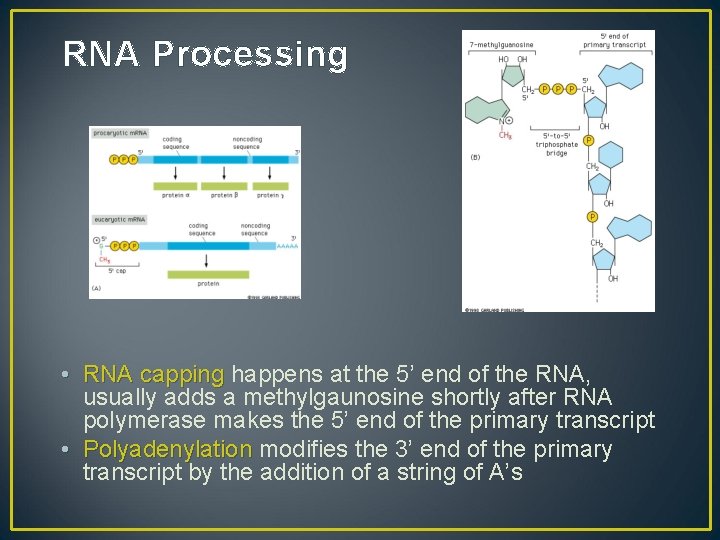
RNA Processing • RNA capping happens at the 5’ end of the RNA, usually adds a methylgaunosine shortly after RNA polymerase makes the 5’ end of the primary transcript • Polyadenylation modifies the 3’ end of the primary transcript by the addition of a string of A’s
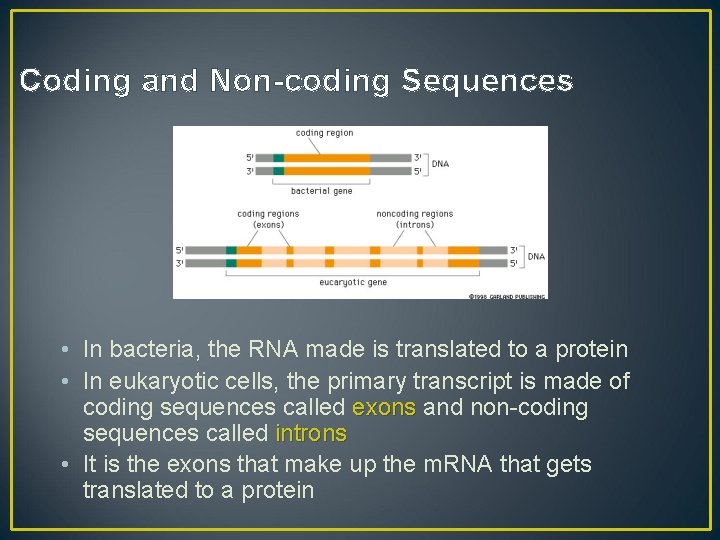
Coding and Non-coding Sequences • In bacteria, the RNA made is translated to a protein • In eukaryotic cells, the primary transcript is made of coding sequences called exons and non-coding sequences called introns • It is the exons that make up the m. RNA that gets translated to a protein
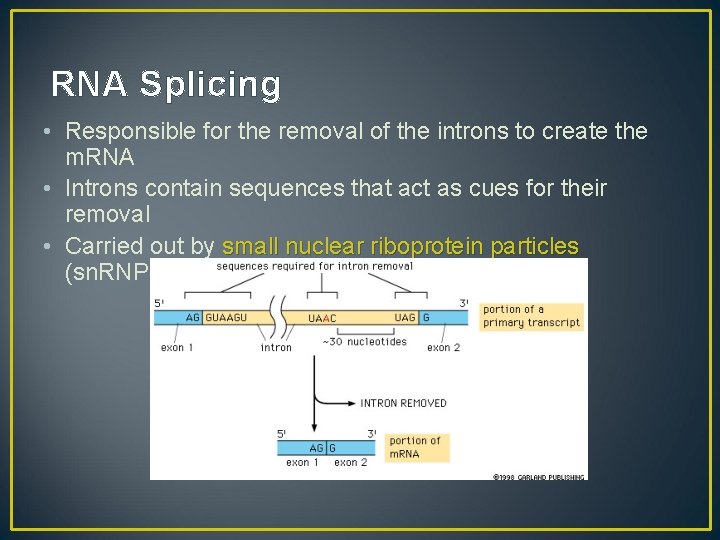
RNA Splicing • Responsible for the removal of the introns to create the m. RNA • Introns contain sequences that act as cues for their removal • Carried out by small nuclear riboprotein particles (sn. RNPs)
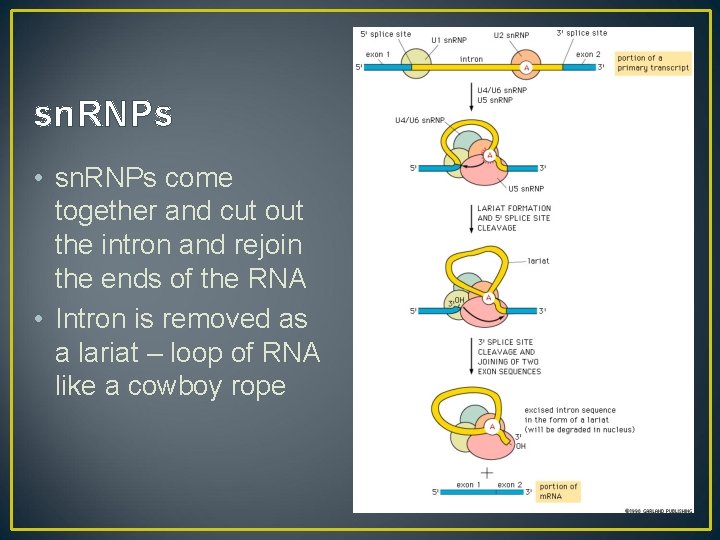
sn. RNPs • sn. RNPs come together and cut out the intron and rejoin the ends of the RNA • Intron is removed as a lariat – loop of RNA like a cowboy rope
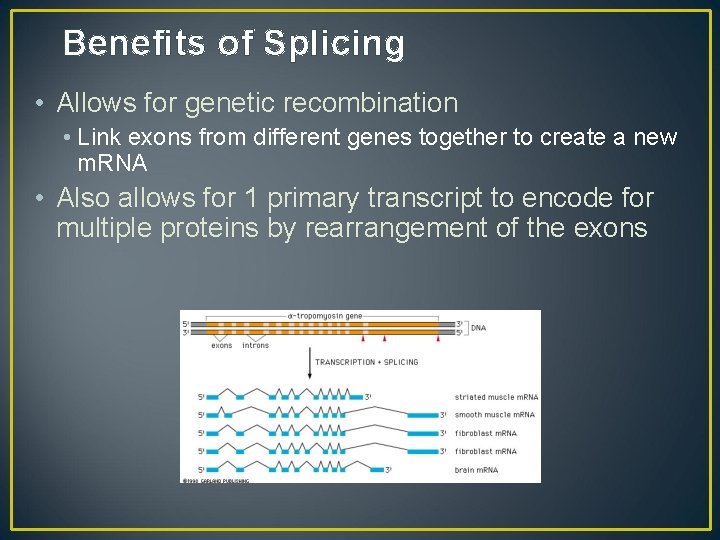
Benefits of Splicing • Allows for genetic recombination • Link exons from different genes together to create a new m. RNA • Also allows for 1 primary transcript to encode for multiple proteins by rearrangement of the exons
Summary
RNA to Protein • Translation is the process of turning m. RNA into protein • Translate from one “language” (m. RNA nucleotides) to a second “language” (amino acids) • Genetic code – nucleotide sequence that is translated to amino acids of the protein
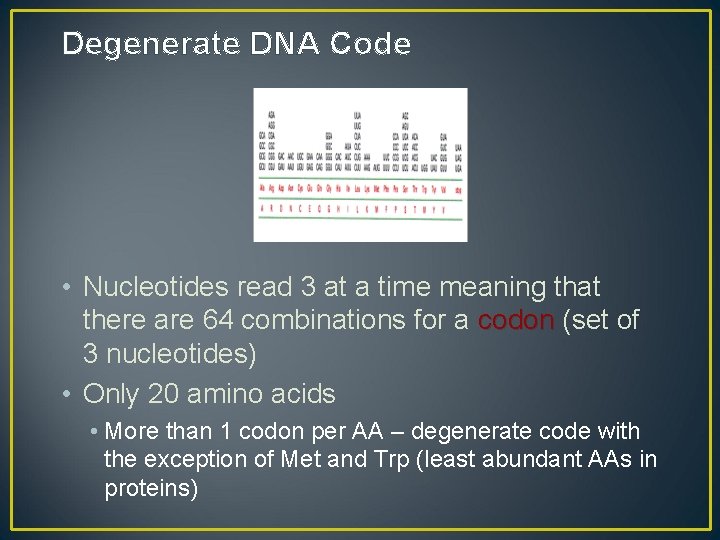
Degenerate DNA Code • Nucleotides read 3 at a time meaning that there are 64 combinations for a codon (set of 3 nucleotides) • Only 20 amino acids • More than 1 codon per AA – degenerate code with the exception of Met and Trp (least abundant AAs in proteins)
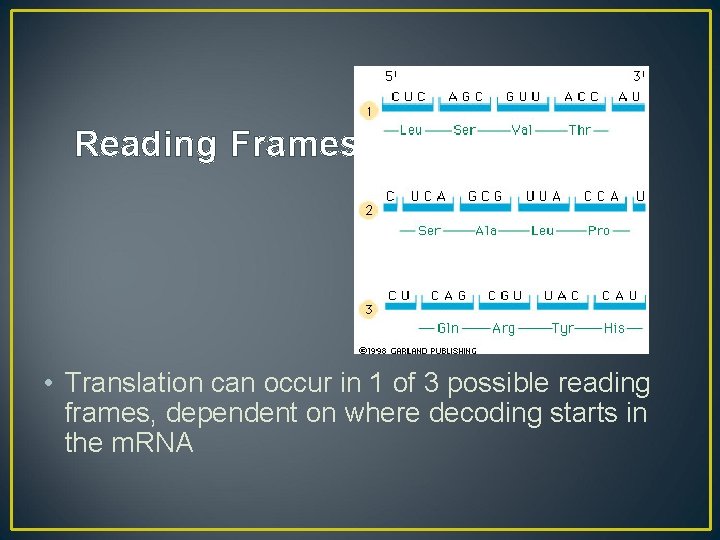
Reading Frames • Translation can occur in 1 of 3 possible reading frames, dependent on where decoding starts in the m. RNA
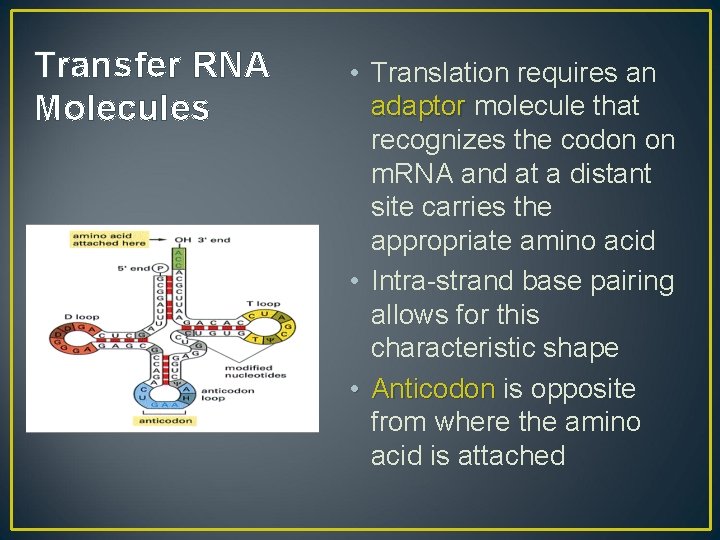
Transfer RNA Molecules • Translation requires an adaptor molecule that recognizes the codon on m. RNA and at a distant site carries the appropriate amino acid • Intra-strand base pairing allows for this characteristic shape • Anticodon is opposite from where the amino acid is attached
Wobble Base Pairing • Due to degenerate code for amino acids some t. RNA can recognize several codons because the 3 rd spot can wobble or be mismatched • Allows for there only being 31 t. RNA for the 61 codons
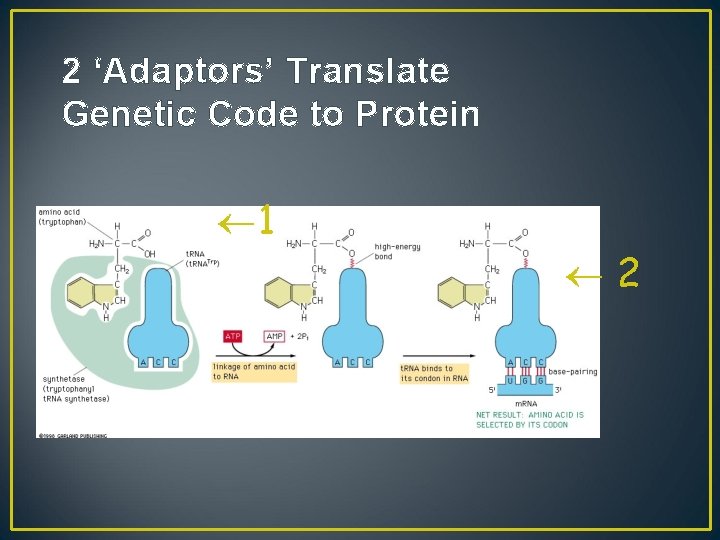
Attachment of AA to t. RNA • Aminoacyl-t. RNA synthase is the enzyme responsible for linking the amino acid to the t. RNA • A specific enzyme for each amino acid and not for the t. RNA
2 ‘Adaptors’ Translate Genetic Code to Protein 1 2
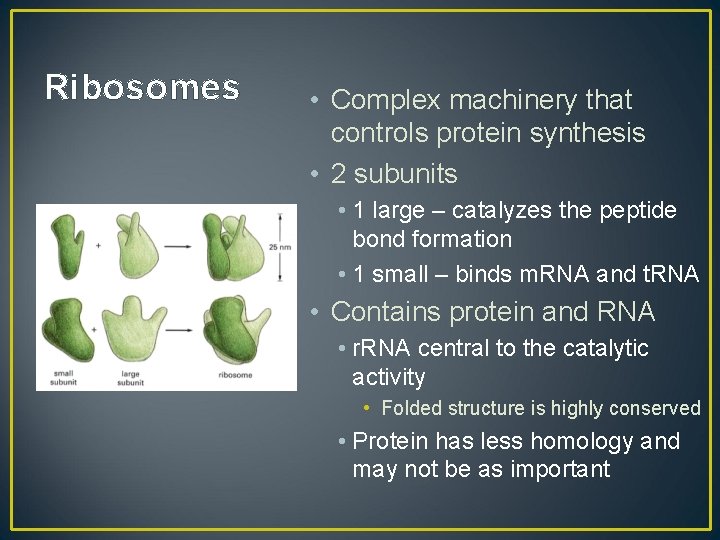
Ribosomes • Complex machinery that controls protein synthesis • 2 subunits • 1 large – catalyzes the peptide bond formation • 1 small – binds m. RNA and t. RNA • Contains protein and RNA • r. RNA central to the catalytic activity • Folded structure is highly conserved • Protein has less homology and may not be as important
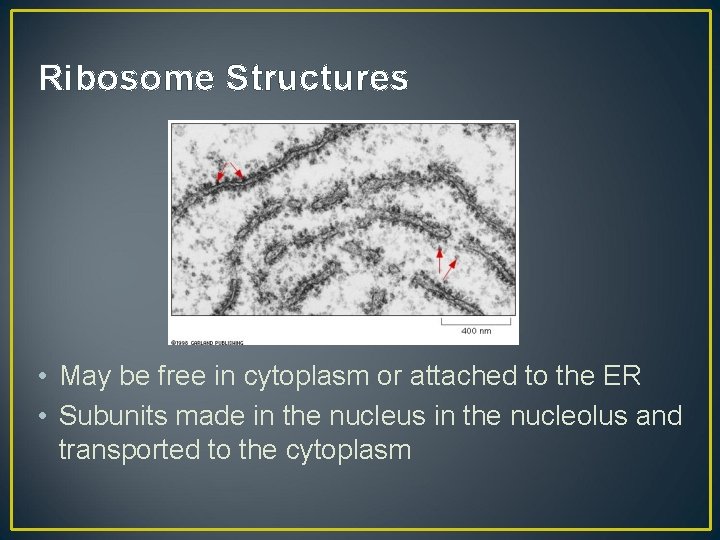
Ribosome Structures • May be free in cytoplasm or attached to the ER • Subunits made in the nucleus in the nucleolus and transported to the cytoplasm
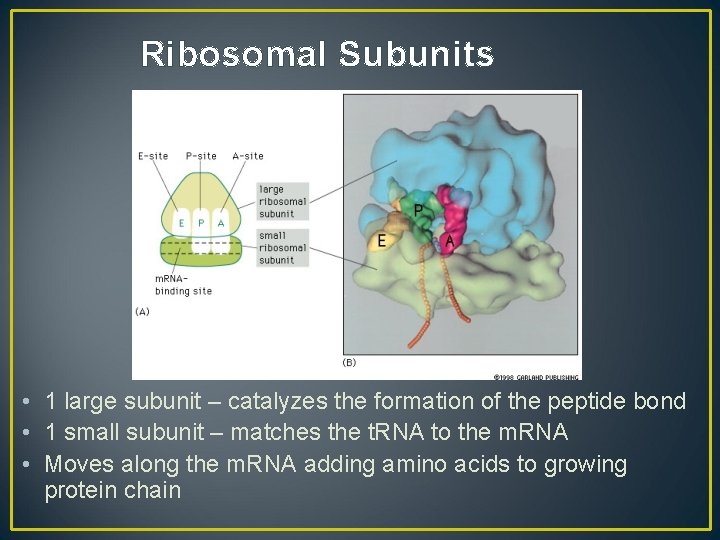
Ribosomal Subunits • 1 large subunit – catalyzes the formation of the peptide bond • 1 small subunit – matches the t. RNA to the m. RNA • Moves along the m. RNA adding amino acids to growing protein chain
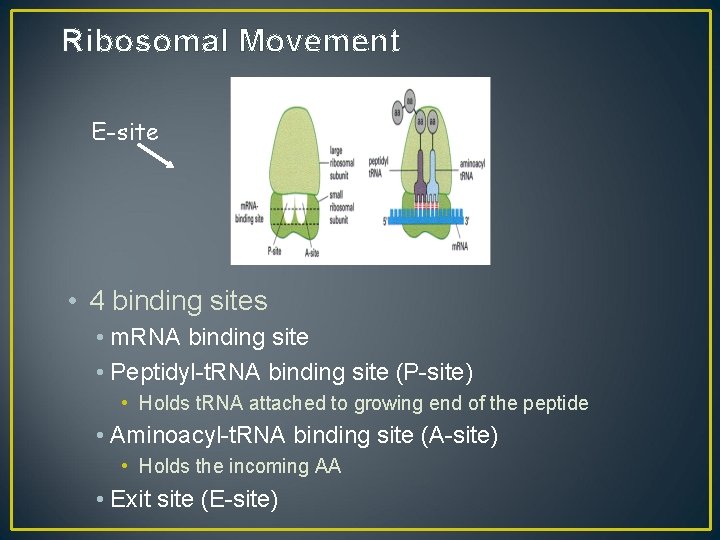
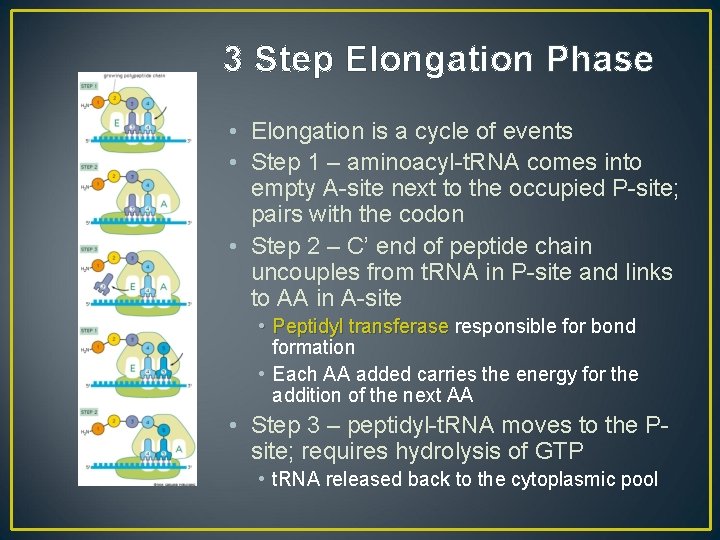
Ribosomal Movement E-site • 4 binding sites • m. RNA binding site • Peptidyl-t. RNA binding site (P-site) • Holds t. RNA attached to growing end of the peptide • Aminoacyl-t. RNA binding site (A-site) • Holds the incoming AA • Exit site (E-site)
3 Step Elongation Phase • Elongation is a cycle of events • Step 1 – aminoacyl-t. RNA comes into empty A-site next to the occupied P-site; pairs with the codon • Step 2 – C’ end of peptide chain uncouples from t. RNA in P-site and links to AA in A-site • Peptidyl transferase responsible for bond formation • Each AA added carries the energy for the addition of the next AA • Step 3 – peptidyl-t. RNA moves to the Psite; requires hydrolysis of GTP • t. RNA released back to the cytoplasmic pool
Initiation Process • Determines whether m. RNA is synthesized and sets the reading frame that is used to make the protein • Initiation process brings the ribosomal subunits together at the site where the peptide should begin • Initiator t. RNA brings in Met • Initiator t. RNA is different than the t. RNA that adds other Met
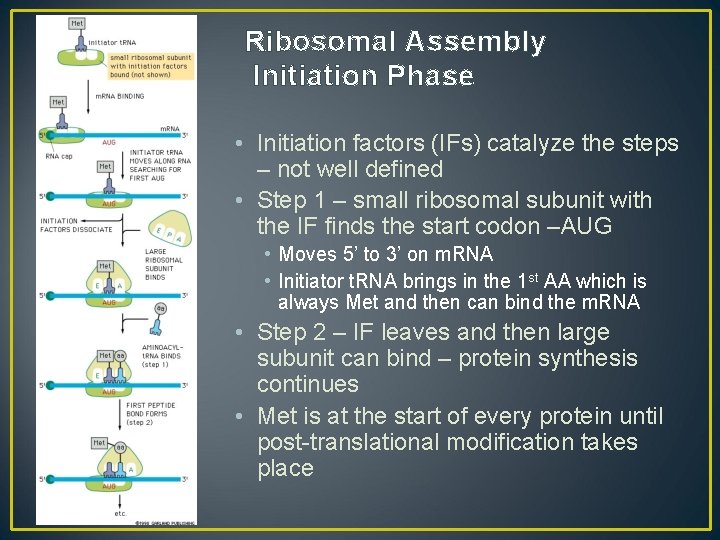
Ribosomal Assembly Initiation Phase • Initiation factors (IFs) catalyze the steps – not well defined • Step 1 – small ribosomal subunit with the IF finds the start codon –AUG • Moves 5’ to 3’ on m. RNA • Initiator t. RNA brings in the 1 st AA which is always Met and then can bind the m. RNA • Step 2 – IF leaves and then large subunit can bind – protein synthesis continues • Met is at the start of every protein until post-translational modification takes place
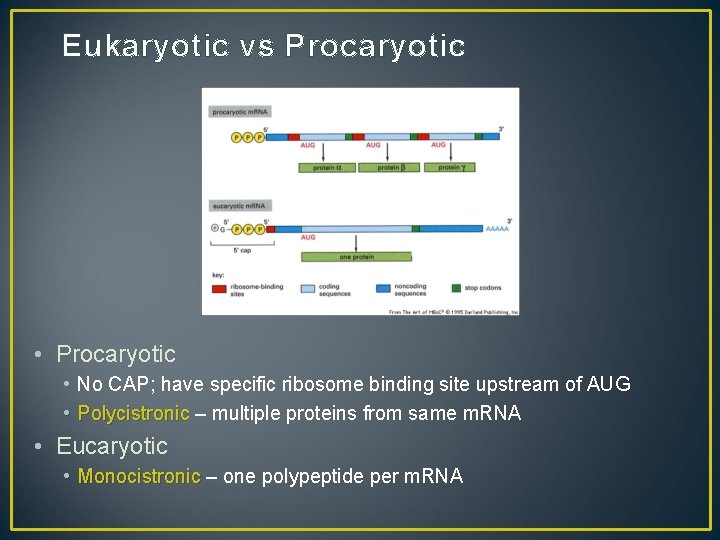
Eukaryotic vs Procaryotic • Procaryotic • No CAP; have specific ribosome binding site upstream of AUG • Polycistronic – multiple proteins from same m. RNA • Eucaryotic • Monocistronic – one polypeptide per m. RNA
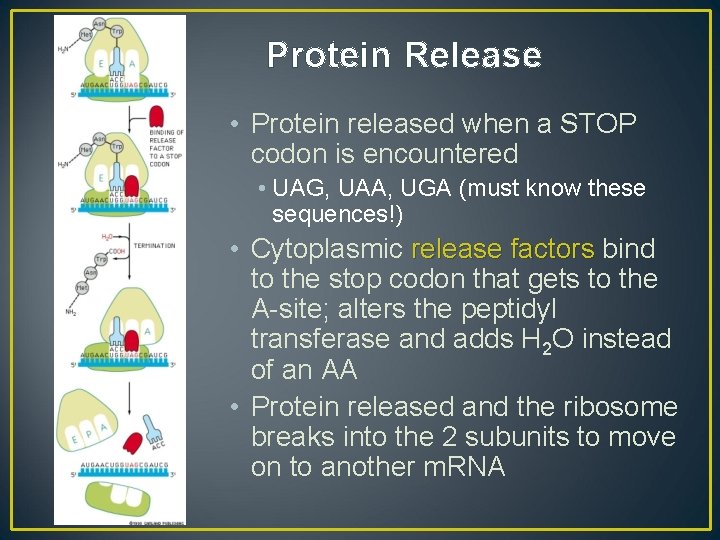
Protein Release • Protein released when a STOP codon is encountered • UAG, UAA, UGA (must know these sequences!) • Cytoplasmic release factors bind to the stop codon that gets to the A-site; alters the peptidyl transferase and adds H 2 O instead of an AA • Protein released and the ribosome breaks into the 2 subunits to move on to another m. RNA
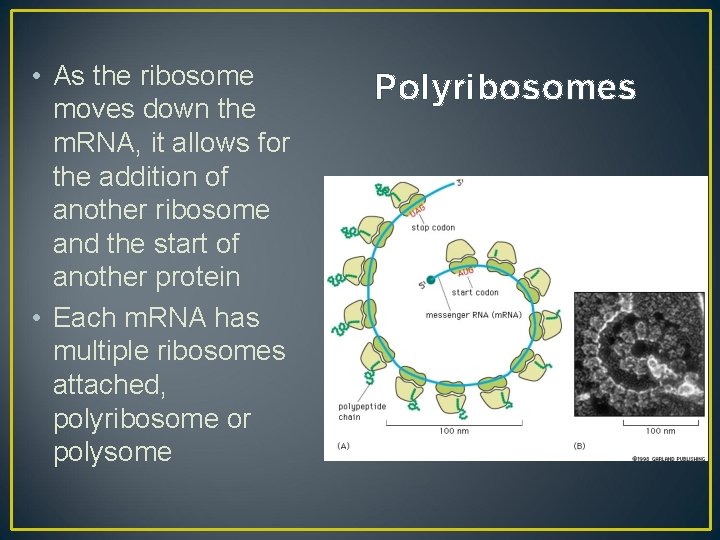
• As the ribosome moves down the m. RNA, it allows for the addition of another ribosome and the start of another protein • Each m. RNA has multiple ribosomes attached, polyribosome or polysome Polyribosomes
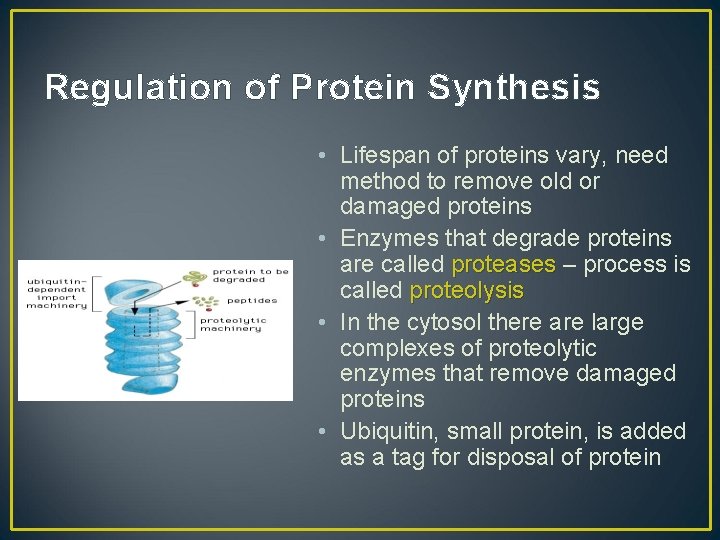
Regulation of Protein Synthesis • Lifespan of proteins vary, need method to remove old or damaged proteins • Enzymes that degrade proteins are called proteases – process is called proteolysis • In the cytosol there are large complexes of proteolytic enzymes that remove damaged proteins • Ubiquitin, small protein, is added as a tag for disposal of protein
Protein Synthesis • Protein synthesis takes the most energy input of all the biosynthetic pathways • 4 high-energy bonds required for each AA addition • 2 in charging the t. RNA (adding AA) • 2 in ribosomal activities (step 1 and step 3 of elongation phase)
Summary
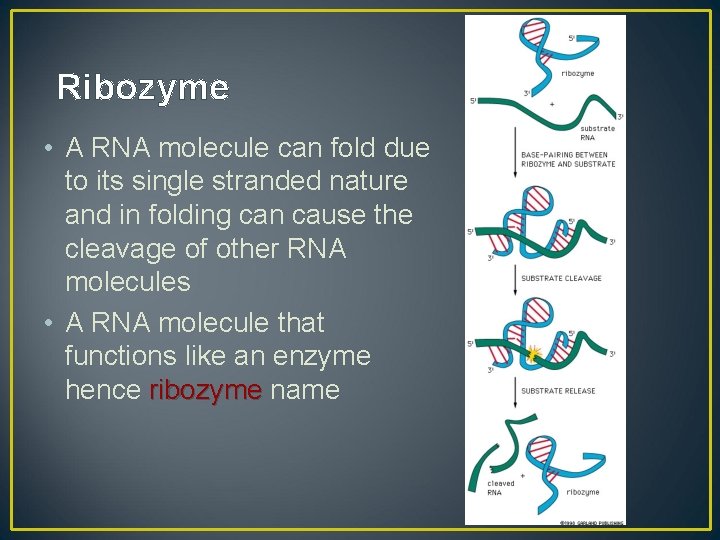
Ribozyme • A RNA molecule can fold due to its single stranded nature and in folding can cause the cleavage of other RNA molecules • A RNA molecule that functions like an enzyme hence ribozyme name