
DNA The Stuff of Life DNA Structure Copyright




- Slides: 45
DNA: The Stuff of Life
DNA Structure Copyright Pearson Prentice Hall
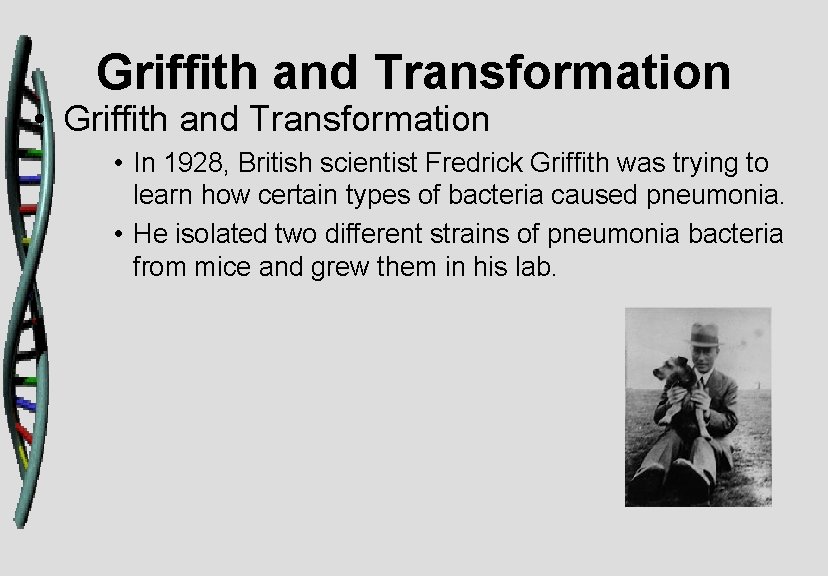
Griffith and Transformation • In 1928, British scientist Fredrick Griffith was trying to learn how certain types of bacteria caused pneumonia. • He isolated two different strains of pneumonia bacteria from mice and grew them in his lab.
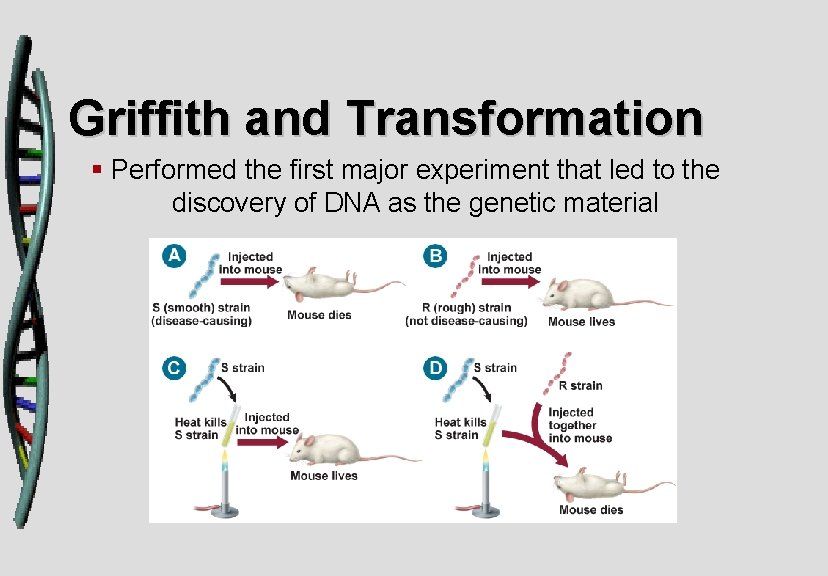
Griffith and Transformation § Performed the first major experiment that led to the discovery of DNA as the genetic material
Griffith and Transformation – Transformation • Griffith determined that bacteria could pass genetic information from one to another. • Griffith called this process transformation because one strain of bacteria (the harmless strain) had changed permanently into another (the diseasecausing strain).
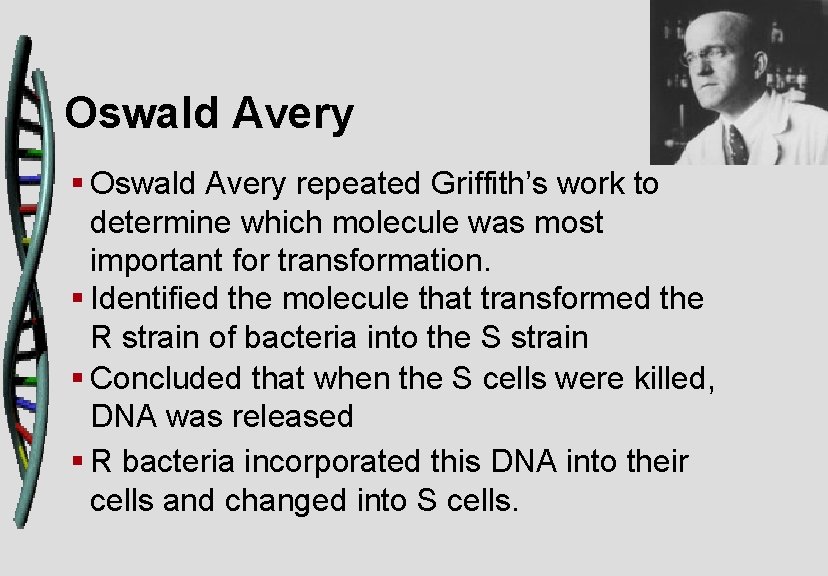
Oswald Avery § Oswald Avery repeated Griffith’s work to determine which molecule was most important for transformation. § Identified the molecule that transformed the R strain of bacteria into the S strain § Concluded that when the S cells were killed, DNA was released § R bacteria incorporated this DNA into their cells and changed into S cells.
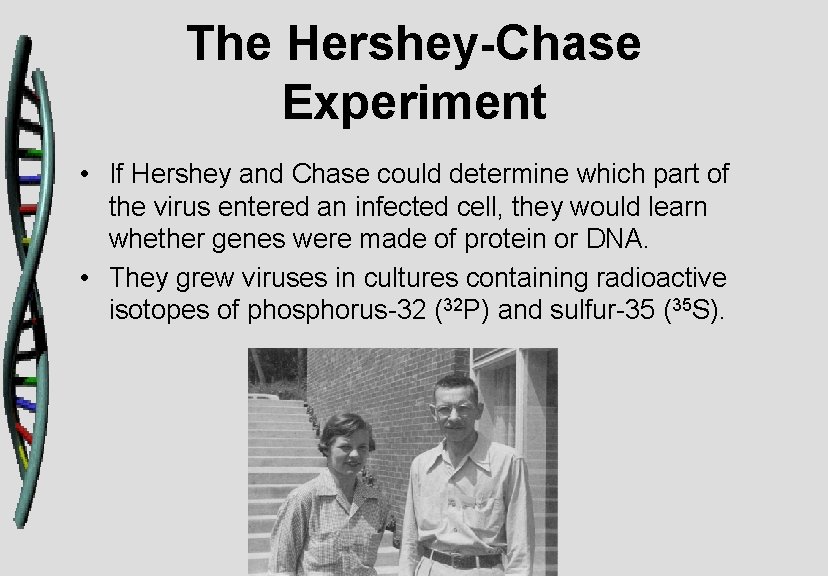
The Hershey-Chase Experiment • The Hershey-Chase Experiment – Alfred Hershey and Martha Chase studied viruses—nonliving particles smaller than a cell that can infect living organisms. • Bacteriophages • A virus that infects bacteria is known as a bacteriophage. • Bacteriophages are composed of a DNA or RNA core and a protein coat.
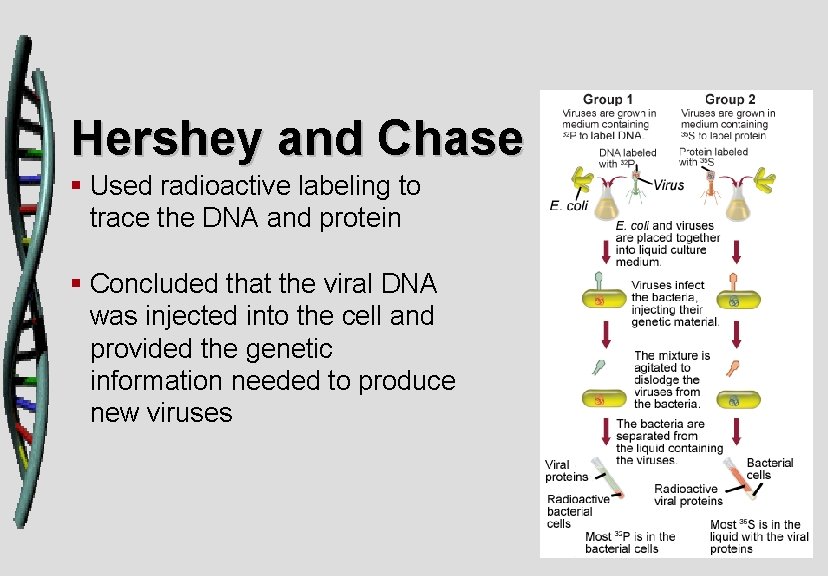
The Hershey-Chase Experiment • If Hershey and Chase could determine which part of the virus entered an infected cell, they would learn whether genes were made of protein or DNA. • They grew viruses in cultures containing radioactive isotopes of phosphorus-32 (32 P) and sulfur-35 (35 S). Copyright Pearson Prentice Hall
Hershey and Chase § Used radioactive labeling to trace the DNA and protein § Concluded that the viral DNA was injected into the cell and provided the genetic information needed to produce new viruses
DNA • • Stands for Deoxyribonucleic acid Made up of subunits called nucleotides Two strands coiled called a double helix Sides made of a pentose sugar Deoxyribose bonded to phosphate (PO 4) • Center made of nitrogen bases bonded together by weak hydrogen bonds Copyright Pearson Prentice Hall
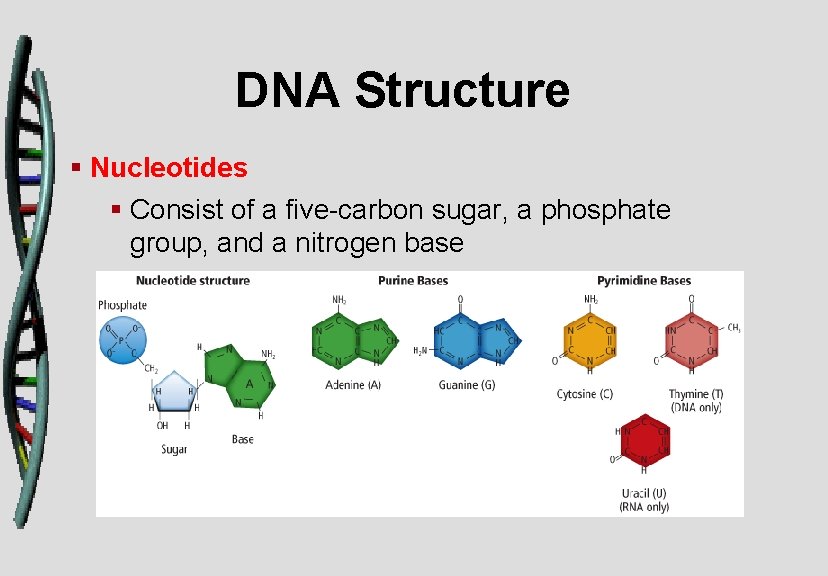
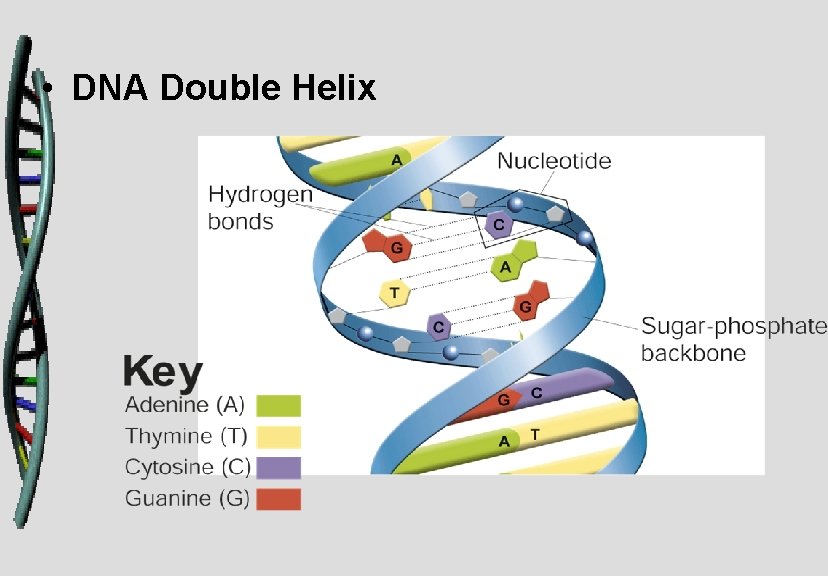
DNA Structure § Nucleotides § Consist of a five-carbon sugar, a phosphate group, and a nitrogen base
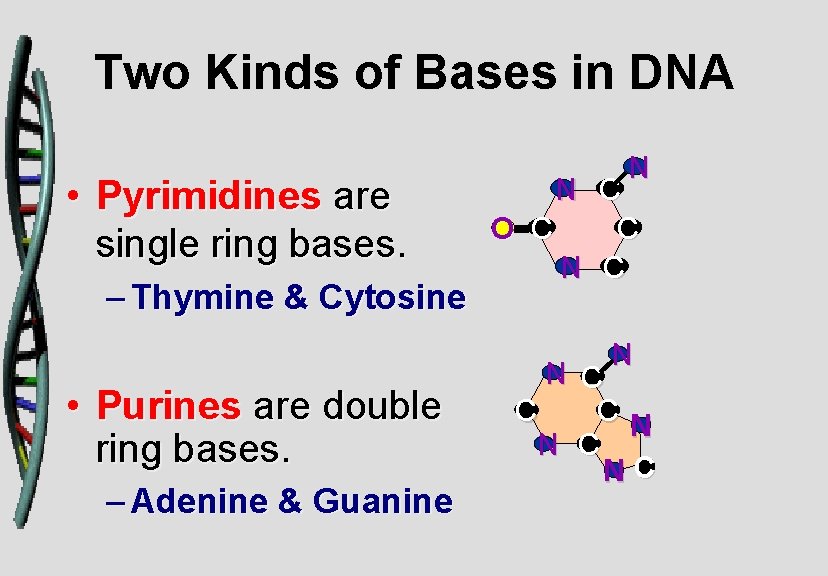
Two Kinds of Bases in DNA • Pyrimidines are single ring bases. – Thymine & Cytosine • Purines are double ring bases. – Adenine & Guanine N N C O C C N N C C CN N C NC
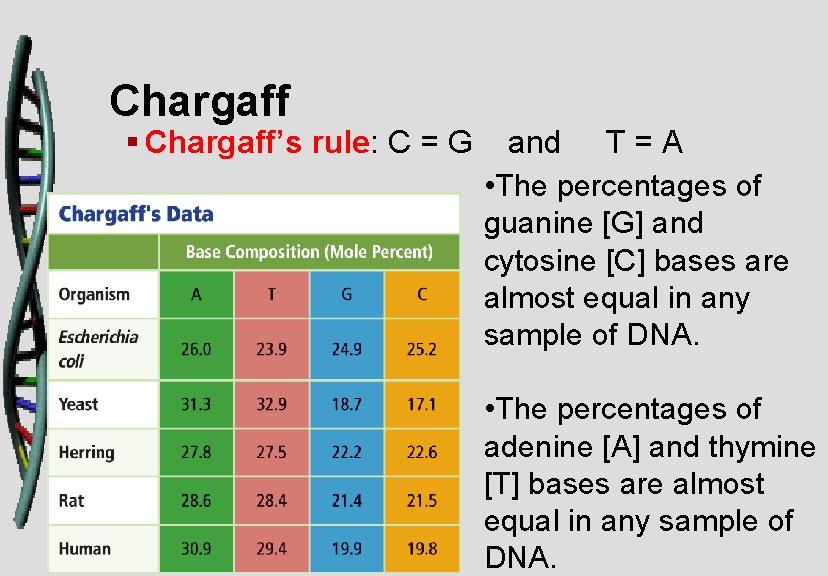
Chargaff § Chargaff’s rule: C = G and T = A • The percentages of guanine [G] and cytosine [C] bases are almost equal in any sample of DNA. • The percentages of adenine [A] and thymine [T] bases are almost equal in any sample of DNA.
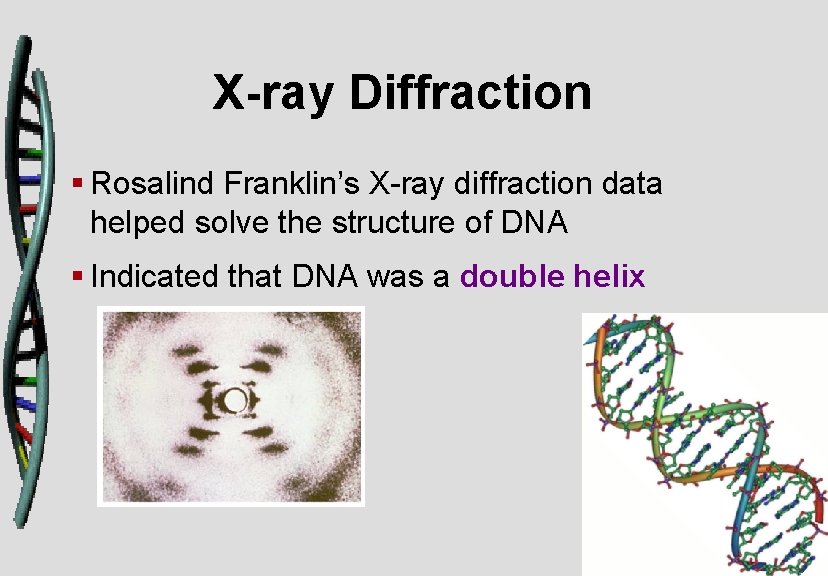
X-ray Diffraction § Rosalind Franklin’s X-ray diffraction data helped solve the structure of DNA § Indicated that DNA was a double helix
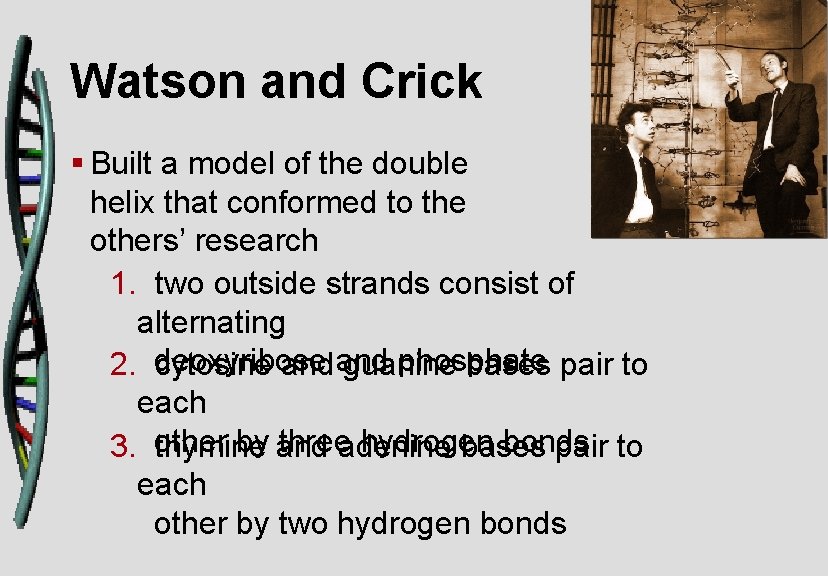
Watson and Crick § Built a model of the double helix that conformed to the others’ research 1. two outside strands consist of alternating deoxyribose and phosphate 2. cytosine and guanine bases pair to each other by three hydrogen bonds 3. thymine and adenine bases pair to each other by two hydrogen bonds
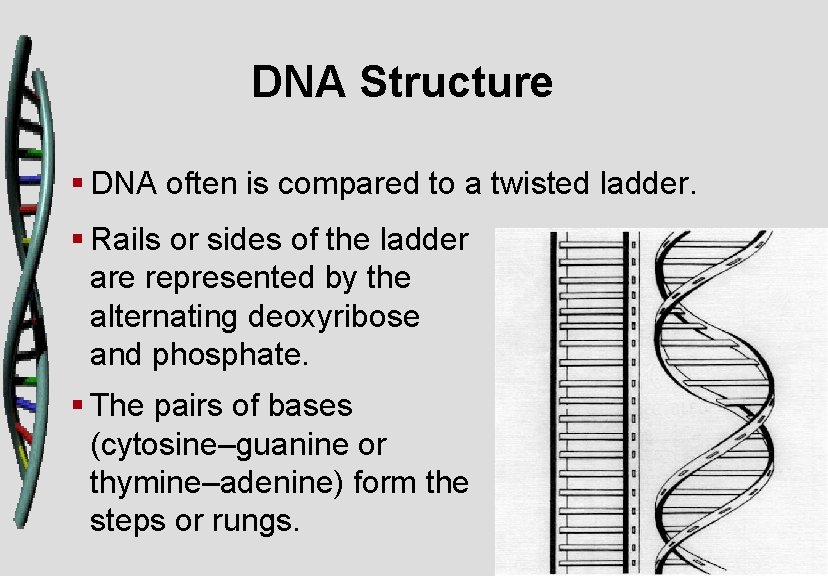
DNA Structure § DNA often is compared to a twisted ladder. § Rails or sides of the ladder are represented by the alternating deoxyribose and phosphate. § The pairs of bases (cytosine–guanine or thymine–adenine) form the steps or rungs.
• DNA Double Helix
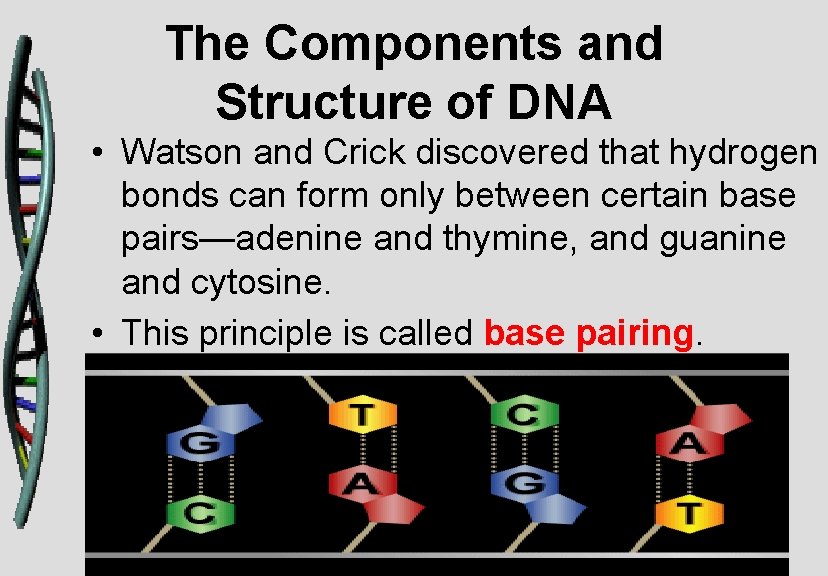
The Components and Structure of DNA • Watson and Crick discovered that hydrogen bonds can form only between certain base pairs—adenine and thymine, and guanine and cytosine. • This principle is called base pairing. Copyright Pearson Prentice Hall
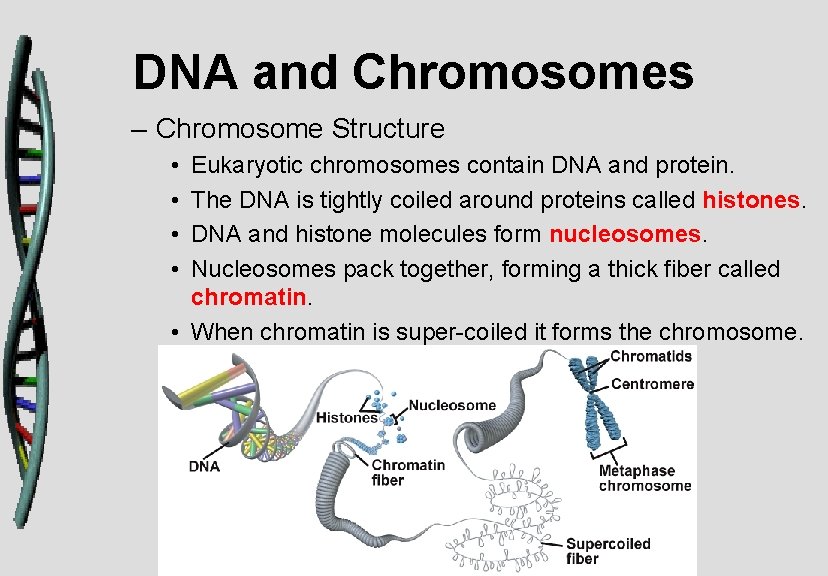
DNA and Chromosomes – Chromosome Structure • • Eukaryotic chromosomes contain DNA and protein. The DNA is tightly coiled around proteins called histones. DNA and histone molecules form nucleosomes. Nucleosomes pack together, forming a thick fiber called chromatin. • When chromatin is super-coiled it forms the chromosome.
DNA (4: 00)
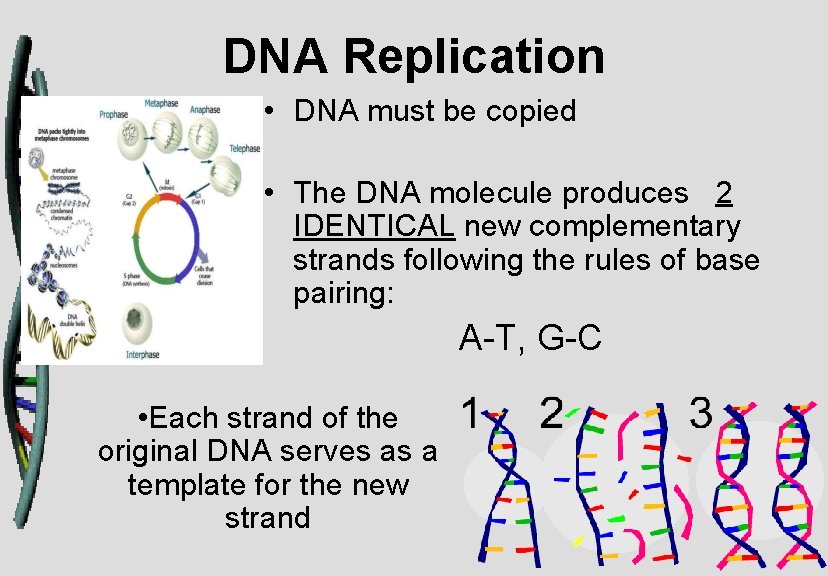
DNA Replication • DNA must be copied • The DNA molecule produces 2 IDENTICAL new complementary strands following the rules of base pairing: A-T, G-C • Each strand of the original DNA serves as a template for the new strand
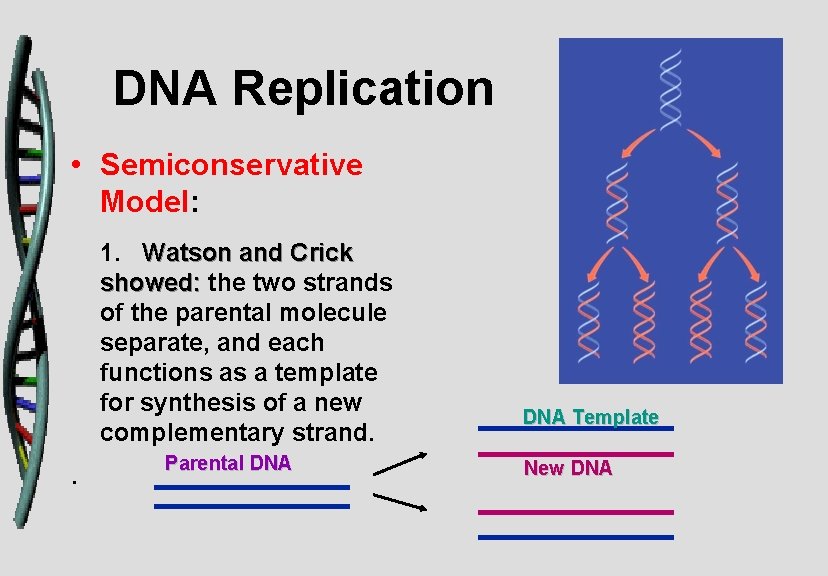
DNA Replication • Semiconservative Model: 1. Watson and Crick showed: the two strands of the parental molecule separate, and each functions as a template for synthesis of a new complementary strand. . Parental DNA Template New DNA
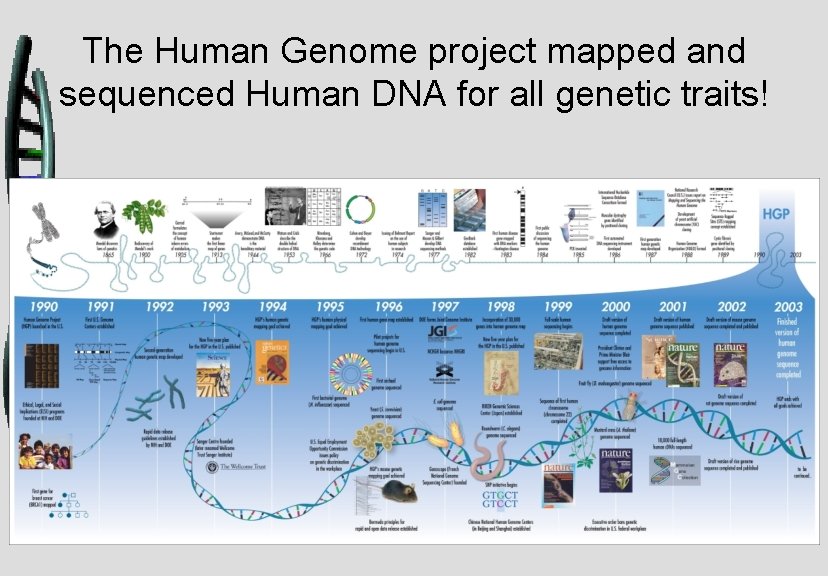
The Human Genome project mapped and sequenced Human DNA for all genetic traits!
Cloning
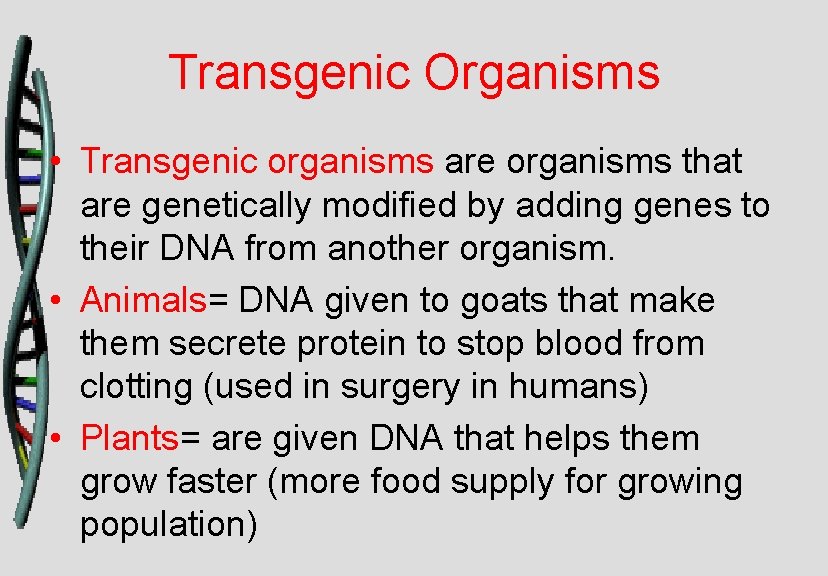
Transgenic Organisms • Transgenic organisms are organisms that are genetically modified by adding genes to their DNA from another organism. • Animals= DNA given to goats that make them secrete protein to stop blood from clotting (used in surgery in humans) • Plants= are given DNA that helps them grow faster (more food supply for growing population)
Phosphate Base Nucleotide Draw this for your notebook check Sugar DNA
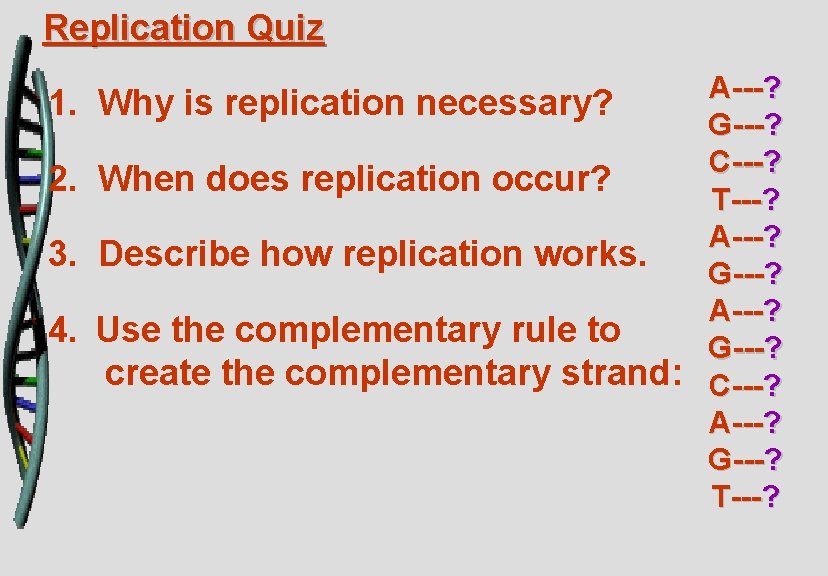
Replication Quiz 1. 2. 3. 4. A ---? Why is replication necessary? G ---? C ---? When does replication occur? T ---? A ---? Describe how replication works. G ---? A ---? Use the complementary rule to G ---? create the complementary strand: C---? A ---? G ---? T ---?
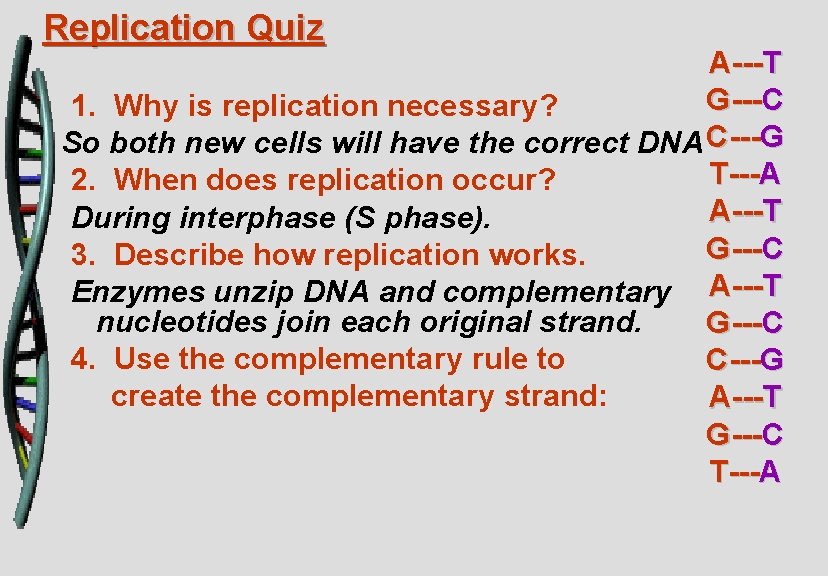
Replication Quiz A ---T G ---C 1. Why is replication necessary? So both new cells will have the correct DNA C---G T ---A 2. When does replication occur? A ---T During interphase (S phase). G ---C 3. Describe how replication works. Enzymes unzip DNA and complementary A---T nucleotides join each original strand. G ---C 4. Use the complementary rule to C ---G create the complementary strand: A ---T G ---C T ---A
DNA Replication
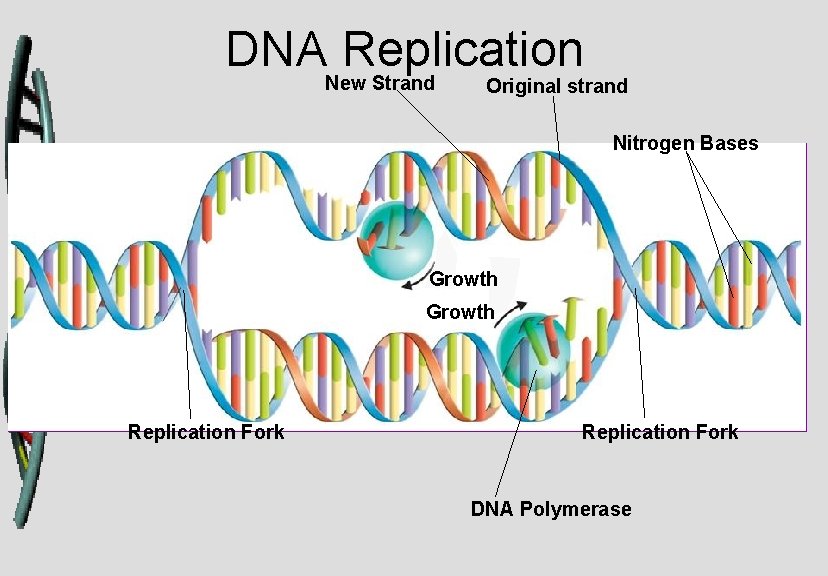
DNA Replication • Each strand of the DNA double helix has all the information needed to reconstruct the other half by the mechanism of base pairing. • In most prokaryotes, DNA replication begins at a single point and continues in two directions.
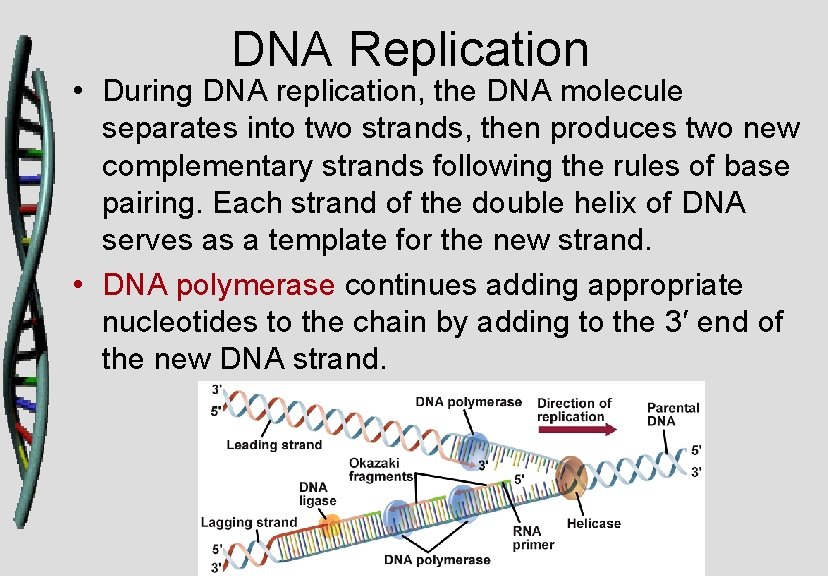
DNA Replication • During DNA replication, the DNA molecule separates into two strands, then produces two new complementary strands following the rules of base pairing. Each strand of the double helix of DNA serves as a template for the new strand. • DNA polymerase continues adding appropriate nucleotides to the chain by adding to the 3′ end of the new DNA strand.
DNA Replication New Strand Original strand Nitrogen Bases Growth Replication Fork DNA Polymerase
DNA Replication • The principal enzyme involved in DNA replication is DNA polymerase. • DNA polymerase joins individual nucleotides to produce a DNA molecule and then “proofreads” each new DNA strand.
Race to the Double Helix • http: //www. biology 4 friends. org/race-for-thedouble-helix-movie. html Copyright Pearson Prentice Hall
Questions – Avery and other scientists discovered that • • DNA is found in a protein coat. DNA stores and transmits genetic information from one generation to the next. transformation does not affect bacteria. proteins transmit genetic information from one generation to the next.
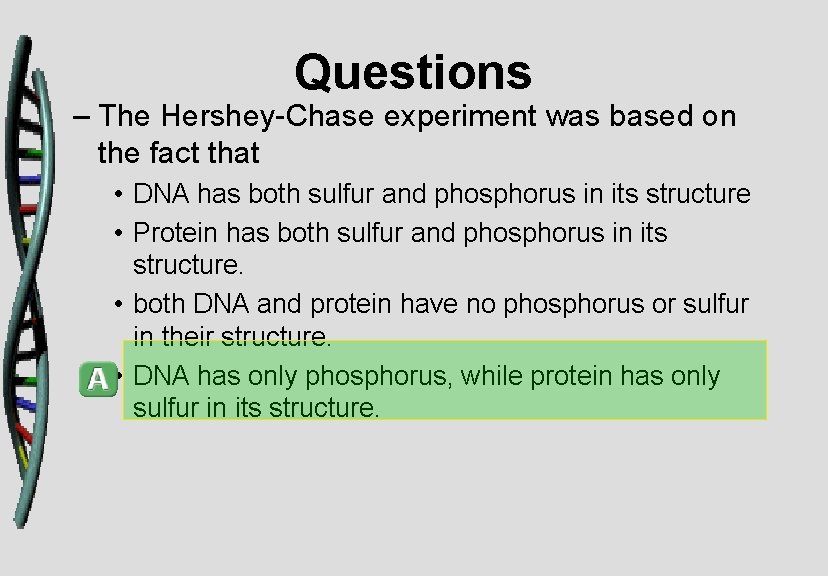
Questions – The Hershey-Chase experiment was based on the fact that • DNA has both sulfur and phosphorus in its structure • Protein has both sulfur and phosphorus in its structure. • both DNA and protein have no phosphorus or sulfur in their structure. • DNA has only phosphorus, while protein has only sulfur in its structure.
Questions – DNA is a long molecule made of monomers called • • nucleotides. purines. pyrimidines. sugars.
Questions – Chargaff's rules state that the number of guanine nucleotides must equal the number of • • cytosine nucleotides. adenine nucleotides. thymine plus adenine nucleotides.
Questions – In DNA, the following base pairs occur: • • A with C, and G with T. A with T, and C with G. A with G, and C with T. A with T, and C with T.
12– 2 – In prokaryotic cells, DNA is found in the • • cytoplasm. nucleus. ribosome. cell membrane.
12– 2 – The first step in DNA replication is • • producing two new strands. separating the strands. producing DNA polymerase. correctly pairing bases.
12– 2 – A DNA molecule separates, and the sequence GCGAATTCG occurs in one strand. What is the base sequence on the other strand? • • GCGAATTCG CGCTTAAGC TATCCGGAT GATGGCCAG
12– 2 – In addition to carrying out the replication of DNA, the enzyme DNA polymerase also functions to • unzip the DNA molecule. • regulate the time copying occurs in the cell cycle. • “proofread” the new copies to minimize the number of mistakes. • wrap the new strands onto histone proteins.
12– 2 – The structure that may play a role in regulating how genes are “read” to make a protein is the • • coil. histone. nucleosome. chromatin.
END OF SECTION