
DNA The Genetic Material Chapter 12 Objectives Identify
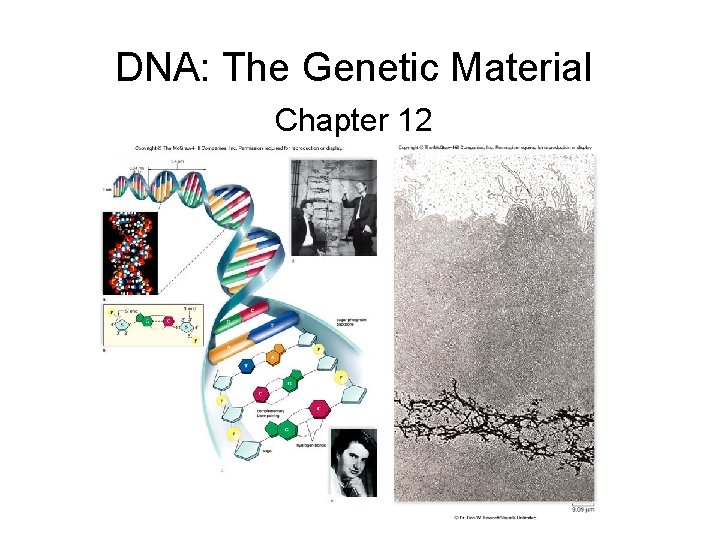
DNA: The Genetic Material Chapter 12
Objectives • Identify key scientist and their contribution to our understanding of DNA • Summarize the relationship between genes and DNA • Describe the overall structure of the DNA molecule
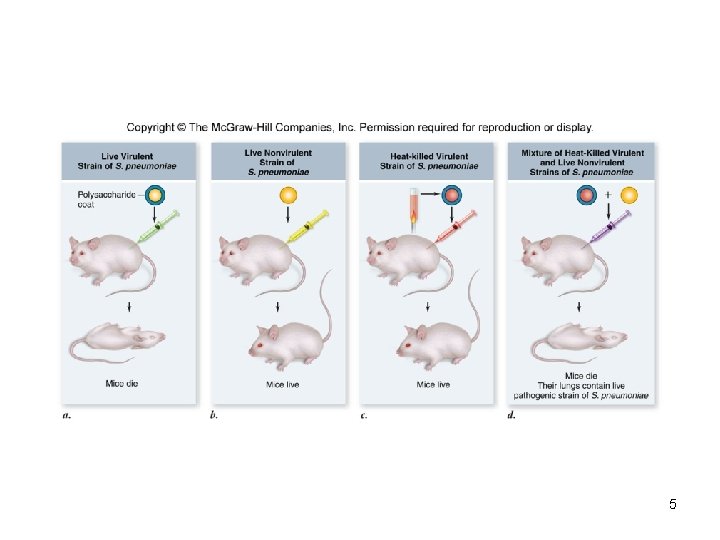
The Genetic Material Frederick Griffith, 1928 studied Streptococcus pneumoniae, a pathogenic bacterium causing pneumonia there are 2 strains of Streptococcus: - S strain is virulent - R strain is nonvirulent Griffith infected mice with these strains hoping to understand the difference between the strains ***video 3
The Genetic Material Griffith’s results: - live S strain cells killed the mice - live R strain cells did not kill the mice - heat-killed S strain + live R strain cells killed the mice 4
5
The Genetic Material Griffith’s conclusion: - information specifying virulence passed from the dead S strain cells into the live R strain cells - Griffith called the transfer of this information transformation 6
The Genetic Material Avery, Mac. Leod, & Mc. Carty, 1944 repeated Griffith’s experiment using purified cell extracts and discovered: - removal of all protein from the transforming material did not destroy its ability to transform R strain cells - DNA-digesting enzymes destroyed all transforming ability - the transforming material is DNA 7
The Genetic Material Hershey & Chase, 1952 - investigated bacteriophages: viruses that infect bacteria - the bacteriophage was composed of only DNA and protein - they wanted to determine which of these molecules is the genetic material that is injected into the bacteria 8
The Genetic Material - Bacteriophage DNA was labeled with radioactive phosphorus (32 P) - Bacteriophage protein was labeled with radioactive sulfur (35 S) - radioactive molecules were tracked - only the bacteriophage DNA (as indicated by the 32 P) entered the bacteria and was used to produce more bacteriophage - conclusion: DNA is the genetic material 9

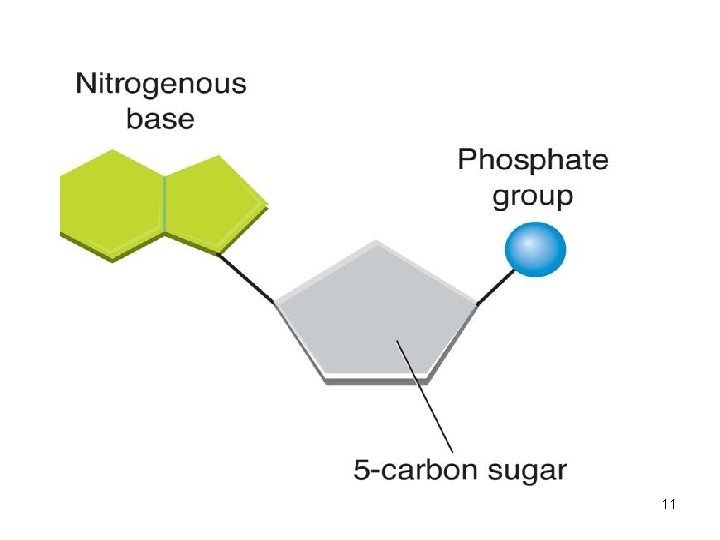
DNA Structure DNA is a nucleic acid. The building blocks of DNA are nucleotides, each composed of: – a 5 -carbon sugar called deoxyribose – a phosphate group – a nitrogenous base • adenine, thymine, cytosine, guanine 10
11
DNA Structure Rosalind Franklin and Maurice Wilkins – performed X-ray diffraction studies to identify the 3 -D structure James Watson and Francis Crick, 1953 – deduced the structure of DNA using evidence from Chargaff, Franklin, and others – proposed a double helix structure 12

DNA Structure The double helix consists of: – 2 sugar-phosphate backbones – nitrogenous bases toward the interior of the molecule – bases form hydrogen bonds with complementary bases on the opposite sugar -phosphate backbone • Cytosine : : Guanine • Adenine : : Thymine 13
QUIZ 1. Which two scientist concluded that genes were probably made of DNA? A. Hershey and Chase B. Avery and Chase C. Griffith and Chase D. Griffith and Avery
QUIZ 1. Which two scientist concluded that genes were probably made of DNA? A. Hershey and Chase B. Avery and Chase C. Griffith and Chase D. Griffith and Avery
QUIZ 1. Which two scientist concluded that the genetic material of bacteriophage was DNA, not proteins? A. Hershey and Chase B. Avery and Chase C. Griffith and Chase D. Griffith and Avery
QUIZ 1. Which two scientist concluded that the genetic material of bacteriophage was DNA, not proteins? A. Hershey and Chase B. Avery and Chase C. Griffith and Chase D. Griffith and Avery
QUIZ 3. All of the following are bases found in DNA, except A. Adenine B. Thymine C. Guanine D. cyotsol
QUIZ 3. All of the following are bases found in DNA, except A. Adenine B. Thymine C. Guanine D. Cyotsol
QUIZ 4. According to the principle of base pairing, which of the is correct? A. Cytosine – Adenine B. Adenine – Guanine C. Cytosine – Guanine D. Guanine – Thymine
QUIZ 4. According to the principle of base pairing, which of the is correct? A. Cytosine – Adenine B. Adenine – Guanine C. Cytosine – Guanine D. Guanine – Thymine
Quiz 5. The Structure of DNA can be described as A. Globular protein B. A structure too complex to comprehend C. A double helix D. An alien masterpiece
Quiz 5. The Structure of DNA can be described as A. Globular protein B. A structure too complex to comprehend C. A double helix D. An alien masterpiece
- Slides: 23