
DNA Structure Replication Objectives To explain how instructions
DNA Structure & Replication
Objectives • To explain how instructions in DNA lead to different cells and result in cells being able to perform certain tasks in an organism • Identify the building blocks and nitrogenous bases (A, T, G, C and U) of nucleic acids
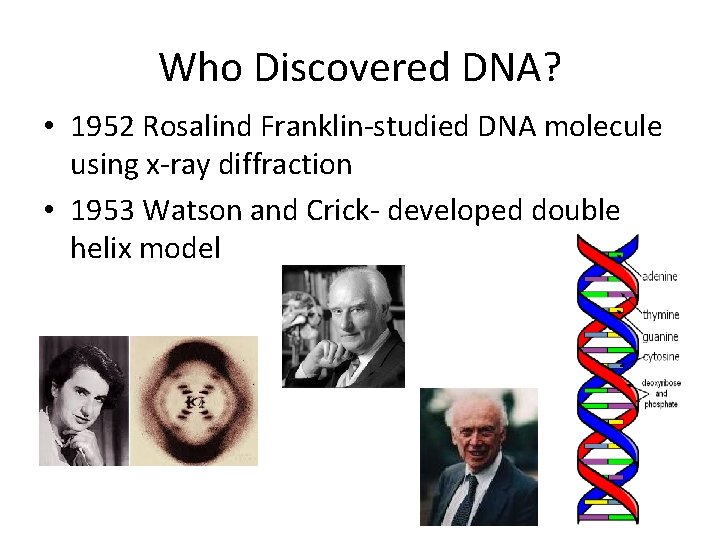
Who Discovered DNA? • 1952 Rosalind Franklin-studied DNA molecule using x-ray diffraction • 1953 Watson and Crick- developed double helix model
What is DNA? • Although the environment can influence how an organism develops, DNA determines the organism’s TRAITS. • Determines the structure of the proteins. • Contains the instructions for LIFE! • DEOXYRIBONUCLEIC ACID! • Prokaryotic and Eukaryotic cells depend on DNA to determine function.
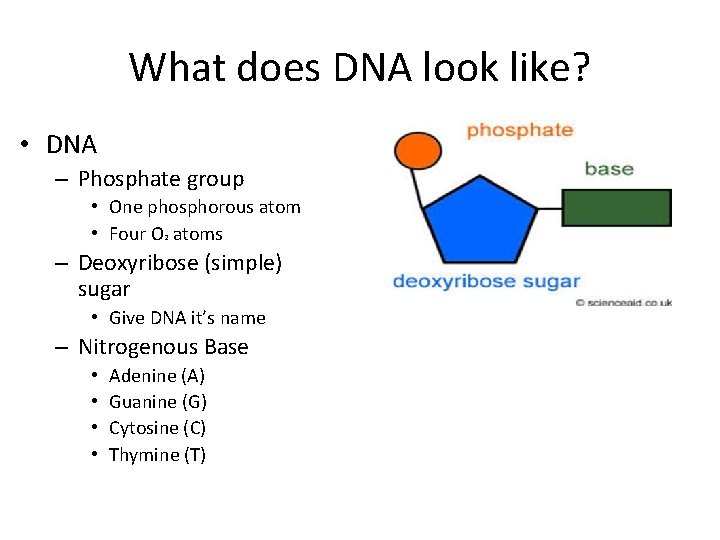
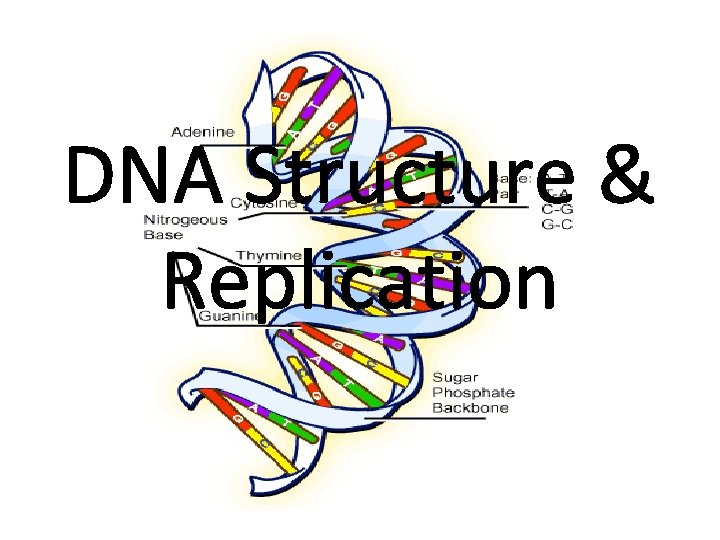
What does DNA look like? • DNA – Phosphate group • One phosphorous atom • Four O 2 atoms – Deoxyribose (simple) sugar • Give DNA it’s name – Nitrogenous Base • • Adenine (A) Guanine (G) Cytosine (C) Thymine (T)
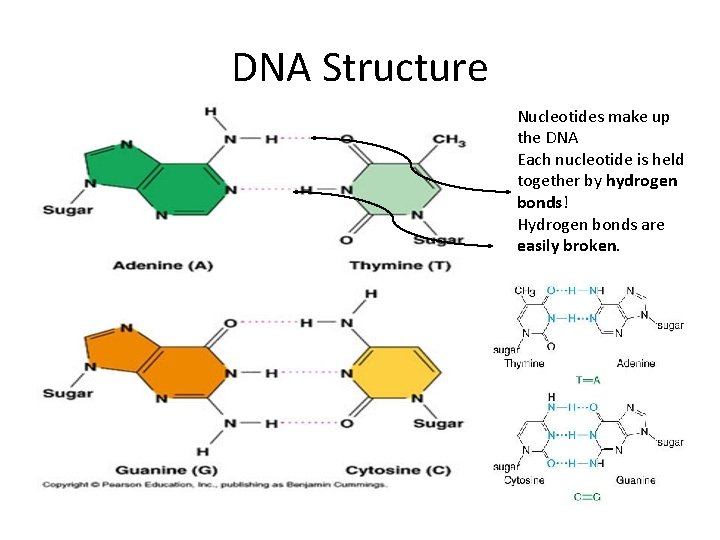
DNA Structure Nucleotides make up the DNA Each nucleotide is held together by hydrogen bonds! Hydrogen bonds are easily broken.

DNA Structure • Double Helix • Twisted ladder structure • Sides have alternating phosphate sugar groups • “Rungs of a DNA ladder” “Chargoff’s rule” A=T & C=G (Complementary Base Paring)
DNA Replication • DNA must be copied before the cell can divide (mitosis or meosis) • Without replication, new cells would only have ½ the DNA of their parents. • Survival, growth, and reproduction would be impossible • Prokaryotic and Eukaryotic cells depend on DNA replication to ensure each daughter cell will receive same genetic instruction as parent cell.
• Because of base pairing, we can predict the sequence of bases on a different strand. • During replication, each strand serves as a template (or pattern) • Enzymes break apart the DNA at the hydrogen bonds. • The old strand is paired with each complementary base generating a complementary strand. • DNA runs 3” to 5” (leading strand) ; DNA replicates 5” to 3” (lagging strand)
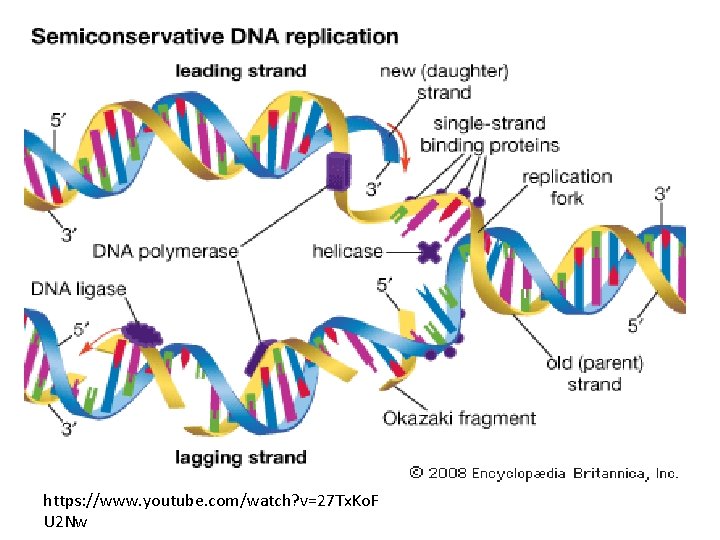
https: //www. youtube. com/watch? v=27 Tx. Ko. F U 2 Nw
Why does sequence matter? • The sequence of nucleotides creates the specific genetic information. • Different sequence = different function. • ATTGAC is not the same as TCCAAA. • The closer a sequence is related to another, the more similar the organisms are to one another
Knowledge Check • • • What is DNA? DNA determines an organism’s ______ What does DNA stand for? What are the 4 nitrogenous bases? Pair the following nitrogenous bases with their matching bases: AAAT CGATATC TTCCGCT
- Slides: 12