
DNA Structure Powerpoint 1 Chapter 12 Vocabulary 1
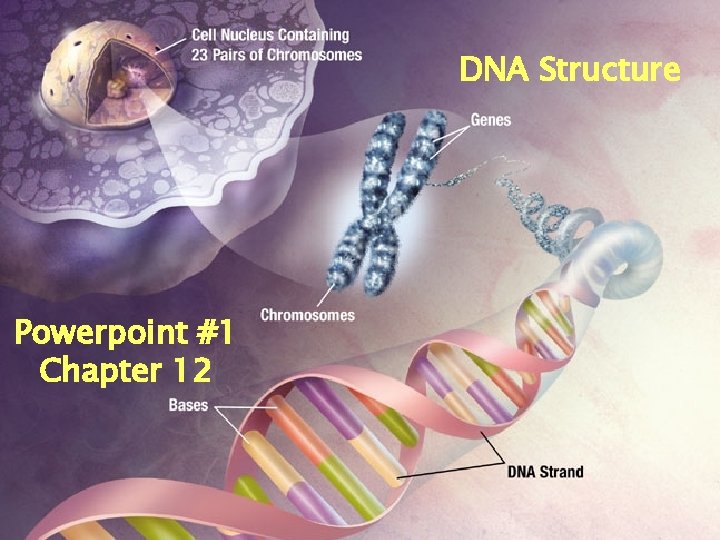
DNA Structure Powerpoint #1 Chapter 12
Vocabulary 1) 2) 3) 4) 5) 6) 7) 8) 9) Base Pair Chargaff’s Rule Chromosome Double helix Gene Histone Nucleotide Watson and Crick X-ray crystallography
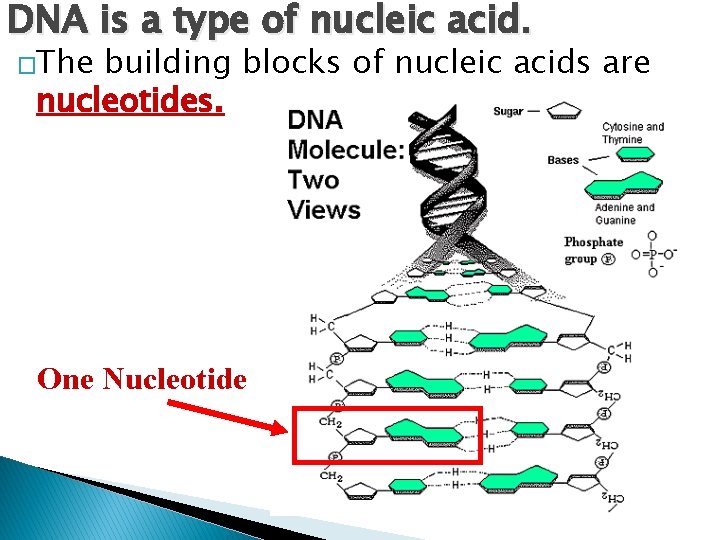
DNA is a type of nucleic acid. �The building blocks of nucleic acids are nucleotides. One Nucleotide
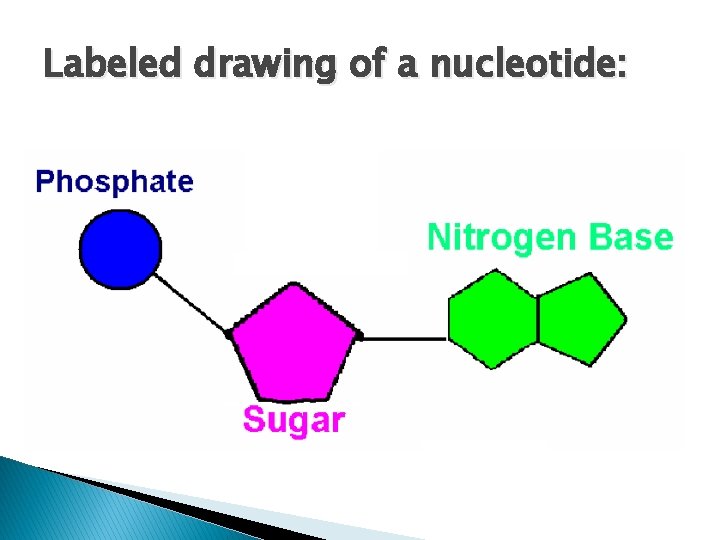
Labeled drawing of a nucleotide:
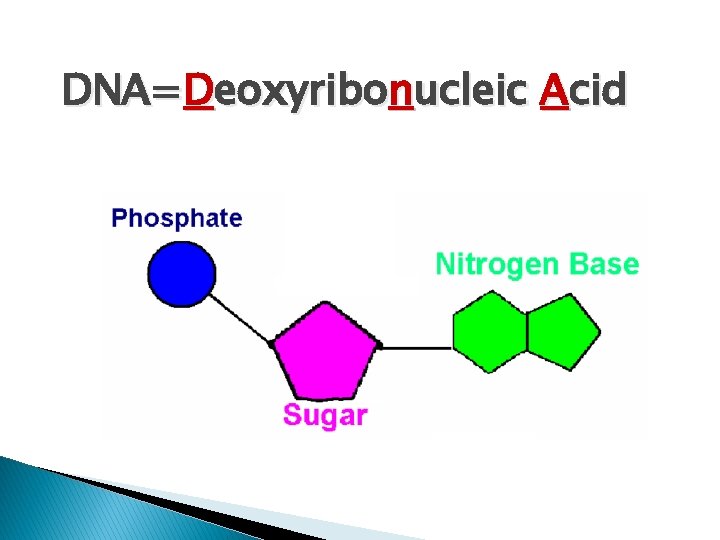
DNA=Deoxyribonucleic Acid
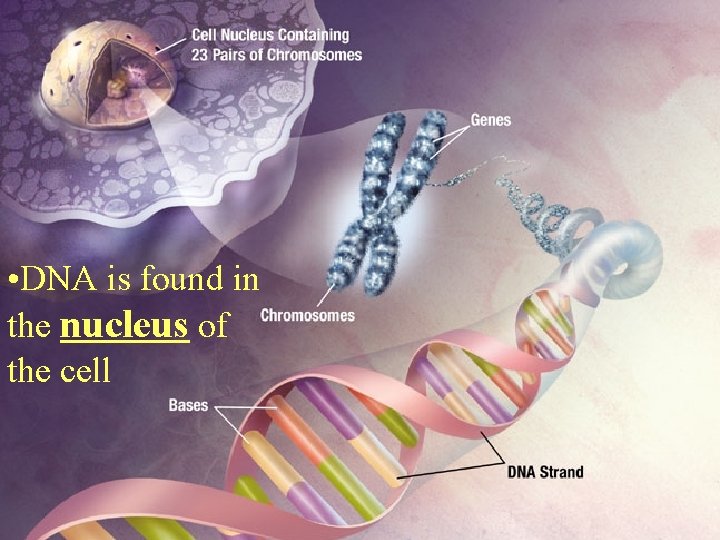
• DNA is found in the nucleus of the cell

• DNA’s function is to store and transmit genetic information. How did scientists determine the structure of DNA?
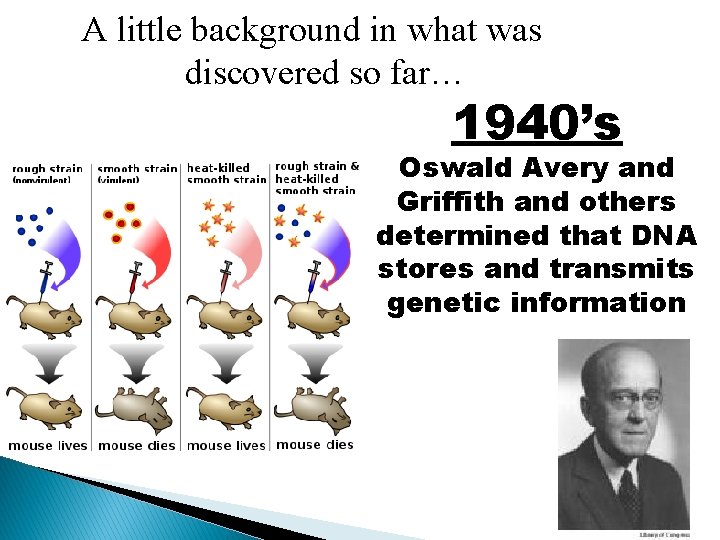
A little background in what was discovered so far… 1940’s Oswald Avery and Griffith and others determined that DNA stores and transmits genetic information
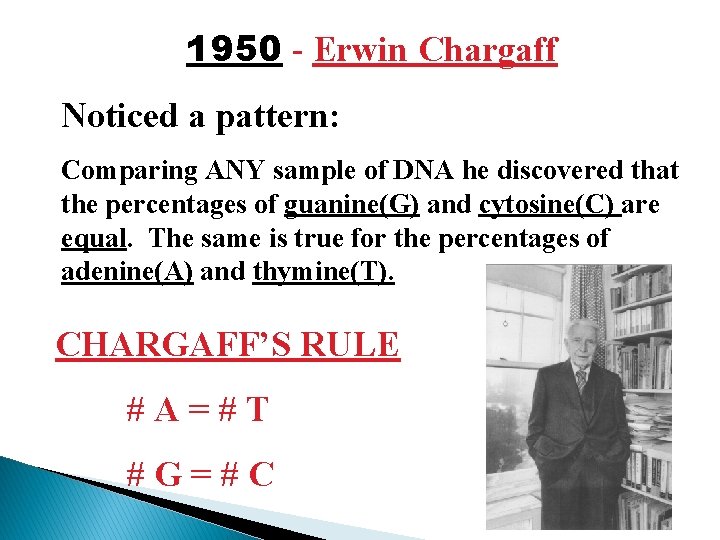
1950 - Erwin Chargaff Noticed a pattern: Comparing ANY sample of DNA he discovered that the percentages of guanine(G) and cytosine(C) are equal. The same is true for the percentages of adenine(A) and thymine(T). CHARGAFF’S RULE #A=#T #G=#C
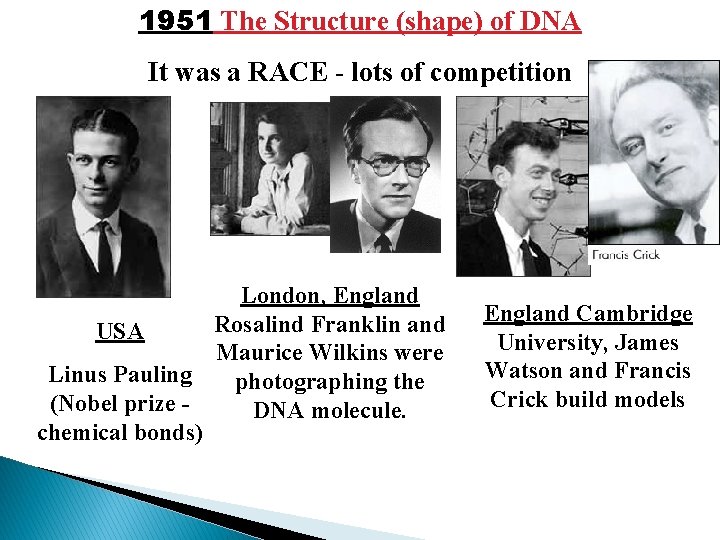
1951 The Structure (shape) of DNA It was a RACE - lots of competition London, England Rosalind Franklin and USA Maurice Wilkins were Linus Pauling photographing the (Nobel prize DNA molecule. chemical bonds) England Cambridge University, James Watson and Francis Crick build models
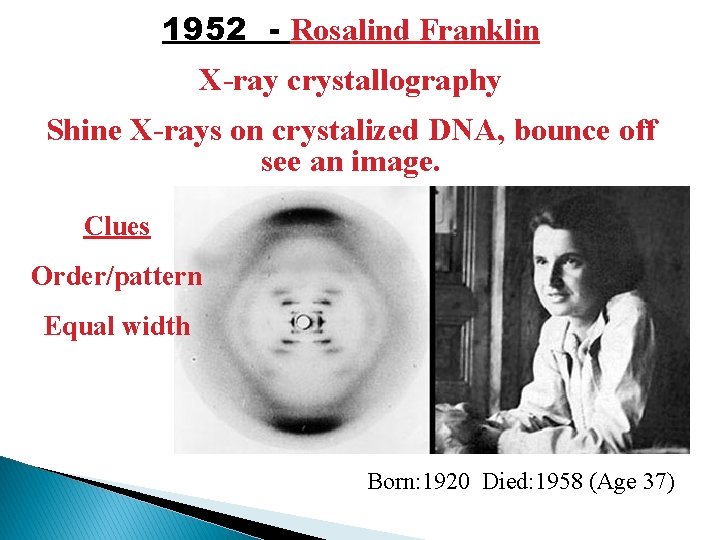
1952 - Rosalind Franklin X-ray crystallography Shine X-rays on crystalized DNA, bounce off see an image. Clues Order/pattern Equal width Born: 1920 Died: 1958 (Age 37)
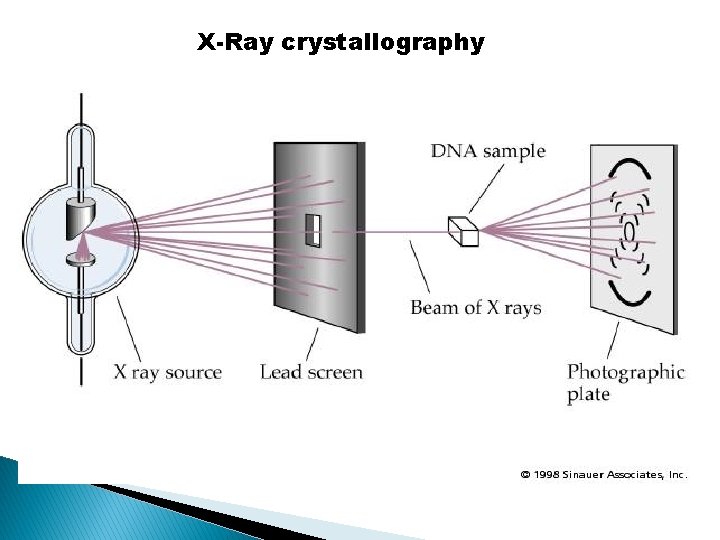
X-Ray crystallography
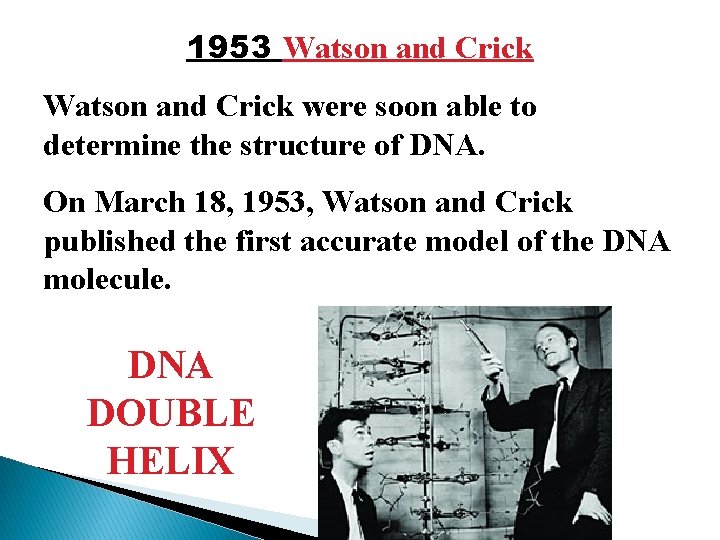
1953 Watson and Crick were soon able to determine the structure of DNA. On March 18, 1953, Watson and Crick published the first accurate model of the DNA molecule. DNA DOUBLE HELIX
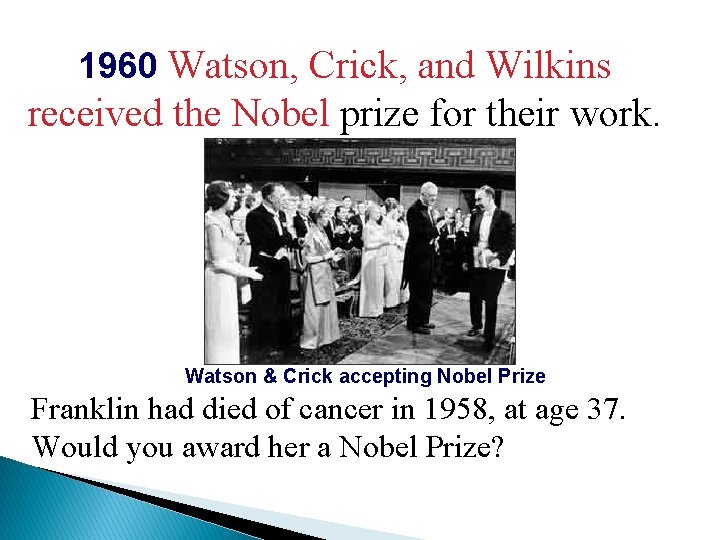
1960 Watson, Crick, and Wilkins received the Nobel prize for their work. Watson & Crick accepting Nobel Prize Franklin had died of cancer in 1958, at age 37. Would you award her a Nobel Prize?
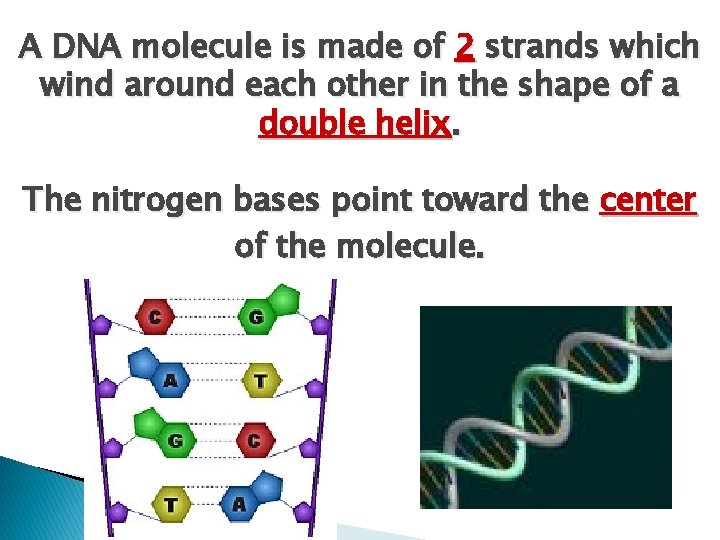
A DNA molecule is made of 2 strands which wind around each other in the shape of a double helix. The nitrogen bases point toward the center of the molecule.
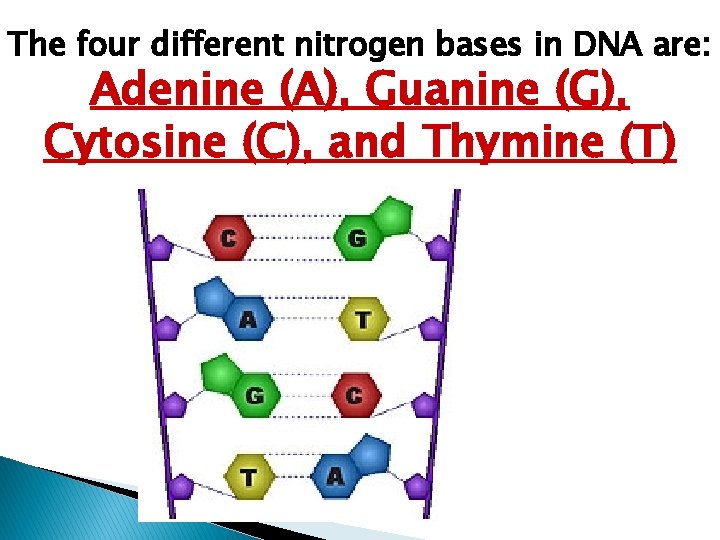
The four different nitrogen bases in DNA are: Adenine (A), Guanine (G), Cytosine (C), and Thymine (T)
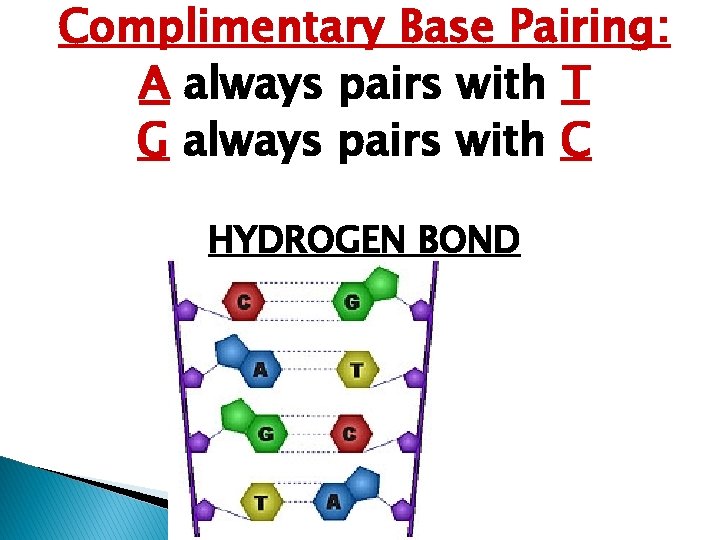
Complimentary Base Pairing: A always pairs with T G always pairs with C HYDROGEN BOND
How can a seemingly simple code with only 4 letters produce millions of different genes? �The code is read 3 bases at a time (4 x 4 x 4=64) and can be thousands or millions of base pairs long. �(64 x 64……. )

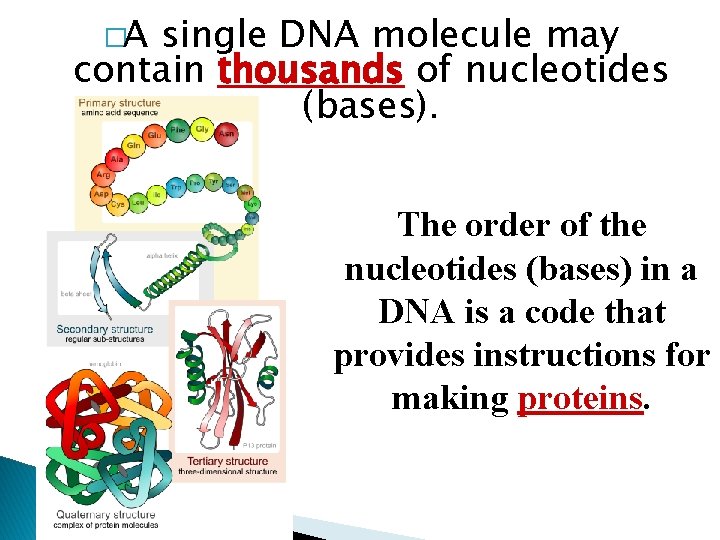
�A single DNA molecule may contain thousands of nucleotides (bases). The order of the nucleotides (bases) in a DNA is a code that provides instructions for making proteins.
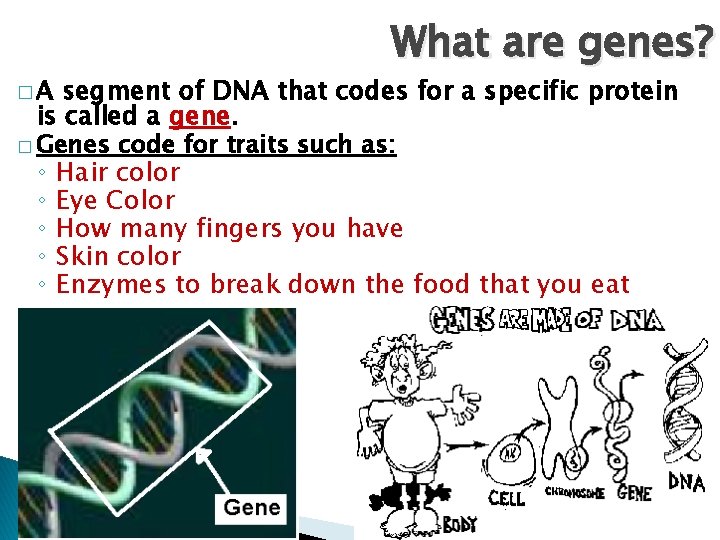
�A What are genes? segment of DNA that codes for a specific protein is called a gene. � Genes code for traits such as: ◦ Hair color ◦ Eye Color ◦ How many fingers you have ◦ Skin color ◦ Enzymes to break down the food that you eat
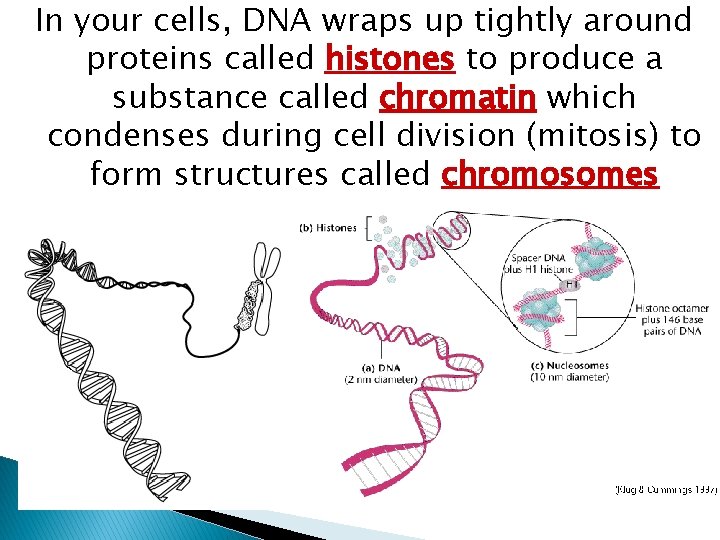
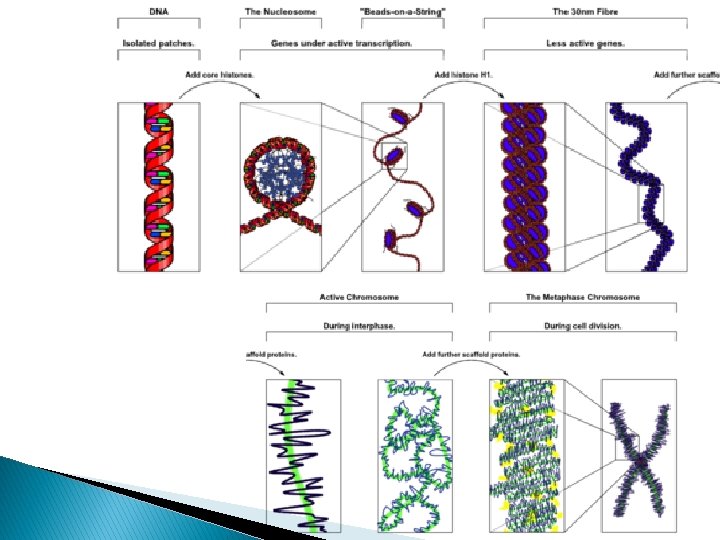
In your cells, DNA wraps up tightly around proteins called histones to produce a substance called chromatin which condenses during cell division (mitosis) to form structures called chromosomes
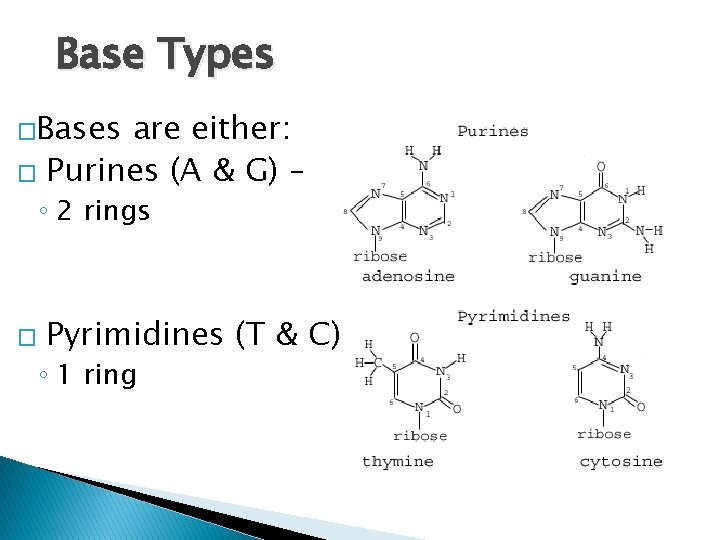
Base Types �Bases are either: � Purines (A & G) – ◦ 2 rings � Pyrimidines (T & C) ◦ 1 ring
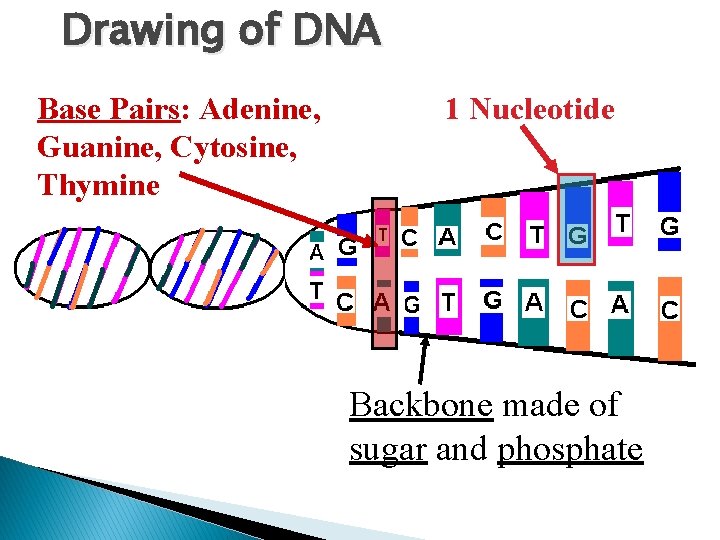
Drawing of DNA Base Pairs: Adenine, Guanine, Cytosine, Thymine 1 Nucleotide Backbone made of sugar and phosphate

Exit Quick Write (2 minutes) In your notebook: - Write what you learned about DNA today. - (ie. Structure, purpose, importance, shape, location, etc. )
- Slides: 28