
DNA Structure of DNA stands for Deoxyribonucleic Acid
DNA
Structure of DNA stands for Deoxyribonucleic Acid The primary function of DNA is to store and transmit the genetic information that tells cells WHICH proteins to make and WHEN to make them. Each segment of DNA that codes for a particular protein is called a GENE.
Your Turn ! • Put the following terms in order from largest to smallest: Gene § Protein § DNA §
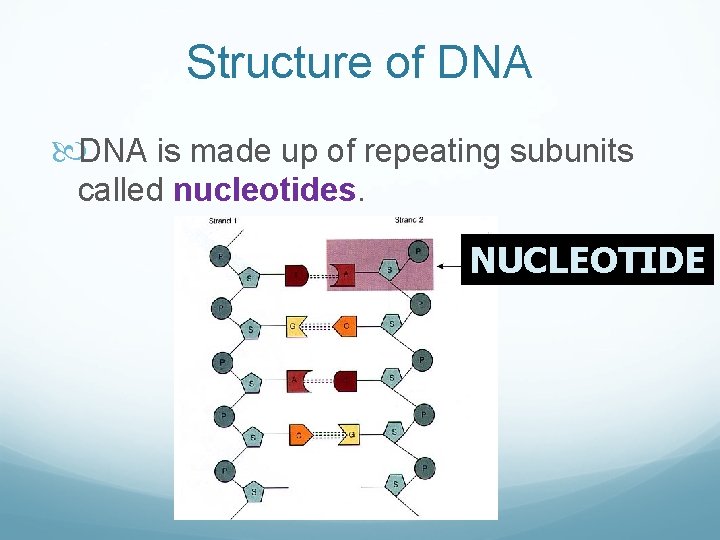
Structure of DNA is made up of repeating subunits called nucleotides. NUCLEOTIDE
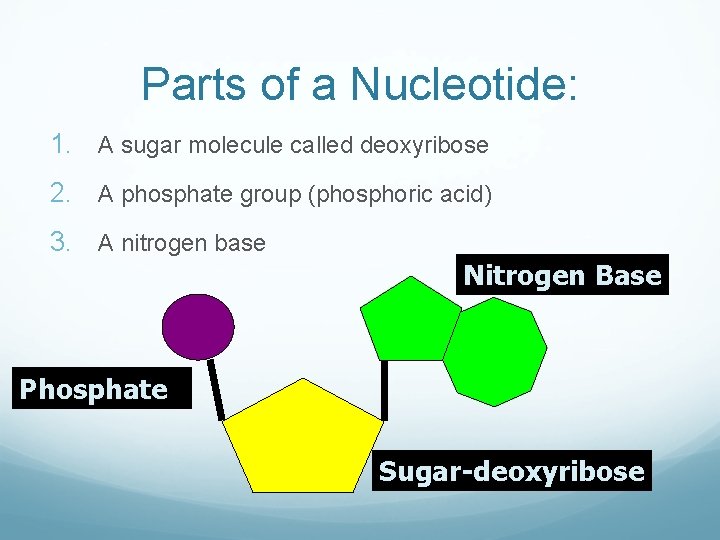
Parts of a Nucleotide: 1. A sugar molecule called deoxyribose 2. A phosphate group (phosphoric acid) 3. A nitrogen base Nitrogen Base Phosphate Sugar-deoxyribose
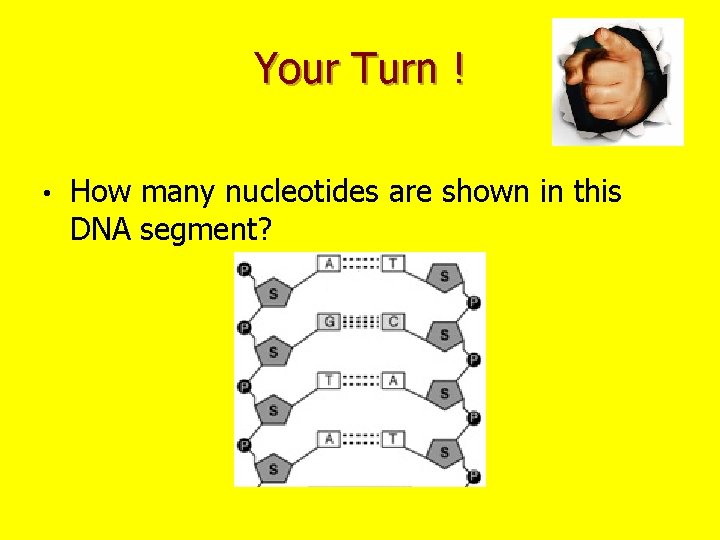
Your Turn ! • How many nucleotides are shown in this DNA segment?
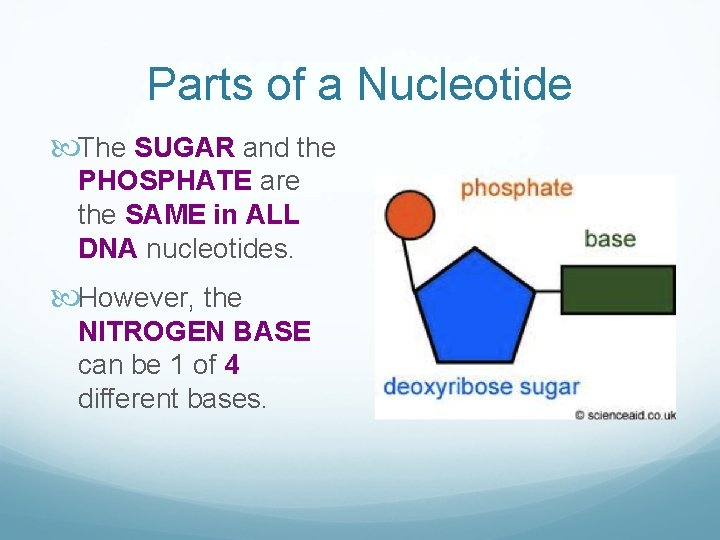
Parts of a Nucleotide The SUGAR and the PHOSPHATE are the SAME in ALL DNA nucleotides. However, the NITROGEN BASE can be 1 of 4 different bases.
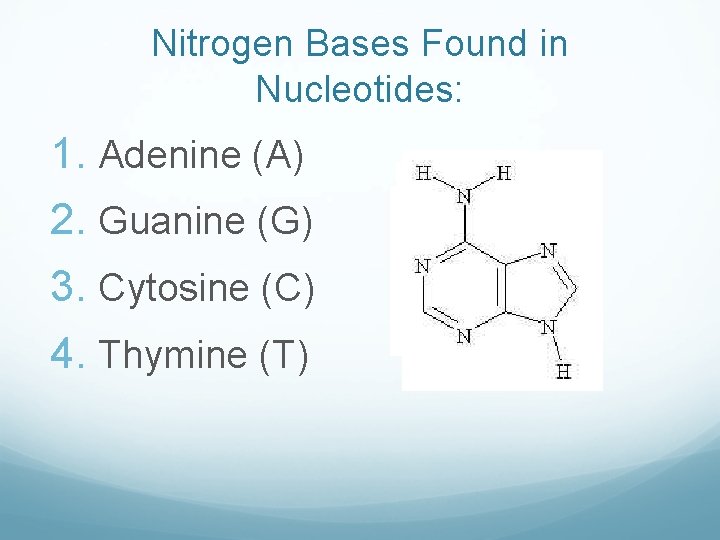
Nitrogen Bases Found in Nucleotides: 1. Adenine (A) 2. Guanine (G) 3. Cytosine (C) 4. Thymine (T)
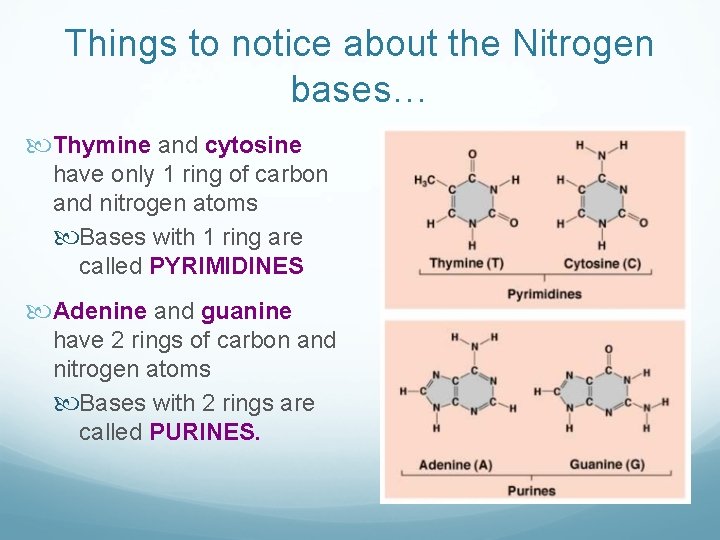
Things to notice about the Nitrogen bases… Thymine and cytosine have only 1 ring of carbon and nitrogen atoms Bases with 1 ring are called PYRIMIDINES Adenine and guanine have 2 rings of carbon and nitrogen atoms Bases with 2 rings are called PURINES.
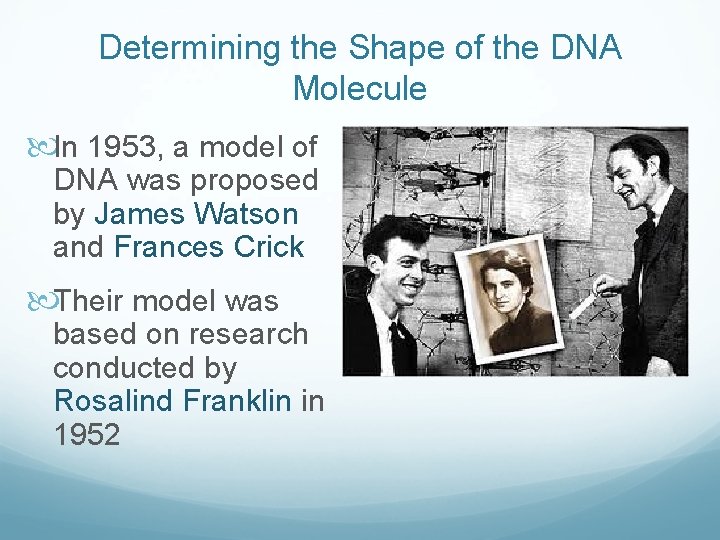
Determining the Shape of the DNA Molecule In 1953, a model of DNA was proposed by James Watson and Frances Crick Their model was based on research conducted by Rosalind Franklin in 1952
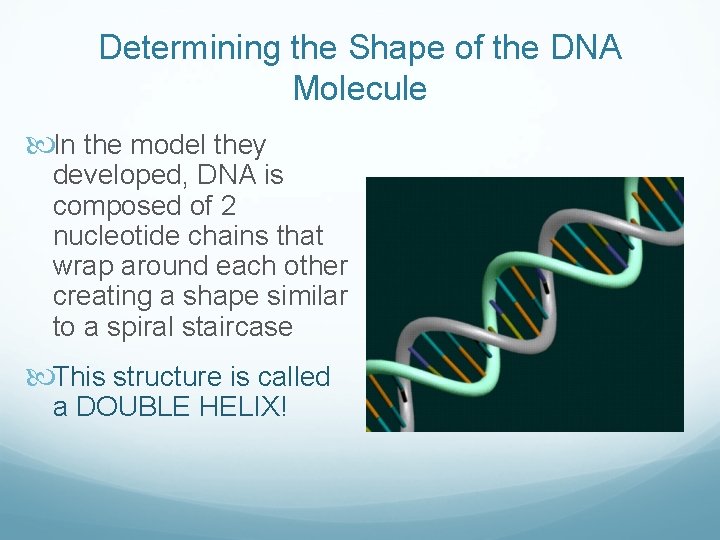
Determining the Shape of the DNA Molecule In the model they developed, DNA is composed of 2 nucleotide chains that wrap around each other creating a shape similar to a spiral staircase This structure is called a DOUBLE HELIX!
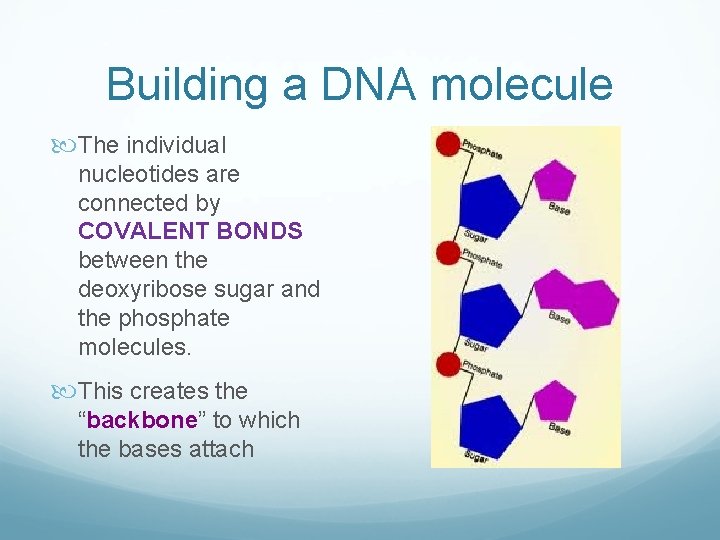
Building a DNA molecule The individual nucleotides are connected by COVALENT BONDS between the deoxyribose sugar and the phosphate molecules. This creates the “backbone” to which the bases attach
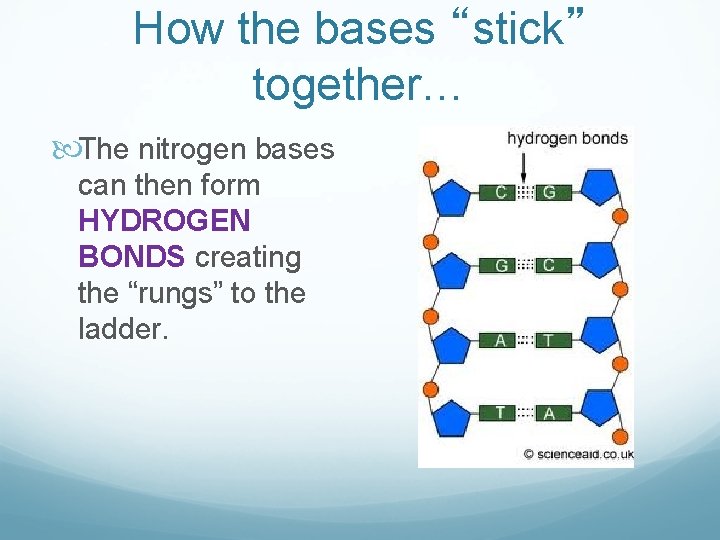
How the bases “stick” together… The nitrogen bases can then form HYDROGEN BONDS creating the “rungs” to the ladder.
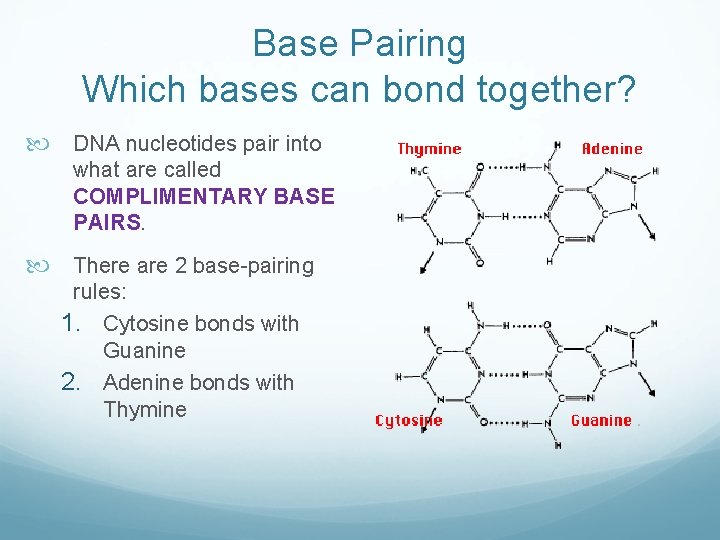
Base Pairing Which bases can bond together? DNA nucleotides pair into what are called COMPLIMENTARY BASE PAIRS. There are 2 base-pairing rules: 1. Cytosine bonds with Guanine 2. Adenine bonds with Thymine
Your Turn ! • If you had a segment of DNA like the one below, what would the complementary base pairs be? § Adenine - ? § Guanine - ? § Cytosine - ? § Thymine - ?
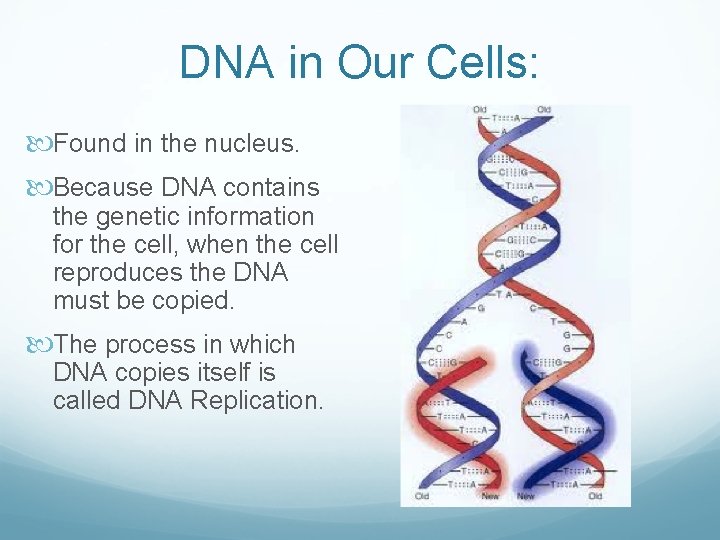
DNA in Our Cells: Found in the nucleus. Because DNA contains the genetic information for the cell, when the cell reproduces the DNA must be copied. The process in which DNA copies itself is called DNA Replication.
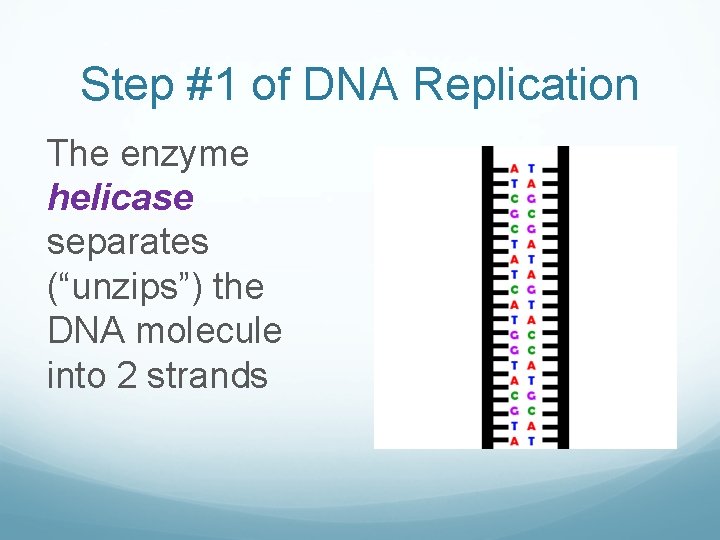
Step #1 of DNA Replication The enzyme helicase separates (“unzips”) the DNA molecule into 2 strands
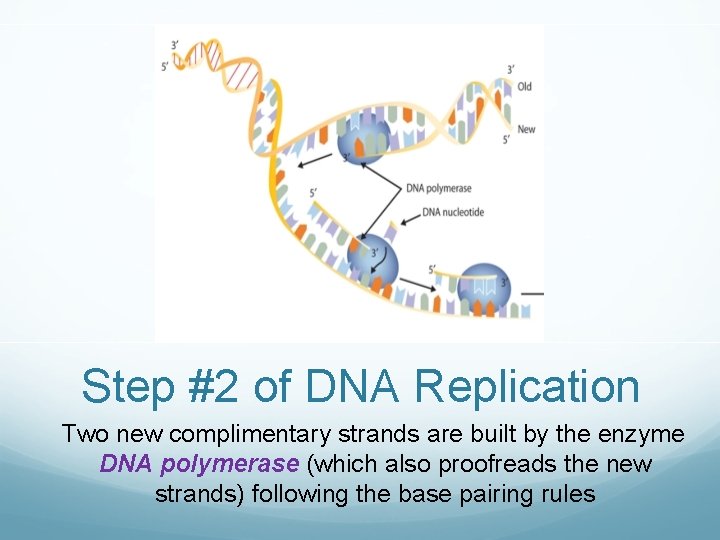
Step #2 of DNA Replication Two new complimentary strands are built by the enzyme DNA polymerase (which also proofreads the new strands) following the base pairing rules
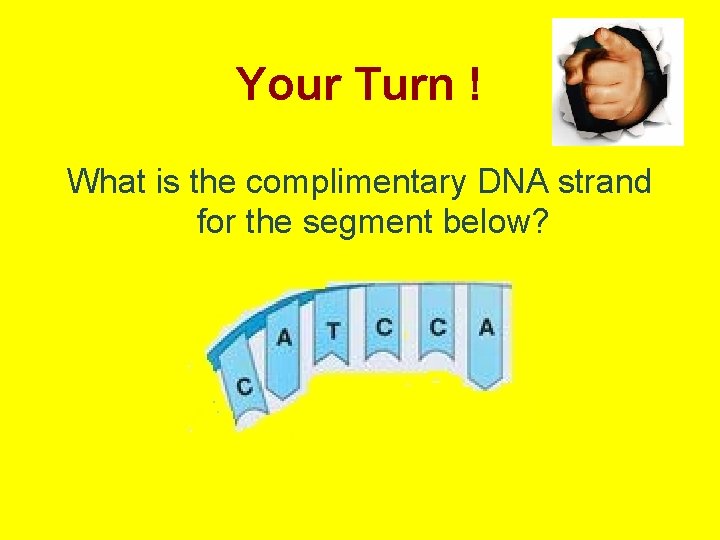
Your Turn ! What is the complimentary DNA strand for the segment below?
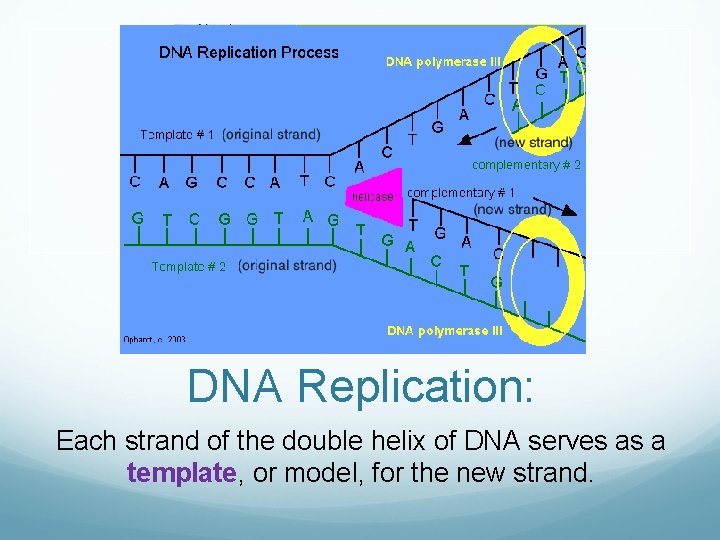
DNA Replication: Each strand of the double helix of DNA serves as a template, or model, for the new strand.
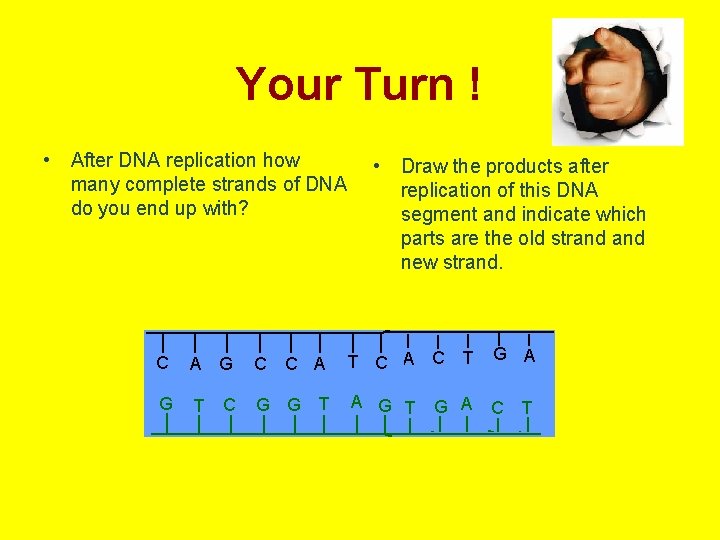
Your Turn ! • After DNA replication how many complete strands of DNA do you end up with? • Draw the products after replication of this DNA segment and indicate which parts are the old strand new strand.
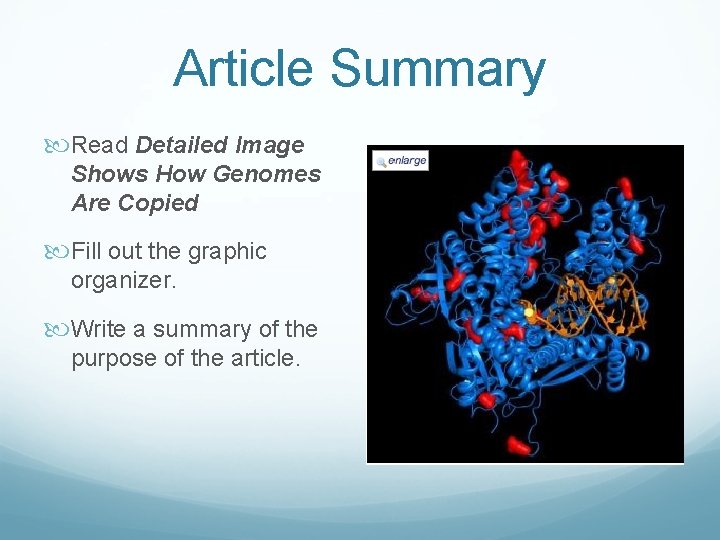
Article Summary Read Detailed Image Shows How Genomes Are Copied Fill out the graphic organizer. Write a summary of the purpose of the article.
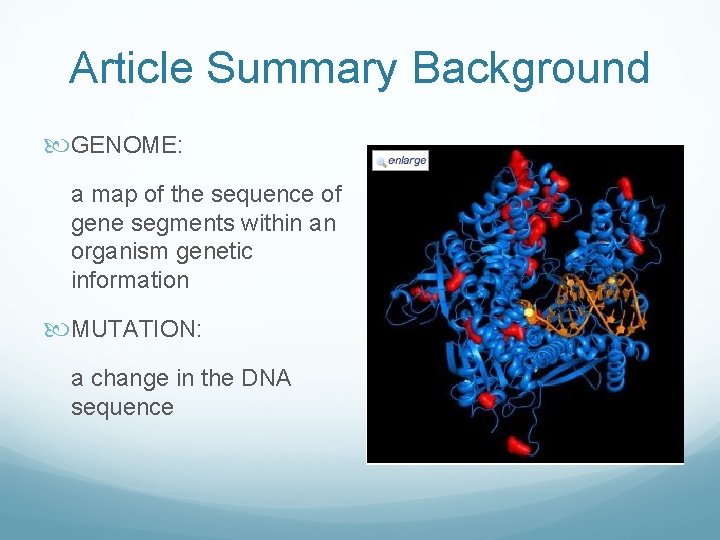
Article Summary Background GENOME: a map of the sequence of gene segments within an organism genetic information MUTATION: a change in the DNA sequence
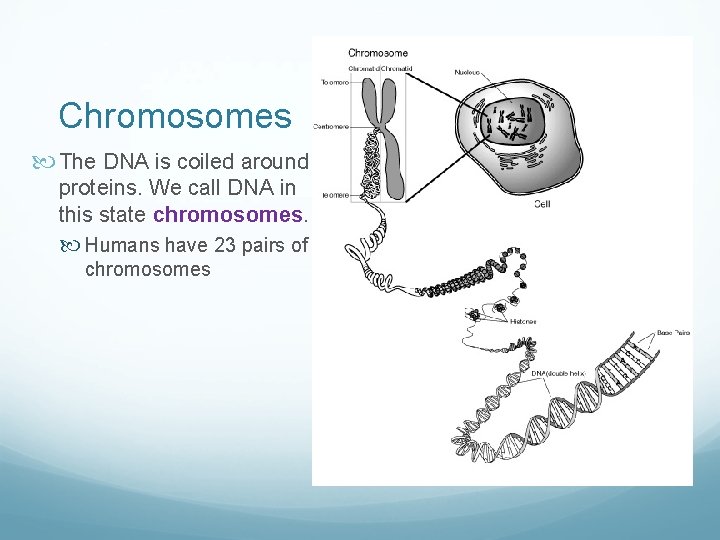
Chromosomes The DNA is coiled around proteins. We call DNA in this state chromosomes. Humans have 23 pairs of chromosomes
Your Turn ! • Put the following terms in order from largest to smallest: § Protein § Gene § Chromosome § DNA
- Slides: 25