
DNA STRUCTURE From Molecular Biology Made Simple and
DNA STRUCTURE From “Molecular Biology Made Simple and Fun” u What does DNA look like? u What are the important parts of DNA structure? u Who determined this structure and how did they figure it out?
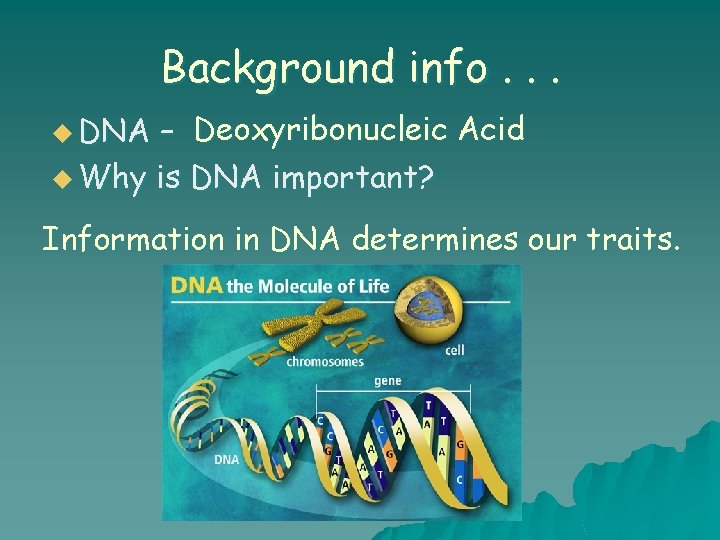
Background info. . . – Deoxyribonucleic Acid u Why is DNA important? u DNA Information in DNA determines our traits.
To understand how DNA stores information and why some DNA leads to genetic disorders, scientists needed to learn what it looks like. They had trouble believing that the goop that you extracted earlier somehow determines your traits and is inheritable. Although, DNA’s structure is too small to see with any microscope, what does DNA look like on a molecular level? = ?
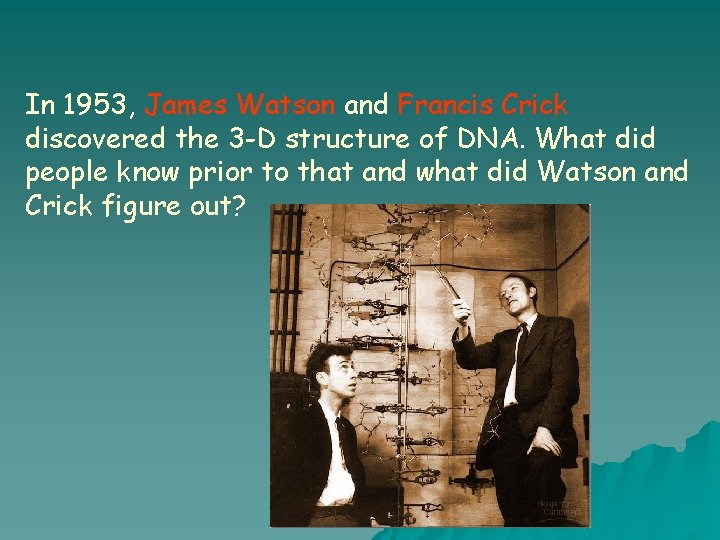
In 1953, James Watson and Francis Crick discovered the 3 -D structure of DNA. What did people know prior to that and what did Watson and Crick figure out?
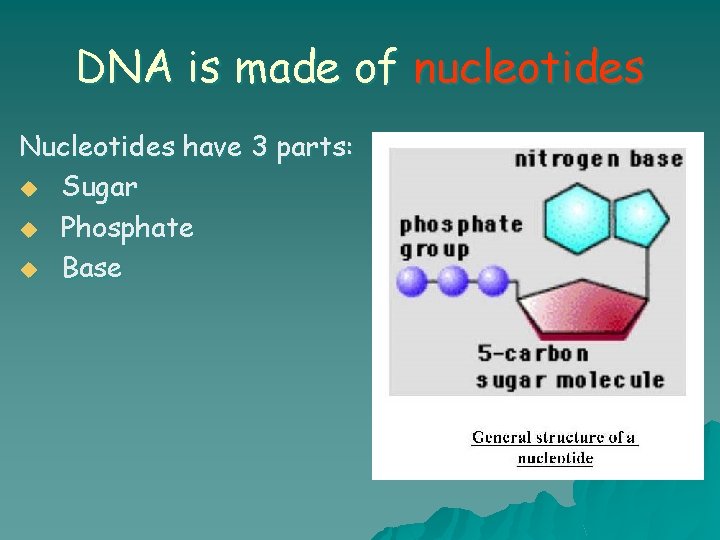
DNA is made of nucleotides Nucleotides have 3 parts: u Sugar u Phosphate u Base
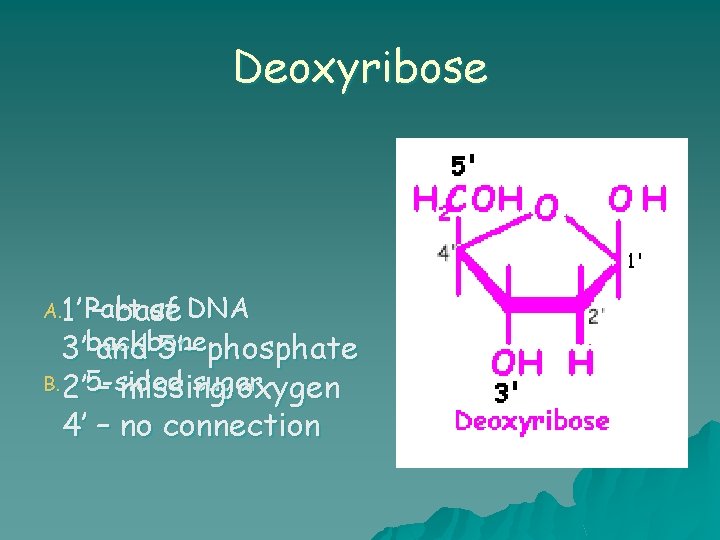
Deoxyribose A. 1’ Part of DNA – base 3’backbone. and 5’– phosphate B. 2’ 5 -sided sugar – missing oxygen 4’ – no connection
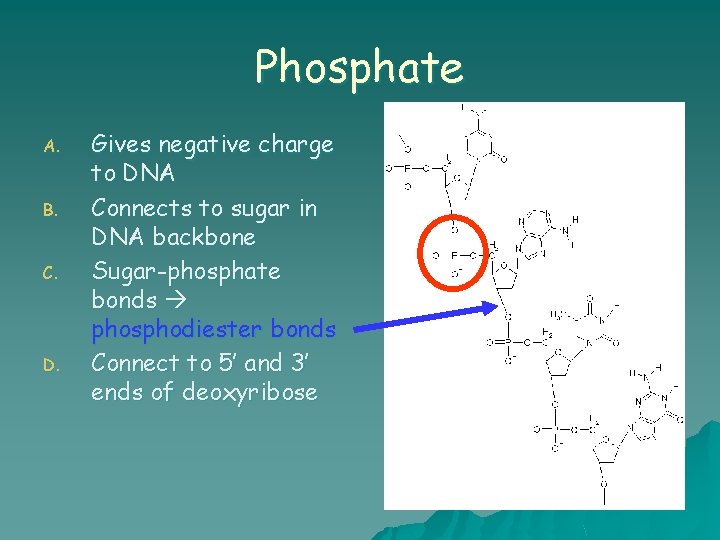
Phosphate A. B. C. D. Gives negative charge to DNA Connects to sugar in DNA backbone Sugar-phosphate bonds phosphodiester bonds Connect to 5’ and 3’ ends of deoxyribose
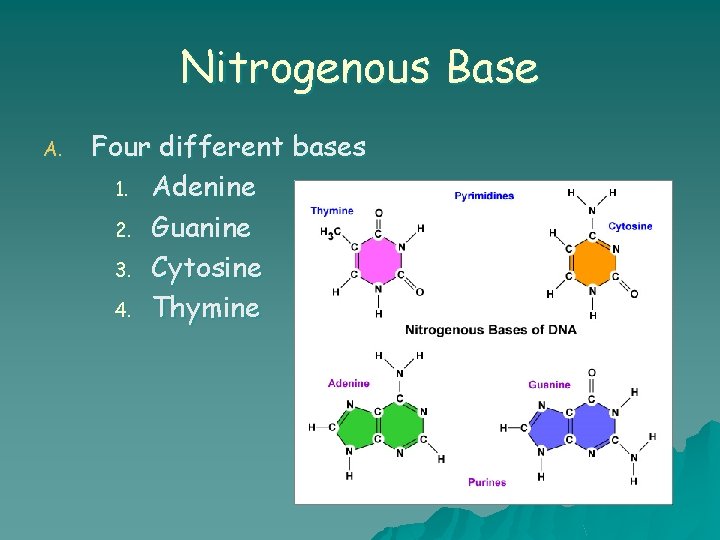
Nitrogenous Base A. Four different bases 1. Adenine 2. Guanine 3. Cytosine 4. Thymine
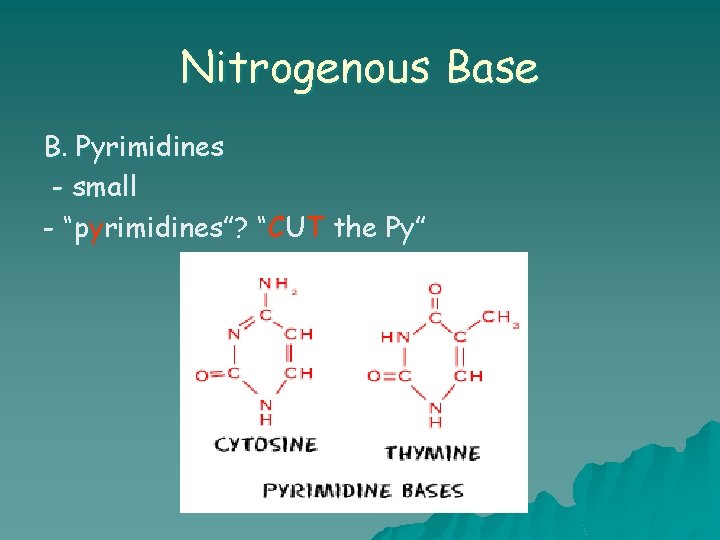
Nitrogenous Base B. Pyrimidines - small - “pyrimidines”? “CUT the Py”
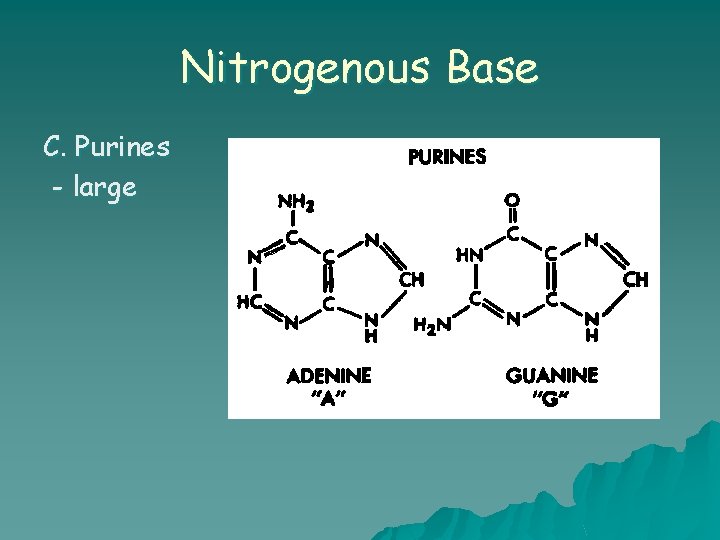
Nitrogenous Base C. Purines - large
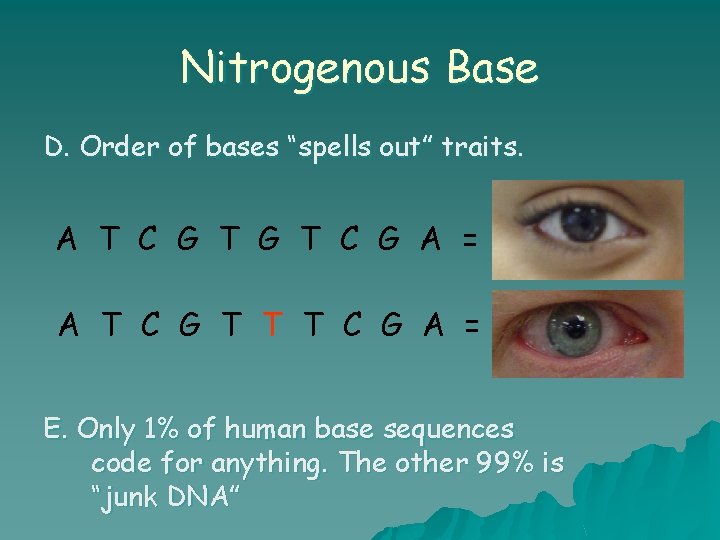
Nitrogenous Base D. Order of bases “spells out” traits. A T C G A = A T C G T T T C G A = E. Only 1% of human base sequences code for anything. The other 99% is “junk DNA”
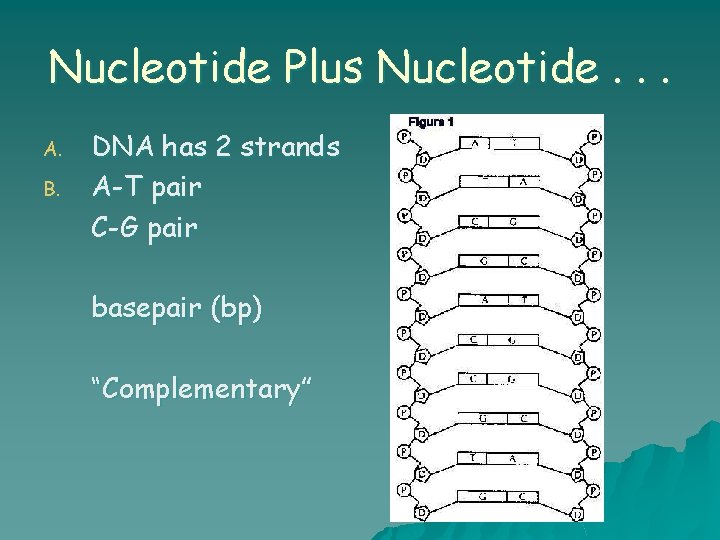
Nucleotide Plus Nucleotide. . . A. B. DNA has 2 strands A-T pair C-G pair basepair (bp) “Complementary”
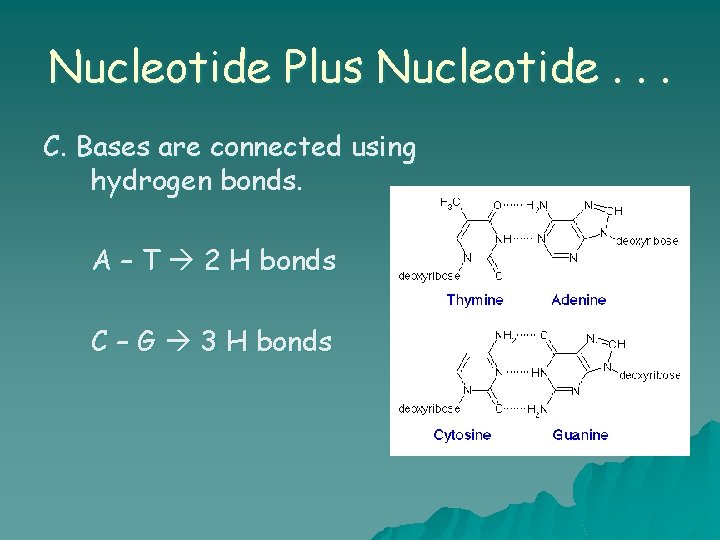
Nucleotide Plus Nucleotide. . . C. Bases are connected using hydrogen bonds. A – T 2 H bonds C – G 3 H bonds
Nucleotide Plus Nucleotide. . . ? D. Strands are antiparallel
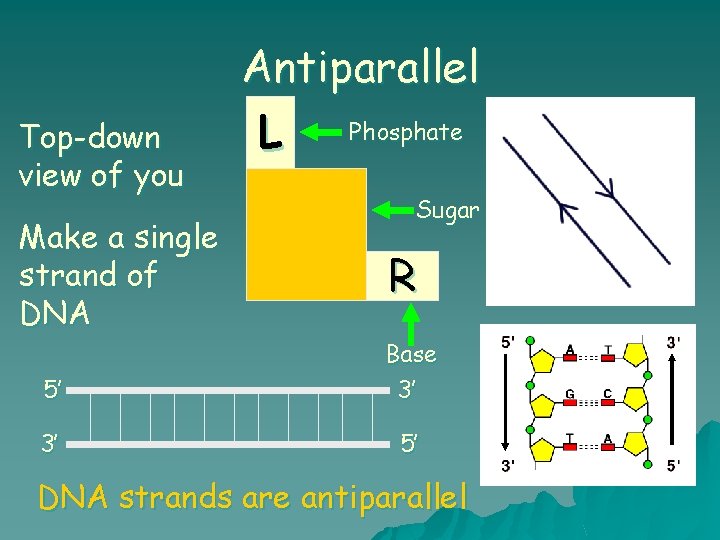
Top-down view of you Make a single strand of DNA Antiparallel Phosphate L Sugar R 5’ Base 3’ 3’ 5’ DNA strands are antiparallel
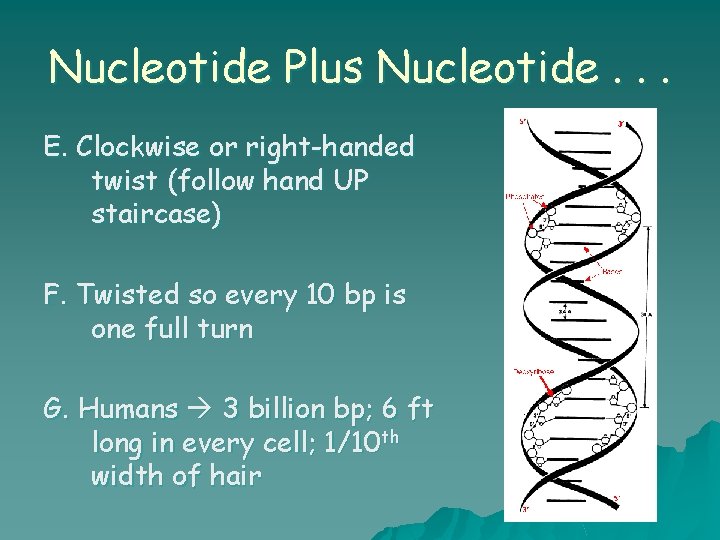
Nucleotide Plus Nucleotide. . . E. Clockwise or right-handed twist (follow hand UP staircase) F. Twisted so every 10 bp is one full turn G. Humans 3 billion bp; 6 ft long in every cell; 1/10 th width of hair
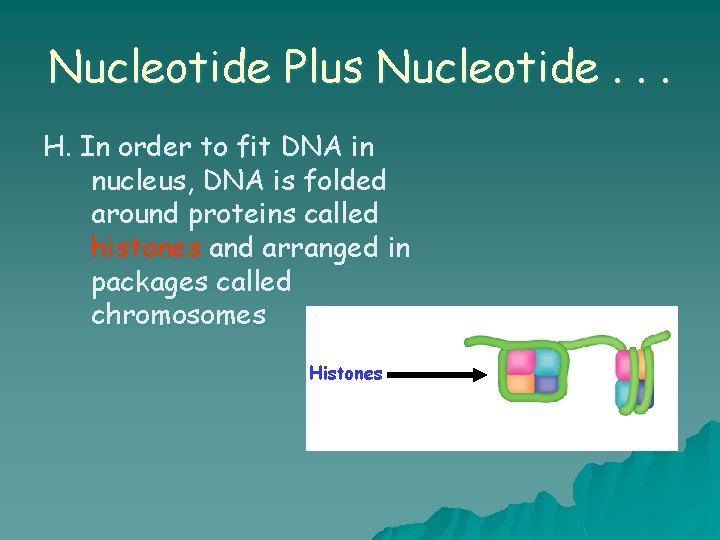
Nucleotide Plus Nucleotide. . . H. In order to fit DNA in nucleus, DNA is folded around proteins called histones and arranged in packages called chromosomes Histones
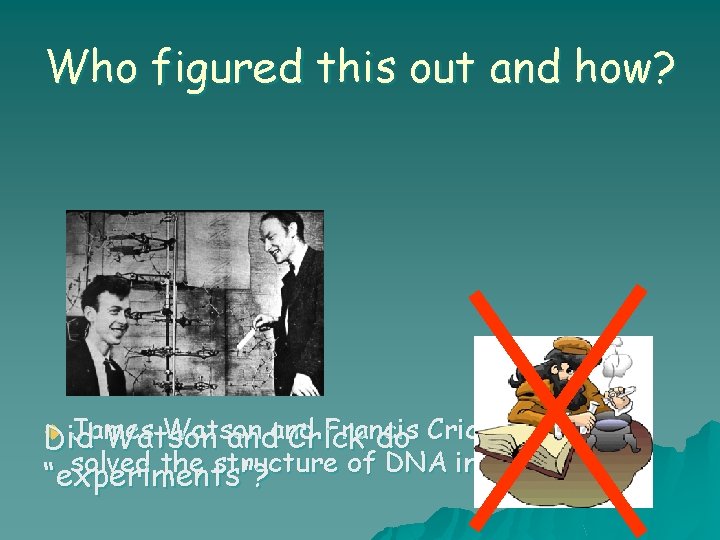
Who figured this out and how? u James Watson Francis Did Watson andand Crick do Crick solved the structure of DNA in 1953. “experiments”?
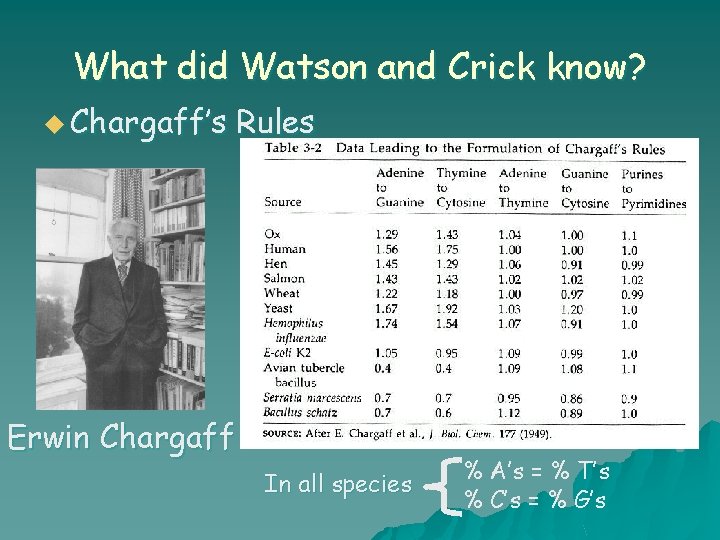
What did Watson and Crick know? u Chargaff’s Rules Erwin Chargaff In all species % A’s = % T’s % C’s = % G’s
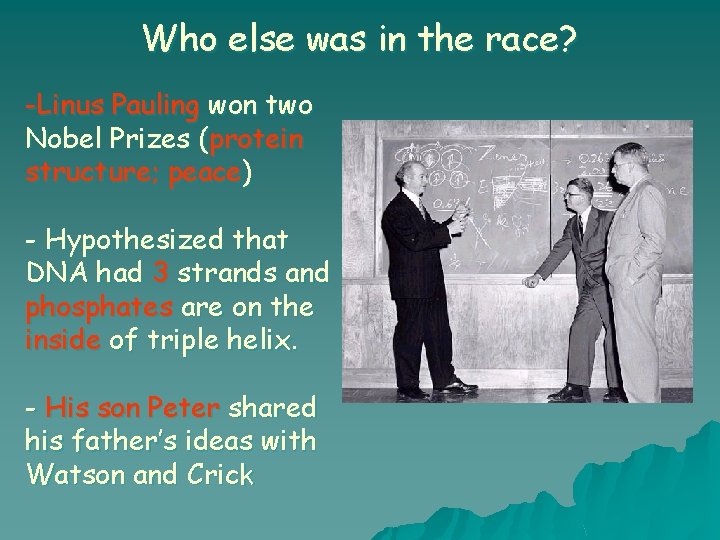
Who else was in the race? -Linus Pauling won two Nobel Prizes (protein structure; peace) - Hypothesized that DNA had 3 strands and phosphates are on the inside of triple helix. - His son Peter shared his father’s ideas with Watson and Crick
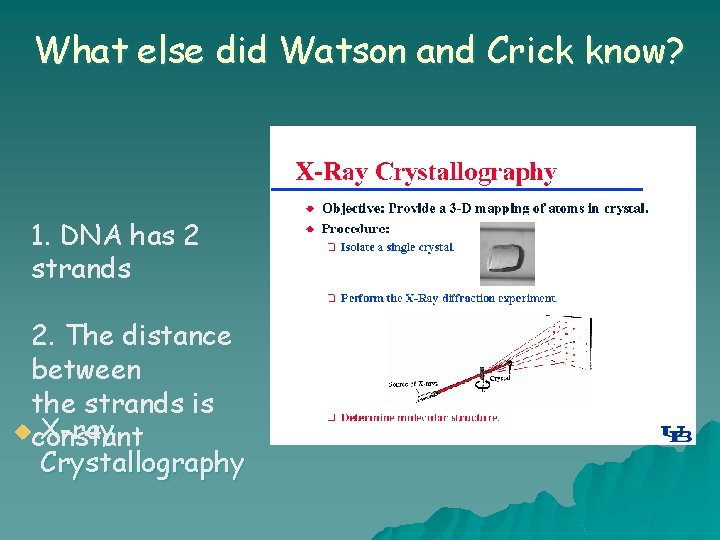
What else did Watson and Crick know? 1. DNA has 2 strands 2. The distance between the strands is uconstant X-ray Crystallography
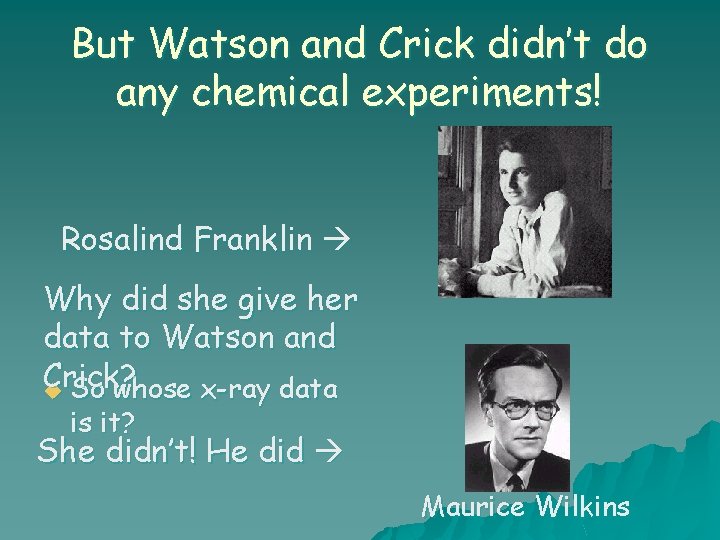
But Watson and Crick didn’t do any chemical experiments! Rosalind Franklin Why did she give her data to Watson and Crick? u So whose x-ray data is it? She didn’t! He did Maurice Wilkins
“The Secret of Life” - What was learned by looking at DNA Structure? u DNA could be copied: unwind helix and follow base pair rules u “Script of life”: sequence of nucleotides can store information
Nobel Prizes. . . or lack thereof u u Watson and Crick awarded Nobel Prize in 1962 No prize for Franklin u. Did Watson and Crick obtain Franklin’s data “illegally”? u. Should Franklin have shared her scientific knowledge? (Never knew her info had been “obtained” by Watson and Crick) u. Should Franklin receive credit for her contributions to solving DNA structure? u. Did Watson and Crick really do a lot of work?
- Slides: 24