
DNA Structure and Replication AP Biology Nucleic Acids
DNA Structure and Replication AP Biology
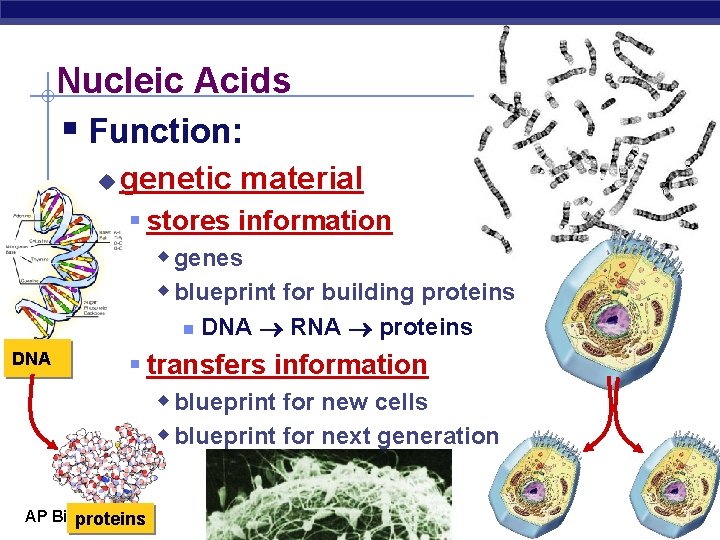
Nucleic Acids § Function: u genetic material § stores information w genes w blueprint for building proteins n DNA RNA proteins § transfers information w blueprint for new cells w blueprint for next generation AP Biology proteins
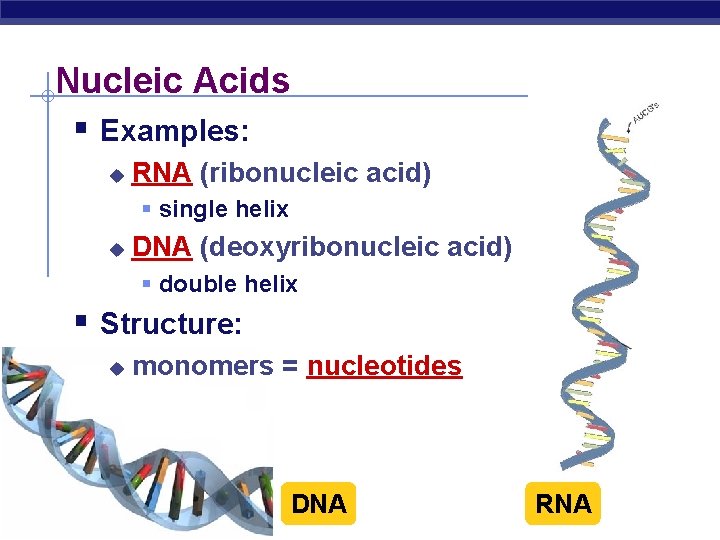
Nucleic Acids § Examples: u RNA (ribonucleic acid) § single helix u DNA (deoxyribonucleic acid) § double helix § Structure: u AP Biology monomers = nucleotides DNA RNA
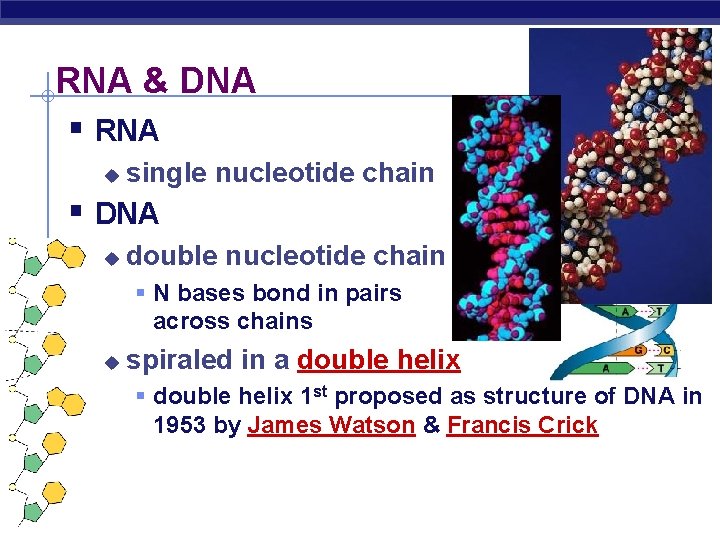
RNA & DNA § RNA u single nucleotide chain § DNA u double nucleotide chain § N bases bond in pairs across chains u spiraled in a double helix § double helix 1 st proposed as structure of DNA in 1953 by James Watson & Francis Crick AP Biology
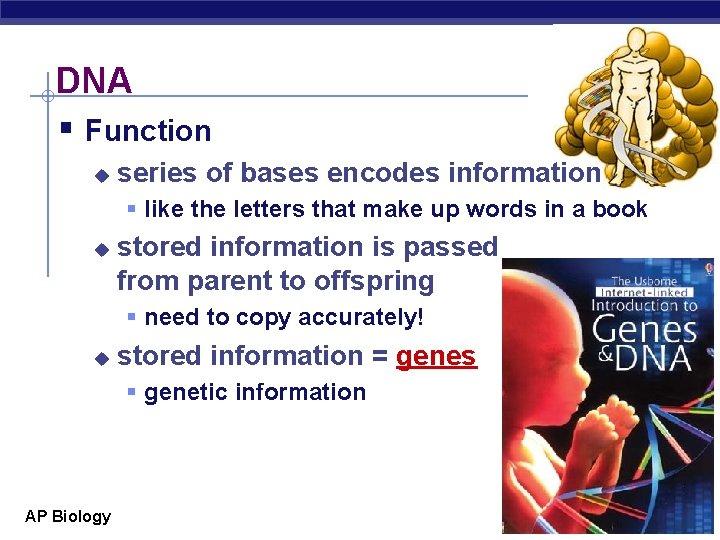
DNA § Function u series of bases encodes information § like the letters that make up words in a book u stored information is passed from parent to offspring § need to copy accurately! u stored information = genes § genetic information AP Biology
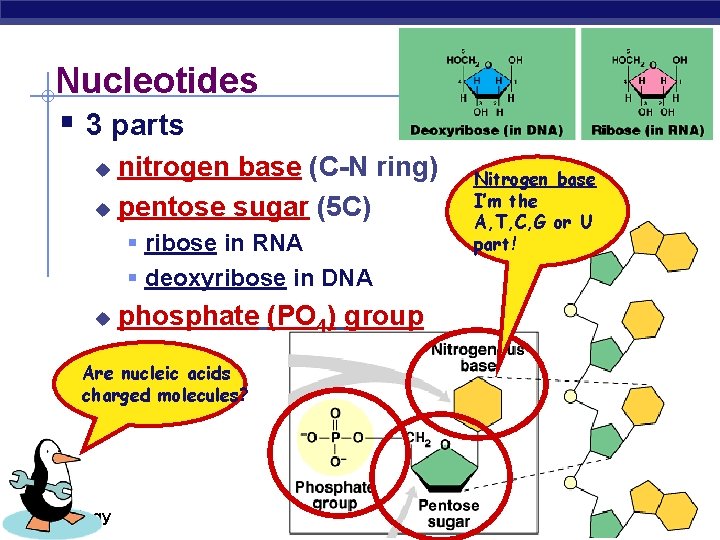
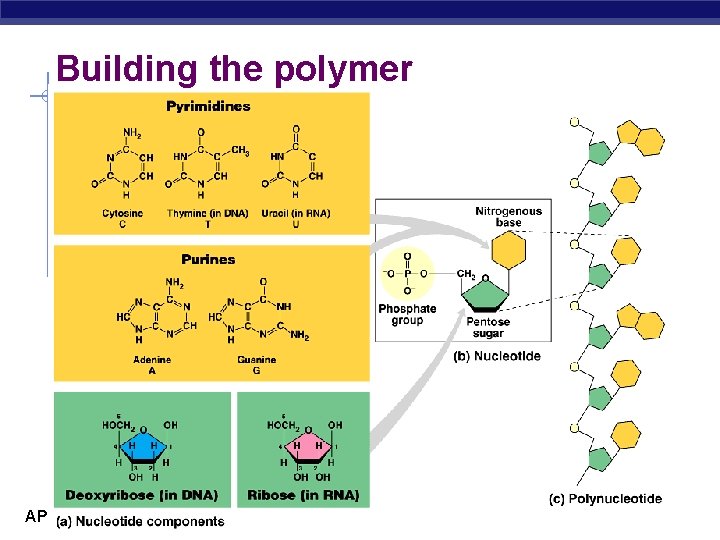
Nucleotides § 3 parts nitrogen base (C-N ring) u pentose sugar (5 C) u § ribose in RNA § deoxyribose in DNA u phosphate (PO 4) group Are nucleic acids charged molecules? AP Biology Nitrogen base I’m the A, T, C, G or U part!
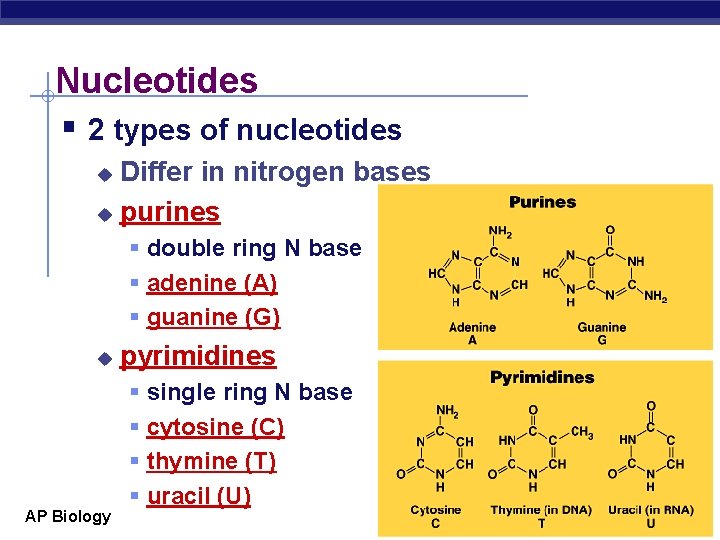
Nucleotides § 2 types of nucleotides Differ in nitrogen bases u purines u § double ring N base § adenine (A) § guanine (G) u AP Biology pyrimidines § § single ring N base cytosine (C) thymine (T) uracil (U)
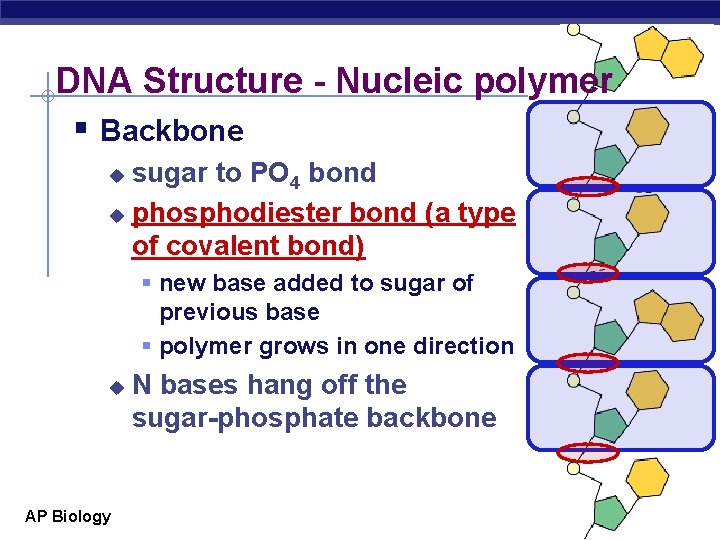
DNA Structure - Nucleic polymer § Backbone sugar to PO 4 bond u phosphodiester bond (a type of covalent bond) u § new base added to sugar of previous base § polymer grows in one direction u AP Biology N bases hang off the sugar-phosphate backbone
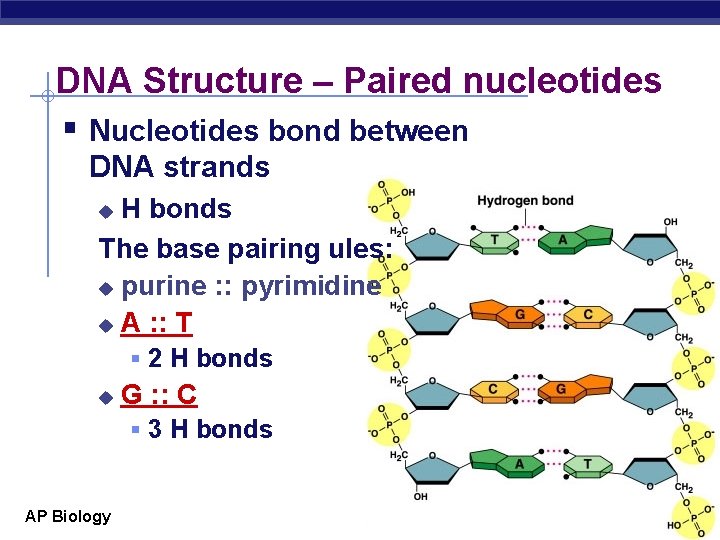
DNA Structure – Paired nucleotides § Nucleotides bond between DNA strands H bonds The base pairing ules: u purine : : pyrimidine u A : : T u § 2 H bonds u G : : C § 3 H bonds AP Biology
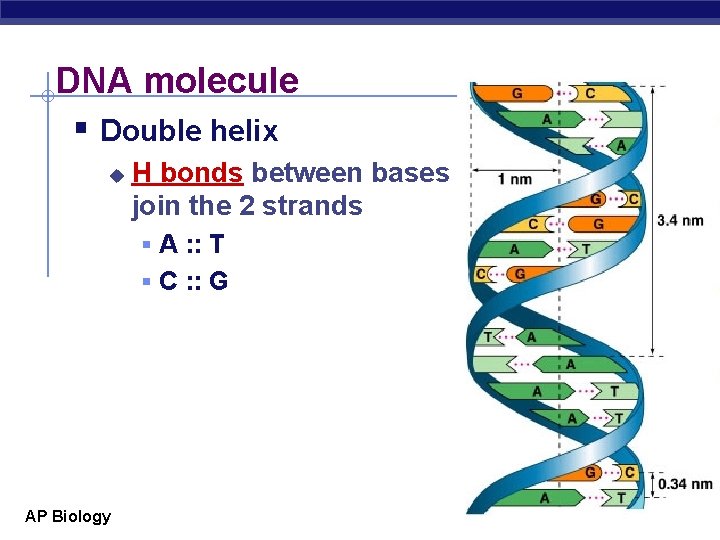
DNA molecule § Double helix u H bonds between bases join the 2 strands § A : : T § C : : G AP Biology
Building the polymer AP Biology
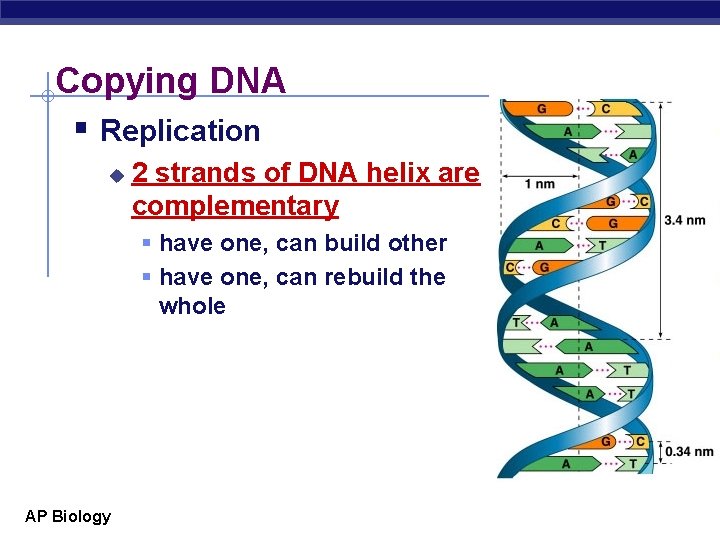
Copying DNA § Replication u 2 strands of DNA helix are complementary § have one, can build other § have one, can rebuild the whole AP Biology
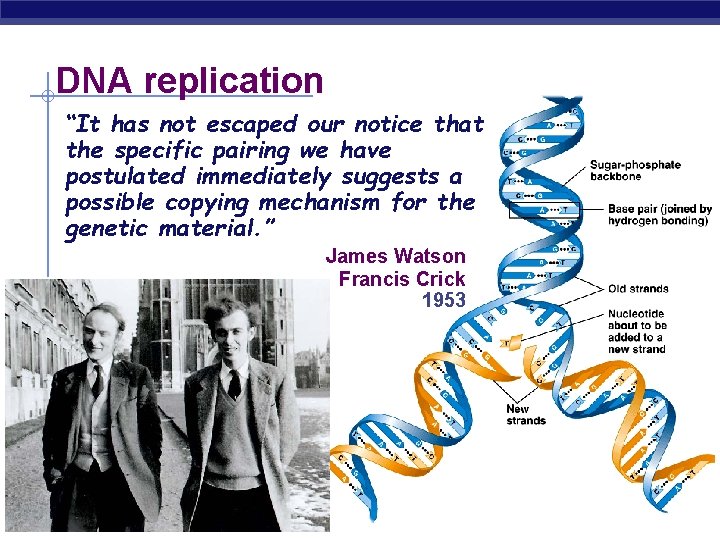
DNA replication “It has not escaped our notice that the specific pairing we have postulated immediately suggests a possible copying mechanism for the genetic material. ” James Watson Francis Crick 1953 AP Biology
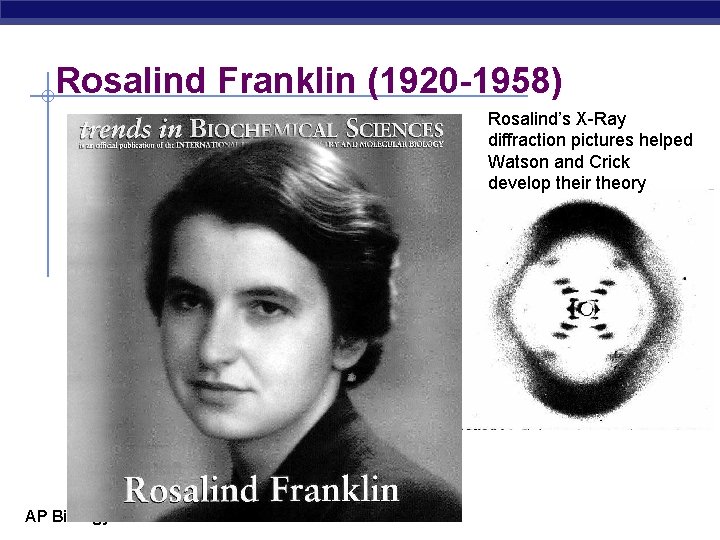
Rosalind Franklin (1920 -1958) Rosalind’s X-Ray diffraction pictures helped Watson and Crick develop their theory AP Biology
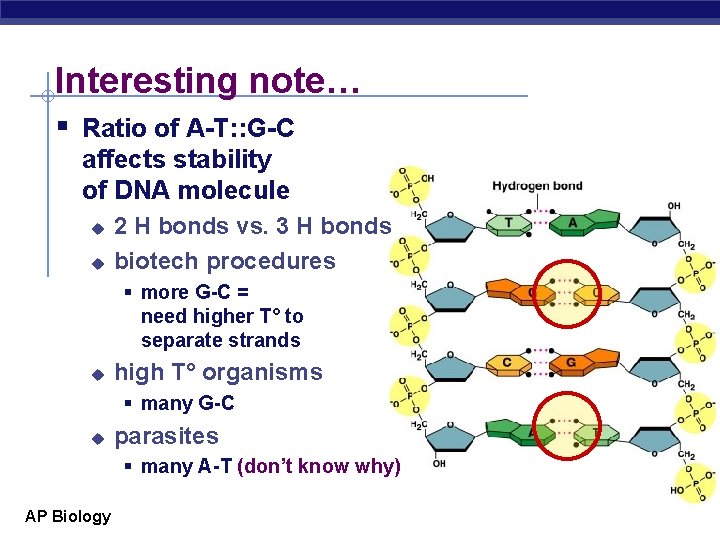
Interesting note… § Ratio of A-T: : G-C affects stability of DNA molecule u u 2 H bonds vs. 3 H bonds biotech procedures § more G-C = need higher T° to separate strands u high T° organisms § many G-C u parasites § many A-T (don’t know why) AP Biology
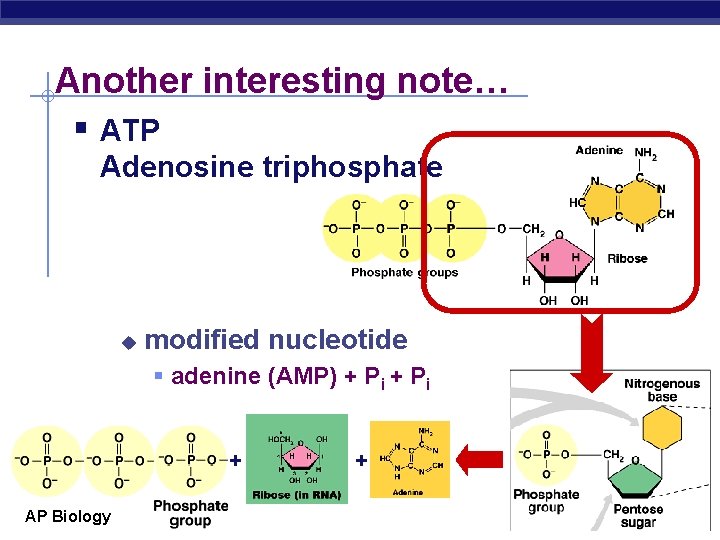
Another interesting note… § ATP Adenosine triphosphate u modified nucleotide § adenine (AMP) + Pi + AP Biology +
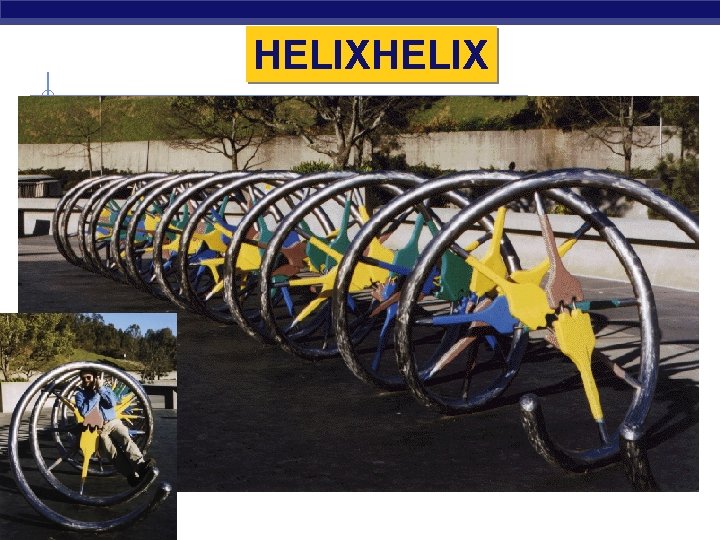
HELIX AP Biology
DNA REPLICATION Preparing for Mitosis
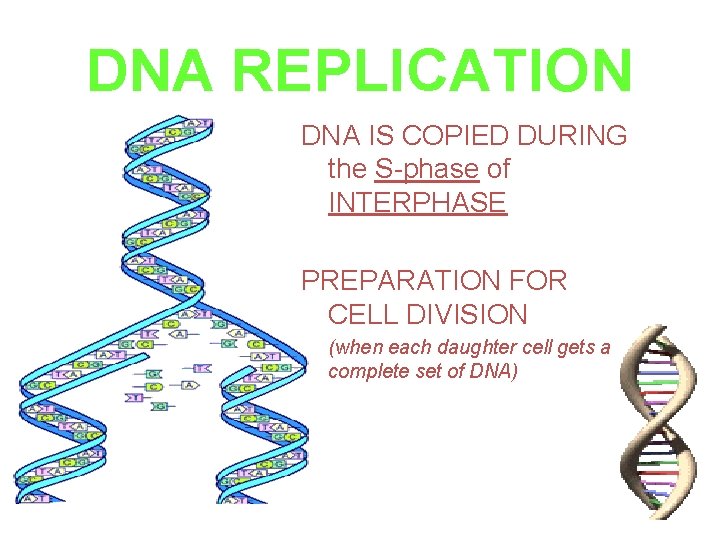
DNA REPLICATION DNA IS COPIED DURING the S-phase of INTERPHASE PREPARATION FOR CELL DIVISION (when each daughter cell gets a complete set of DNA)
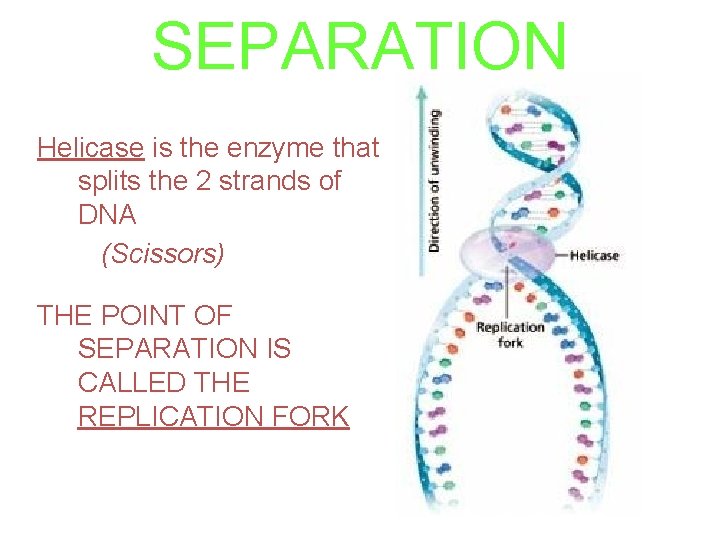
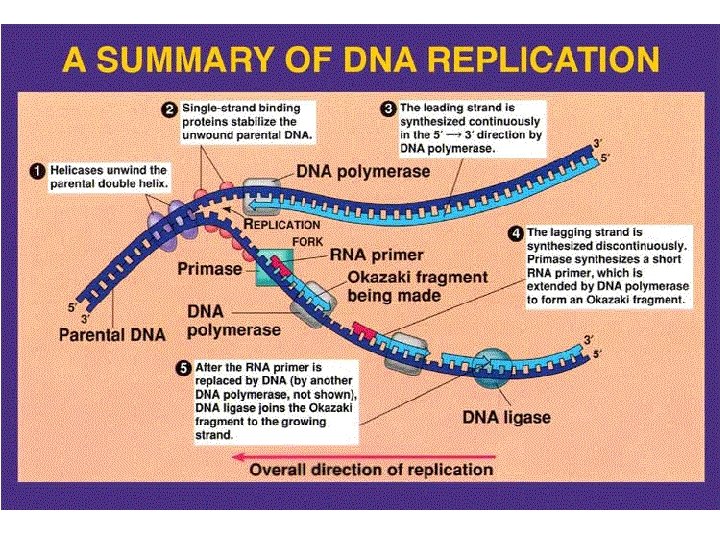
SEPARATION Helicase is the enzyme that splits the 2 strands of DNA (Scissors) THE POINT OF SEPARATION IS CALLED THE REPLICATION FORK
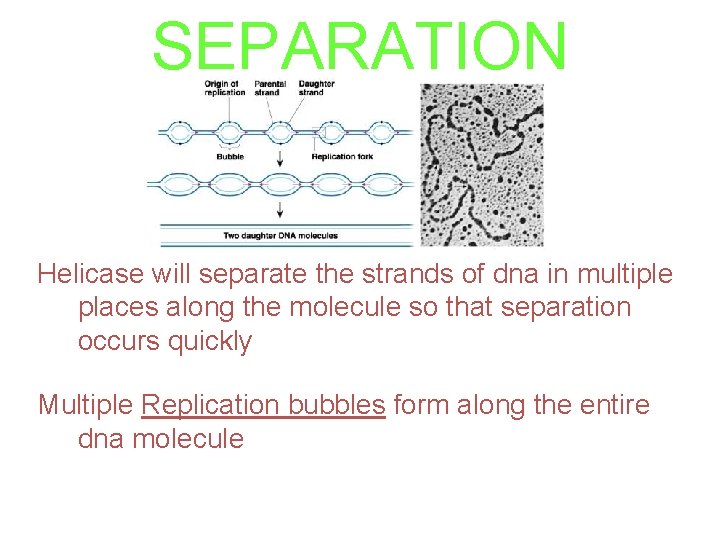
SEPARATION Helicase will separate the strands of dna in multiple places along the molecule so that separation occurs quickly Multiple Replication bubbles form along the entire dna molecule
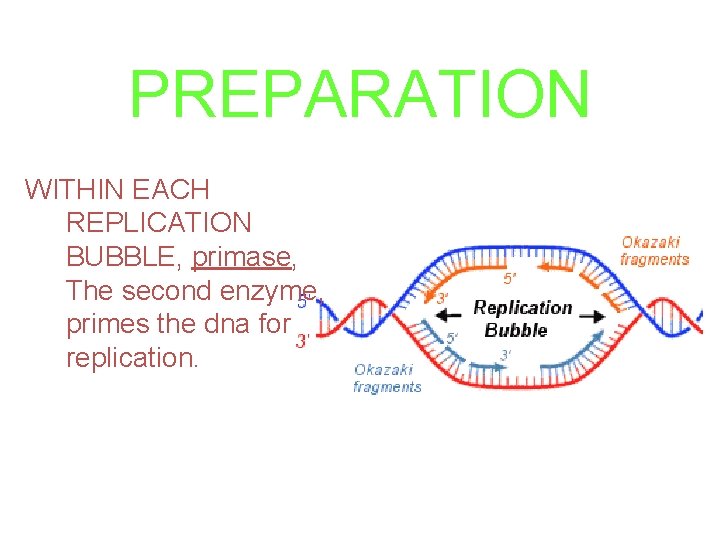
PREPARATION WITHIN EACH REPLICATION BUBBLE, primase, The second enzyme, primes the dna for replication.
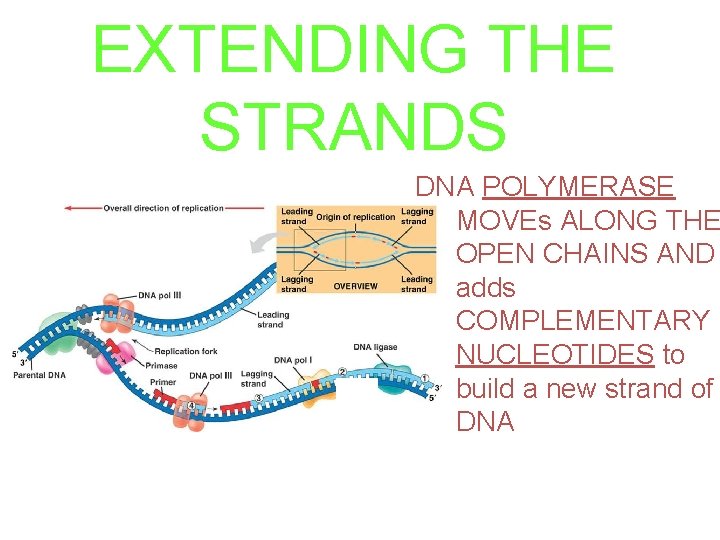
EXTENDING THE STRANDS DNA POLYMERASE MOVEs ALONG THE OPEN CHAINS AND adds COMPLEMENTARY NUCLEOTIDES to build a new strand of DNA
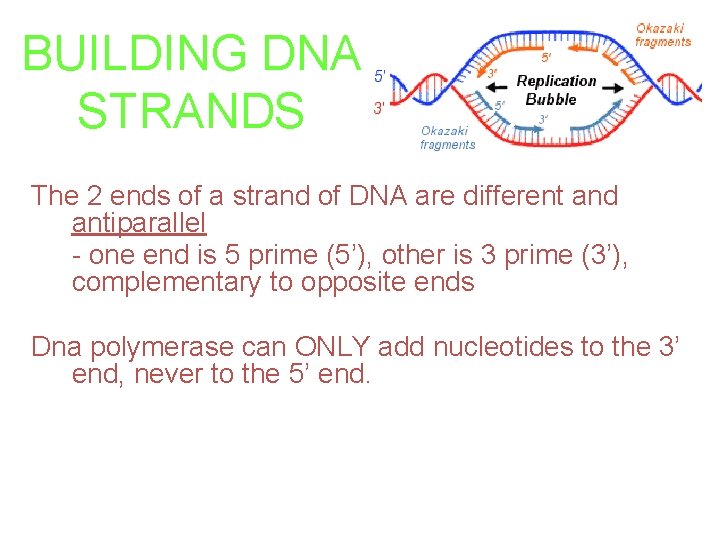
BUILDING DNA STRANDS The 2 ends of a strand of DNA are different and antiparallel - one end is 5 prime (5’), other is 3 prime (3’), complementary to opposite ends Dna polymerase can ONLY add nucleotides to the 3’ end, never to the 5’ end.
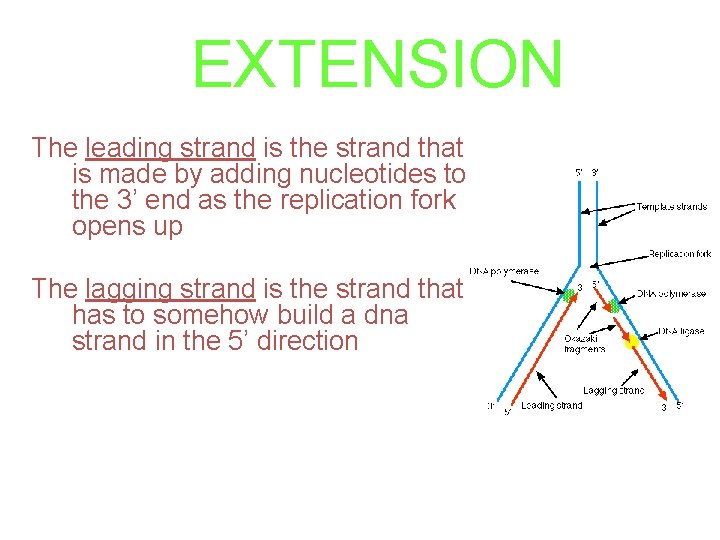
EXTENSION The leading strand is the strand that is made by adding nucleotides to the 3’ end as the replication fork opens up The lagging strand is the strand that has to somehow build a dna strand in the 5’ direction
PROBLEM!!! How does DNA build a lagging strand that is extending in the 5’ direction?
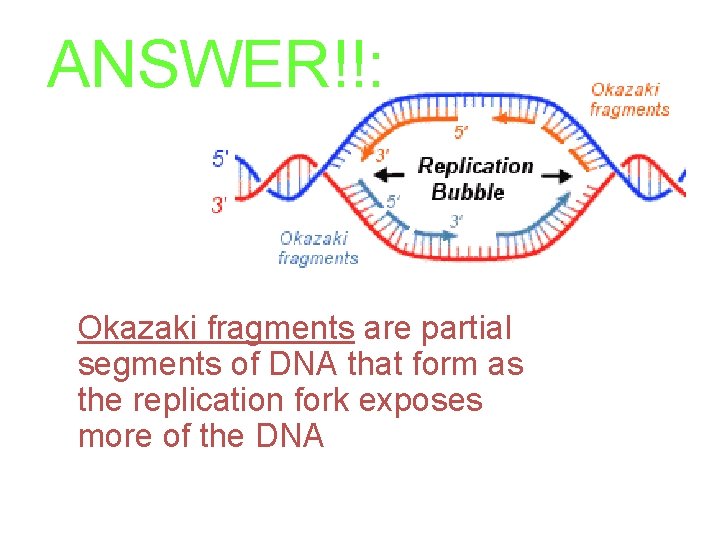
ANSWER!!: Okazaki fragments are partial segments of DNA that form as the replication fork exposes more of the DNA
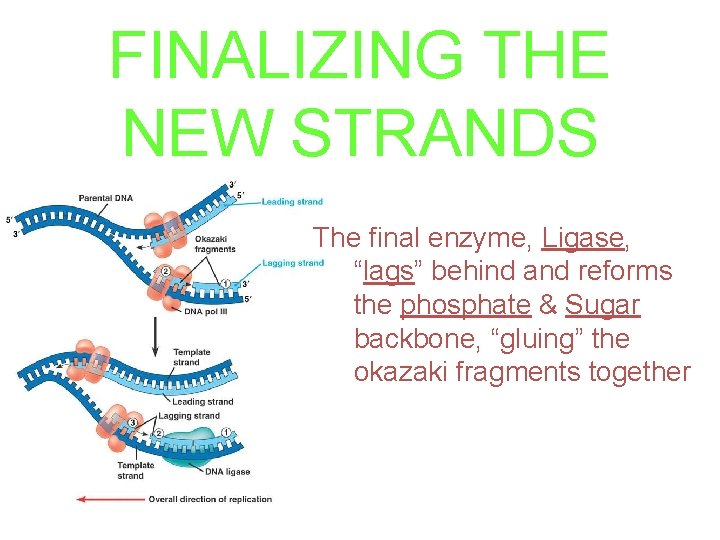
FINALIZING THE NEW STRANDS The final enzyme, Ligase, “lags” behind and reforms the phosphate & Sugar backbone, “gluing” the okazaki fragments together
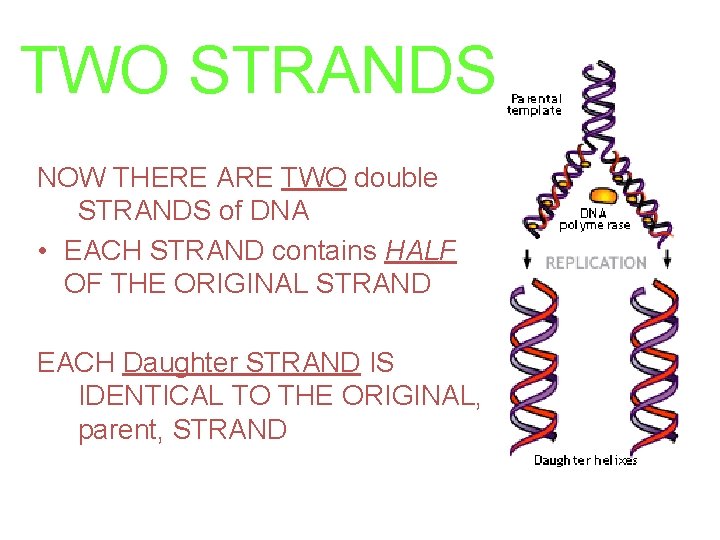
TWO STRANDS NOW THERE ARE TWO double STRANDS of DNA • EACH STRAND contains HALF OF THE ORIGINAL STRAND EACH Daughter STRAND IS IDENTICAL TO THE ORIGINAL, parent, STRAND
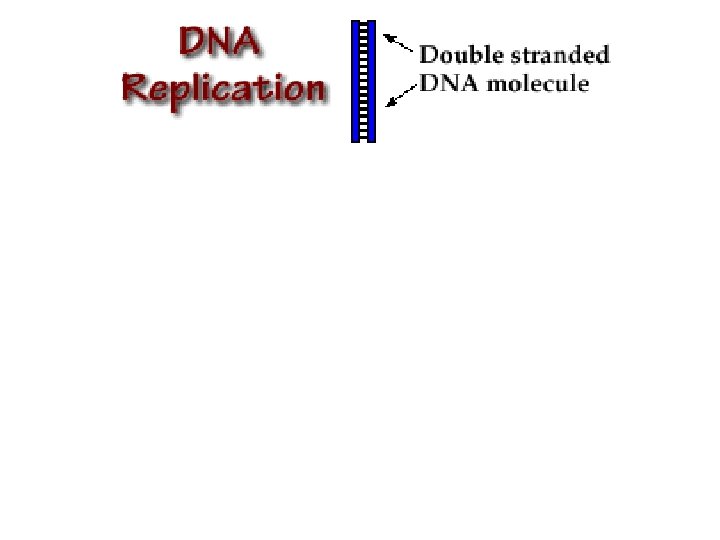
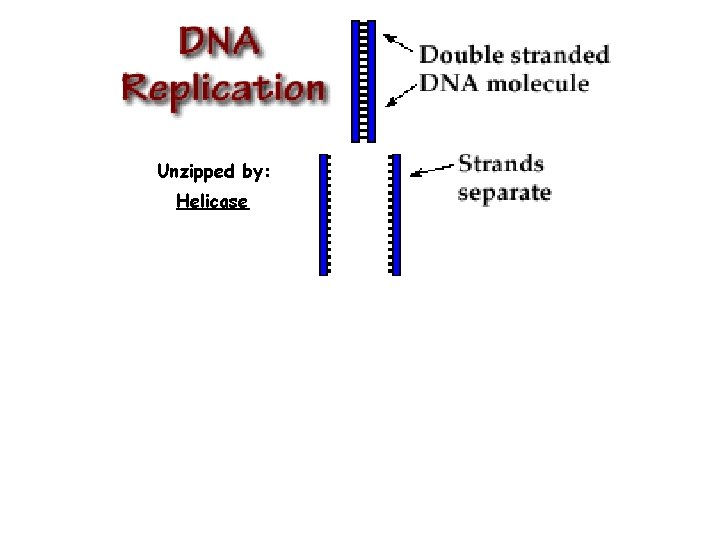
Unzipped by: Helicase
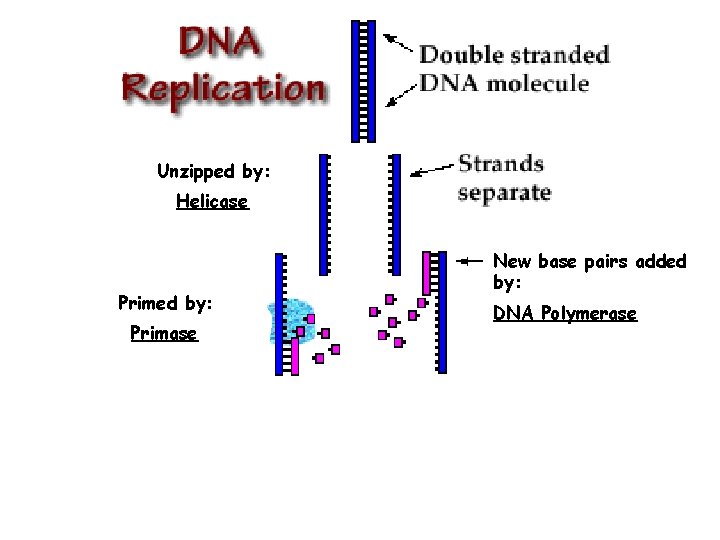
Unzipped by: Helicase Primed by: Primase New base pairs added by: DNA Polymerase
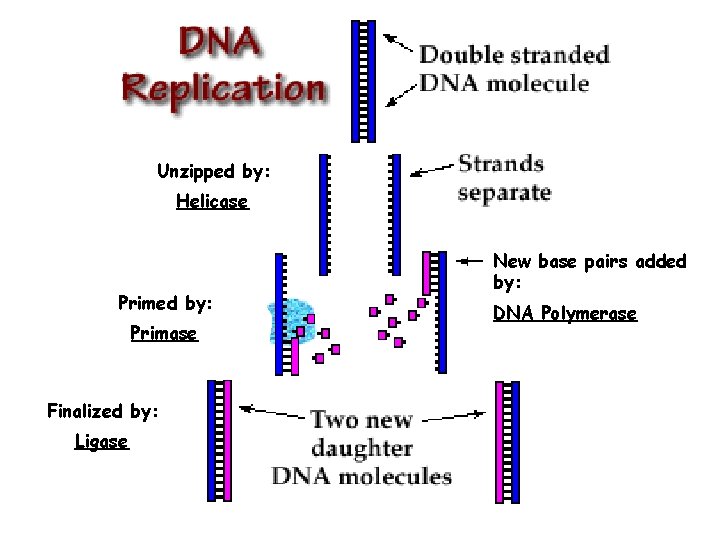
Unzipped by: Helicase Primed by: Primase Finalized by: Ligase New base pairs added by: DNA Polymerase
MOVIES http: //www. johnkyrk. com/DNAreplication. html http: //www. pbs. org/wgbh/aso/tryit/dna/# http: //www. ncc. gmu. edu/dna/repanim. htm http: //sites. fas. harvard. edu/~biotext/animation s/replication 1. swf http: //www. hhmi. org/biointeractive/dnareplication-advanced-detail
- Slides: 35