
DNA STRUCTURE AHL Topic 7 1 IB Biology
DNA STRUCTURE AHL Topic 7. 1 IB Biology Miss Werba
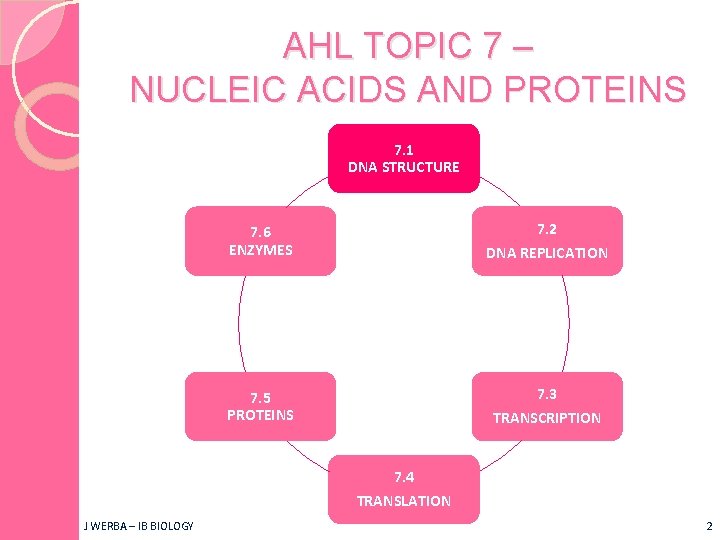
AHL TOPIC 7 – NUCLEIC ACIDS AND PROTEINS 7. 1 DNA STRUCTURE 7. 2 7. 6 ENZYMES DNA REPLICATION 7. 3 7. 5 PROTEINS TRANSCRIPTION 7. 4 TRANSLATION J WERBA – IB BIOLOGY 2
THINGS TO COVER �Structure of DNA: ◦ anti-parallel strands ◦ 3´– 5´ linkages ◦ hydrogen bonding between complementary bases �Structure of nucleosomes �Supercoiling �Genes vs repetitive sequences in the genome �Exons vs introns J WERBA – IB BIOLOGY 3
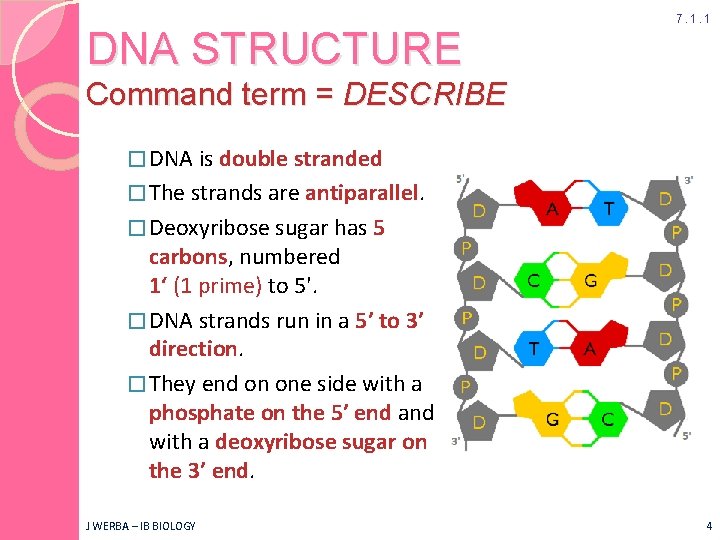
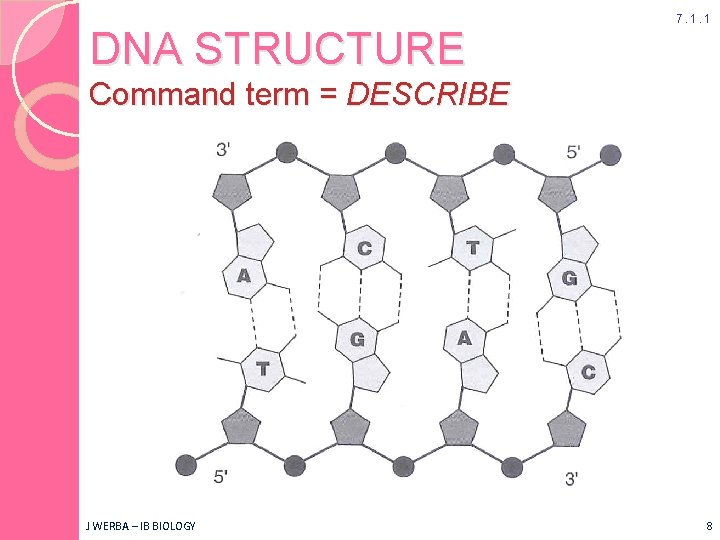
DNA STRUCTURE 7. 1. 1 Command term = DESCRIBE � DNA is double stranded � The strands are antiparallel. � Deoxyribose sugar has 5 carbons, numbered 1‘ (1 prime) to 5'. � DNA strands run in a 5’ to 3’ direction. � They end on one side with a phosphate on the 5’ end and with a deoxyribose sugar on the 3’ end. J WERBA – IB BIOLOGY 4
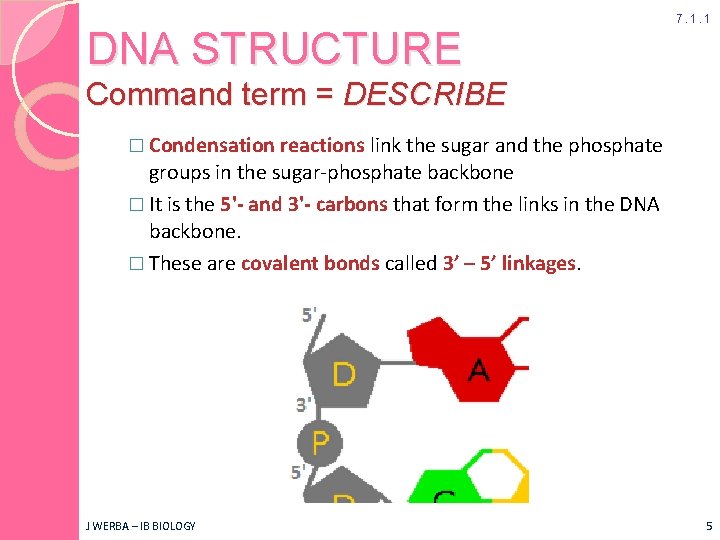
DNA STRUCTURE 7. 1. 1 Command term = DESCRIBE � Condensation reactions link the sugar and the phosphate groups in the sugar-phosphate backbone � It is the 5'- and 3'- carbons that form the links in the DNA backbone. � These are covalent bonds called 3’ – 5’ linkages. J WERBA – IB BIOLOGY 5
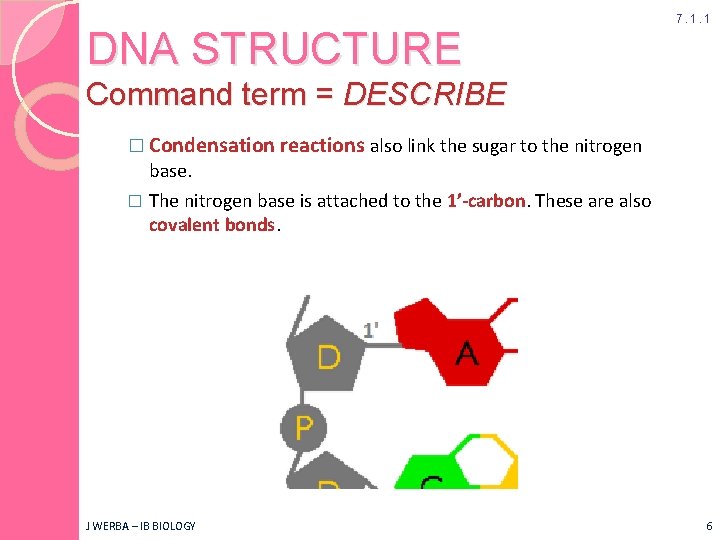
DNA STRUCTURE 7. 1. 1 Command term = DESCRIBE � Condensation reactions also link the sugar to the nitrogen base. � The nitrogen base is attached to the 1’-carbon. These are also covalent bonds. J WERBA – IB BIOLOGY 6
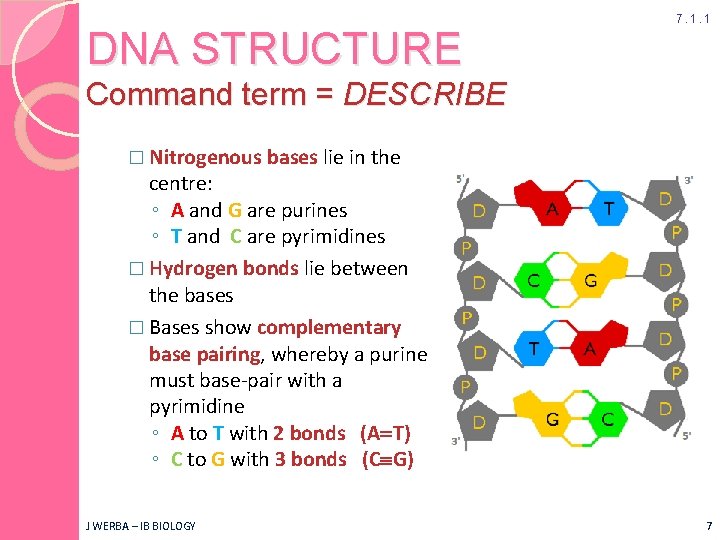
DNA STRUCTURE 7. 1. 1 Command term = DESCRIBE � Nitrogenous bases lie in the centre: ◦ A and G are purines ◦ T and C are pyrimidines � Hydrogen bonds lie between the bases � Bases show complementary base pairing, whereby a purine must base-pair with a pyrimidine ◦ A to T with 2 bonds (A T) ◦ C to G with 3 bonds (C G) J WERBA – IB BIOLOGY 7
DNA STRUCTURE 7. 1. 1 Command term = DESCRIBE J WERBA – IB BIOLOGY 8
7. 1. 2 NUCLEOSOME STRUCTURE Command term = OUTLINE � Nucleosomes hold the DNA together to form chromosomes � Chromosomes exist as highly organised sections of DNA � Allow the 2. 2 m of DNA in each human nucleus, to be shortened to ~0. 02 mm. J WERBA – IB BIOLOGY 9
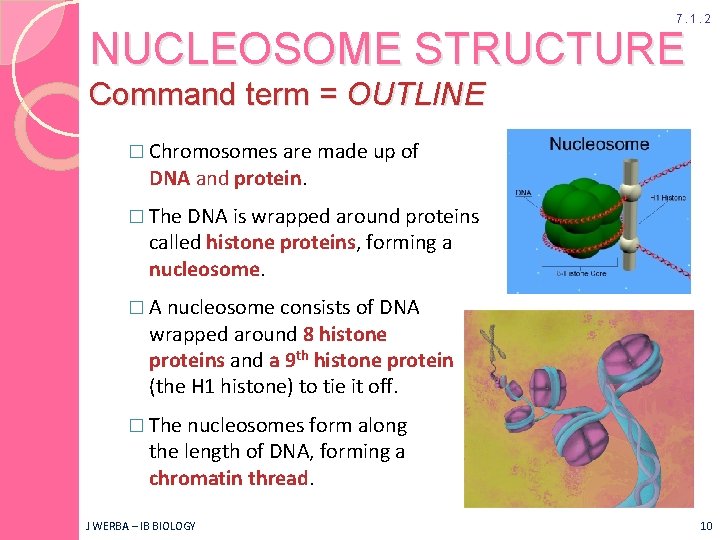
7. 1. 2 NUCLEOSOME STRUCTURE Command term = OUTLINE � Chromosomes are made up of DNA and protein. � The DNA is wrapped around proteins called histone proteins, forming a nucleosome. � A nucleosome consists of DNA wrapped around 8 histone proteins and a 9 th histone protein (the H 1 histone) to tie it off. � The nucleosomes form along the length of DNA, forming a chromatin thread. J WERBA – IB BIOLOGY 10
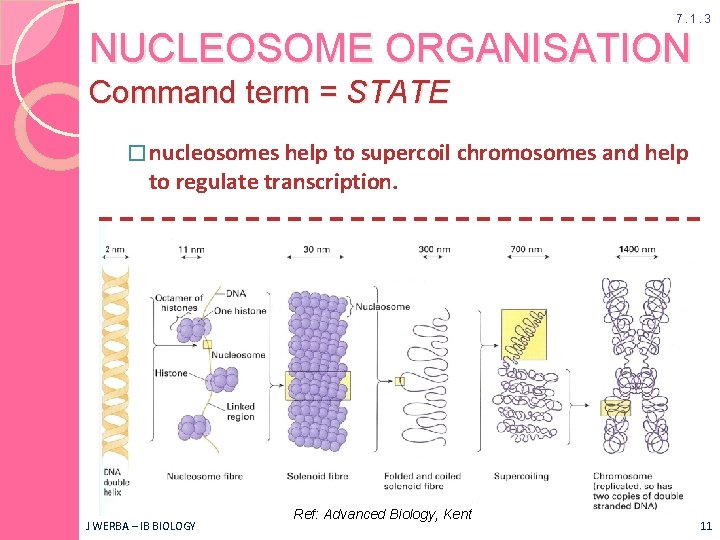
7. 1. 3 NUCLEOSOME ORGANISATION Command term = STATE � nucleosomes help to supercoil chromosomes and help to regulate transcription. J WERBA – IB BIOLOGY Ref: Advanced Biology, Kent 11
7. 1. 3 NUCLEOSOME ORGANISATION Command term = STATE � nucleosomes help to supercoil chromosomes and help to regulate transcription � The DNA cannot be read during transcription if it is condensed into chromosomes � Nucleosome organisation means that the promoter regions on the DNA are inaccessible to the RNA polymerase enzyme and transcription cannot occur. J WERBA – IB BIOLOGY 12
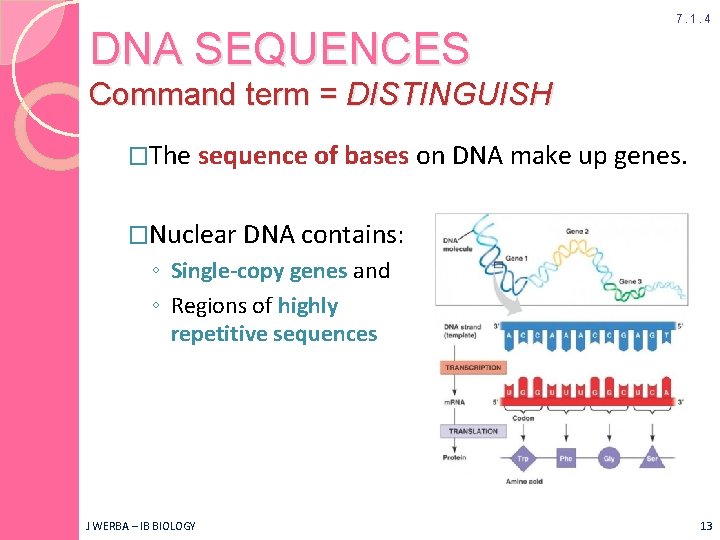
DNA SEQUENCES 7. 1. 4 Command term = DISTINGUISH �The sequence of bases on DNA make up genes. �Nuclear DNA contains: ◦ Single-copy genes and ◦ Regions of highly repetitive sequences J WERBA – IB BIOLOGY 13
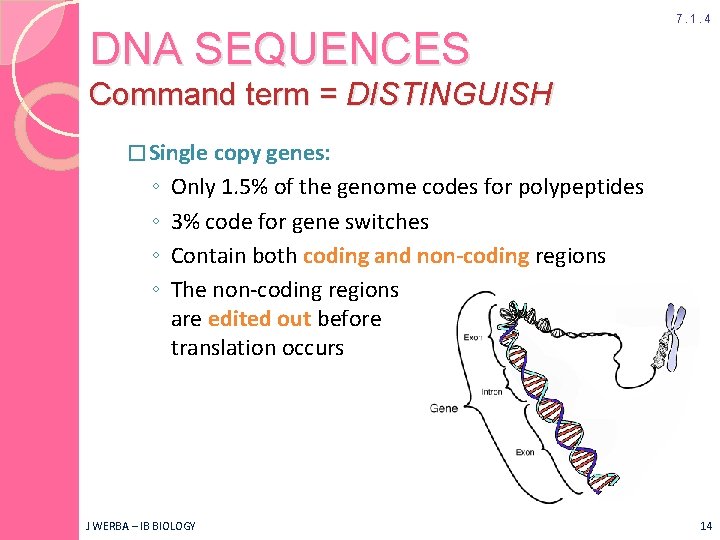
DNA SEQUENCES 7. 1. 4 Command term = DISTINGUISH � Single copy genes: ◦ ◦ Only 1. 5% of the genome codes for polypeptides 3% code for gene switches Contain both coding and non-coding regions The non-coding regions are edited out before translation occurs J WERBA – IB BIOLOGY 14
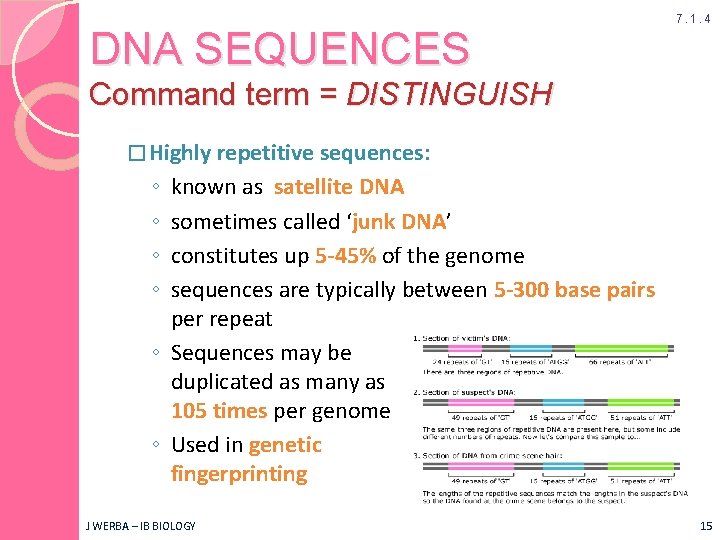
DNA SEQUENCES 7. 1. 4 Command term = DISTINGUISH � Highly repetitive sequences: ◦ ◦ known as satellite DNA sometimes called ‘junk DNA’ constitutes up 5 -45% of the genome sequences are typically between 5 -300 base pairs per repeat ◦ Sequences may be duplicated as many as 105 times per genome ◦ Used in genetic fingerprinting J WERBA – IB BIOLOGY 15
EXONS and INTRONS 7. 1. 5 Command term = STATE � eukaryotic genes can contain exons and introns � Prokaryotic DNA contains no repetitive sequences. � Eukaryotic genes are interrupted by introns � Introns are non-coding sequences: ◦ They are transcribed (read) into pre-messenger RNA (pre -m. RNA) but not translated (synthesised) � The coding sequences are known as exons, which are both transcribed and translated into mature m. RNA. J WERBA – IB BIOLOGY 16
Sample questions Q 1. What does a nucleosome consist of ? DNA and histones B. DNA and chromatin C. Chromatin and nucleotides D. Mature RNA and histones A. J WERBA – IB BIOLOGY 17
Sample questions Q 2. Which base is connected to its complementary base in a base pair by three hydrogen bonds? Uracil B. Thymine C. Guanine D. Adenine A. J WERBA – IB BIOLOGY 18
Sample questions Q 3. Most of the DNA of a human cell is contained in the nucleus. Distinguish between unique and highly repetitive sequences in nuclear DNA. [5] J WERBA – IB BIOLOGY 19
Sample questions � A 1. A � A 2. C J WERBA – IB BIOLOGY 20
![Sample questions A 3. Award [1] for each pair of statements in the table](http://slidetodoc.com/presentation_image_h2/9e07dbd3031227d948b3489735a71af6/image-21.jpg "Sample questions A 3. Award [1] for each pair of statements in the table")
Sample questions A 3. Award [1] for each pair of statements in the table and [1] for any statement below the table. � satellite DNA is repetitive; � repetitive sequences are used for profiling; � prokaryotes do not (usually) contain repetitive sequences; 5 max J WERBA – IB BIOLOGY 21
- Slides: 21