
DNA Sequencing Method to sequence longer regions genomic




- Slides: 46
DNA Sequencing
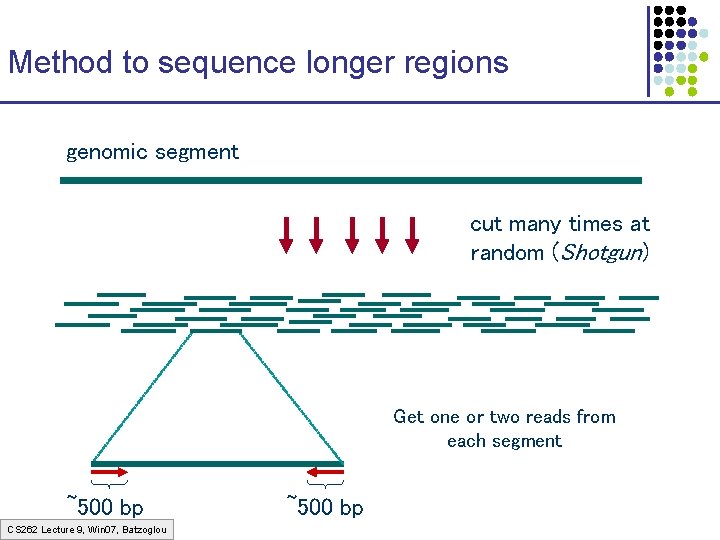
Method to sequence longer regions genomic segment cut many times at random (Shotgun) Get one or two reads from each segment ~500 bp CS 262 Lecture 9, Win 07, Batzoglou ~500 bp
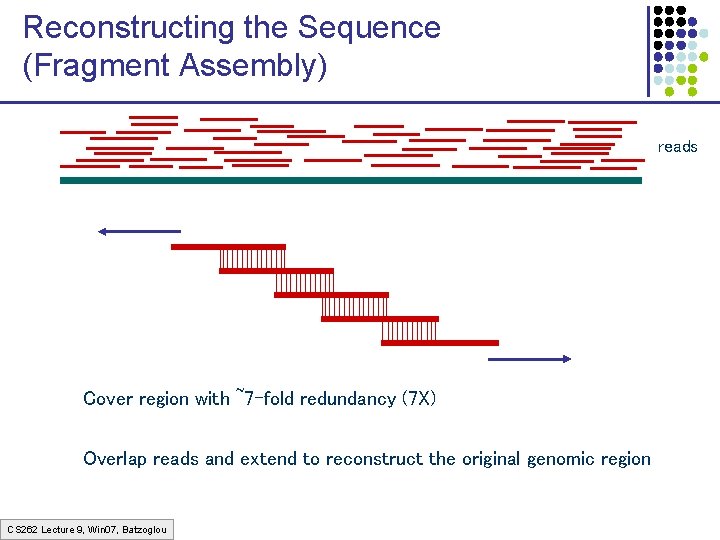
Reconstructing the Sequence (Fragment Assembly) reads Cover region with ~7 -fold redundancy (7 X) Overlap reads and extend to reconstruct the original genomic region CS 262 Lecture 9, Win 07, Batzoglou
Definition of Coverage C Length of genomic segment: Number of reads: Length of each read: L n l Definition: C=nl/L Coverage How much coverage is enough? Lander-Waterman model: Assuming uniform distribution of reads, C=10 results in 1 gapped region /1, 000 nucleotides CS 262 Lecture 9, Win 07, Batzoglou
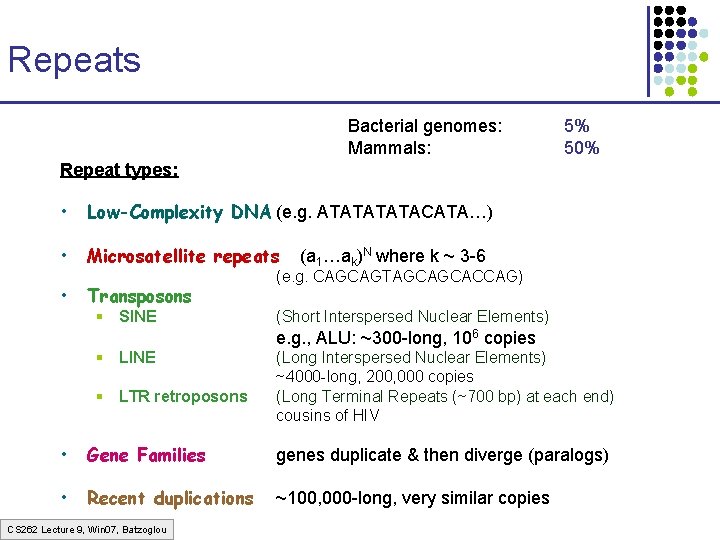
Repeats Bacterial genomes: Mammals: 5% 50% Repeat types: • Low-Complexity DNA (e. g. ATATACATA…) • Microsatellite repeats • Transposons § SINE (a 1…ak)N where k ~ 3 -6 (e. g. CAGCAGTAGCAGCACCAG) (Short Interspersed Nuclear Elements) e. g. , ALU: ~300 -long, 106 copies § LINE § LTR retroposons (Long Interspersed Nuclear Elements) ~4000 -long, 200, 000 copies (Long Terminal Repeats (~700 bp) at each end) cousins of HIV • Gene Families genes duplicate & then diverge (paralogs) • Recent duplications ~100, 000 -long, very similar copies CS 262 Lecture 9, Win 07, Batzoglou
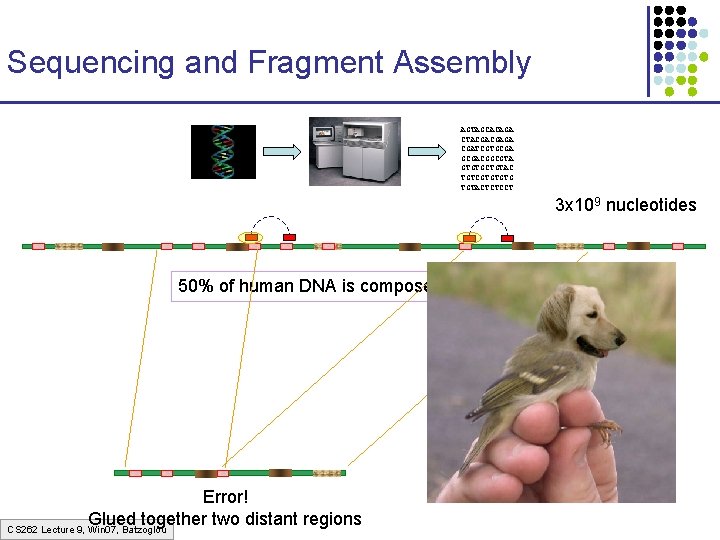
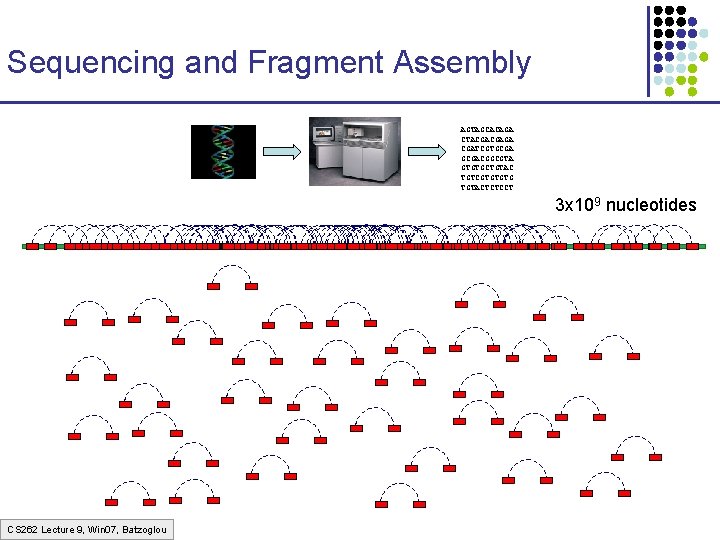
Sequencing and Fragment Assembly AGTAGCACAGA CTACGACGAGA CGATCGTGCGACGGCGTA GTGTGCTGTAC TGTCGTGTGTG TGTACTCTCCT 3 x 10⁹ nucleotides 50% of human DNA is composed of repeats Error! Glued together two distant regions CS 262 Lecture 9, Win 07, Batzoglou
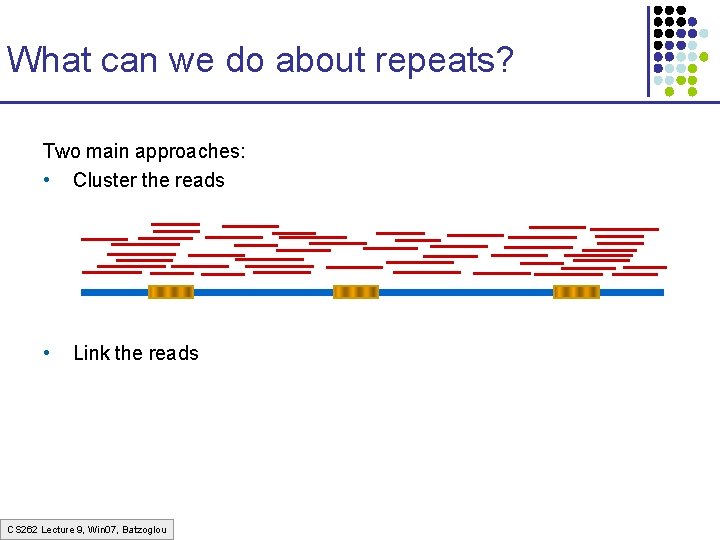
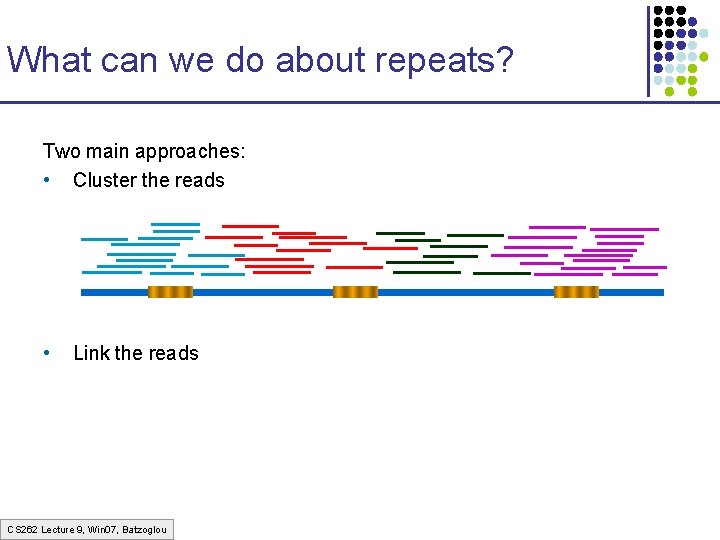
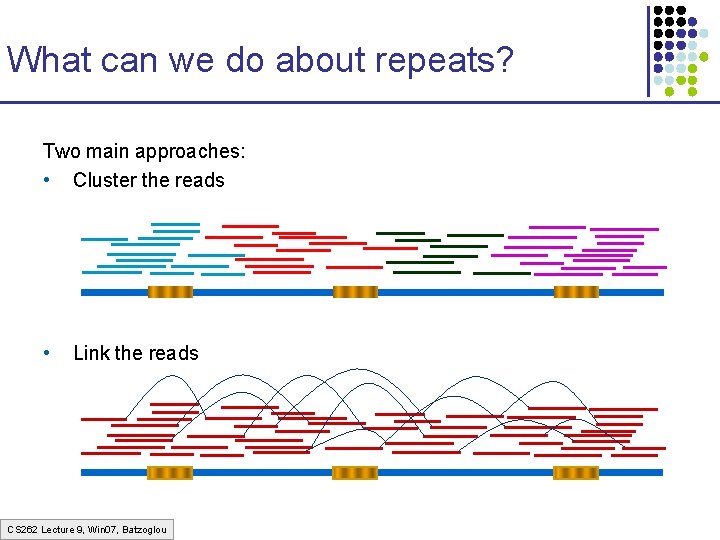
What can we do about repeats? Two main approaches: • Cluster the reads • Link the reads CS 262 Lecture 9, Win 07, Batzoglou
What can we do about repeats? Two main approaches: • Cluster the reads • Link the reads CS 262 Lecture 9, Win 07, Batzoglou
What can we do about repeats? Two main approaches: • Cluster the reads • Link the reads CS 262 Lecture 9, Win 07, Batzoglou
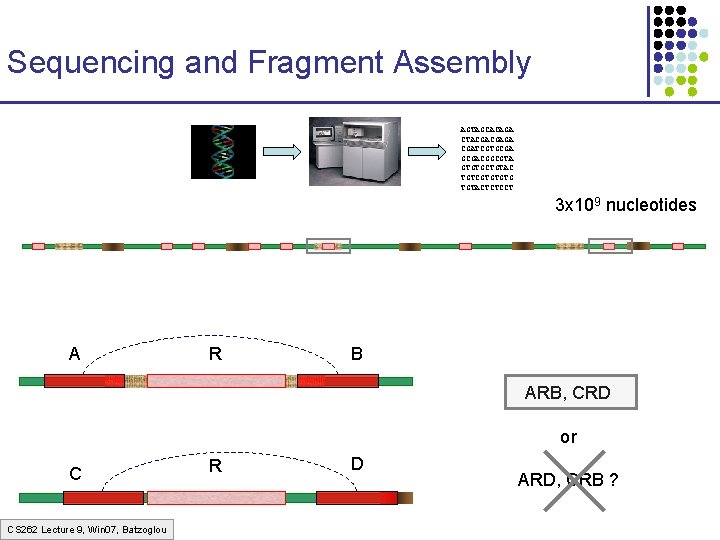
Sequencing and Fragment Assembly AGTAGCACAGA CTACGACGAGA CGATCGTGCGACGGCGTA GTGTGCTGTAC TGTCGTGTGTG TGTACTCTCCT 3 x 10⁹ nucleotides A R B ARB, CRD or C CS 262 Lecture 9, Win 07, Batzoglou R D ARD, CRB ?
Sequencing and Fragment Assembly AGTAGCACAGA CTACGACGAGA CGATCGTGCGACGGCGTA GTGTGCTGTAC TGTCGTGTGTG TGTACTCTCCT 3 x 10⁹ nucleotides CS 262 Lecture 9, Win 07, Batzoglou
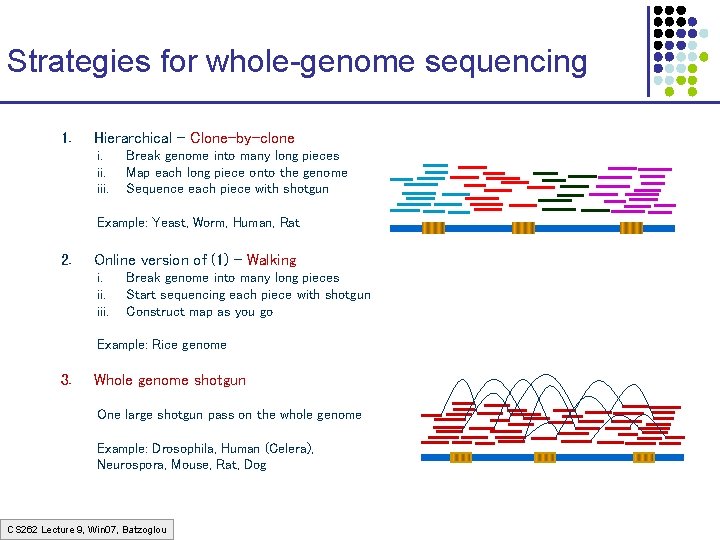
Strategies for whole-genome sequencing 1. Hierarchical – Clone-by-clone i. iii. Break genome into many long pieces Map each long piece onto the genome Sequence each piece with shotgun Example: Yeast, Worm, Human, Rat 2. Online version of (1) – Walking i. iii. Break genome into many long pieces Start sequencing each piece with shotgun Construct map as you go Example: Rice genome 3. Whole genome shotgun One large shotgun pass on the whole genome Example: Drosophila, Human (Celera), Neurospora, Mouse, Rat, Dog CS 262 Lecture 9, Win 07, Batzoglou
Hierarchical Sequencing CS 262 Lecture 9, Win 07, Batzoglou
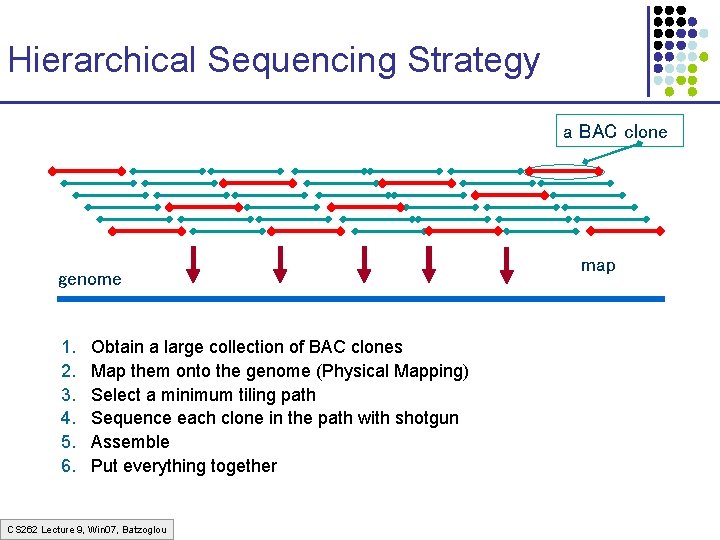
Hierarchical Sequencing Strategy a BAC clone genome 1. 2. 3. 4. 5. 6. Obtain a large collection of BAC clones Map them onto the genome (Physical Mapping) Select a minimum tiling path Sequence each clone in the path with shotgun Assemble Put everything together CS 262 Lecture 9, Win 07, Batzoglou map
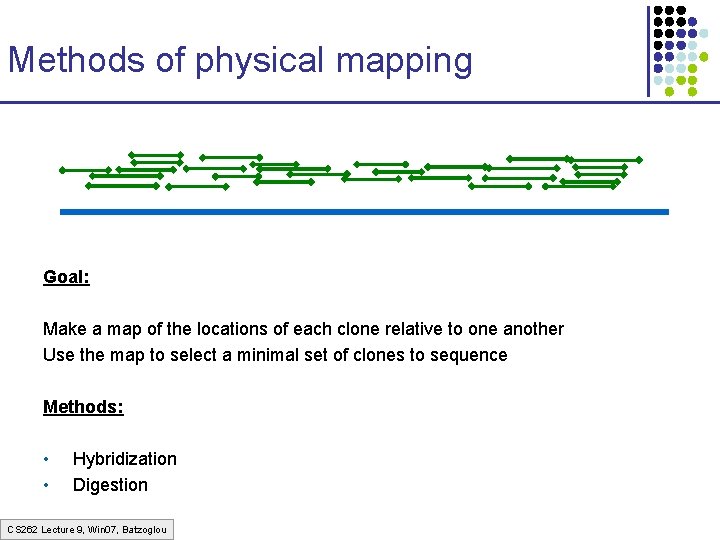
Methods of physical mapping Goal: Make a map of the locations of each clone relative to one another Use the map to select a minimal set of clones to sequence Methods: • • Hybridization Digestion CS 262 Lecture 9, Win 07, Batzoglou
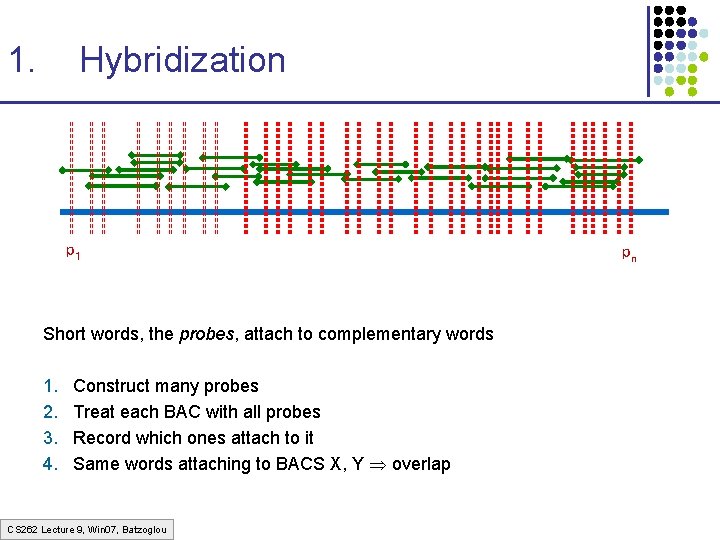
1. Hybridization p 1 Short words, the probes, attach to complementary words 1. 2. 3. 4. Construct many probes Treat each BAC with all probes Record which ones attach to it Same words attaching to BACS X, Y overlap CS 262 Lecture 9, Win 07, Batzoglou pn
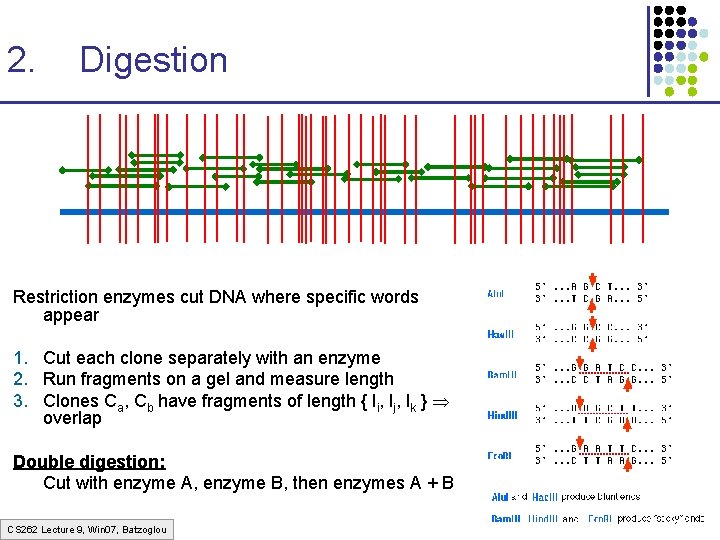
2. Digestion Restriction enzymes cut DNA where specific words appear 1. Cut each clone separately with an enzyme 2. Run fragments on a gel and measure length 3. Clones Ca, Cb have fragments of length { li, lj, lk } overlap Double digestion: Cut with enzyme A, enzyme B, then enzymes A + B CS 262 Lecture 9, Win 07, Batzoglou
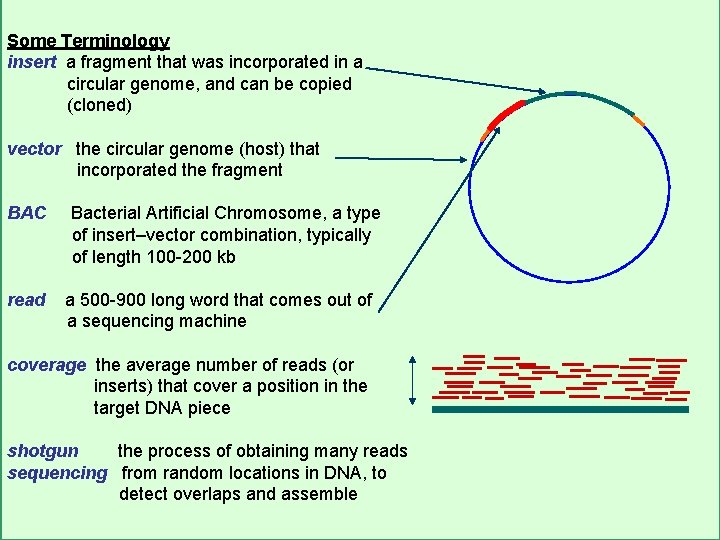
Some Terminology insert a fragment that was incorporated in a circular genome, and can be copied (cloned) vector the circular genome (host) that incorporated the fragment BAC read Bacterial Artificial Chromosome, a type of insert–vector combination, typically of length 100 -200 kb a 500 -900 long word that comes out of a sequencing machine coverage the average number of reads (or inserts) that cover a position in the target DNA piece shotgun the process of obtaining many reads sequencing from random locations in DNA, to detect overlaps and assemble CS 262 Lecture 9, Win 07, Batzoglou
Whole Genome Shotgun Sequencing genome cut many times at random plasmids (2 – 10 Kbp) known dist cosmids (40 Kbp) ~500 bp CS 262 Lecture 9, Win 07, Batzoglou forward-reverse paired reads ~500 bp
Fragment Assembly (in whole-genome shotgun sequencing) CS 262 Lecture 9, Win 07, Batzoglou
Fragment Assembly Given N reads… Where N ~ 30 million… We need to use a linear-time algorithm CS 262 Lecture 9, Win 07, Batzoglou
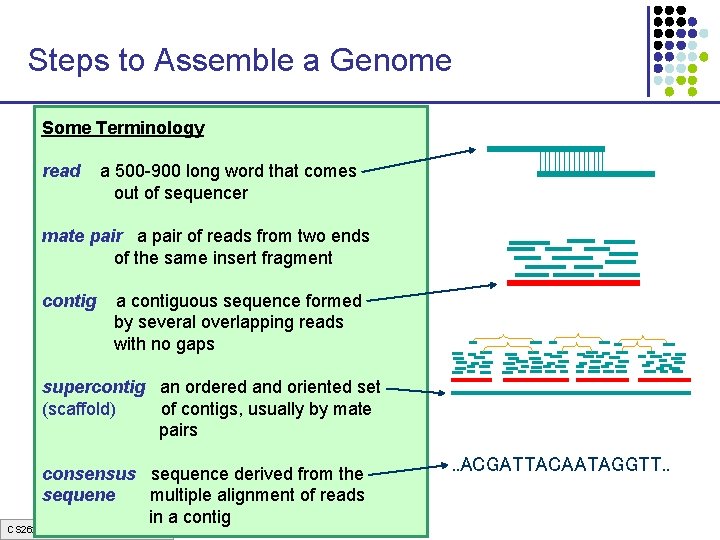
Steps to Assemble a Genome Some Terminology 1. Find overlapping readsthat comes read a 500 -900 long word out of sequencer mate pair a pair of reads from two ends 2. Merge some “good” of reads into of the same insert pairs fragment longer contigs contig a contiguous sequence formed by several overlapping reads with no gaps 3. Link contigs to form supercontigs supercontig an ordered and oriented set (scaffold) of contigs, usually by mate pairs 4. Derive consensus sequence derived from the sequene multiple alignment of reads in a contig CS 262 Lecture 9, Win 07, Batzoglou . . ACGATTACAATAGGTT. .
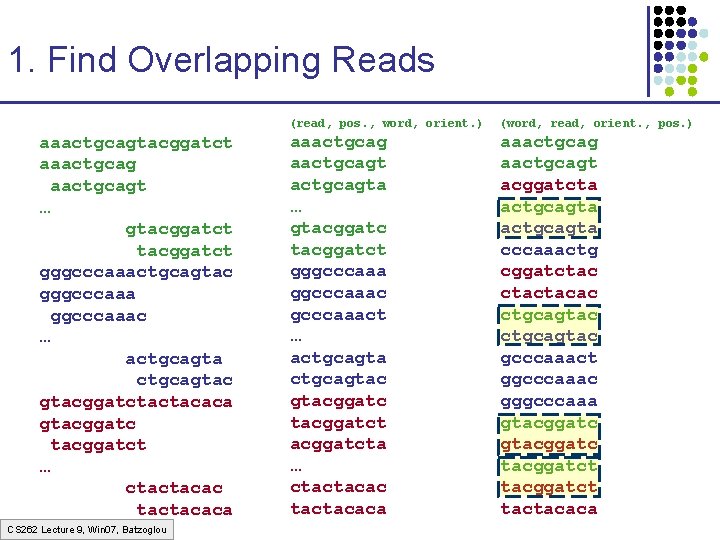
1. Find Overlapping Reads aaactgcagtacggatct aaactgcagt … gtacggatct gggcccaaactgcagtac gggcccaaac … actgcagtac gtacggatctactacaca gtacggatct … ctactacaca CS 262 Lecture 9, Win 07, Batzoglou (read, pos. , word, orient. ) (word, read, orient. , pos. ) aaactgcagt actgcagta … gtacggatct gggcccaaac gcccaaact … actgcagtac gtacggatct acggatcta … ctactacaca aaactgcagt acggatcta actgcagta cccaaactg cggatctactacac ctgcagtac gcccaaact ggcccaaac gggcccaaa gtacggatct tactacaca
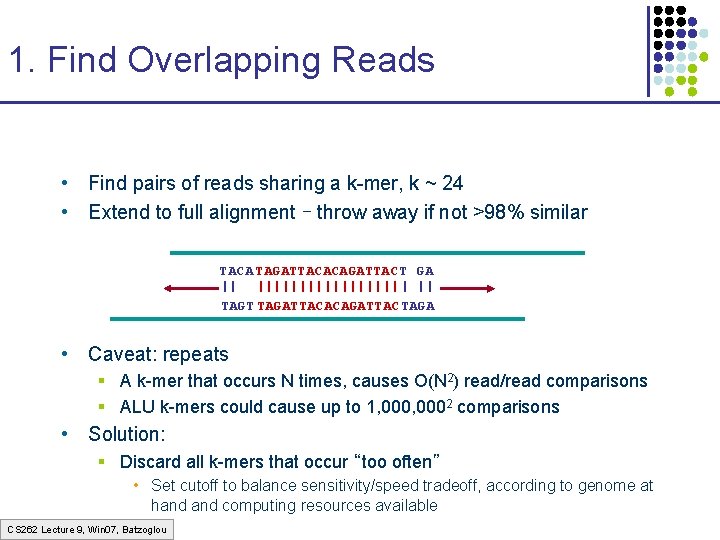
1. Find Overlapping Reads • Find pairs of reads sharing a k-mer, k ~ 24 • Extend to full alignment – throw away if not >98% similar TACA TAGATTACACAGATTAC T GA || ||||||||| | || TAGT TAGATTACACAGATTAC TAGA • Caveat: repeats § A k-mer that occurs N times, causes O(N 2) read/read comparisons § ALU k-mers could cause up to 1, 0002 comparisons • Solution: § Discard all k-mers that occur “too often” • Set cutoff to balance sensitivity/speed tradeoff, according to genome at hand computing resources available CS 262 Lecture 9, Win 07, Batzoglou
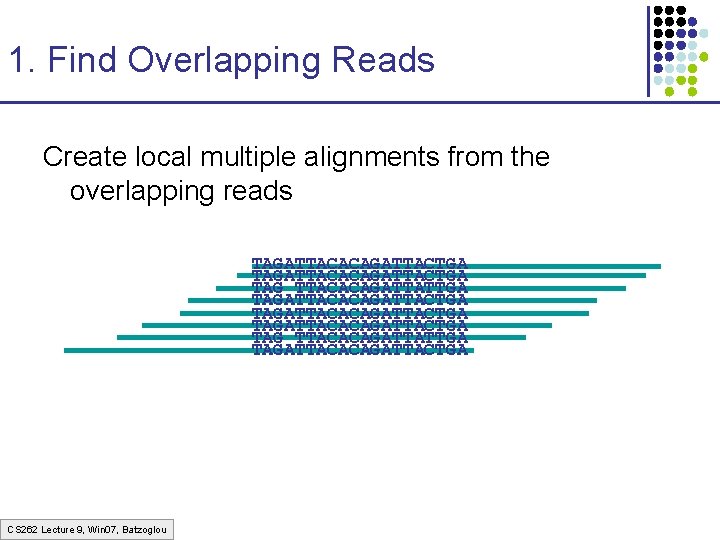
1. Find Overlapping Reads Create local multiple alignments from the overlapping reads TAGATTACACAGATTACTGA TAG TTACACAGATTATTGA TAGATTACACAGATTACTGA CS 262 Lecture 9, Win 07, Batzoglou
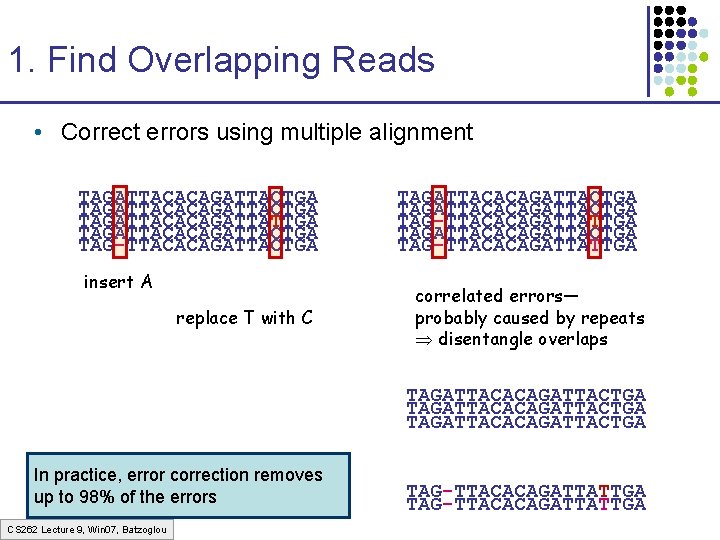
1. Find Overlapping Reads • Correct errors using multiple alignment TAGATTACACAGATTACTGA TAGATTACACAGATTATTGA TAGATTACACAGATTACTGA TAG-TTACACAGATTACTGA insert A replace T with C TAGATTACACAGATTACTGA TAG-TTACACAGATTATTGA correlated errors— probably caused by repeats disentangle overlaps TAGATTACACAGATTACTGA In practice, error correction removes up to 98% of the errors CS 262 Lecture 9, Win 07, Batzoglou TAG-TTACACAGATTATTGA
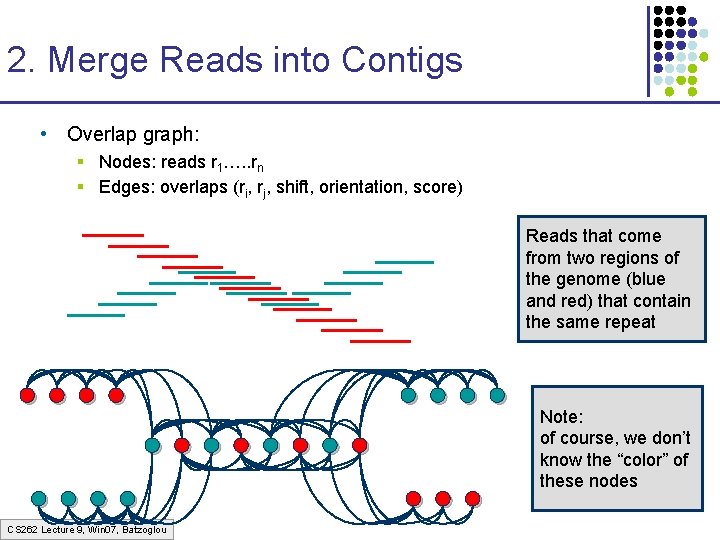
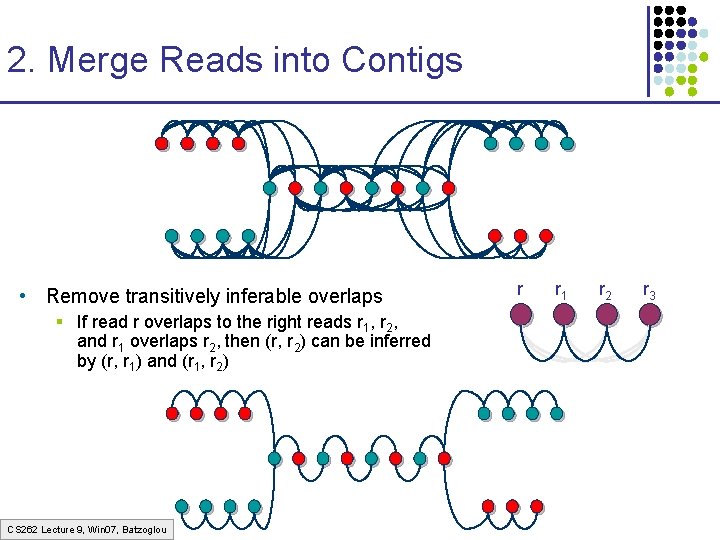
2. Merge Reads into Contigs • Overlap graph: § Nodes: reads r 1…. . rn § Edges: overlaps (ri, rj, shift, orientation, score) Reads that come from two regions of the genome (blue and red) that contain the same repeat Note: of course, we don’t know the “color” of these nodes CS 262 Lecture 9, Win 07, Batzoglou
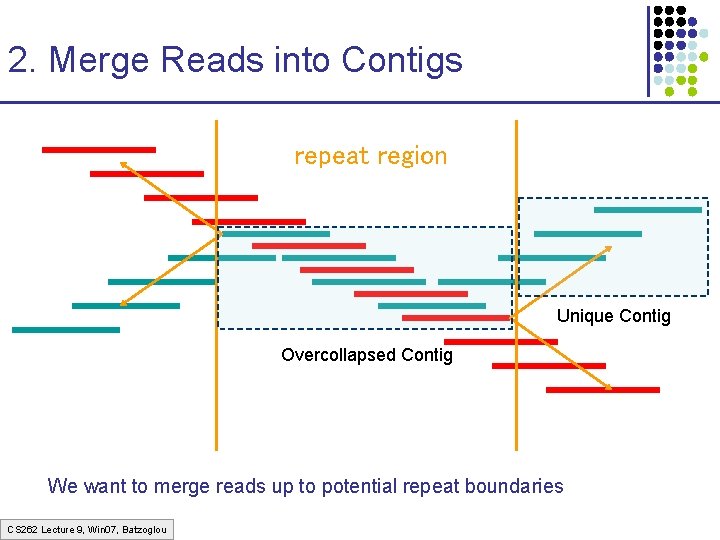
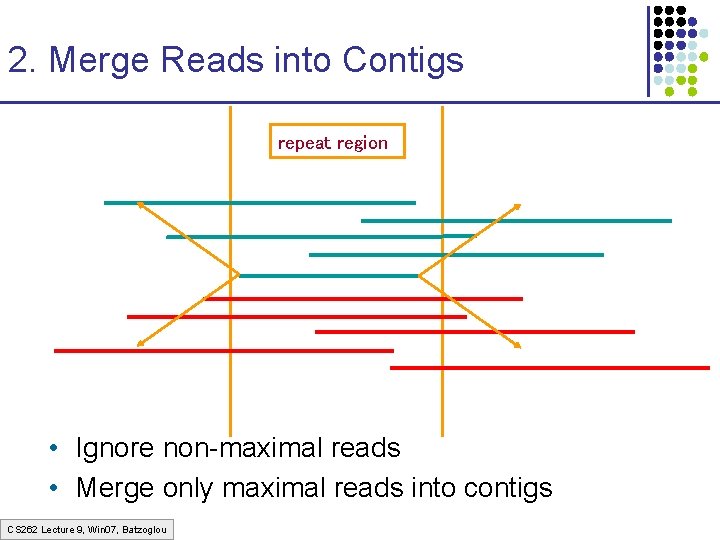
2. Merge Reads into Contigs repeat region Unique Contig Overcollapsed Contig We want to merge reads up to potential repeat boundaries CS 262 Lecture 9, Win 07, Batzoglou
2. Merge Reads into Contigs repeat region • Ignore non-maximal reads • Merge only maximal reads into contigs CS 262 Lecture 9, Win 07, Batzoglou
2. Merge Reads into Contigs • Remove transitively inferable overlaps § If read r overlaps to the right reads r 1, r 2, and r 1 overlaps r 2, then (r, r 2) can be inferred by (r, r 1) and (r 1, r 2) CS 262 Lecture 9, Win 07, Batzoglou r r 1 r 2 r 3
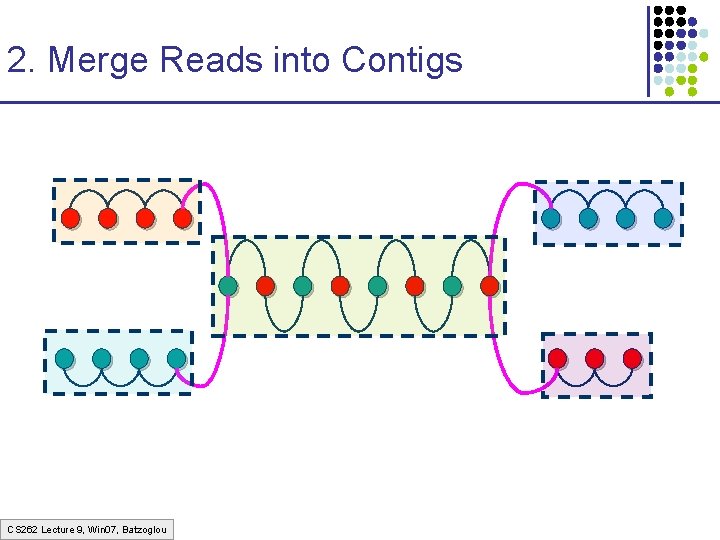
2. Merge Reads into Contigs CS 262 Lecture 9, Win 07, Batzoglou
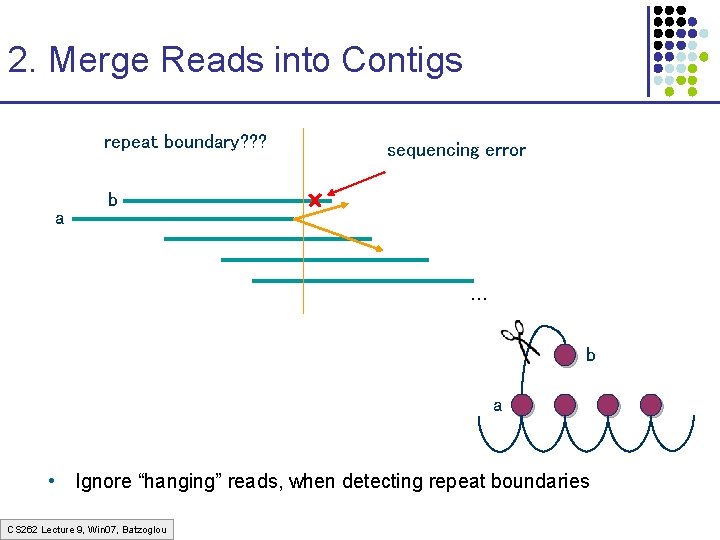
2. Merge Reads into Contigs repeat boundary? ? ? a sequencing error b … b a • Ignore “hanging” reads, when detecting repeat boundaries CS 262 Lecture 9, Win 07, Batzoglou
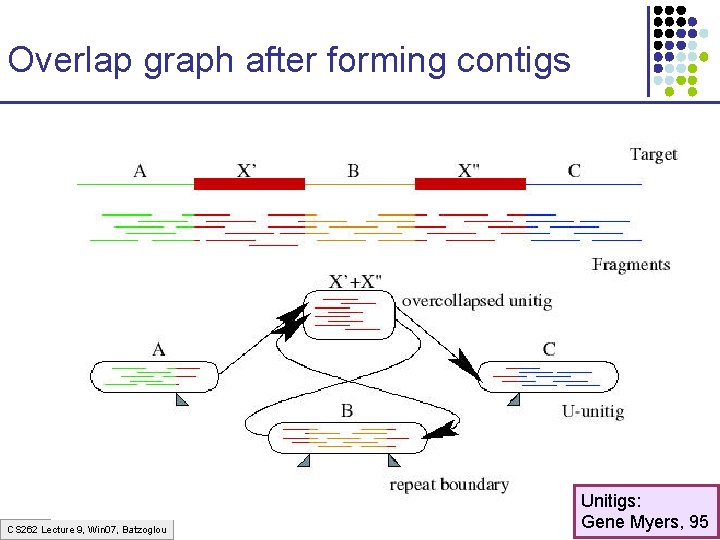
Overlap graph after forming contigs CS 262 Lecture 9, Win 07, Batzoglou Unitigs: Gene Myers, 95
Repeats, errors, and contig lengths • Repeats shorter than read length are easily resolved § Read that spans across a repeat disambiguates order of flanking regions • Repeats with more base pair diffs than sequencing error rate are OK § We throw overlaps between two reads in different copies of the repeat • To make the genome appear less repetitive, try to: § Increase read length § Decrease sequencing error rate Role of error correction: Discards up to 98% of single-letter sequencing errors decreases error rate decreases effective repeat content increases contig length CS 262 Lecture 9, Win 07, Batzoglou
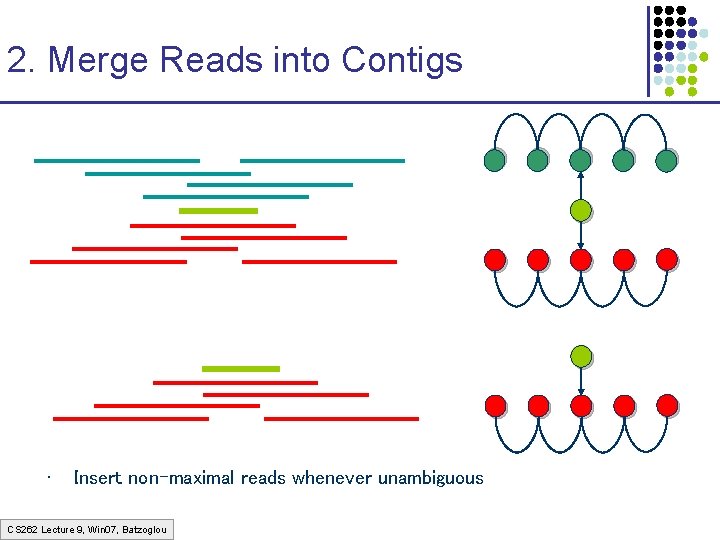
2. Merge Reads into Contigs • Insert non-maximal reads whenever unambiguous CS 262 Lecture 9, Win 07, Batzoglou
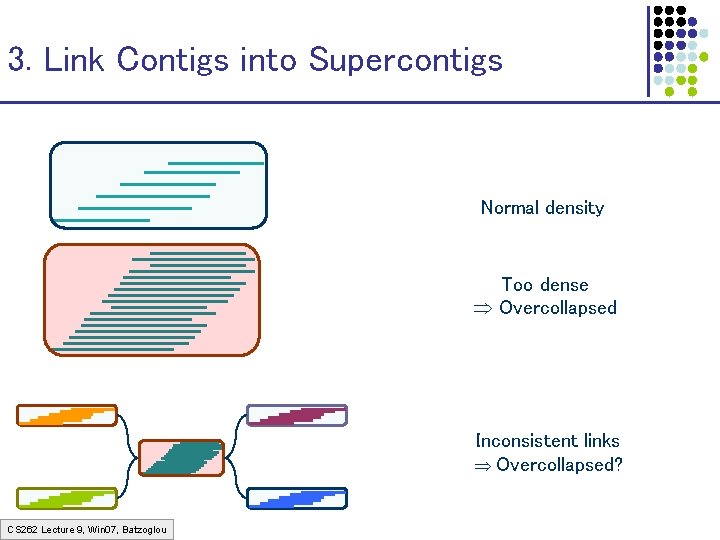
3. Link Contigs into Supercontigs Normal density Too dense Overcollapsed Inconsistent links Overcollapsed? CS 262 Lecture 9, Win 07, Batzoglou
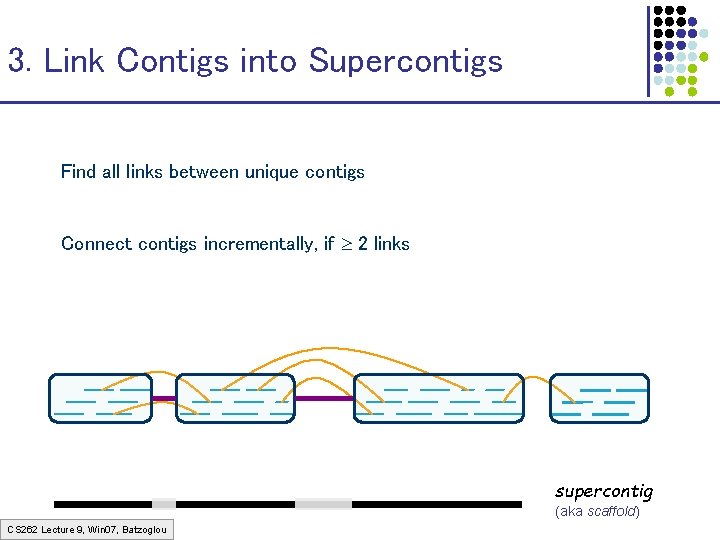
3. Link Contigs into Supercontigs Find all links between unique contigs Connect contigs incrementally, if 2 links supercontig (aka scaffold) CS 262 Lecture 9, Win 07, Batzoglou
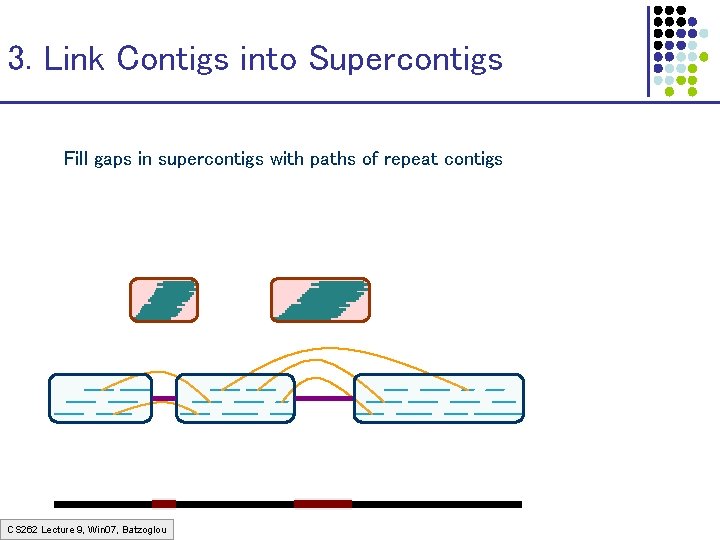
3. Link Contigs into Supercontigs Fill gaps in supercontigs with paths of repeat contigs CS 262 Lecture 9, Win 07, Batzoglou
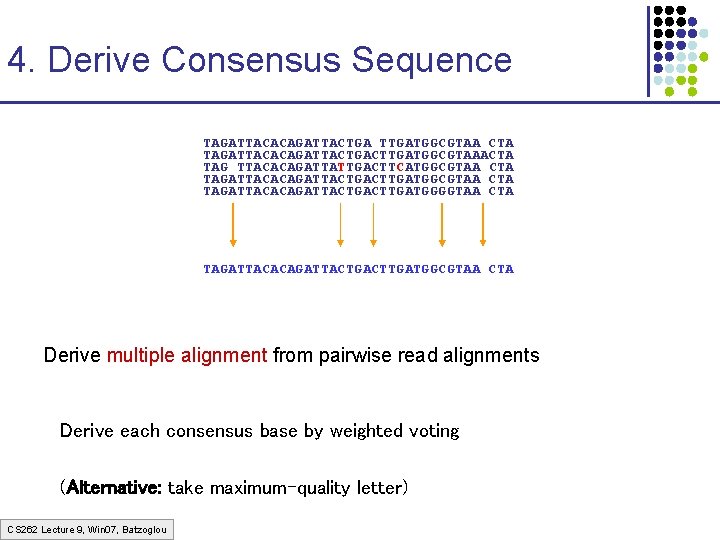
4. Derive Consensus Sequence TAGATTACACAGATTACTGA TTGATGGCGTAA CTA TAGATTACACAGATTACTGACTTGATGGCGTAAACTA TAG TTACACAGATTATTGACTTCATGGCGTAA CTA TAGATTACACAGATTACTGACTTGATGGGGTAA CTA TAGATTACACAGATTACTGACTTGATGGCGTAA CTA Derive multiple alignment from pairwise read alignments Derive each consensus base by weighted voting (Alternative: take maximum-quality letter) CS 262 Lecture 9, Win 07, Batzoglou
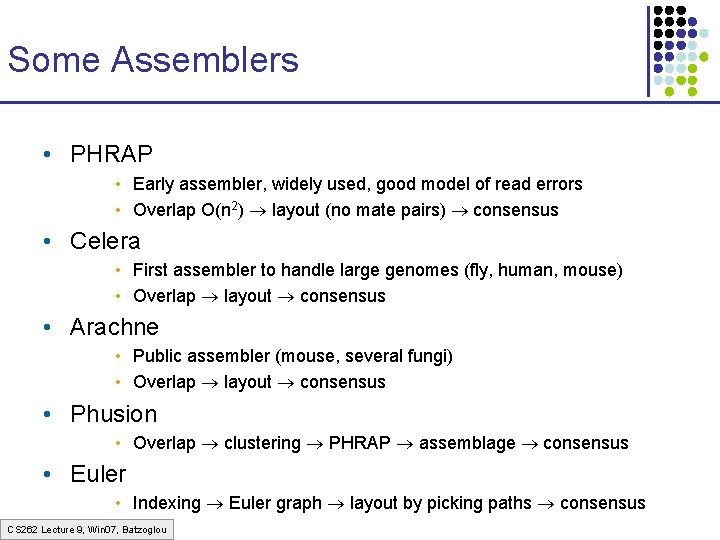
Some Assemblers • PHRAP • Early assembler, widely used, good model of read errors • Overlap O(n 2) layout (no mate pairs) consensus • Celera • First assembler to handle large genomes (fly, human, mouse) • Overlap layout consensus • Arachne • Public assembler (mouse, several fungi) • Overlap layout consensus • Phusion • Overlap clustering PHRAP assemblage consensus • Euler • Indexing Euler graph layout by picking paths consensus CS 262 Lecture 9, Win 07, Batzoglou
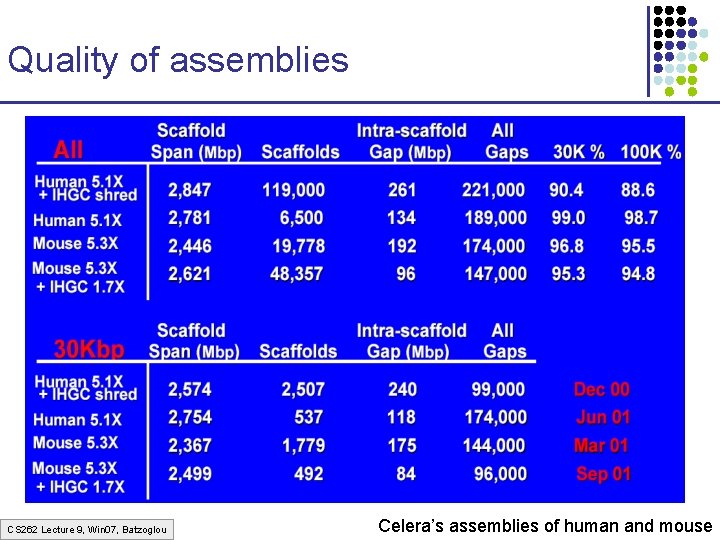
Quality of assemblies CS 262 Lecture 9, Win 07, Batzoglou Celera’s assemblies of human and mouse
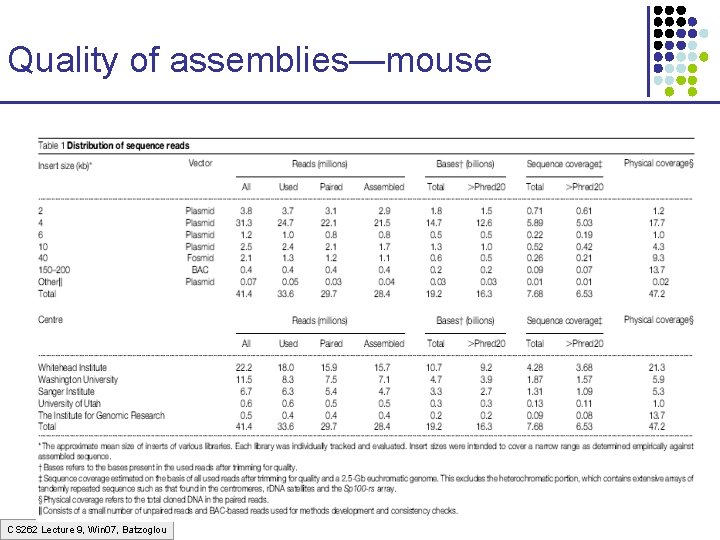
Quality of assemblies—mouse CS 262 Lecture 9, Win 07, Batzoglou
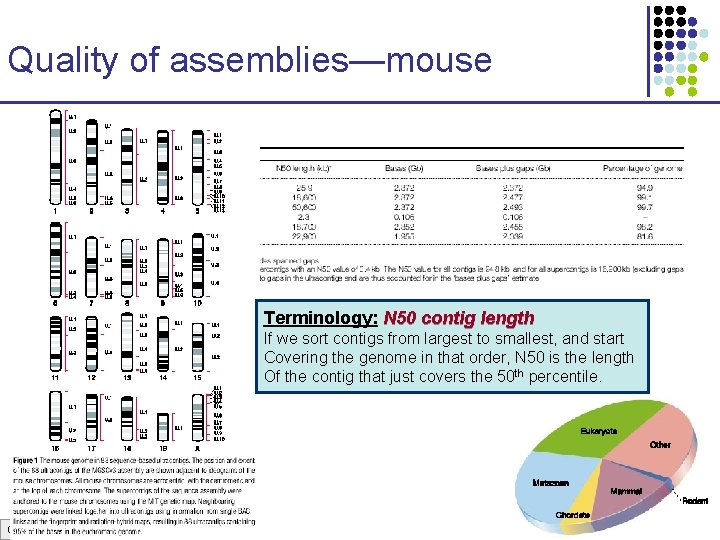
Quality of assemblies—mouse Terminology: N 50 contig length If we sort contigs from largest to smallest, and start Covering the genome in that order, N 50 is the length Of the contig that just covers the 50 th percentile. CS 262 Lecture 9, Win 07, Batzoglou
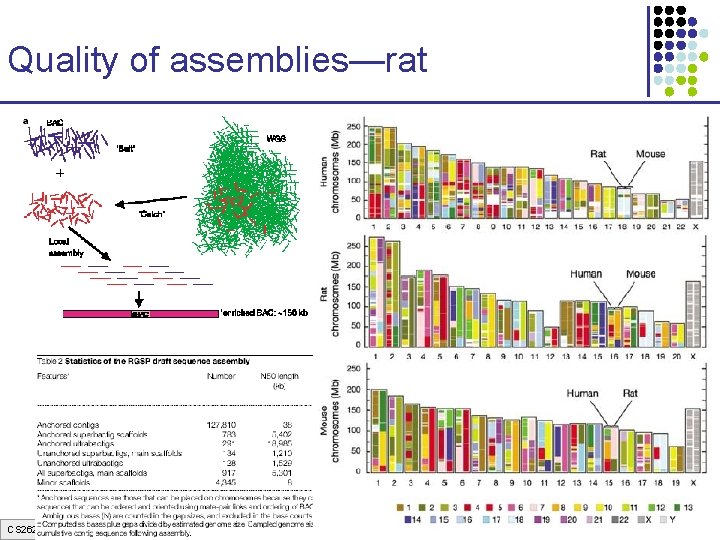
Quality of assemblies—rat CS 262 Lecture 9, Win 07, Batzoglou
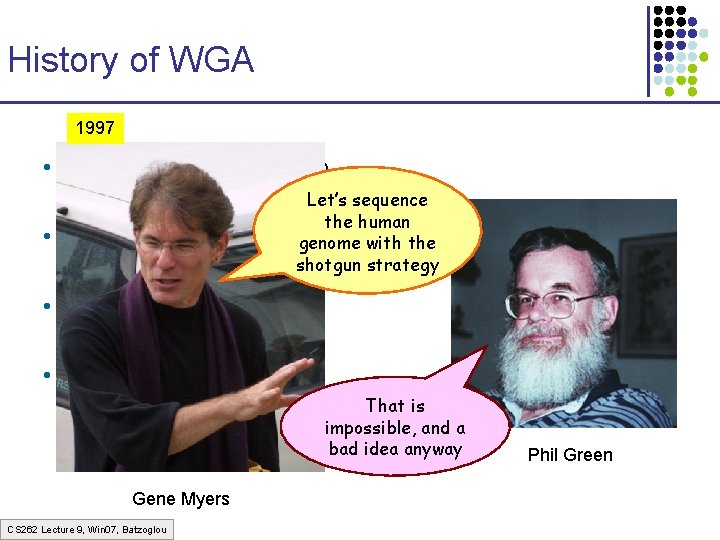
History of WGA 1997 • 1982: -virus, 48, 502 bp • 1995: h-influenzae, Let’s sequence the human 1 genome Mbp with the shotgun strategy • 2000: fly, 100 Mbp • 2001 – present Thatrat is*, chicken, dog, chimpanzee, § human (3 Gbp), mouse (2. 5 Gbp), several fungal genomes impossible, and a bad idea anyway Gene Myers CS 262 Lecture 9, Win 07, Batzoglou Phil Green
Genomes Sequenced • http: //www. genome. gov/10002154 CS 262 Lecture 9, Win 07, Batzoglou