
DNA RNA AND PROTEIN SYNTHESIS Chapter 12 HISTORICAL







- Slides: 36
DNA, RNA, AND PROTEIN SYNTHESIS Chapter 12
HISTORICAL PERSPECTIVES Debrief using the DNA Research and Structure Summary
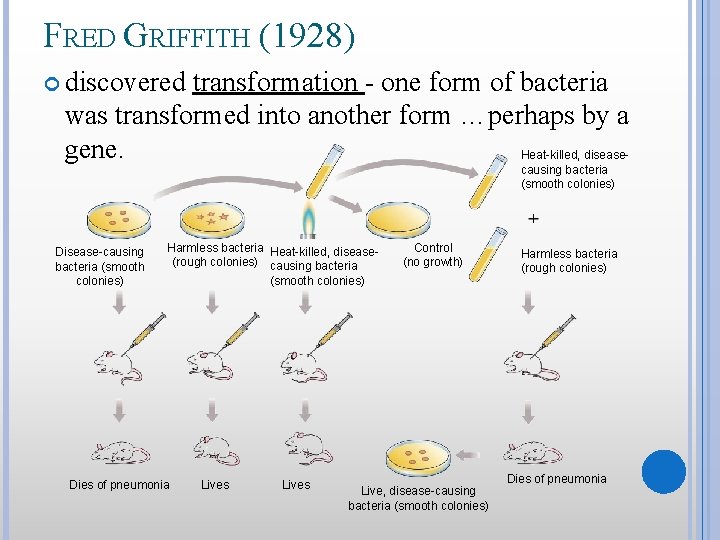
FRED GRIFFITH (1928) discovered transformation - one form of bacteria was transformed into another form …perhaps by a gene. Heat-killed, diseasecausing bacteria (smooth colonies) Disease-causing bacteria (smooth colonies) Harmless bacteria Heat-killed, disease(rough colonies) causing bacteria (smooth colonies) Dies of pneumonia Lives Control (no growth) Live, disease-causing bacteria (smooth colonies) Harmless bacteria (rough colonies) Dies of pneumonia
OSWALD AVERY (1944) Avery expanded on Griffith’s experiment by destroying various compounds with ______ and seeing if transformation occurred found that _____ (not protein) is the genetic material
HERSHEY AND CHASE (1952) Radioactively labeled the PROTEIN of a virus with sulfur and the DNA of a virus with phosphorus After the virus transmitted genetic material into the bacteria cell, radioactive phosphorus was found in the cell Means the genetic material is DNA
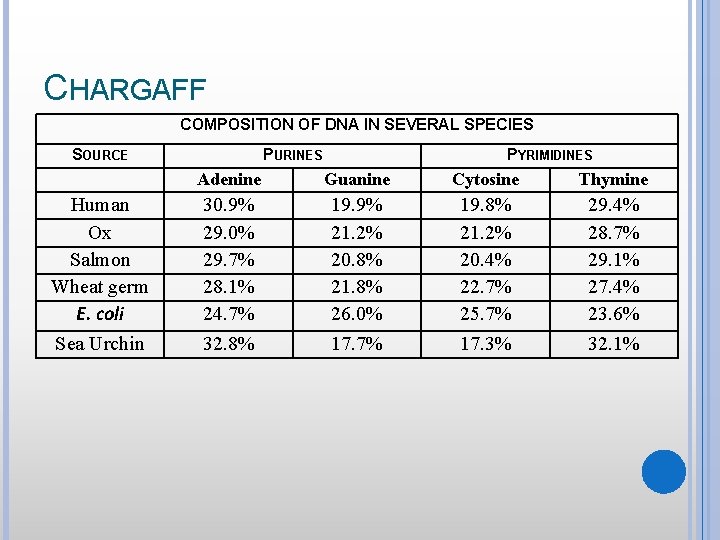
CHARGAFF COMPOSITION OF DNA IN SEVERAL SPECIES SOURCE PURINES PYRIMIDINES Adenine Guanine Cytosine Thymine Human Ox Salmon Wheat germ E. coli 30. 9% 29. 0% 29. 7% 28. 1% 24. 7% 19. 9% 21. 2% 20. 8% 21. 8% 26. 0% 19. 8% 21. 2% 20. 4% 22. 7% 25. 7% 29. 4% 28. 7% 29. 1% 27. 4% 23. 6% Sea Urchin 32. 8% 17. 7% 17. 3% 32. 1%
ROSALIND FRANKLIN Saw X-shaped pattern with X-ray diffraction
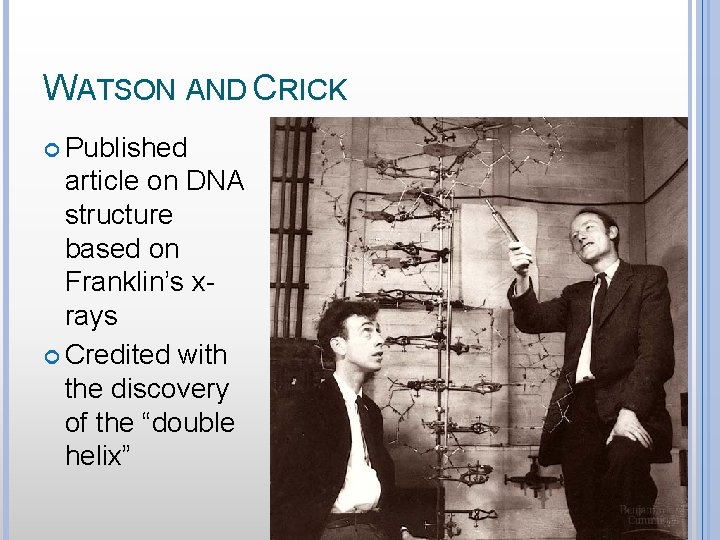
WATSON AND CRICK Published article on DNA structure based on Franklin’s xrays Credited with the discovery of the “double helix”
STRUCTURE OF DEOXYRIBONUCLEIC ACID (DNA)
o DNA is made of subunits called nucleotides • Nucleotides have 3 parts: 1. Deoxyribose sugar (5 -carbon, pentagon shaped) 2. Phosphate group 3. Nitrogen base – 4 nitrogen bases in 2 categories A. Purines: adenine and guanine - double-ringed structure B. Pyrimidines: thymine and cytosine - singleringed structure
Purines Adenine Guanine Pyrimidines Cytosine Thymine nucleotide Pg 291 Phosphate group Deoxyribose Sugar
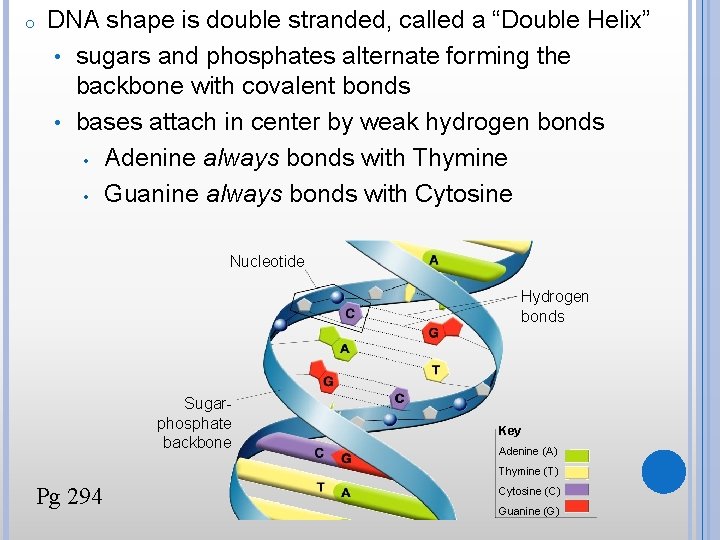
o DNA shape is double stranded, called a “Double Helix” • sugars and phosphates alternate forming the backbone with covalent bonds • bases attach in center by weak hydrogen bonds • Adenine always bonds with Thymine • Guanine always bonds with Cytosine Nucleotide Hydrogen bonds Sugarphosphate backbone Key Adenine (A) Thymine (T) Pg 294 Cytosine (C) Guanine (G)
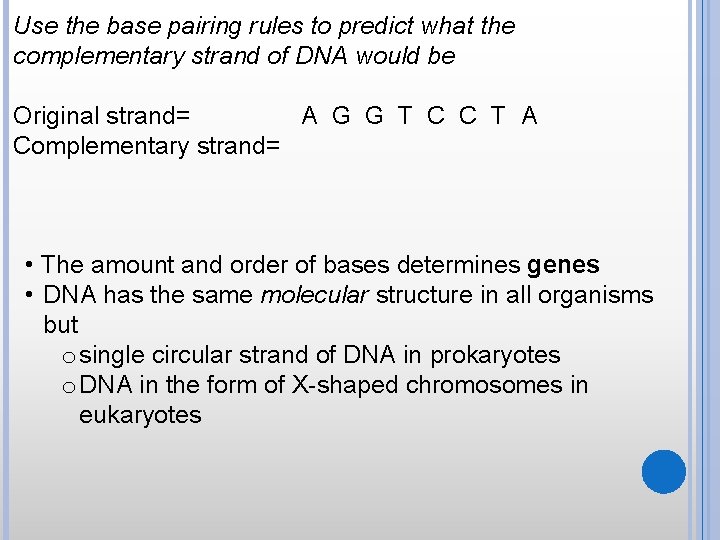
Use the base pairing rules to predict what the complementary strand of DNA would be Original strand= A G G T C C T A Complementary strand= • The amount and order of bases determines genes • DNA has the same molecular structure in all organisms but o single circular strand of DNA in prokaryotes o DNA in the form of X-shaped chromosomes in eukaryotes
DNA REPLICATION
DNA REPLICATION o o Occurs in nucleus Because strands are complementary, each strand serves as a template for a new strand
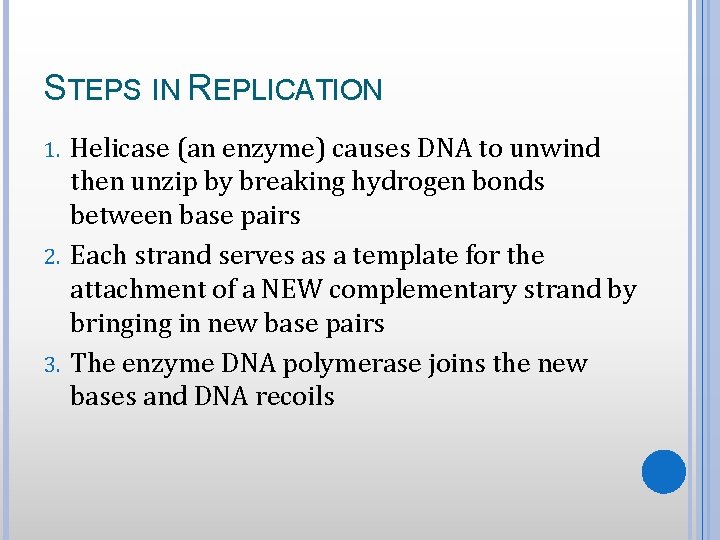
STEPS IN REPLICATION Helicase (an enzyme) causes DNA to unwind then unzip by breaking hydrogen bonds between base pairs 2. Each strand serves as a template for the attachment of a NEW complementary strand by bringing in new base pairs 3. The enzyme DNA polymerase joins the new bases and DNA recoils 1.
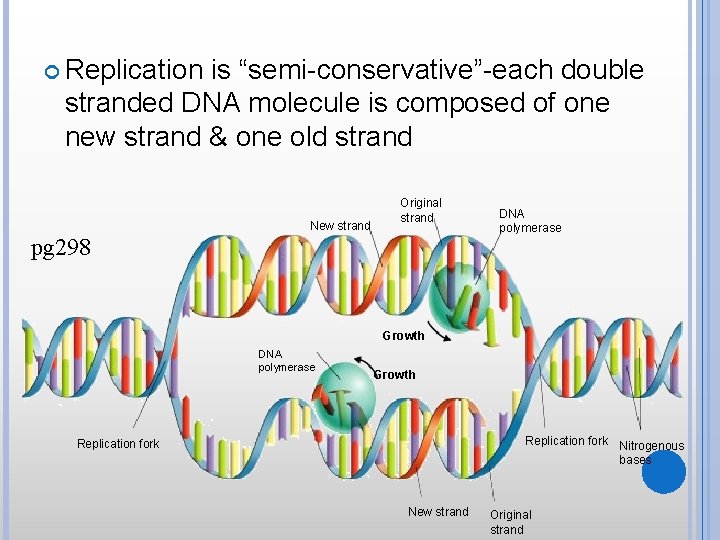
Replication is “semi-conservative”-each double stranded DNA molecule is composed of one new strand & one old strand New strand Original strand pg 298 DNA polymerase Growth Replication fork Nitrogenous bases Replication fork New strand Original strand
RNA – RIBONUCLEIC ACID
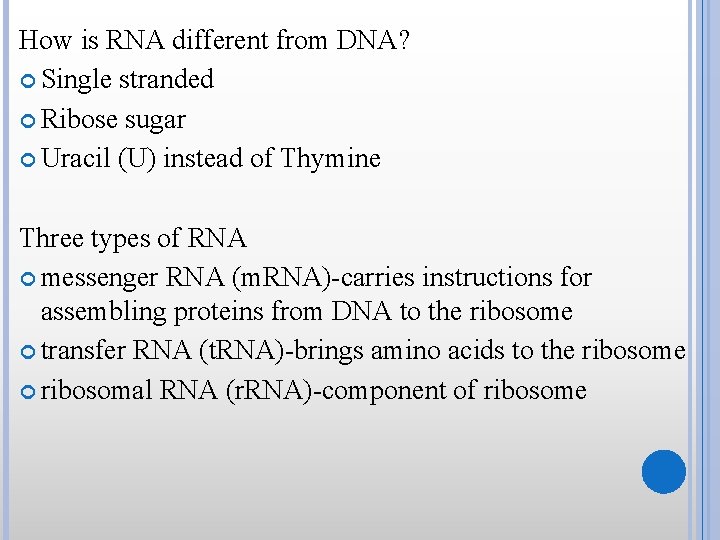
How is RNA different from DNA? Single stranded Ribose sugar Uracil (U) instead of Thymine Three types of RNA messenger RNA (m. RNA)-carries instructions for assembling proteins from DNA to the ribosome transfer RNA (t. RNA)-brings amino acids to the ribosome ribosomal RNA (r. RNA)-component of ribosome
TRANSCRIPTION How does the message in DNA get to the ribosome?
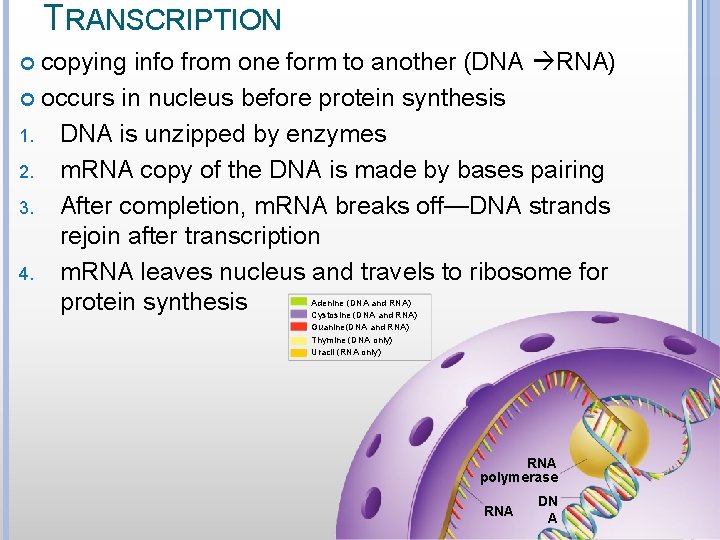
TRANSCRIPTION copying info from one form to another (DNA RNA) occurs in nucleus before protein synthesis 1. DNA is unzipped by enzymes 2. m. RNA copy of the DNA is made by bases pairing 3. After completion, m. RNA breaks off—DNA strands rejoin after transcription 4. m. RNA leaves nucleus and travels to ribosome for protein synthesis Adenine (DNA and RNA) Cystosine (DNA and RNA) Guanine(DNA and RNA) Thymine (DNA only) Uracil (RNA only) RNA polymerase RNA DN A
THE GENETIC CODE
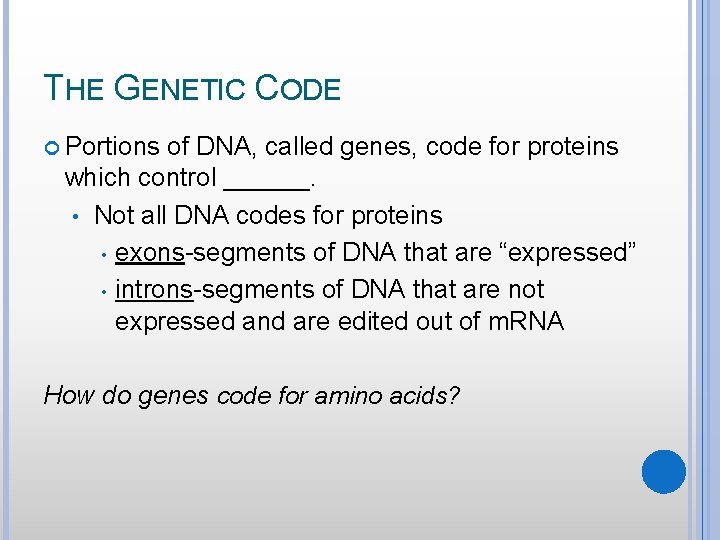
THE GENETIC CODE Portions of DNA, called genes, code for proteins which control ______. • Not all DNA codes for proteins • exons-segments of DNA that are “expressed” • introns-segments of DNA that are not expressed and are edited out of m. RNA How do genes code for amino acids?
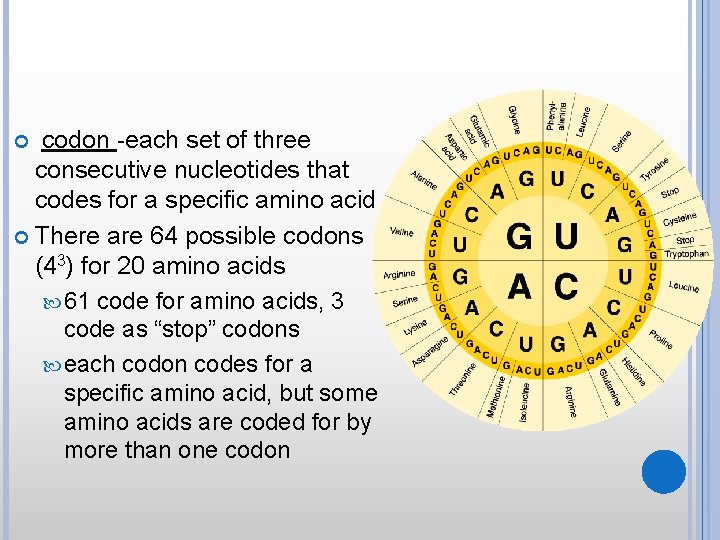
codon -each set of three consecutive nucleotides that codes for a specific amino acid There are 64 possible codons (43) for 20 amino acids 61 code for amino acids, 3 code as “stop” codons each codon codes for a specific amino acid, but some amino acids are coded for by more than one codon
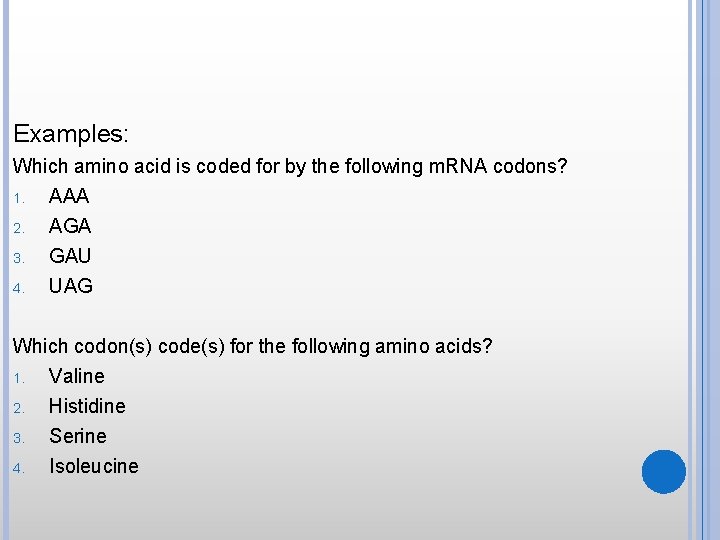
Examples: Which amino acid is coded for by the following m. RNA codons? 1. 2. 3. 4. AAA AGA GAU UAG Which codon(s) code(s) for the following amino acids? 1. Valine 2. Histidine 3. Serine 4. Isoleucine
TRANSLATION: PROTEIN SYNTHESIS
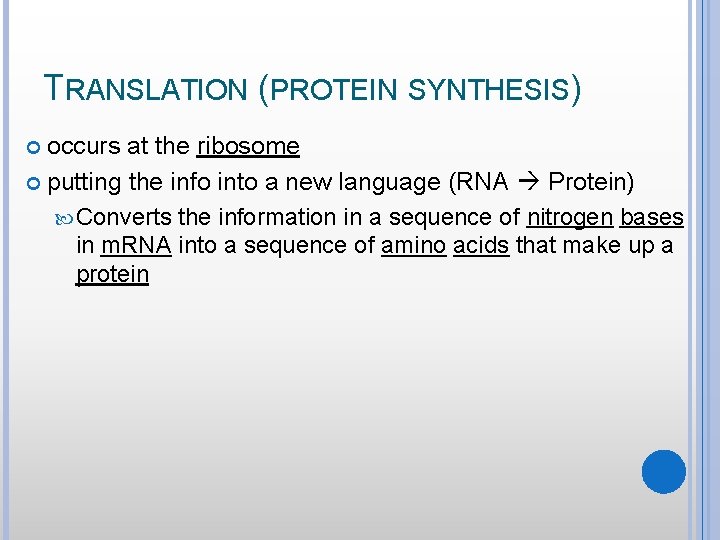
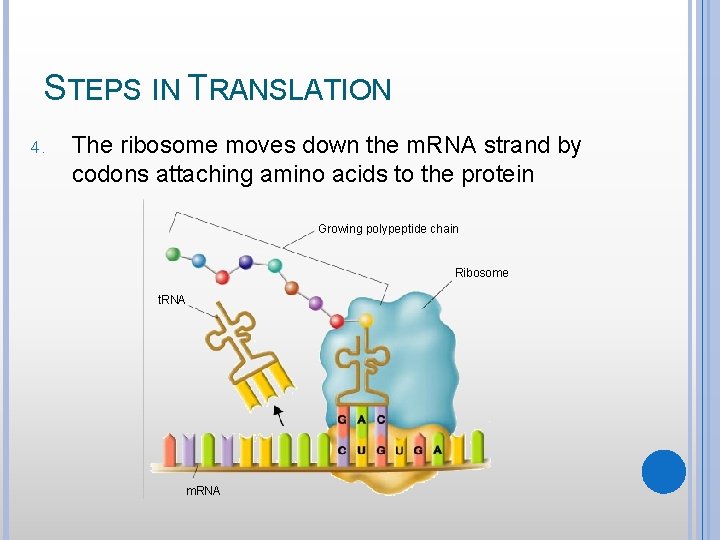
TRANSLATION (PROTEIN SYNTHESIS) occurs at the ribosome putting the info into a new language (RNA Protein) Converts the information in a sequence of nitrogen bases in m. RNA into a sequence of amino acids that make up a protein
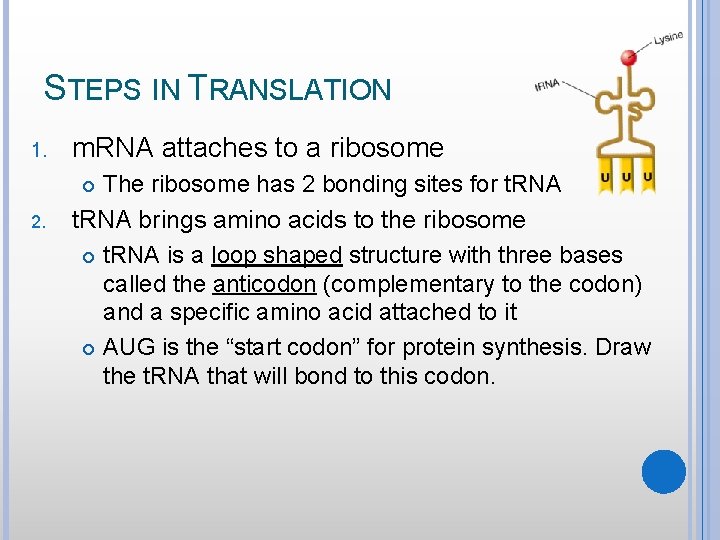
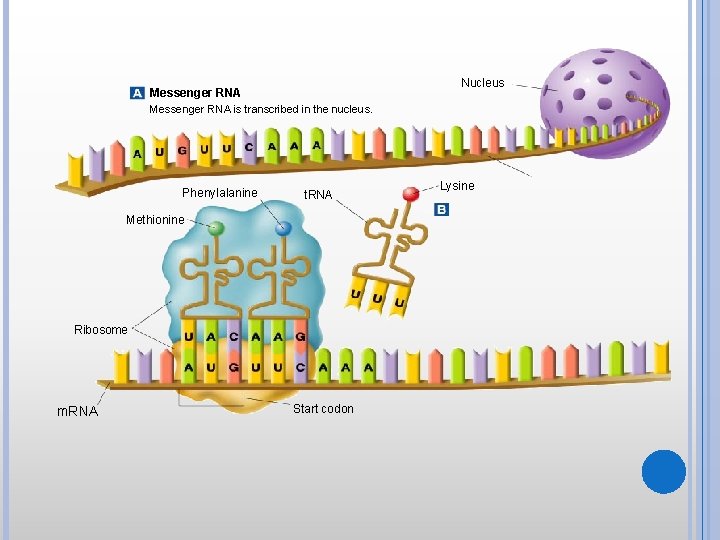
STEPS IN TRANSLATION 1. m. RNA attaches to a ribosome The ribosome has 2 bonding sites for t. RNA brings amino acids to the ribosome t. RNA is a loop shaped structure with three bases called the anticodon (complementary to the codon) and a specific amino acid attached to it AUG is the “start codon” for protein synthesis. Draw the t. RNA that will bond to this codon. 2.
Nucleus Messenger RNA is transcribed in the nucleus. Phenylalanine t. RNA Methionine Ribosome m. RNA Start codon Lysine
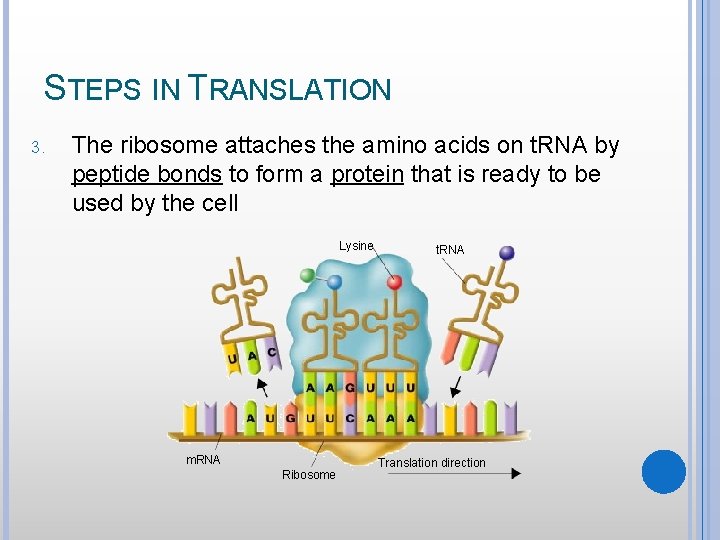
STEPS IN TRANSLATION 3. The ribosome attaches the amino acids on t. RNA by peptide bonds to form a protein that is ready to be used by the cell Lysine m. RNA Ribosome t. RNA Translation direction
STEPS IN TRANSLATION 4. The ribosome moves down the m. RNA strand by codons attaching amino acids to the protein Growing polypeptide chain Ribosome t. RNA m. RNA
GENE MUTATIONS
GENE MUTATIONS any mistake in DNA is a mutation source of evolution, genetic disorders, cancer, etc. can be random, can be caused by environmental factors x-rays, chemicals, radioactive substances, UV light Two types of gene mutations: 1. point mutation-change in a single base pair in DNA sequence (also called a substitution) some do not impact protein function, others are disastrous
ex of point mutation THE CAT ATE THE RAT Replace this letter with a C. What happens? THE CAT CTE THE RAT What if the 6 th DNA nucleotide was changed instead of the 5 th?
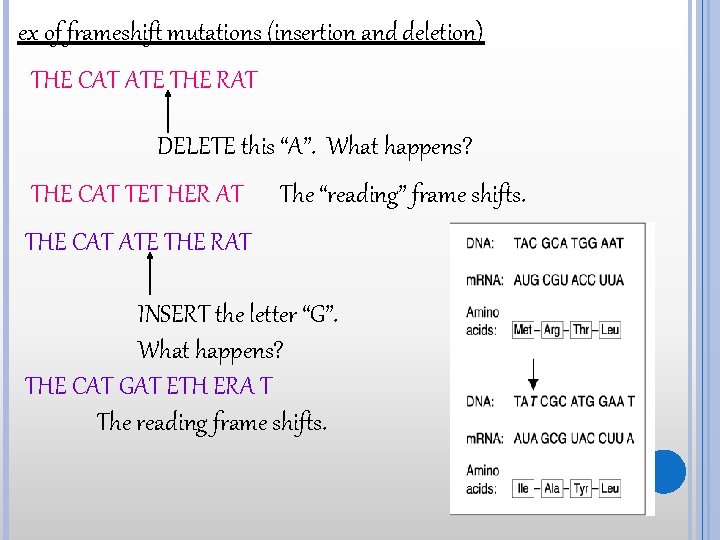
GENE MUTATIONS (CONT) frameshift mutation-results from the addition (insertion) or deletion of a single base pair. Proteins resulting from these mutations are rarely functional and usually disastrous
ex of frameshift mutations (insertion and deletion) THE CAT ATE THE RAT DELETE this “A”. What happens? THE CAT TET HER AT The “reading” frame shifts. THE CAT ATE THE RAT INSERT the letter “G”. What happens? THE CAT GAT ETH ERA T The reading frame shifts.