
DNA Replication Why is DNA Replication important The
- Slides: 10
DNA Replication Why is DNA Replication important? The important idea is that an exact duplication of the DNA message is required, so that each new cell in the body has the same set of genetic instructions as the cells that preceded it. This also insures that every new generation of individuals has the same genetic information as his/her parents.
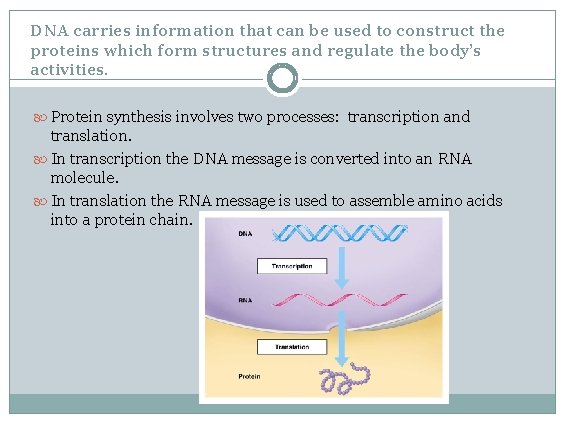
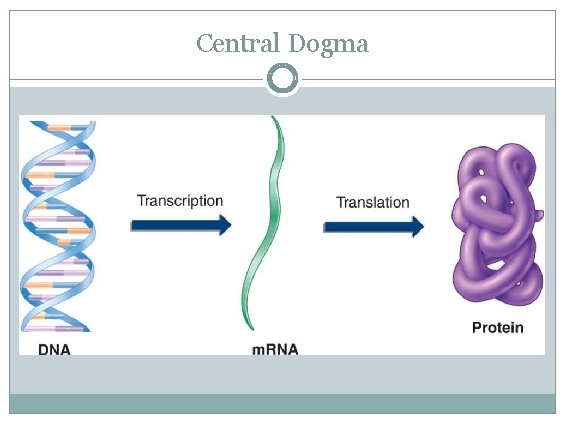
DNA carries information that can be used to construct the proteins which form structures and regulate the body’s activities. Protein synthesis involves two processes: transcription and translation. In transcription the DNA message is converted into an RNA molecule. In translation the RNA message is used to assemble amino acids into a protein chain.
Central Dogma
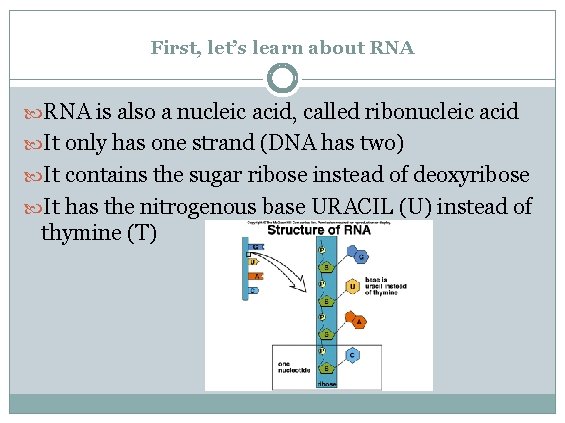
First, let’s learn about RNA is also a nucleic acid, called ribonucleic acid It only has one strand (DNA has two) It contains the sugar ribose instead of deoxyribose It has the nitrogenous base URACIL (U) instead of thymine (T)
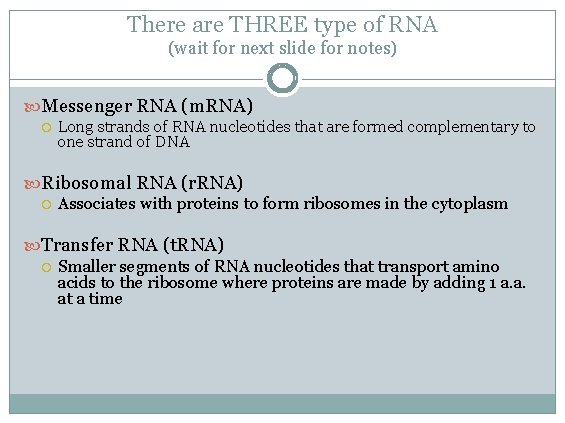
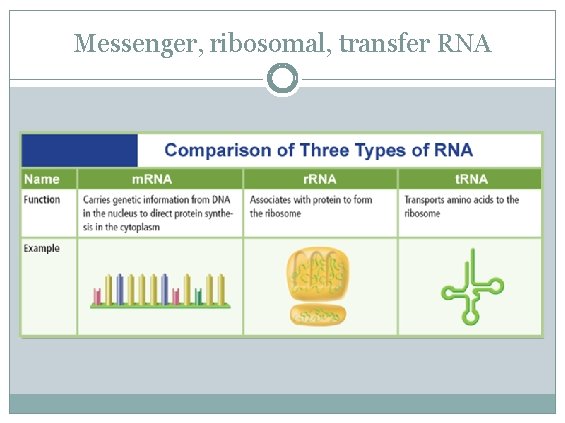
There are THREE type of RNA (wait for next slide for notes) Messenger RNA (m. RNA) Long strands of RNA nucleotides that are formed complementary to one strand of DNA Ribosomal RNA (r. RNA) Associates with proteins to form ribosomes in the cytoplasm Transfer RNA (t. RNA) Smaller segments of RNA nucleotides that transport amino acids to the ribosome where proteins are made by adding 1 a. a. at a time
Messenger, ribosomal, transfer RNA
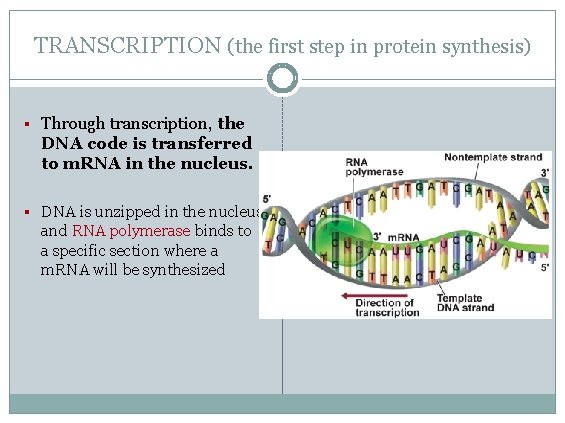
TRANSCRIPTION (the first step in protein synthesis) § Through transcription, the DNA code is transferred to m. RNA in the nucleus. § DNA is unzipped in the nucleus and RNA polymerase binds to a specific section where a m. RNA will be synthesized
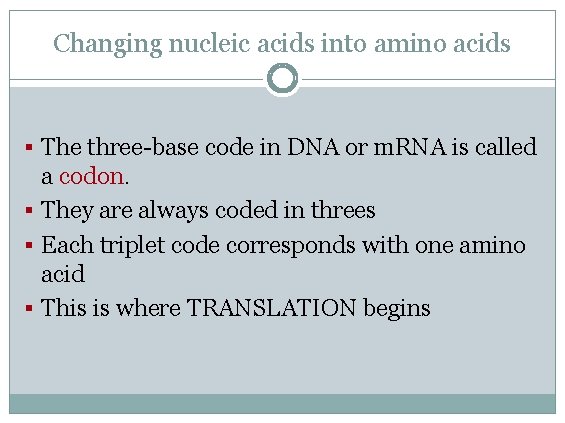
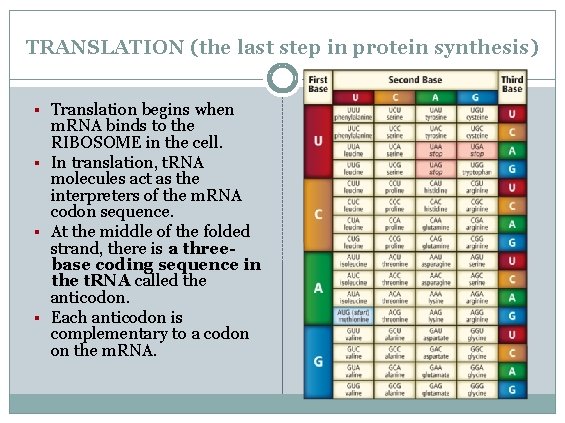
Changing nucleic acids into amino acids § The three-base code in DNA or m. RNA is called a codon. § They are always coded in threes § Each triplet code corresponds with one amino acid § This is where TRANSLATION begins
TRANSLATION (the last step in protein synthesis) § Translation begins when m. RNA binds to the RIBOSOME in the cell. § In translation, t. RNA molecules act as the interpreters of the m. RNA codon sequence. § At the middle of the folded strand, there is a threebase coding sequence in the t. RNA called the anticodon. § Each anticodon is complementary to a codon on the m. RNA.
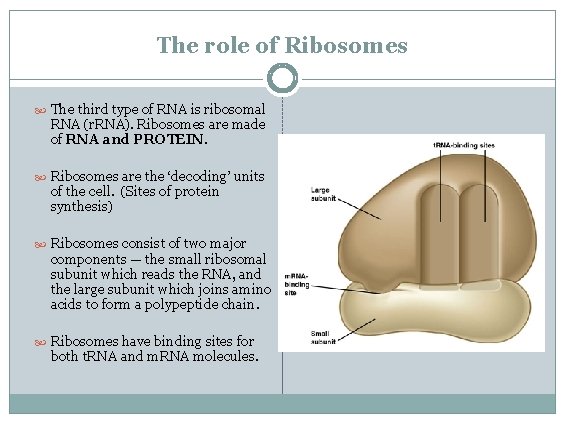
The role of Ribosomes The third type of RNA is ribosomal RNA (r. RNA). Ribosomes are made of RNA and PROTEIN. Ribosomes are the ‘decoding’ units of the cell. (Sites of protein synthesis) Ribosomes consist of two major components — the small ribosomal subunit which reads the RNA, and the large subunit which joins amino acids to form a polypeptide chain. Ribosomes have binding sites for both t. RNA and m. RNA molecules.