
DNA Replication Watson and Crick Base pairing in
DNA Replication
Watson and Crick • Base pairing in the double helix explains how DNA can be replicated – Each base on one strand pairs with one –and only one- base on the opposite strand – Each strand of the double helix has all the information needed to reconstruct the other half by mechanism of base pairing – Each strand can be used to make the other strand…complimentary
The Replication Process • Before a cell divides, it duplicates its DNA in a process called replication…each resulting cell has the same complete set of DNA molecules • DNA molecule splits into two strands and then produces two new complimentary strands following the rules of base pairing • Each strand of the double helix of DNA serves as a template for the new strand
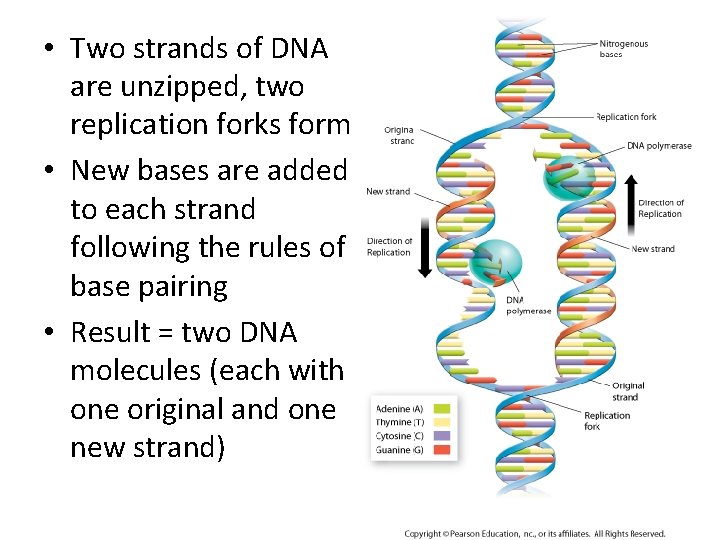
• Two strands of DNA are unzipped, two replication forks form • New bases are added to each strand following the rules of base pairing • Result = two DNA molecules (each with one original and one new strand)

The Role of Enzymes • DNA replication is carried out by a series of enzymes • Enzymes are proteins with highly specific functions- often named for the reactions they catalyze
• Enzymes (Helicase) “unzip” a molecule of DNA by breaking the hydrogen bonds between base pairs and unwinding the two strands • Each strand serves as a template for the attachment of complimentary bases • DNA Polymerase- enzyme that joins individual nucleotides to produce a new strand of DNA – Produces sugar-phosphate bonds that join nucleotides together – Proofreads each new DNA strand
Telomeres • DNA at the tips of chromosomes • Difficult to replicate • Telomerase – enzyme – adds short, repeating DNA sequences to telomeres • Helps prevent genes from being damaged or lost during replication • Sci. Show: Elizabeth Blackburn Great Minds

Replication in Living Cells • Replication occurs during the S phase of the cell cycle • Carefully regulated • Prokaryotes vs Eukaryotes
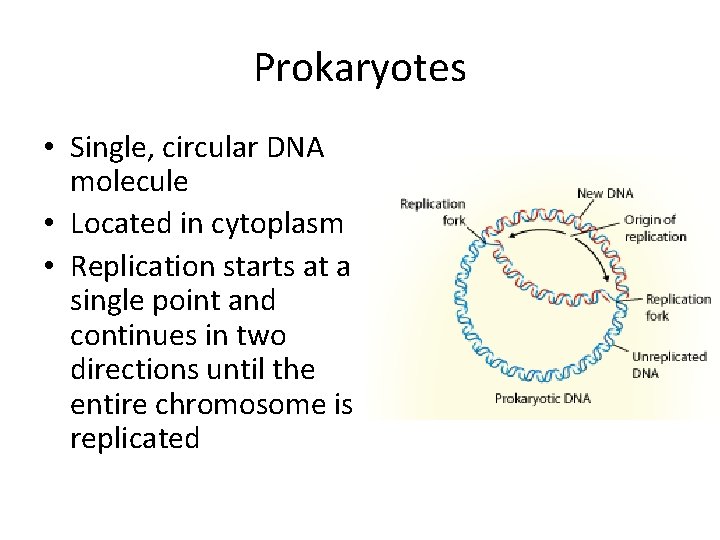
Prokaryotes • Single, circular DNA molecule • Located in cytoplasm • Replication starts at a single point and continues in two directions until the entire chromosome is replicated
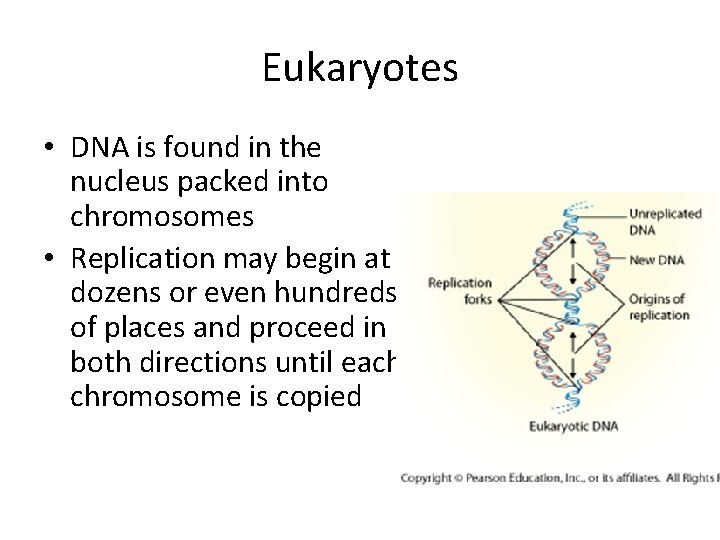
Eukaryotes • DNA is found in the nucleus packed into chromosomes • Replication may begin at dozens or even hundreds of places and proceed in both directions until each chromosome is copied
• TED-ed Twisting Tale of DNA
- Slides: 11