
DNA Replication Transcription Translation Lecture 7 Figure by
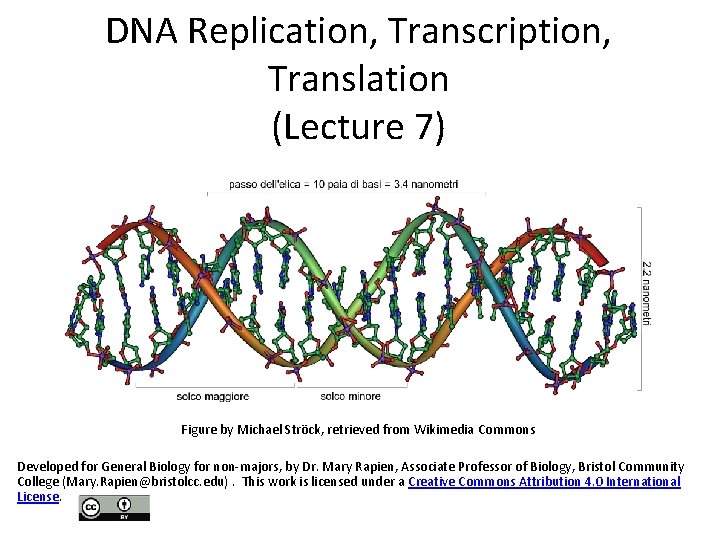
DNA Replication, Transcription, Translation (Lecture 7) Figure by Michael Ströck, retrieved from Wikimedia Commons Developed for General Biology for non-majors, by Dr. Mary Rapien, Associate Professor of Biology, Bristol Community College (Mary. Rapien@bristolcc. edu). This work is licensed under a Creative Commons Attribution 4. 0 International License.
DNA • DNA provides the genetic blueprint for all living organisms • At a basic level, DNA contains the instructions for building proteins. This is the essence of the “Central Dogma” in Biology.
DNA 2 • DNA is composed of two polynucleotide chains joined together by hydrogen bonding between bases, twisted into a helical shape – The sugar-phosphate backbone is on the outside – The nitrogenous bases are perpendicular to the backbone in the interior (the “rungs” of the ladder) – Specific pairs of bases give the helix a uniform shape – A pairs with T, forming two hydrogen bonds – G pairs with C, forming three hydrogen bonds
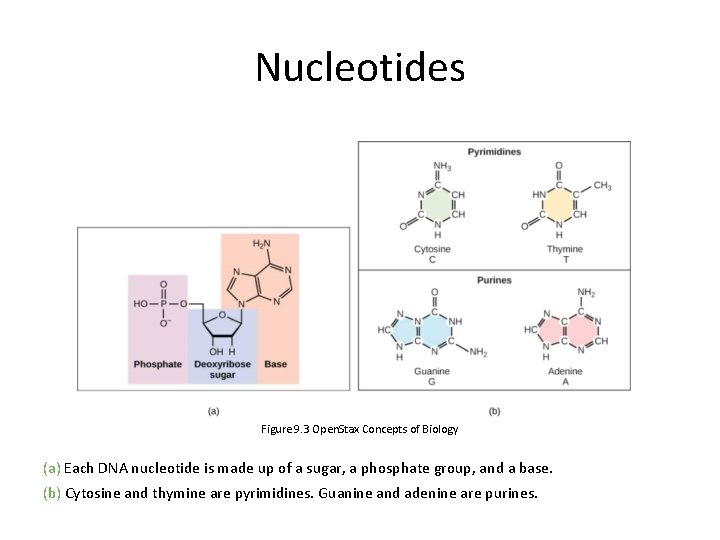
Nucleotides Figure 9. 3 Open. Stax Concepts of Biology (a) Each DNA nucleotide is made up of a sugar, a phosphate group, and a base. (b) Cytosine and thymine are pyrimidines. Guanine and adenine are purines.
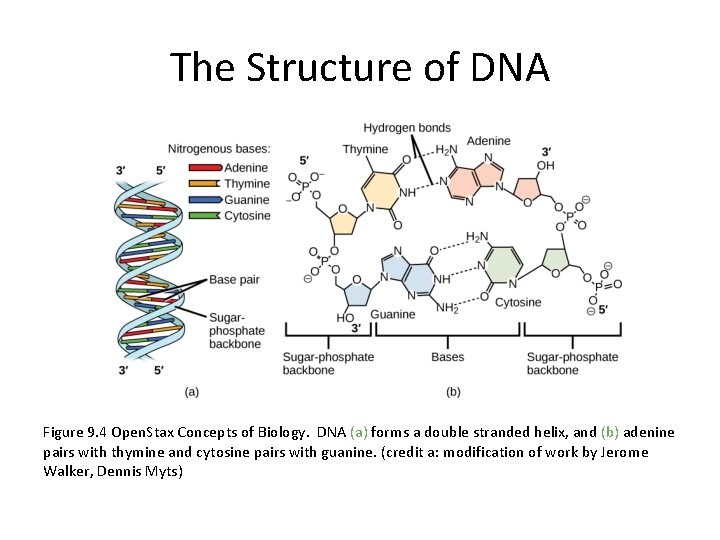
The Structure of DNA Figure 9. 4 Open. Stax Concepts of Biology. DNA (a) forms a double stranded helix, and (b) adenine pairs with thymine and cytosine pairs with guanine. (credit a: modification of work by Jerome Walker, Dennis Myts)
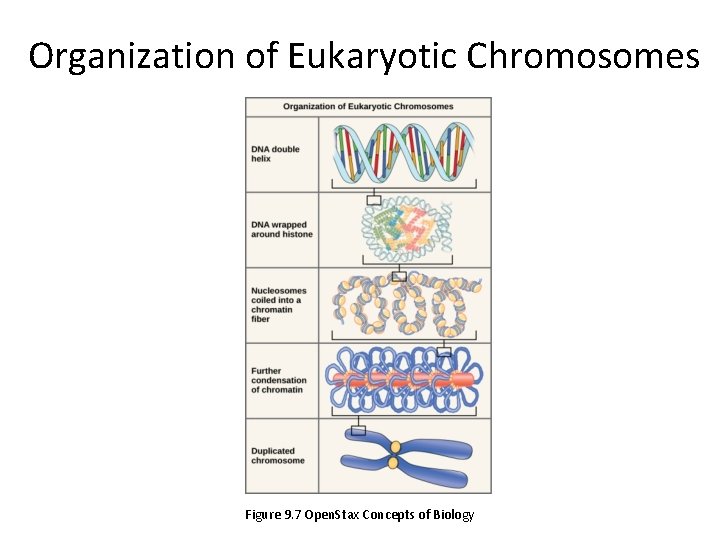
Organization of Eukaryotic Chromosomes Figure 9. 7 Open. Stax Concepts of Biology

DNA Replication The two strands of DNA are complementary, meaning the sequence of bases in one strand can be used to create the correct sequence of bases in the other strand. Figure 9. 2 Open. Stax Concepts of Biology
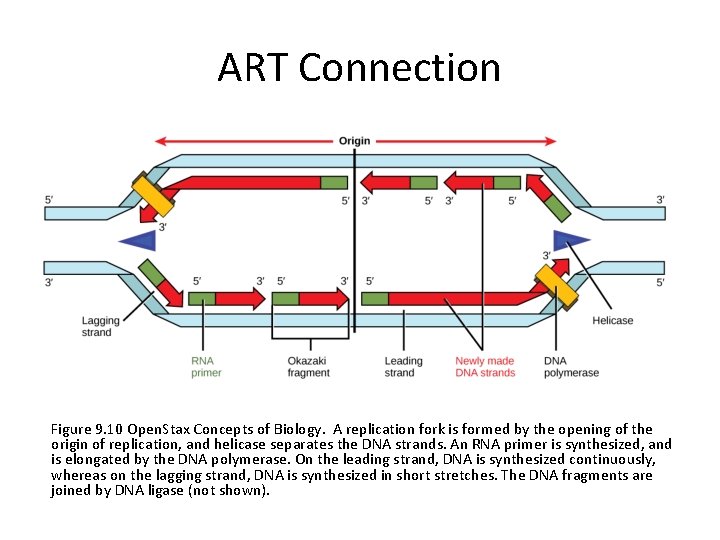
ART Connection Figure 9. 10 Open. Stax Concepts of Biology. A replication fork is formed by the opening of the origin of replication, and helicase separates the DNA strands. An RNA primer is synthesized, and is elongated by the DNA polymerase. On the leading strand, DNA is synthesized continuously, whereas on the lagging strand, DNA is synthesized in short stretches. The DNA fragments are joined by DNA ligase (not shown).
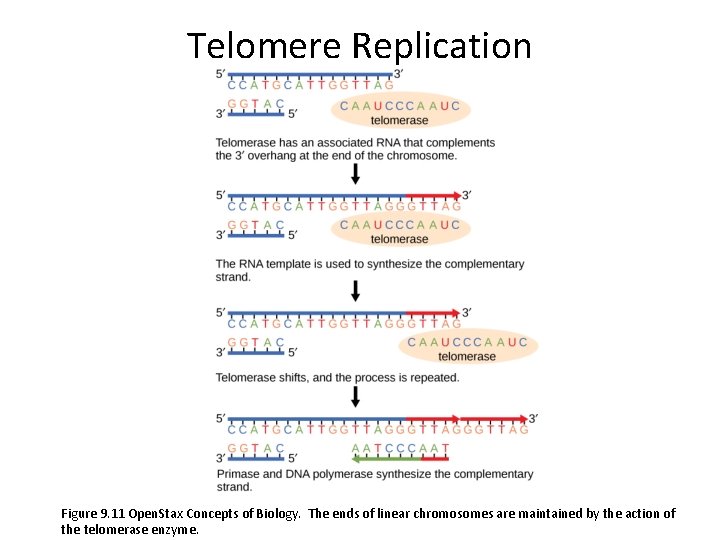
Telomere Replication Figure 9. 11 Open. Stax Concepts of Biology. The ends of linear chromosomes are maintained by the action of the telomerase enzyme.
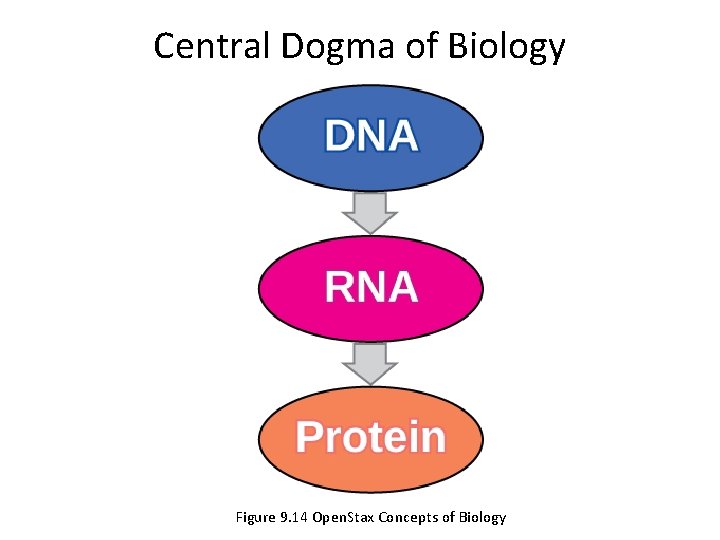
Central Dogma of Biology Figure 9. 14 Open. Stax Concepts of Biology
The Central Dogma involves two main processes: Transcription: Instructions in the gene are copied to m. RNA Translation: Instructions in m. RNA are used by ribosomes to insert the correct amino acids in the correct sequence to form the protein coded for by that gene
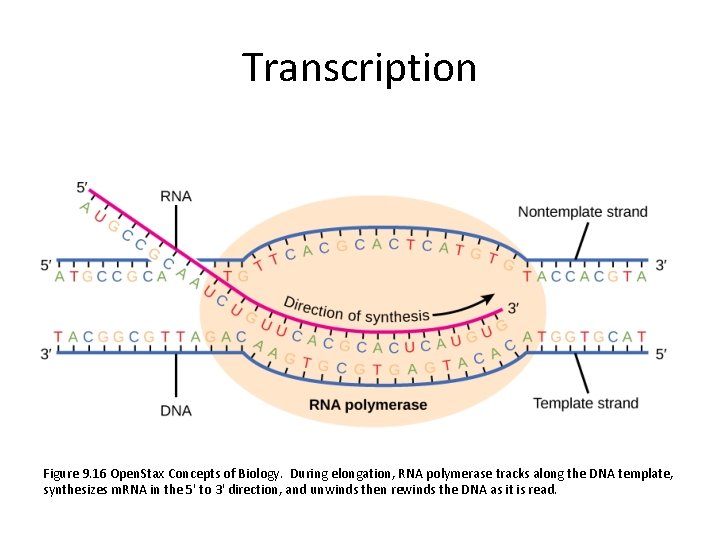
Transcription Figure 9. 16 Open. Stax Concepts of Biology. During elongation, RNA polymerase tracks along the DNA template, synthesizes m. RNA in the 5' to 3' direction, and unwinds then rewinds the DNA as it is read.
Genetic Code • Characteristics of the genetic code – Triplet: Three nucleotides specify one amino acid – 61 codons correspond to amino acids – AUG codes for methionine and signals the start of transcription – 3 “stop” codons signal the end of translation
Genetic Code (cont. ) – Redundant: More than one codon for some amino acids – Unambiguous: Each codon codes for only one amino acid and does not code for any other amino acid – Does not contain spacers or punctuation: Codons are adjacent to each other with no gaps in between – Nearly universal
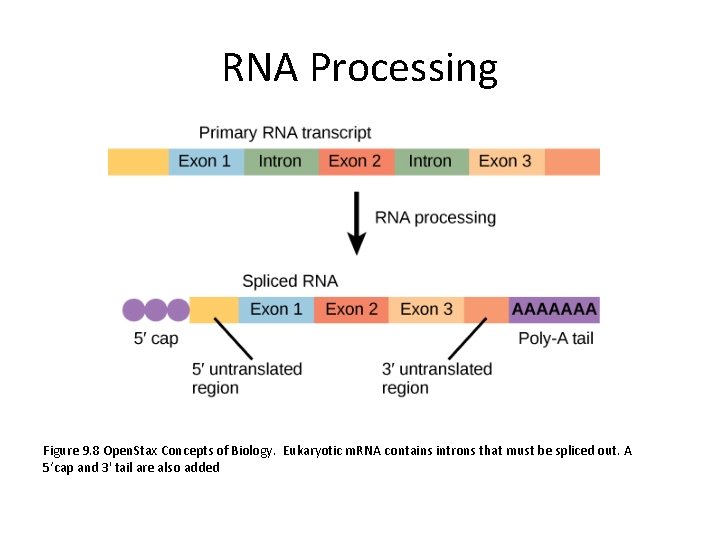
RNA Processing Figure 9. 8 Open. Stax Concepts of Biology. Eukaryotic m. RNA contains introns that must be spliced out. A 5‘cap and 3' tail are also added
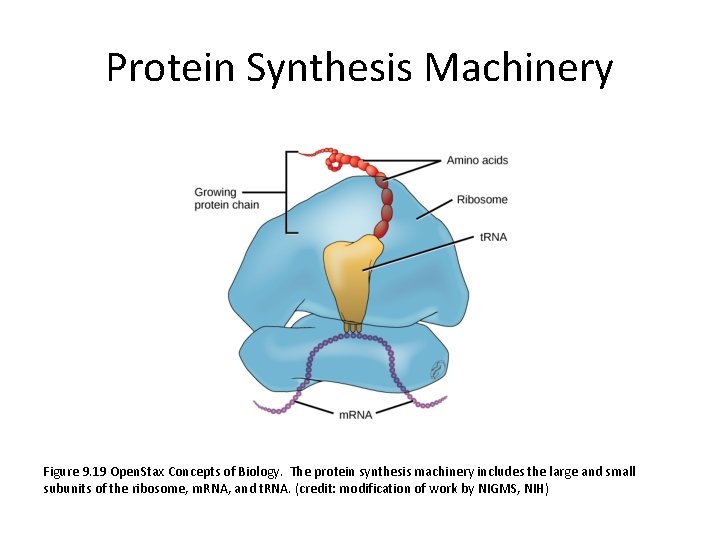
Protein Synthesis Machinery Figure 9. 19 Open. Stax Concepts of Biology. The protein synthesis machinery includes the large and small subunits of the ribosome, m. RNA, and t. RNA. (credit: modification of work by NIGMS, NIH)
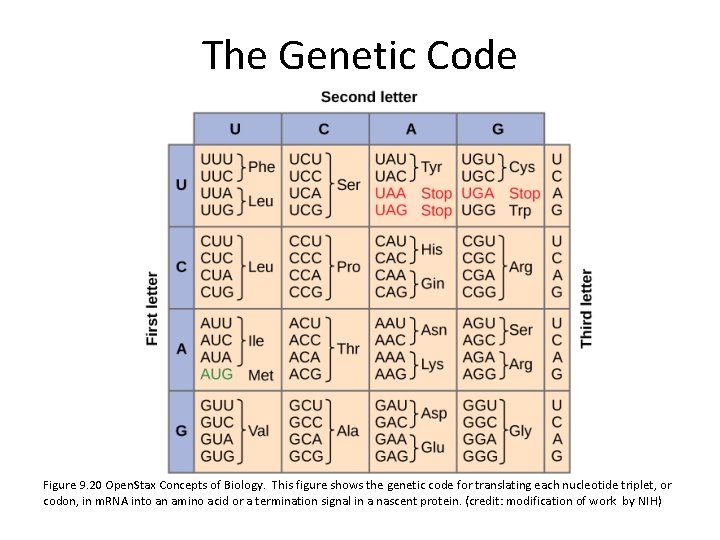
The Genetic Code Figure 9. 20 Open. Stax Concepts of Biology. This figure shows the genetic code for translating each nucleotide triplet, or codon, in m. RNA into an amino acid or a termination signal in a nascent protein. (credit: modification of work by NIH)
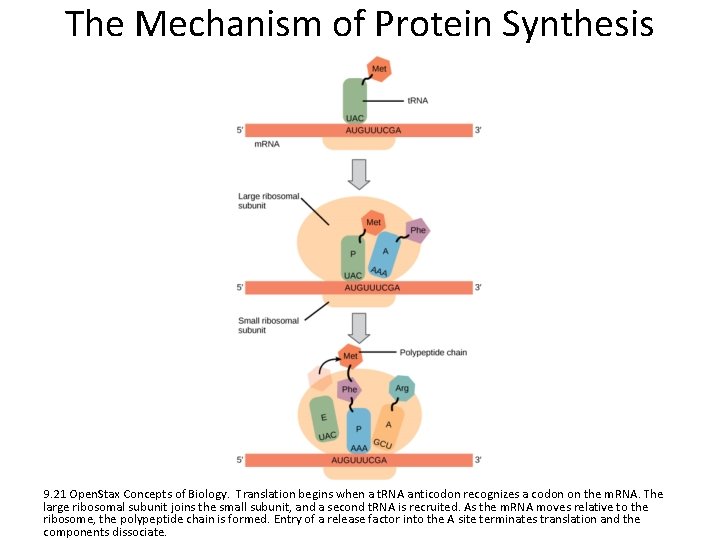
The Mechanism of Protein Synthesis 9. 21 Open. Stax Concepts of Biology. Translation begins when a t. RNA anticodon recognizes a codon on the m. RNA. The large ribosomal subunit joins the small subunit, and a second t. RNA is recruited. As the m. RNA moves relative to the ribosome, the polypeptide chain is formed. Entry of a release factor into the A site terminates translation and the components dissociate.
Mutations • A mutation is a change in the nucleotide sequence of DNA – Base substitutions: replacement of one nucleotide with another – Effect depends on whethere is an amino acid change that alters the shape, and therefore function, of the protein – Deletions or insertions – Alter the reading frame of the m. RNA, so that nucleotides are grouped into different codons – Lead to significant changes in amino acid sequence downstream of mutation – Cause a nonfunctional polypeptide to be produced
Mutations (cont. ) • Mutations can be – Spontaneous: due to errors in DNA replication or recombination – Induced by mutagens – High-energy radiation – Chemicals
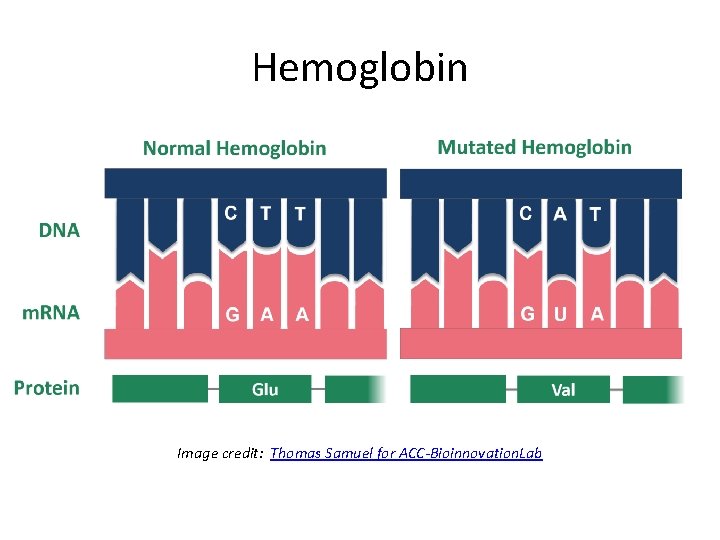
Hemoglobin Image credit: Thomas Samuel for ACC-Bioinnovation. Lab
Funding This workforce product was funded by a TAACCCT grant awarded by the U. S. Department of Labor’s Employment and Training Administration. The product was created by the grantee and does not necessarily reflect the official position of the U. S. Department of Labor. The U. S. Department of Labor makes no guarantees, warranties, or assurances of any kind, express or implied, with respect to such information, including any information on linked sites and including, but not limited to, accuracy of the information or its completeness, timeliness, usefulness, adequacy, continued availability, or ownership.
- Slides: 22