
DNA Replication Pt 2 Repair SBI 4 U
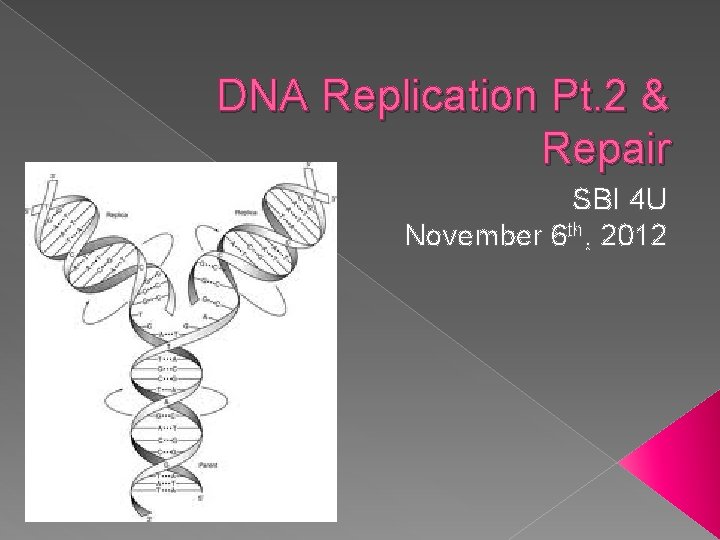
DNA Replication Pt. 2 & Repair SBI 4 U November 6 th, 2012
Please respond to the following: What experiment proved the semiconservative replication nature of DNA? 2. What are the 3 steps of the DNA replication process? 3. What proteins help to prevent the re-joining of base pairs? 4. What is the replication bubble? 1.
Step 2: Building Complementary Strands � RNA primase brings the replication process by building a small complementary RNA segment on the strand at the beginning of the replication fork � These short ribonucleotide pieces of RNA are called RNA primers
Recall… Nucleoside triphosphate a building block and energy source for replicating DNA � DNA polymerase builds the new strand of DNA using nucleoside triphosphates �
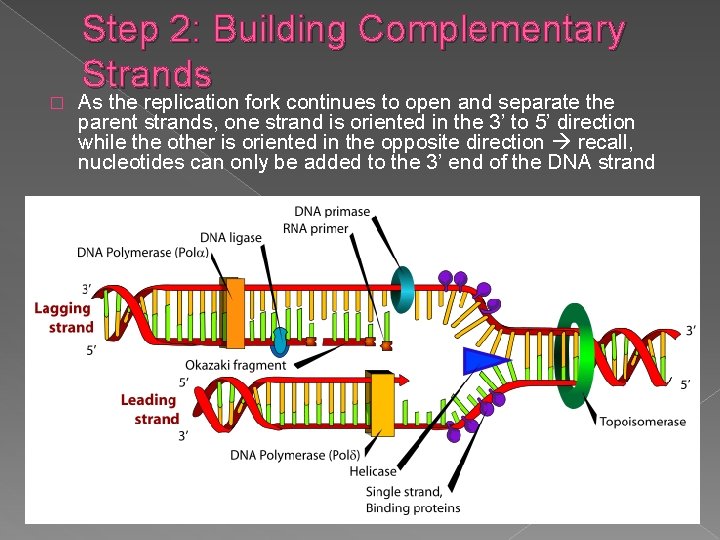
� Step 2: Building Complementary Strands As the replication fork continues to open and separate the parent strands, one strand is oriented in the 3’ to 5’ direction while the other is oriented in the opposite direction recall, nucleotides can only be added to the 3’ end of the DNA strand

Step 2: Building Complementary Strands � RNA primase makes RNA primers � DNA polymerase III adds DNA nucleotides to the RNA primer � Since DNA polymerase III only builds the new strand in the 5’ to 3’ direction DNA polymerase III that is building a strand toward the fork is able to keep moving forward continuously leading strand

Step 2: Building Complementary Strands Opposite strand DNA polymerase III moving away from replication fork lagging strand � RNA primase attaches another primer to the parent strand another DNA polymerase III begins these short DNA fragments are called okazaki fragments �

Step 2: Building Complementary Strands Completion of lagging strand: DNA polymerase I removes the RNA nucleotides and replaces with DNA nucleotides � DNA Ligase: catalyzes the formation of a phosphodiester bond between 2 DNA strands as well as between the Okazaki fragments �
Step: 3 – Dealing with Errors � DNA polymerase also proofread and correct errors � Usually base pair mis-matches � DNA repair complexes read strands for errors missed by DNA polymerase III
- Slides: 9