
DNA Replication Overview Mechanism in Bacteria Copyright 2002
DNA Replication Overview Mechanism in Bacteria Copyright, ©, 2002, John Wiley & Sons, Inc. , Karp/CELL & MOLECULAR BIOLOGY 3 E
Semiconservative Replication • First: RNA molecules that could self-replicate • Later: DNA – DNA Replication more complex – Required a large number of auxiliary components – DNA is template, but not enzyme • Watson & Crick (1953) - proposed DNA structure – Replication by strand separation – Both strands have same information Copyright, ©, 2002, John Wiley & Sons, Inc. , Karp/CELL & MOLECULAR BIOLOGY 3 E
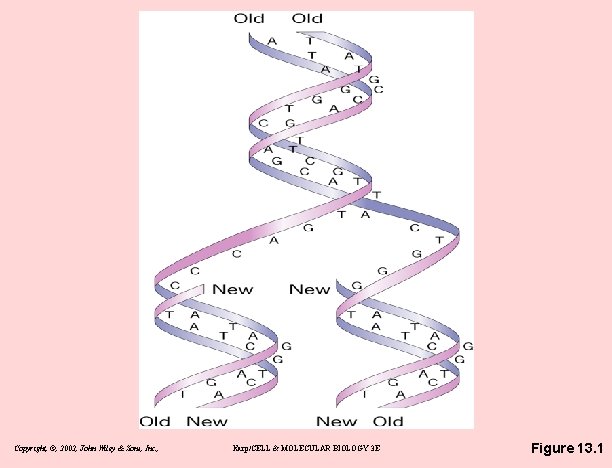
Copyright, ©, 2002, John Wiley & Sons, Inc. , Karp/CELL & MOLECULAR BIOLOGY 3 E Figure 13. 1
Semiconservative Replication • Watson & Crick predicted • Other Possibilities – Conservative - 2 original strands stay together – Dispersive - parental strand integrity disrupted Copyright, ©, 2002, John Wiley & Sons, Inc. , Karp/CELL & MOLECULAR BIOLOGY 3 E
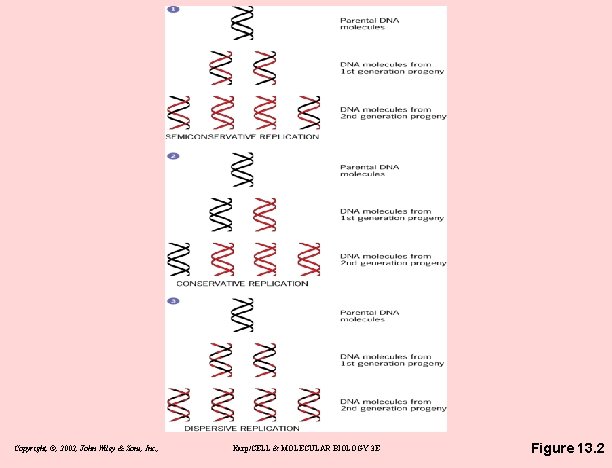
Copyright, ©, 2002, John Wiley & Sons, Inc. , Karp/CELL & MOLECULAR BIOLOGY 3 E Figure 13. 2
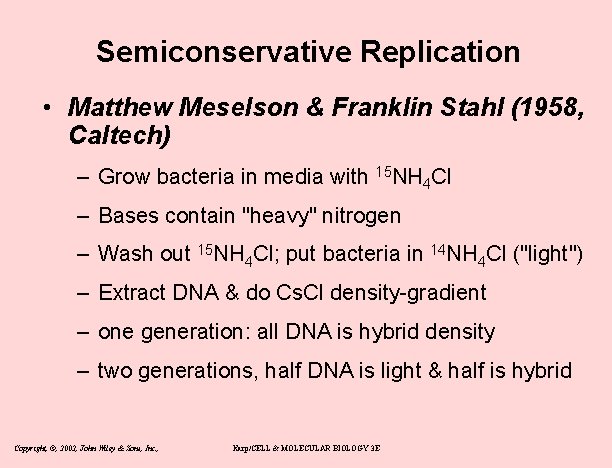
Semiconservative Replication • Matthew Meselson & Franklin Stahl (1958, Caltech) – Grow bacteria in media with 15 NH 4 Cl – Bases contain "heavy" nitrogen – Wash out 15 NH 4 Cl; put bacteria in 14 NH 4 Cl ("light") – Extract DNA & do Cs. Cl density-gradient – one generation: all DNA is hybrid density – two generations, half DNA is light & half is hybrid Copyright, ©, 2002, John Wiley & Sons, Inc. , Karp/CELL & MOLECULAR BIOLOGY 3 E
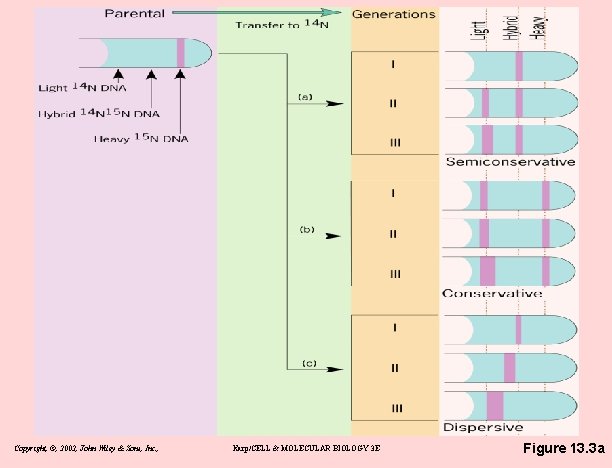
Copyright, ©, 2002, John Wiley & Sons, Inc. , Karp/CELL & MOLECULAR BIOLOGY 3 E Figure 13. 3 a
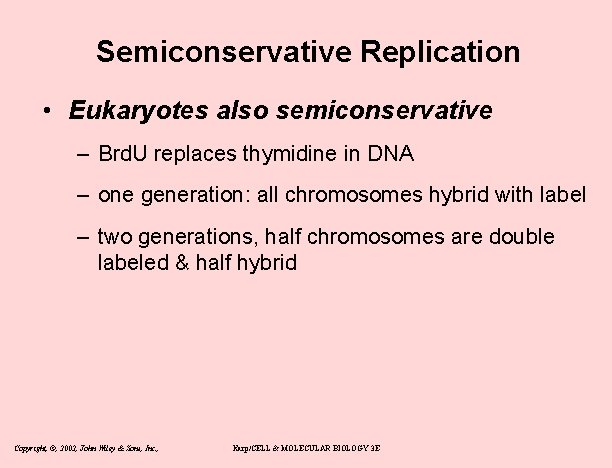
Semiconservative Replication • Eukaryotes also semiconservative – Brd. U replaces thymidine in DNA – one generation: all chromosomes hybrid with label – two generations, half chromosomes are double labeled & half hybrid Copyright, ©, 2002, John Wiley & Sons, Inc. , Karp/CELL & MOLECULAR BIOLOGY 3 E
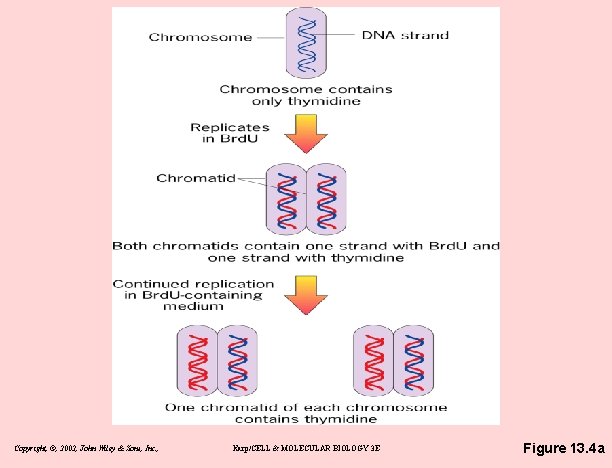
Copyright, ©, 2002, John Wiley & Sons, Inc. , Karp/CELL & MOLECULAR BIOLOGY 3 E Figure 13. 4 a
Genetic & Biochemical Dissection • Availability of mutants – how can such cells be cultured? – ts mutants • in vitro replication systems – Replicate DNA with extracts – Remove specific proteins (antibodies) or – Add purified proteins whose activity is to be tested • at least 30 proteins needed for E. coli replication Copyright, ©, 2002, John Wiley & Sons, Inc. , Karp/CELL & MOLECULAR BIOLOGY 3 E
Bidirectional Replication • Replication origins – ori. C ; ~245 bp sequence on bacterial chromosome – Proteins (a number) bind at ori. C to initiate replication – Replication is bidirectional • Replication forks – Parental helix is undergoing strand separation – Complementary strand synthesis – Forks meet across from origin, where replication is terminated Copyright, ©, 2002, John Wiley & Sons, Inc. , Karp/CELL & MOLECULAR BIOLOGY 3 E
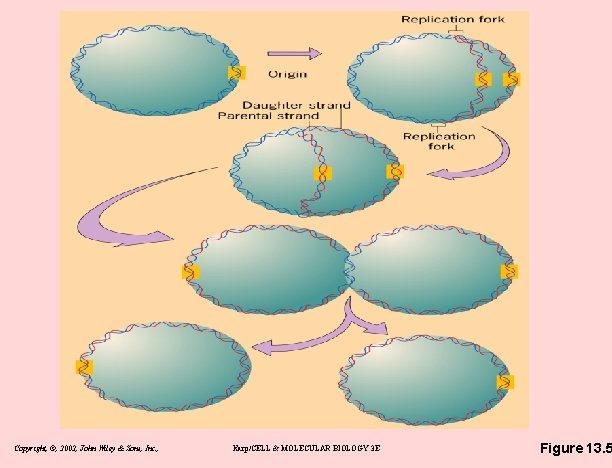
Copyright, ©, 2002, John Wiley & Sons, Inc. , Karp/CELL & MOLECULAR BIOLOGY 3 E Figure 13. 5
The Topology of Unwinding • Analogy: two-stranded helical rope – Circular & linear DNAs not free to rotate – Tension not relieved – DNA can become tightly overwound – Positive Supercoiling (ahead of fork) – E. coli : ~400, 000 turns replicated by 2 forks in ~40 min Copyright, ©, 2002, John Wiley & Sons, Inc. , Karp/CELL & MOLECULAR BIOLOGY 3 E
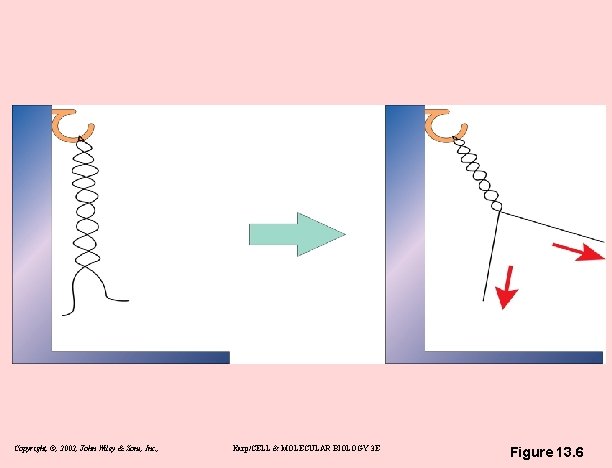
Copyright, ©, 2002, John Wiley & Sons, Inc. , Karp/CELL & MOLECULAR BIOLOGY 3 E Figure 13. 6
The Topology of Unwinding • Topoisomerases relieves mechanical strain – DNA gyrase can relieve stress – Generates Negative Supercoils – Mechanism • Cleaves both duplex strands • Passes DNA through double-stranded break • Seals cuts; driven by ATP hydrolysis – Similar enzymes are found in eukaryotes Copyright, ©, 2002, John Wiley & Sons, Inc. , Karp/CELL & MOLECULAR BIOLOGY 3 E
DNA Polymerase Properties • DNA polymerase I (E. coli) – incorporates labeled DNA precursors into polymer – Requires template, d. TTP, d. ATP, d. CTP, d. GTP) – New DNA had same composition as original Copyright, ©, 2002, John Wiley & Sons, Inc. , Karp/CELL & MOLECULAR BIOLOGY 3 E
DNA Polymerase Properties • DNA polymerase reaction similar to RNA polymerase, but. . . – DNA not RNA, requires primer – Single-stranded DNA alone does not work – All DNA polymerases require primer & template – Polymerizes DNA in 5' to 3' (5'—>3') direction – How is synthesis initiated in cell without DNA primer? Copyright, ©, 2002, John Wiley & Sons, Inc. , Karp/CELL & MOLECULAR BIOLOGY 3 E
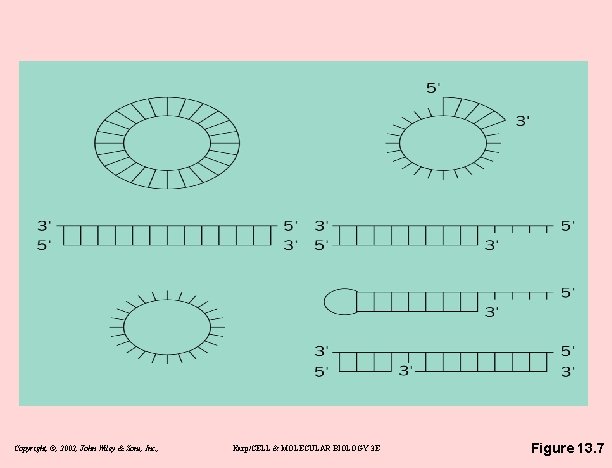
Copyright, ©, 2002, John Wiley & Sons, Inc. , Karp/CELL & MOLECULAR BIOLOGY 3 E Figure 13. 7
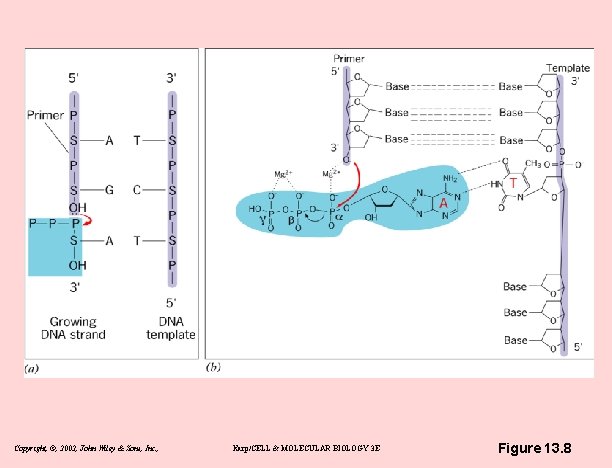
Copyright, ©, 2002, John Wiley & Sons, Inc. , Karp/CELL & MOLECULAR BIOLOGY 3 E Figure 13. 8
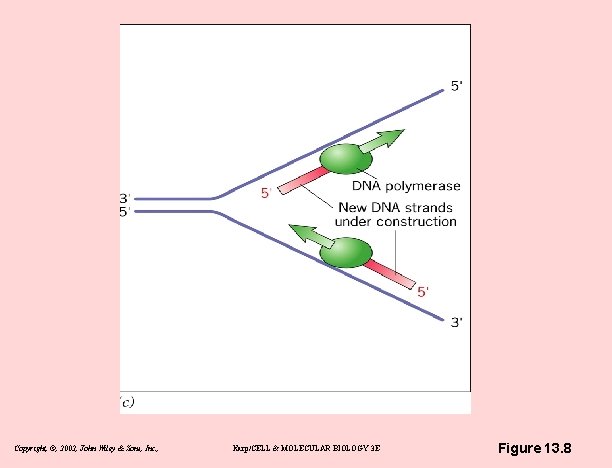
Copyright, ©, 2002, John Wiley & Sons, Inc. , Karp/CELL & MOLECULAR BIOLOGY 3 E Figure 13. 8
DNA Polymerase Properties • DNA polymerases (II & III) were discovered with mutants of Pol I – Pol I mutant had <1% of normal pol activity – but multiplied at normal rate! – Typical bacterium • ~300 - 400 copies of DNA Polymerase I • ~40 copies of DNA Pol II • 10 copies of DNA Pol III Copyright, ©, 2002, John Wiley & Sons, Inc. , Karp/CELL & MOLECULAR BIOLOGY 3 E
Semi-discontinuous Replication • both strands at fork synthesized 5’ to 3’ – Leading strand (toward fork) made continuously – Lagging strand (away from fork) made in fragments – Okazaki fragments must wait for parental strands to separate – Later, these fragments are linked together – Both strands probably made simultaneously Copyright, ©, 2002, John Wiley & Sons, Inc. , Karp/CELL & MOLECULAR BIOLOGY 3 E
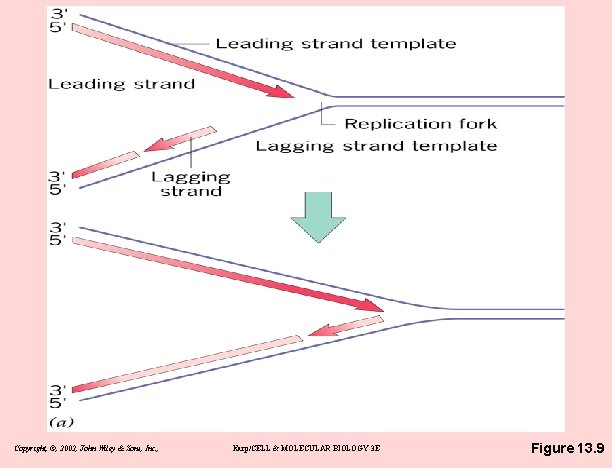
Copyright, ©, 2002, John Wiley & Sons, Inc. , Karp/CELL & MOLECULAR BIOLOGY 3 E Figure 13. 9
Semi-discontinuous Replication • Reiji Okazaki (Nagoya Univ. ; Japan) – brief pulses of 3 H-thymidine – Label in DNA fragments (~1000 - 2000 nucleotides long) – pulse then chase: label in much larger DNA – Joined by DNA ligase Copyright, ©, 2002, John Wiley & Sons, Inc. , Karp/CELL & MOLECULAR BIOLOGY 3 E
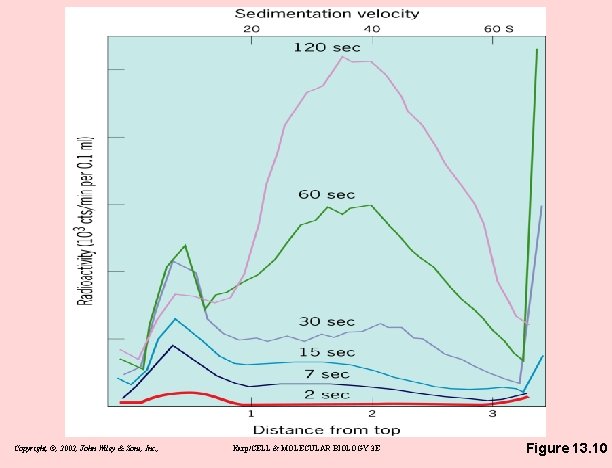
Copyright, ©, 2002, John Wiley & Sons, Inc. , Karp/CELL & MOLECULAR BIOLOGY 3 E Figure 13. 10
Semi-discontinuous Replication • But DNA polymerase requires primer – Enzyme makes short RNA primer for initiation – Leading strand initiated at origin by an RNA polymerase – Okazaki fragments also initiated by primase – Short RNA primers eventually removed – gap is filled with DNA & sealed by DNA ligase Copyright, ©, 2002, John Wiley & Sons, Inc. , Karp/CELL & MOLECULAR BIOLOGY 3 E
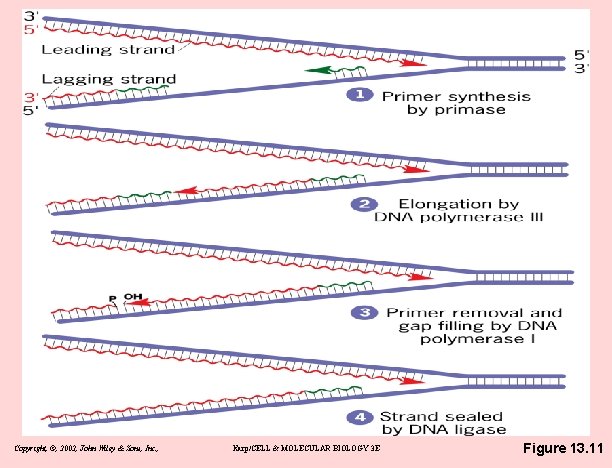
Copyright, ©, 2002, John Wiley & Sons, Inc. , Karp/CELL & MOLECULAR BIOLOGY 3 E Figure 13. 11
Solving the Topological Problem • DNA gyrase – Negatively supercoils DNA – Genome and Plasmids maintained in Negatively Supercoiled state – DNA already “primed” to unwind & separate Copyright, ©, 2002, John Wiley & Sons, Inc. , Karp/CELL & MOLECULAR BIOLOGY 3 E
Solving the Topological Problem • Helicase (E. coli has at least 12) – Dna. B helicase, unwinding machine during replication – Fired by ATP hydrolysis – Break H bonds holding 2 strands together – 6 subunits arranged to form ring-shaped protein – Encircles a single DNA strand – First attaches to DNA at replication origin – Helped by Dna. C – moves along lagging-strand template unwinding helix Copyright, ©, 2002, John Wiley & Sons, Inc. , Karp/CELL & MOLECULAR BIOLOGY 3 E
Solving the Topological Problem • SSB proteins (single strand binding proteins) – SSBs bind selectively to single-stranded DNA – Keep it extended & prevent it from being rewound Copyright, ©, 2002, John Wiley & Sons, Inc. , Karp/CELL & MOLECULAR BIOLOGY 3 E
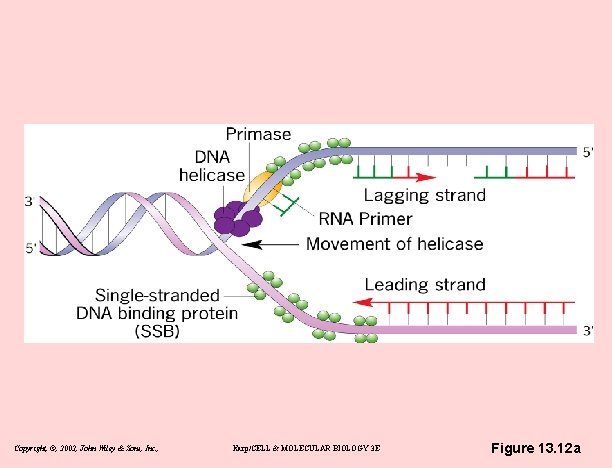
Copyright, ©, 2002, John Wiley & Sons, Inc. , Karp/CELL & MOLECULAR BIOLOGY 3 E Figure 13. 12 a
Primosome = primase + helicase • Helicase moves processively – primase periodically binds to helicase – initiates synthesis of short RNA primers – Primers extended as DNA by a DNA polymerase Copyright, ©, 2002, John Wiley & Sons, Inc. , Karp/CELL & MOLECULAR BIOLOGY 3 E
Primosome = primase + helicase • Does same DNA polymerase III synthesize Okazaki fragments? – Replicate DNA in vitro and suddenly dilute reaction – Reaction does not slow – Hitches a ride with DNA polymerase going other way – 2 polymerases are part of a single protein complex – DNA of the lagging strand loops back on itself – When Okazaki fragment finished, lagging-strand released – trombone model: looping DNA grows & shortens Copyright, ©, 2002, John Wiley & Sons, Inc. , Karp/CELL & MOLECULAR BIOLOGY 3 E
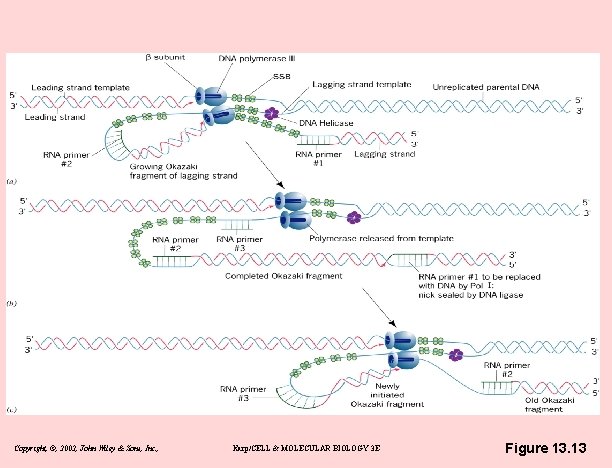
Copyright, ©, 2002, John Wiley & Sons, Inc. , Karp/CELL & MOLECULAR BIOLOGY 3 E Figure 13. 13
Roles of DNA Polymerases • DNA polymerase I – mostly for DNA repair to correct damaged DNA – single subunit – removes RNA primers at 5' Okazaki fragment end – replaces the RNA with DNA Copyright, ©, 2002, John Wiley & Sons, Inc. , Karp/CELL & MOLECULAR BIOLOGY 3 E
Roles of DNA Polymerases • DNA polymerase II – Role uncertain – mutants have no evident deficiency • DNA polymerase III (replicase) – acts in DNA replication in E. coli – part of large complex: DNA polymerase III holoenzyme Copyright, ©, 2002, John Wiley & Sons, Inc. , Karp/CELL & MOLECULAR BIOLOGY 3 E
DNA Polymerase III Structure • holoenzyme much larger than other two polymerases • 10 different subunits • b subunit “clamp” and multisubunit “clamp loader” • Clamp loader required to assemble b clamp Copyright, ©, 2002, John Wiley & Sons, Inc. , Karp/CELL & MOLECULAR BIOLOGY 3 E
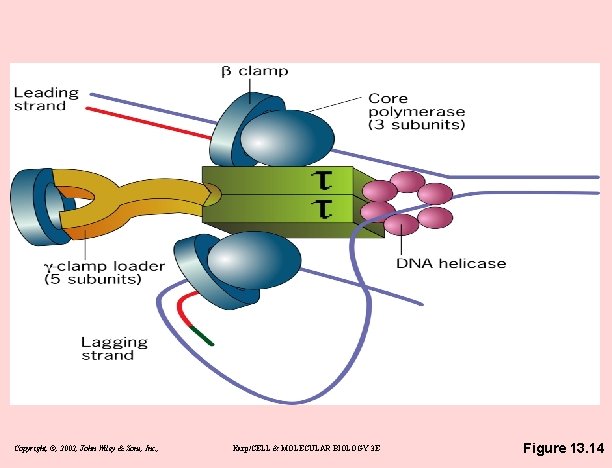
Copyright, ©, 2002, John Wiley & Sons, Inc. , Karp/CELL & MOLECULAR BIOLOGY 3 E Figure 13. 14
DNA Polymerase III Structure • b subunit – a noncatalytic subunit – keeps the polymerase associated with the DNA template – stong attachment required for processivity – loose attachment required to move along template – conflicting properties: balance – b subunits (2) form a doughnut-shaped complex around DNA – sliding clamp allows processive movement – Pol III cycled to new b clamp waiting at RNA primer Copyright, ©, 2002, John Wiley & Sons, Inc. , Karp/CELL & MOLECULAR BIOLOGY 3 E
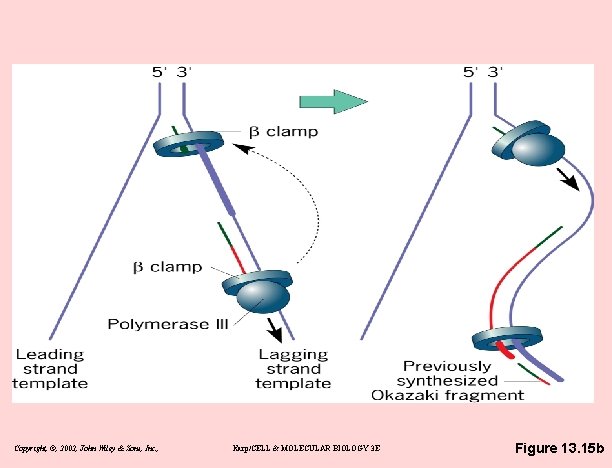
Copyright, ©, 2002, John Wiley & Sons, Inc. , Karp/CELL & MOLECULAR BIOLOGY 3 E Figure 13. 15 b
DNA Polymerases and Exonucleases • enzymes that degrade nucleic acids • remove 1 or more terminal nucleotides at a time • Kornberg first to observe in DNA Polymerases • Due to contaminating enzyme? No. • Exonucleases can be 5'—>3' or 3'—>5' Copyright, ©, 2002, John Wiley & Sons, Inc. , Karp/CELL & MOLECULAR BIOLOGY 3 E
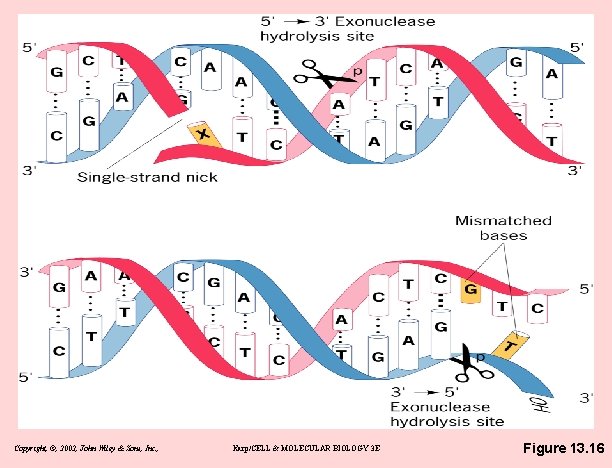
Copyright, ©, 2002, John Wiley & Sons, Inc. , Karp/CELL & MOLECULAR BIOLOGY 3 E Figure 13. 16
DNA Polymerases and Exonucleases • DNA pol I has both 5'—>3' & 3'—>5' exo – 3 different domains of enzyme – The 2 exonuclease activities have entirely different roles in replication • Pol I 5'—>3' exonuclease activity degrades both RNA & DNA – removes RNA primer at Okazaki fragment 5' end – polymerase fills in the resulting gap Copyright, ©, 2002, John Wiley & Sons, Inc. , Karp/CELL & MOLECULAR BIOLOGY 3 E
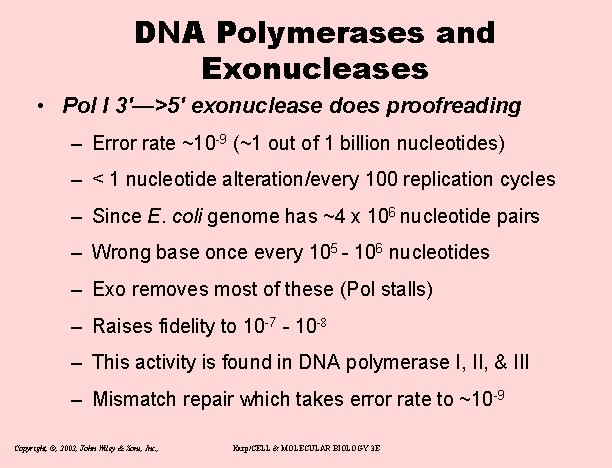
DNA Polymerases and Exonucleases • Pol I 3'—>5' exonuclease does proofreading – Error rate ~10 -9 (~1 out of 1 billion nucleotides) – < 1 nucleotide alteration/every 100 replication cycles – Since E. coli genome has ~4 x 10⁶ nucleotide pairs – Wrong base once every 105 - 106 nucleotides – Exo removes most of these (Pol stalls) – Raises fidelity to 10 -7 - 10 -8 – This activity is found in DNA polymerase I, II, & III – Mismatch repair which takes error rate to ~10 -9 Copyright, ©, 2002, John Wiley & Sons, Inc. , Karp/CELL & MOLECULAR BIOLOGY 3 E
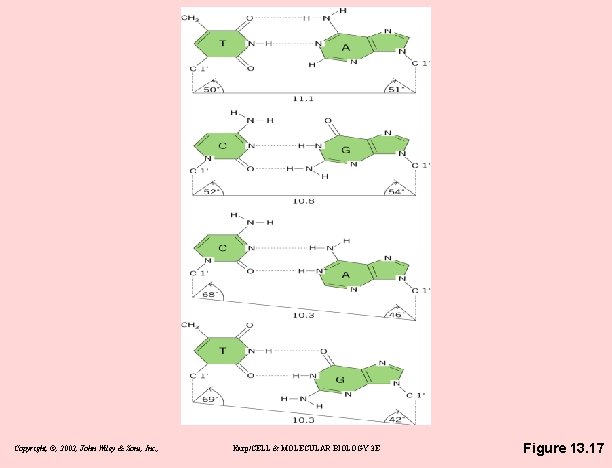
Copyright, ©, 2002, John Wiley & Sons, Inc. , Karp/CELL & MOLECULAR BIOLOGY 3 E Figure 13. 17
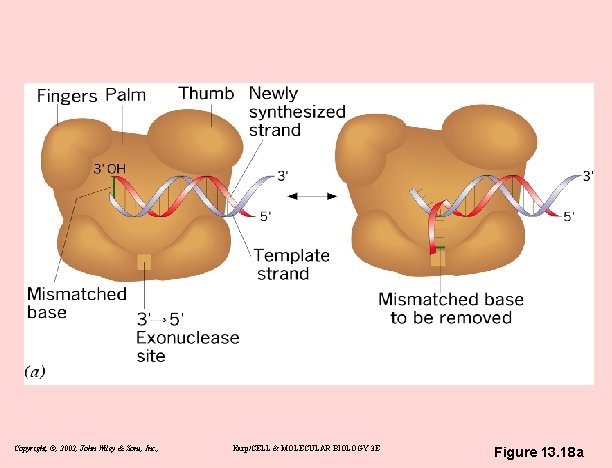
Copyright, ©, 2002, John Wiley & Sons, Inc. , Karp/CELL & MOLECULAR BIOLOGY 3 E Figure 13. 18 a
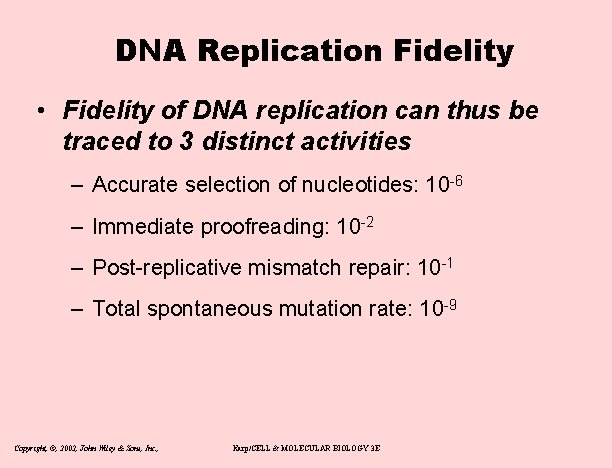
DNA Replication Fidelity • Fidelity of DNA replication can thus be traced to 3 distinct activities – Accurate selection of nucleotides: 10 -6 – Immediate proofreading: 10 -2 – Post-replicative mismatch repair: 10 -1 – Total spontaneous mutation rate: 10 -9 Copyright, ©, 2002, John Wiley & Sons, Inc. , Karp/CELL & MOLECULAR BIOLOGY 3 E
- Slides: 47