
DNA Replication Chapter 25 DNA Polymerase E coli
- Slides: 50
DNA Replication Chapter 25
DNA Polymerase (E. coli ex) • Catalyzes synth of new DNA strand • d(NMP)n + d. NTP d(NMP)n+1 + PPi • 3’ –OH of newly synth’d strand attacks first phosphate of incoming d. NTP • Rxn thermodynamically favorable – Why? ?
DNA Polymerase – cont’d • Noncovalent stabilizing forces impt – REMEMBER? ? • Base stacking hydrophobic interactions • Base pairing multiple H-bonds between duplex strands – As length of helix incr’d, # of these forces incr’d stabilization
DNA Polymerase – cont’d • Can only add nucleotides to preexisting strand – So problematic at beginning of repl’n – Problem solved by synth of ….
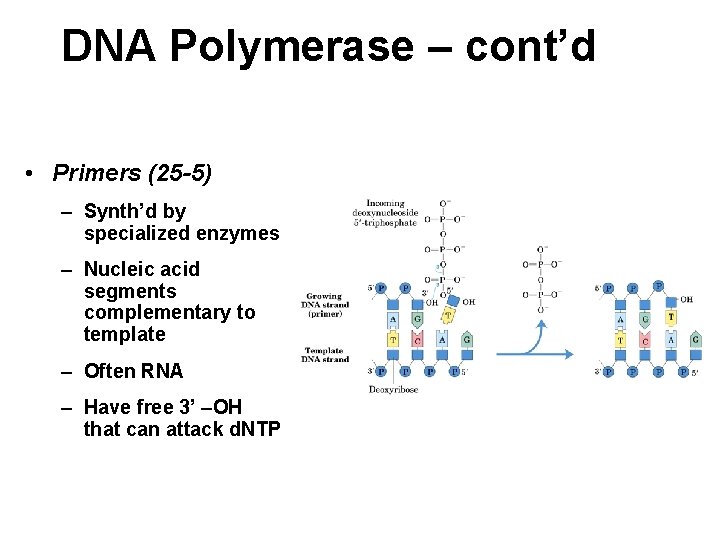
DNA Polymerase – cont’d • Primers (25 -5) – Synth’d by specialized enzymes – Nucleic acid segments complementary to template – Often RNA – Have free 3’ –OH that can attack d. NTP
DNA Polymerase – cont’d • Once DNA polymerase begins synth of DNA chain, can dissociate OR can continue along template adding more nucleotides to growing chain – Rate of synth DNA depends on ability of enz to continue w/out falling off – Processivity
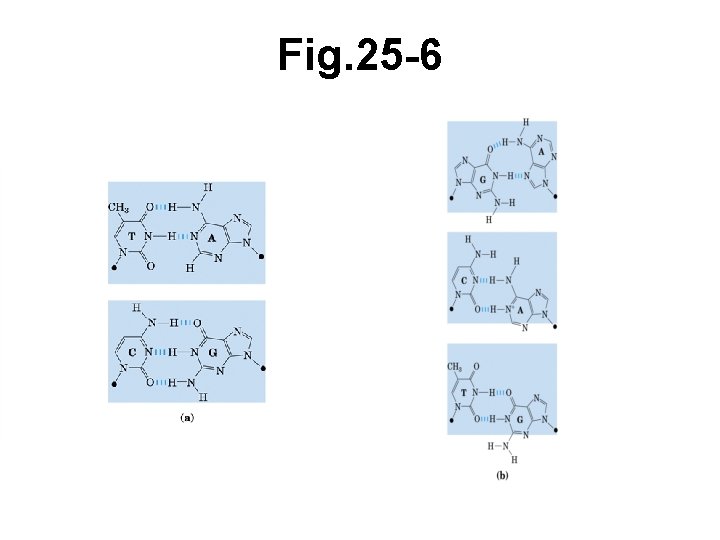
DNA Polymerase – Accuracy • Enz must ACCURATELY add correct nucleotide to growing chain – E. coli accuracy ~ 1 mistake per 109 – 1010 nucleotides added • Geometry of enz active site matches geom. of correct base pairs (25 -6) – A=T, G=C fit – Other pairings don’t fit
Fig. 25 -6
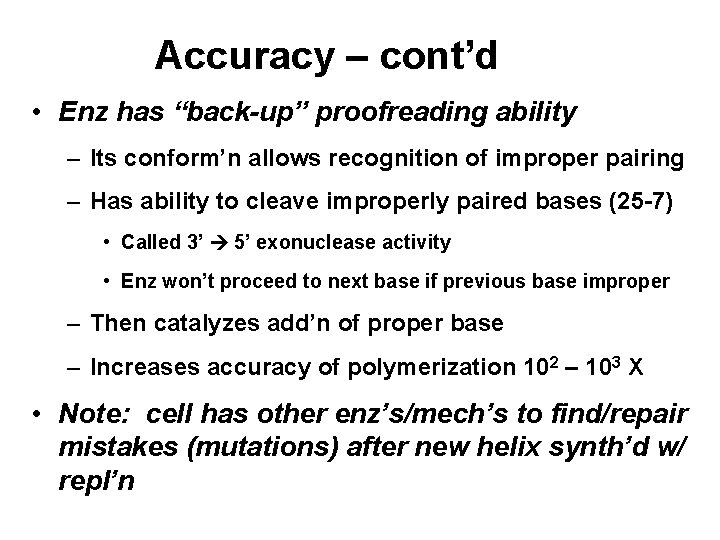
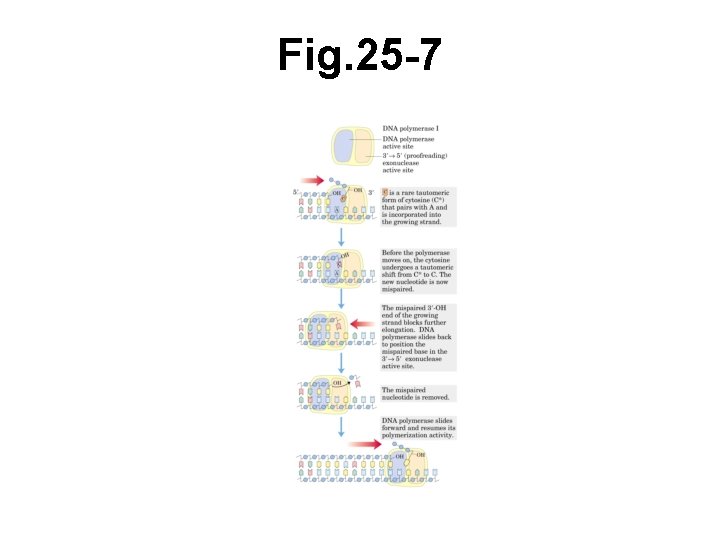
Accuracy – cont’d • Enz has “back-up” proofreading ability – Its conform’n allows recognition of improper pairing – Has ability to cleave improperly paired bases (25 -7) • Called 3’ 5’ exonuclease activity • Enz won’t proceed to next base if previous base improper – Then catalyzes add’n of proper base – Increases accuracy of polymerization 102 – 103 X • Note: cell has other enz’s/mech’s to find/repair mistakes (mutations) after new helix synth’d w/ repl’n
Fig. 25 -7
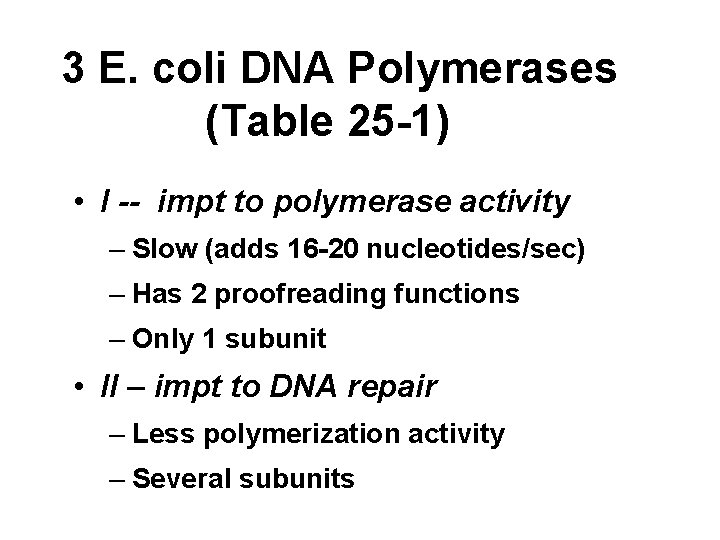
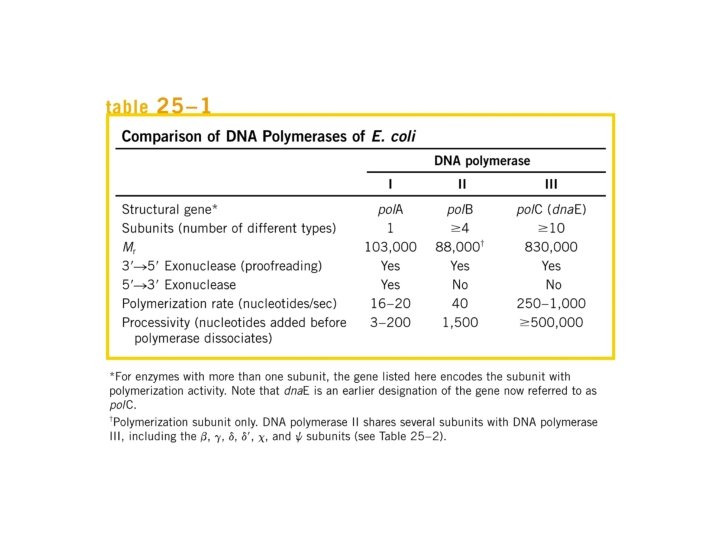
3 E. coli DNA Polymerases (Table 25 -1) • I -- impt to polymerase activity – Slow (adds 16 -20 nucleotides/sec) – Has 2 proofreading functions – Only 1 subunit • II – impt to DNA repair – Less polymerization activity – Several subunits
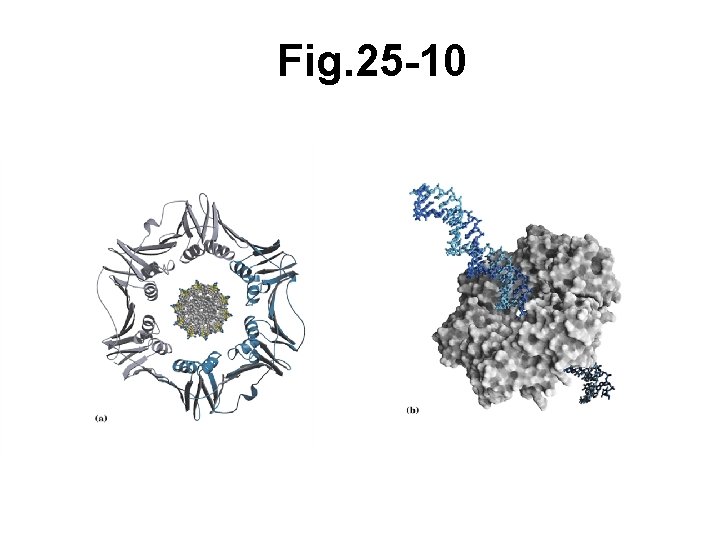
3 DNA Polymerases -- cont’d • III – principle repl’n enz – Much faster than polymerase I (adds 250 -1000 nucleotides/sec) – Many subunits (Table 25 -2) each w/ partic function • Encircles DNA; slides along helix (25 -10) • One subunit “clamps” helix better processivity
Fig. 25 -10
Replisome • Many other enz’s/prot’s necessary for repl’n (Table 25 -3) • Complex together replisome • Helicases – sep strands • Topoisomerases – relieve strain w/ sep’n • Binding proteins – keep parent strands from reannealing • Primases – synth primers • Ligases – seal backbone – What bonds hold nucleic acid backbone together?
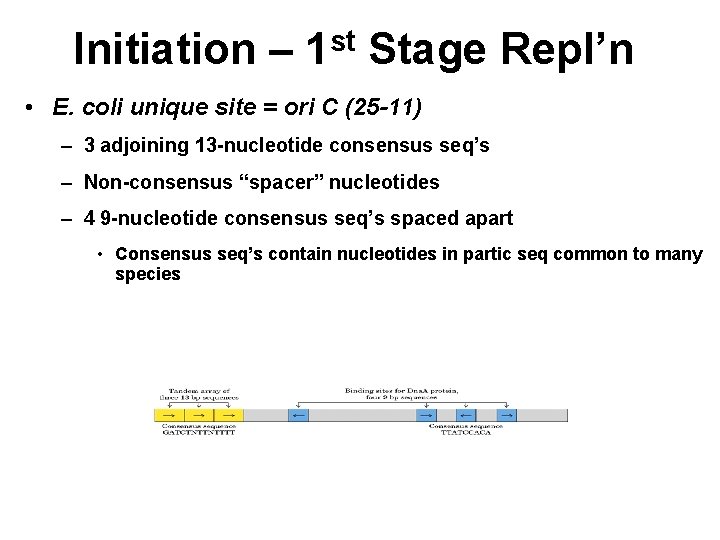
Initiation – st 1 Stage Repl’n • E. coli unique site = ori C (25 -11) – 3 adjoining 13 -nucleotide consensus seq’s – Non-consensus “spacer” nucleotides – 4 9 -nucleotide consensus seq’s spaced apart • Consensus seq’s contain nucleotides in partic seq common to many species
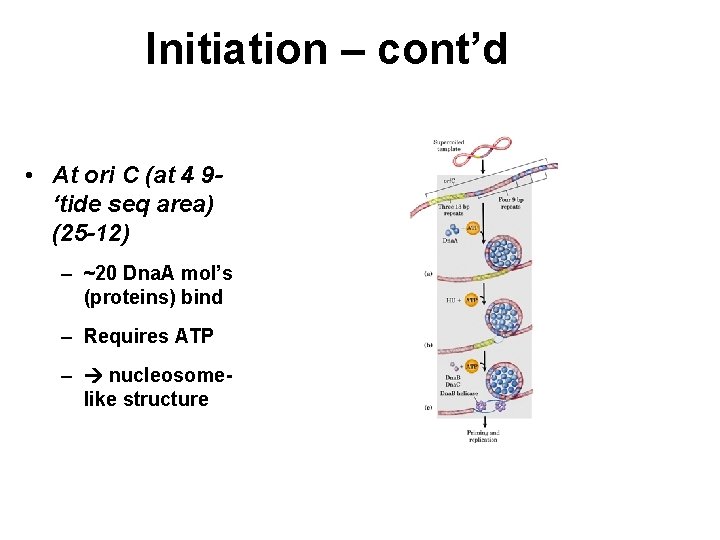
Initiation – cont’d • At ori C (at 4 9‘tide seq area) (25 -12) – ~20 Dna. A mol’s (proteins) bind – Requires ATP – nucleosomelike structure
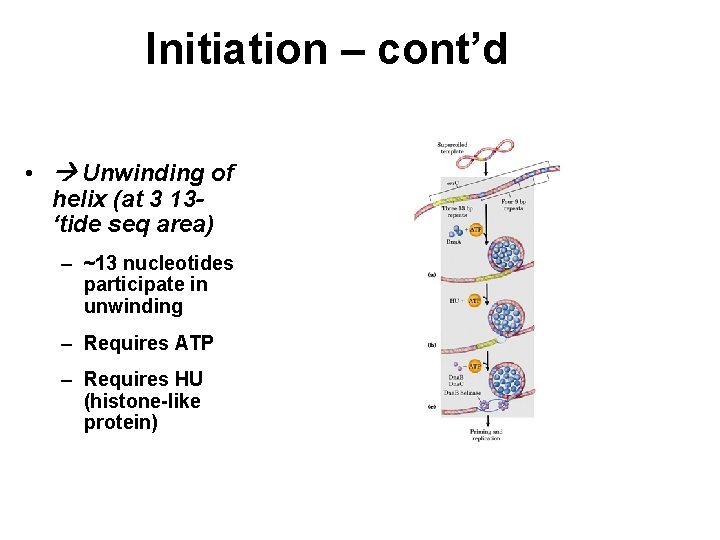
Initiation – cont’d • Unwinding of helix (at 3 13‘tide seq area) – ~13 nucleotides participate in unwinding – Requires ATP – Requires HU (histone-like protein)
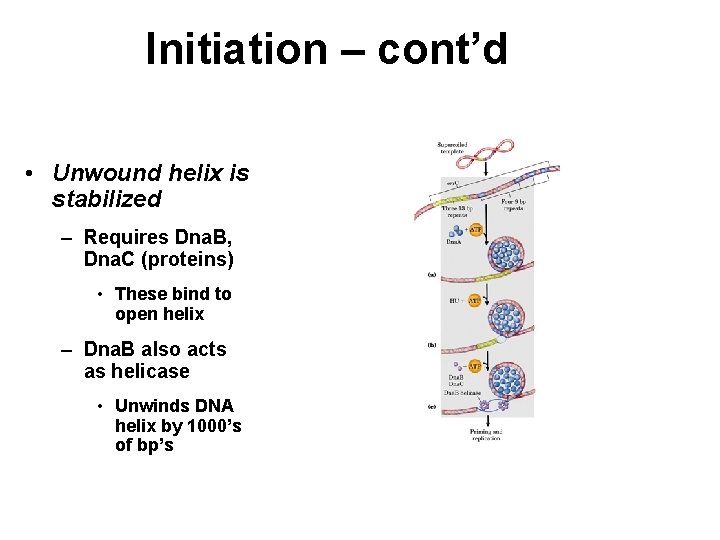
Initiation – cont’d • Unwound helix is stabilized – Requires Dna. B, Dna. C (proteins) • These bind to open helix – Dna. B also acts as helicase • Unwinds DNA helix by 1000’s of bp’s
Initiation – cont’d Result: – Nucleotide bases now exposed for base pairing in semiconservative repl'n • What does semiconservative mean? – Yields 2 repl’n forks
Initiation – cont’d • Other impt repl’n factors at repl’n forks (Table 25 -4) – SSB = Single Strand DNA Binding Protein • Stabilizes sep’d DNA strands • Prevents renaturation – DNA gyrase -- a topoisomerase • Relieves physical stress of unwinding • Note: in E. coli, repl’n is regulated ONLY @ initiation
Elongation • Second stage of repl’n • Must synth both leading and lagging strands – REMEMBER: 1 parent strand 3' 5; its daughter can be synth'd 5' 3' easily. What about the other parent strand (runs 5' 3')? ? • Follows init’n w/ successful unwinding repl’n fork, stabilized by prot’s – So have parent strands available as templates for base-pairing 2 daughter dbl helices
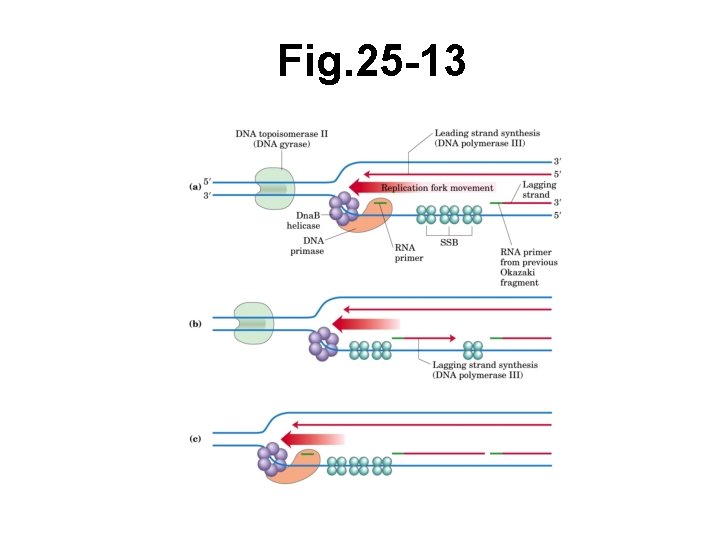
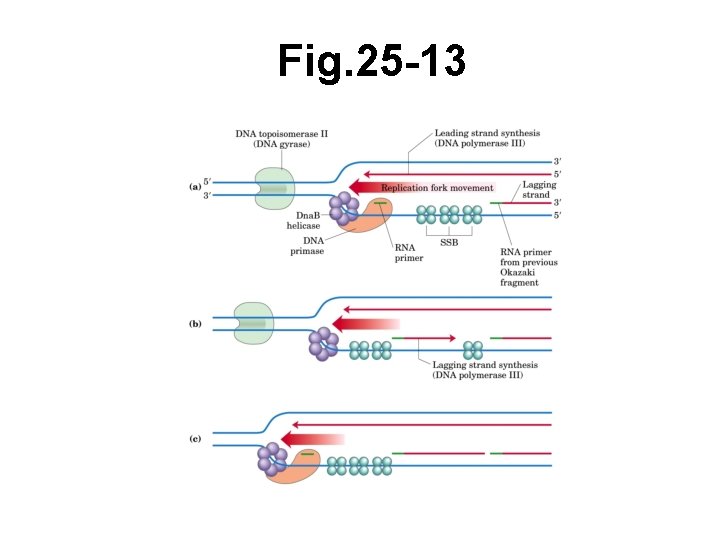
Elongation -- cont'd – Leading Strand • Simpler, more direct (25 -13) • Primase (=Dna. G) synthesizes primer – 10 -60 nucleotides – NOT deoxynucleotides • Short RNA segment – Occurs @ fork opening – Yields free 3’ –OH that will attack further d. NTP’s
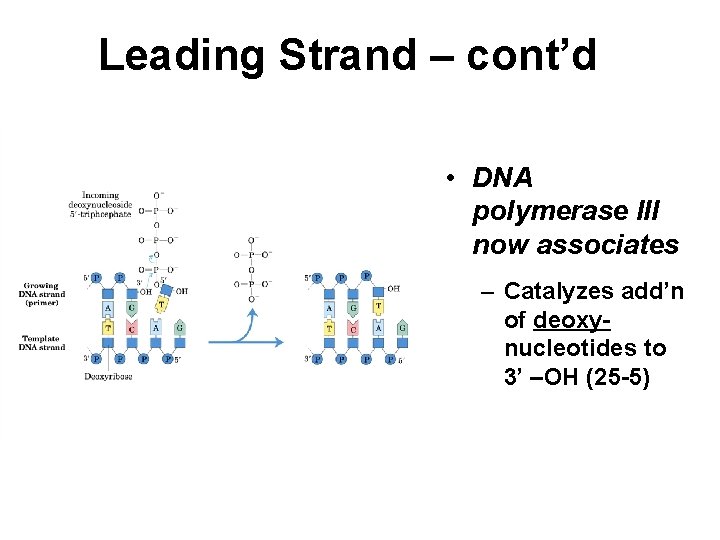
Leading Strand – cont’d • DNA polymerase III now associates – Catalyzes add’n of deoxynucleotides to 3’ –OH (25 -5)
Leading Strand – cont’d • Elongation of leading strand keeps up w/ unwinding of DNA @ repl’n fork – Gyrase/helicase unwind more DNA further repl’n fork – SSB stabilizes single strand DNA til polymerase arrives – Synth continues 5’ 3’ along daughter strand
Fig. 25 -13
Elongation -- cont'd – Lagging Strand • More complicated • REMEMBER: still need 5’ 3’ synth, AND still need to have antiparallel strands. – Template strand here is 5’ 3’ – Can’t synth continuous daughter strand 5’ 3’ – Cell synth’s discontinuous DNA fragments (Okazaki fragments) that will be joined (25 -13) • Must have several primers AND coordinated fork movement
Fig. 25 -13
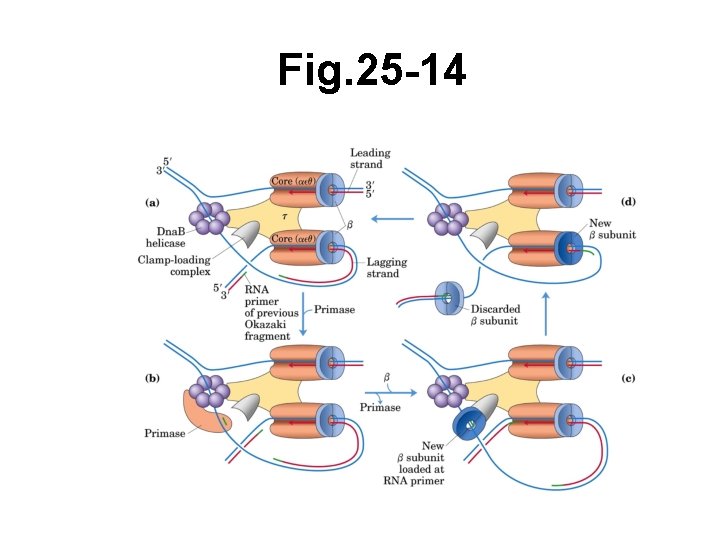
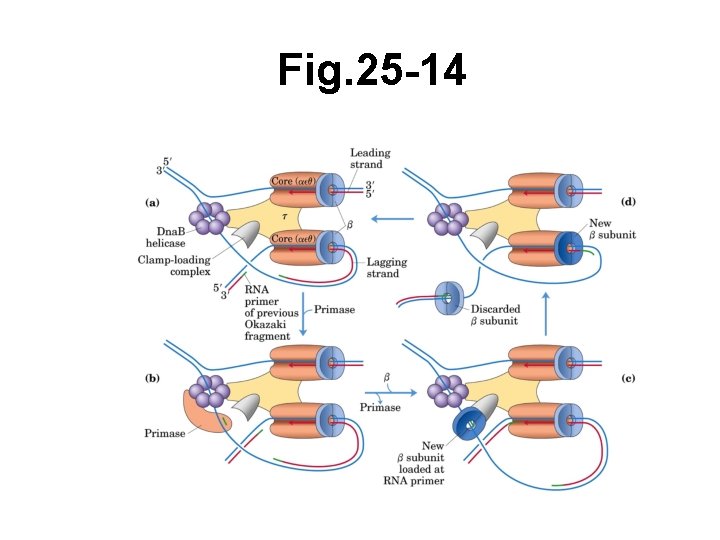
Lagging Strand – cont’d • Lagging strand is looped next to leading strand (25 -14) – DNA polymerase III complex of subunits catalyzes nucleic acid elongation on both strands simultaneously – Primosome = Dna. B, Dna. G (primase) held together w/ DNA polymerase III by other prot’s
Fig. 25 -14
Lagging Strand – cont’d • One subunit complex of DNA polymerase III moves along lagging strand @ fork in 3’ 5’ direction (along parent) – Another subunit complex of polymerase III synth’s daughter strand along leading strand • At intervals, primase attaches to Dna. B (helicase) – Here, primase catalyzes synth of primer (as on leading strand) – Also (once primer synth’d), primase directs “clamp” subunit of polymerase III to this site – This directs other polymerase III subunits to primer
Lagging Strand – cont’d Now polymerase III catalytic subunits add deoxynucleotides to primer Okazaki fragment – Book notes primosome moves 3’ 5’ along daughter strand, but both primase & polymerase synthesize strands 5’ 3’ along daughter
Fig. 25 -14
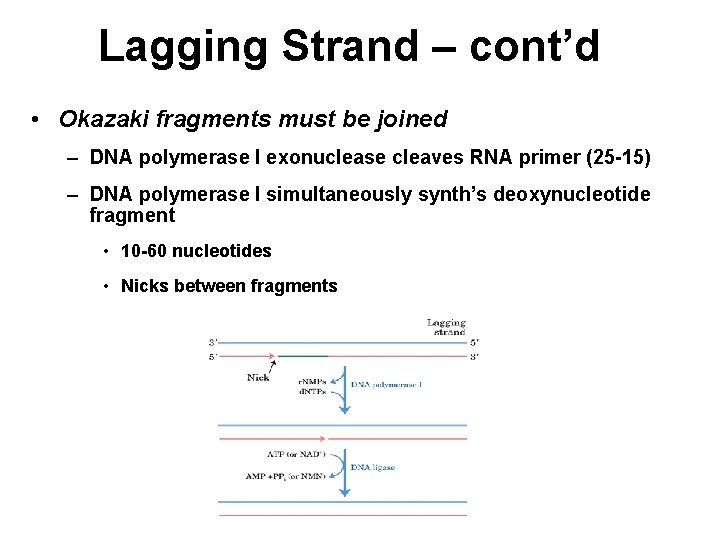
Lagging Strand – cont’d • Okazaki fragments must be joined – DNA polymerase I exonuclease cleaves RNA primer (25 -15) – DNA polymerase I simultaneously synth’s deoxynucleotide fragment • 10 -60 nucleotides • Nicks between fragments
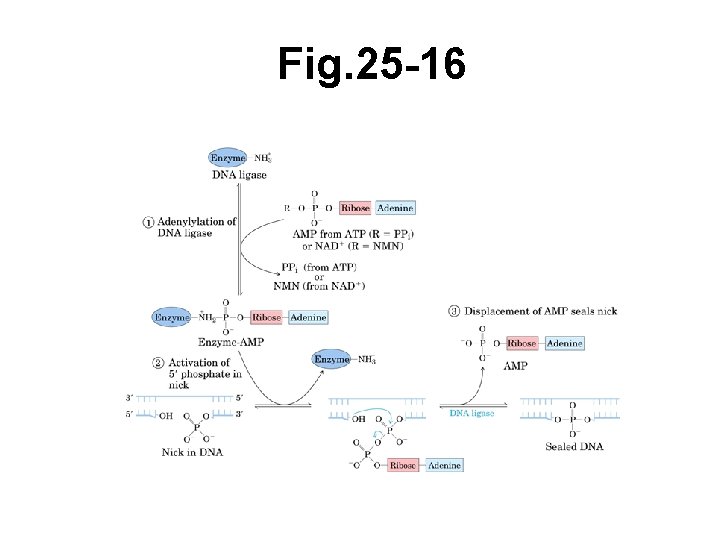
Lagging Strand – cont’d – DNA ligase seals nicks between fragments (25 -16) • Catalyzes synth of phosphodiester bond • NADH impt (coordination role? )
Fig. 25 -16
Termination • Repl'n has occurred bidirectionally @ 2 forks concurrently • E. coli genome is closed circular – So 2 repl'n forks will meet
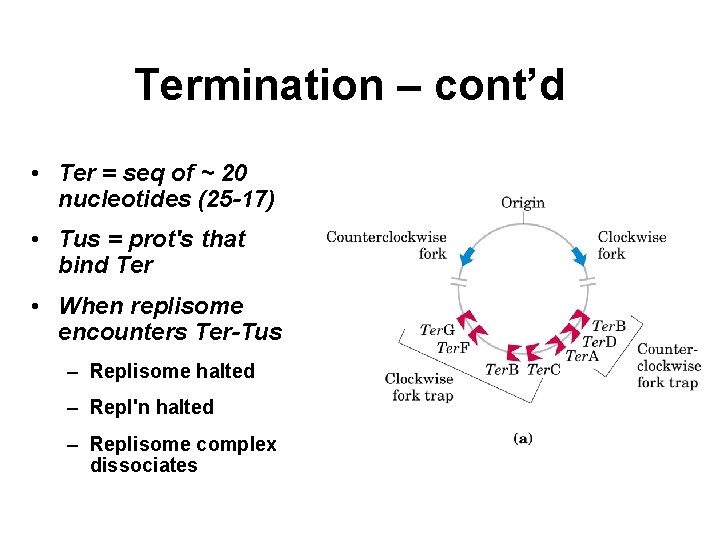
Termination – cont’d • Ter = seq of ~ 20 nucleotides (25 -17) • Tus = prot's that bind Ter • When replisome encounters Ter-Tus – Replisome halted – Repl'n halted – Replisome complex dissociates
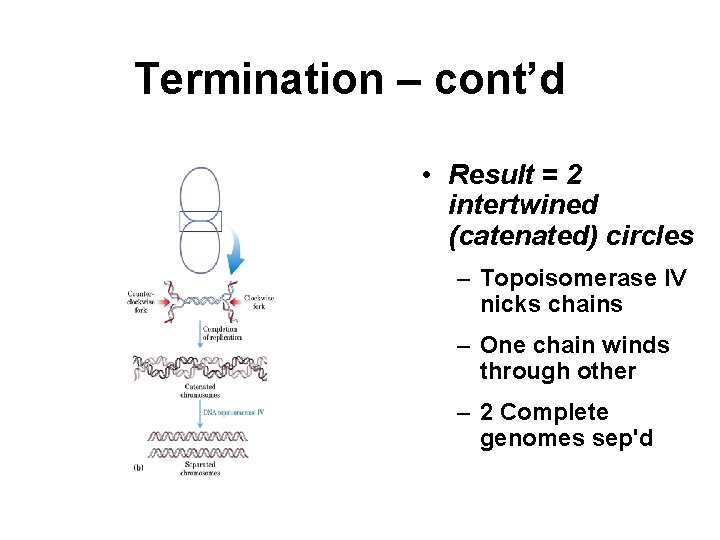
Termination – cont’d • Result = 2 intertwined (catenated) circles – Topoisomerase IV nicks chains – One chain winds through other – 2 Complete genomes sep'd
Eukaryotic DNA Replication • Repl'n mechanism & replisome structures similar to prokaryotes, BUT: – DNA more complex • Not all is coding for peptides – Chromatin packaging more complex • REMEMBER: nucleosomes, 30 nm fibers, nuclear scaffold, etc. – No single origination pt for repl'n • Many forks develop • Simultaneous repl'ns bidirectionally • Forks move more slowly than in E. coli – But efficient because more forks
Eukaryotic DNA Replication • Repl'n enzymes not yet fully understood – DNA polymerase a • In nucleus • Has subunit w/ primase activity • May be impt to lagging strand synth – DNA polymerase d • Assoc'd w/ a • Impt to attaching enz to nucleic acid chain • Has 3' 5' exonuclease ability (proofreading) – DNA polymerase e • Impt in repair
Eukaryotic DNA Replication • Replisome proteins not yet fully understood – Found prot's similar to SSB prot's of E. coli • Termination seems to involve telomerases – Telomeres = seq's @ ends of chromosomes
DNA Alterations • Need unaltered, correct nucleotide seq to code for correct aa's correct peptides correct proteins – Some changes acceptable • Some "wobble" in genetic code – Some DNA damage in mature cells can be fixed • DNA repair mechanisms avail for TT dimers (ex) • Have (more) other mature cells that can maintain homeostasis in organism • BUT -- if mispaired bases during repl'n mutation in daughter cell (and her subsequent daughters)
Definitions • Lesion = unrepaired DNA damage – Mammalian cell prod's > 104 lesions/day • Mutation = permanent change in nucleotide seq – Can be replicated during cell division – Results if DNA polymerase proofreading fails – May occur in unimpt region = Silent Mutation • Doesn't effect health of organism
Definitions – cont’d • Mutation -- cont’d – May confer advantage to organism = Favorable • Rare • Impt in evolution – May be catastrophic to organism health • Correlations between mutations & carcinogenesis
DNA Repair • Cell has biochem mech's to repair damage to DNA – Though 104 lesions/day, mutations < 1/1, 000 bp's • If repair mech's defective disease/dysfunction – Ex: xeroderma pigmentosum • UV light DNA lesions • No repair mech • Skin cancers • Repair mech ex: base excision repair – Takes advantage of complementarity of strands
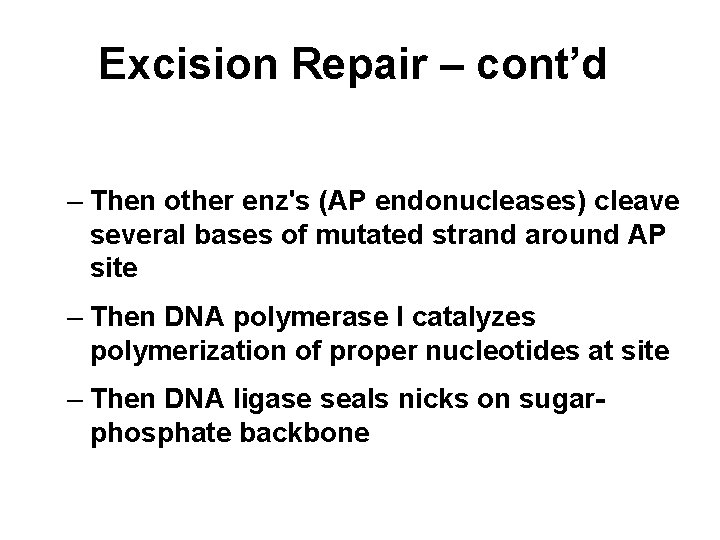
Base Excision Repair • N-Glycosylases – Cleave N-glycosyl bonds • What parts of nucleic acid are joined by Nglycosyl bonds? – Several specific N-glycosylases • Each recognizes a common DNA lesion – Common -- bases altered by deamination events – Yields apurinic or apyrimidinic (AP) site
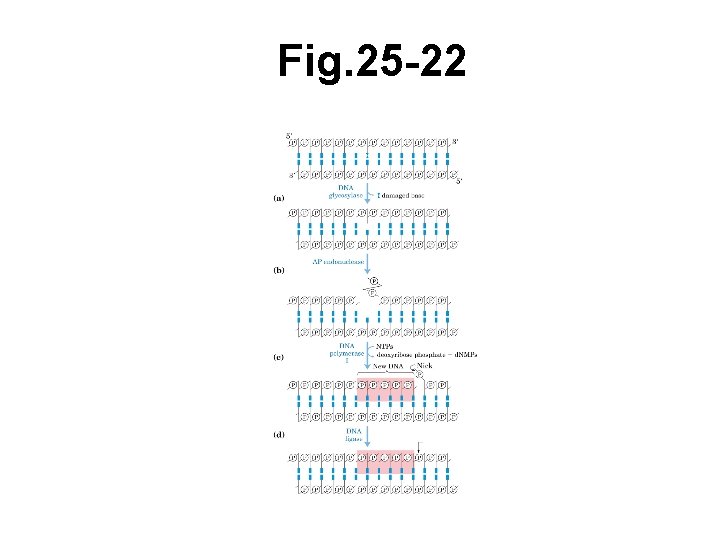
Excision Repair – cont’d • Uracil Glycosylase -- ex – Deamination of cytosine uracil (improper) – Enz recognizes, cleaves ONLY U in DNA • Not U in RNA • Not T in DNA – AP site on DNA (25 -22) • Would this be apurinic or apyrimidinic? • Leaves behind sugar-phosphate of original nucleotide
Excision Repair – cont’d – Then other enz's (AP endonucleases) cleave several bases of mutated strand around AP site – Then DNA polymerase I catalyzes polymerization of proper nucleotides at site – Then DNA ligase seals nicks on sugarphosphate backbone
Fig. 25 -22