
DNA Replication AP Biology Chapter 16 part 2
DNA Replication AP Biology Chapter 16 part 2
Watson and Crick • In a second paper Watson and Crick published their hypothesis for how DNA replicates. – Essentially, because each strand is complementary to each other, each can form a template when separated. – The order of bases on one strand can be used to add in complementary bases and therefore duplicate the pairs of bases exactly.
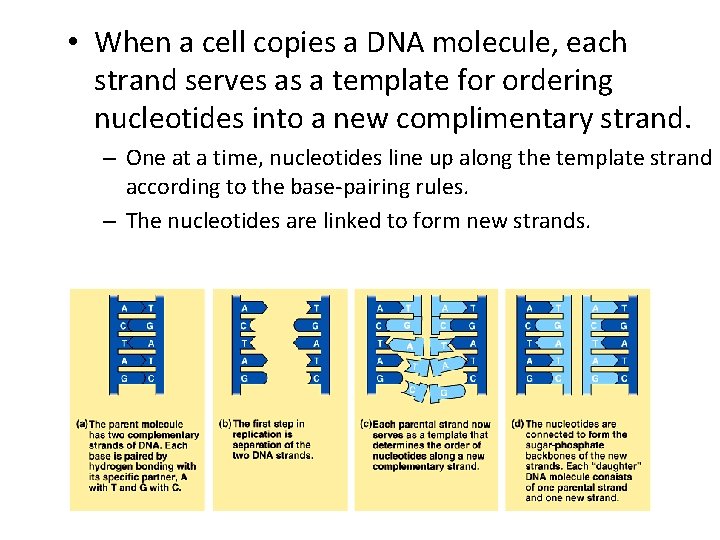
• When a cell copies a DNA molecule, each strand serves as a template for ordering nucleotides into a new complimentary strand. – One at a time, nucleotides line up along the template strand according to the base-pairing rules. – The nucleotides are linked to form new strands.
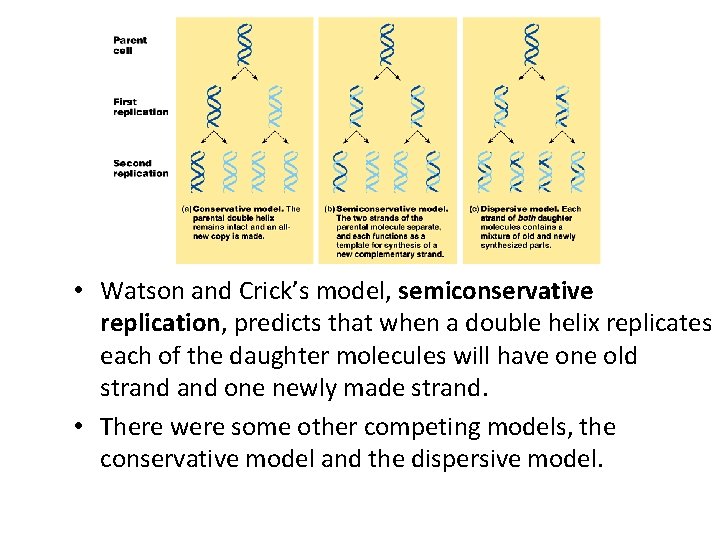
• Watson and Crick’s model, semiconservative replication, predicts that when a double helix replicates each of the daughter molecules will have one old strand one newly made strand. • There were some other competing models, the conservative model and the dispersive model.
The Semiconservative Model • Experiments in the late 1950 s by Matthew Meselson and Franklin Stahl supported the semiconservative model, proposed by Watson and Crick, over the other two models. – They labeled the nucleotides of the old strands with a heavy isotope of nitrogen (15 N) while any new nucleotides would be indicated by a lighter isotope (14 N). – Replicated strands could be separated by density in a centrifuge. – Each model: the semi-conservative model, the conservative model, and the dispersive model, made specific predictions on the density of replicated DNA strands.
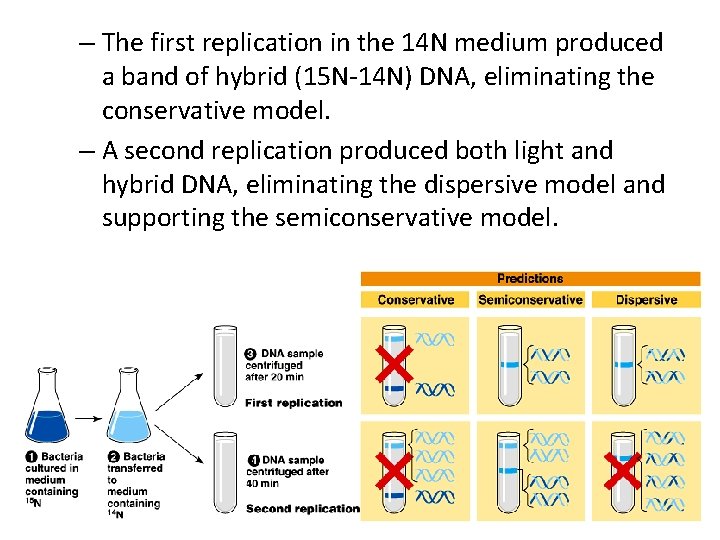
– The first replication in the 14 N medium produced a band of hybrid (15 N-14 N) DNA, eliminating the conservative model. – A second replication produced both light and hybrid DNA, eliminating the dispersive model and supporting the semiconservative model.
FYI… • It takes E. coli less than an hour to copy each of the 5 million base pairs in its single chromosome and divide to form two identical daughter cells. • A human cell can copy its 6 billion base pairs and divide into daughter cells in only a few hours. • This process is remarkably accurate, with only one error per billion nucleotides. • More than a dozen enzymes and other proteins participate in DNA replication.
How Replication Begins • The replication of a DNA molecule begins at the origins of replication. • In bacteria, this is a single specific sequence of nucleotides that is recognized by the replication enzymes. – These enzymes separate the strands, forming a replication “bubble”. – Replication proceeds in both directions until the entire molecule is copied.
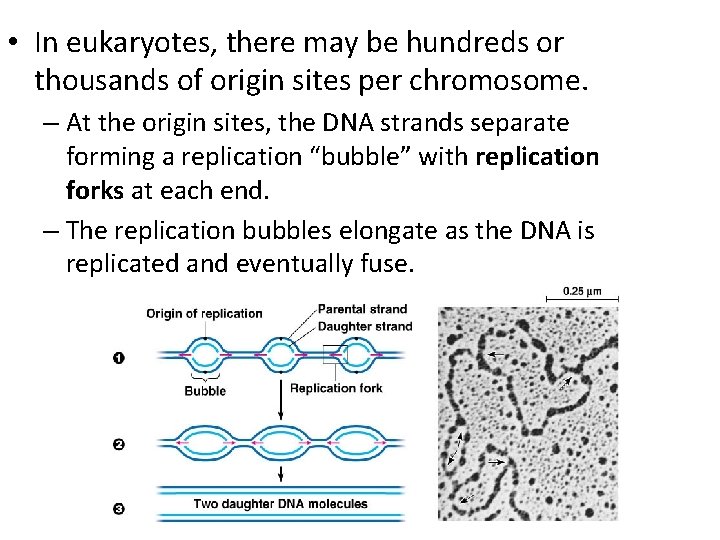
• In eukaryotes, there may be hundreds or thousands of origin sites per chromosome. – At the origin sites, the DNA strands separate forming a replication “bubble” with replication forks at each end. – The replication bubbles elongate as the DNA is replicated and eventually fuse.
Stuff Needed for Replication • DNA polymerases starts the elongation of new DNA at a replication fork. • As nucleotides match with complementary bases along the template strand, they are added to the growing end of the new strand by the polymerase. – The rate of elongation is about 500 nucleotides per second in bacteria and 50 per second in human cells. • The raw nucleotides are nucleoside triphosphates. – Each has a nitrogen base, deoxyribose, and a triphosphate tail.
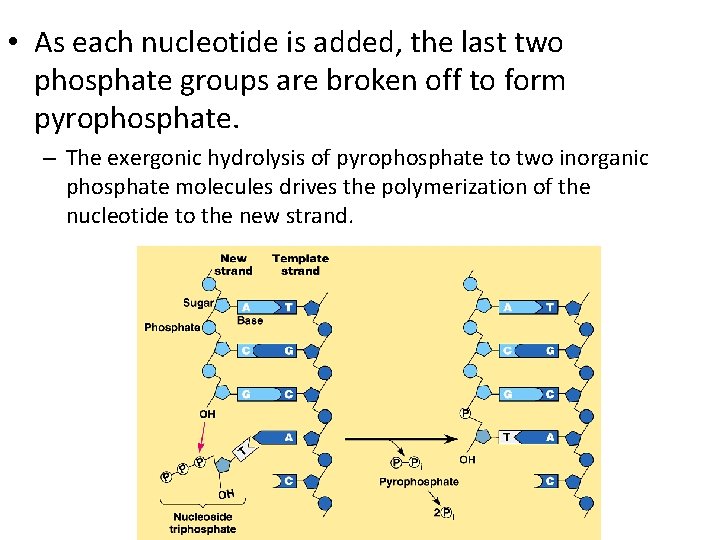
• As each nucleotide is added, the last two phosphate groups are broken off to form pyrophosphate. – The exergonic hydrolysis of pyrophosphate to two inorganic phosphate molecules drives the polymerization of the nucleotide to the new strand.
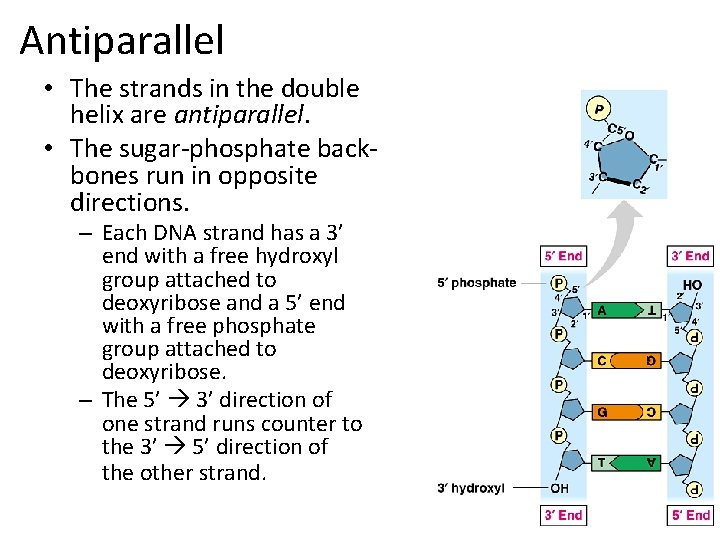
Antiparallel • The strands in the double helix are antiparallel. • The sugar-phosphate backbones run in opposite directions. – Each DNA strand has a 3’ end with a free hydroxyl group attached to deoxyribose and a 5’ end with a free phosphate group attached to deoxyribose. – The 5’ 3’ direction of one strand runs counter to the 3’ 5’ direction of the other strand.
How DNA Strands Grow • DNA polymerases can only add nucleotides to the free 3’ end of a growing DNA strand. • A new DNA strand can only elongate in the 5’ to 3’ direction. • This creates a problem at the replication fork because one parental strand is oriented 3’ 5’ into the fork, while the other antiparallel parental strand is oriented 5’ 3’ into the fork. • At the replication fork, one parental strand (3’ 5’ into the fork), the leading strand, can be used by polymerases as a template for a continuous complimentary strand.
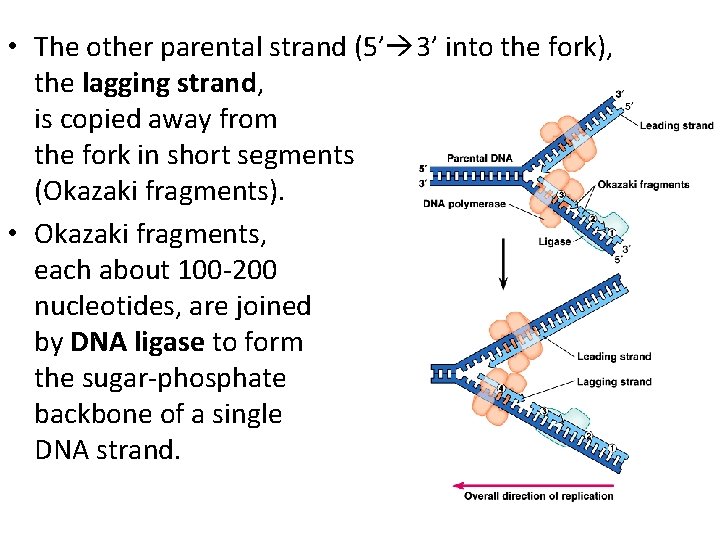
• The other parental strand (5’ 3’ into the fork), the lagging strand, is copied away from the fork in short segments (Okazaki fragments). • Okazaki fragments, each about 100 -200 nucleotides, are joined by DNA ligase to form the sugar-phosphate backbone of a single DNA strand.
Primers • DNA polymerases cannot initiate synthesis of a polynucleotide because they can only add nucleotides to the end of an existing chain that is base-paired with the template strand. • To start a new chain requires a primer, a short segment of RNA. – The primer is about 10 nucleotides long in eukaryotes. • Primase, an RNA polymerase, links ribonucleotides that are complementary to the DNA template into the primer. – RNA polymerases can start an RNA chain from a single template strand.
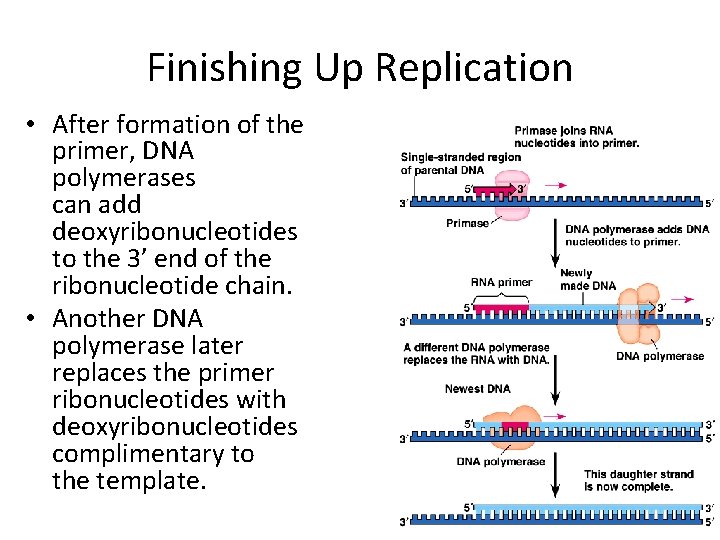
Finishing Up Replication • After formation of the primer, DNA polymerases can add deoxyribonucleotides to the 3’ end of the ribonucleotide chain. • Another DNA polymerase later replaces the primer ribonucleotides with deoxyribonucleotides complimentary to the template.
The Lagging Strand • Returning to the original problem at the replication fork, the leading strand requires the formation of only a single primer as the replication fork continues to separate. • The lagging strand requires formation of a new primer as the replication fork progresses. • After the primer is formed, DNA polymerase can add new nucleotides away from the fork until it runs into the previous Okazaki fragment. • The primers are converted to DNA before DNA ligase joins the fragments together.
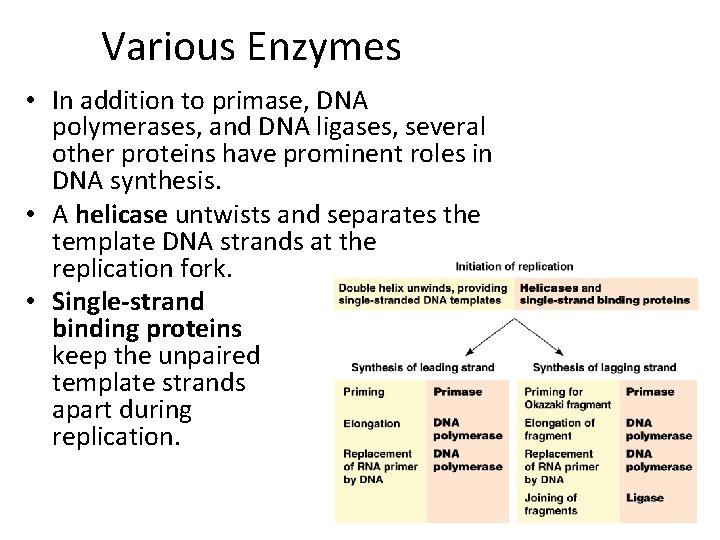
Various Enzymes • In addition to primase, DNA polymerases, and DNA ligases, several other proteins have prominent roles in DNA synthesis. • A helicase untwists and separates the template DNA strands at the replication fork. • Single-strand binding proteins keep the unpaired template strands apart during replication.
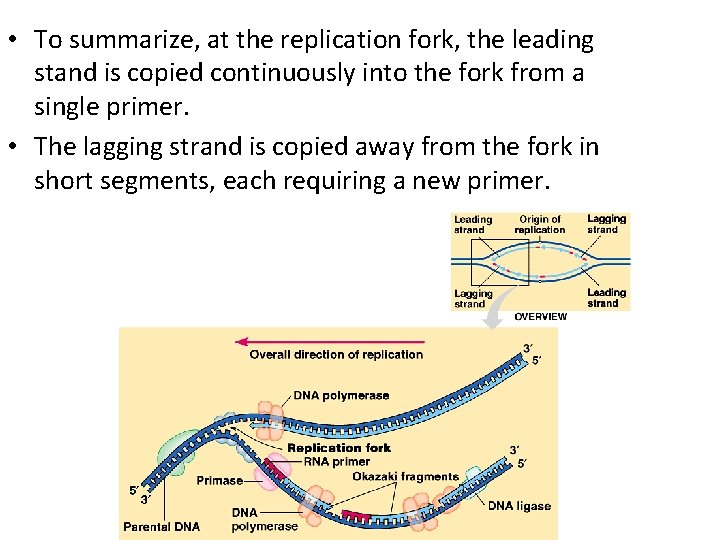
• To summarize, at the replication fork, the leading stand is copied continuously into the fork from a single primer. • The lagging strand is copied away from the fork in short segments, each requiring a new primer.
What About Mistakes? • Mistakes during the initial pairing of template nucleotides and complementary nucleotides occur at a rate of one error per 10, 000 base pairs. • DNA polymerase proofreads each new nucleotide against the template nucleotide as soon as it is added. • If there is an incorrect pairing, the enzyme removes the wrong nucleotide and then resumes synthesis. • The final error rate is only one per billion nucleotides.
Mutagens • DNA molecules are constantly subject to potentially harmful chemical and physical agents. – Reactive chemicals, radioactive emissions, X-rays, and ultraviolet light can change nucleotides in ways that can affect encoded genetic information. – DNA bases often undergo spontaneous chemical changes under normal cellular conditions. • Mismatched nucleotides that are missed by DNA polymerase or mutations that occur after DNA synthesis is completed can often be repaired. – Each cell continually monitors and repairs its genetic material, with over 130 repair enzymes identified in humans.
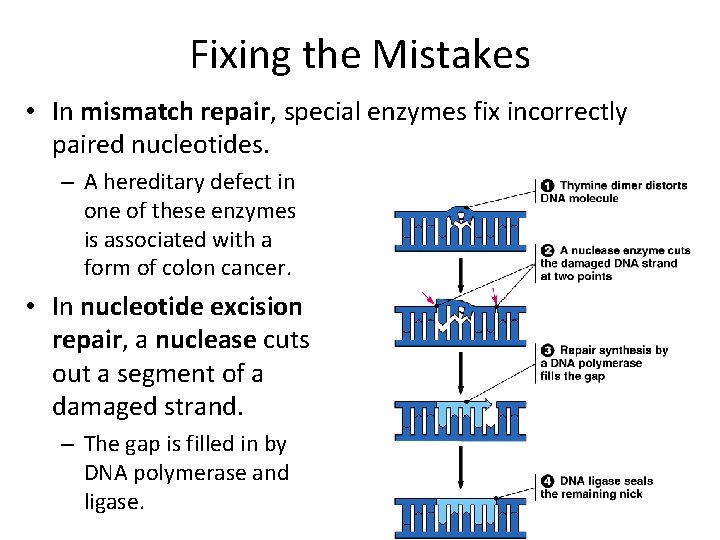
Fixing the Mistakes • In mismatch repair, special enzymes fix incorrectly paired nucleotides. – A hereditary defect in one of these enzymes is associated with a form of colon cancer. • In nucleotide excision repair, a nuclease cuts out a segment of a damaged strand. – The gap is filled in by DNA polymerase and ligase.
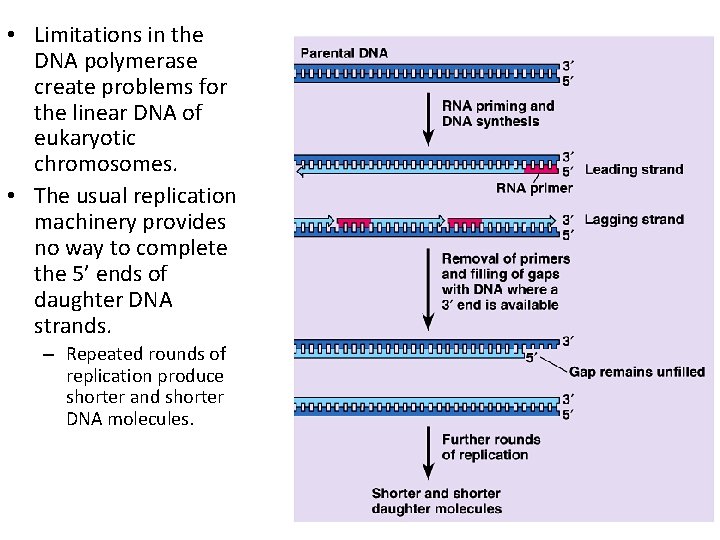
• Limitations in the DNA polymerase create problems for the linear DNA of eukaryotic chromosomes. • The usual replication machinery provides no way to complete the 5’ ends of daughter DNA strands. – Repeated rounds of replication produce shorter and shorter DNA molecules.
Telomeres • Telomerase is not present in most cells of multicellular organisms. • Therefore, the DNA of dividing somatic cells and cultured cells does tend to become shorter. • Thus, telomere length may be a limiting factor in the life span of certain tissues and the organism. • Telomerase is present in germ-line cells, ensuring that zygotes have long telomeres. • Active telomerase is also found in cancerous somatic cells. – This overcomes the progressive shortening that would eventually lead to self-destruction of the cancer.
- Slides: 24