
DNA Replication 1 15122021 DNA replication is central

- Slides: 17
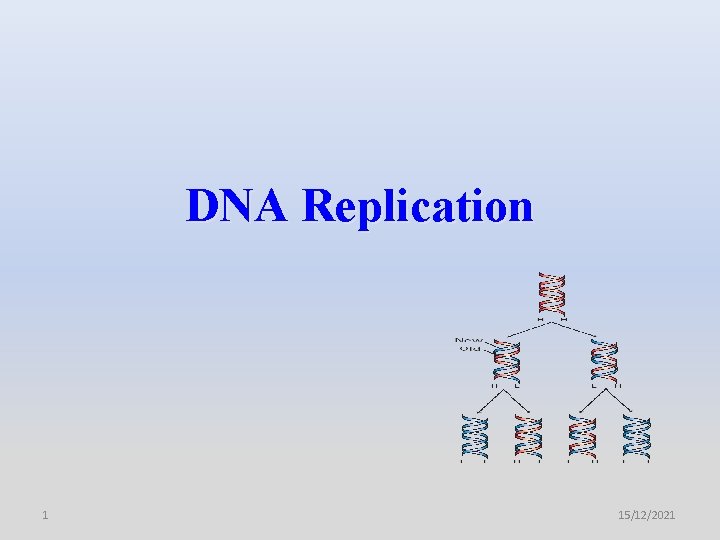
DNA Replication 1 15/12/2021
DNA replication is central to life and to evolution; in which the stored genomic information is handed down to the next generation. The principles of DNA replication are similar in bacteria, archaea, and eukaryotes alike. 2 15/12/2021
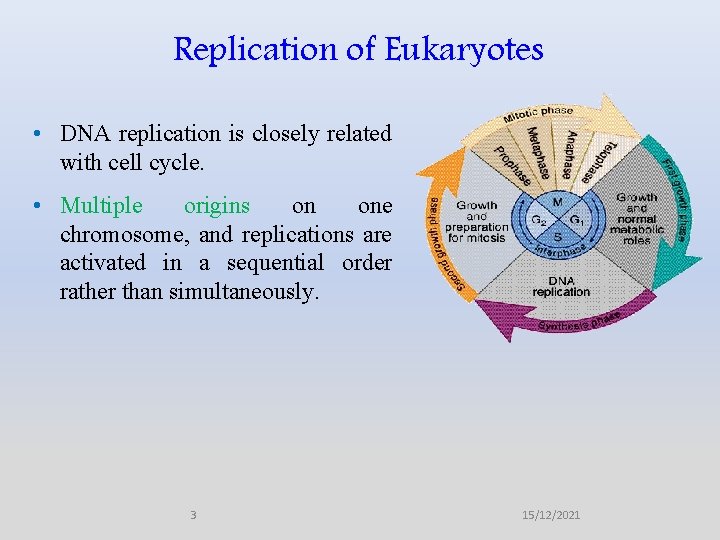
Replication of Eukaryotes • DNA replication is closely related with cell cycle. • Multiple origins on one chromosome, and replications are activated in a sequential order rather than simultaneously. 3 15/12/2021
• Occurs in the S phase of cell cycle, before cell division. • Results in doubling of the DNA content of cells. • The entire content of DNA in the nucleus multiplies. 4 15/12/2021
5 15/12/2021
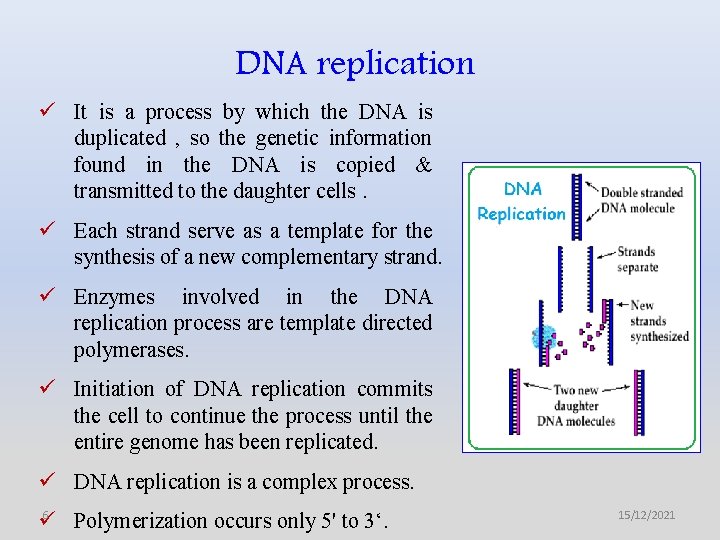
DNA replication ü It is a process by which the DNA is duplicated , so the genetic information found in the DNA is copied & transmitted to the daughter cells. ü Each strand serve as a template for the synthesis of a new complementary strand. ü Enzymes involved in the DNA replication process are template directed polymerases. ü Initiation of DNA replication commits the cell to continue the process until the entire genome has been replicated. ü DNA replication is a complex process. 6 ü Polymerization occurs only 5' to 3‘. 15/12/2021
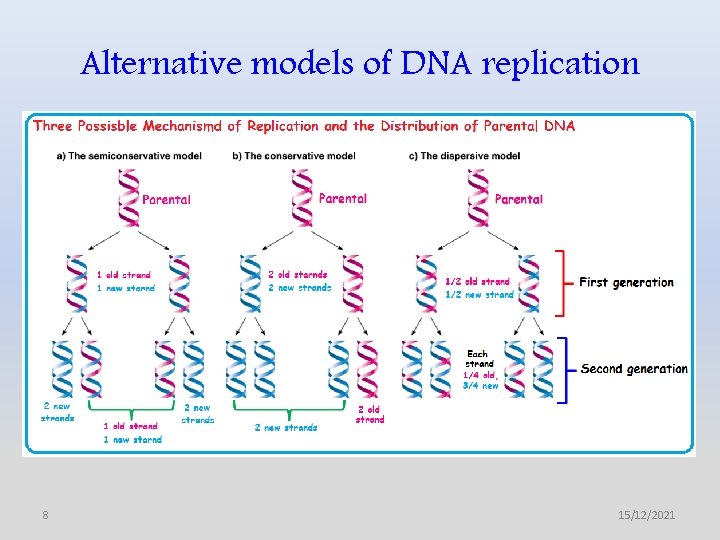
When replication has been completed, are old strands paired with new, or old with old & new with new , or what? ü In the late 1950 s, three different mechanisms were proposed for the replication of DNA. 7 15/12/2021
Alternative models of DNA replication 8 15/12/2021
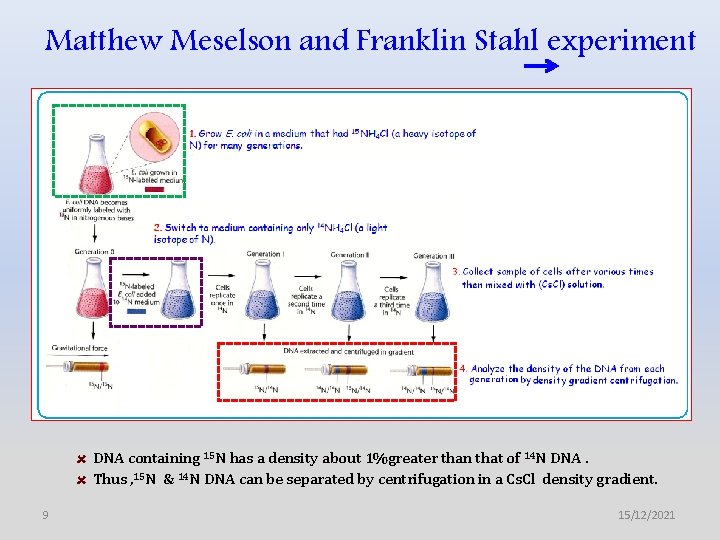
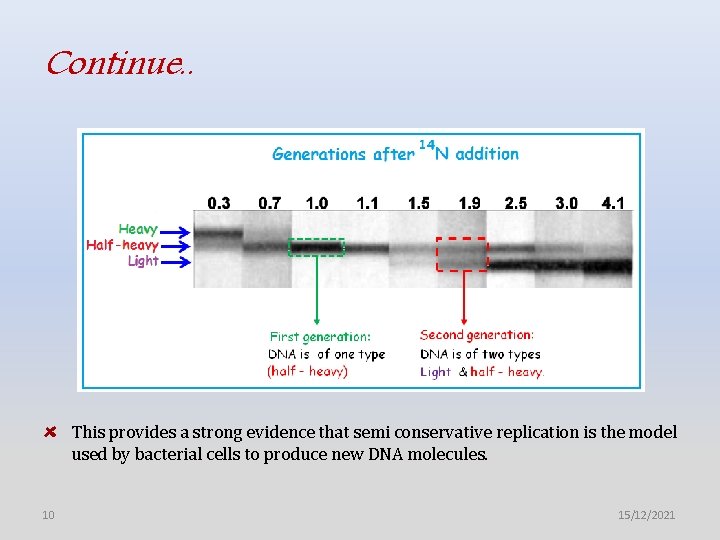
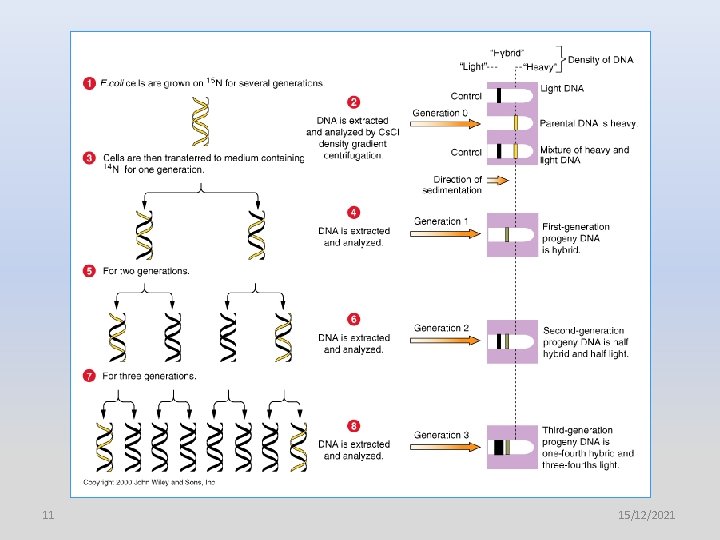
Matthew Meselson and Franklin Stahl experiment DNA containing 15 N has a density about 1%greater than that of 14 N DNA. Thus , 15 N & 14 N DNA can be separated by centrifugation in a Cs. Cl density gradient. 9 15/12/2021
Continue. . This provides a strong evidence that semi conservative replication is the model used by bacterial cells to produce new DNA molecules. 10 15/12/2021
11 15/12/2021
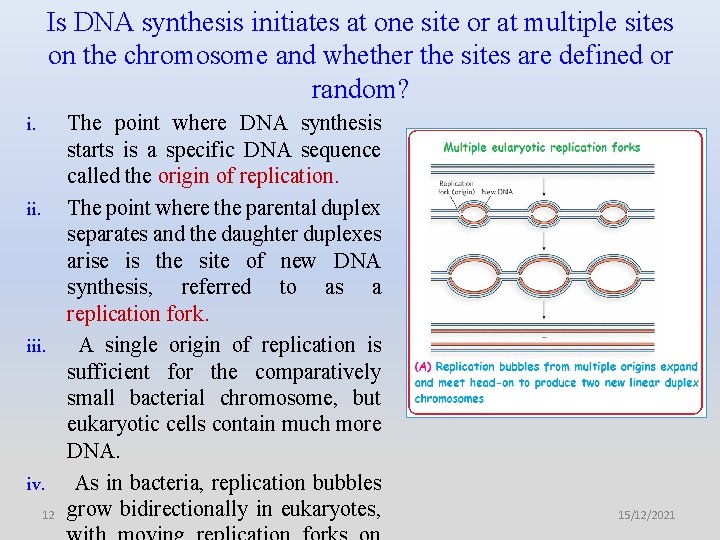
Is DNA synthesis initiates at one site or at multiple sites on the chromosome and whether the sites are defined or random? The point where DNA synthesis starts is a specific DNA sequence called the origin of replication. ii. The point where the parental duplex separates and the daughter duplexes arise is the site of new DNA synthesis, referred to as a replication fork. iii. A single origin of replication is sufficient for the comparatively small bacterial chromosome, but eukaryotic cells contain much more DNA. iv. As in bacteria, replication bubbles 12 grow bidirectionally in eukaryotes, i. 15/12/2021
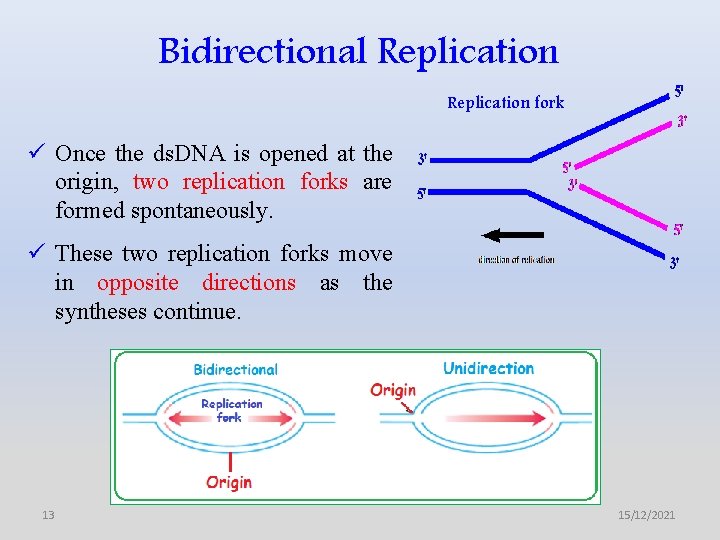
Bidirectional Replication fork ü Once the ds. DNA is opened at the origin, two replication forks are formed spontaneously. ü These two replication forks move in opposite directions as the syntheses continue. 13 15/12/2021
We know that specific origin sequences are present in bacteria, archaea, and the simple eukaryote Saccharomyces cerevisiae (baker’s yeast), but the nature of the origins of replication in complex eukaryotes remains uncertain. 14 15/12/2021
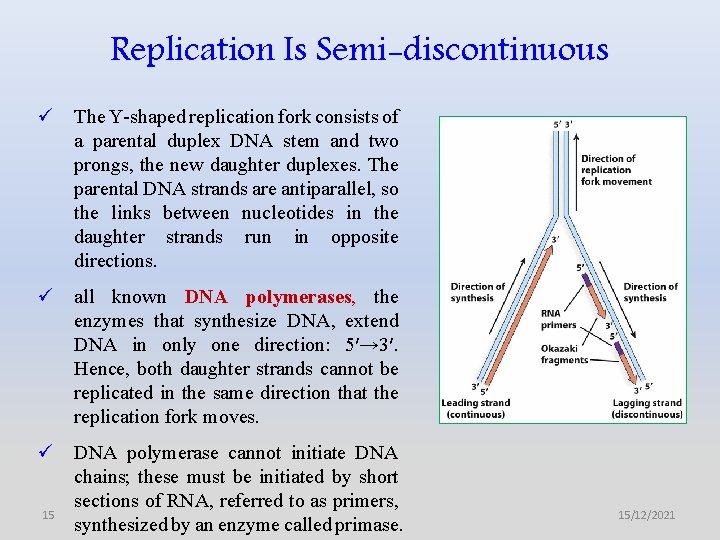
Replication Is Semi-discontinuous ü The Y-shaped replication fork consists of a parental duplex DNA stem and two prongs, the new daughter duplexes. The parental DNA strands are antiparallel, so the links between nucleotides in the daughter strands run in opposite directions. ü all known DNA polymerases, the enzymes that synthesize DNA, extend DNA in only one direction: 5′→ 3′. Hence, both daughter strands cannot be replicated in the same direction that the replication fork moves. ü DNA polymerase cannot initiate DNA chains; these must be initiated by short sections of RNA, referred to as primers, 15 synthesized by an enzyme called primase. 15/12/2021
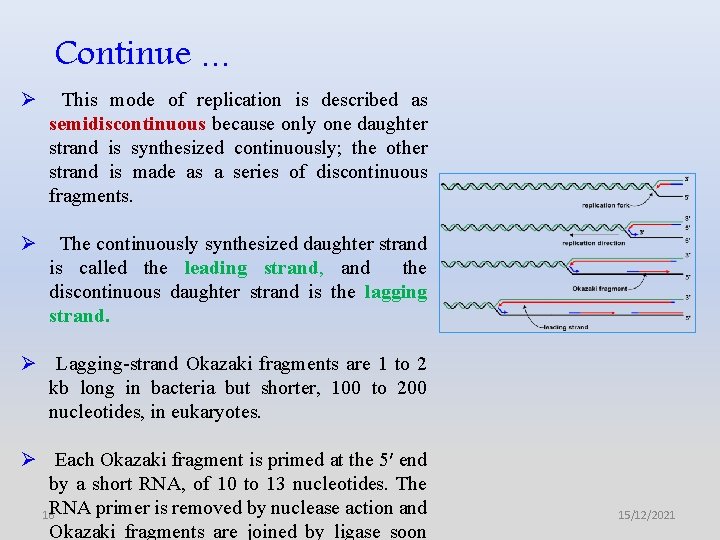
Continue. . . Ø This mode of replication is described as semidiscontinuous because only one daughter strand is synthesized continuously; the other strand is made as a series of discontinuous fragments. Ø The continuously synthesized daughter strand is called the leading strand, and the discontinuous daughter strand is the lagging strand. Ø Lagging-strand Okazaki fragments are 1 to 2 kb long in bacteria but shorter, 100 to 200 nucleotides, in eukaryotes. Ø Each Okazaki fragment is primed at the 5′ end by a short RNA, of 10 to 13 nucleotides. The 16 RNA primer is removed by nuclease action and Okazaki fragments are joined by ligase soon 15/12/2021
• DNA replication is semiconservative; each daughter chromosome contains one parental strand one newly synthesized strand. • Replication is initiated at specific sites on the DNA, the origins of replication. Circular bacterial chromosomes can have only one origin, whereas long, linear eukaryotic chromosomes are dotted with numerous origins. • Replication usually proceeds bidirectionally from the origin, at growing points known as replication forks. • At a replication fork, the parental DNA strands are separated and used as templates to simultaneously form two new daughter duplexes. • The two strands of DNA in a duplex are antiparallel, yet DNA polymerases extend DNA only in the 5′→ 3′ direction. Therefore, only one strand, the leading strand, is extended “continuously” in the direction of replication fork movement; the other strand, the lagging strand, is synthesized “discontinuously” in the opposite direction as a series of Okazaki fragments. This is the process of semidiscontinuous replication. 17 15/12/2021