
DNA REPAIR MECHANISM Presented by B Bhargavi Microbiology
DNA REPAIR MECHANISM • Presented by B. Bhargavi Microbiology Faculty
Repair mechanisms 1. Reversal of damage 2. Excision repair 3. Mismatch repair 4. Recombination repair 5. Error-prone repair 6. Restriction-modification systems
1. Reversal of damage • Enzymatically un-do the damage • a) Photoreactivation • b) Removal of methyl groups
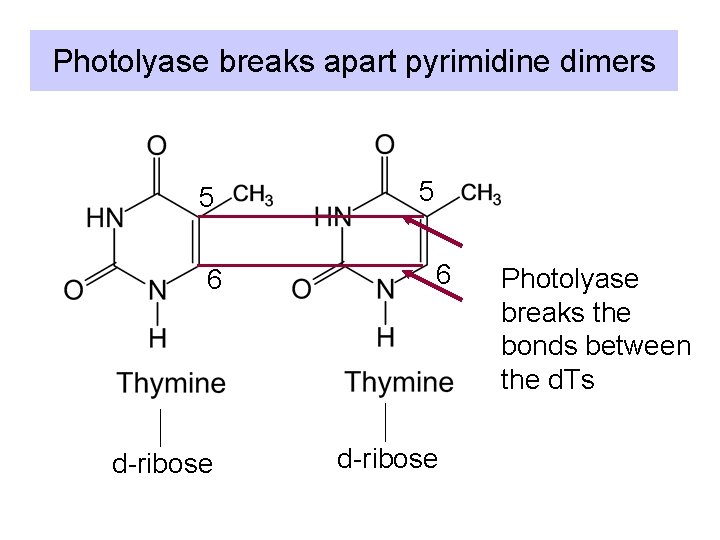
Photolyase breaks apart pyrimidine dimers 5 6 d-ribose Photolyase breaks the bonds between the d. Ts

1 a. Photoreactivation • Photolyase: binds a pyrimidine dimers and catalyzes a photochemical reaction • Breaks the cyclobutane ring and reforms two adjacent T’s • 2 subunits, encoded by phr. A and phr. B.
2. Excision repair • General Process: – remove damage (base or DNA backbone) – ss nick/gap provides 3’OH for DNA Pol I initiation – DNA ligase seals nick • Nucleotide excision repair: – Cut out a segment of DNA around a damaged base. • Base excision repair: – Cut out the base, then cut next to the apurinic/apyrimidinic site, and let DNA Pol I repair
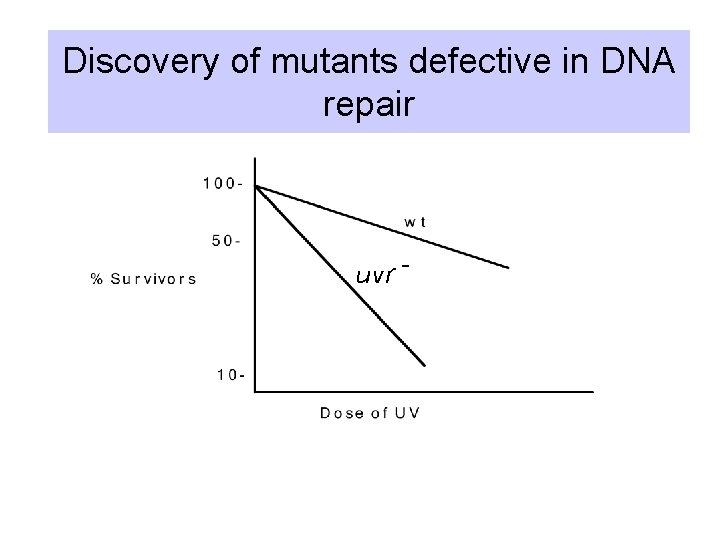
Discovery of mutants defective in DNA repair uvr -
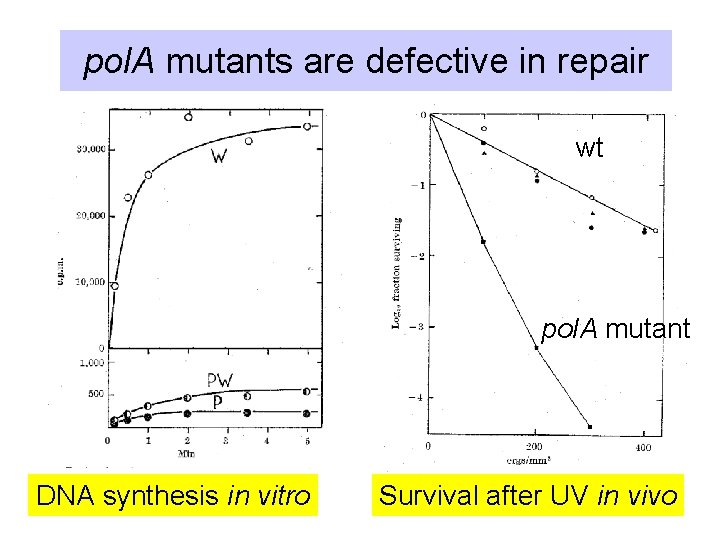
pol. A mutants are defective in repair wt pol. A mutant DNA synthesis in vitro Survival after UV in vivo
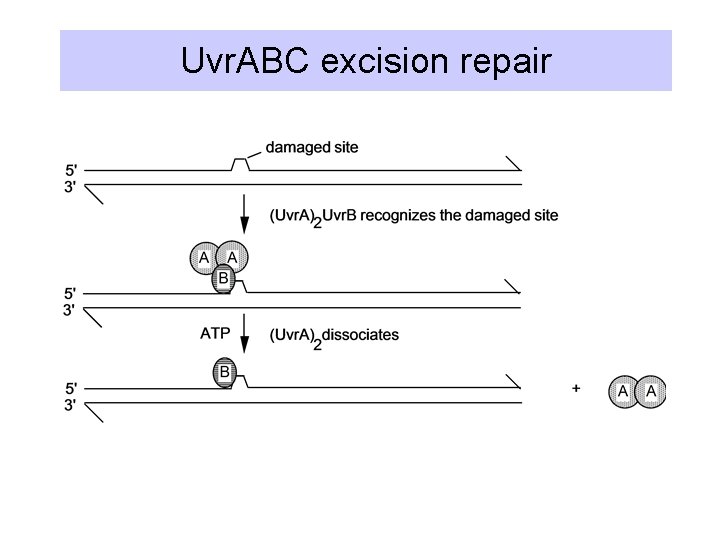
Uvr. ABC excision repair
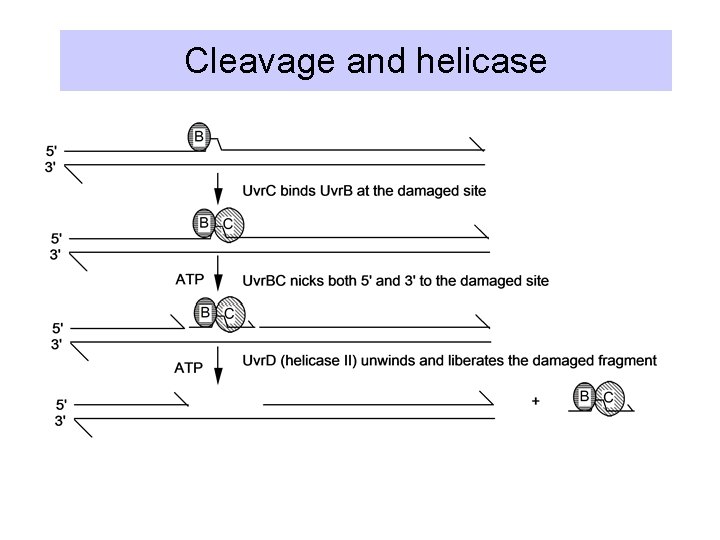
Cleavage and helicase
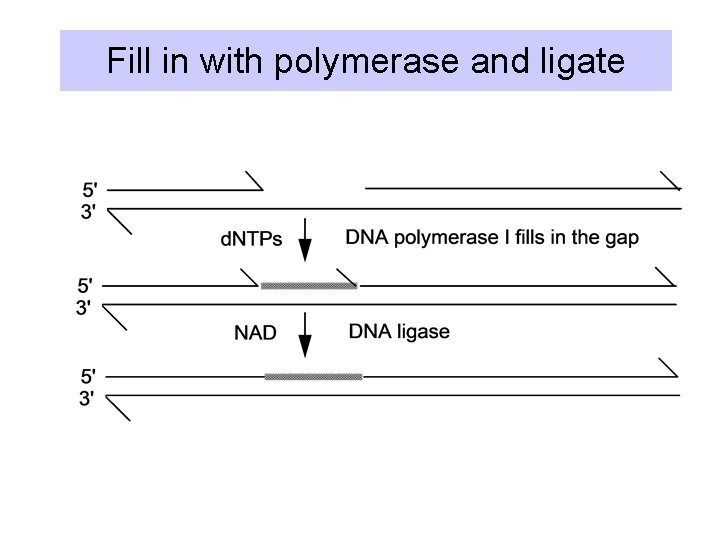
Fill in with polymerase and ligate
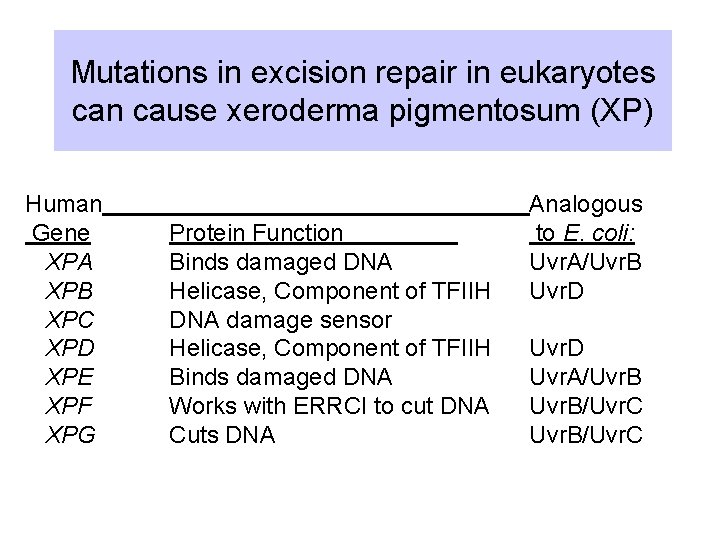
Mutations in excision repair in eukaryotes can cause xeroderma pigmentosum (XP) Human Gene XPA XPB XPC XPD XPE XPF XPG Protein Function Binds damaged DNA Helicase, Component of TFIIH DNA damage sensor Helicase, Component of TFIIH Binds damaged DNA Works with ERRCI to cut DNA Cuts DNA Analogous to E. coli: Uvr. A/Uvr. B Uvr. D Uvr. A/Uvr. B/Uvr. C
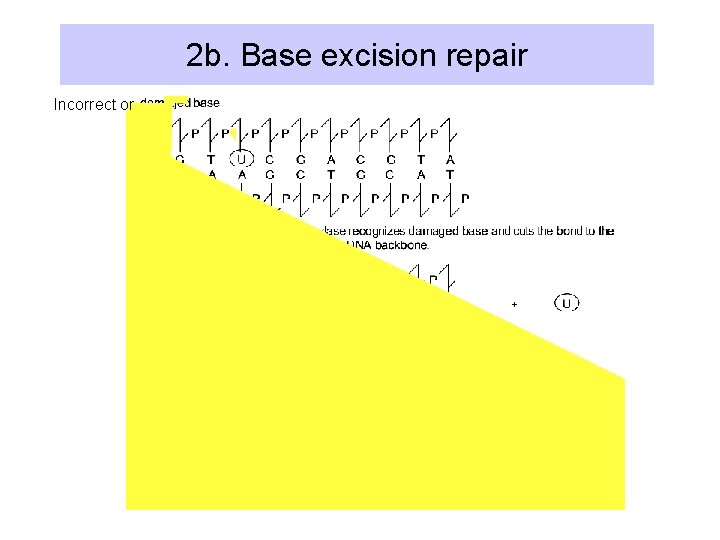
2 b. Base excision repair Incorrect or
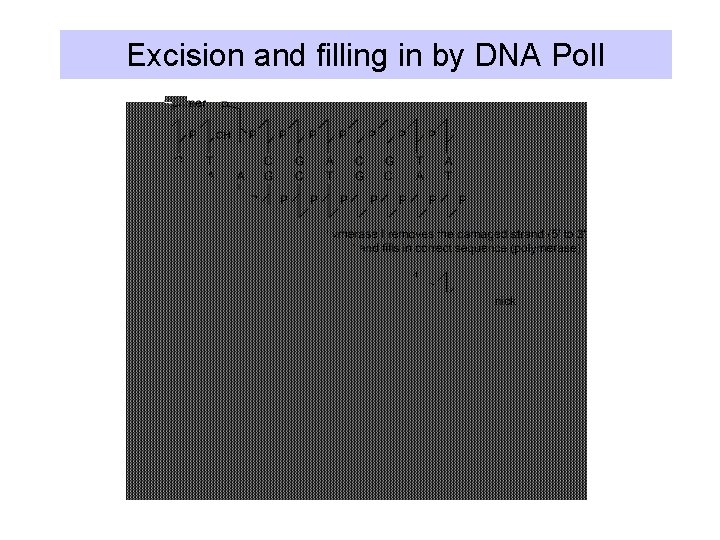
Excision and filling in by DNA Pol. I
3. Mismatch repair • Action of DNA polymerase III (including proofreading exonuclease) results in 1 misincorporation per 108 bases synthesized. • Mismatch repair reduces this rate to 1 change in every 1010 or 1011 bases. • Recognize mispaired bases in DNA, e. g. GT or A-C base pairs • These do not cause large distortions in the helix: the mismatch repair system apparently reads the sequence of bases in the DNA.
Role of methylation in discriminating parental and progeny strands • dam methylase acts on the A of GATC (note that this sequence is symmetical or pseudopalindromic). • Methylation is delayed for several minutes after replication. • Mismatch repair works on the un-methylated strand (which is newly replicated) so that replication errors are removed preferentially.
Action of Mut. S, Mut. L, Mut. H • Mut. S: recognizes the mismatch (heteroduplex) • Mut. L: a dimer; in presence of ATP, binds to Mut. S-heteroduplex complex to activate Mut. H • Mut. H: endonuclease that cleaves 5' to the G in an unmethylated GATC, leaves a nick
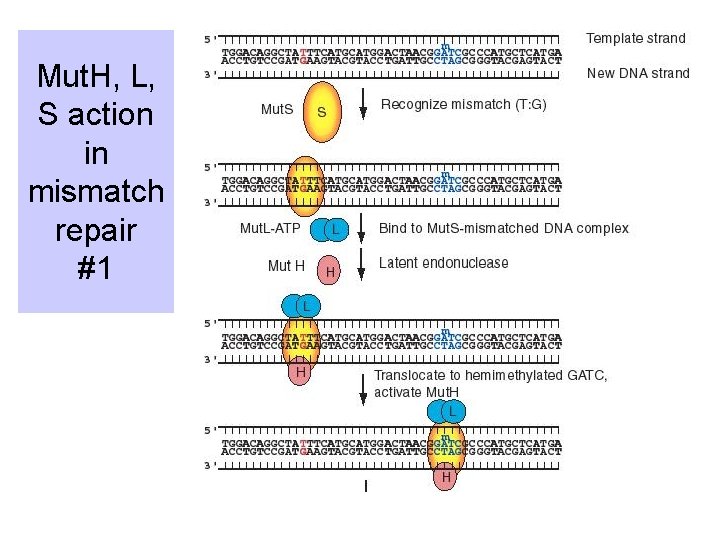
Mut. H, L, S action in mismatch repair #1
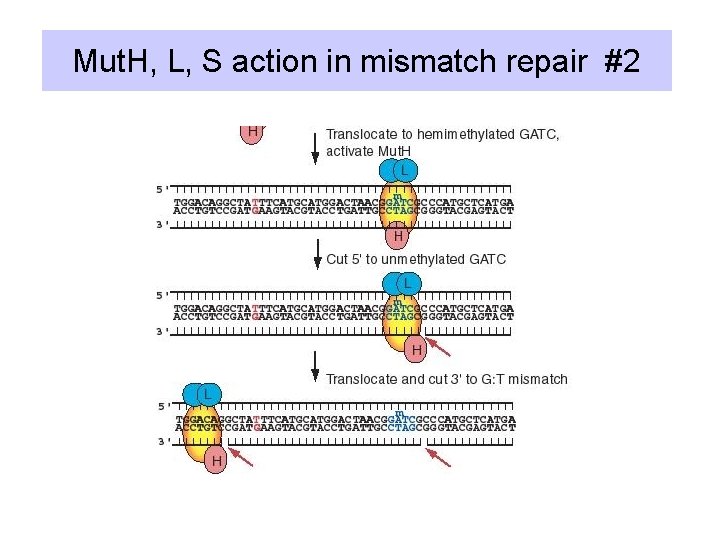
Mut. H, L, S action in mismatch repair #2
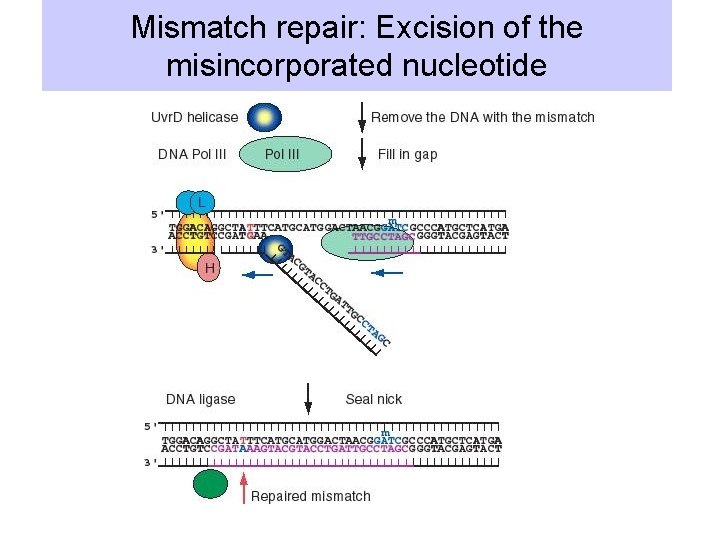
Mismatch repair: Excision of the misincorporated nucleotide
Eukaryotic homologs in mismatch repair • Human homologs to mut. L (h. MLH 1) and mut. S (h. MSH 2, h. MSH 1) have been discovered, because. . . • Mutations in them can cause one of the most common hereditary cancers, hereditary nonpolyposis colon cancer (HNPCC).
• Thank you
- Slides: 22